Disclosure: Some links in this post are affiliate links. As an Amazon Associate I earn from qualifying purchases, at no extra cost to you. Learn more
Specs are compiled from manufacturer listings and verified buyer reviews and can change over time — please confirm the key details on the product page before buying.
Cut a flower stem with the wrong blade and the damage shows up days later — a brown, mushy end that wilts before the bloom ever opens. The fix is a bypass blade (two sharp edges that slice past each other like real scissors) rather than an anvil blade that pinches the stem flat. Every pick below uses a clean slicing action, and the differences between them come down to blade length, handle fit, and how they hold up to sap and damp.
This guide is built by comparing the manufacturers’ published specifications and the patterns across verified customer reviews, so you get each pick’s real strengths and trade-offs instead of marketing spin.
What separates a good floral snip from a frustrating one is rarely the price tag. It is whether the tip reaches into a tight bundle, whether the spring saves your thumb across an afternoon of deadheading, and whether the steel survives a season of wet stems without spotting. Below you will find the five sets that hold up best, sorted by what each one is genuinely built to do, in this breakdown of the scissors for cutting flowers.
Top Picks

How To Choose The Best Scissors for Cutting Flowers
A good floral snip does one thing well: it slices a stem clean instead of crushing the water channels inside it. Get that wrong and your flowers droop in the vase no matter how fresh they were when you cut them. Here is what actually decides whether a pair earns a spot in your toolkit.
Blade action: slice, don’t pinch
A bypass blade works like household scissors — two edges pass each other and slice the stem. A sliced stem keeps its water uptake intact, so blooms last longer in the vase. An anvil blade presses the stem against a flat plate instead, which is fine for dead wood but bruises soft green stems. For flowers, herbs, and anything you plan to put in water, bypass is the design you want.
Blade length and tip shape decide your reach
A long, narrow tip slips between stems to reach a flower buried deep in a bouquet, while a short blade gives you more control on delicate work like deadheading. Think about your actual job: harvesting a bucket of blooms wants reach, while snipping spent heads off potted plants wants precision. Check the cutting width and blade length on each listing — a wider opening handles thicker branches, a narrower one is built for fine stems.
Handle comfort across a long session
Hand fatigue is the quiet deal-breaker for anyone cutting more than a handful of stems. A spring that reopens the blades after each snip saves your thumb thousands of tiny movements across an afternoon. Look for an ergonomic grip, a finger notch, and a handle wide enough that your fingers don’t get pinched together mid-cut. For small or arthritic hands, handle size matters as much as blade sharpness.
Steel, rust, and the damp-stem reality
Flower stems are wet, and wet steel rusts. Stainless steel blades resist corrosion in damp greenhouses and hydroponic setups. High-carbon steel takes a keener edge but wants a wipe-down and a light oiling after use to keep spotting away. Either way, dry the blades before you store them — that single habit is what separates a pair that lasts from one that pits within a season.
Side-by-Side Comparison
| Model | Best For | Cutting Width | Blade Material | Item Weight | Amazon |
|---|---|---|---|---|---|
| Sakagen Hand Creation F-170★ Best Overall | All-round floral work | 4.2 cm blade length | Alloy steel | 128 g | Amazon |
| TABOR TOOLS K17A Pruning SnipsLongest Reach | Reaching into tight bundles | 6 millimeters | Stainless steel | 4.64 ounces | Amazon |
| ARS HP-300L Needle Nose Fruit Pruners | Harvesting and heavier stems | 46 millimeters | High carbon steel | 115 g | Amazon |
| Cyrus Blue Stainless Floral Shears | Rose de-thorning and design work | 4.2 inches | Stainless steel | 170 g | Amazon |
| Modern Sprout Pruning Shears | Precise work on fine stems | 6″ x 3″ overall | High carbon steel | — | Amazon |
Detailed Reviews
1. Sakagen Hand Creation F-170 Flower Scissors
Our pick — 4.5+★ from 600+ verified ratings; the strongest balance of quality and price.
The Japanese-made snipper that florists reach for first, and the one most likely to still be on your bench years from now.
Start with the coating. The blades get a fluororesin treatment — a slick, non-stick finish baked onto the metal — so sap wipes off instead of cementing to the steel and rust has a much harder time taking hold. That matters because wet stems are the number-one enemy of a floral snip. The blades themselves run 4.2 centimeters long, set in an ambidextrous handle, and the whole tool weighs 128 grams — light enough to forget it’s in your hand, heavy enough to feel like real metal.
What wins people over is the build. This is the crowd favorite of the group at 4.5+ stars across 600+ ratings, and the praise clusters around sheer quality and cutting performance on floral stems. The feel in hand gets constant mention too: the grip is shaped so your hand doesn’t cramp up across a long shift, and buyers doing eight-hour floral work report it holds up. The cutting edge stays sharp for a long stretch — buyers who’ve owned a pair for the better part of three years say it still slices clean, with no rough, crushed ends on the stems.
One practical note before you order: it arrives with a cover for the cutter and that cover’s color can vary from the violet handle shown. The honest trade-off is the handle material — there is iron inside it, so dry it after a wet session rather than leaving it to sit damp. That single habit is the difference between this lasting and a cheaper pair pitting.
What earns the top spot
- Fluororesin-coated blades shrug off sap and resist rusting
- 4.2 cm blade length balances reach with control for everyday stems
- Ambidextrous, 128 g build keeps long sessions comfortable
- Cover included for safe storage in a drawer or toolkit
Where it asks a little care
- Iron inside the handle means you should dry it after wet use
- The included blade cover color may not match the violet handle
Reach for it if: you want one do-it-all floral snip for cutting blooms, deadheading, and light branch work, and you’d rather buy once.
Know this going in: it’s the priciest of the five, and the iron core in the handle wants a quick dry-down after every wet session.
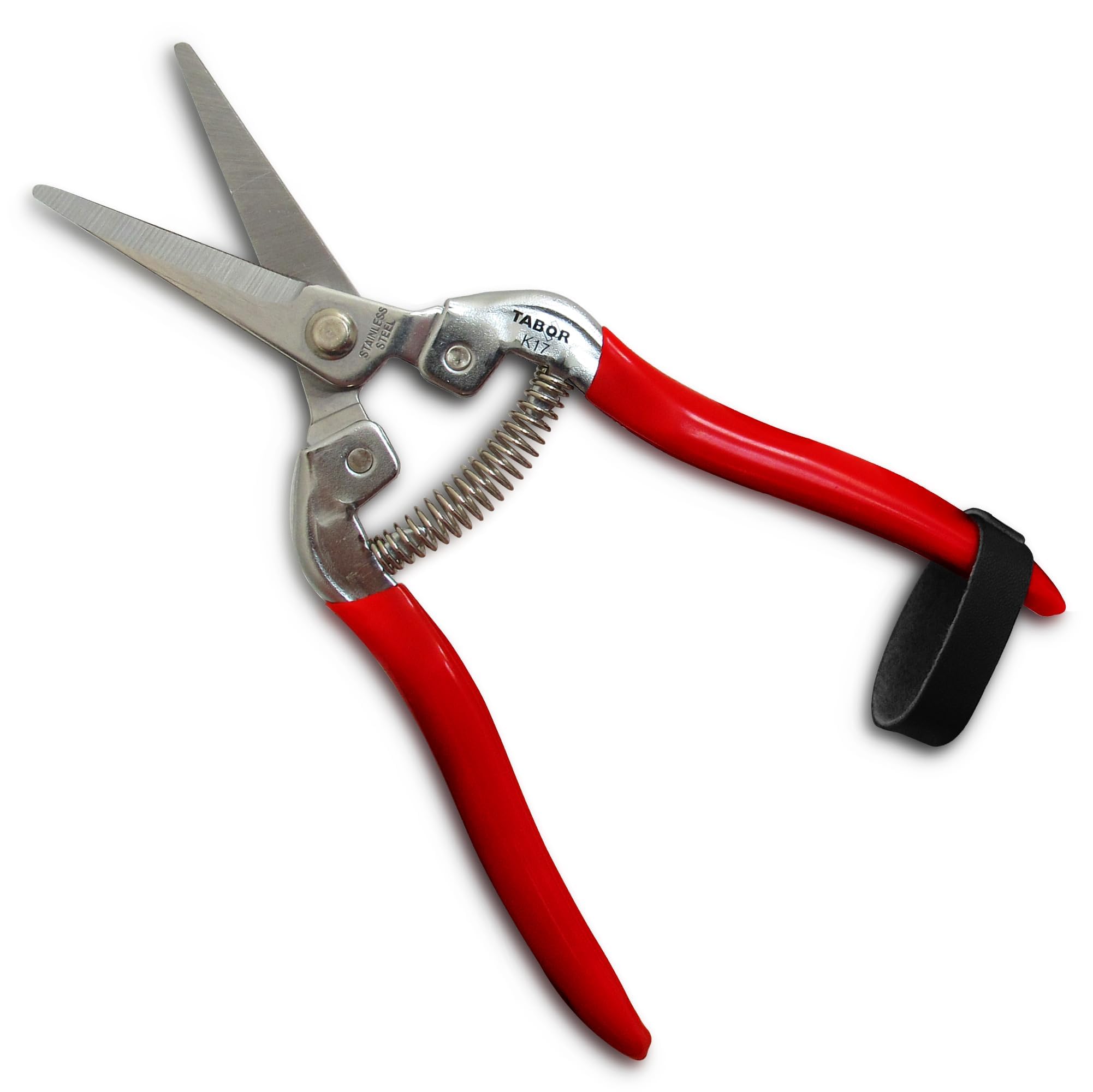
2. TABOR TOOLS K17A Pruning Snips
Long, thin, pointed blades built to slide into a jammed bouquet and pinch out the one stem you actually want.
The number that tells you what this snip is for: a 6-millimeter cutting width. That narrow opening is paired with a long, pointed, straight blade, so the tip slips into spaces a fatter pruner can’t go. Compare that to the ARS HP-300L below, which opens to 46 millimeters — the TABOR is a precision instrument where the ARS is a workhorse. If your job is deadheading, snipping buds, or reaching stems deep inside a bundle, that skinny profile is exactly the point.
The stainless steel blades resist rust in damp greenhouses and hydroponic trays, and a non-stick coating lets them glide through stems without sap building up. The shock-absorbing spring reopens the blades after each cut, so your thumb isn’t doing all the work — a real comfort edge for arthritic or weak-grip hands. It’s ambidextrous too, cutting cleanly to the tip for both hands. The quality story is the strongest signal here: it’s the most-praised trait of the set, with sharpness a close second, and buyers cutting cut-flowers and trimming work rate it professional-grade.
Here’s the limitation to plan around: this is not a woody-stem tool. Hard, hardened branches will fight it, and the maker says so directly. Keep it for flowers, herbs, tomatoes, and soft growth, and it’s a joy. A small recurring grip is the handle-bottom piece that holds the blades closed — useful, but it can get in the way mid-cut. All told, it’s the pick for anyone whose work lives in tight, delicate spaces.
The reach advantage: a 6-millimeter cutting width and long pointed nose do what a wide-opening pruner physically cannot — get between stems deep in a bundle without crushing the neighbors.
Where it stops: soft stems only. For anything woody, step up to the wider-opening ARS pick below, which handles branches the TABOR won’t.
Best matched to: deadheaders, herb harvesters, and anyone working tight floral arrangements who wants a spring doing the reopening for them.
Look elsewhere if: your cutting list includes hard woody branches — this snip is designed for soft growth and will struggle past that.
3. ARS HP-300L Needle Nose Fruit Pruners
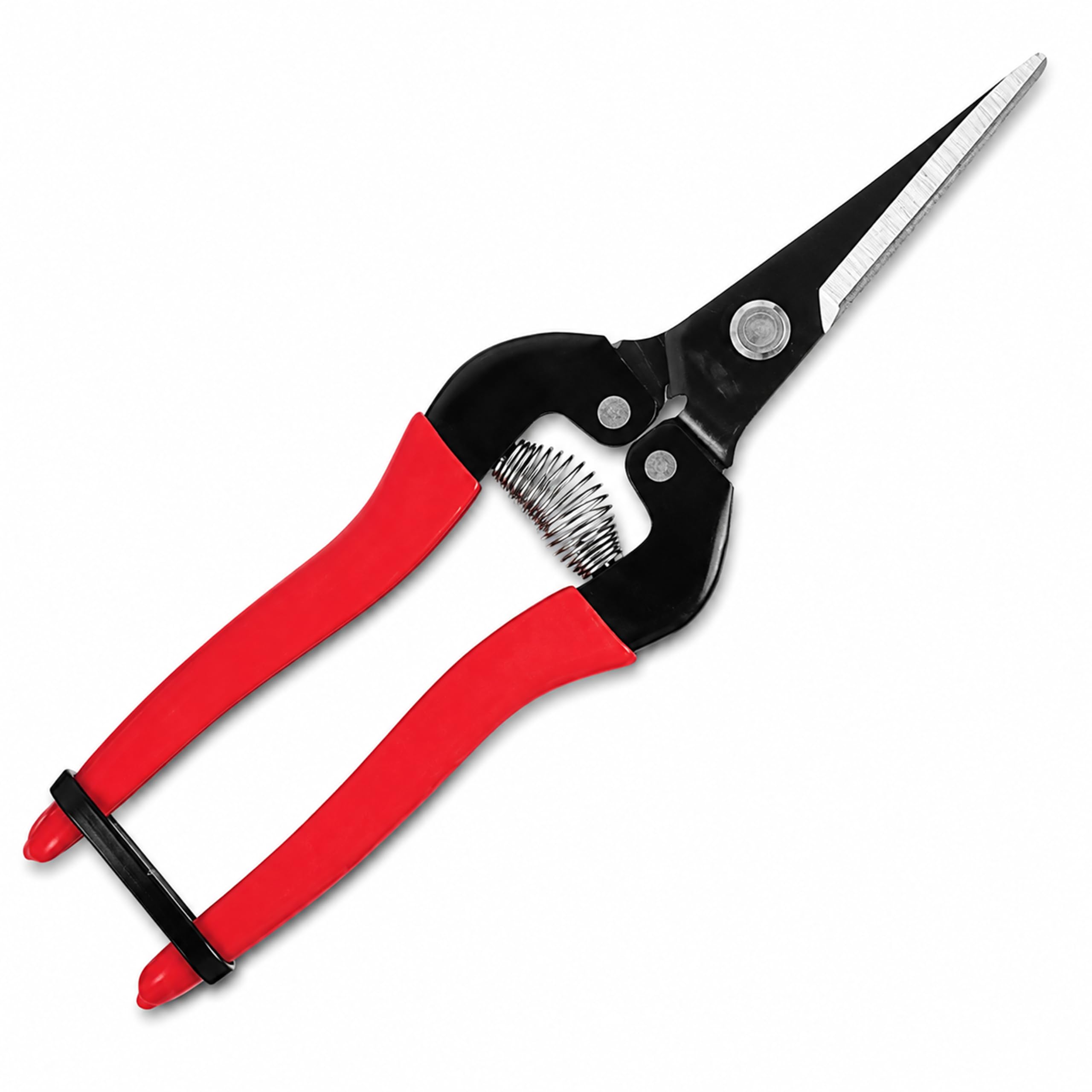
The heavyweight of the group — a 46-millimeter opening and all-metal frame that bites through stems the delicate snips can’t touch.
Where the TABOR tops out at 6 millimeters of cutting width, the ARS opens all the way to 46 millimeters — the widest by a wide margin here. That gap is your buying decision in one line: this is the snip you grab when the stems are thick, the branches are sunflowers, or the harvest is a full bucket of fruit. The high-carbon steel blade takes a keen edge, the needle-nose profile still lets you aim precisely, and at 115 grams it stays light in hand despite the metal construction. It’s also physically smaller overall than the Sakagen at 8 inches long by 2 inches wide.
Commercial growers put this through serious volume — hundreds of stems a day — and report it never jams shut, stays sharp, and eases hand fatigue across the day. The bright red handle makes it easy to spot when you set it down in the beds. A built-in strap holds the spring handles closed between uses. What buyers praise most here is the overall quality of the build, with effectiveness close behind, and it’s a strong value against pricier brands.
The mixed signal worth knowing about is corrosion. Some buyers find the blades spot or rust after extended use in wet conditions — one described needing to clean the blades back up after months of work. That’s a maintenance habit, not a defect: dry the blades after use, keep a light oil on them, and the ARS rewards you. Treat it as the tool that wants a wipe-down and gives you the widest reach in return.
Why it earns its place
- 46-millimeter cutting width handles thick stems and small branches
- High-carbon steel needle-nose blade stays precise and sharp
- 115 g all-metal build stays light despite the strength
- Built-in strap keeps the spring handles closed in storage
What to watch
- Blades can spot or rust in damp use without a wipe-down and oil
- Its wide opening is more tool than the delicate fine-stem work needs
Pick this when: your stems are chunky, your harvest is heavy, and you want the widest bite of any snip here without giving up precision.
One caveat: it asks for a dry-and-oil habit in wet climates, so lazy storage will cost you the edge.
4. Cyrus Blue Stainless Steel Floral Shears

Two tools in one — a floral snip with a built-in thorn-removing hole, made for the rose arranger who is tired of hunting for a stripper.
This is the only pick with a dedicated thorn-removing hole built into the frame, so stripping leaves and thorns off a rose stem becomes part of the same motion as trimming. The stainless steel blades carry an electroplating treatment that resists corrosion and rust, and the 8-centimeter blade length is set in a two-tone ergonomic handle with a non-slip grip and a finger notch. At 170 grams it’s the heaviest of the bunch — a solid, planted feel rather than a featherweight one.
The one-piece molded body is the durability story: the frame is shaped as a single piece instead of assembled from parts, which makes the main structure harder to break. Buyers cutting flower stems for wreaths and handling bigger stems say it takes them with ease. Buyers praise the ergonomics: the wide handle leaves finger room so your hand doesn’t get pinched, and the smooth action suits hands that tire easily. The thing people like most is the overall quality, with effectiveness and sharpness tied close behind.
The size is the one split opinion. Some hands find it roomy and comfortable; smaller hands may find it a touch big, and the short blades paired with large handles are a fit question rather than a flaw. If you’re doing delicate fine-stem work and have small hands, the Modern Sprout below is the better match. For rose work and floral design, though, the built-in thorn stripper alone justifies a look.
The two-in-one trick: that thorn-removing hole turns de-thorning and trimming into one tool you grab, not two — a genuine time-saver for anyone arranging roses regularly.
The fit question: 170 grams and wide handles suit bigger hands and heavier use; smaller hands should size-check before committing.
Made for you if: roses are your main crop and you want the thorn stripper built in so you’re not swapping tools mid-stem.
Second-guess it if: your hands are small or your work is all fine-stem precision — the wide handles may feel oversized.
5. Modern Sprout Pruning Shears
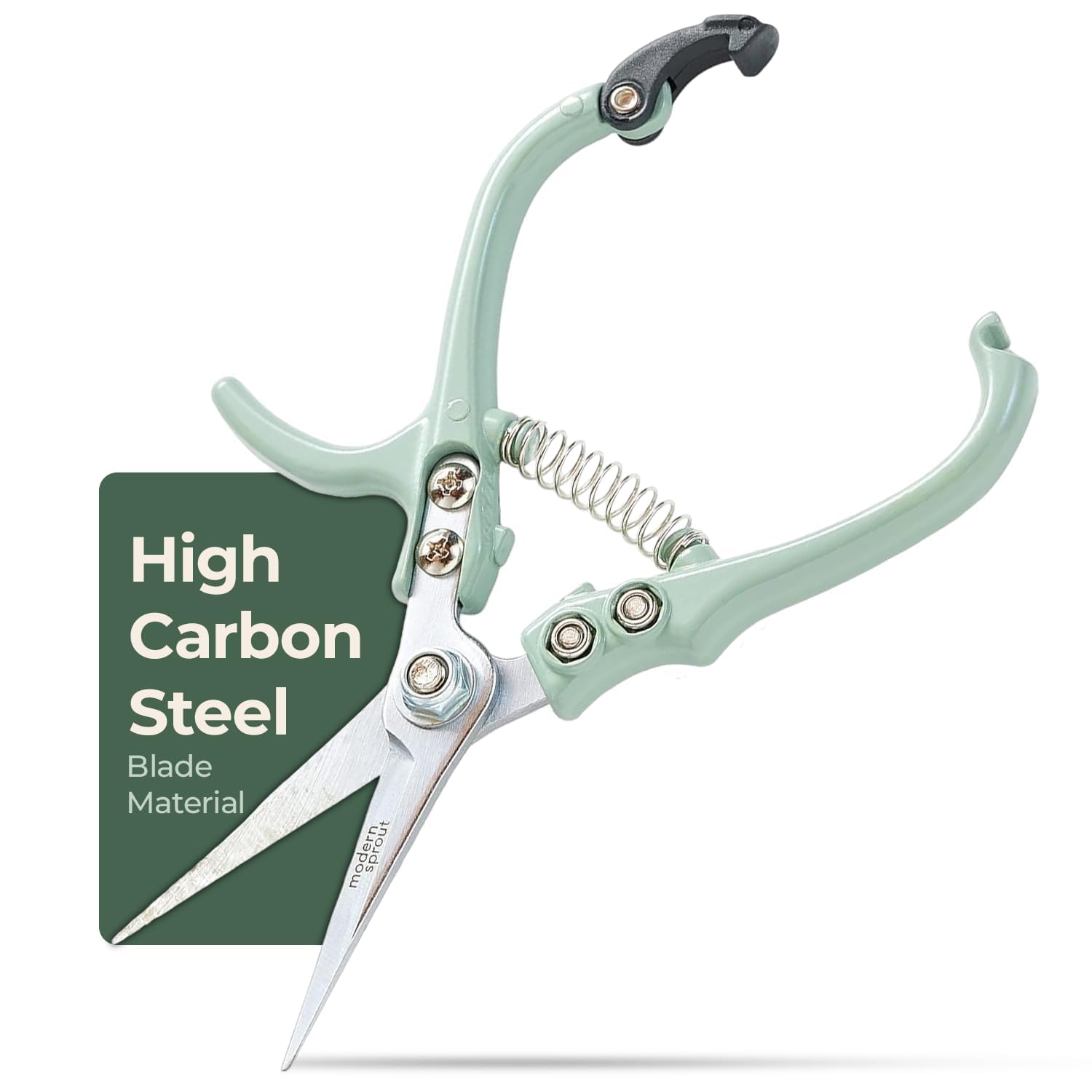
A compact, fine-tipped snip that treats a single orchid stem with more care than a full-size pruner ever could.
The shaped handles and fine needle-nose tip of the Modern Sprout are built for precision, not volume. High-carbon steel blades stay sharp and resist rust, and the compact 6″ x 3″ footprint slips into a pot, a drawer, or a toolkit without taking up room. There’s an easy-lock safety latch that holds the blades closed for safe storage, plus a reusable holster — handy if you’re moving between indoor pots and an outdoor bed. The aluminum handles keep it light for extended sessions.
The reason this climbs this high despite being the compact one is the comfort and the reach. The needle-nose tip gets into tight spots without bruising the leaves around it, which is exactly what orchid care, basil, mint, and bonsai want. The ergonomic handles ease hand strain over long trimming sessions, and the ambidextrous design cuts as cleanly left-handed as right. Quality is the trait buyers prize most, with sharpness a strong second, and the durability holds up as long as you maintain it — keep the blades clean and dry, and it keeps its edge. The lock is a favorite detail: sturdy and reliable, it keeps the blades shut in a bag so nothing gets nicked.
The fit note is size. The handles are made for smaller hands — buyers with bigger palms sometimes find them snug, and the narrow tip is less suited to thick woody branches than the ARS. If you cut a lot of heftier stems, the wider ARS is the better tool. If your work is delicate blooms, herbs, and potted plants, this is the precise little snip you’ll keep by the window.
Why it fits fine work
- Needle-nose high-carbon steel tip reaches tight spots without bruising leaves
- Sturdy safety lock keeps blades closed in drawers and bags
- Aluminum handles and compact 6″ x 3″ build stay light and portable
- Reusable holster included for carrying between gardens
The honest edge
- Handles suit smaller hands; bigger palms may find them snug
- Narrow tip is not built for thick woody branches
Your snip if: you’re tending orchids, herbs, bonsai, or potted blooms and want a light, precise tool with a reliable lock.
Size yourself first: it’s shaped for smaller hands — if yours are large or your stems are thick, look to the ARS instead.
Know the Specs
Cutting Width
This is how far the blades open — the widest stem or branch the snip can bite in one go. A narrow opening like 6 millimeters is built for fine stems and reaching into tight spots. A wide opening like 46 millimeters takes on thick stems and small branches. Match this number to the thickest thing you actually cut, and you’ve solved most of the choice.
Blade Material
Stainless steel resists rust in damp greenhouses and hydroponic trays — good if your stems are wet and your workspace is humid. High-carbon steel takes a sharper edge and keeps it, but wants a wipe-down and a light oil after use. Either way, dry the blades before storage; that habit protects the edge more than the material choice does.
Weight and Handle Fit
Weight runs from 115 to 128 grams up to 170 grams across these picks, and that range matters over a long session. Lighter snips ease fatigue across hundreds of cuts; heavier ones feel planted and sturdy. Pair the weight with handle shape: wide handles leave finger room, but smaller hands may find them oversized, so size your grip before you buy.
Spring and Blade Action
A spring reopens the blades after each cut, saving your thumb from doing the work thousands of times across an afternoon — the single biggest comfort factor for anyone with arthritis or limited grip. Bypass blades slice past each other for clean stem cuts; anvil blades press against a plate. For flowers headed into water, bypass is the action you want.
Common Questions
What kind of scissors are best for cutting flower stems?
Can these scissors cut woody branches or only soft stems?
How do I stop my floral snips from rusting?
Are these flower scissors safe to use with weak or arthritic hands?
What is the difference between a floral snip and a full-size pruner?
Are these scissors left-handed friendly?
How long do floral snips last, and do they need sharpening?
What does the built-in thorn remover on the Cyrus shears do?
Can these scissors cut thin wire or garden twine, or only plant material?
Which flower scissors work best for small hands?
The Bottom Line
For most people cutting flowers, the Sakagen Hand Creation F-17 is the one to buy. It earns it on the fluororesin-coated blades that fight off sap and rust, a 4.2 cm blade that balances reach and control, and a build that holds up over years of steady use — buy it once and keep it sharp.
If you want the longest reach for tight bundles, grab the TABOR TOOLS K17A. For thick stems and a heavy harvest, the ARS HP-300L gives you a 46-millimeter bite the delicate snips can’t match. And for rose work or fine-stem precision in smaller hands, the Cyrus shears and the Modern Sprout shears each bring a specialty the others don’t. Start with your thickest stem, match the opening, and one of these five will be the only snip you reach for.
How we choose
We do not accept paid placement. Every pick is matched to a real buyer and a real use-case; we do not hands-on test units.
Sources
Specifications: manufacturer listings and product documentation. Review insights: verified customer reviews, as of October 2026. Pricing: not shown on this page (it changes often); check the current price via the retailer link.
As an Amazon Associate, Aappliancez earns from qualifying purchases. This does not affect which products we feature.