Disclosure: Some links in this post are affiliate links. As an Amazon Associate I earn from qualifying purchases, at no extra cost to you. Learn more
Specs are compiled from manufacturer listings and verified buyer reviews and can change over time — please confirm the key details on the product page before buying.
If your scar strip peels up at the edges by lunchtime, the product is the problem, not your skin. Silicone sheeting only does its job while it stays flat against the scar, so the strip that actually holds through a shower and a workday beats the one with the prettier box. Below you will find five real options ranked by how well they stay put, how much coverage you get, and what buyers genuinely report after weeks of wear.
This guide is built by comparing the manufacturers’ published specifications and the patterns across verified customer reviews, so you get each pick’s real strengths and trade-offs instead of marketing spin.
Some strips are cut-to-size rolls that cover a long surgical line, while others are small precut sheets aimed at a single C-section or Mohs incision. The picks below cover both shapes, and each one earns its place on adhesion and coverage rather than hype, which is what matters most when you shop for scar strips.
Top Picks

How To Choose The Best Scar Strips
The biggest mistake buyers make is grabbing the cheapest pack of thin clear strips and expecting the scar to change. A scar strip works by sealing the scar under a thin layer of silicone, which keeps the area hydrated so the tissue can soften and flatten over time. If the strip lifts, curls, or slides off in the shower, that seal breaks and the weeks of wear count for nothing. Judge hold first, then how much of your scar one piece actually covers.
Match the strip shape to your scar
A long surgical line — a C-section, a hip replacement, a thyroidectomy — needs either a long roll you cut to length or a sheet wide enough to cover the whole line in one piece. A small round or short scar does fine with a precut sheet. Rolls waste less because you trim exactly what you need, while precut sheets are faster to slap on but leave you short if your scar runs longer than the sheet.
Judge adhesion before anything else
Silicone sticks to clean, dry skin and to almost nothing else, which is why a strip applied over lotion or a damp shoulder tends to fail. The strips that hold best tend to have a slightly thicker body or a fabric outer layer, because that extra structure resists the edge-roll that kills a thin clear sheet. Expect to replace a strip once the edges lift or the sticky face picks up lint — most strips are rated for roughly 7-10 days of wear before that happens.
Plan for weeks, not days
Silicone works slowly, over weeks rather than days. Manufacturers commonly frame visible change over a span of weeks rather than overnight, and older, well-established scars usually take longer than fresh ones. Buy enough strips or enough roll length to keep the scar covered continuously through that stretch, because gaps in coverage reset the clock.
Side-by-Side Comparison
| Model | Best For | Format | Coverage | Wear Life | Amazon |
|---|---|---|---|---|---|
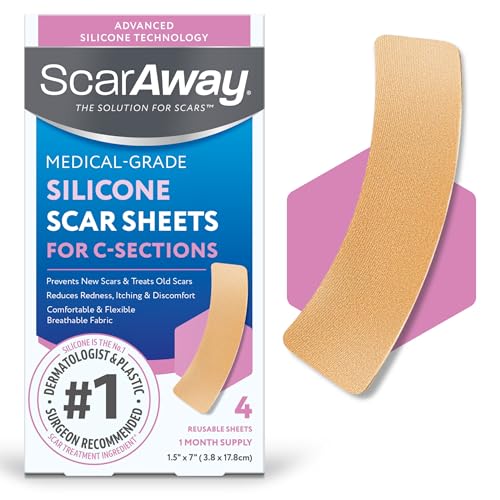
| ScarAway C-Section Scar Sheets★ Best Overall | C-section and surgical lines | 4 precut sheets, 1.5 x 7 in | 4 sheets per box | 7-10 days per sheet | Amazon |
| ViveCare Scar TapeBest Value | Long scars on a budget | Cut-to-size roll, 1.6 in x 120 in | 120 in roll | Reusable, rinses and reapplies | Amazon |
| HealFast Large Silicone Scar Sheets & Strips | Facial and small scars | Cut-to-size strips | — | — | Amazon |
| ScarAway Scar Fabric Sheets | Compression over raised scars | 8 fabric sheets, 1.5 x 3 in | 8 sheets per box | 7-10 days per sheet | Amazon |
| NUVADERMIS Silicone Scar Sheets | Big scars, long-term coverage | Roll, 10 ft (2-pack) | 10 ft per roll | Up to 24 hours per application | Amazon |
Detailed Reviews
1. ScarAway C-Section Scar Sheets
Our pick — 4.5+★ from 750+ verified ratings; the strongest balance of quality and price.
Four tan sheets built for one job: covering a C-section line without peeling at the corner.
Each sheet measures 1.5 x 7 inches, which is a length that runs the full width of a typical C-section incision in one piece — no overlapping strips, no gaps in the middle. You get 4 sheets per box, and each one is rated for 7-10 days of wear before it needs replacing. The tan, skin-tone color is the quiet win here: it disappears under clothing rather than catching the light like a clear plastic film can.
The surface is an ultra-thin breathable fabric rather than bare silicone, and that fabric backing is what keeps the sheet from curling in on itself when you move. You can wash it, let it dry, and stick it back on, and it stays breathable over a healing line. The medical-grade silicone here is the same ingredient surgeons recommend, cut into 1.5 x 7-inch sheets you can trim to your incision.
The catch is adhesion on high-movement or sweaty areas. As owners put it, the tape largely holds but a heavy sweat session can work the edges loose, and once the sticky face picks up fuzz from clothing it will not wash back to full grip. A few buyers mention the price relative to cheaper silicone strips. Neither of those is a defect — it just means you should plan to reorder if you want continuous coverage across many weeks.
What makes it the default pick
- 7-inch length covers a full C-section line in a single sheet
- Breathable fabric backing resists the edge-curl that thin clear sheets get
- Tan color sits quietly under clothing instead of shining through
- Washable and reusable across a 7-10 day stretch
Where it asks more of you
- Adhesion weakens under heavy sweat or on high-movement spots
- Only 4 sheets per box, so long-term use means restocking
- Costs more per strip than a cut-to-size roll
The short version: if your scar is a straight surgical line you want covered cleanly and discreetly, this is the one to start with.
Think twice if: you sweat heavily through the day or your scar sits where clothing rubs — the edges will lift and a roll of tape may serve you better.
2. ViveCare Scar Tape
One roll that outlasts a whole box of sheets — and then some.
Here is the number that changes the math: this roll carries 120 inches of tape against the 7-inch sheets in the ScarAway C-section box. That is a far longer single roll than the 7-inch precut format, so you cut exactly what your scar needs and waste nothing. The 1.6-inch width also runs slightly wider than the 1.5-inch sheet, giving you a little extra margin at the edges of a surgical line.
What wins people over is how well it survives daily life. It stays put through the day and overnight, and the waterproof silicone means a rinse under the tap is all it takes to refresh it. Cut the corners round before you stick it down and clothing is far less likely to snag and peel the edge. One strip can carry you through a full week of wear, which keeps the cost per covered day genuinely low.
The honest trade-off is a fussy adhesive. When it is completely dry it grips hard — so hard that it will latch onto itself or anything else the moment it touches down, and once it is wet the sticky face stops working until it dries again. Apply it straight from dry skin to dry tape and you are fine. Fumble the placement and you have wasted a length.
Why the roll wins: 120 inches of cut-to-size medical-grade silicone means you handle long scars, small scars, and a spare strip or two without buying a second box. The waterproof build and reusable design make it the most economical way to keep a scar covered continuously.
The one habit to learn: dry tape, dry skin, first try. The adhesive is unforgiving of a second attempt.
Reach for this if: you want one purchase to cover a long scar for weeks, or you are treating more than one scar at once.
Look elsewhere if: you would rather have a precut sheet that needs zero trimming and no placement skill.
3. HealFast Large Silicone Scar Sheets

The pick for a scar you cannot hide behind a shirt collar.
Facial and small scars need a different rulebook. You want a strip thin enough to sit invisibly under makeup, gentle enough for delicate skin, and trimmable so it fits a short line exactly. This pack is built around the crosspolymer silicone format the maker describes, and you cut each strip down to the size of the scar you are treating rather than accepting a one-size sheet.
The reports that matter most here come from people covering forehead and face scars. One buyer used it nightly for 2 months on a 2-inch thyroidectomy scar and saw a huge difference over that stretch, and another wore it after stage 2 skin cancer surgery on a 4-inch forehead scar, where it stayed nearly invisible under foundation. That combination — thin enough to conceal, gentle enough for the face — is why this pick sits here even though it is not the top scorer overall.
The honest limit is hold on a freshly washed face. This strip wants skin that is freshly washed and fully dry, and even then the edges can lift on high-movement spots. Many buyers report it sticks well and stays comfortable all day, but a real minority find it rolls at the ends or barely holds. If your scar is on your back or a joint, this is not the strip to bet on.
What it gets right: thin, cuttable silicone that disappears under makeup and suits delicate facial skin, with buyers reporting visible change on thyroidectomy and forehead scars after a couple of months of nightly wear.
Where it stumbles: adhesion is the recurring split verdict. Clean, dry skin is non-negotiable, and on mobile areas the edges can lift within the day.
Choose this when: your scar is on your face, neck, or another spot where visibility matters and you want to cut each strip to fit.
Pass on it when: your scar sits on a joint or your back and you need a strip that grips through constant movement.
4. ScarAway Scar Fabric Sheets

Small fabric squares that add a touch of compression to a thick, bumpy scar.
Eight sheets at 1.5 x 3 inches each give you a compact square that suits a raised bump rather than a long incision line. The fabric outer layer is the real differentiator: it holds a little shape against the skin, so you get a slight compression effect that a bare plastic sheet cannot offer. For a keloid or a thickened Mohs scar, that modest pressure is often what helps a bump settle flatter.
Effectiveness is the thing buyers talk about most here, and it holds up. Fabric sheets have helped flatten Mohs surgery scars on the nose, and on breast surgery scars the soft fabric sits comfortably on sensitive skin and is shower-safe, with water actually improving the grip. Each sheet is self-adhesive and water resistant, rated for up to 7-10 days of coverage, and the whole box keeps a multi-site scar covered for weeks.
The recurring gripe is that the small sheets come off easily once the edges lift, and they can tangle when you peel them. A wrap or surgical tape over the top solves that and extends the wear. A dermatology-minded buyer may also notice a mixed experience with skin irritation — worth a patch test if your skin reacts easily. Size is the other honest limit: 3 inches of length will not cover a full C-section line.
Where it shines: fabric-backed silicone with a gentle compression feel, well-suited to raised keloid and Mohs scars that need a nudge toward flat.
Where it tests your patience: short 3-inch sheets that lift at the edges unless you anchor them with a wrap, and a slight size limit for long incisions.
This is your pick if: you are working on a raised, thick, or bumpy scar and want a small fabric square with a bit of compression.
Better elsewhere if: your scar is a long surgical line — the 3-inch sheets will come up short and you want a roll instead.
5. NUVADERMIS Silicone Scar Sheets
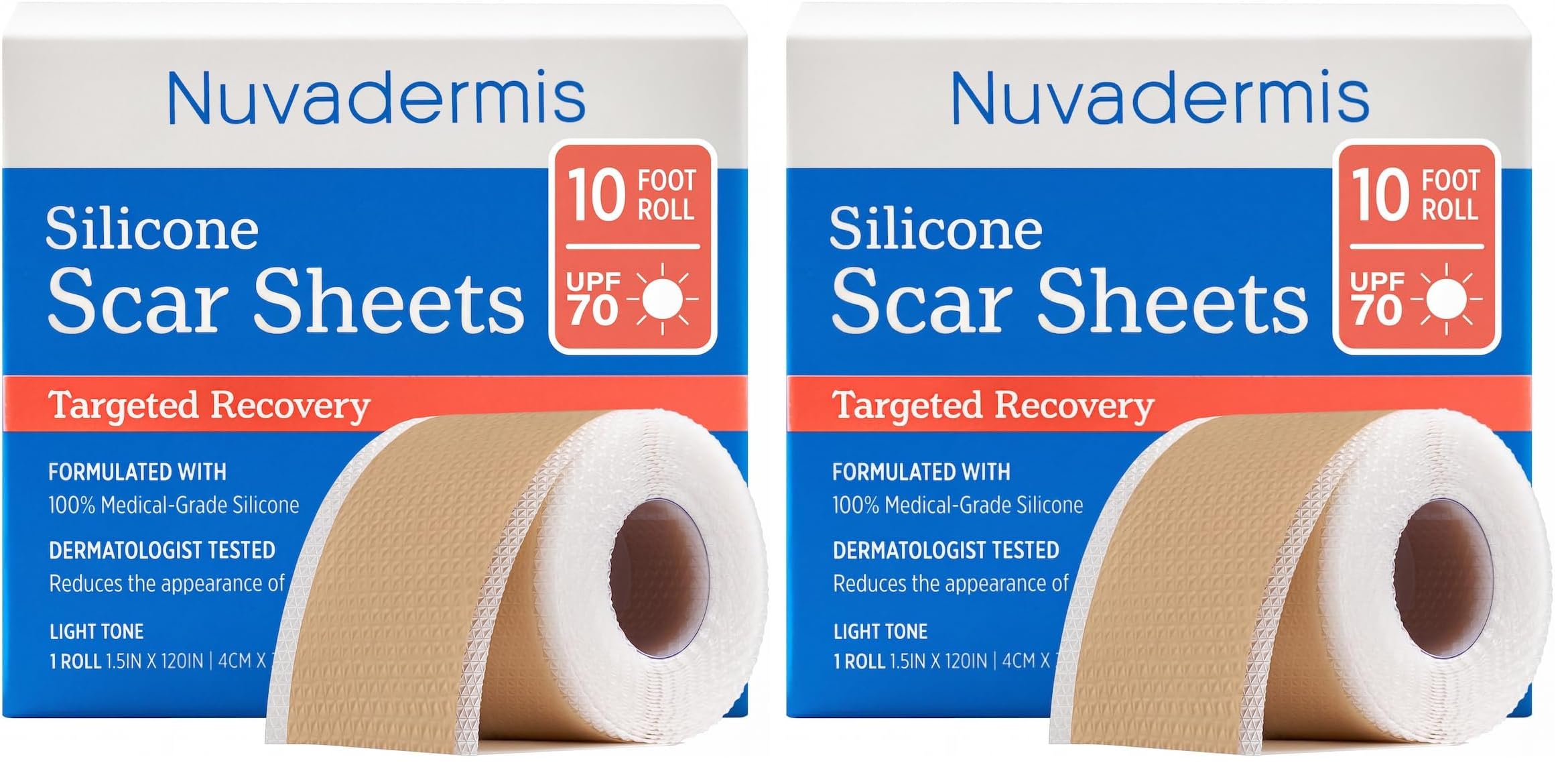
Two ten-foot rolls for anyone treating a big scar or several at once.
This is where coverage goes off the scale. Two rolls of 10 feet each, cut to fit whatever scar you are covering, means you can handle a panniculectomy line, a neck scar, and a spare strip without rationing. The soft, flexible, breathable silicone is easy to peel from its backing and trims cleanly with scissors. When the width runs wide enough, you can slice it into narrow strips to cover a thick scar in sections.
What owners rave about is how well it hangs on. It stays put through showers, under a compression garment, and through a child’s daytime movement, with the tape holding from 5 to 7 days at a stretch. The roll format also lets you cover two incision sites with a single length cut to fit. Latex-free and gentle on sensitive skin round out the reasons people reorder.
The honest catch is consistency. Some strips grip firmly and stay put for a week, while others lift sooner, and a noticeable share of buyers find the adhesion mixed. One buyer also flagged that the box says Made in China despite the European-sourced silicone claim — worth knowing rather than a reason to steer clear. The 24-hour comfort figure is a per-application guide, not a claim that the roll lasts a week without removing to wash.
The coverage argument: 10-foot rolls in a two-pack beat any precut box on sheer length, and the flexible silicone respects a compression garment without shifting.
Keep in mind: adhesion is genuinely mixed across units, and the sourcing label does not always match the marketing.
Go for it if: you are covering one large scar or several at once and want enough roll length to last a long stretch.
Look elsewhere if: you want a strip that holds with total consistency without fussing over reapplication.
Know the Specs
Roll length versus sheet count
A “10 ft roll” gives you a long continuous strip you cut yourself, while “8 Ct” or “4 Ct” means a fixed number of sheets. Length buys flexibility — you trim exactly what a scar needs, so a long incision runs in one piece and a small scar wastes nothing. Sheet counts are faster to use but leave you short if your scar exceeds the sheet’s length. Add up the inches you actually need to cover, because a box of 3-inch sheets covers far less skin than a single long roll.
Why adhesion decides everything
Silicone only softens and flattens a scar while it sits flush against the skin, so a lifted edge means a partial break in coverage. Thicker, fabric-backed strips resist the edge-roll that thin clear sheets are prone to. Skin prep matters: wash the area, dry it fully, and apply the strip to bare skin without lotion. Once the sticky face picks up lint or fuzz, it usually will not wash back to full grip — that is the moment to replace the strip.
Common Questions
How long should I wear a scar strip each day?
Will a scar strip stay on in the shower?
How do I stop the edges of my strip from rolling up?
Can I reuse a silicone strip after washing it?
Is a long roll better than precut sheets for a C-section scar?
Can I use a scar strip on my face?
Which scar strips help with raised or keloid scars?
How long before I see a change in my scar?
Why does my strip stop sticking after a few days?
Do I need to remove the strip to wash the scar?
The Bottom Line
For most people, the scar strips winner is the ScarAway C-Section Scar Sheets because a 7-inch tan sheet covers a typical surgical line in one piece, stays discreet under clothing, and is rated for 7-10 days of wear. If you want one purchase that handles long scars and several sites, grab the ViveCare Scar Tape — its 120-inch roll gives you the most cut-to-size coverage for the money. And for a large or long-term scar, the NUVADERMIS Silicone Scar Sheets is the one to reach for, with two 10-foot rolls that will keep you covered through the full stretch of treatment.
What separates a strip that works from one that sits in a drawer is hold. Whichever you pick, buy enough length to stay covered without gaps, and prep the skin first. The ScarAway C-section sheets remain the crowd favorite, holding a strong score across hundreds of owners, and they are the easiest place to start if you are unsure.
How we choose
We do not accept paid placement. Every pick is matched to a real buyer and a real use-case; we do not hands-on test units.
Sources
Specifications: manufacturer listings and product documentation. Review insights: verified customer reviews, as of October 2026. Pricing: not shown on this page (it changes often); check the current price via the retailer link.
As an Amazon Associate, Aappliancez earns from qualifying purchases. This does not affect which products we feature.