Disclosure: Some links in this post are affiliate links. As an Amazon Associate I earn from qualifying purchases, at no extra cost to you. Learn more
Specs are compiled from manufacturer listings and verified buyer reviews and can change over time — please confirm the key details on the product page before buying.
If you have ever watched two bars of signal disappear on a mountain road, you already know why people search for a satellite walkie talkie. There are two very different ways to buy one: a 4G LTE push-to-talk handheld or a true satellite communicator. One camp runs push-to-talk over cellular (PoC) handhelds, which use 4G LTE phone networks with a free lifetime SIM to talk city to city. The other camp is real satellite gear, which bounces your messages off satellites overhead so nothing depends on a cell tower. Pick the wrong camp and you stay frustrated, so this guide separates the two by network, battery and range.
This guide is built by comparing the manufacturers’ published specifications and the patterns across verified customer reviews, so you get each pick’s real strengths and trade-offs instead of marketing spin.
Below you will find the real differences that matter at the trailhead: whether a radio needs a tower, how long the battery holds, and how far the signal truly carries before the terrain wins. Every pick here is matched to a job — city-wide crew, rope team, or off-grid SOS — so you can skip straight to the one that fits.
Top Picks

How To Choose The Best Satellite Walkie Talkie
The first question to settle is whether you will be in cell coverage or outside it. A radio that rides a 4G LTE tower can reach across the country, but it goes quiet the moment you step where towers do not reach. A satellite communicator works where there is no signal at all, but it is built for messages and emergency alerts rather than everyday chatter.
PoC versus satellite: two very different tools
A PoC radio (push-to-talk over cellular) sends your voice over the same network your phone uses. That means instant conversations over huge distances for a team, and it also means the network has to exist. A satellite communicator uses an orbital network such as Iridium to send and receive short text messages, trigger an SOS, and share your location. Choose PoC when your crews are spread across cities and warehouses. Choose satellite when you are hiking, climbing, or driving beyond the last tower.
Range claims need translating
A radio advertising unlimited range over cellular is not doing anything magical — it is simply using the phone network. A license-free FRS handheld (Family Radio Service, a short-range walkie talkie band) usually gets a few miles in real terrain because its signal travels in a straight line. A GMRS radio (General Mobile Radio Service, a higher-power band that involves a licence) can often push further and talk through repeaters. Treat “35 miles” as a best-case line of sight number, not a promise for a valley.
Water rating and battery numbers to check
An IP rating (Ingress Protection, a two-digit code for dust and water) tells you what a radio survives. IP56 handles splashes and snow, while IP67 means it can sit in a meter of water. On the battery side, read whether the figure is continuous talk time or standby between transmissions, because a 14-day figure on a satellite device usually means checking in on a tracking interval rather than talking all day.
Side-by-Side Comparison
| Model | Best For | Network Type | Stated Battery | Pack Size | Amazon |
|---|---|---|---|---|---|
| KAYOTOM Lifetime Free Global Walkie Talkies 4-Pack★ Best Overall | Whole-team coverage without a phone plan | 4G LTE Push-to-Talk | 24 hours continuous use | 4 | Amazon |
| Garmin GPSMAP 67iBest for Navigation | Navigation plus off-grid SOS | Iridium satellite + GPS | Up to 165 hours in 10-minute tracking | 1 | Amazon |
| Rocky Talkie Mountain RadioBackcountry Ready | Backcountry teams and rope partners | FRS, licence-free | 4 days | 2 | Amazon |
| KaYoTom M12 4G LTE 3-Pack | Fleets and family across states | 4G LTE Push-to-Talk | 72h+ use, 15 days standby | 3 | Amazon |
| XOTODREM G05 Global POC 4-Pack | Long trips and outdoor crews | 4G LTE Push-to-Talk | 7 days | 4 | Amazon |
| Poclink POC-1 Lite | Self-managed group administration | 4G LTE + Bluetooth | 8–10 days per charge | 3 | Amazon |
| Garmin inReach Mini 2 Bundle | Solo trips beyond all towers | Iridium satellite | 14 days at 10-minute tracking | 1 | Amazon |
| Rocky Talkie Expedition 5 Watt | Rugged GMRS with weather alerts | GMRS, 5 Watt | 5 days | 2 | Amazon |
| OMIZN T6 Ultra-Thin 7-Pack | Large crews wanting slim hardware | 4G LTE Push-to-Talk | Long-shift rechargeable, USB-C | 7 | Amazon |
Detailed Reviews
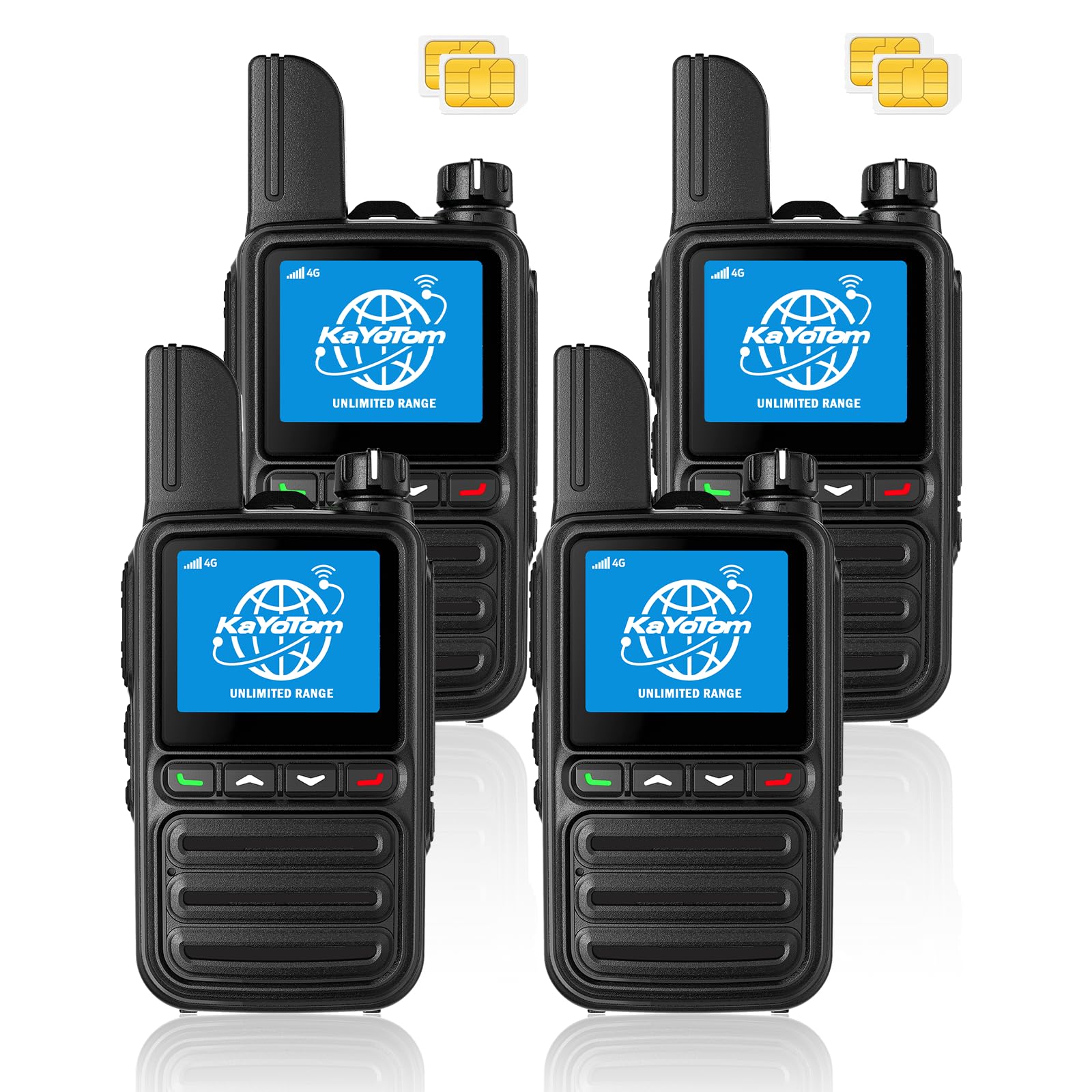
1. KAYOTOM Lifetime Free Global Walkie Talkies 4-Pack
Our pick — 4.5+★ from 250+ verified ratings; the strongest balance of quality and price.
Four radios, one free SIM per handset, and no monthly bill to argue about.
For a small team that needs to talk across a city — or across the country — this is the pick that removes the subscription question entirely. The radios run push-to-talk over 4G LTE using a lifetime free SIM, so you get 5,000 miles and beyond of coverage with no subscription and no hidden fees. Where traditional walkie talkies run out of reach at a few miles, these keep going for as long as a cell tower is nearby.
Battery life is a genuine workhorse figure: the 3000mAh pack (milliamp-hours, the size of the power tank inside) gives over 24 hours of continuous use. Plug in the USB-C port and you get back 50% power in just 20 minutes, which is the number that matters when a crew is swapping shifts. Audio clarity is helped by AI noise cancellation that filters out 95% of background sound, so a busy site or heavy rain does not swallow your instructions.
The free lifetime SIM is why buyers report it as a straight alternative to a phone plan — one even swapped a flip phone for it and found the pair durable and easy to hand off. A warehouse crew ran them across 20 miles with clear voice from every exit, and one buyer reached through mountains wherever a tower still stood. The catch is the belt clip, which is fiddly to fit; slip the included lanyard on instead and stop thinking about it.
What earns its place at the top
- Lifetime free SIM with no monthly fees or subscriptions
- Over 24 hours of continuous use from a 3000mAh battery
- 50% recharge in 20 minutes over USB-C
- 95% ambient noise filtered out by AI noise cancellation
- Four handsets in the box, ready to be grouped by IMEI
Where it asks a little patience
- Needs cell coverage to work at all
- The belt clip is hard to install, so use the lanyard
- Grouping separate purchases means sharing IMEI numbers with support
Made for: crews, families and small businesses that want instant push-to-talk across towns or states without a phone bill.
Not the tool for: deep wilderness beyond the last tower — that job belongs to a satellite communicator further down this list.
2. Garmin GPSMAP 67i Rugged GPS Handheld
A mapping GPS and a satellite messenger welded into one rugged handheld.
This is the pick for the hiker who wants one device doing two jobs: telling you exactly where you are, and letting you send a message home when there is no phone signal. It runs two-way messaging and location tracking over the Iridium satellite network, which covers the globe rather than a region, and it can trigger an interactive SOS to Garmin Response — a coordination centre staffed around the clock. Some jurisdictions regulate or prohibit satellite communications devices, so check your destination before you travel.
Navigation is where it pulls ahead of the pack. Preloaded TopoActive mapping plus multi-band GNSS (a receiver that listens on several satellite frequency bands at once for a tighter position fix) keeps you on the trail, and the large 3-inch sunlight-readable colour display stays legible under open sky. Battery is the headline spec here: up to 165 hours in 10-minute tracking mode, stretching to 425 hours in expedition mode with 30-minute tracking intervals. Against the KAYOTOM’s 24 hours of continuous use, that 165-hour figure is a different kind of endurance entirely.
Owners describe inReach messaging and roughly 80 hours of real-world battery, with satellite acquisition holding up even when the unit rides loose in a gearbag. What wins people over is sheer capability — the mapping is rated above the phone-based alternatives, and the buttons are sized so they work with thick gloves on. The honesty note: menus come with a learning curve most buyers describe as a weekend of study, and the price of entry includes an active satellite subscription.
The trade you accept: it is a large, heavy handheld at 8.1 ounces that assumes you will actually be navigating — if you only want to talk within a few miles, the Rocky Talkie above does the job for far less complexity.
Who it converts: hikers, overlanders and backcountry hunters who want a paper-map backup in the same pocket as their SOS button.
Reach for this if: your trips take you off trail and you want mapping, messaging and an emergency button in one glove-friendly body.
Look elsewhere if: you want quick chat between vehicles in town — a cellular PTT radio is far simpler.
3. Rocky Talkie Mountain Radio 2-Pack
The rope-team radio built to survive a whiteout and a carabiner clip.
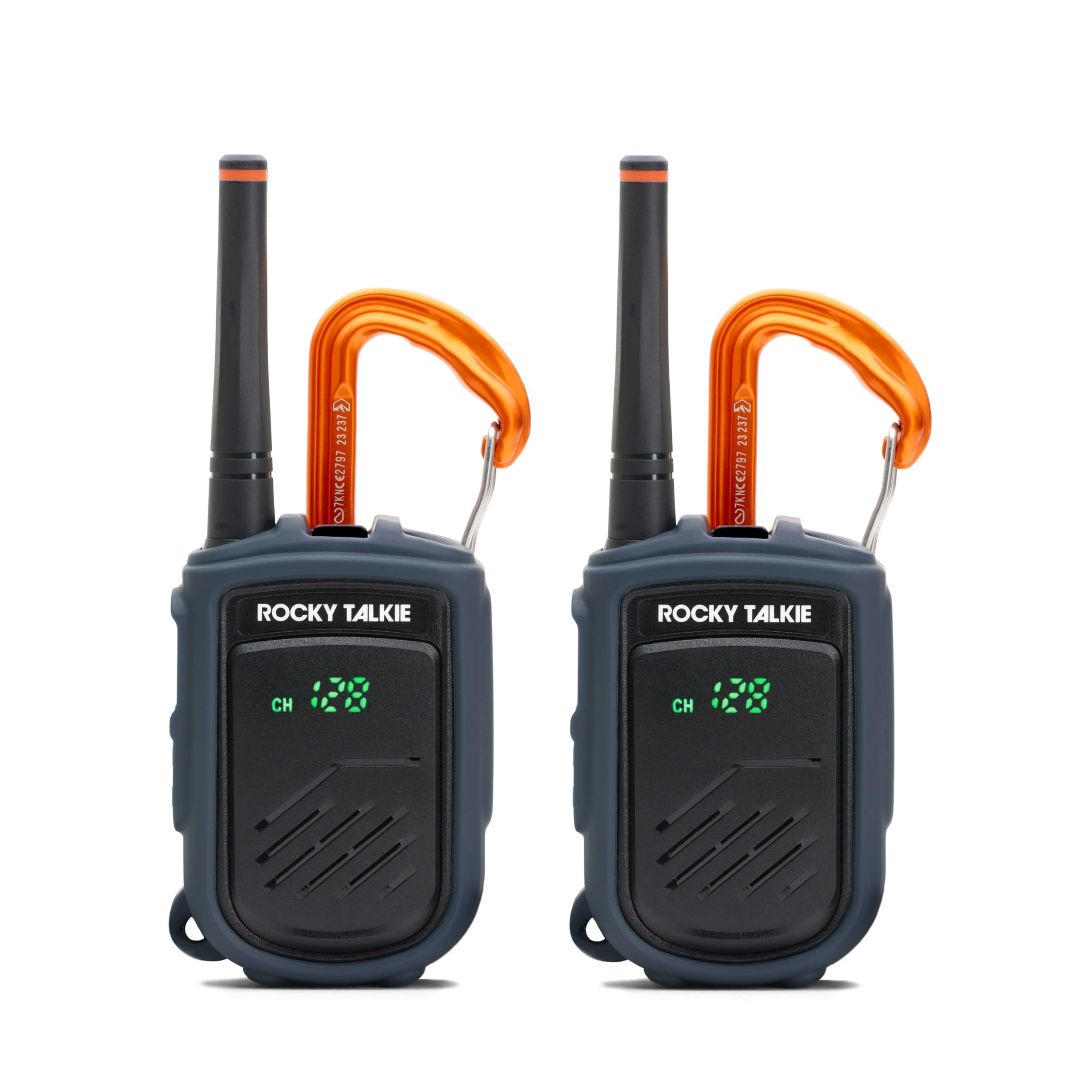
Anyone who climbs or skis in a pair knows the pain of a brittle walkie talkie whose clip snaps in the cold. This is the opposite of that: a shatterproof LED screen under a thermoplastic shell, no fragile plastic clip, and a climbing-rated carabiner plus a metal-reinforced backup leash in the box. It is rated IP56, which means it shrugs off splashes and snow rather than surviving a dunking.
The battery is the number that sells it: a rechargeable lithium-ion pack rated for over 4 days of life, even in very cold conditions. That beats a day-shift mentality entirely, and it is why ski patrollers and alpine guides gravitate to it. Range-wise it is an FRS radio transmitting at the maximum legal licence-free power of 2 watts — up to 35 miles at best, but 1 to 5 miles in typical backcountry terrain, which is the honest number to plan around.
What wins people over is usability under pressure. Five buttons and zero configuration mean a four-year-old can key up, and the volume dial holds its position instead of drifting. A family took them on a Rockies road trip and got four days per charge, and a Rainier climber used one to reach a rope partner 30 feet away when wind drowned out voices. Skip the carabiner and ask for a belt clip and you have a near-perfect trail radio — the only thing to weigh is whether 2 watts is enough reach for your terrain.
Where it shines: instant, no-setup voice between partners who are within a few miles of each other, with cold-weather battery that outlasts most trips.
The limit worth knowing: it is a licence-free FRS unit, so if you regularly need communication beyond a mile or two, the 5-watt GMRS Expedition below is the better fit.
Best for: climbing parties, ski teams and backcountry hikers who want a radio that takes a beating and lasts four days.
Think twice if: your group needs miles of range in wooded valleys — that calls for more transmit power.
4. KaYoTom M12 4G LTE 3-Pack
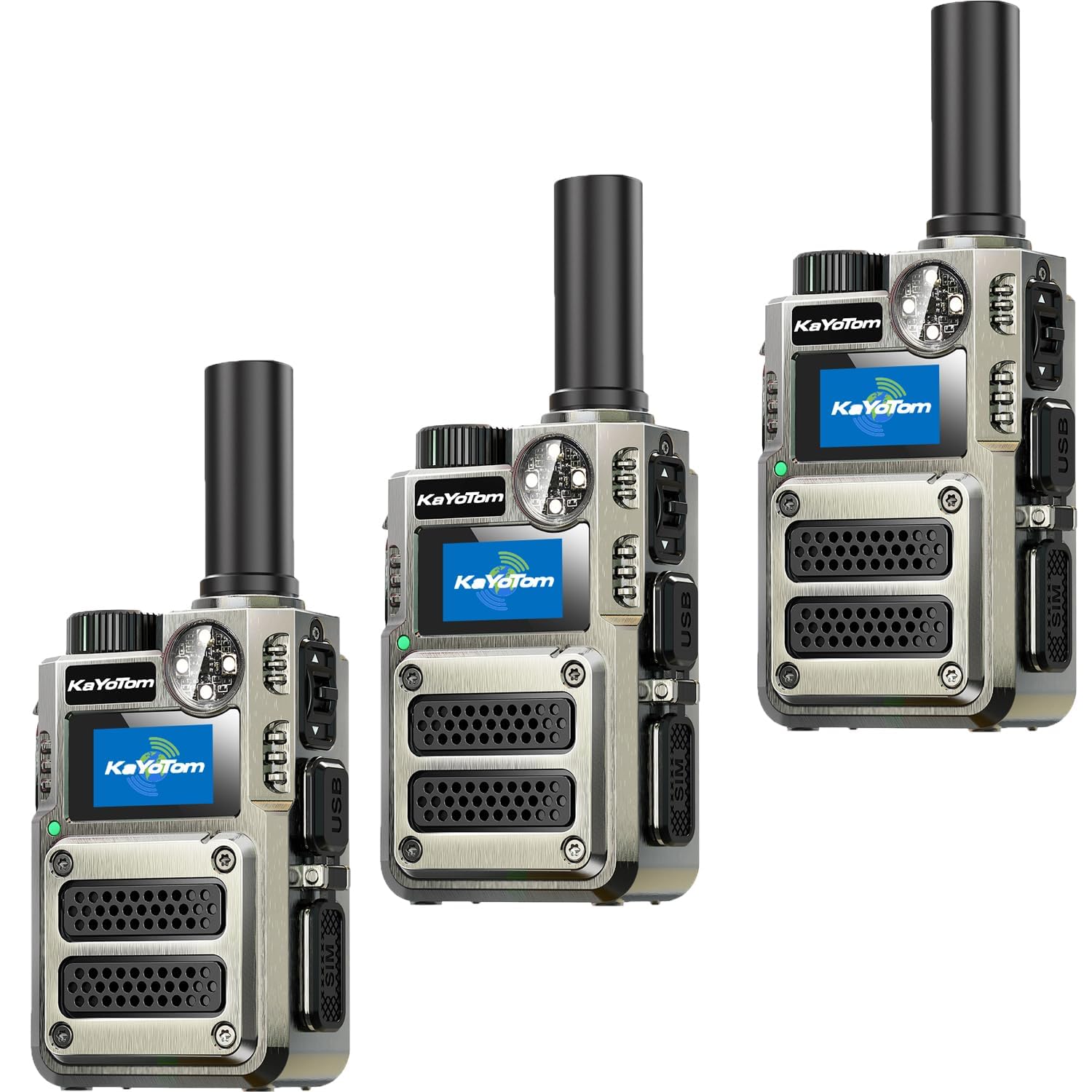
Three rugged handsets that turn a coast-to-coast road trip into one talk group.
Where the KAYOTOM runs for a day, this sibling from the same maker stretches the battery to a stated 72 hours of use plus 15 days of standby, and tops it up with 50% in about 40 minutes over USB-C. The SIM is pre-inserted, so you power on and talk — no carrier check, no activation ritual. Three packs land in the box, which suits a small fleet, a moving convoy, or a family split across two vehicles.
The extra here is the tactical kit: a powerful strobe light for wilderness distress signalling, plus IR/UV illumination (an infrared and ultraviolet beam you use for night navigation without lighting up your own position), alongside the SOS alert. Quality is the trait that dominates owner consensus, with the metal case and sturdy clips named again and again. Audio sounds phone-like rather than radio-crackly, which is the whole point of HD voice over 4G.
One RV owner used a set across three states for live traffic feedback while towing, and another talked Virginia to Florida with a grandchild over 4G. The honest catch is network dependence: in deep mountains without towers, these go quiet until you reach one — the buyer who tests his gear in high country says exactly that. A handful of small gripes surface around belt clip screws and an occasional login hiccup at low battery, which sized against the whole picture is a firmware-level nuisance rather than a dealbreaker.
Why convoys like it
- 72h+ battery use and 15 days standby from a 3000mAh cell
- Pre-installed SIM — batteries in, switch on, talk
- Strobe light and IR/UV for night use
- Sturdy metal case with pre-paired handsets
The fine print
- Requires cellular coverage — dead in deep wilderness
- Small screws on the belt clip have been a minor gripe
- Adding a second set later means sharing IMEI numbers with support
Pick this when: your people are spread across states on roads and worksites and you want long battery plus a distress strobe in the same handset.
Leave it for: an off-grid summit where there is no tower — that is satellite territory.
5. XOTODREM G05 Global POC 4-Pack
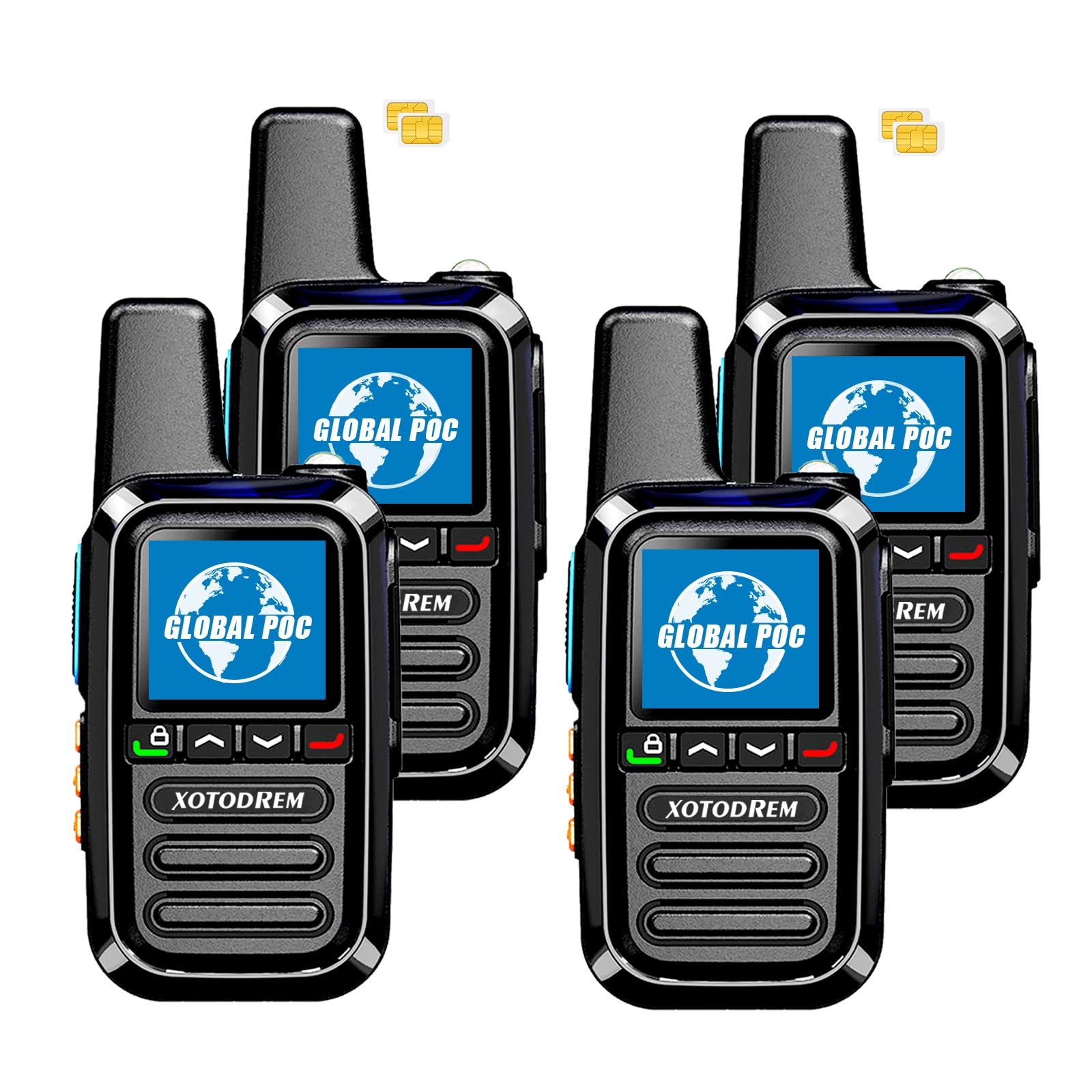
Four radios with a 5000mAh power tank and a full week of standby.
If long days away from a charger are the worry, this is the biggest battery in the cellular group here. The 5000mAh pack is rated for a full day of talk time and seven days of standby, which translates to one charge across a whole camping trip or a busy week of warehouse turnover. A Type-C port handles the refill, and four handsets plus two 365-day unlimited data SIM cards come in the box.
The microphone is sensitive enough to catch your voice while cutting out 95% of environmental noise, and the built-in chip encryption protects one-on-one and group calls — genuinely useful for a security team that does not want its radio traffic on display. A digital display and flashlight round out the night-time practicality. Weight sits at 280 grams, so it carries like a small phone rather than a chunky brick.
The free lifetime SIM is real, but note the commitment: several owners mention an annual renewal contact through the app, which is a housekeeping step rather than a fee. One crew used them for events with clear audio and quick PTT across the venue, and a team of five found them pocketable enough to forget, with battery that lasted the whole day. Charging is fussy about power bricks — a USB-C-to-USB-C fast charger may not work, so keep a standard cable handy.
Where it stands out: the largest power reserve of any cellular pick here at 5000mAh with seven days of standby, paired with encrypted group calling.
The reality check: an annual IMEI renewal contact keeps the free service running, and it will not charge from every fast charger you own.
Fits best: security teams, event crews and outdoor groups that need encrypted channels and a battery that ignores the weekend.
Pass it up for: a place with zero cellular signal, where only a satellite device reaches out.
6. Poclink POC-1 Lite Global Walkie Talkie 3-Pack
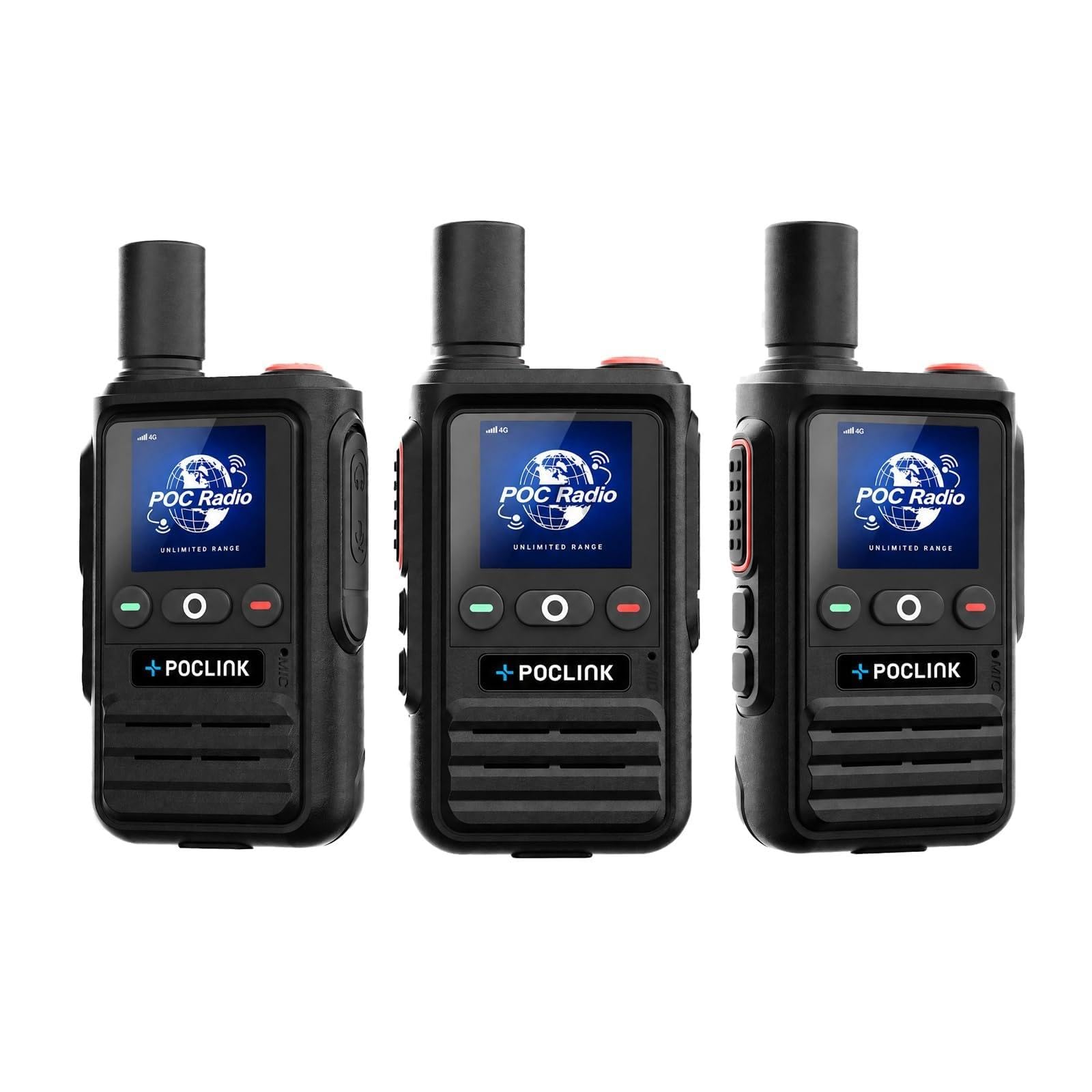
Build your own call groups from your phone instead of emailing support.
Most of the cellular radios in this list ask you to send IMEI numbers to a seller before your team can talk to each other. This one hands that power back through the Poclink app: you create and manage your own groups, with room for up to 100 groups and 1000 members each, and you can rename handsets and store data locally. For a logistics or hotel operation that reorganises crews often, that is a real operational improvement rather than a spec-sheet flourish.
The 3000mAh battery with fast Type-C charging is rated eight to ten days per charge for daily team use, and the handset weighs 130 grams, so it clips to a shirt and disappears. Bluetooth is the standout: it pairs dedicated PTT headsets and standard Bluetooth earbuds, letting you keep private calls off the speaker. Coverage claims up to 25,000 miles over partnered networks, with automatic switching to a stronger carrier when your own signal fades.
Owners find the app clean and the audio low-latency, with a drop from shoulder height survived and multi-day battery holding up. The bigger point of honesty is what you are buying: this is not a radio in the traditional sense but a voice-over-network handset, so if the service ever disappeared the hardware would go with it. Slow charging surfaces in feedback, and value gets mixed reviews — the lifetime SIM is the thing that makes the math work.
The reason to pay up: self-service group administration plus Bluetooth headset support — no other cellular pick here lets you build groups without a support ticket.
The catch to embrace: it depends on the network and the provider staying in business, so treat it as a service-tied tool.
Ideal for: businesses that reshuffle teams weekly and want to manage everything from a phone.
Skip if you want: a radio that keeps working with no network and no provider at all.
7. Garmin inReach Mini 2 Satellite Communicator Bundle

The tiny satellite box that sends a text home from beyond every tower.
At 3.5 ounces and barely the size of a palm, this is the genuine satellite communicator on the list — no cell tower involved, no coverage map to check. It sends and receives two-way texts and emails over the Iridium satellite network, works inReach to inReach in the field, and can trigger an interactive SOS to the Garmin Response centre staffed 24/7. Where the GPSMAP 67i above carries a full maps screen, this goes the other way: it is built to disappear in a pack until you need it.
The battery rating is up to 14 days in the default 10-minute tracking mode, extending to 30 days on a 30-minute interval. TracBack routing retraces your steps to the start if you lose the trail, a digital compass gives a heading even when you are standing still, and paired with your phone it can pull weather forecasts and sync location sharing through MapShare. The MIL-STD-810 rating (a military durability standard for shock and temperature) and IPX7 water resistance (survives being dropped in water) mean the elements are not the concern.
Solo hikers treat it as the piece of kit they never climb without, and long-haul travellers in remote parts of the world carry it as backup. The breadcrumb trail updates roughly every ten minutes, so it is an emergency communicator rather than a live tracker. The subscription is the honest caveat — plan around it, and the hardware itself earns its keep. A few buyers still carry battery packs for multi-day trips, but the 14-day rating means most find that is belt-and-braces comfort.
What justifies the premium
- True global satellite coverage with no cell tower needed
- Two-way messaging in and out of range of phones
- Up to 14 days in 10-minute tracking mode
- Interactive SOS to a staffed 24/7 centre
Budget these in
- Satellite airtime requires a subscription
- Breadcrumb position updates arrive roughly every 10 minutes
- Button typing is slower than a phone keyboard
Built for: solo hikers, climbers and globe-trotting travellers who want a rescue line in a pocket-sized shell.
You will not like it if: you expect live tracking, or you grudge a monthly satellite plan.
8. Rocky Talkie Expedition 5 Watt GMRS 2-Pack
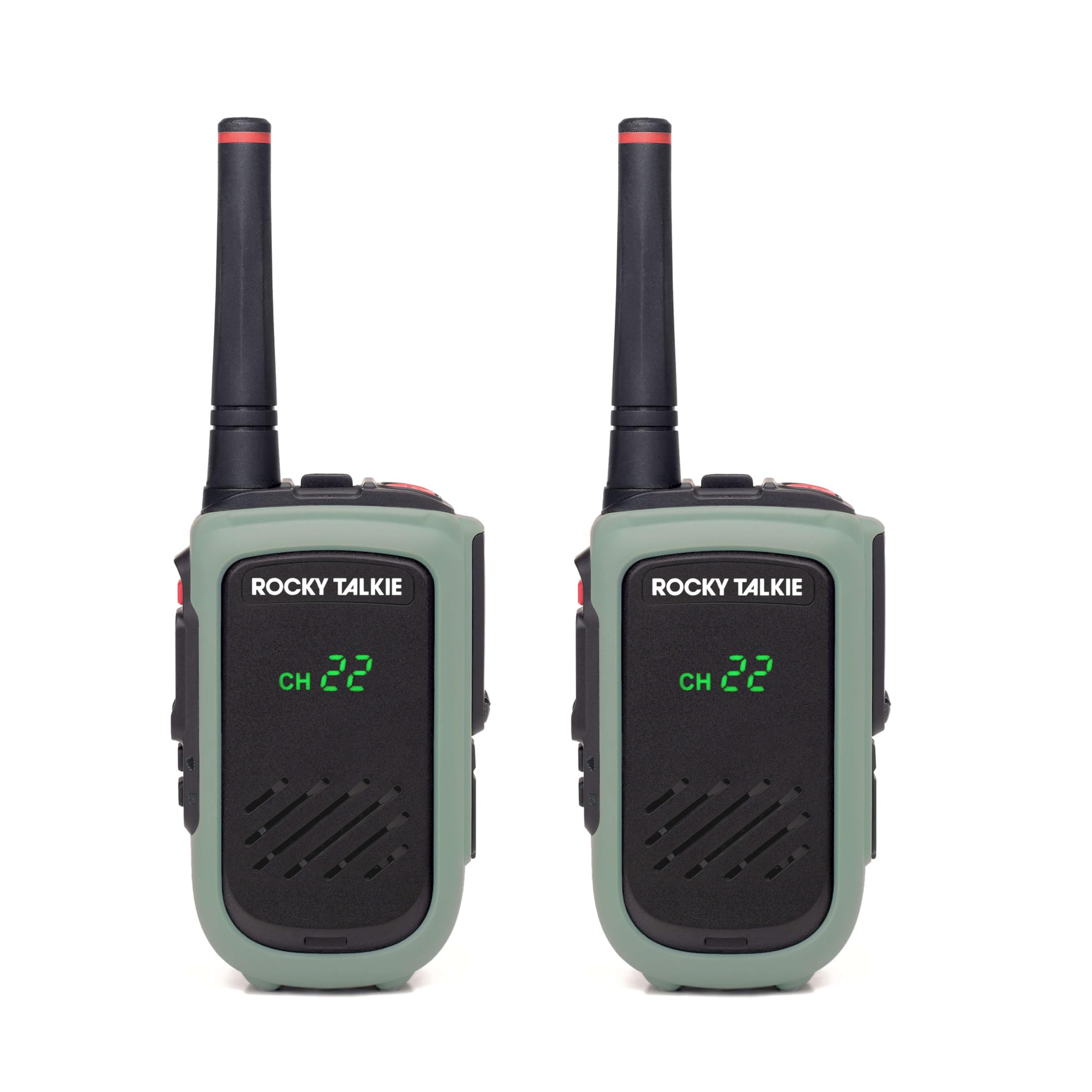
Five watts of mountaintop-tough GMRS power in a waterproof shell.
Where the Mountain Radio above relies on licence-free FRS, this one upgrades to GMRS at 5 watts — the maximum handheld power the band allows — and adds the ability to open up 8 repeater channels that extend your reach. Range at best is over 35 miles, though 2 to 8 miles is the honest backcountry number. That extra power is exactly what a wooded valley destroys on a 2-watt set.
The weather-proofing jumps to IP67, which means it can sit in a meter of water, and it also tunes NOAA weather channels and alerts (the US network of continuous weather broadcasts). An average of 5 days per charge from a 1800mAh battery that still performs in frigid conditions makes this a multi-day companion. Both a pre-installed 7.5cm antenna and a 17cm option are in the box, so you can trade compactness for reach.
Off-road groups report clear contact at 2.4 miles with a dam and 300 feet of elevation in the way, and a careful tester logged that battery dipped only about 5% across 8 to 10 hour hikes thanks to the percentage display. Traditional FRS radios often cannot cover that distance with any reliability, which is the argument for the extra power. A ham operator calls it the most rugged walkie talkie he has owned. Small gripes: you must read the manual before setup, and GMRS operation requires a licence, so budget for that.
The strength to buy it for: 5 watts and 8 repeater channels deliver reach that license-free FRS simply cannot, all in an IP67 housing with NOAA alerts and a 5-day battery.
The thing to plan around: GMRS needs a licence, and line-of-sight mountains still block the signal without a repeater.
Buy this if: you are off-road, on a ranch, or anywhere a 2-watt radio keeps dropping out and you want reach plus weather alerts.
Choose differently if: you want zero paperwork — the FRS Mountain Radio needs no licence.
9. OMIZN T6 Ultra-Thin 4G LTE 7-Pack
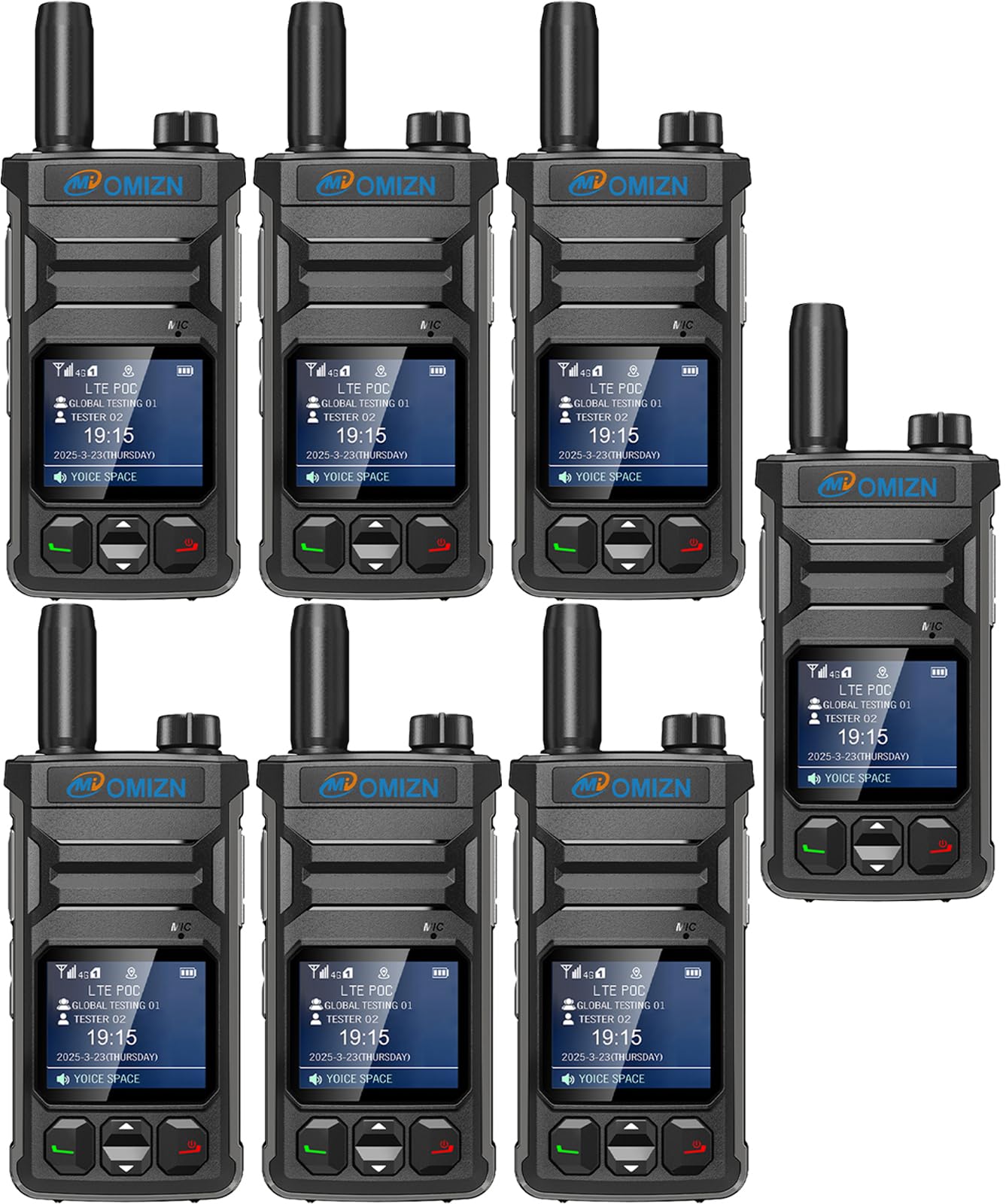
Seven slim handsets for a whole crew, without a bulky brick in every pocket.
When you need a radio in the hands of an entire shift, pack size becomes the decision. Seven units arrive with preinstalled SIMs supporting up to 172 countries and regions (contact the seller before use outside the continental US), so you can hand them out on day one. The 0.78-inch slim zinc-alloy body is the design feature that gets mentioned — it sits flatter than the chunky metal radios around it.
Groups work through a top selector knob, so switching crews does not mean diving into menus, and smart noise reduction keeps speech readable on a noisy site. Private and group calls let a dispatcher reach one person or the whole team, and encryption protects the conversation. Support can set up a sub-account so you manage your own groups and members as staffing changes, which suits a growing contractor rather than a fixed crew.
A few owners found reception stronger than their phone on the same network — three bars where the handset barely registered one — and one praised the customer service for replacing a battery that would not hold a charge. The honest caveat: sound quality is good rather than excellent, which is a side effect of how these devices compress voice, and it still needs cellular coverage to work. Bottom line, this is a practical fleet pick where the slim profile and seven-in-one box matter most.
Where it lands: a slim zinc-alloy handset, seven to a pack, with a knob for group switching and encryption on the calls.
The trade: audio is fine but not the sharpest here, and if you are outside a coverage area the handset goes silent.
Right choice for: shops, fleets and multi-crew sites that need seven radios in one order with minimal bulk.
Wrong choice for: anyone whose work happens past the edge of the cell map.
Know the Specs
Push-to-Talk over Cellular (PoC)
A PoC radio sends your voice over a 4G LTE data connection instead of a direct radio signal. That is why it can reach 5,000 miles and beyond — it is using the phone network, not the air between two handsets. It also means the coverage area is the coverage area: if there is no cell tower, there is no call. Look for a pre-installed SIM, a free lifetime plan, and a group-management system so a team can be configured quickly.
Iridium Satellite Messaging
An Iridium-based communicator talks to a constellation of satellites rather than a tower, so it works from a ridge with no phone signal at all. Two-way messaging sends a text in and out, location sharing lets family track you, and an SOS button contacts a staffed emergency response centre. These units run on a subscription and are built for short messages and safety rather than chatter. Check the tracking interval and the battery number for that specific mode.
FRS versus GMRS
FRS (Family Radio Service) is the licence-free band most consumer walkie talkies live on and is capped at 2 watts of power. GMRS (General Mobile Radio Service) allows up to 5 watts handheld and access to repeater channels, which is why a GMRS set outranges an FRS set in the same terrain. GMRS requires a licence, while FRS does not, so this is a paperwork decision as much as a performance one.
IP ratings and battery figures
An IP rating’s two digits cover dust and water. IP56 means it shrugs off splashes and snow, while IP67 means it can be submerged in a meter of water. Battery claims need reading carefully too: a 3000mAh pack might mean 24 hours of continuous talk or days of standby. Continuous talk time is usually a day or less; standby figures stretch into a week. Check both so you know what you are actually buying.
Common Questions
Do I need a cell signal for a satellite walkie talkie to work?
Why do satellite radios claim 5,000 mile range?
What is the difference between FRS and GMRS on these radios?
How long does the battery last on a typical satellite handset?
Can multiple walkie talkies be connected into one group?
Are these radios waterproof?
Does a satellite communicator require a paid subscription?
Can I use a walkie talkie outside the country?
Is a PoC radio better than a phone for a team?
What size are these radios for carrying all day?
The Bottom Line
For the majority of shoppers, the satellite walkie talkie winner is the KAYOTOM 4-Pack because it delivers true push-to-talk across thousands of miles with a free lifetime SIM and a 24-hour battery. If you want real satellite coverage with messaging and a 24/7 SOS button, the Garmin inReach Mini 2 is the one to carry. And for a rugged GMRS set that reaches further in the backcountry, the Rocky Talkie Expedition earns its place. Pick the camp that matches where you actually travel — towers or satellites — and you will not waste a single transmission.
How we choose
We do not accept paid placement. Every pick is matched to a real buyer and a real use-case; we do not hands-on test units.
Sources
Specifications: manufacturer listings and product documentation. Review insights: verified customer reviews, as of October 2026. Pricing: not shown on this page (it changes often); check the current price via the retailer link.
As an Amazon Associate, Aappliancez earns from qualifying purchases. This does not affect which products we feature.