Disclosure: Some links in this post are affiliate links. As an Amazon Associate I earn from qualifying purchases, at no extra cost to you. Learn more
Specs are compiled from manufacturer listings and verified buyer reviews and can change over time — please confirm the key details on the product page before buying.
If your RV roof shows black rubber through a chalky white surface, or you find damp patches near the vents, you need a coating that bonds to rubber and stays flexible through every freeze and heat wave. The short answer: the Countryman 100% Silicone Roof Coating handles the widest range of roof materials, the LUVBOATE 1 Gallon is the easiest way to test the waters on a small camper, and the HENG’S Rubber Roof Coating is the proven name for EPDM rubber (a common synthetic rubber used on RV roofs) specifically. What separates a coating that lasts from one that peels in a season is simple: solids content (the part that stays behind after the liquid dries), flexibility, and how well it grips a properly cleaned surface.
This guide is built by comparing the manufacturers’ published specifications and the patterns across verified customer reviews, so you get each pick’s real strengths and trade-offs instead of marketing spin.
Rubber RV roofs will not last forever on their own, and replacing one costs far more than coating it. A good coating buys you years of extra protection for a fraction of that cost. This guide breaks down the best rv rubber roof coating options by real-world coverage.
Top Picks

How To Choose The Best RV Rubber Roof Coating
Every RV rubber roof coating on this list works. The one you pick depends on what your roof is made of, how bad the existing surface is, and how much roof you are covering in a single session. Get those three things right and you will not waste a bucket.
Match the coating to your roof material first
EPDM rubber (the standard black rubber sheet found on most travel trailers and motorhomes), TPO (a lighter-colored thermoplastic sheet), fiberglass, and aluminum all accept coatings differently. Silicone-based products bond to metal, EPDM rubber, fiberglass, and modified bitumen in most cases. Acrylic-based products like Dicor’s are made specifically for EPDM and PVC. Pick a coating that lists your roof material as compatible, or you will be redoing the job in a year.
Calculate how much you need from the coverage rate
Manufacturers state coverage in gallons per square foot. Some give you one gallon per 50 square feet; others give you one gallon per 125 square feet. A 30-foot trailer roof is roughly 240 square feet, so an entry-level gallon-to-50-sq-ft product needs at least two heavy coats. Buy a little extra rather than running short mid-application — it is easier to close a bucket than to match a half-cured layer with a fresh one.
Flexibility and elongation keep the coating from cracking
Your RV roof expands in summer heat and contracts in winter cold. A coating that cannot stretch with it will crack at the seams and around vents. Look for coatings that state a flexibility figure or an elongation percentage — that number tells you how much the final membrane can stretch before it tears. Silicone and premium acrylics hold flexibility across a wider temperature range than basic formulas.
Prep work is where the job succeeds or fails
Every review across the products here points to the same thing: cleaning determines whether the coating adheres. Power wash with soap and water, let the surface dry completely, and tape off the sides if you want a clean stripe. Coatings that cover bad black rubber need two to three coats over a properly cleaned surface. Skip the prep and you get peeling, bubbles, and wrinkles — not a coating problem, a foundation problem.
Side-by-Side Comparison
| Model | Best For | Coverage | Material Base | Container Size | Amazon |
|---|---|---|---|---|---|
| Countryman 100% Silicone Roof Coating★ Best Overall | Best Overall — all roof materials | Single-coat at recommended rate | Silicone | 4.75 Gallon | Amazon |
| LUVBOATE RV Roof SealantBudget Entry | Budget entry / small camper | 1 Gallon per 50 sq ft per coat | Acrylic | 1 Gallon | Amazon |
| HENG’S Rubber Roof Coating | Best for EPDM rubber roofs | — | Rubber | 1 Gallon | Amazon |
| Dicor RP-CRC-1 EPDM Rubber Roof Coating | Best for EPDM and PVC | 1 Gallon per 125 sq ft per coat | Acrylic | 1 Gallon | Amazon |
| Liquid Rubber Silicone Roof Coating | Best for multi-surface sealing | 1 Gallon per 50 sq ft | Silicone | 1 Gallon | Amazon |
| Wadities RV Roof Coating | Best for full RV coverage | 1 Gallon per 50 sq ft per coat | Acrylic | 4 Gallon | Amazon |
| Everbond RV Roof Waterproof Sealant | Best coverage per bucket | 1 Gallon per 50 sq ft | Rubber | 4.75 Gallon | Amazon |
Detailed Reviews
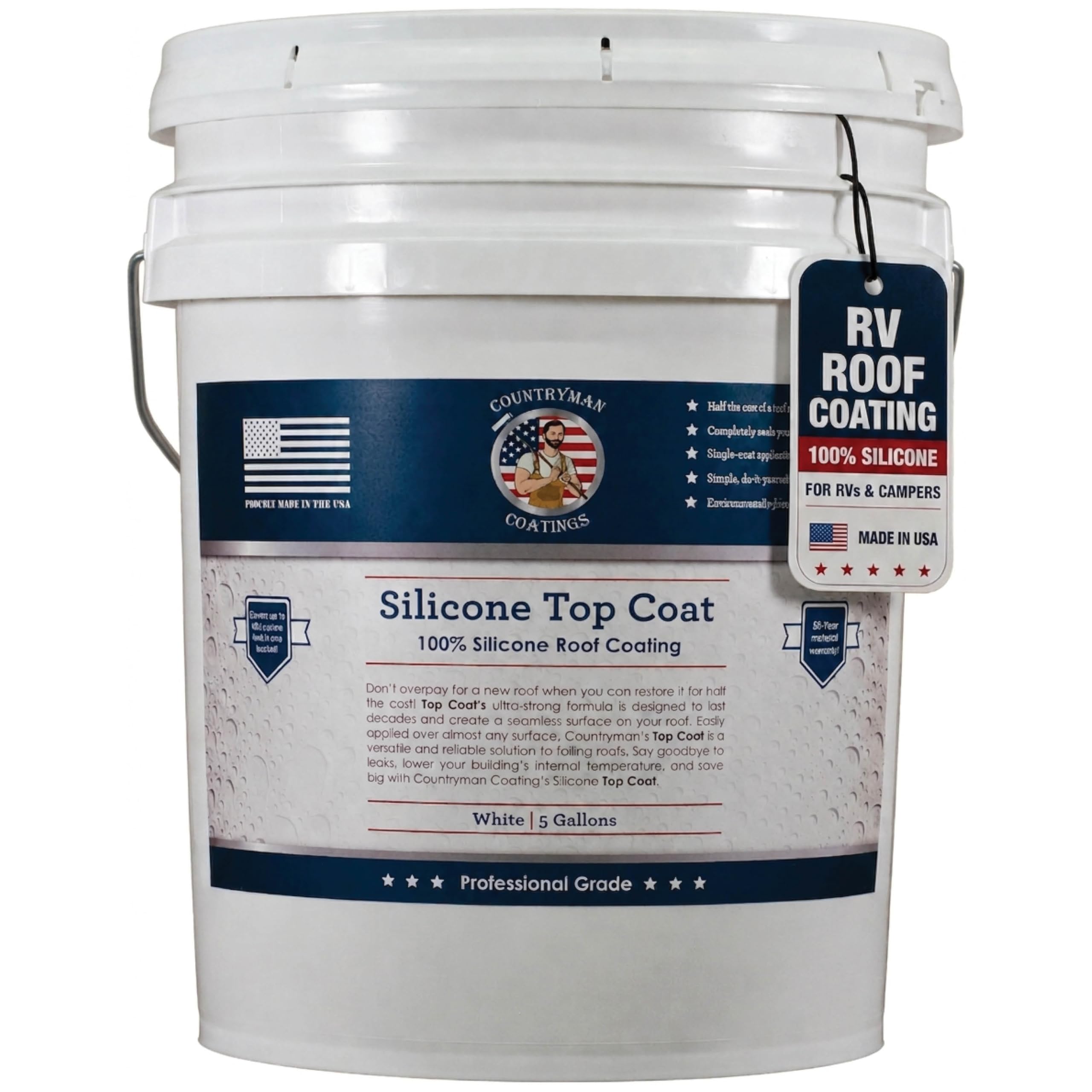
1. Countryman Silicone Roof Coating 4.75 Gallon
Our pick — 4.5+★ from 200+ verified ratings; the strongest balance of quality and price.
The 100% silicone coating that bonds to EPDM, fiberglass, and metal without primer in most applications.
This is the bucket for the RV owner who is tired of patching. The Countryman formula is 100% silicone, which means it resists ponding water (standing water that pools on a slightly sagging roof) and UV exposure without turning brittle the way acrylic and latex coatings can over a few seasons. It bonds to properly prepared metal, EPDM rubber, fiberglass, SPF, modified bitumen, and even existing silicone coatings without a primer in most applications. That wide compatibility is why this is the safest single purchase if you are not certain exactly what your roof sheet is.
Weight and size tell you this is a serious restoration job. The pail measures 12.5 x 12.5 x 15 inches. Applied at the recommended coverage rate, the manufacturer states this restores and protects in a single application, saving you a coat compared to products requiring two to three passes. As buyers report: “One 5-gal covers 34′ Bounder + 11.5′ truck camper double-coated.”
What wins people over is the heat reflection. The white finish bounces sunlight off the roof and keeps the interior noticeably cooler — and the quality of the cured surface is the thing most often singled out in owner feedback. As one buyer described it: “Reflects 90% of the heat off the roof, you couldn’t walk on it before barefoot it was so hot and now we lay on the roof and sun tan it’s amazing how well it reflects heat.” Others report it survived two hail storms and looks like glass when fully cured. The honest trade-off: once cured, a wet silicone surface is slippery, and the bright white will stain tan over time on a dirty roof. It is also the heaviest product here — this is not a small-camper touch-up bucket.
Silicone RV Roof Coating
- Bonds to metal, EPDM, fiberglass, and modified bitumen without primer in most applications — one product covers almost any roof type
- Single-coat application at the recommended rate restores and protects in one pass
- Resists ponding water, UV, and extreme weather without cracking or peeling
- Reflects heat off the roof, keeping the RV interior cooler — a benefit many owners call out
Pail Lifting Required
- At 49 pounds, this is the heaviest product on the list — you will need a second pair of hands on the ladder
- Slippery when wet until fully cured
- White surface will discolor from roof dirt over time
Silicone Roofs: you want one coating that handles any roof material and gives you the strongest UV and heat reflection in the lineup.
Acrylic Roofs: your camper is small and you would rather not buy a 49-pound pail for a quick patch job.
2. RV Roof Sealant White 1 Gallon
The one-gallon acrylic kit with brush and cloth included, sized for a small camper roof.
Start here if your rig is short and you want to prove the concept before buying a bigger bucket. The LUVBOATE gallon is an acrylic formula that bonds to metal, plastic, and fiberglass, forming a flexible waterproof layer that moves with the RV body as it expands and contracts. It ships as a complete kit — one gallon of coating, a brush, and a polyester cloth — so you can start the job the day it arrives. The coverage rate is 1 gallon per 50 square feet per coat, with 2-3 thick coats recommended for full protection. As owners mention: “Worked great; 1gal covered 22ft camper top one coat, looks new.”
Flexibility is the reason this holds through weather swings. Because the cured acrylic stays pliable rather than going hard, it follows the natural movement of the camper body instead of cracking at the seams. It also works beyond the RV roof — the manufacturer lists gutters, planter boxes, foundations, interior basements, fences, wood, concrete, and stucco as acceptable surfaces. Application is as easy as painting: brush, roller, or a high-quality sprayer all work. Two people can cover a coat in under half an hour on a mid-size trailer.
The catch is thickness and coat count. Some owners find a single coat too thin and need a second or third to build up a proper membrane. The drying time draws mixed feedback — some report it dries quickly, others wait longer in humid conditions. The gallon container is also a limitation for larger rigs: you will need multiple gallons for anything over roughly 25 feet. Most owners who plan for 2-3 coats and buy accordingly are satisfied with the outcome.
Small Roof Coverage: the gallon size and included brush make this the easiest way to coat a pop-up, teardrop, or short travel trailer without overbuying.
Plan Application: budget for at least two gallons on anything longer than a compact camper, and give the second coat a full dry window before applying it.
Small RV Roofs: you have a small to mid-size camper and want a complete, affordable kit with everything needed to start.
Large Roofs: you have a full-size motorhome — you will need several gallons, and the single-gallon container is not the efficient way to get there.
3. HENG’S Industries Rubber Roof Coating 1 Gallon
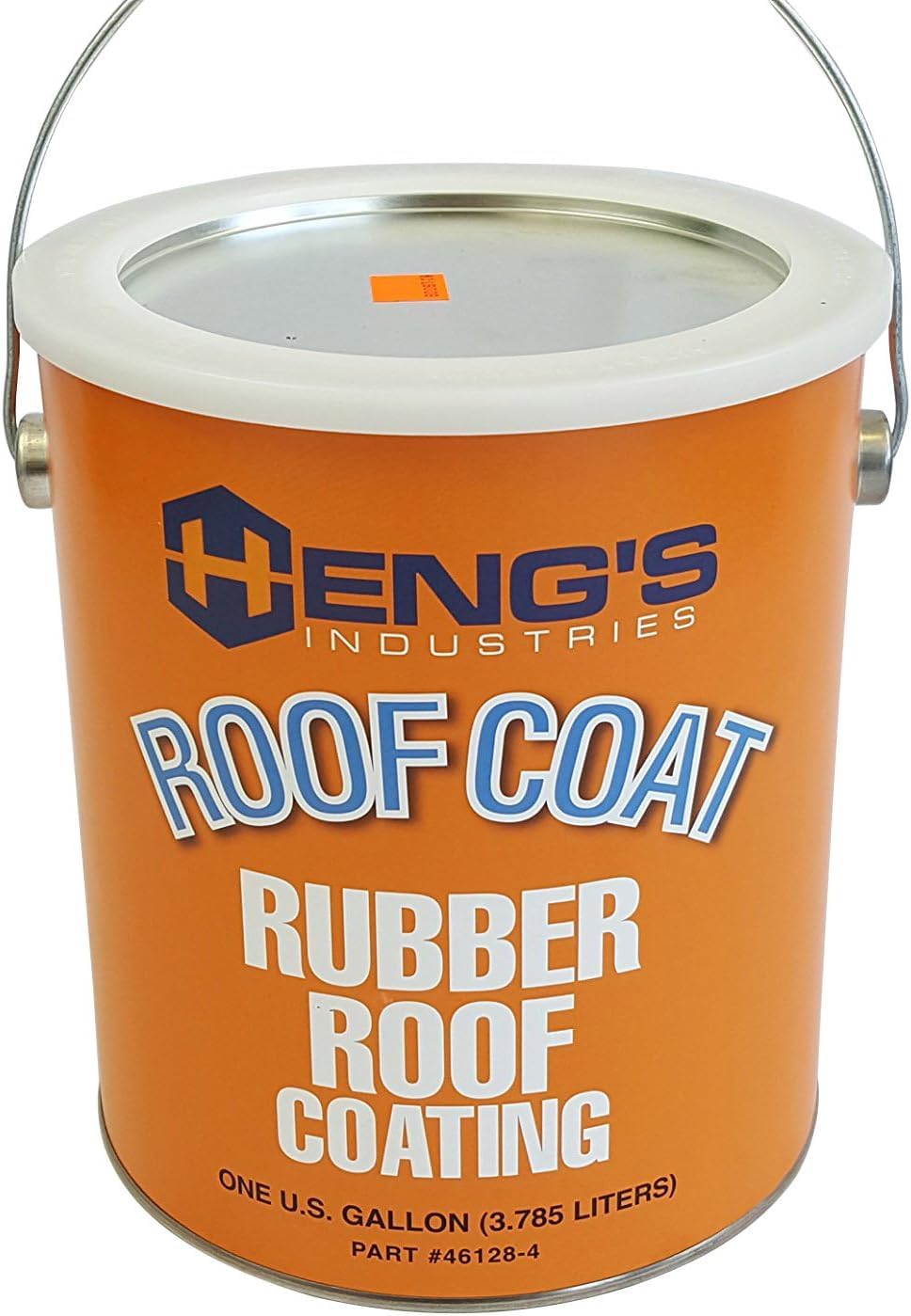
The rubber-based coating formulated specifically for EPDM roof sheets.
If your motorhome roof is the standard black EPDM rubber sheet, this is the coating designed to match it. HENG’S formulates this product as a rubber-based coating that goes over EPDM roofs, at seams and tears, and around vents, air conditioners, and other penetrations. It expands and contracts with the roof — the exact behavior you need when the rubber sheet underneath is moving with temperature — and resists cracking and impact. It is non-polluting and non-toxic by formulation. At 5 pounds for a gallon, it is one of the lightest buckets here, easy to carry up a ladder.
Owner feedback on this one is deep and mostly positive. What owners praise most is application — it rolls on quickly and covers a thin factory coating with measurable results. As one buyer described their first job: “First-time RV roof coating on a 33′ Class A. Factory coating very thin, black rubber showing. Cleaned with Dawn dish soap, pre-wet sides to avoid streaks. Trimmed edges with brush, rolled rest. 1.5 hrs total. 1 gal per coat; 2 coats used.” A 28-foot trailer required 1.5 gallons for two coats, and the same roof was reported intact two years later after South Carolina sun and severe storms.
Adhesion and durability are the mixed-feedback areas — most customers note a solid result after proper prep, while a few note peeling in spots. The pattern across reviews makes the reason clear: the black rubber has to be fully cleaned and any failing lap sealant replaced before coating. Owners who pressure-washed and removed old sealant had a stronger result than those who rolled straight over a dirty surface. One preventable complaint: the gallon can sometimes arrives dented, which is a shipping matter rather than a formula issue.
EPDM Roofs: EPDM rubber roof owners who want a rubber-matched coating with the strongest field-proven record in the EPDM category.
TPO Roofs: your roof is TPO or fiberglass — HENG’S is designed for rubber, and a silicone or acrylic formula made for other materials will bond better.
4. Dicor RP-CRC-1 EPDM Rubber Roof Acrylic Coating

The acrylic coating that covers 125 square feet per gallon, the highest coverage rate on this list.
Coverage is the headline. Dicor states 1 gallon per 125 square feet per coat — and that is 150% the coverage of the 1-gallon-per-50-square-foot rate used by the LUVBOATE, Liquid Rubber, Wadities, and Everbond products on this list. On a 30-foot rig, one gallon at this rate covers far more roof per application, and the manufacturer states it saves over 25% in labor versus similar systems. For a long trailer or a Class A where square footage adds up fast, that rate is the difference between two gallons and four.
Dicor is designed for EPDM and PVC roofs only, and works best when paired with the brand’s Rubber Roof Cleaner/Activator for proper adhesion. It cures to a high-gloss finish and reaches full cure in 48 hours. The coating is water-based acrylic and, per owner reports, has no harsh solvent smell during application. A 17-foot hybrid camper was fully covered with one gallon over three coats; a 30-foot Fleetwood fifth wheel took three gallons over three coats with the third coat described as overkill.
Durability and drying time draw honest mixed feedback. Some reviewers point out years of service with cracks fully filled and covered. Others note small areas peeling, and the drying time is described as quick by some and sticky by others depending on humidity. The recurring lesson from owners: use the Dicor activator before coating rather than skipping it — several report that adhesion is best when the surface is activated, not simply cleaned. The coating also will not fix lifting edges or loose trim; that is a job for sealant tape before the coating goes on.
Acrylic EPDM Coating: the 125-square-foot-per-gallon rate is the highest here, so a long trailer needs fewer gallons.
Part Two Needed: EPDM and PVC only — skip this if your roof is metal, fiberglass, or TPO.
EPDM Roofs: long trailers and Class A motorhomes on EPDM or PVC roofs where the 125-square-foot rate cuts the number of gallons you need.
Metal Roofs: you are coating a metal, fiberglass, or TPO roof — Dicor is formulated specifically for EPDM and PVC surfaces.
5. Liquid Rubber Silicone Roof Coating 1 Gallon

The silicone formula with 237% elongation that stretches with the roof instead of cracking.
Flexibility is this coating’s defining number: the final membrane has over 237% elongation, which is the percentage the membrane can stretch before it tears. That matters on a moving RV roof where thermal expansion and contraction are constant — the coating stretches with the sheet instead of splitting at the seams. It is UV stable, so sun exposure will not degrade the surface, and it is formulated with no solvents and ultra-low VOC (volatile organic compounds — the fumes that make some coatings unpleasant to work with indoors). No special breathing apparatus is required, and the manufacturer states no primer is needed except over EPDM or TPO surfaces.
Beyond the RV roof, this is the most versatile coating in the lineup. The manufacturer lists flat roofs, sloped roofs, sheds, wood, concrete, and metal as acceptable surfaces, plus RV roofs, foundations, ponds, and planter boxes as part of the wider Liquid Rubber line. Coverage is approximately 1 gallon per 50 square feet, with 1-2 layers recommended. Shoppers say it fills and seals cracks in older tar surfacing, and it is used on more than RV roofs — one buyer waterproofed the wooden side of a homemade micro camper with it and found it fully waterproof within hours of the first layer.
The honest caveat: this coating is very sticky during application, and rubber gloves are strongly advised. Wind can turn an outdoor application into a mess since the sticky material catches debris. It is also a one-gallon container, so for a full-size RV roof you will need multiple gallons — the coverage rate is the same as the budget multi-coat products. For a focused, high-flexibility job on a smaller area or a mixed-surface project, that trade-off is worth it.
Sunny Climates: maximum stretch and crack resistance on a smaller roof area, or a mixed-surface job that touches wood, metal, or concrete alongside the RV.
Shaded Areas: you are covering a full-size RV roof and want to buy fewer, larger containers — the single gallon will require multiple purchases.
6. Wadities RV Roof Coating 4 Gallon
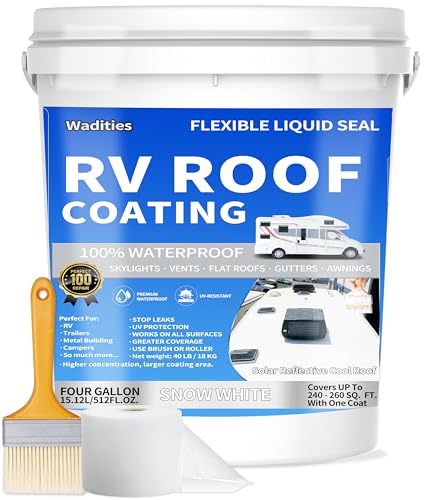
The 4-gallon acrylic bucket with a brush and 20 meters of polyester fabric included.
Billed as a full-coat solution for a complete RV roof, the Wadities 4-gallon acrylic coating states that a single 1-gallon pail coats RVs up to 30 feet, so a 4-gallon container extends well past that. Coverage is stated as 1 gallon per 50 square feet per coat with 2-3 heavy coats recommended. The final membrane offers 1000% flexibility — a manufacturer-stated figure reflecting the acrylic’s crack resistance under thermal movement — and is UV stable against sun degradation. It comes with a brush and 20 meters of polyester fabric inside the bucket, so the reinforcement material is there without a separate purchase.
The formula is built with a higher concentration of solid materials than thinner alternatives, which is what provides better roof repair results. It can be applied by brush, roller, or high-quality paint sprayer and works on fiberglass, aluminum, TPO, and wood. The manufacturer states it is safe for humans and pets and can be used indoors and outdoors. The bucket is resealable, which means leftover material can be saved for touch-ups instead of drying out. At 40 pounds, it is lighter than the two 4.75-gallon silicon buckets but still substantial.
Application is where the mixed feedback concentrates — some find it goes on smoothly, others find it super sticky and harder to spread. Durability has both fans and skeptics, with peeling reported by some and a durable seal reported by others. The pattern suggests prep quality and coat thickness drive the difference. The recurring wish from owners is a sealable store — although the container is resealable, several mention they would like the unused portion to store better between coats.
Large Roof Coverage: a 4-gallon container with brush and fabric included means you can start coating a full-size trailer roof without an extra hardware store trip.
Application Challenges: sticky during application, and owner results vary with prep quality — take the time to clean fully before rolling.
Big RV Roofs: full-size RV owners who want a single large container with the reinforcement fabric and brush bundled in, cutting trips and separate orders.
Small Roofs: you want a lower-fuss application — the sticky consistency asks for extra patience and careful roll-out.
7. Everbond RV Roof Waterproof Sealant 4.75 Gallon
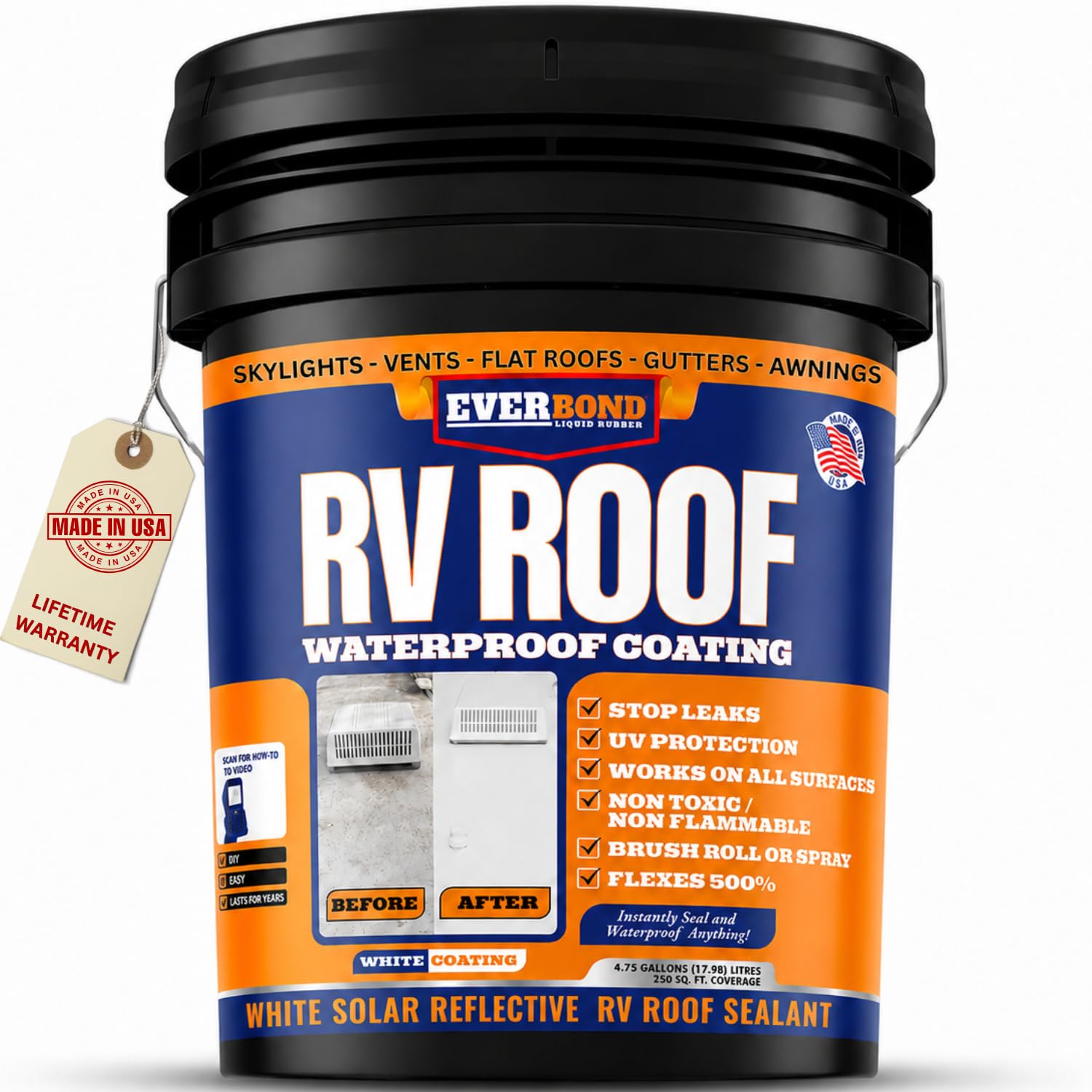
The 4.75-gallon bucket that covers a 30-foot RV in a single day’s work.
Everbond’s pitch is simple: one 4.75-gallon pail covers a 30-foot RV. That coverage rate is 1 gallon per 50 square feet, and the manufacturer states the whole job can be done in one day with a first coat, a four-hour wait, and a second coat — full cure in 48 hours at temperatures between 40°F and 90°F. The waterproof membrane is a rubber-based elastomeric (a stretchy, rubber-like material) formula designed to stay flexible across all temperatures. It is solvent-free with ultra-low VOC (volatile organic compounds — the fumes that off-gas from some coatings) and positioned as safe around humans and pets indoors and outdoors. It is manufactured in the United States and covered by a Limited Lifetime Warranty against product failure.
The feedback on this one points to genuine staying power. Buyers report long-running results — one describes coating a 50-foot toy hauler with two coats at about 8 mils thick (a mil is one-thousandth of an inch) and using only half the bucket, going on to report years without leaks, longer when docked than when travelling. Another used it on a used RV with a badly deteriorated roof and found the dry time quick with nice thick coats. The formula fills pinhole punctures when cured and remains rubbery rather than brittle. On a 29-foot TPO roof (a common single-ply RV roof membrane), a buyer reported it still bonded well and still looked great 1.5 years on, with no blistering or peeling.
The trade-off is consistency. Drying time and viscosity draw honest mixed feedback — some find it dries slower than expected, and some find it thinner than they expected. The manufacturer’s own instructions call for thin layers and warn that runs are hard to remove once dry, so careful roll-out is the discipline. Buyers who prepped thoroughly and applied in thin passes had the strongest results; those who applied too heavily ran into tackiness.
Leak Repairs: you have a 30-foot RV, want to cover the whole roof in one bucket, and value a limited lifetime warranty against product failure.
Full Coatings: you prefer a thicker, less runny coating straight out of the bucket — this formula rewards patience with thin layers.
Know the Specs
Coverage Rate (Gallons Per Square Foot)
Coverage rate tells you how far one gallon of coating spreads at the manufacturer’s recommended thickness. The rate is the single most useful number for planning how much to buy. A coating rated at 1 gallon per 125 square feet per coat spreads much further than one rated at 1 gallon per 50 square feet per coat, so the same 30-foot roof may need fewer gallons of the higher-coverage product. Always check the recommended number of coats written on the label — most RV rubber roof coatings here call for two to three coats, and the coverage rate is stated per coat, not per roof.
Material Base (Silicone, Acrylic, or Rubber)
The base material determines what your roof accepts and how long the coating lasts. Silicone coatings bond to a wider variety of roof types including metal, EPDM rubber, fiberglass, and modified bitumen, and they resist ponding water without turning brittle. Acrylic coatings are typically made for EPDM and PVC and cure to a harder surface but expand and contract more readily with temperature. Rubber-based coatings are formulated to match EPDM rubber sheets for the closest chemical bond. Match the material base to your roof sheet before anything else, because the wrong base can mean peeling within a season.
Flexibility and Elongation
Flexibility is what allows the cured coating to move with the RV body instead of cracking at seams and vents. Elongation is written as a percentage and describes how far the final membrane can stretch before it tears. Higher elongation means more forgiveness when your RV roof expands in summer and contracts in winter. Even the most flexible coating will crack if the surface below is dirty, so pair any flexibility rating with thorough cleaning for best results.
UV Reflectivity and Heat Reduction
A white, solar-reflective roof coating bounces sunlight that would otherwise transfer through the roof into the RV interior. Higher reflectivity keeps the surface cooler and reduces heat buildup inside the camper during summer use. White is the standard color for this reason — all seven products here reflect heat, and the silicone versions with high white solids are reported to reduce surface temperature noticeably. Reflectivity matters most if you use your RV in hot, sunny climates or park it uncovered.
Common Questions
How many coats of RV rubber roof coating do I need?
How do I calculate how much coating to buy for my RV roof?
Will silicone roof coating bond to my EPDM rubber roof?
How do I prep my RV rubber roof before coating it?
How long does RV rubber roof coating take to cure?
Can I apply RV roof coating over a roof that already has coating on it?
Is a silicone coating better than an acrylic coating for an RV roof?
Do I need a primer under RV rubber roof coating?
Will a white roof coating really make the inside of my RV cooler?
How long does an RV rubber roof coating last before I need to recoat?
The Bottom Line
For most RV owners dealing with a rubber roof that needs protection or repair, the rv rubber roof coating winner is the Countryman 100% Silicone Roof Coating, because it bonds to almost any roof material without primer and reflects heat back off the interior. If you want the strongest field-proven record specifically on EPDM rubber roofs, grab the HENG’S Industries Rubber Roof Coating. And for a full-size rig where you want coverage in one day, the Everbond RV Roof Waterproof Sealant is the one to reach for. When you are ready to order, buy according to your roof’s square footage and the coat count on the label — one extra gallon now beats running short mid-roof later.
How we choose
We do not accept paid placement. Every pick is matched to a real buyer and a real use-case; we do not hands-on test units.
Sources
Specifications: manufacturer listings and product documentation. Review insights: verified customer reviews, as of October 2026. Pricing: not shown on this page (it changes often); check the current price via the retailer link.
As an Amazon Associate, Aappliancez earns from qualifying purchases. This does not affect which products we feature.