Disclosure: Some links in this post are affiliate links. As an Amazon Associate I earn from qualifying purchases, at no extra cost to you. Learn more
Specs are compiled from manufacturer listings and verified buyer reviews and can change over time — please confirm the key details on the product page before buying.
Here is the short answer. If you want one fridge that handles a hot van, a freezer zone for meat, and an app on your phone, get the BODEGACOOLER 79QT. If you are replacing a failing propane box inside a travel trailer and want a full-size kitchen feel, the RecPro 10 Cu Ft is the box owners keep recommending. Everything else on this list earns its place on a narrower reason, and each pick below spells out exactly who it fits.
This guide is built by comparing the manufacturers’ published specifications and the patterns across verified customer reviews, so you get each pick’s real strengths and trade-offs instead of marketing spin.
An RV fridge is a different animal from the one in your kitchen, because it has to survive vibration, tight cabinets, and power that comes and goes. The picks below cover every format, and this breakdown of the rv fridge market separates compressor units from absorption units so you buy the right one once.
Top Picks


How To Choose The Best RV Fridge
The first fork in the road is not brand and it is not size. It is cooling method. A compressor fridge works like the one in your house, using a sealed compressor to pump refrigerant around. An absorption fridge, the kind that runs on propane, uses heat and a chemical cycle with no moving parts at all. Each wins in a different campsite, and picking the wrong one is the mistake that sends people back to the listing page.
Compressor Power Versus Propane Silence
A compressor unit needs steady electricity, usually 12V from your house battery. In exchange it chills fast and holds a set temperature no matter how hot the outside air gets. An absorption unit burns propane, draws almost no battery, and runs with no sound at all. The trade is slower cooling and a unit that needs a level surface and good airflow to work right. If you move campsites every day and have solar or a big battery bank, compressor wins. If you park for weeks with no sun and a propane bottle, absorption wins.
Quarts And Cubic Feet Mean Different Things
Portable units are measured in quarts, while built-in boxes are measured in cubic feet. Those numbers do not convert cleanly in your head, so skip the math and read the real payload. The BODEGACOOLER 79QT listing spells out that its 75 liters holds 114 cans of cola, 82 water bottles, or 45 bottles of red wine. That is the number that tells you whether it fits a week of groceries or just the drinks.
Watch The 12V Amps Before You Buy
A built-in 12V fridge can quietly drain a small battery bank overnight if you have not planned for it. The RecPro 10 Cu Ft draws a modest load on a single 100AH battery according to owner reports, while the Norcold N10DCSSR pulls just under 5A at 12V. Neither number is scary on its own, but both tell you to check your battery capacity and your solar input before you commit. Voltage protection settings, usually low, medium, and high, are your safety net so the fridge shuts off before it strands your engine battery.
Side-by-Side Comparison
| Model | Best For | Capacity | Power Source | Cooling Method | Amazon |
|---|---|---|---|---|---|
| BODEGACOOLER 79QT★ Best Overall | Hot-van dual-zone chilling | 75 liters (79 qt) | 12/24V DC & 110-240V AC | Compressor | Amazon |
| Upstreman 11.6 Cu.Ft.Premium Pick | Full-size cabin or camper swap | 11.6 cubic feet | 110V AC | Compressor | Amazon |
| Frigidaire Upright FreezerCompact Pick | Tight-corner frozen backup | 1.05 cubic feet | 110V AC | Compressor | Amazon |
| ICECO GO20 | Truck cab and road trips | 21 quarts | 12/24V DC & 100-240V AC | Compressor | Amazon |
| Hamilton Beach 6.8 Cu Ft | Convertible fridge-or-freezer | 6.8 cubic feet | 110V AC | Compressor | Amazon |
| Smad 2.1 Cu.Ft. Propane | Silent off-grid camping | 2.12 cubic feet | 12V, 110V, or LPG | Absorption | Amazon |
| BLACK+DECKER 12.1 Cu. Ft. | Apartment-style kitchen fridge | 12.1 cubic feet | 110V AC | Compressor | Amazon |
| BLACK+DECKER 10 Cu. Ft. Chest | Bulk frozen storage | 10 cubic feet | 110V AC | Compressor | Amazon |
| RecPro 10 Cu Ft 12V | Full-time RV replacement | 10 cubic feet | 12V DC | Compressor | Amazon |
| Norcold N10DCSSR | Built-in look and travel latch | 10 cubic feet | 12V DC | Compressor | Amazon |
| SMETA 9.4 Cu.Ft. Propane | Long off-grid propane stays | 9.4 cubic feet (9.5 total) | 110V AC or LPG | Absorption | Amazon |
Detailed Reviews
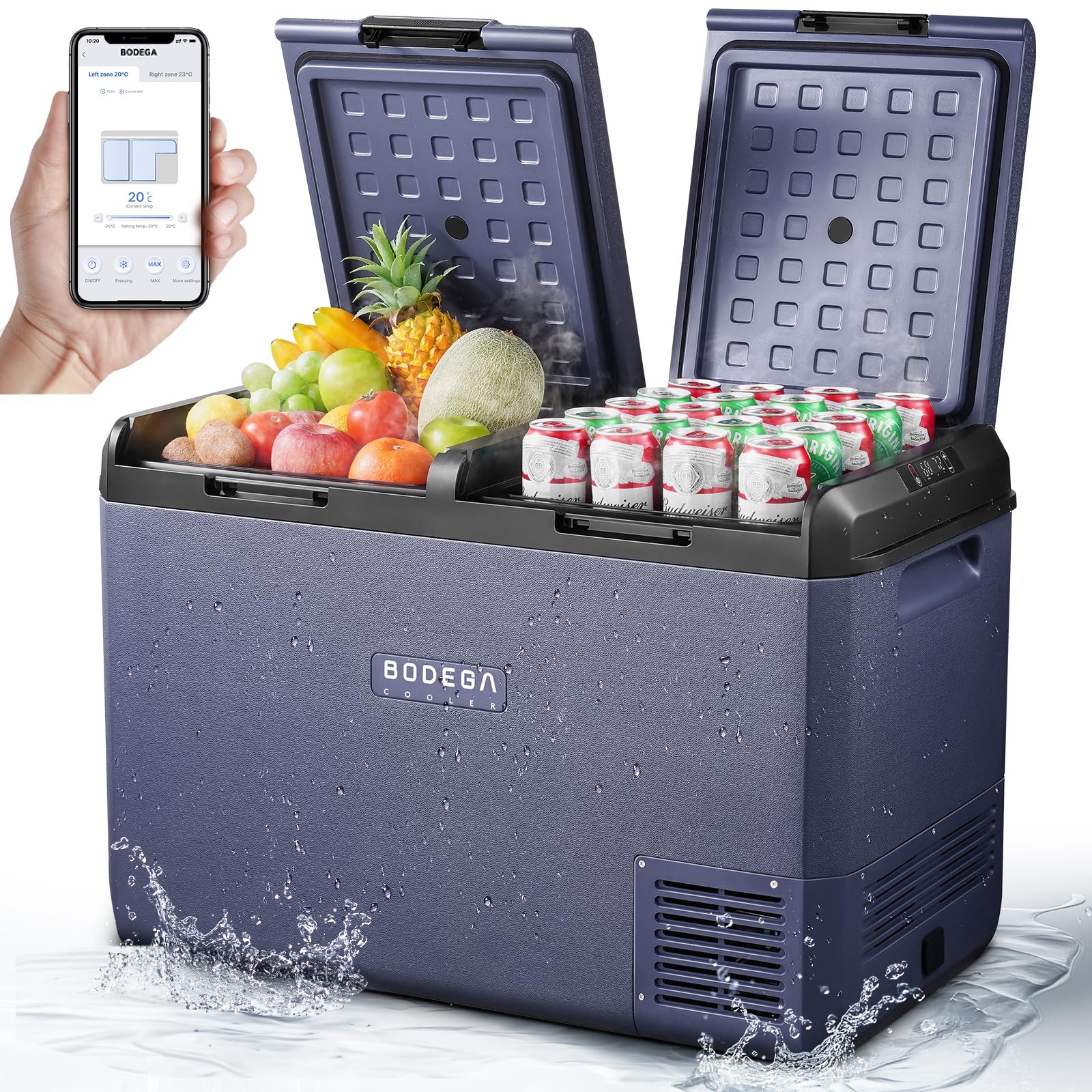
1. BODEGACOOLER 79QT Dual Zone 12 Volt Car Refrigerator
Our pick — 4.5+★ from 450+ verified ratings; the strongest balance of quality and price.
The dual-zone unit that held 0°F and 40°F through a New Orleans summer in an uninsulated van.
Split-temperature storage is the whole reason this one takes the top slot. The 75-liter body is divided into a 43-liter left zone and a 32-liter right zone, and each side has its own thermostat, so you can run one half as a fridge and the other as a freezer at the same time. The payload is what sells it: the same space holds 114 cans of cola, 82 water bottles, or 45 bottles of red wine. Set either zone anywhere from -4℉ to 68℉ and it stays there.
One buyer ran it in an uninsulated van through a New Orleans summer, interior at 104℉, and reported both compartments held their targets with the zones set at 0℉ and 40℉. That is the whole point of a compressor cooler over an ice chest: no ice to buy, no waterlogged food, no daily drain-and-refill routine. It pulls 40-50W at max and steps down in Eco mode, where the maker says you get 40% longer runtime, which makes it a realistic fit for a solar setup or a portable power station.
Control is either physical buttons or the app on Android and iOS, so you can nudge the temp from the driver’s seat without opening the lid. The compressor is quiet enough that owners compare it to a soft hum rather than a motor, and the anti-shake design keeps it running when the vehicle leans into a climb. Two detachable, reversible doors and a built-in LED light make night-time digging easy, and the bottom drain hole simplifies cleaning. IPX4 protection, which means it shrugs off rain and splashes, covers lakeside humidity and beach sand.
Where it wins
- Two independently controlled zones: 43L plus 32L for 75L total, so frozen and fresh travel side by side.
- Pulls a modest 40-50W at max according to owner reports, which a portable power station can carry.
- Reaches -4℉ on the max setting, so it functions as a true freezer, not a glorified cooler.
- Lives in the trunk, the van, or the kitchen, because it accepts both 12/24V DC and 110-240V AC.
Where it asks more of you
- The molded side handles are awkward for a two-person lift, and there are no wheels or pull handle.
- The supplied power cord is not rated for outdoor use, so route it carefully at a wet campsite.
Buy this if: you want one box that can freeze a steak in one half and keep the drinks crisp in the other, all from a 12V socket or a wall plug.
Think twice if: you are loading and unloading solo every night and want wheels under the fridge instead of your arms.
2. Upstreman 11.6 Cu.Ft. Double Door Refrigerator
A full-size top-freezer that some owners dropped into a camper and never looked back.
This is the pick for anyone who wants kitchen-grade storage rather than a portable cooler. The 11.6 cu. ft. body splits into 8.4 cu. ft. of fresh food space and a deeper 3.2 cu. ft. freezer up top. Four removable shelves and a crisper drawer handle the organization, and the stainless steel door finish is what gets it past the visual test in a finished interior.
The number that makes this a real camper candidate is the auto-defrost. An air-cooled cycle moves cold air through the freezer so frost never builds up, which means no chipping out an ice wall by hand every month. The maker lists an average of roughly fifteen cents a day in electricity, and it carries ENERGY STAR certification. Frozen zone runs from 7.16℉ down to -7.24℉, while the fridge zone ranges from 32.5℉ to 46.4℉ with three manual temperature settings. At that size it is a proper swap for a large absorption unit in a motorhome, where owners note that the smaller gross size still performs better than the box it replaced.
Going by the review pattern, what wins people over is 8.4 cu. ft. of fresh food plus a 3.2 cu. ft. freezer at this noise level. The recurring comparisons put this one at or below the noise of far more expensive appliances, and the door swing reverses easily so it can open the right way for your cabinet run. The honest catch is a missing freezer light, a small gap buyers fill with a rechargeable motion strip. An occasional unit shows up with a weak magnet door seal, so give the door a firm push the first week.
The size story: 8.4 cu. ft. of fresh food next to 3.2 cu. ft. of freezer is more cold storage than most camper builds start with, and it is frost free.
The trade-off: it runs on wall power, not 12V, so it belongs in a rig with an inverter or a shore-power hookup, not a pure boondock setup.
Reach for this if: you have a shore-power rig or inverter and want a real kitchen fridge that will not demand manual defrost work.
Look elsewhere if: you need a freestanding 12V box with no inverter in the chain.
3. Frigidaire 1.05 Cu Ft Upright Freezer
A slim upright for the corner of a trailer that freezes solid but asks for careful handling.
If your goal is a dedicated frozen backup rather than a fridge, this is the smallest footprint that still makes sense. The flush back and recessed handle let it slide into a tight corner or a small trailer cabinet, and the listing names RVs and dorm rooms as intended homes. Six interior wire shelves keep items sorted so you can find the pack buried at the back. The door reverses so it opens whichever way your space demands, and the vinyl-coated metal finish wipes clean easily.
The trade you make for the compact size is manual defrost. There is no auto cycle here, so ice will build over time and you will chip it out periodically. The seal appears on the tight side in owner experience, since one reviewer noted the manual defrost interval rarely came up more than twice a year. The other thing to know is that the cooling coils are built into the sides, which means the sides run warm and you need a little air gap around the unit. The shelf spacing is fixed by those coils, so a whole turkey or a tall jug will not drop in.
On the reliability side the picture is genuinely mixed. Some units run quiet for months and cut the power bill without a bump, while a few owners saw a unit quit early. The recurring pattern is a gasket that does not seat right from the factory, which shows up as ice on top of the cabinet. The fix is a two-minute job: run a paper strip around the door, find where it slides too freely, soften the gasket with a warm hairdryer, and reseat it. Do that check on day one and the defrost schedule becomes far less painful.
The upside first: 1.05 cu. ft. of frozen storage with a reversible door and six wire shelves is far more usable than the cube suggests in a tight trailer corner.
The honest caveat: manual defrost and side-mounted coils mean you must leave breathing room and accept that a tall or wide item simply will not fit.
It earns its corner space if: you want a dedicated little freezer for backup meat and ice without pulling a full-size box into a small rig.
Skip this one if: you refuse to defrost by hand or need to store whole birds and roasts.
4. ICECO GO20 Dual Zone 12V Portable Fridge Freezer
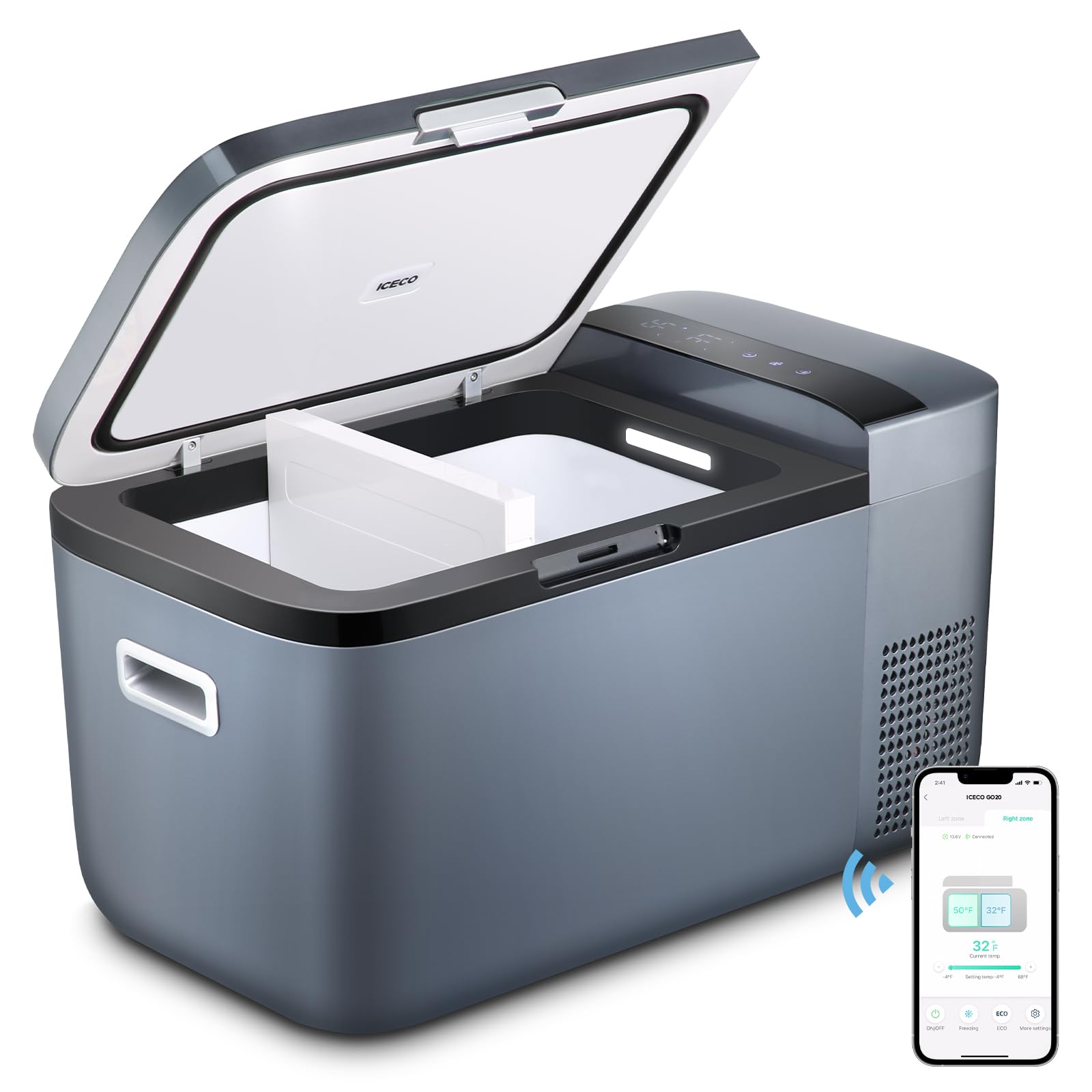
Twenty-one quarts that hit 0°F in about 45 minutes and slide under a truck bunk.
The GO20 is the smaller, scrappier cousin of the BODEGACOOLER above. Its 21-quart body is compact enough for a truck cab or an SUV cargo bay, and the SECOP compressor drives temperatures from 0℉ to 50℉ with a fast-cool mode. The anti-bump compressor is designed to keep running even on a 40-degree slope, which is the reason this one lives in a big rig rather than only in a campsite. Dual zones can be merged into one by pulling the divider, or split into separate fridge and freezer sections with two independent digital controllers.
What gets owners talking is the speed. Buyers report the freezer zone is at 0℉ and the fridge zone at 36℉ within roughly fifteen minutes to the cool-down mark, and the app on iOS works without pairing. The power draw is gentle: one report notes a 2000Wh battery bank running it four to five days, drawing 30-40W. The 2.5m cigarette lighter cord doubles up with a wall adapter so it moves between home and cab. Value for money lands somewhere between love and grumble, since a 5-year compressor warranty backs it up.
Two quirks are worth knowing up front. The adapter’s spring can nudge the plug out of the socket, which is the reason several reviews drop to a second star, and a few owners fix it with tape. The other is that the shiny shell scratches without a protective bag. Owners also report the temperature reading can wander up to 10℉ before the compressor kicks back in, though the compressor restarts within about fifteen seconds, so the actual food temp stays close. One owner’s solenoids failed just past year one, and customer service came back with an out-of-warranty replacement.
What earns the space in a cab
- The anti-bump SECOP compressor keeps it running on a 40-degree incline, so a mountain pass does not shut it off.
- Reaches 0℉ in about 45 minutes, so a frozen load is ready before the first rest stop.
- 21 quarts, sized to fit two cans in the short dimension per owner reports, which suits a truck bunk shelf.
What you live with
- The cigarette plug can work loose from the adapter spring, so bring a strip of tape.
- The glossy shell scuffs without a bag, and the temperature reading drifts before the compressor restarts.
Pick it for: the truck cab, the SUV cargo bay, and the road trip where fast chill and a 5-year compressor warranty matter more than bulk capacity.
Not for: a family of four hauling a week of groceries, where 21 quarts will run out fast.
5. Hamilton Beach 6.8 Cu Ft Convertible Fridge/Freezer

Flip one switch and 6.8 cubic feet becomes a fridge or a freezer, whichever you need this trip.
The convertible switch is the whole pitch. With a single click the interior moves between freezer mode and refrigerator mode, so an extra frozen backup in the off-season can become the drinks cooler for a holiday weekend. At 6.8 cu. ft. with a 6.5 cu. ft. freezer capacity, it holds more backup meat than any of the portable boxes on this list. The recessed handle and flat back let it slide against a wall, and a bottom slide-out transparent bin keeps small items from getting lost.
The build is a compressor unit with a matte white finish and leveling legs, which is what you want in a corner that is not perfectly flat. Running costs are reasonable for the size, since the listing notes about 300 kilowatt hours a year. The space saving story works for RVs and dorms: the same footprint fits a tight corner, and the reversible hinge handles a left- or right-handed opening. Buyers who got a clean unit talk up how perfectly it fits their intended nook, and the reversible door is the fix when your wall decides which way it must swing.
This is the pick on the list where the honest caveat matters most, and it is a delivery problem, not a design one. Multiple units arrived dented, and the most common version of that damage is a bent lower hinge pin that drops the door. That is a shipping issue rather than a flaw in the cooling, and the units that arrive intact chug along without complaint. One buyer did note the left side can run warm. The interior light is absent, which one owner missed. Buy the listing with care, inspect the corners the moment it lands, and request a replacement before you install anything.
The draw: one box, two modes, and a reversible hinge means it adapts to whatever you need this season rather than locking you into one role.
The caution: packaging has not protected every unit, so open the carton slowly and photograph the corners before assembly.
This suits you: if you want a convertible upright that can be a holiday freezer and a drinks fridge the rest of the year in a tight corner.
Not the pick if: you want a self-defrosting unit exactly as advertised and nothing less — check the actual defrost spec against the listing before you buy.
6. Smad 2.1 Cu.Ft. Propane Refrigerator, 3-Way AC/DC/LPG
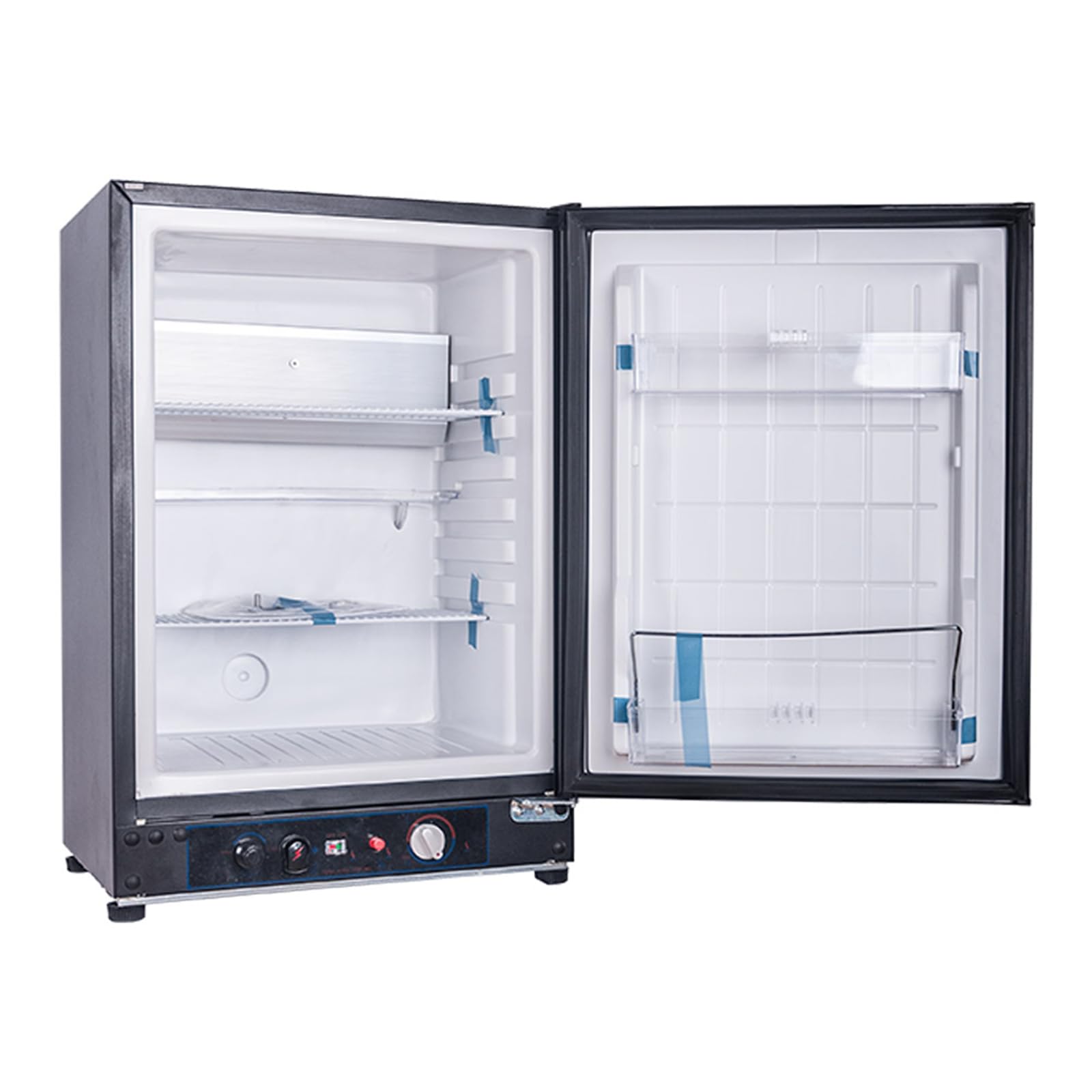
Zero decibels of compressor noise, because there is no compressor at all.
Here is where absorption cooling earns its keep. This 2.12 cu. ft. box runs on 12V, 110V, or LPG propane, and the LPG side uses an absorption cycle with no moving parts. That is why the listing can honestly say it runs at 0 dB, a true silence a compressor fridge can never match. Set the temp from 32℉ to 50℉ using the gas or electric controls independently, and the LPG pressure it needs is 2.8Kpa (28mbar). For a light sleeper, a bedroom setup, or a camper with a baby aboard, that quiet is the whole reason to buy it.
Cooling is slower than a compressor, and that is normal for this design. Owners mention it reaches temperature in two to three hours, and on the coldest setting it will freeze drinks after about two days. The 2.12 cu. ft. body is freezerless, but it is a compact 18.1 x 18.9 x 26.6 inches, so it slots into a tight camper or truck trailer. Adjustable feet keep it level for better performance, and the removable shelves make organizing a weekend of food easy. There is a single honest gotcha: on 12V, it needs careful power planning, since one Sprinter owner lost food after an undersized battery drained overnight.
The absorption design also means it does not knock out the ignition from an external source, since the battery ignition is built in. The one design quirk several buyers flag is the lack of a switchover dial to move between electric and propane, which matters on a converted cargo trailer. The build quality draws mixed reviews, with a few units failing early but customer service stepping up with a replacement offer. Treat the first delivery as a test week, watch the temperature, and keep the manual handy for the pressure regulator setup.
Why it earns silent status
- 0 dB operation thanks to the absorption cycle, which is the quietest a fridge can physically get.
- Three power paths: 12V DC, 110V AC, and LPG propane, so it works in a camper or a cabin.
- The 2.12 cu. ft. body fits a tight corner at 18.1 x 18.9 x 26.6 inches.
The limitations to plan around
- No internal switchover dial to move between electric and propane, so you do it physically.
- On 12V it demands careful battery planning, and an undersized bank can drain overnight.
Worth it for: the off-grid camper, the quiet cabin, or the bedroom setup where a compressor hum would keep someone awake.
Best to skip: if you need fast chilling and cannot tolerate a two-to-three-hour cool-down, since propane absorption is a slow-cold design.
7. BLACK+DECKER 12.1 Cu. Ft. Top Mount Refrigerator, BR1210HS
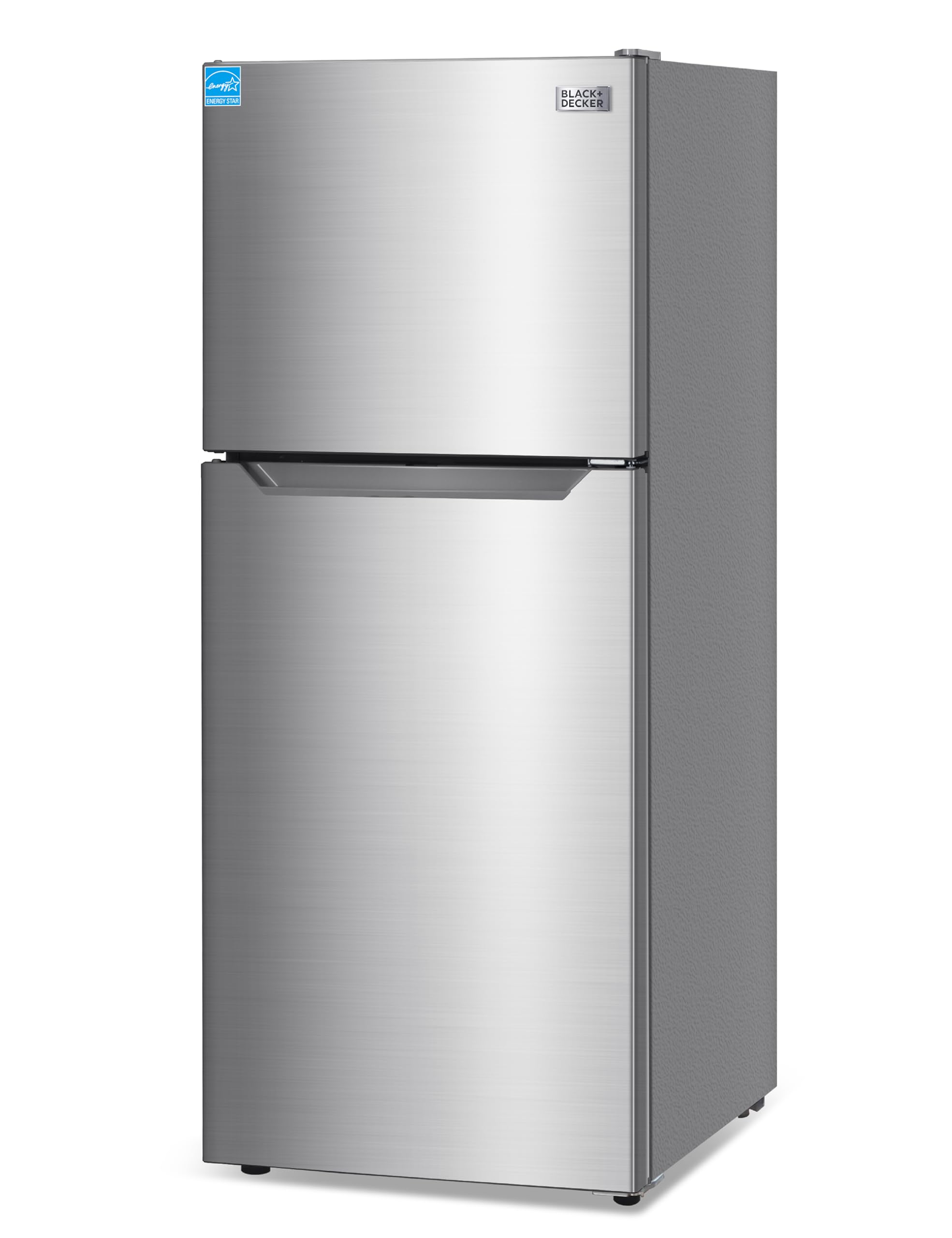
Twelve cubic feet of full-size kitchen storage that has its own Sabbath mode built in.
The 12.1 cu. ft. body pairs a deep top freezer with a full fresh-food section, sized for a small home or apartment rather than a van shelf. Auto-defrost keeps frost from collecting, so there is no ice wall to chip out. Adjustable temperature control lets you dial in the fridge and the freezer separately, and the wire freezer shelf is removable for larger items. The stainless-look finish is a nice touch on a budget-priced box, and it carries ENERGY STAR certification, so running cost stays reasonable.
What sets this apart is the Sabbath mode, which pauses displays and sounds so the appliance complies with religious law on the Sabbath and Jewish holidays. That is a feature almost no fridge in this size offers. Owners who find the right fit love how roomy it feels inside for a 12.1 cu. ft. cabinet, and the reversible door handles a kitchen that wants the swing one way. The nearest small apartment tenant is exactly the buyer this box suits: two people, a compact kitchen, and a freezer for backup meals. It is not built for a 6-foot-tall cook without a stand, since customers note a slight bend to reach the lower drawer.
The place to look hard is door seal and reliability. One owner found the magnetic seal too weak and needed a firm push to close. Another saw the door swing open on its own and added a child lock. And a few units quit within the first week. Against that, owners who got a good unit describe it as cold and spacious. This is a box to buy with a solid returns plan and to check thoroughly the first weekend.
What stands out: 12.1 cu. ft. of storage, ENERGY STAR certification, and a Sabbath mode almost none of its peers include.
The fair warning: the door seal can be weak, so budget for a child latch and a close-and-check habit.
Fits your kitchen if: you need a full-size box for a small household and the Sabbath mode is a must-have rather than a nice extra.
Keep looking if: you are taller than average without a stand, since the lower shelves sit low and there is no self-closing latch.
8. BLACK+DECKER 10 Cu. Ft. Chest Freezer, BCF1000E
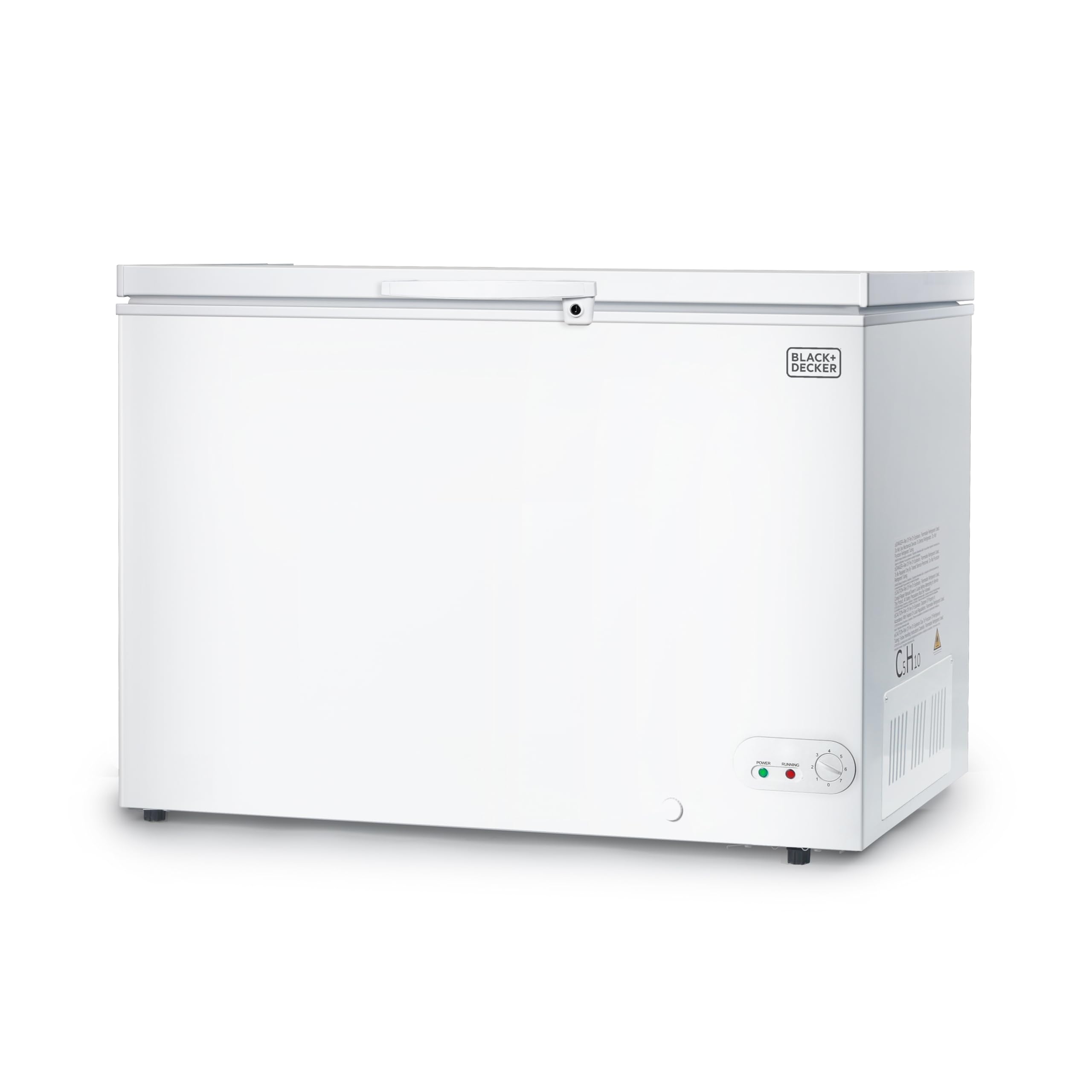
Ten cubic feet of chest freezer that apartment dwellers keep stuffing to the brim.
A chest freezer is a different tool from an upright. Cold air sits in the well, so it holds temperature through a power blink and you lose less cold every time you open the top. The 10 cu. ft. body here swallows a full haul of frozen meat, dinners, and ice cream. A removable storage basket lifts out for the small stuff, so you are not digging through the whole hoard to find one bag of peas. The mechanical dial and indicator lights live on the outside, so you can adjust without lifting the lid.
The 10 cu. ft. body is why this one sells. Apartment owners and RV off-season storage both treat it as the backup box, since the footprint fits a small kitchen or a basement corner. The manual defrost drain makes emptying meltwater a simple job rather than a bucket-and-towel routine. Reviewers point out it runs quietly and freezes fast, and it settles into a corner without drama. The single most useful prep step is a full three days unplugged before first start, so the oil and refrigerant can resettle after shipping.
The honest notes are the usual for a chest freezer. It is heavy enough at 99.2 pounds that two people should move it, and the manual defrost means you will empty it once in a while. Durability draws some grumbles, but the overall picture is a solid, quiet box that holds temperature well. Give it a flat surface and a dedicated outlet and it does its job.
Why apartment owners keep it
- 10 cu. ft. of chest storage holds a serious haul of frozen food without hogging a whole wall.
- The top-opening design loses less cold air every time you lift the lid.
- Manual defrost comes with an easy-access drain so emptying is quick.
What to expect
- At 99.2 pounds it is a two-person lift, so plan how it reaches its corner.
- Manual defrost means a periodic empty-and-scrape, and odd-shaped bags eat the usable space fast.
Go for it when: you want a dedicated frozen box for bulk meat, meal prep, or off-season RV stock without the footprint of an upright.
Reconsider if: you want frost-free autopilot or you plan to move it solo every season.
9. RecPro 10 Cu Ft 12V RV Refrigerator, Frost-Free

The 10-cubic-foot 12V box that slides into the hole the old propane unit leaves behind.
For a full-time RVer replacing the original absorption box, this is the swap that makes the most financial sense. The 10 cu. ft. interior gives you more usable space than the propane unit it typically replaces, and it runs on 12V DC so it works from a modest battery bank. The door side reverses, so the hinge fits your layout. It is frost-free, which means no chipping ice out of the freezer on a rest day. The stainless steel front and one door shelf finish off the built-in look without a cabinet rebuild.
The install pattern is well documented in owner experience. The most common report is that it drops into the old absorption cavity with only minor trim work, wired to a fused 12V panel. Owners describe it as gentle on a single 100AH battery, and the adjustment is that you lose the propane bottle dependency entirely. The power draw is the main factor in whether this is right for your rig, so check your amp-hour budget before ordering. Owners who made the switch talk about far more space than the old fridge offered and no more refilling the propane bottle every few weeks.
The catch is the freezer side. The review pattern shows the freezer can ice up repeatedly on some units, and a handful of owners chase excessive frost. A few units also fail early, and the cooling performance draws mixed feedback by star score. That is the fit note, not a blanket verdict. The box that lands right keeps the food cold the whole season. Plan your install with a spare 12V run if possible, and check the freezer door seal on day one.
The upgrade logic: 10 cu. ft. of frost-free space on 12V replaces a typical RV absorption box and ends the propane refill cycle.
The variable: the freezer can build ice on some units, so a careful day-one seal check matters more than the sticker.
This is the one if: you are replacing a failing propane fridge in a full-time RV and want more interior room without a cabinet rebuild.
Give it a pass if: you do not have the battery capacity or the wiring to feed a 12V compressor full-time.
10. Norcold N10DCSSR Polar-Series RV Refrigerator
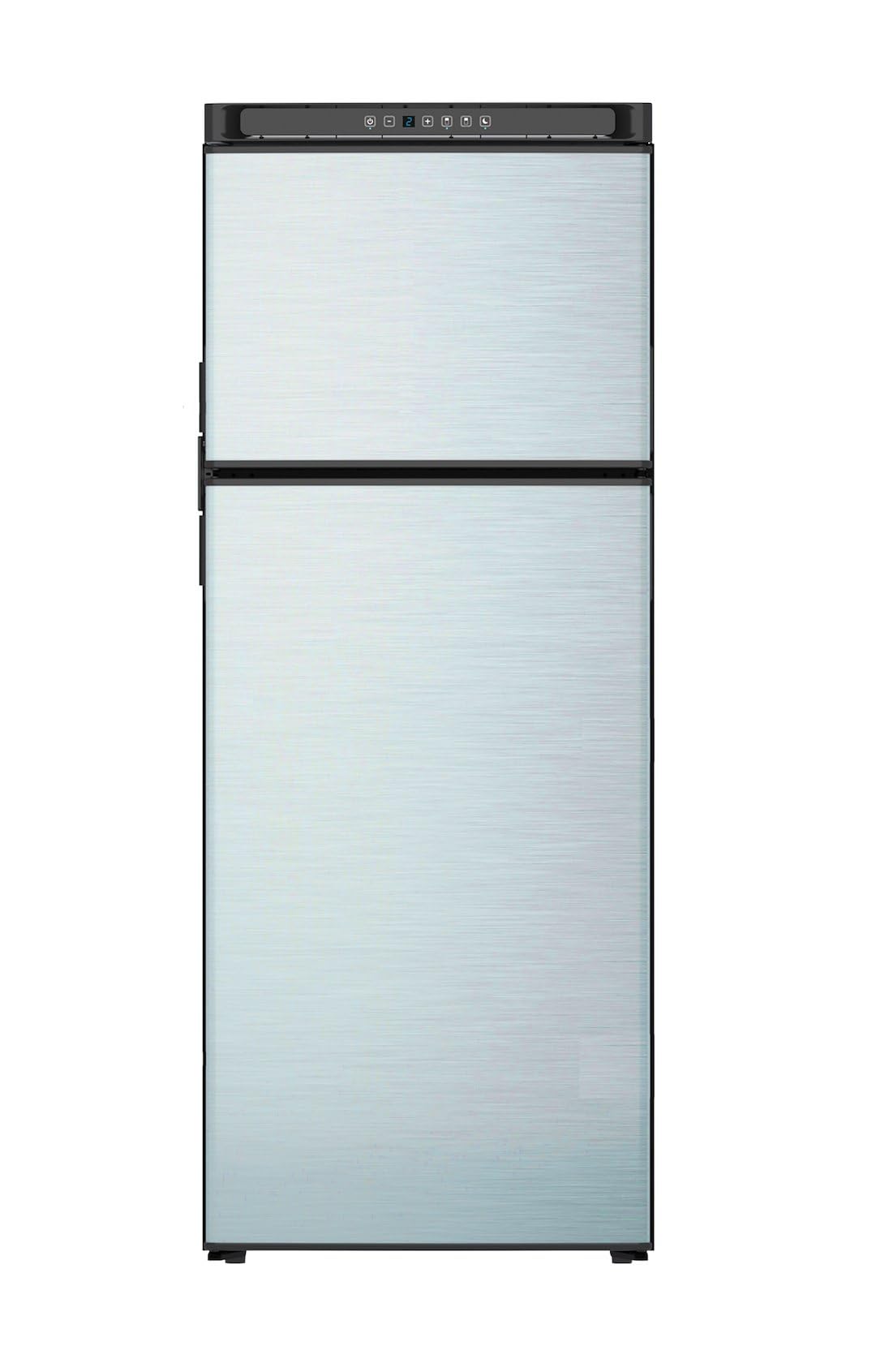
The 10-cubic-foot 12V unit built specifically for an RV cavity, right down to the travel latch.
This one is engineered as an RV drop-in rather than a converted household fridge. The mounting holes match RV-standard spacing, so it installs without a bracket jig. The reversible stainless doors have curved edges that make it look factory-fitted rather than bolted in. The travel latch is the star: it keeps the doors shut on a rough road where an unlatched fridge would swing open and dump the contents across the aisle. The LCD control panel sits at eye level with touch control, so you can adjust the temp without squatting.
Owner reports of 32℉ to 37℉ on the fridge side and 0℉ in the freezer, on 200W of solar and a 400Ah LiFePO4 bank, are why this earns its slot. Owners who swapped out propane describe the fridge side running 32℉ to 37℉ and the freezer down to 0℉ while sitting on 200W of solar and a 400Ah LiFePO4 bank. Another long-haul report held 37-39℉ on a full trip, and systems run under 5A at 12V normally. The newer absorption-free builds have owners praising the reliability after two years of use. It runs a night mode so the fan noise steps down after dark, and the retractable shelf plus sunken freezer make the interior layout smarter than the box shape suggests.
Two things to plan for. The unit is pricey, and when a compressor fails the warranty path can test your patience if the support line is slow. One owner reported an E3 low-voltage error on first use from a replacement unit. The installation also wants heavier 12V wiring than a propane swap and a sealed exterior vent, which a knowledgeable installer handles in about a day. If you have a good RV tech and a healthy battery bank, this is a solid long-term fit. If you install it yourself and run into trouble, the fix can be slow to arrive.
The standout: a travel latch, RV-standard mounting holes, and a true 12V compressor make it a proper drop-in rather than an adapter project.
The honest trade-off: when a unit fails, the support and warranty path can drag, so buy with an installer you trust behind you.
Choose it when: you want a factory-fit 12V compressor fridge with a travel latch that keeps the door shut on mountain roads.
Hold off if: you are a do-it-yourself installer with no tech support on call, since a fault can mean a slow wait.
11. SMETA 9.4 Cu.Ft. Propane Refrigerator, 2-Way 110V/LPG

Almost ten cubic feet of full-size storage that runs on a propane bottle, not a power grid.
This is the big propane box, sized like a full kitchenfridge while still running on an absorption cycle with no compressor. The 9.4 cu. ft. body splits into a 7.3 cu. ft. fresh-food section and a 2.1 cu. ft. freezer, so it handles a week of groceries rather than just drinks. Four adjustable shelves, a vegetable crisper, and five door shelves that hold two-liter bottles keep a real kitchen organized. The handles are recessed so it looks clean in a camper hotel or a cabin, and adjustable feet keep it level for faster cooling.
Two numbers define what you live with day to day. The first is the gas burn: the maker lists about 1.6 lb of propane per day, which is what a long off-grid stay actually costs you. The second is clearance, with 4 inches needed on top and 1 inch on the back and sides so the absorption cycle can shed heat. Owners who set it up right talk about six months of flawless operation, heavy and well built, quiet, with the propane use matching the spec rather than running hot. The absorption design means no compressor, no fan, and no Freon, so it runs with no noise and no vibration at all.
Owners who got a clean unit describe flawless operation, and the ones who did not point at shipping damage and doors that needed adjusting. One report mentions dents on arrival and a door gap that let cold air leak, even after the hinges were adjusted. This is the sort of unit you order with a delivery inspection plan. Give it three days to settle on a level floor and check the door seal before you put food in. The clearance requirement also means you cannot bury it in a cabinet, so measure your alcove before ordering.
Why an off-grid buyer picks it
- 9.4 cu. ft. total splits into 7.3 cu. ft. fresh plus a 2.1 cu. ft. freezer, so it holds a real grocery run.
- Runs on 110V or LPG propane with no compressor and no fan, so it works with no power grid at all.
- Five door shelves hold two-liter bottles, with a vegetable crisper and four adjustable shelves inside.
What the setup demands
- Needs 4 inches of top clearance and 1 inch on the back and sides, so a tight alcove will not work.
- Shipping damage and misaligned doors show up on some units, so inspect on arrival before installing.
Worth it for: the off-grid cabin, the farm, or the long-stay camper where a propane bottle is easier to manage than a power bank.
Weigh the alternative if: you have plenty of solar and a big battery bank, since a 12V compressor will cool faster than absorption.
Know the Specs
Compressor vs Absorption Cooling
These are the two ways an RV fridge makes cold, and they behave nothing alike. A compressor unit uses a sealed pump to move refrigerant, so it chills fast and holds a precise temperature no matter how hot the outside air gets. An absorption unit uses heat, often from propane, plus a chemical cycle with no moving parts, which is why it runs at 0 dB with zero vibration. The trade is speed and precision: absorption is slower to cool and is fussier about being level and having airflow around it. Match the method to how you travel, not to the sticker.
Voltage Protection and Battery Draw
A built-in 12V compressor fridge can quietly drain a small battery bank overnight if you have not planned for it. That is where the H/M/L voltage protection settings come in, letting you set the low-voltage threshold where the fridge shuts off so it does not strand your engine battery. The number to check before you buy is the 12V amp draw, since the Norcold N10DCSSR pulls just under 5A and some portable units draw 30-40W. A 400Ah LiFePO4 bank comfortably runs the larger boxes, and a small single 100AH battery can just about carry a 10 cu. ft. unit.
Capacity in Quarts and Cubic Feet
Portable units are measured in quarts, while built-in boxes are measured in cubic feet, and the two scales do not convert in your head. Read the real payload instead. A 75-liter portable like the BODEGACOOLER’s 79QT holds 114 cans or 82 water bottles or 45 wine bottles, while a 10 cu. ft. built-in box holds a week of groceries for a small household. Decide from your actual trip food first, then look at the size label.
Dual Zone and Frost-Free Design
A dual-zone unit splits the interior into two independently controlled compartments, so one side goes freezer while the other stays fridge. That lets you keep steak frozen and drinks crisp in one box without a second appliance. Frost-free is a different feature, an auto-defrost cycle that moves cold air around the freezer so ice never builds up. Manual defrost fridges still work fine, but you will empty and chip the box periodically, so weigh that chore in your decision.
Common Questions
Will a 12V compressor fridge drain my RV house battery overnight?
Is a propane RV fridge better than a 12V compressor fridge?
How many cans will a 79-quart dual-zone RV fridge actually hold?
Can I use a portable 12V fridge in the house as well as the car?
Should I choose a frost-free unit or a manual defrost unit?
What clearance does a propane absorption fridge need?
Do I need a pure sine wave inverter for a portable fridge?
How long does it take an RV fridge to cool down from a warm start?
Can I swap a propane RV fridge for a 12V compressor unit without rewiring?
Does a chest freezer or an upright fridge work better for RV storage?
The Bottom Line
For most buyers replacing an RV fridge, the rv fridge winner is the BODEGACOOLER 79QT because it does the thing an RV fridge has to do in real heat: hold 0℉ in one zone and 40℉ in the other in a 104℉ van, from a 12V socket or a wall plug. If you want a full-size drop-in replacement for a failing propane unit, grab the RecPro 10 Cu Ft 12V. And for an off-grid cabin or a long propane stay, the SMETA 9.4 Cu.Ft. is the one to reach for.
Before you click: the top pick is rated 4.5+ stars across 400+ owners, the largest review base of any pick here. Pick the one that matches how you actually travel.
How we choose
We do not accept paid placement. Every pick is matched to a real buyer and a real use-case; we do not hands-on test units.
Sources
Specifications: manufacturer listings and product documentation. Review insights: verified customer reviews, as of October 2026. Pricing: not shown on this page (it changes often); check the current price via the retailer link.
As an Amazon Associate, Aappliancez earns from qualifying purchases. This does not affect which products we feature.