Disclosure: Some links in this post are affiliate links. As an Amazon Associate I earn from qualifying purchases, at no extra cost to you. Learn more
Specs are compiled from manufacturer listings and verified buyer reviews and can change over time — please confirm the key details on the product page before buying.
If you are staring at orange-brown crust on a trailer hitch, a boat engine, a carbon steel knife, or the metal frame around an oceanfront window, you do not need a stronger brush — you need the right chemistry. This guide covers five rust removers and rust preventers that work in completely different ways, from wax-based sprays that seal metal for months to gels that cling to vertical surfaces without dripping. Match the product to your surface and your patience level, and the rust stops coming back.
This guide is built by comparing the manufacturers’ published specifications and the patterns across verified customer reviews, so you get each pick’s real strengths and trade-offs instead of marketing spin.
Some of these products dissolve existing rust stains; others coat clean metal to stop rust before it starts — knowing which job you have is half the battle. Every pick below is sorted by what it does best, so you can settle on the right rust remover in one read instead of five returns.
Top Picks

How To Choose The Best Rust Remover
Rust removal products split into two families, and picking the wrong family is the single biggest mistake buyers make. One family dissolves existing rust stains and converts them into something you can rinse away. The other family coats clean or lightly rusted metal in a protective barrier that keeps moisture, salt, and oxygen from starting the rust cycle again. Before you buy anything, look at what you are actually dealing with — a brown stain on a surface, or bare metal that needs defending.
Remover or Preventer — Know Which Job You Have
A gel remover is the tool for a surface that is already stained: a concrete patio with an umbrella-stand ring, tile grout, stainless steel hardware, or fabric with rust bleed. It sits where you put it and works on the stain itself. A spray inhibitor is the tool for metal you want to keep rust-free: hinges, trailer couplers, battery terminals, boat engines. Spray inhibitors do not lift heavy crust — they stop the crust from forming in the first place. If you are buying for a mix of both, expect to need one of each.
Vertical and Overhead Surfaces Demand a Gel
Thin liquids run off a vertical surface before they can act. A gel formula stays where you apply it, which is why it is the only sensible choice for rust stains running down a wall, a boat hull, or overhead metalwork. Look for “highly adhesive” or “clings” in the description — that is the formulator telling you it won’t sag.”
Understand Coatings Before You Spray
Wax-based inhibitors dry to a thin film and leave a cleaner finish; heavy-duty formulas leave a thicker, goopier coating that resists pressure washing but attracts more dirt. Neither is better in the abstract — a thin wax film suits a bicycle frame or a door hinge, while a heavy barrier suits a boat trailer axle that lives in salt spray. Match the coating weight to the environment, not to a packaging promise.
Side-by-Side Comparison
| Model | Best For | Form | Rust Job | Volume / Weight | Amazon |
|---|---|---|---|---|---|
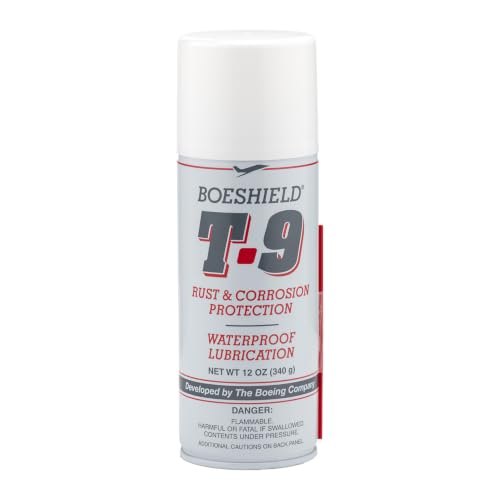
| Boeshield T-9★ Best Overall | Lasting protection on vehicles, garage gear, and battery terminals | Spray | Prevention | 12 fl oz / 12 oz | Amazon |
| Magica Rust Remover GelPremium Pick | Vertical and overhead rust stains on tile, tubs, and hardware | Gel | Removal | 8 oz / 9.17 oz | Amazon |
| Dalstrong Rust Remover and Eraser | Knives, scissors, whetstones, and steel cookware | Solid eraser block | Removal | 14.2 g | Amazon |
| Workshop Hero Metal Rescue Gel | Spot rust and hard-to-reach rust on large vertical surfaces | Gel | Removal | 17.64 fl oz / 1.2 lb | Amazon |
| CorrosionX Heavy Duty | Saltwater, marine, and heavy industrial metal | Spray | Prevention | 12 oz / 13.76 oz | Amazon |
Detailed Reviews
1. Boeshield T-9 Automotive Waterproof Lubricant
Our pick — 4.5+★ from 350+ verified ratings; the strongest balance of quality and price.
The wax-film formula that protects metal without turning it into a sticky dirt magnet
If you own anything with metal that lives outdoors — a trailer, a boat, a snowblower, a bicycle you keep in the garage — Boeshield T-9 is built for that exact job. It sprays on as a penetrating formula, displaces moisture, then dries down to a thin waxy film rather than a wet oily coating. That thin film is the whole point: it protects against humidity, road spray, salt exposure, and the long seasonal slumber of stored equipment, and it does it without collecting grit the way a heavy oil does. At 12 fluid ounces in a 12-ounce can, you get a full-size aerosol of a formula that started life inside Boeing — which is the kind of origin story that usually means a chemistry was designed for aviation-grade corrosion problems, not shelf appeal.
The comparison worth making here is against Magica’s gel, and it is a weight-per-ounce story. Boeshield’s 12 ounces against Magica’s 9.17 ounces is a 31% more gap — you are getting a materially larger container for the same category of protection, and the format matters too. A spray reaches inside frame tubes, behind latches, and down into hinge pins where a gel can’t travel. Buyers who use it on saltwater engines report both units looking brand new after years of service, and the recurring theme in the review pages is that it behaves differently from the thin petroleum sprays — it dries waxy, it doesn’t attract dirt, and it seals out corrosion rather than simply displacing water for a week. RV owners have adopted it as an all-purpose treatment for doors, windows, locks, hinges, hitches, awnings, and jacks, plus e-bike frames and battery terminals.
The honest caveat is the smell and the overspray. This is a potent chemical aerosol — anyone spraying inside a bike frame or a closed garage needs eye protection, a mask, and decent ventilation, and one user found it lifted a bit of paint on a bicycle. Go lighter on the trigger than you think you need. The other thing to know: on the oceanfront-window test, a first-time user was honest that “I’ve only used it once. The proof will be the protection it gives the metal along the ocean. I should be communicating next year!” — meaning this is a product you judge over seasons, not weekends. It is also the crowd favorite in this lineup at 4.5+ stars across 300+ ratings, so the long view has already been taken by plenty of people.
What earns its keep
- Dries to a thin waxy film — no sticky residue collecting road dust
- 12 fl oz of spray covers crevices, hinges, and frame interiors a gel can’t reach
- Works across vehicles, RV hardware, e-bikes, and battery terminals
- Displaces moisture and seals out salt, road spray, and humidity
What you should know first
- Strong chemical smell — ventilate, and wear goggles, mask, and gloves
- Can lift paint on some finishes if you overspray
- It prevents and treats light corrosion; it is not a heavy crust dissolver
Buy this if: you have metal that lives outside and you want one can that keeps it protected for months at a time.
Not your pick if: you are trying to strip thick, baked-on rust from a decade-old tool — that is a gel-remover job.
2. Magica Rust Remover Gel (8oz) USA Made
The gel that turns rust stains into harmless salts so you can just rinse them away
Magica is the pick for a stain you can see rather than a surface you want to defend. Its trick is chemical: the gel transforms rust into harmless salts, which then dissolve and rinse off. You apply it to a focused area — a rust ring under an umbrella stand, a streak on a tile wall, staining on stainless steel hardware — and watch it fade without scrubbing. Because it is a gel and not a liquid, it stays put on vertical walls and overhead metalwork instead of running off before it does anything. That single property makes it the best choice in this lineup for anything that isn’t flat.
The surface list here is genuinely broad: appliances, garden tools, sinks, tubs, tile, outdoor furniture, boats, cars, and even clothing. One buyer who spends seven months a year living aboard a sailboat called Magica “the real deal,” describing it as go-to for stainless steel hardware, fabrics, “literally any surface that has a rust stain.” That is the review-page personality of this product — people don’t use it once on a single job, they keep a bottle around and hit every rust stain they find. The company has been manufacturing these formulas in Wisconsin since 1988, and this one carries a biodegradable material feature, which matters if you are rinsing it into a garden bed or onto a driveway that drains to a lawn.
The catch is that gel chemistry is surface-specific. On a porous concrete patio it performed beautifully for one user — serious rust from an umbrella stand lifted fast with no damage to the overlay’s finish or color — but a dissenting voice found it did nothing at all on their job. Sizing that honestly: this is a product with a strong following and an occasional miss, and it is the smallest container in the lineup at 9.17 ounces against Boeshield’s 12. For heavy, layered, decades-old rust on bare iron, a thicker gel like Metal Rescue covers more ground per application. For visible staining on a hard surface, Magica is the easier tool.
Where it wins: vertical and overhead staining is the whole reason to choose a gel, and this one is formulated specifically to be applied to a focused area and left to fade the rust without scrubbing.
Reach for this if: your rust lives as a stain on tile, tubs, hardware, fabric, or appliances — especially on walls and ceilings.
Look elsewhere if: you are restoring a heavily corroded bare-steel part and need a bigger, thicker gel application.
3. Dalstrong Rust Remover and Eraser – Knife Maintenance Tool

A 14.2-gram block that brings a rusted carbon steel knife back in about a minute
Everything else in this lineup is a liquid, a gel, or a spray. The Dalstrong eraser is a physical block — a fine-grit abrasive you wet and rub across surface rust, staining, and oxidation. One pass on a rust spot, a little water, and about thirty seconds of circular motion, and the metal is clean again. It works on German steel, Japanese steel, stainless, and carbon, which means it covers the whole knife drawer regardless of what you cook with. And at 14.2 grams it is the lightest thing here by an enormous margin — it lives in a drawer, not on a shelf.
The second job most people don’t expect is whetstone restoration. Sharpening stones go gray and glazed when metal filings and swarf clog the surface, and the eraser strips that layer back to clean grit without damaging the stone face. A glazed #1000 stone comes back cutting like new — the maker’s own example puts it around five minutes. The same fine abrasive also handles heat discoloration, mineral deposits, and watermarks on stainless cookware and shears, so a single block covers a knife collection, a set of pans, and your scissors. On ease of use, this is the simplest product in the article: no dwell time, no rinsing, no ventilation, no gloves.
Now the mixed part, and it deserves a straight answer. Scratch resistance is the aspect buyers are most divided on, and the honest read is that this block works along the grain, not against it. Rub it across the blade the wrong way on a polished finish and you can leave visible fine scratching — the recurring advice is to soak the eraser in water for five minutes, wet the rusty item, and work deliberately. On standard carbon steel kitchen knives and tools it is a favorite: one cook who used it on carbon steel kitchen knives said plainly “I used the block on my carbon steel kitchen knives and it works well I would buy again.” For mirror-polished or high-end Japanese blades, treat it with real patience or use a gentler method.
Why cooks keep one in the drawer
- Removes surface rust, staining, and oxidation in roughly a minute per blade
- Also restores glazed whetstones and cleans stainless cookware and shears
- No fumes, no gloves, no dwell time — wet it and rub
- Works across German, Japanese, stainless, and carbon steels
Where it demands care
- Can leave fine scratches if you rub against the grain on polished steel
- Abrasive block, not a chemical — it removes metal surface rather than dissolving rust
- Wears down gradually across sessions
Suits you if: you want knife maintenance to be a sixty-second habit you actually keep up with.
Think twice if: your blades are mirror-polished showpieces where any surface change is unacceptable.
4. Workshop Hero WH003227 Metal Rescue Rust Remover Gel

A non-toxic, unscented gel for big vertical surfaces where brushing is impossible
The container size is the first thing that jumps out. At 17.64 fluid ounces — 500 ml in one pack — this is the largest remover in the article, and that capacity is aimed squarely at large surfaces. Metal Rescue is built to handle spot rust and hard-to-reach rust on panels, frames, and structural metal where you can’t reach with a wire brush. The formula is highly adhesive, so it stays on a vertical surface instead of sagging off. And there is no scrubbing, dipping, or wire brushing required — apply it, let it work, and deal with what it leaves behind.
Two practical details make this the easiest product to live with. It is unscented and marked non-toxic, and the gel stays good for up to one year after opening, so a partially used jug does not become waste. On car paint specifically, the feedback is reassuring: it doesn’t harm the finish, according to the owner notes. Together with the 17.64-ounce volume against Magica’s 8 ounces, this is a product you buy when the job is bigger than a stain and smaller than a full restoration.
The trade-off is the removal step. Effectiveness and rust removal are the two things people consistently affirm here — the gel genuinely breaks down rust — but how easy it is to get back off is a different story, and the recurring note is that it takes a while to dry. A handful of buyers found the value proposition uneven, some ready to repurchase immediately and others unimpressed by the yield. Practical move: apply it deliberately to the rusted area rather than slathering the whole panel, and give it time. Budget for the drying and cleanup step in your afternoon, and the coverage per bottle is what makes it the value play.
The size argument: on the dollar-per-ounce math, the 17.64-ounce format is the most generous pour in this group, and it’s the only one specifically marketed for hard-to-reach rust on large vertical faces.
Great match for: a big panel, frame, or piece of machinery where rust is spread over hard-to-brush area.
Wrong tool if: you want to apply and wipe in one pass — expect drying and cleanup time.
5. CorrosionX Heavy Duty Anti Rust Spray

The thick, dripless barrier built for saltwater, trailers, and machinery that gets abused
If your metal lives in a genuinely hostile place, this is the heaviest hitter here. CorrosionX Heavy Duty lays down a self-healing barrier that clings through rain, seawater, and pressure washing — it won’t drip, wash away, or quit. Its longevity claim is the boldest here: up to 5 years indoors and 2 years outside. That is the trade for a formula that stays flexible instead of drying hard — where wax sprays eventually flake and crack off, this one flexes and stays bonded even when machinery shifts and vibrates. Polar Bonding is the branded name for how it locks onto surfaces to stop corrosion before it starts, and the makers point to preventing electrolysis and galvanic damage in places you cannot see.
The specific role the format fills is electrical hardware. It is designed for larger terminals and connectors like battery posts and grounding lugs, and the thick, non-conductive formula protects without harming sensitive components. That is a niche no thin spray handles well. Out in the field, the use cases stack up fast: boat trailer leaf springs, winches, axles, transmission pans, snowblowers, exhaust pipes, mufflers, and boat davits all come up as jobs this product takes on. One boat owner who uses it monthly on a motor’s metal called it the ultimate protection against salt corrosion and highlighted its versatility across metal, rubber, and plastic. What it does most — its core functionality — is where the strongest praise lands, and saltwater protection is the point of the whole formula.
The trade you are making is messiness. This is a genuinely thick, goopy coating, and the recurring gripe is exactly that — it attracts dirt and looks rough after a few months, and it will stain hands and clothes, so keep it away from contact areas you grab or brush against. The spray also goes everywhere, so mask off surrounding surfaces and protect yourself. Coverage per can is the second complaint: only 12 ounces, which genuinely limits how much surface one can covers, and it can be hard to find locally. An occasional active rust patch needs a few days of contact before it grays out rather than disappearing instantly. For a salt-sprayed trailer axle, though, that thick film is the reason it works.
The case for going heavy
- Self-healing, dripless barrier survives rain, seawater, and pressure washing
- Rated for up to 5 years indoors and 2 years outside
- Stays flexible rather than flaking or cracking off machinery that vibrates
- Thick, non-conductive formula suited to battery posts and grounding lugs
The messy truth
- Thick goopy film attracts dirt and looks rough over time
- Will stain hands and clothing — keep it off contact surfaces
- Overspray travels, and one can covers limited area
Built for: trailer axles, boat hardware, and industrial metal that has to survive salt and weather for years.
skip it if: you want invisible protection on a surface people touch — this coating is meant to be seen and left alone.
Know the Specs
Form: Spray, Gel, or Abrasive Block
The form decides what the product can physically reach. A spray travels into hinges, latches, battery terminals, and frame interiors, and it’s the only format here that can treat metal you can’t see. A gel stays where you put it, which makes it the answer for vertical walls and overhead metalwork. A solid abrasive eraser is a contact tool — it only works on the exact spot you rub, but it needs no ventilation, no dwell time, and no rinsing. Match the form to the surface before you look at anything else.
Removal Versus Prevention
Removers break existing rust down so it can be rinsed or wiped away. Preventers coat the metal so rust never starts. They are not interchangeable and buying the wrong one is the most common mistake in this category. Removing a stain and then leaving the metal bare means the rust comes straight back the next time moisture touches it — that’s why a full job is often a remover followed by a protective film.
Why Curing Time and Drying Matter
Some gels need a period of contact and then a drying stage before you can clean them up. That time is not a defect — it’s how the chemistry gets into the rust. The gels here advertise extended shelf life — Metal Rescue’s stays good for up to one year after opening, so a partial container isn’t wasted. Plan your job around the curing window rather than expecting an instant wipe.
Film Weight and Surface Compatibility
Wax-based films dry thin and leave a cleaner finish; heavy-duty barriers leave a thick, dripless coating that resists pressure washing but attracts dirt. Neither is universally better. A thin film suits door hinges and bike frames. A heavy barrier suits a trailer axle in salt spray — but it will stain hands and clothing, so it belongs away from contact surfaces and painted panels you care about.
Common Questions
Does a rust remover actually stop the rust from coming back?
Can I use a gel rust remover on a vertical wall or overhead surface?
Will a rust eraser block scratch my knife?
How long do I have to wait for a rust remover gel to work?
Is a rust remover safe to use on car paint?
Should I use a spray or a gel for a boat?
What is the difference between a wax film and a heavy-duty barrier?
How long does the protection actually last?
Do I need to remove rust before applying a corrosion inhibitor?
Will a rust remover damage stainless steel or rubber parts?
The Bottom Line
For most people, the rust remover winner is the Boeshield T-9, because it protects metal for months, reaches places a gel can’t, and dries to a clean wax film instead of an oily mess. If you are fighting visible rust stains on walls, tile, or hardware, grab the Magica Rust Remover Gel — it clings to vertical surfaces and rinses away without scrubbing. And for a boat trailer or industrial gear in heavy salt, the CorrosionX Heavy Duty is the coating to reach for.
How we choose
We do not accept paid placement. Every pick is matched to a real buyer and a real use-case; we do not hands-on test units.
Sources
Specifications: manufacturer listings and product documentation. Review insights: verified customer reviews, as of October 2026. Pricing: not shown on this page (it changes often); check the current price via the retailer link.
As an Amazon Associate, Aappliancez earns from qualifying purchases. This does not affect which products we feature.