Disclosure: Some links in this post are affiliate links. As an Amazon Associate I earn from qualifying purchases, at no extra cost to you. Learn more
Specs are compiled from manufacturer listings and verified buyer reviews and can change over time — please confirm the key details on the product page before buying.
Rust never sleeps, but the right spray can stop it in its tracks before it eats through your tools, trailer, boat, or car frame. “Rust remover spray” covers two jobs: removers dissolve existing corrosion down to bare metal, while inhibitors leave a barrier film that keeps rust from forming. CorrosionX Rust Inhibitor takes the top spot because it does both — a dielectric film rated over 39,000 volts that bonds to metal and a deep-penetrating oil that frees frozen bolts.
This guide is built by comparing the manufacturers’ published specifications and the patterns across verified customer reviews, so you get each pick’s real strengths and trade-offs instead of marketing spin.
You will find two clear categories here: spray-and-protect inhibitors and soak-and-restore removers, and picking the right one depends on whether you are treating rust you already have or shielding metal you want to keep. The list below matches each job to its pick, from a five-gallon soak bucket to a waxy undercoating can that survives road salt. Here is the honest breakdown of the best rust remover spray for every job and budget.
Top Picks


How To Choose The Best Rust Remover Spray
Start by asking what you are actually fighting. Surface rust on a trailer frame you want to keep looking new calls for a barrier inhibitor you spray on and leave. Rust already flaking off a fifty-year-old bolt calls for a remover that eats the corrosion away and leaves bare steel behind.
Remover or Inhibitor — Know Which You Need
A rust remover chemically dissolves existing corrosion. Evapo-Rust, for example, is a water-based dip you submerge parts into, and its own instructions say to soak, rinse, and reuse with no sanding or scrubbing. A rust inhibitor does the opposite job: it forms a film that blocks the moisture and salt that feed rust in the first place. CorrosionX builds a dielectric barrier that bonds to metal, while B’Laster Surface Shield lays down a thick lanolin coating that clings without sagging or dripping. Many buyers end up wanting both — one to clean up what is already there, one to stop it coming back.
Match the Form to the Job
Where the part sits decides the form you buy. Aerosol cans reach into box sections, inner panels, doors, and chassis rails that a brush never will, which is exactly the use Jenolite builds its Waxoil for. A dip works when you can pull the part off and drop it in a bucket, but it cannot reach a truck frame still bolted to the vehicle. Coverage and dry time matter too: Rust-Oleum Rust Reformer lists coverage of 20 square feet with a 24-hour full cure, so you can size up whether one can finishes your project or you need two.
Size and Reusability Change the Real Cost
Liquid removers in large containers can be reused until they stop working, which stretches how far one purchase goes — Evapo-Rust ships in a 5-gallon pail for exactly that reason. Aerosols are one-and-done, so count your square footage before you commit. Weight also tells you what arrives at your door: a full 5-gallon pail tips the scale at 45 pounds, versus roughly half a kilogram for a single aerosol can.
Side-by-Side Comparison
| Model | Best For | Type | Container / Volume | Item Weight | Amazon |
|---|---|---|---|---|---|
| CorrosionX Rust Inhibitor★ Best Overall | Marine, electrical, and all-round corrosion defense | Aerosol oil-based inhibitor & penetrant | 16 fl oz can | 0.6 kg | Amazon |
| Jenolite Waxoil AerosolPremium Pick | Vehicle underbodies and hard-to-reach box sections | Aerosol waxy fluid inhibitor | 16.9 oz can | 15.17 oz | Amazon |
| Rust-Oleum Rust Reformer | Converting rust into a paintable surface before topcoat | Liquid rust converter | 8 fl oz can | — | Amazon |
| B’Laster Surface Shield | Undercoating daily drivers in the Salt Belt | Aerosol lanolin undercoating | Pack of 6 cans | 8.5 oz | Amazon |
| Evapo-Rust CRC Heavy Duty Rust Remover | Soaking parts and tools down to bare metal | Water-based reusable dip remover | 5 gallons | 45 lbs | Amazon |
Detailed Reviews
1. CorrosionX Rust Inhibitor 16oz
Our pick — 4.5+★ from 800+ verified ratings; the strongest balance of quality and price.
The do-it-all aerosol that frees frozen bolts and shields wiring in the same pass.
If you own a boat, a trailer parked near the coast, or a garage full of tools that live in humid air, this is the pick that covers the most ground. CorrosionX forms a dielectric film — a non-conductive coating that keeps electricity where it belongs — rated over 39,000 volts. That rating is why it is safe to spray straight onto battery terminals, sensors, and live circuit boards, not just the metal around them.
It does two jobs at once, which is rare on this list. As an inhibitor it molecularly bonds to the metal surface and blocks moisture; as a penetrant it creeps into frozen bolts, marine fittings, and seized engine parts to break corrosion loose. The 16 fl oz aerosol weighs 0.6 kg, light enough to toss in a boat bag, and the oil-based formula leaves no sticky residue behind. Its maker, Corrosion Technologies, holds the only military-spec qualification for an Advanced Corrosion Preventive Compound.
Owners treat it as a fixture in shops and garages, and the marine crowd is the loudest. The review pages sum it up in one buyer’s words: “I’ve used Corrosion X for years both regular formula and heavy duty. My primary use is for corrosion resistance in my engine room and anything electrical on my boat and airplane. I honestly don’t think there is a better product made.” The recurring honest gripe is small but real — the can would be easier to aim into tight seams with an attached straw. With 4.5+ stars across 800+ ratings, this is the crowd favorite by a clear margin.
What Earns It The Top Slot
- Dielectric film rated over 39,000 volts protects wiring, terminals, and sensors
- Penetrating oil frees rusted bolts, hinges, and seized marine fittings
- 16 fl oz aerosol at 0.6 kg travels easily and dispenses without a sticky film
Where It Falls Short Of Perfect
- No attached straw on the nozzle, so precise aiming into tight seams takes some care
- You must saturate the part and give it time — this is not a wipe-on, walk-away spray
The pick for you if: you need one can that guards electrical connections, marine gear, and rusty hardware all at once.
Rethink it if: you want a spray that dries to a visible waxy coating — this one leaves a clear protective film instead.
2. Jenolite Waxoil Aerosol, 1×16.9oz
The undercarriage specialist that dries to a waxy shield and heals its own scratches.
Underside protection is where Jenolite Waxoil earns its place, because the places that rust first are the places a brush never reaches. It is built for box sections, inner panels, doors, sills, wheel arches, chassis, and underbody — all the enclosed cavities where a spray is the only tool that fits. The thick waxy fluid drives out moisture and carries a rust killer that goes after existing corrosion while blocking new rust from forming.
The clever part is the self-sealing behavior. If the coating gets scratched or punctured, the advanced formulation stays active and seals back over itself rather than leaving a bare patch exposed. Applied to a vehicle underside before winter, that means a stone chip does not automatically become a rust starting point. At 15.17 ounces it is a genuinely heavy can — the same weight class as a multipack can of lanolin spray, even though this is a single unit.
What wins people over here is durability, and the pattern is consistent — 16 separate mentions of rust resistance and 9 of outright coating quality. The long-term crowd is the clearest signal: owners who sprayed a coal stove exhaust pipe months earlier still find it shiny, and there are buyers calling this a better option than wool wax or straight oils. A single can goes further than you might expect; one buyer’s own summary is simply, “One 16 oz goes a long way,” after treating a full front suspension on a Nissan Pathfinder. The trade-off is prep — this is a spray-and-leave coating, so the surface should be reasonably clean before you start.
Cleanest finish on the list: it sprays on clear and dries to a waxy film, which is exactly why owners reach for it over lanolin products that smell strong and leave an oily residue.
One caveat before you order: a single can covers a front suspension or a set of slide rails, but a full truck underbody project will call for more than one.
Grab this one if you are winter-proofing a car, van, or motorbike and want a coating that survives chips.
Look elsewhere if you need to free a frozen bolt today — this protects and treats, but it is not a penetrating oil.
3. Rust-Oleum Rust Reformer

Turns flaking rust into a black paintable base — no sanding required.
This one plays a different game from the sprays above: it is a converter, not a shield. You brush or spray it onto rusted iron and steel, and it chemically converts the corrosion into a smooth, paintable surface, which reduces the need to sand down to bare metal first. For anyone refinishing patio furniture, wrought-iron railings, or an iron bench, that saves a full afternoon of wire-brushing.
Once dry it leaves a durable black matte finish that can be top-coated with most oil-based finishes or primed, so your final color goes on over a stable base. The numbers you plan around are coverage and cure: 20 square feet per can, dry to the touch in around an hour, and a full cure at 24 hours before you sand or paint. At 8 fl oz the bottle is compact — about half the volume of the CorrosionX can above — but the liquid is thin, so it spreads further than the size suggests. This is the entry-level price tier of the list, and it punches well above that.
What earns the most praise is the finish quality once it sets, followed closely by how well it actually stops the rust from spreading. There is a moment owners describe where nothing seems to happen and then the metal suddenly goes black — exactly as one buyer put it, “Couple days later and it was suddenly black!” The honest catch is the color: reviews flag the finish as black and the base-coat stage as mixed, so if you need a specific final tint, plan on a topcoat rather than relying on this alone. Coverage of 20 square feet is also worth measuring against your project before you buy.
The value read: for small to mid-size metal projects, this delivers a paintable rust-stabilized surface at the lowest cost of anything here.
Why it is not higher: topcoat is effectively required if you want anything other than black, and one can only covers 20 square feet.
Best for: railing, furniture, and equipment restoration where you plan to paint over the treated surface anyway.
Not the one if: you want a clear protective film or a spray that reaches enclosed cavities — this is a brush-and-build product.
4. B’Laster Surface Shield Rust Prevention Spray Pack of 6
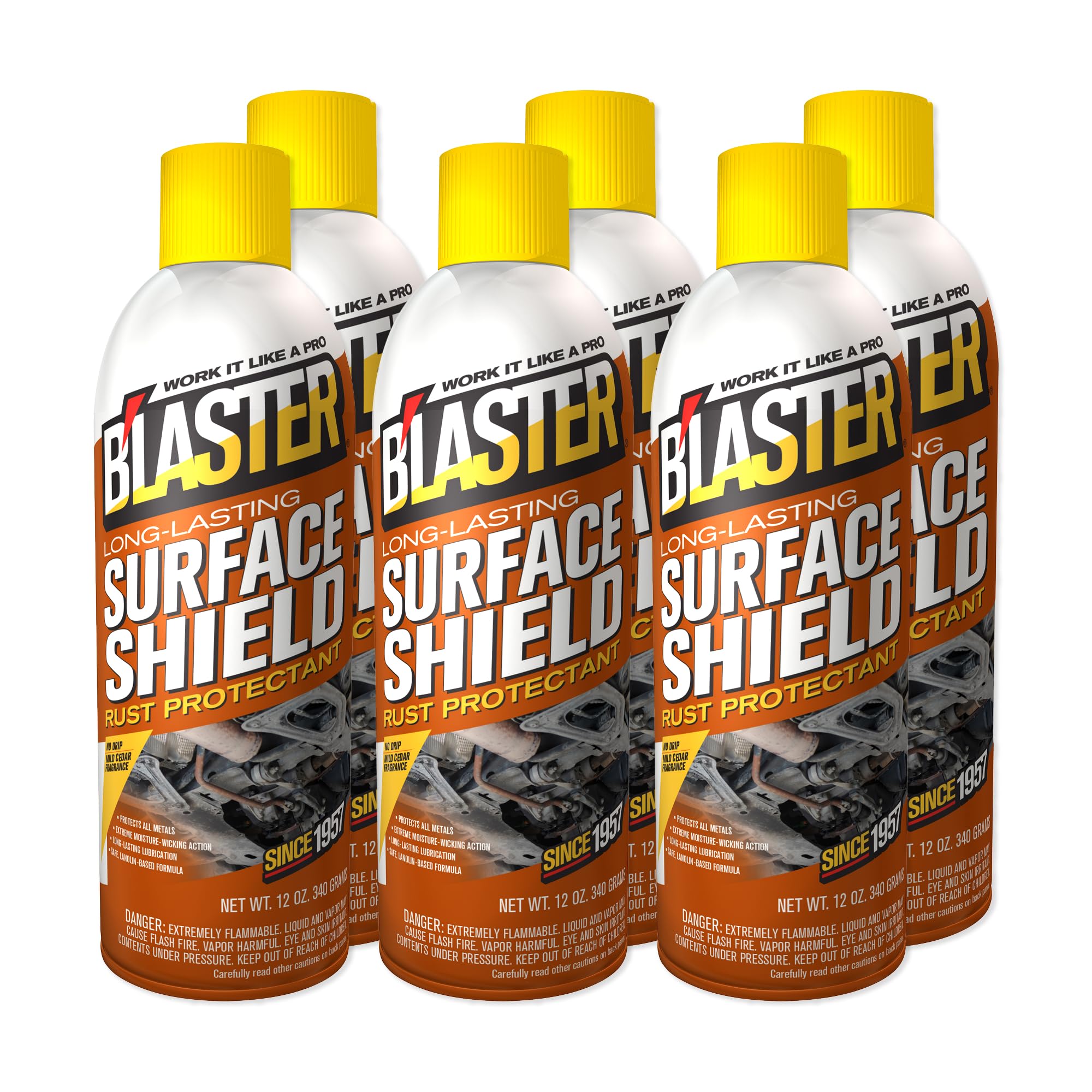
The Salt Belt answer — a thick lanolin coat that clings, displaces moisture, and shrugs off washings.
If road salt is your problem every winter, this is the format built for it. B’Laster Surface Shield is a lanolin-based undercoating that lays down a durable barrier against moisture, salt, and rust, and it is engineered to cling to metal without sagging or dripping. The manufacturer rates protection at up to 2 years, and the formula is 50-state VOC compliant.
It is an aggressive moisture displacer that resists high-pressure washing, so a trip through the car wash does not strip your investment off the frame. The weight spec here is a good tell: each can weighs 8.5 ounces, much lighter per unit than the 15.17-ounce Jenolite can above, and that difference tracks with the thinner lanolin formula. One practical quirk the manufacturer calls out directly — the formula can thicken in cold temperatures, so shake thoroughly before every application for even coverage.
What buyers care about most here is function and pure rust resistance, with the old-vehicle crowd leading the charge — owners running rust-affected frames and undercarriage sheet metal report real results. Applied to 20-year-old Toyotas, buyers describe it as more durable and less stinky than Fluid Film, though some note it needs an aftermarket nozzle for precise aiming. The consistent warnings are worth reading before you order: it drips onto the ground during application (put newspaper down first) and it collects dust, which is simply the cost of a coating this clingy. The 6-can pack is sized for repeat seasonal use rather than a single job.
The pattern in the reviews: buyers on the Salt Belt praise the rust-resistance result specifically, with one owner of older trucks calling this their preference over the big-name alternatives because it is thicker and seems to stick and last longer.
The honest downside: it is messy by design — drips during spraying, collects dust, and needs shaking in cold weather to apply evenly.
Reach for this if you live where roads get salted and want a 6-can supply for seasonal undercoating.
Consider a different format if you only need to treat a small handheld part — this is overkill for a single bracket.
5. Evapo-Rust CRC Heavy Duty Rust Remover 5 Gallon
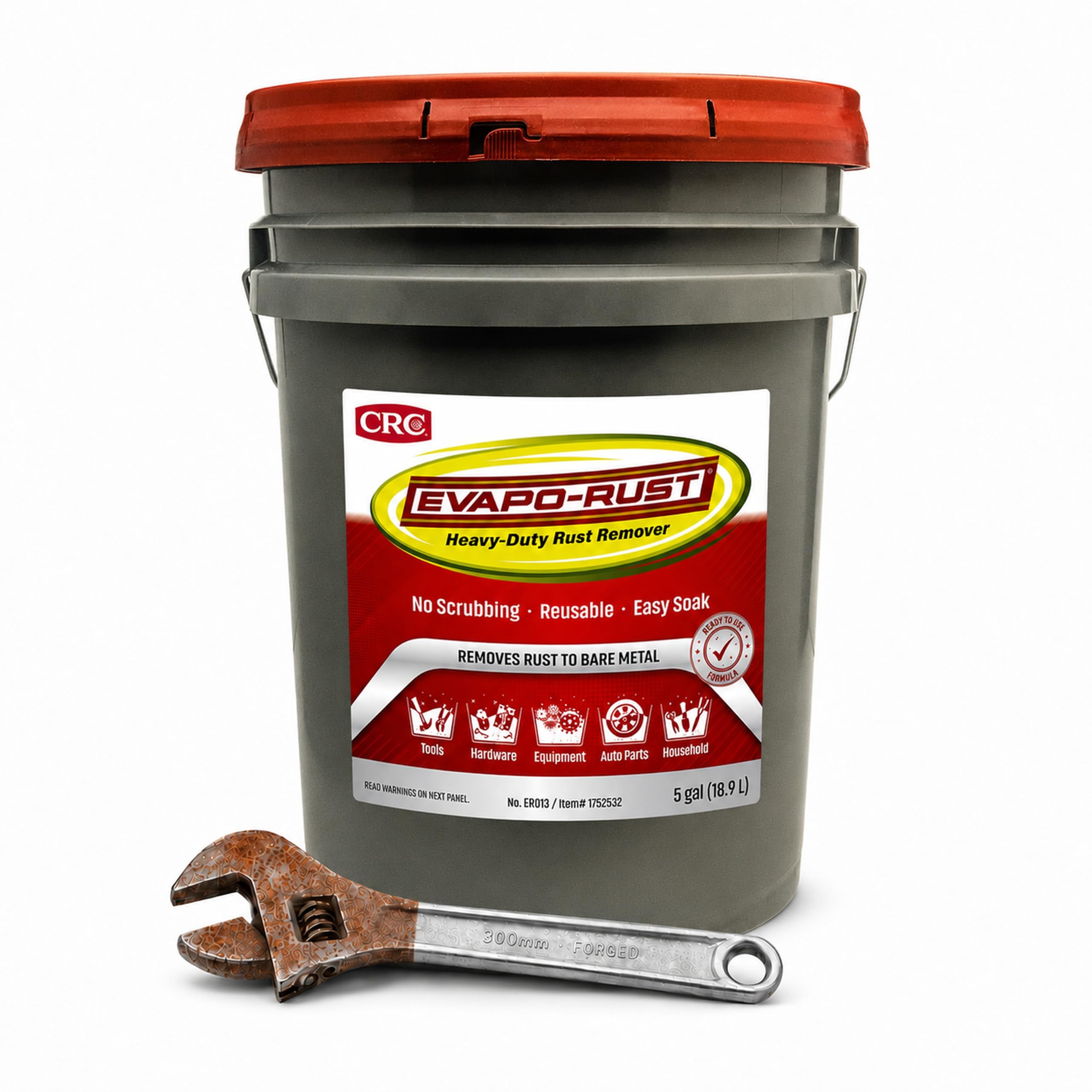
A five-gallon dip tank that strips rust to bare steel without sanding or scrubbing.
For restoration work, the volume is the whole point. This is a non-corrosive, water-based, acid-free dip that you submerge rusty parts into — no mixing, no prep, straight out of the pail. Once the rust is gone you rinse with water and protect the part with a corrosion inhibitor like one of the sprays above. It is biodegradable and will not attack plastic, paint, chrome, or anodized finishes.
Freed from the constraints of a single part, you can drop in auto parts, tools, cast iron cookware, clocks, grills, gardening tools, antiques, and camping gear. The 5-gallon pail holds 45 pounds when full, so plan a permanent spot for it rather than moving it around your shop. Because it is reusable, the same bucket serves project after project — the parts-to-parts workflow that makes this the most versatile pick by function, even though it costs the most of anything on this list.
Effectiveness is what dominates the feedback across a huge review base, and the before-and-after is what hooks people. A buyer restoring a 1947 Jeep reported this outperforming brake cleaner and acid; another dropped a starter, carburetor, coils, and stator into a bucket during a welder overhaul and pulled them out sparkling steel grey. The catch is real, though — it is a soak, not a spray, so you have to remove the part first. Amazon’s own replacement response to a poorly packed bucket that arrived empty is also worth knowing before you order. You also need the part fully submerged; buyers recommend gloves, though reports say it will not burn skin.
Pick this if you restore tools, jeeps, or antiques and can pull parts off the machine to soak them.
skip it if the rust lives on a bolted-on trailer frame or enclosed chassis cavity — that job belongs to the sprays above.
Know the Specs
Rust Remover vs Rust Inhibitor
The single spec that decides everything. A rust remover chemically dissolves existing corrosion and leaves bare metal — Evapo-Rust is a dip that you soak parts in, then rinse and reuse. A rust inhibitor blocks the moisture and salt that feed rust in the first place, forming a film on the metal. CorrosionX relies on a dielectric film, while B’Laster uses a thick lanolin barrier. Buy the remover for rust you have; buy the inhibitor for rust you want to prevent. Many projects need both, applied in that order.
Container Size and Coverage
Size tells you how far one purchase goes. A small 8 fl oz can of Rust-Oleum Rust Reformer covers 20 square feet with a 24-hour cure, ideal for small metal projects and one-can budgets. A 5-gallon Evapo-Rust pail holds 45 pounds when full and can be reused across many jobs, making it a long-term investment. An aerosol like CorrosionX at 16 fl oz is a single-use, throw-in-the-toolbox option. Match container size to project size before you commit.
Dry Time and Cure Time
Two different numbers. Dry-to-touch means the surface is no longer wet — Rust-Oleum Rust Reformer hits this in about an hour. Full cure means the coating has hardened to its final strength — that is 24 hours for the Rust Reformer before you can sand or topcoat it. Waxy coatings like Jenolite Waxoil stay semi-soft and self-sealing rather than fully hardening, which is exactly how they survive scratches and chips without cracking.
Application Method and Reach
How you deliver the product decides where it can go. Aerosols reach enclosed spaces — box sections, inner panels, doors, sills, chassis, and underbody — that a brush or dip cannot touch, which is why Jenolite Waxoil is built as a spray. Dips require full submersion, so the part has to come off first; the trade-off is that they can clean complex shapes completely. Match the application method to whether the rust is on a bolted-on part or a permanently installed structure.
Common Questions
Can I use a rust remover spray on electronics or battery terminals?
Do I need to sand the metal before applying a rust remover?
How long does a single can of rust prevention spray actually last on the metal?
Is a rust remover safe on painted or chrome surfaces?
Can I reuse a liquid rust remover dip or do I pour it out after one use?
What is the best way to apply an undercoating to a truck or car frame?
Does a rust remover work on cast iron cookware and cast iron tools?
Can I topcoat over a rust converter or do I need to leave it alone?
Will a rust remover spray damage rubber or plastic components it touches?
How much surface area will one can or one bucket actually cover?
The Bottom Line
For the best rust remover spray that handles the widest range of real-world jobs, the CorrosionX Rust Inhibitor is the one to buy — it is the only pick here that penetrates, protects, and is specified safe on live electronics, with a dielectric film rated over 39,000 volts. The runner-up for vehicle owners is the Jenolite Waxoil Aerosol, whose self-sealing waxy film is purpose-built for underbody and cavity work. And if you are restoring old tools or antiques and can soak the parts, the Evapo-Rust 5-Gallon is the whole-job choice. If you still cannot decide, buy the CorrosionX Rust Inhibitor — the highest-rated, most versatile pick here — and treat the rest as upgrades for a specific job.
How we choose
We do not accept paid placement. Every pick is matched to a real buyer and a real use-case; we do not hands-on test units.
Sources
Specifications: manufacturer listings and product documentation. Review insights: verified customer reviews, as of October 2026. Pricing: not shown on this page (it changes often); check the current price via the retailer link.
As an Amazon Associate, Aappliancez earns from qualifying purchases. This does not affect which products we feature.