Disclosure: Some links in this post are affiliate links. As an Amazon Associate I earn from qualifying purchases, at no extra cost to you. Learn more
Specs are compiled from manufacturer listings and verified buyer reviews and can change over time — please confirm the key details on the product page before buying.
If you are trying to pick the right rubber flooring for basement use, the short answer is this: buy by thickness and drainage, not by color. A basement sits below grade, so the floor sweats, water creeps, and anything you leave directly on the concrete wicks damp. A drain tile keeps boxes off the slab, lets air move underneath, and hoses down without rotting.
This guide is built by comparing the manufacturers’ published specifications and the patterns across verified customer reviews, so you get each pick’s real strengths and trade-offs instead of marketing spin.
Thin decorative mats curl at the edges within weeks, while thick rolls stay flat under a car but fight you during install. The picks below split into two camps: snap-together drain tiles and solid protective rolls. For anyone weighing moisture, traffic, and cleanup, the best rubber flooring for basement you can buy depends on which of those two jobs your space actually needs.
Top Picks


How To Choose The Best Rubber Flooring for Basement
Two mats can look identical in a photo and behave nothing alike after a wet winter. What separates a basement floor that stays usable from one you regret is how the material handles standing water, how thick the tile or roll actually is, and whether it locks together or shifts underfoot. Start with the water question, then work outward.
Drainage tiles versus a solid roll
A drainage tile is built with holes and raised support pins underneath. Water passes straight through the surface and dries under the mat instead of pooling on top. That matters most in a basement that gets humid air or occasional seepage.
A solid roll does the opposite job. It seals the concrete under a car, a workbench, or gym equipment and wipes clean in one pass. Choose the roll when your basement is already dry and you are protecting the slab from oil, salt, or scuffs.
Thickness tells you how it will behave
Thicker is not automatically better for every space. A solid roll around 2.8mm is flexible enough to roll out but heavy enough to stay put under a parked vehicle. A tile with a thickness in the double digits of millimeters gives you real cushioning and keeps your feet clear of a cold slab.
Where thickness bites you is install. Heavier material resists wrinkles but is awkward to stretch flat, and thin rolls tear easily when you cut them to size.
Side-by-Side Comparison
| Model | Best For | Style | Thickness | Footprint | Amazon |
|---|---|---|---|---|---|
| MYFAMIREA Modular Interlocking Cushion 12 Pack★ Best Overall | Snap-together drain tiles | Interlocking drain tile | — | 12 tiles, each 11.8″ x 11.8″ | Amazon |
| Geemax 4×10 FT Diamond Plate Garage Floor MatBest Value | Large single-sheet coverage | Solid PVC roll | 2.8 mm | 120″L x 48″W | Amazon |
| EVANCENT 12” x 12” Drainage Interlocking Floor Mats 12 Pack | Wet, ventilated corners | Interlocking drain tile | 12 mm | 12 tiles, each 12″ x 12″ | Amazon |
| VEVOR Diamond-Plate Rubber Flooring Roll | Under vehicles and gym gear | Solid SBR rubber roll | 0.12 inch (3 mm) | 4 ft x 8 ft | Amazon |
| VEVOR Modular Interlocking Cushion 50 Pack | Big rooms and flood-prone zones | Interlocking drain tile | 0.6 inch (15 mm) | 50 tiles, each 12″ x 12″ | Amazon |
Detailed Reviews
1. MYFAMIREA Modular Interlocking Cushion 12 Pack 11.8″ x 11.8″
Our pick — 4.5+★ from 450+ verified ratings; the strongest balance of quality and price.
The snap-together set that lets a damp basement floor dry itself out underneath.
Twelve square tiles, each measuring 11.8″ x 11.8″, made from PVC (a flexible plastic that stays springy instead of cracking). Put them down in a grid and you get roughly eleven square feet of walking surface — enough to line a stair landing, a laundry corner, or the strip in front of a chest freezer. The tiles link through molded snaps on the edges, so the row holds together when you walk across it rather than sliding apart.
The hollow mesh face is the real reason this one wins. Water and spills drop through the openings to the concrete instead of sitting on top where you stand. That is exactly the condition a below-grade room creates, and it means a wet-vac or a garden hose in the spring does most of the cleanup for you. The surface is also textured for grip, so bare feet on a finished-ceiling basement floor do not skate.
The catch is the smell from the start and the fit of the joints. The PVC tiles arrive with a noticeable odor that fades, so air them out before laying them in a closed room. Several owners also found the snap connectors tight on the first build and used a mallet or a firm palm strike to seat them. One reviewer noted: “Multipurpose use item but great for RV living. It created the air pace I needed between my foundation and mattress.”
Each tile can be trimmed with scissors to fit around a floor drain or a post, and the corner holes let you screw tiles down if a section keeps drifting. Sold in black.
What wins people over
- The mesh face handles standing water the way a basement needs — it drains straight through instead of pooling.
- Snaps make the set modular: add or pull tiles without redoing the whole floor.
- Cuttable with household scissors, so a drain or a support post is not a problem.
Where it asks you to adapt
- Fresh out of the bag there is a strong odor — air them out before a closed-room install.
- The joints seat tight on the first pass and may need a mallet to click home.
- Twelve tiles cover a modest area, so a full room takes more than one pack.
Best for: a laundry corner, stair landing, or pet area where moisture is a daily fact of life.
Think twice if: you are flooring an entire room in one go — the 12-tile pack will leave you short and you will be ordering a second set.
2. Geemax 4×10 FT Diamond Plate Garage Floor Mat
One big sheet of textured PVC that turns a rough basement slab into a wipe-clean surface.
Where the interlocking tiles above are modular, this is the opposite approach: a single 4×10 ft roll that stretches 120″ long by 48″ wide in a 2.8mm sheet. Roll it out and the whole footprint is covered at once — no seams to line up, no connectors to seat. That makes it the quicker install if you just want the floor under a car, a motorcycle, or a golf cart done today.
The raised diamond pattern is the headline. It gives wet feet and tires something to grip instead of a slick slab, and it leaves channels for water so the surface does not hold a puddle. The PVC compound resists oil, grease, winter salt, and chemicals, so a drip pan leak or a splash of driveway brine wipes off instead of staining the concrete underneath. The roll ships with five meters of double-sided tape to pin the edges down.
Plan for a break-in period before the wrinkles relax. Rolled material keeps a memory of the coil, so it needs warm weather and patience to lie flat — one owner described a mat taking about a week to settle once it warmed up. You can trim it around a wall or a pillar with scissors or a utility knife. At 2.8mm, this is a floor cover, not a cushion.
Coverage math that matters: the 120″ x 48″ sheet gives you one continuous 4×10 ft area — no gaps to trip on and no tile edges to catch a caster wheel.
The honest break-in: give it a day in a warm room before you judge the flatness, and keep the included tape handy for any edge that wants to lift.
Reach for this if: you want one rolling sheet to protect a slab under a vehicle or bench and value speed over modularity.
Look elsewhere if: your basement floor actually gets wet regularly — a sealed sheet holds moisture against the concrete rather than draining it.
3. EVANCENT 12” x 12” Drainage Interlocking Floor Mats 12 Pack

The thicker tile pack for the corner of the basement that never quite dries out.
If the MYFAMIREA set is the everyday choice, this is the one for the problem spot. Each tile measures 12″ x 12″ and 0.47″ thick — noticeably beefier underfoot than a thin drain mat. You can see the size gap in the specs: these run 12″ square, while the MYFAMIREA tiles come in at 11.8″ x 11.8″. That small difference is why this pack covers a slightly larger grid from the same twelve tiles.
The build is commercial-grade 100% recycled PVC, which keeps the tile soft and flexible rather than stiff. It hooks together with a puzzle-style edge — two male sides, two female sides — so a single person can lay a whole walkway without help. The holes across the face let liquid pass through and sweep away, and the whole thing can be hosed down and left to dry on its own.
Two things to plan around. First, the thickness means a bare concrete floor underneath needs to be reasonably even, since a thick tile over a big dip will flex underfoot. Second, cutting around a drain or a post is done with a utility knife, so measure twice. Buyers report the recycled PVC tiles hold up in humid, rainy conditions and snap together easily.
The case for it
- At 0.47″ thick it is a real cushion, keeping stored boxes off a cold, damp slab.
- Puzzle edges mean one person can snap a whole run together.
- Made from 100% recycled PVC — soft, flexible, and hose-clean.
The trade-offs
- Ships as twelve separate tiles, so a large room needs more than one pack.
- A thick tile over an uneven slab will rock — level the area first.
- Trim work around drains and posts takes a careful hand with a utility knife.
Pick it when: your basement has an outdoor-shower-style wet zone, a hot tub walkway, or a door where rain tracks in.
Leave it if: you want one smooth sheet — this is a tile build, so the seams are visible by design.
4. VEVOR Diamond-Plate Rubber Flooring Roll, 3 mm x 4 ft x 8 ft
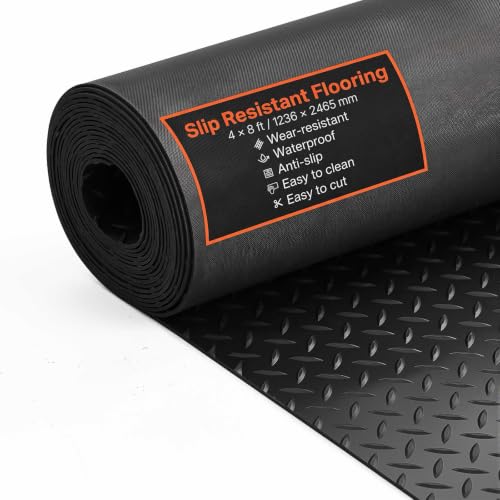
Real rubber instead of plastic — a 4×8 ft roll that will not creep out from under a car.
The material here is the point. This roll is made from SBR rubber (styrene butadiene rubber, the same family used in tire tread), not the PVC of the plastic-based mats. That matters in a basement because rubber grips and stays put under weight, while thinner PVC has more of a tendency to slide. The sheet measures 0.12 inch thick — about 3mm — across a 4 ft x 8 ft footprint.
The diamond-plate pattern is cut as a 3D backing, not just printed on. It handles water stains and spills by giving them nowhere to sit and seep, so the concrete beneath stays dry and the mat wipes back to new. In a gym setup or under a workbench, the texture is also what stops a heavy item from skating when the floor is damp.
Two realities come with rubber. It is heavy — that is the trade for staying flat under a vehicle — and it means wrestling the roll flat takes some muscle. Owners flag a strong rubber smell out of the bag that fades over days, so air the roll out before closing a basement door on it. Cutting it to size with scissors works, but the material is not delicate; over-force the cut and it can tear.
What the rubber buys you: grip that holds under a parked car, and a waterproof surface you can hand-wash and reuse instead of replacing every year.
Set expectations up front: budget a few days for the smell to clear and a helper for the initial rollout — neither is a defect, just how rubber behaves.
The one to grab if: your basement doubles as a gym, a workshop, or a motorcycle bay and you want heavy-duty protection that stays in place.
Pass on it if: you need a cushiony surface to walk barefoot on — this is a protective floor cover, and at 3mm it is thin underfoot.
5. VEVOR Modular Interlocking Cushion, 50 Pack 12″ x 12″

Fifty interlocking tiles with upgraded pins — enough drainage mats to floor a whole basement room.
Coverage is the headline here. This pack holds 50 tiles at 12″ x 12″ each, a large jump over the 12-tile sets — the Geemax roll covers a single 4×10 ft area, while this pack spreads across a full room in modular form. If you are sealing off a damp storage zone or lining a whole laundry room in one purchase, the count alone makes it the practical pick.
The engineering is where it earns the premium slot. Each tile sits on 0.6-inch support pins — the raised pegs underneath that hold the tile off the slab and let water drain away fast, instead of collecting as surface water. Horizontal locking edges fit snugly so the grid does not drift apart, and the upgraded PVC is built to hold its shape over time rather than flatten out. A single rinse is usually all the cleanup it takes, since the material resists hair and oil.
Do the math before you buy, though. Fifty tiles sounds enormous, but each is 12″ square, so an average basement room still calls for a considered count — measure your area and order accordingly. The set weighs 21.1 kg, so plan a two-person haul down the stairs. For a wet, high-traffic space that needs drainage across a big footprint, this is the set that does the job in one go.
Why it stands out
- 50 tiles in one box covers a full room, not just a corner.
- 0.6-inch support pins move water away and keep feet off the slab.
- Upgraded PVC resists hair and oil, so cleanup is a rinse.
Plan around this
- At 21.1 kg for the set, get help carrying it to the basement.
- Fifty tiles may leave leftovers if your space is small — measure first.
- Modular tiles mean visible seams, so it is not a smooth single sheet.
The verdict: a whole-room drain floor for a large basement that sees real moisture and foot traffic.
Scale down if: you only need a small area covered — the 50-pack is built for a full footprint, not a narrow strip.
Know the Specs
Thickness and What It Controls
Thickness, measured in millimeters or inches, decides whether a mat cushions your feet or just protects the floor. A solid roll around 2.8mm to 3mm stays flexible and flips over easily, so it works best as a cover under a car or bench. A tile measured at 12mm or 15mm is a true cushion, keeping boxes and bare feet up off a cold, damp slab. Thicker tile also means more drainage height underneath if it has support pins.
Drainage Design and Drain Tiles
A drain tile is a mat with holes through the surface and raised supports below. Water drops through instead of pooling, so the floor dries on its own — the single most useful trait below grade. A solid roll does the opposite: it seals the floor and wipes clean, which is right for a dry basement but holds moisture against the concrete if the slab gets wet. Match the design to how damp your space actually is.
Common Questions
Will rubber flooring sit directly on a basement concrete slab?
How much area does a 12-tile drain mat pack actually cover?
Do these mats smell when they arrive?
How do I stop a rolled mat from curling at the edges?
Can I cut drain tiles or a rubber roll to fit around a floor drain?
Is a solid rubber roll or an interlocking drain tile better for a damp basement?
Do interlocking tiles need adhesive or tape to stay put?
What is the difference between PVC and SBR rubber flooring?
How do I clean these mats in a basement?
Will heavy items like a car or gym rack damage the rubber roll?
The Bottom Line
For most owners, the winner in our rubber flooring for basement lineup is the MYFAMIREA Modular Interlocking Cushion 12 Pack because it drains water away, snaps together without tools, and can be cut to fit a problem corner. If you want a heavy-duty cover for a gym or a motorcycle bay, grab the VEVOR Diamond-Plate Rubber Flooring Roll — real SBR rubber that grips and stays put. And for a wet, high-traffic space that needs enough tiles to cover a whole room, the VEVOR Modular Interlocking Cushion 50 Pack is the one to reach for. Measure your area first, air out the material, and let the drainage decide which camp you land in — pick the drain tiles for a damp space and a solid roll for a dry one.
How we choose
We do not accept paid placement. Every pick is matched to a real buyer and a real use-case; we do not hands-on test units.
Sources
Specifications: manufacturer listings and product documentation. Review insights: verified customer reviews, as of October 2026. Pricing: not shown on this page (it changes often); check the current price via the retailer link.
As an Amazon Associate, Aappliancez earns from qualifying purchases. This does not affect which products we feature.