Disclosure: Some links in this post are affiliate links. As an Amazon Associate I earn from qualifying purchases, at no extra cost to you. Learn more
Specs are compiled from manufacturer listings and verified buyer reviews and can change over time — please confirm the key details on the product page before buying.
You want a real rowing workout at home, and you do not want another monthly bill attached to it. That is the whole point of this list. Every machine here rows without a paid class subscription, so the rower is yours to use the day it arrives and every day after. Some connect to a free app, some run on nothing but your own effort, and none of them lock the basic workout behind a paywall. Below you will find the machines that hold up to daily use, sorted so the strongest all-rounder sits first and the budget-friendly options come last.
This guide is built by comparing the manufacturers’ published specifications and the patterns across verified customer reviews, so you get each pick’s real strengths and trade-offs instead of marketing spin.
From air flywheels to water tanks, the difference between a machine you keep and one you abandon is usually the resistance type and the seat. This breakdown covers the best rowing machine without subscription for every kind of home gym.
Top Picks


How To Choose The Best Rowing Machine Without Subscription
“No subscription” does not mean “no data.” Plenty of these rowers show your time, distance, and calories on a built-in screen for free. What you are avoiding is the machine that refuses to give you a proper workout unless you pay a monthly class fee. Decide up front if you want a screen that stands alone or one that beams your numbers to a phone app you already use.
Pick your resistance type first
Air resistance spins a fan wheel, and the harder you pull the more resistance you get — it feels closest to rowing on open water. Magnetic resistance uses magnets near a flywheel, so it runs very quiet and lets you dial in a fixed level. Water resistance moves paddles through a tank, which gives a smooth stroke and a soft splashing sound. Your choice here decides noise, feel, and how much upkeep the machine needs.
Check the rail length and seat height against your body
Rail length is the track the seat slides on, and it decides whether your legs can fully extend at the end of a stroke. Seat height is how far you sit off the floor, which matters if you have stiff knees or hips. A taller seat is easier to get on and off. A longer rail suits taller rowers and long-legged users.
Weigh storage against footprint before you buy
Most rowers are long. Several here split into two pieces or fold upright so they tuck against a wall. Others stay assembled and need a dedicated patch of floor. Measure the space you actually have, then look for a machine that folds, splits, or stands on end. Built-in transport wheels make a heavy frame far easier to shift alone.
Read the monitor, not the marketing
A basic LCD screen that shows time, strokes, and calories is enough for most home rowers. Competition-level monitors add watts and split times, which matter if you are chasing numbers. None of that requires a subscription on the machines below. What you are paying for is accuracy and readability, not access.
Side-by-Side Comparison
| Model | Best For | Resistance | Max User Weight | Machine Weight | Amazon |
|---|---|---|---|---|---|
| Concept2 RowErg with Tall Legs★ Best Overall | Overall performance | Air | 500 pounds | 29 kg | Amazon |
| PASYOU PR70 Air RowerBest Value Air Rower | Air feel on a budget | Air, 10 levels | 150 kg | 70.5 pounds | Amazon |
| Xterra Fitness Water RowerBest Water Feel | Quiet water feel | Water, 6 levels | 300 pounds | 82.7 pounds | Amazon |
| JOROTO Water Rower MR280PRO | Wood look and folding | Water | 400 pounds | 52 pounds | Amazon |
| pooboo h015 Magnetic Rower | Quiet budget daily use | Magnetic, 14 levels | 350 pounds | — | Amazon |
| YOSUDA PRO H-187 | Tall rowers on a budget | Magnetic, 16 levels | 400 pounds | 59.5 pounds | Amazon |
| Merach RS3 Scull Rower | Dual-arm variety | Magnetic, 16 levels | 350 pounds | 58 pounds | Amazon |
| pooboo Dual Scull H188 | Full-motion arms | Wind and magnetic, 14 levels | 400 pounds | — | Amazon |
| Sunny Health & Fitness 360° | Value full-motion | Magnetic, 16 levels | 330 pounds | 91.8 pounds | Amazon |
| Merach R60N | Heavy-duty air feel | Air and magnetic | 500 pounds | 33.3 kg | Amazon |
| WaterRower Club S4 | Handcrafted water classic | Water | 300 pounds | 117 pounds | Amazon |
Detailed Reviews
1. Concept2 RowErg Indoor Rowing Machine
Our pick — 4.5+★ from 550+ verified ratings; the strongest balance of quality and price.
The gym-class standard, built to take a daily beating without a monthly bill
This one tops the list because it gives you a full, honest workout with nothing to subscribe to, and the frame is built to survive years of it. The tall-leg version sits you at a 20-inch seat height, which is easier on the knees than a low frame. That extra height is the whole case for this model — as one owner put it: “Glad I got this model it’s easy on my knees.” The air flywheel (a fan that adds resistance the harder you pull) and nickel-plated chain give you a smooth pull that gets harder the faster you go. The PM5 monitor (the rower’s built-in computer) reads distance, speed, pace, calories, and watts without an account, so your splits stay free.
What wins people over is the workout itself — it earns more praise than any other single thing about this machine. The welded steel frame with aluminum front legs is rated for 500 pounds, and it splits into two pieces on caster wheels for storage. Compare that with the Xterra Fitness water rower’s 300 pounds, and the gap is 200 pounds in this rower’s favor. Assembly is the second most-praised point, and the monitor draws power from the spinning flywheel to stretch its two D-cell batteries.
The catch is footprint. It needs a 9×4-foot patch of floor, and it is long enough that it takes up more room than you expect. A couple of small quirks show up too — the seat runs firm on longer sessions and one owner found two screw holes slightly misaligned and widened them. Neither stops the machine. The tall legs are what sell it, and 500+ ratings hold this rower at 4.5+ stars, the strongest-rated pick here.
tall legs for easy entry
- 500-pound weight rating — more than any other rower on this list
- PM5 monitor tracks watts and splits with no subscription
- 20-inch seat height eases getting on and off, and is gentle on knees
- Flywheel stays quieter than a fan while still scaling resistance with effort
- Splits into two pieces and rolls on caster wheels
premium price tag
- Needs a 9×4-foot footprint — the biggest space ask in this article
- Seat is firm; a cushion helps on long sessions
- Some units arrive with slightly misaligned screw holes
serious home rowers: anyone who wants the reference machine, rows a little every day, and refuses to rent software to do it.
budget shoppers: if your floor space is tight — the 9×4-foot footprint is the real cost here.
2. PASYOU Air Rowing Machine PR70 with 10-Level Resistance
Air resistance that feels close to the big-name machine at a friendlier tier
For a home rower who wants that fan-driven air feel without the premium price, the PR70 gets surprisingly close. The frame runs on a 96-inch rail with four triple rollers supporting the seat, and the steel tubing is 2.5 mm thick, rated for 350 pounds. Its 70.5-pound frame is lighter than the Xterra Fitness water rower’s 82.7 pounds, which makes it easier to shift around the room. What earns it the second slot is the pull: the 9.92-pound flywheel and 10 levels of air resistance deliver a stroke owners keep comparing to rowers that cost far more.
The display here is the practical weak point. It tracks time, time per 500 meters, strokes, distance, calories, RPM, and pulse on a backlit screen, but the angle matters — it reads best with the arm tilted your way. Owners treat the built-in numbers as a rough guide and let an app handle the rest. The quieter, smoother pull earns steady praise, and the frame holds up under daily use. Assembly is minimal — one owner found only the front base needed attaching and called it “extremely easy assembly.”
The honest trade-off is the resistance ceiling. If you are a competitive indoor rower chasing exact splits, the air resistance feels slightly lighter at the top end than the reference machine, and the distance readout is not built for racing precision. Casual rowers and anyone training by time and heart rate will never notice. Beginners who want a serious-feeling air stroke on a budget will be well served.
adjustable intensity seekers: you want air-resistance feel and a folding frame without the premium tier — the 45.1-inch folded footprint helps.
quiet workout fans: you race on splits and need pinpoint distance accuracy.
3. Xterra Fitness Water Rowing Machine
Tranquil water swish instead of a fan roar, at a lighter carry than the water-rower classic
If the sound of a fan wheel puts you off, this is the rower that swaps it for a soft water swish. Paddles spin inside the tank, and the 6 resistance levels are set by how much water you pour in. That gives a smooth, rhythmic stroke that owners describe as soothing rather than loud. The 5.5-inch LCD console tilts to your eye line and carries 7 built-in workout programs, so you get structure without opening an app. It also comes with two AA batteries for the console and a wide 80.7-inch frame.
The construction is the standout. Welded alloy steel, grade-8 hardware, and solid steel foot platforms earn the most praise of any feature — the build quality is what sells it. Assembly is quick at roughly 15 to 20 minutes. At 82.7 pounds it is heavier than the PASYOU air rower’s 70.5 pounds, but it rolls easily on its wheels and stands upright to store compactly. Max weight capacity is 300 pounds, and durability over years is mentioned positively, including one owner who reports four years of use.
The parts that wear are the honest caveat. The foot straps and plastic pedals are the points owners flag as the weak spots over time, and the tank needs occasional care — water treatment tablets are not included, though Xterra responds fast when contacted. The seat also runs firm. Get one for the quiet water feel and the sturdy steel frame, and keep an eye on the pedals.
water resistance realism: the water tank gives you a low, rhythmic sound at 30-plus strokes a minute, which is why it suits apartments and early risers.
heavier footprint: the foot pedals and straps take the most wear, so treat them carefully and the frame will outlast them.
realistic stroke feel: noise-sensitive homes that want a gentle, water-based stroke and built-in workout programs.
tight space owners: you want a near-competition resistance ceiling — 6 levels is gentler than a magnetic dial.
4. JOROTO Water Rowing Machine MR280PRO

Furniture-grade oak that folds upright when the workout is done
This is the rower for someone who wants the water-sound experience and does not want an industrial steel frame in the living room. The frame is FSC-certified solid oak, it holds up to 400 pounds, and it folds 180 degrees upright to save space. At 52 pounds it is by far the lightest machine here — the Xterra Fitness water rower weighs 82.7 pounds — so one person can shift it easily. The rail accommodates a maximum leg length of 39 inches. The Bluetooth monitor connects to the JOROTO app with lifetime free access, so guided workouts do not cost extra.
The water tank stays sealed even when the rower stands on end, and the frame arrives 90 percent pre-assembled, so setup is just the seat and monitor. Owners love the look and the water sound. Then the fit-and-finish shows its limits.
Here is the honest part: the seat has been the trouble spot on some units, rolling unevenly or catching, and a small number of buyers report water leaking or a frame failing early. It is a smaller, newer machine, so treat it as a wood-and-water rower for someone who values looks and folding over hard daily abuse. If you want a conversation piece that folds flat against a wall and rows with a gentle sound, it fits that job.
oak frame durability: a 400-pound rating on a 52-pound frame is a serious strength-to-weight result, and the 180-degree fold makes it a genuine space-saver.
wood needs care: the seat rollers and the water seal are the two things to inspect on arrival and keep clean.
natural wood lovers: the rower lives in a visible room and has to look good folded against the wall.
low maintenance fans: if your priority is plain durability over design.
5. pooboo Magnetic Rowing Machine h015
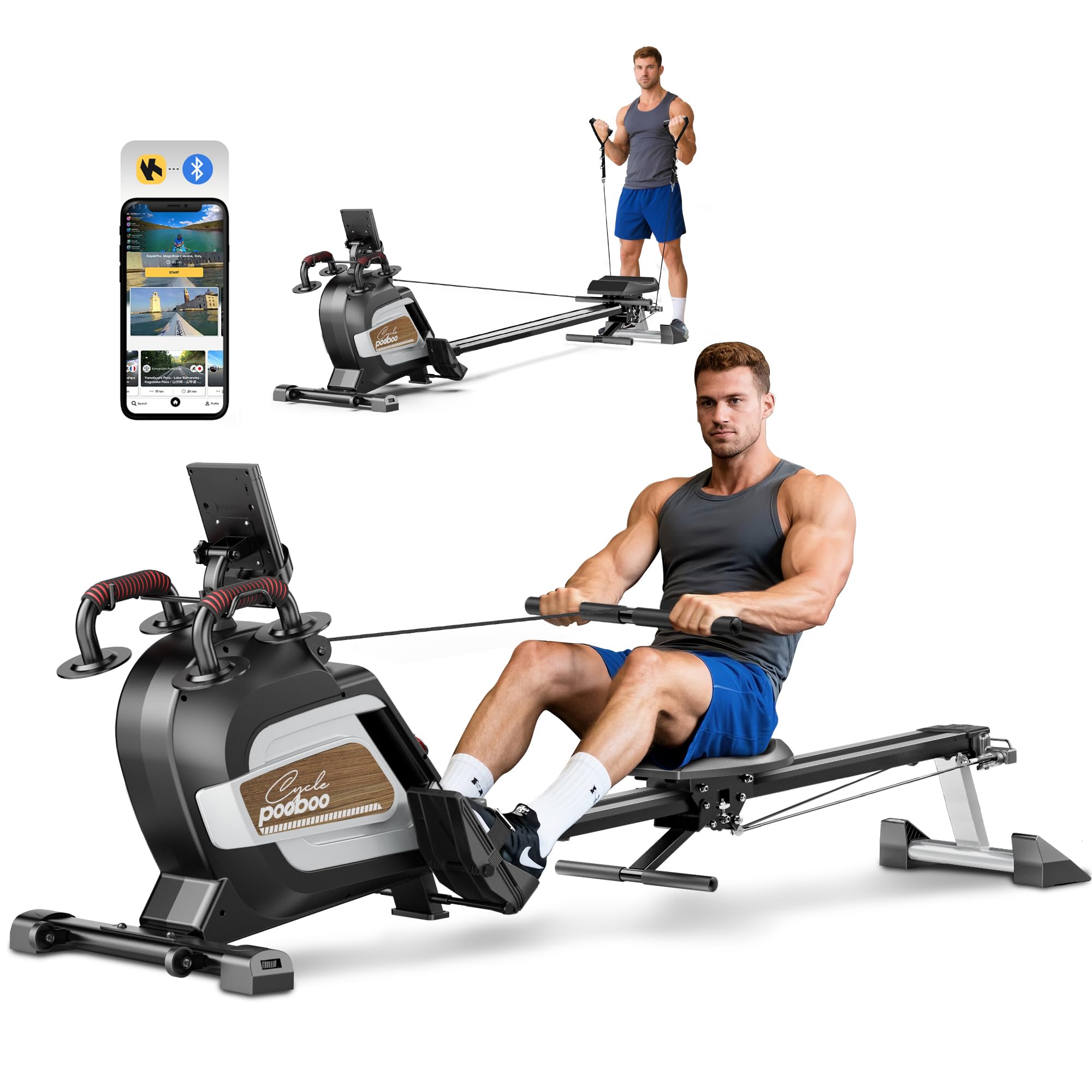
A near-silent magnetic rower that also doubles as a cable trainer
Two things separate this from a basic magnetic rower: it runs on 14 levels of magnetic resistance that stay quiet enough to row beside a sleeping household, and it doubles as a multifunction trainer. A resistance cord lets you switch to bent-over rows, cable squats, lateral raises, and bicep curls off the same machine. The steel frame holds 350 pounds, the LCD panel tilts to your angle, and a tablet stand holds your screen. Assembly is well-documented and labeled, and the whole thing folds and rolls on wheels for storage.
The build is the reason it lands in the middle of the list. The center beam is a strong rectangular tube — one taller owner fit the beam at 2 to 3 inches above 5-foot-9 — and the magnetic drive glides smoothly with sealed-bearing seat rollers. Owners rate it durable and quiet, and the customer service earns repeated praise for sending free replacement parts when something small fails. The one recurring note is that the max resistance could be stronger; the 8th level still gives a real burn but will not satisfy someone chasing hard intervals.
If you share a small apartment and want a near-silent rower that also handles cable squats and curls, this is a smart fit. The trade-off is the resistance ceiling, so treat it as a daily-movement machine rather than a race trainer. It is one of the best-value magnetic options here for pure quiet operation.
apartment dwellers: apartment dwellers who want a quiet daily rower that also adds a little strength training.
power rowers: interval chasers — the resistance tops out on the lighter side.
6. YOSUDA PRO Magnetic Rowing Machine H-187
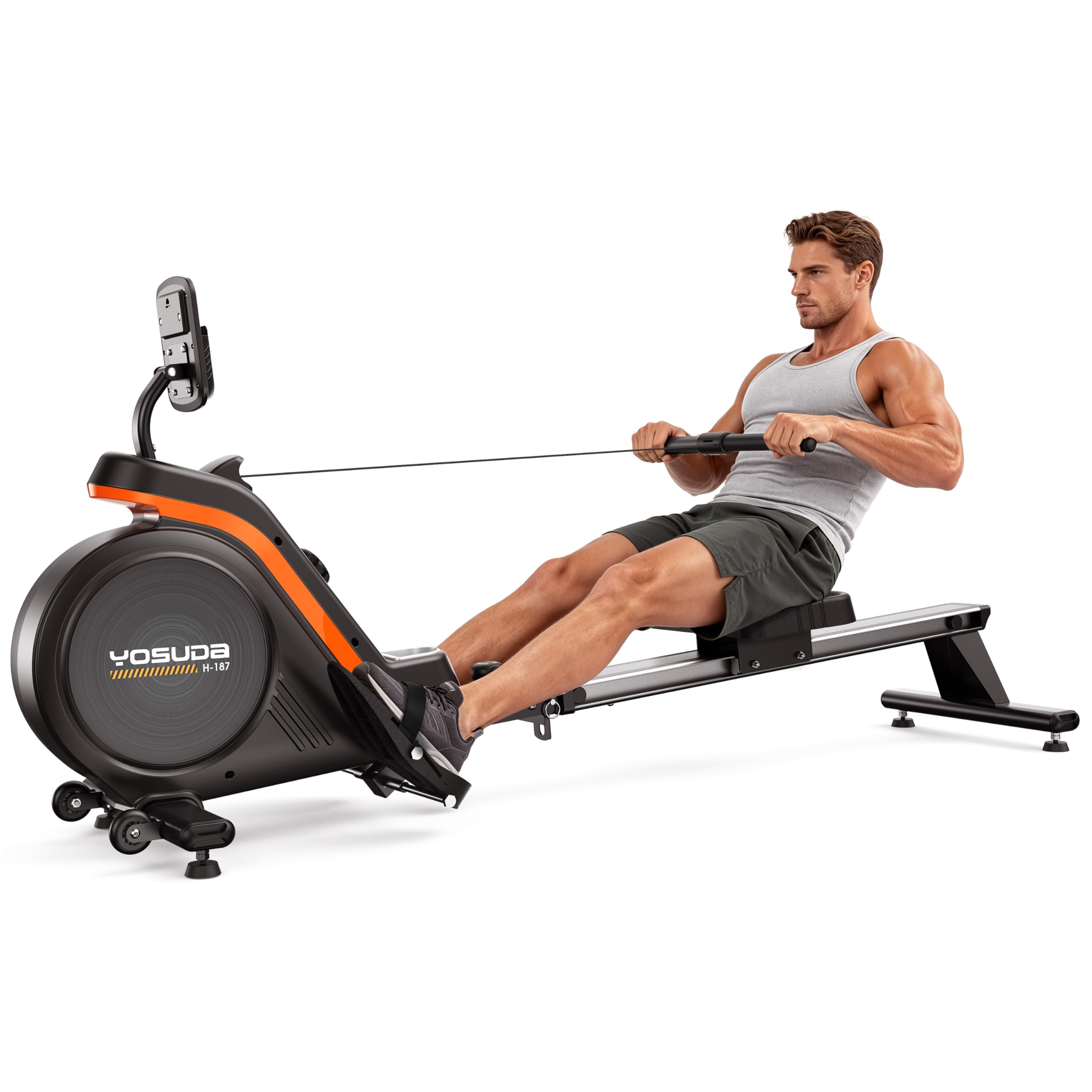
Legroom for the long-legged, with a magnetic pull that stays whisper-quiet
Tall rowers hit a wall with short rails, and this machine is the answer. It carries a 53-inch inseam and a 400-pound rating on a 4 mm commercial steel frame with two widened stabilizers, so it fits users up to 6-foot-6 without cramping the stroke. The aluminum slide rail runs smoother and quieter than ordinary iron tracks, and 16 levels of non-touching magnetic resistance use neodymium magnets and a 16-pound flywheel. The screen tilts 180 degrees, shows 9 types of data, and holds a tablet up to 9.25 inches. It also arrives about 90 percent pre-assembled.
Where this machine shines is setup — assembly is the single most-praised thing about it, and just behind that is how quiet it runs. The magnetic system truly does not touch, so it will not wake anyone. It is the kind of rower a beginner can build in about 20 minutes and then use without fuss. It is also a fraction of the space and weight of an air or water rower at 59.5 pounds, and it folds in half for storage.
The honest limit is durability over the long run and the resistance scale. The folding knob demands careful alignment or it will cross-thread, and a handful of owners mention the plastic strap guide or display failing past the first year. It is a budget rower, and the 16 levels are gentle compared with a premium magnetic machine. For a taller beginner who wants quiet and simple, those are fair trade-offs.
tall rider clearance: a 53-inch inseam and 400-pound capacity is rare at this tier, and it suits anyone over six feet well.
basic monitor: the folding knob needs a careful, aligned turn — treat it gently and it holds.
taller users: tall beginners who need a quiet, roomy magnetic rower that folds flat.
data tracking fans: if you want a hard resistance ceiling for serious conditioning.
7. Merach RS3 Scull Rowing Machine
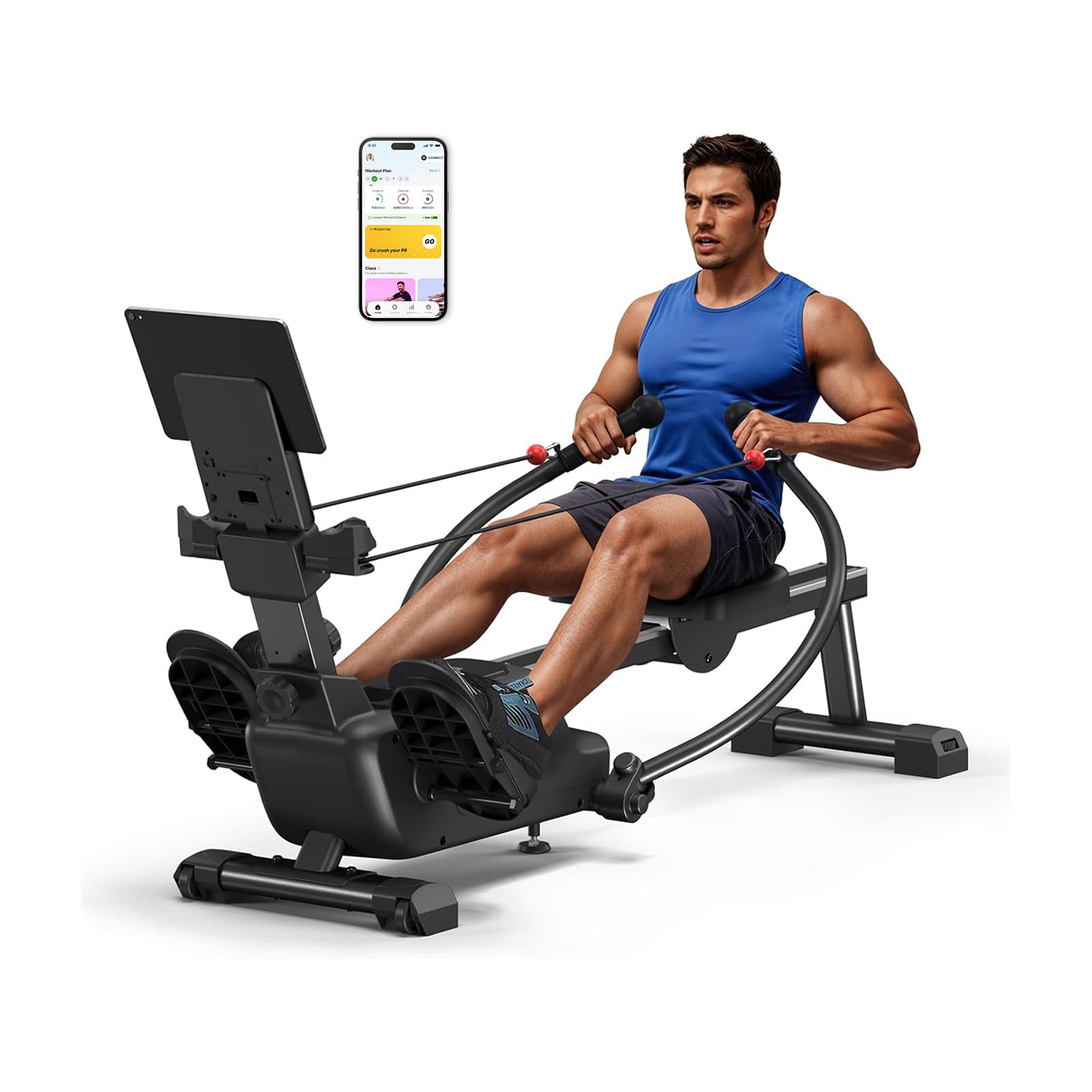
Two moving oar handles that let you row one arm at a time
The scull handles are the whole idea here. Instead of a single bar, two handles swing out and can move together or independently, which opens up one-arm rows, alternating strokes, and synchronized pulls. The pull itself is 80 pounds of magnetic resistance across 16 levels — strong enough that beginners will find plenty of room to grow. It fits exercisers up to 6-foot-4, holds 350 pounds, and arrives 85 percent pre-assembled for about a 20-minute setup. The Bluetooth connection links to the MERACH app and its free course library.
This is the rower for a runner or CrossFitter who wants cross-training variety instead of a single fixed stroke. Owners describe the glide as smooth and quiet, and the dual-handle design lets you hit arms, shoulders, back, and legs from slightly different angles. The compact frame folds to stand against a wall, so it does not need a dedicated floor. It weighs 58 pounds, which keeps it movable on its own.
Two things pull it back from the very top. The app’s free access runs only 30 days before a monthly fee — the rower works fully without it, but the guided courses are the paid part. The seat also runs hard, and serious on-water rowers will want the reference machine instead. For a general-fitness user who wants variety and no mandatory subscription, it is a strong pick.
upper body focus: you want to break up a rowing session with one-arm and alternating strokes, and store the machine against a wall.
leg power purists: you plan to row long distances every day — the seat runs firm.
8. pooboo Dual Scull Rowing Machine H188
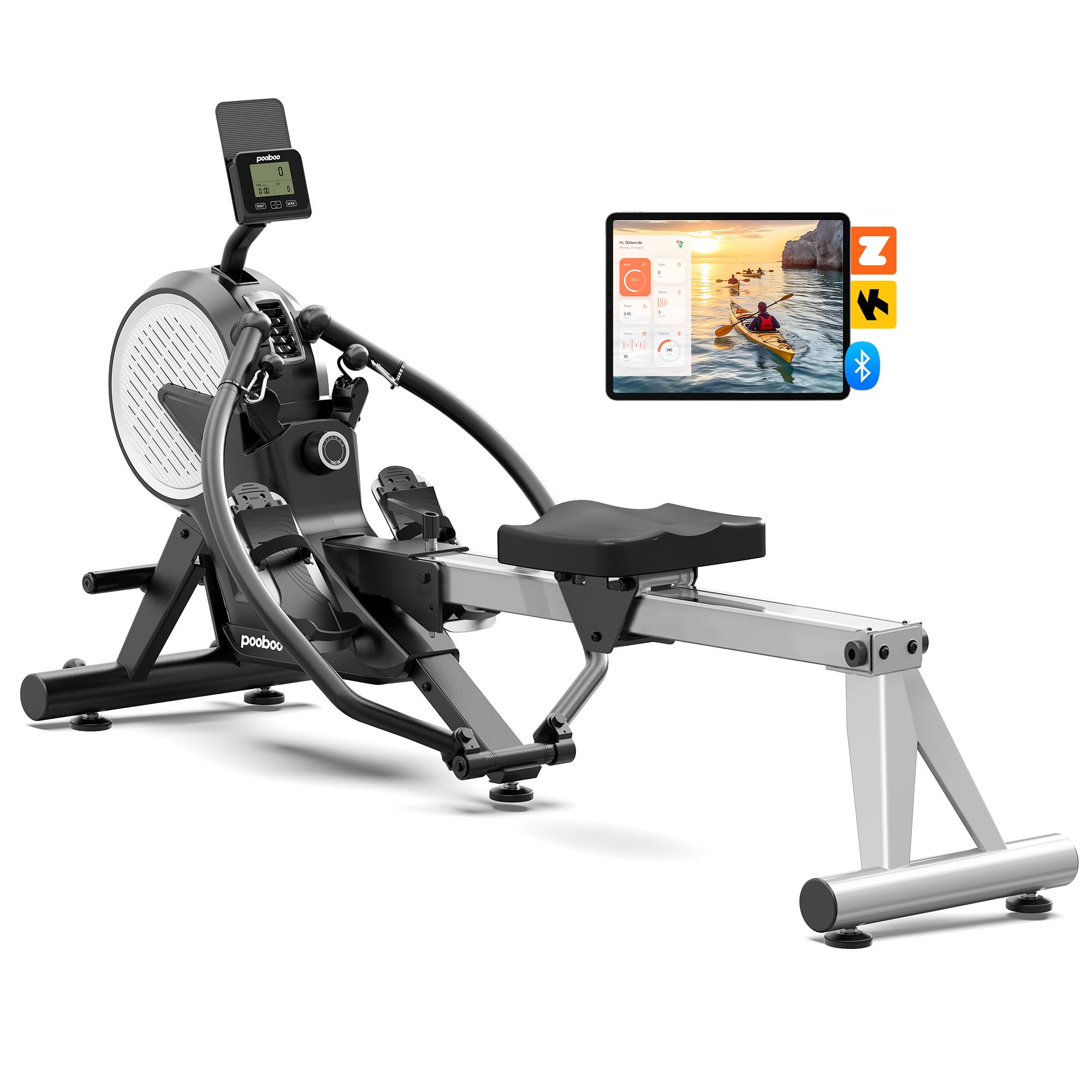
A 360-degree handlebar that lets your arms follow the real rowing arc
The standout here is the 360-degree rotating handlebar. It mimics the natural arc of a rowing stroke, engaging legs, back, core, and arms through a fuller range than a fixed bar. Underneath that, a dual wind and magnetic system gives you 14 levels of quiet resistance, so the workout stays low-noise at home. The rower fits users up to 6-foot-6 thanks to a 38-inch slide rail and a 15-inch seat height, and it holds up to 400 pounds. It folds vertically for storage and rolls on built-in wheels.
The 9-type LCD shows time, time per 500 strokes, calories, distance, and power, and the Bluetooth connection links to the KINOMAP app for guided routes. Assembly is 90 percent done on arrival — about 20 minutes. Owners praise the performance most, closely followed by how easy it is to build, and the dual option of sculling oars or a straight bar earns repeated thanks. A first-time rower who started at level 4 found the resistance fine for beginners and the machine quiet and durable.
The one thing to know is the seat: it runs firm, and a hard session may leave you wanting a cushion. The display has also been called hard to read at certain angles in a few cases, and the front air vent is more decorative than useful. None of that changes the stroke. Spend here for the arm-motion feel and the tall-user legroom.
dual scull handles: the 360-degree handlebar and 38-inch rail give you a natural stroke right up to 6-foot-6 — a genuine full-motion feel.
assembly time: the seat runs firm and the display is best viewed straight on, so consider a cushion.
full-body workouts: you are tall and want that swinging oar motion and app routes without a class subscription.
simple setup seekers: you want a racing-grade monitor for exact splits.
9. Sunny Health & Fitness Smart 360° Magnetic Rowing Machine
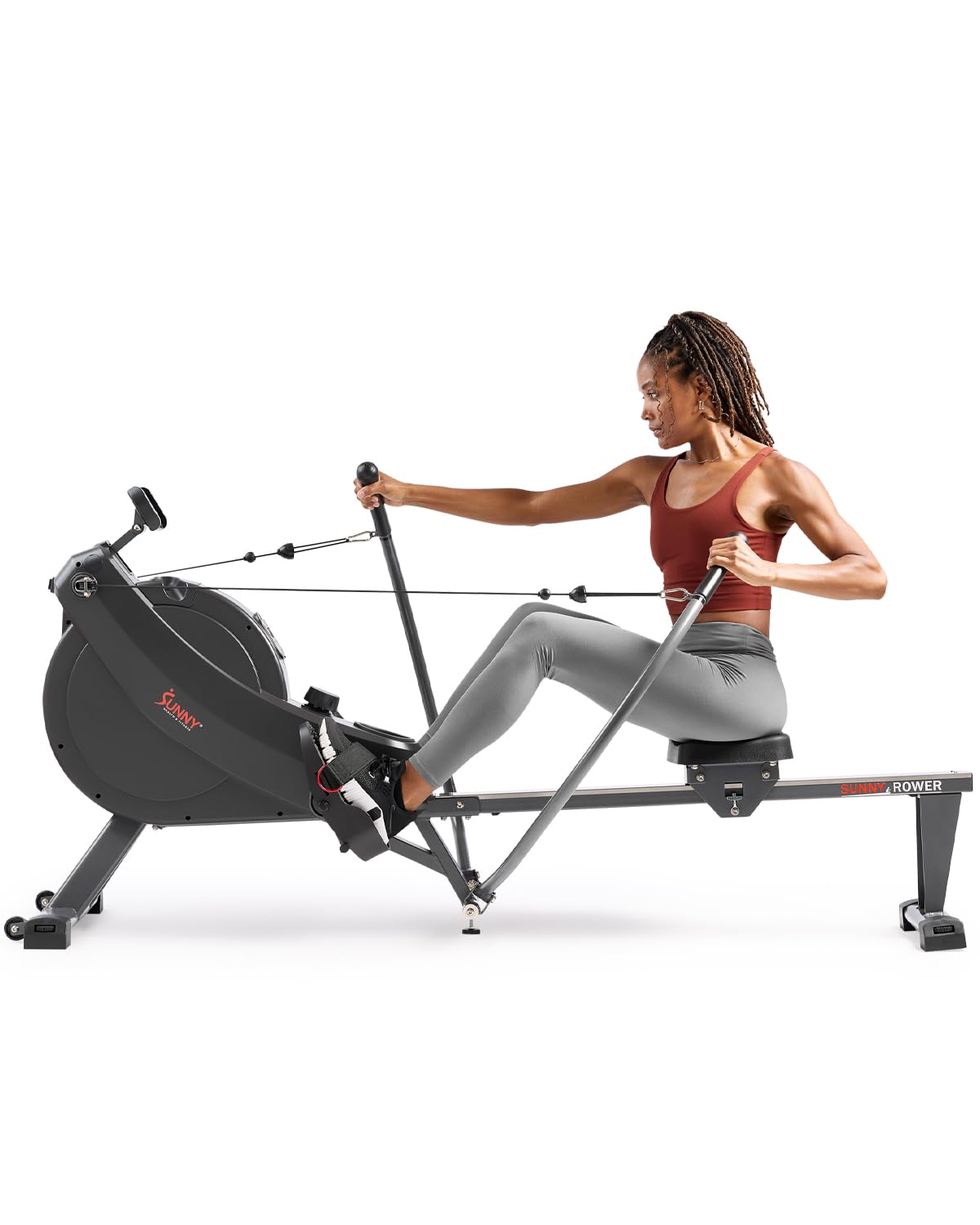
Full-motion arms on a long steel rail, with a free app to match
The 360-degree full-motion handlebar is the headline. A double-cord design lets your arms follow the rowing arc and adds a shoulder-mobility angle a fixed handlebar misses. Under that sits a 51.3-inch rail with a stainless steel cover for a smoother, quieter glide, and a padded seat set at a 17.6-inch height to ease your lower back. It holds up to 330 pounds and includes a free connection to the SunnyFit app. The LCD tracks distance, time, count, total counts, strokes per minute, and calories.
Value is the most-praised quality, and assembly is right behind it. The included tools make setup fast — one owner had it together in 30 minutes — and the machine stores upright for small spaces. The seat and arm movement run smooth, and owners row on it daily without trouble. At 91.8 pounds it sits heavy but stays movable by holding the arms.
Where it asks patience is the resistance. The dial under the seat is the least precise part of the design, and the top end runs on the softer side — 16 levels exist but the range feels narrower than the number suggests. That makes it a fine everyday-workout rower and a weaker choice for interval training. Get it for the arm motion, the long rail, and the free app.
dual function versatility: a 51.3-inch covered rail and a free app make it a genuinely useful full-motion rower for the money.
soft resistance top end: the resistance dial under the seat is fiddly and tops out gently — fine for steady sessions, not intervals.
variety seekers: a steady daily rower who wants shoulder-mobility motion and a free app.
hardcore rowers: hard interval training where you want to dial exact resistance.
10. Merach R60N Rowing Machine

A rugged air-and-magnetic hybrid rated for two people’s worth of weight
Two resistance systems drive this rower. Speeds 1 to 7 run on pure air resistance for smooth training, while speeds 8 to 10 add magnetic resistance for heavier HIIT work, with a peak magnetic lift force of 45 percent or more. The result is a machine that rows light when you warm up and gets serious when you push. The 53-inch aluminum rail has an I-beam structure that supports up to 500 pounds, matching the reference machine’s capacity. The seat sits at 17.7 inches with adjustable footplates to fine-tune your leg position.
Build quality is what wins people over — the frame earns more praise than any other single feature. It assembles in about 20 to 30 minutes, stands vertically for storage, and the track splits into two parts in two seconds. It self-generates power so you never charge it, and the backlit monitor is designed for low light. Owners regularly compare it to far pricier rowers and call it a clone-level match for the stroke.
The trade-off is the display. A number of owners find it hard to read in lower light — the backlit claim does not fully hold up — and it scrolls its metrics every few seconds rather than showing all at once. Resistance at the top damper setting also feels lighter than expected for a dual-system machine. If you pair it with a Bluetooth app, the rower itself holds up fine; the screen is the weak link.
hybrid resistance fans: you want a 500-pound-rated air-and-magnetic rower that self-powers and stores vertically.
compact space owners: the on-machine screen is your main way of tracking stats.
11. WaterRower Club Rowing Machine with S4 BLE Monitor

Hand-built solid ash and the original water flywheel, made to outlast trends
This is the original water rower, designed in the mid-’80s by a US national team rower, and it is still hand-built in Rhode Island from solid ash sourced from Appalachian hardwood forests. The resistance comes from paddle blades spinning through a water tank, and it scales with effort — the harder you pull, the more resistance you feel. The 82-inch rail stores upright on end. It weighs 117 pounds, and the water tank is filled at setup. Nothing about the basic workout asks for a subscription.
Owners rave about the quality of the build — handcut wood and a pulley system that one calls as smooth as silk. The water sound is soothing, the seat is comfortable, and assembly runs 30 to 45 minutes. The S4 monitor is upgradeable with Bluetooth, so you can push your data to a phone. Customer service earns praise too, including one case where a cracked tank was replaced and the machine still works flawlessly.
The catch here is real-world upkeep and the foot straps. The tank needs occasional water treatment to stay clean, and the tank fill can be fiddly at setup. A minority also find the straps to be the weakest part — a single strap wraps both feet and takes practice to adjust. That is the price of the classic. It is a beautiful, durable machine for someone who wants the water rowing experience in hand-built solid ash.
solid wood build: handcrafted solid ash and a water flywheel give it a feel and look no steel frame on this list matches.
premium pricing: the twin foot straps take practice, and the tank wants a little care to stay clean.
long-term investors: you want a made-in-the-USA wood rower that doubles as furniture and rows for years.
casual beginners: you want zero water maintenance or a very light frame.
Know the Specs
Resistance type (air, magnetic, water)
Air resistance spins a fan wheel, and the resistance grows the faster you pull — it feels closest to real rowing. Magnetic resistance uses magnets near a flywheel, so it stays very quiet and lets you dial a fixed level. Water resistance moves paddles through a tank for a smooth, soft splash. The resistance type decides noise, feel, and upkeep, so it is the first spec to settle before anything else.
Weight capacity and rail length
Weight capacity is the most a machine is rated to hold, and it ranges widely on this list — from 300 pounds on the Xterra water rower up to 500 pounds on the Concept2 and Merach R60N. Rail length is the track the seat slides on, and it decides legroom for tall rowers. A 53-inch inseam or an extended rail suits longer legs, so match both to your body before you buy.
Machine weight and storage
Machine weight tells you how easily you can move a rower, and how stable it feels. Lighter frames like the 52-pound JOROTO roll easily; heavier ones like the 91.8-pound Sunny stay planted. Look for folding, splitting, or upright storage if space is tight, and check for transport wheels so a heavy frame is not stuck in one spot.
The monitor and app connection
A monitor is the built-in computer that shows time, distance, strokes, and calories. A basic LCD is enough for home use, while competition-level monitors add watts and split times. Bluetooth lets a rower sync to a free app like SunnyFit or KINOMAP. None of these machines require a paid subscription to row — the monitor just tells you how the session went.
Common Questions
Can I use a rowing machine without any app at all?
Do any of these rowers require a paid subscription to open up the workout?
Is air or magnetic resistance quieter for an apartment?
How much floor space does a rower need?
Can a tall person use a folding magnetic rower?
Is a water rower hard to maintain compared with magnetic?
How much weight can these rowing machines hold?
Will a rower work for someone with knee or back issues?
Do magnetic rowers let you adjust resistance mid-stroke?
How long does assembly take on these rowers?
The Bottom Line
For most buyers, the rowing machine without subscription winner is the Concept2 RowErg with Tall Legs. It delivers a full, honest workout on a 500-pound-rated welded steel frame with nothing to rent, and the PM5 monitor tracks your watts and splits for free. If you want a folding air rower at a friendlier tier, grab the PASYOU PR70. And for a quiet apartment rower that doubles as a strength trainer, the pooboo h015 is the one to reach for.
The Concept2 holds 4.5+ stars and the best build on this list, so if you can spare a 9×4-foot patch of floor, it is the machine you will still be rowing on years from now. If space or budget is the tighter constraint, the folding magnetic and air picks above prove you do not need a big footprint or a monthly fee to get a real workout at home.
How we choose
We do not accept paid placement. Every pick is matched to a real buyer and a real use-case; we do not hands-on test units.
Sources
Specifications: manufacturer listings and product documentation. Review insights: verified customer reviews, as of October 2026. Pricing: not shown on this page (it changes often); check the current price via the retailer link.
As an Amazon Associate, Aappliancez earns from qualifying purchases. This does not affect which products we feature.