Disclosure: Some links in this post are affiliate links. As an Amazon Associate I earn from qualifying purchases, at no extra cost to you. Learn more
Specs are compiled from manufacturer listings and verified buyer reviews and can change over time — please confirm the key details on the product page before buying.
If you make jewelry, you already know the problem: most rotary tools are built for bigger jobs and shake your hand just enough to ruin a bezel setting. The right pick has to do three things well — hold a slow polish without stalling, run fast without wobbling, and stay light enough to hold like a pen for an hour. This list covers ten tools that actually do that, from pen-sized cordless engravers to a benchtop press for drilling beads straight through.
This guide is built by comparing the manufacturers’ published specifications and the patterns across verified customer reviews, so you get each pick’s real strengths and trade-offs instead of marketing spin.
The jump from a general-purpose tool to a dedicated jewelry tool shows up at the low end of the speed dial, where polishing and edge cleanup happen. Below, you’ll find the speed range, chuck size and control method that separate a smooth polish from a melted edge, so keep reading for the best rotary tool for jewelry making.
Top Picks

How To Choose The Best Rotary Tool for Jewelry Making
Jewelry work lives in the small end of the dial. You need a tool that holds a steady slow spin for polishing a resin cabochon, then speeds up for drilling a hole through a bead. Buy for control first and raw power second — a 180W motor that jumps between speeds will scar more resin edges than a gentler one that holds a steady slow spin.
Low-speed control beats headline RPM
A tool rated down to 5,000 rpm gives you a usable slow setting for polishing and edge cleanup. One that starts at 8,000 rpm is livelier but jumps into the material faster than a beginner expects. If you plan to work near thin resin edges or soft wire, the lower floor is the safer place to start.
Corded, cordless, or flex shaft
Corded kits run all day with no battery worry. Cordless pens slip into your hand like a pencil and free you from a trailing lead, at the cost of runtime. A flex shaft moves the motor off your hand entirely, so the handpiece stays thin — the better pick if you sit at a bench for hours.
Chuck size and bit fit
Most jewelry burs and diamond bits use a 3/32 inch shank. Check the collet or chuck spec before you buy, because a tool that only ships with one collet size limits which bits you can load. A keyless or locking-button change saves real time when you swap between a drill bit and a polishing wheel.
Noise, vibration, and your hand
A rotary tool that buzzes will blur your fine lines. Low-vibration designs keep the bit where you put it. Weight matters too — a lighter handpiece is easier to steer for detail work, while a heavier one feels steadier for grinding.
Side-by-Side Comparison
| Model | Best For | Speed Range | Power Source | Accessories | Amazon |
|---|---|---|---|---|---|
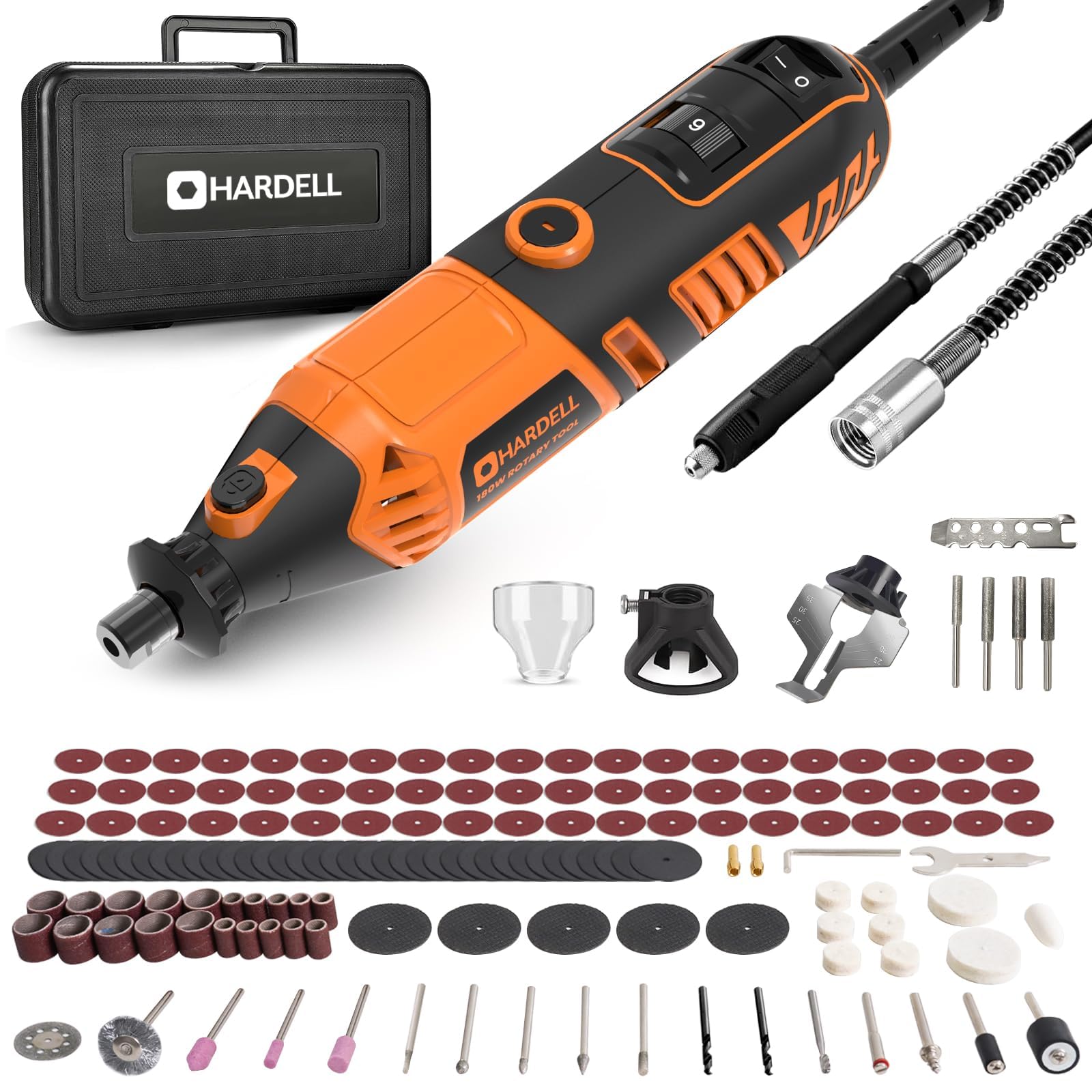
| Dremel 4000-2/32★ Best Overall | All-round jewelry bench work | 5,000–35,000 rpm | Corded | 32 | Amazon |
| HYCHIKA 180W Rotary ToolBest Value | Budget bench starter | 8,000–35,000 rpm | Corded | 173 | Amazon |
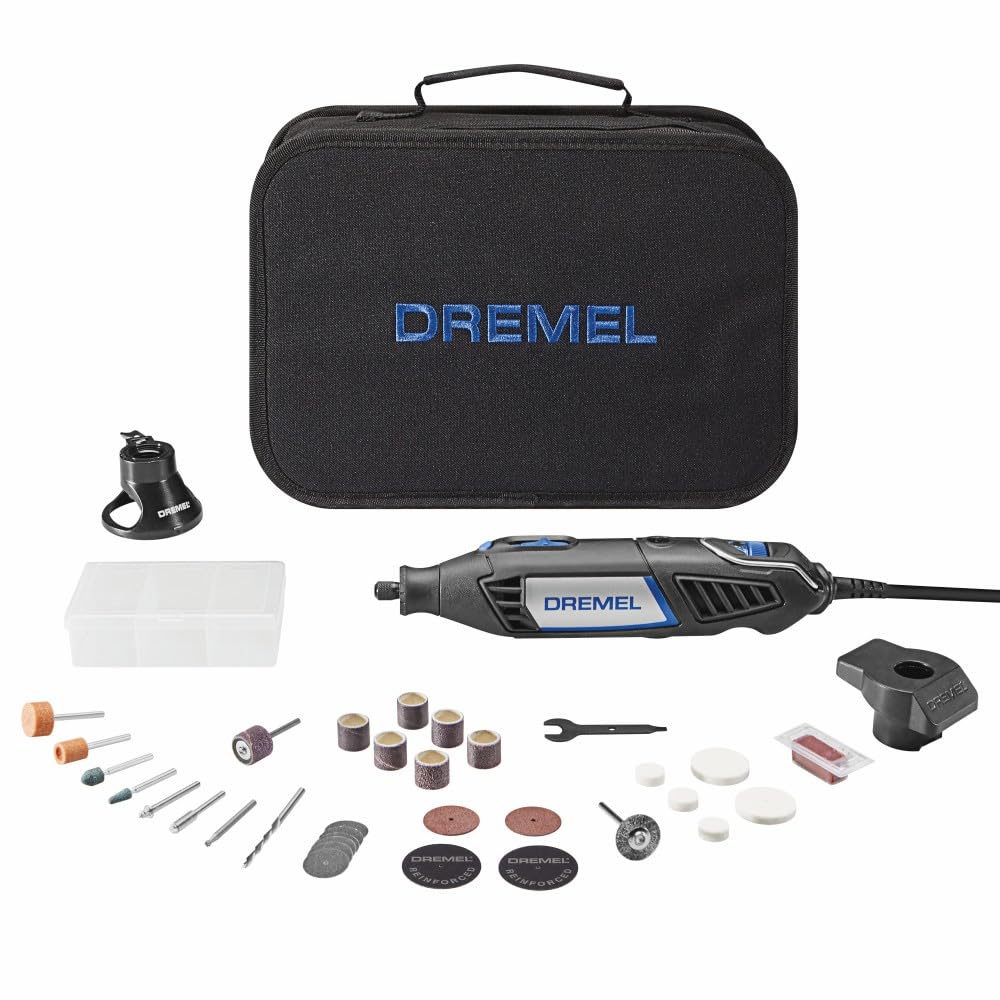
| HARDELL 180W Rotary Tool KitBest Bit Selection | Beginners who want a big bit set | 8,000–35,000 rpm | Corded | 153 | Amazon |
| Resiners 52pcs Cordless Kit | Resin jewelry makers | 8,000–16,000 rpm | Cordless (1,500mAh) | 52 | Amazon |
| AM ARROWMAX Engraving Pen | Fine engraving and bead detail | Up to 30,000 rpm | Cordless (5V) | 42 | Amazon |
| Dremel 3100-1/15 | Clean corded bench work | 5,000–35,000 rpm | Corded | 15 | Amazon |
| Marathon-III Micromotor | Bench jeweler polish station | 0–35,000 rpm | Corded | — | Amazon |
| Fanttik F2 PRO | Cordless detail finishing | 5,000–25,000 rpm | Cordless (3,000mAh) | 55 | Amazon |
| BERXOL Mini Drill Press | Straight holes in beads and stone | Max 7,000 rpm | Corded (24V) | 11 bits | Amazon |
| SE Flex Shaft Grinder | Long bench sessions | Up to 22,000 rpm | Corded | 55 | Amazon |
Detailed Reviews
1. Dremel 4000-2/32 Rotary Tool Kit
Our pick — 4.5+★ from 850+ verified ratings; the strongest balance of quality and price.
The bench standard that holds a slow polish without stalling your resin edge.
The dial is what sells this one for jewelry work. It drops all the way to 5,000 rpm (revolutions per minute — how fast the bit spins) and climbs to 35,000 rpm, so you get one setting for burnishing a soft edge and another for drilling through a bead. The 1.6 Amp motor is rated 33% more powerful than the Dremel 3100, and the electronic speed control holds that speed steady when the bit bites into a bezel edge.
Hand comfort sits high on the list here. The 360-degree grip zone means you can rotate your fingers around the body instead of gripping one fixed spot, which is the difference between a clean line at minute forty and a wobbly one. The tool weighs 3 pounds, so it sits steady on the bench rather than dancing around. Buyers report using it for exactly this kind of work — one review describes drilling holes into beads, sea glass and shells for sun catchers with diamond-tip bits that fit the chuck perfectly.
Where it does not keep up with cheaper kits is accessory volume. This kit ships with 32 accessories, against 153 in the HARDELL kit, so you will be ordering specific burs, polishing points and drill bits separately. The bits also wear — as owners put it, brushes and consumables break down faster with frequent use and need replacing. Neither point makes it a bad tool, just a tool for someone who’d rather buy the pieces they actually use.
Where this Dremel earns its keep
- Wide 5,000–35,000 rpm range gives you a true slow setting for polishing
- Electronic speed control keeps the bit spinning evenly under load
- 360-degree grip zone lets you reposition your hand mid-job
- Two attachments included, so a flex shaft or cutting guide is ready out of the case
What to plan around
- 32 accessories is a lean kit next to the 153-piece budget options
- Consumable bits and brushes wear with heavy use
- 3 pounds is stable on the bench but not a pen-weight tool
Buy this if: you want one corded tool that covers polishing, drilling and engraving on a jewelry bench and you’d rather pick your own bits.
Look at the HYCHIKA instead if: you want a huge starter bit set for the same first project.
2. HYCHIKA 180W Rotary Tool with Flex Shaft
A 173-piece starter spread that lets you test a dozen finishing techniques before buying better bits.
The number that does the work here is 173 — that is how many accessories ride in the case. For a jewelry bench that matters, because you can try a felt wheel, a diamond point and a drill bit in one week without a second order. Under the plastic sits a 180W corded motor with six speed settings from 8,000 to 35,000 rpm. That floor is 8,000, so it is not the slowest starter on this list, but the range still covers sanding through to cutting.
A 1m flex shaft (a flexible cable that moves the spinning bit to a slim handpiece) is the piece jewelry makers will use most. It lets you work at awkward angles on a pendant without wrestling the whole motor body around, and it cuts hand fatigue during long sessions. Power holds up in prose, too — builders report it cutting steel bolts and polishing without bogging down, and owners mention the tool is “perfectly functional and very powerful” with a nice assortment of accessories.
The honest ceiling is heavy production. This is a light-to-medium tool, and the vibe across the listings is occasional use rather than a full-time shop. That makes it a strong first kit for learning the bits and a weaker choice for someone already running bezels all day. Note that the chuck needs tightening with the included spanner before the first use.
The real draw: 173 accessories plus a flex shaft in one case, on a 180W motor rated 8,000–35,000 rpm — more kit than the Dremel 4000-2/32 gives you, by a wide margin.
Set your expectation: this is a hobby-tier tool. Buy it to learn the bits, not to outlast a professional handpiece.
Reach for this if: you are starting from nothing and want every bit type in front of you plus a flex shaft to reach tight settings.
Spend elsewhere if: your work is daily, high-volume bezel and prong finishing.
3. HARDELL 180W Corded Rotary Tool Kit
Ten diamond grinding heads and a wool wheel set — the jewelry-relevant bits are already in the box.
Most starter kits bury you in cut-off wheels you will never touch. This one is different in one useful way: it includes five diamond grinding heads at 3.2mm, three aluminium oxide grinding wheels at 3.2mm, two wool wheels and six small wool wheels. Those are the exact shapes you reach for when smoothing a resin edge or polishing a metal finding.
The motor is a 180W unit with a six-speed gear adjustment from 8,000 to 35,000 rpm. Unlike a slider, the gear change clicks into place, which is steadier when your hands are busy. The body carries soft rubber inlays and ventilation holes that shed heat during longer sessions. What wins people over is the raw amount of tool per project — customers note engraving names on wood rounds and sanding foam clay with it, and one review calls it a great value with a good choice of speeds and a locking button for quick changes.
Two things to know before you commit to it as your main engraver. The first is the flex shaft extension: it is sensitive to bending, so route it in a gentle curve rather than a sharp one. The second is that the sanding drums can work loose mid-job and need re-tightening. Neither ruins the tool, but both cost you a minute in the middle of a piece.
Why the diamond heads matter: 153 accessories in total, with five 3.2mm diamond grinding heads and a full wool-wheel set aimed at polishing, plus a protective cover and a small wrench for bit changes.
Handle with care: keep the flex shaft curve gentle and check the sanding drum tension, and this stays a solid first corded kit.
Pick it when: the bit assortment is your buying decision and you want diamond grinding heads included from day one.
Pass if: you plan to lean hard on the flex shaft in tight angles — that cable prefers to hang free.
4. Resiners 52pcs Cordless Rotary Tool Kit
A pen-style body built for resin dust and a bench that has no room for a cord.
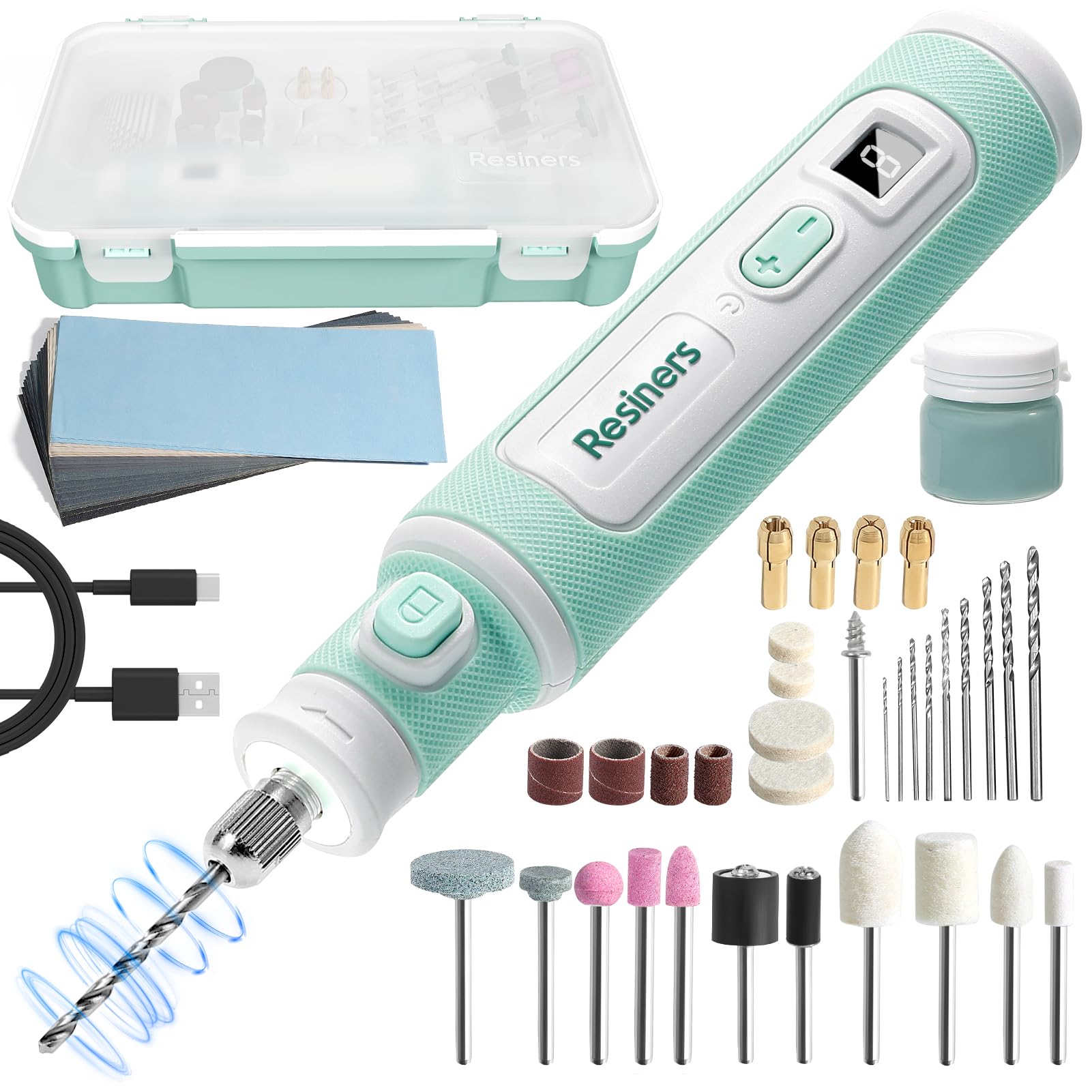
This one is aimed squarely at resin crafters, and the specs show it. Eight speed settings run from 8,000 to 16,000 rpm — a narrow band, but exactly the band you want for smoothing a cured cabochon rather than slicing it. Torque is rated at 200gf.cm (a measure of twisting force), enough to keep a polishing bit turning when it meets a raised edge.
The body is TPU with a pen-style shape, and a small light sits near the bit so you can see the edge you are working. Power comes from a 1,500mAh rechargeable battery over USB Type-C, with a claimed 2 hours to charge and up to 1.5 hours of continuous use. The 52-piece set sits in a compartmental box with dedicated slots for collets and wrenches, which keeps a small workspace tidy.
Battery runtime is the trade-off. The listing claims 1.5 hours, and some owners find it falls short of a long session, so plan your work around a charge rather than expecting an all-evening tool. There are also reports of units cutting out during use — worth knowing, and worth testing hard in the first weeks while the seller’s response is still quick. Treat it as a dedicated resin finisher, not a do-everything bench tool.
What sells the resin crowd
- 8 speeds capped at 16,000 rpm — a controlled band for delicate resin edges
- Cordless pen body with a USB Type-C port and 1,500mAh battery
- 52 accessories in a compartment box with slots for collets and wrenches
- Built-in light near the bit for detailed work
Where it asks patience
- Runtime is modest — plan projects around a charge
- Some units have cut out mid-job, so test yours early
- 8,000 rpm floor limits it to light material
This is your tool if: you pour and polish resin jewelry on a small desk and want no cord in the way.
Not for: anyone drilling metal or running long uninterrupted sessions.
5. AM ARROWMAX Electric Mini Engraving Pen

Hold it like a pencil, change direction with your thumb, and engrave a name on a bead.
Direction control is the feature that separates this pen from the rest of the list. A power button flips the bit between forward and reverse with one hand, and a gear key sets four RPM modes. That reverse matters for jewelry: you can pull a bur out of a drilled hole instead of backing it out by hand and chipping the edge.
Inside is a hollow-core motor that the maker claims delivers three times the torque of a standard motor, driving a diamond tip for engraving bead surfaces. It tops out at 30,000 rpm. The 42-piece set brings 30 engraving bits and 12 polishing bits in an aluminium case, and the pen charges magnetically over USB with a 5V battery rated for up to 90 minutes of use. Reviewers point out using it across wood, plastic and coated surfaces for light engraving, and note the bit changes are quick.
The bits are the thing to watch. They are consumables, and some owners find they wear down fast on harder material — a handful of engraving lines and the edge softens. Order a set of spare diamond bits with the pen and this stops being a problem. Power is also modest for hard metals, so keep it to soft metal, wood, glass, resin and plastic.
What wins people over: one-thumb forward and reverse plus four speed modes on a 30,000 rpm pen, with 42 bits and a magnetic USB charger in an aluminium case.
The catch to plan for: tips dull faster than you would like, so keep spares on the bench.
Hand this to someone who: needs fine lettering and bead detail with a pen grip and no cord.
Skip it for: cutting or grinding hard steel, where the small motor runs out of push.
6. Dremel 3100-1/15 Rotary Tool Kit
Five detent-click speeds, a six-foot cord, and no battery to die mid-polish.
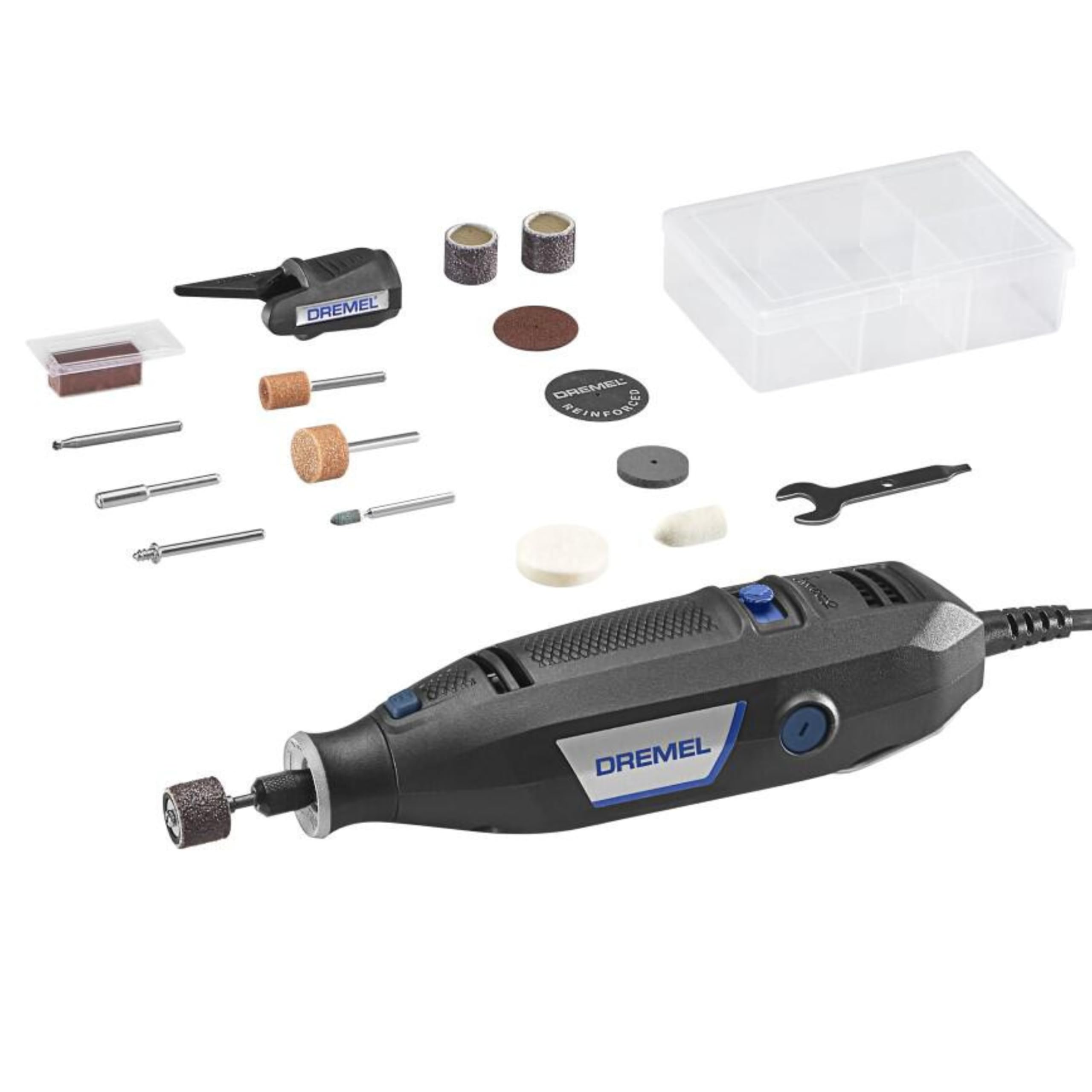
Speeds here click through five settings from 5,000 to 35,000 rpm, and the detent switch (a stepped switch that lands in fixed notches) is easier to hit precisely than a smooth slider. A 1.2 Amp motor drives it, rated 33% more powerful than the Dremel 200, so it keeps a polishing wheel turning under light pressure. The airflow design is rated 10% cooler than the Dremel 3000, so the body stays comfortable through a long polishing session.
The six-foot cord is the quiet advantage. You can set the tool down and reach the far end of a bench without an extension lead. It weighs 1.9 pounds, light enough to hold for detail work but grounded enough not to skate. Builders report cutting glass pipe at a mid power level with diamond wheels, which is a fair signal that the low and middle settings carry real control.
The accessory count is the honest limit — 15 pieces and one attachment, against 153 or 173 in the budget kits. Some also find it ships with a single collet size, so check your bit shanks before ordering. It accepts compatible third-party bits, so filling the gaps is cheap, just not instant.
Buy it for the switch: five fixed speed notches over 5,000–35,000 rpm on a 1.2 Amp motor, with a six-foot cord and a body rated cooler than the Dremel 3000.
Budget for bits: 15 accessories will not cover a jewelry project on its own.
Best for: a maker who wants a reliable corded body and picks bits individually.
Think twice if: you want everything in the box on day one.
7. Marathon-III Micromotor Lab Jewelry Carving Kit
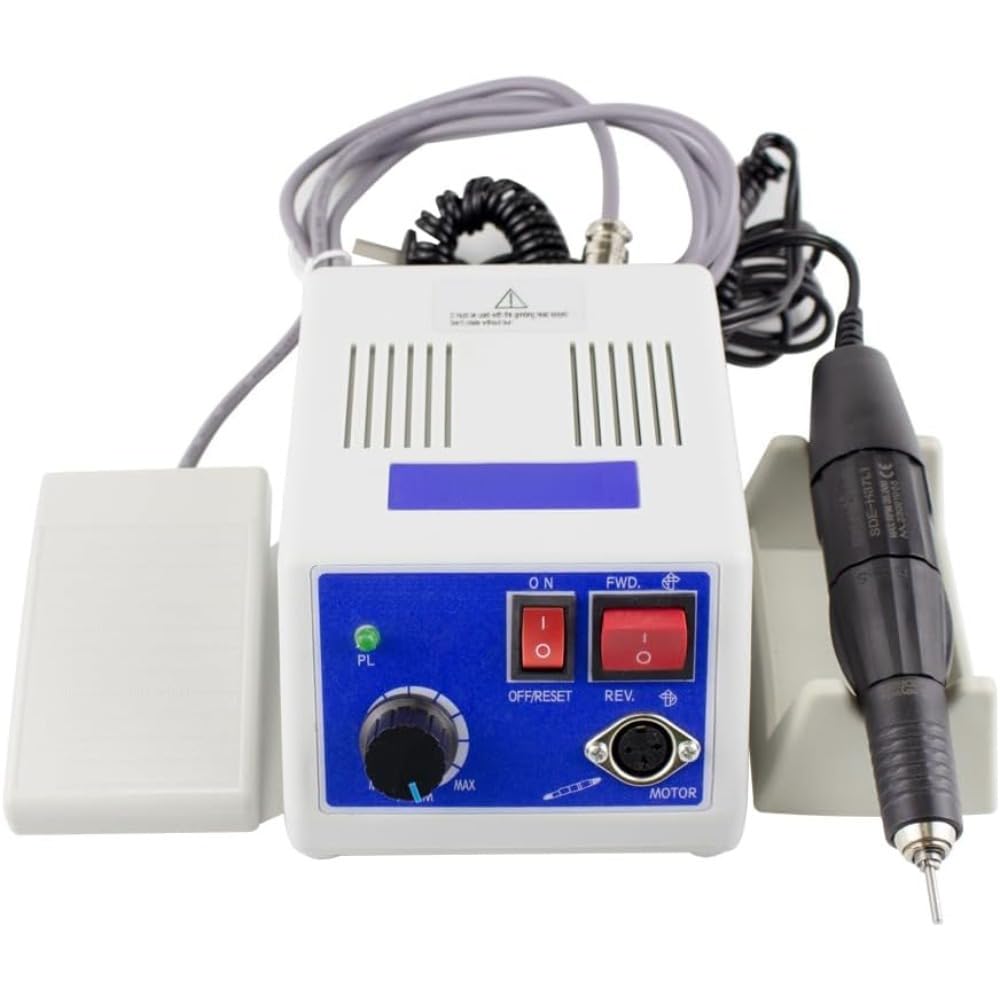
A pencil-thin handpiece and a foot pedal — the setup a bench jeweler already knows.
Two design choices make this feel like a jeweler’s tool rather than a hobby rotary. The first is the foot control, an ON/OFF pedal with variable speed, so both your hands stay on the piece while your foot does the dialing. The second is the pencil-style handpiece with a 3/32 inch chuck, machined to take 2.35mm burs — the standard shank on most jewelry burs.
Speed is a non-stage system from zero to 35,000 rpm, meaning it ramps smoothly rather than stepping between fixed settings. That makes it the only tool on this list that can crawl at a near-stop for setting work. Rotation runs both directions for different carving and polishing actions, and the compact control box keeps the motor off your hand entirely. It is reasonably quiet and low on vibration in use.
The caution is durability. Reports on the motor and handpiece are split, with some units failing within a few months of regular work, so this rewards gentle use and a light hand rather than heavy pressure. It is also built for a specific job — jewelry, carving and polishing — and does not pretend to be a general DIY tool. Check the handpiece before the return window closes.
The bench-jeweler setup
- Foot pedal gives hands-free variable speed control
- 3/32 inch chuck accepts standard 2.35mm jewelry burs
- Non-stage speed from zero to 35,000 rpm for fine setting work
- Bidirectional rotation for carving and polishing actions
Run it gently
- Longevity is uneven — some handpieces fail early
- Light-use tool, not built for heavy pressure
- Corded AC only, with no battery option
Worth it for: a jeweler who works seated at a bench and wants foot control plus a slim pencil handpiece.
Look at the SE flex shaft instead if: you want the same overhead-motor idea from a longer-established design.
8. Fanttik F2 PRO Cordless Rotary Tool Kit
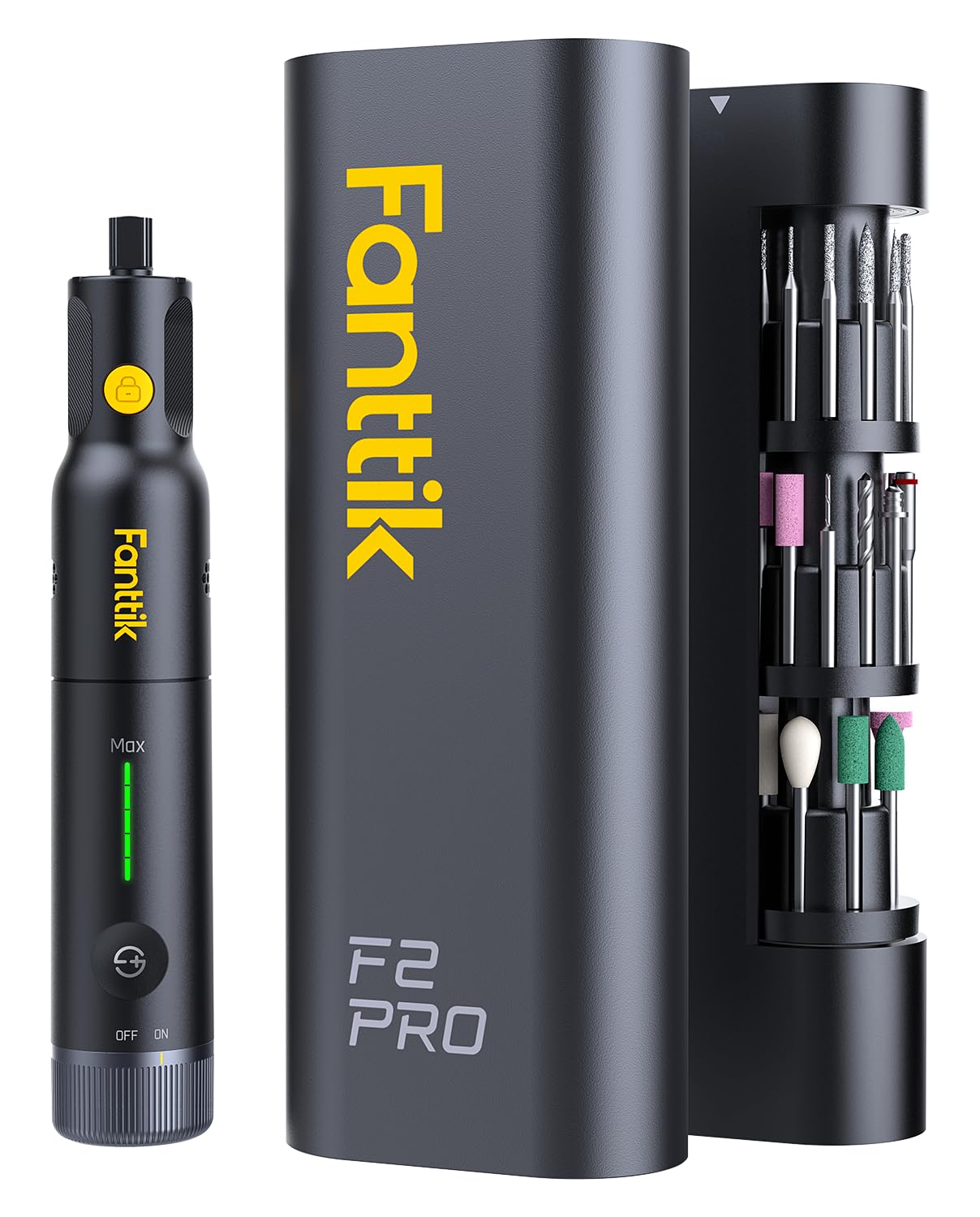
Twenty-five thousand rpm in your hand with no cord, and a magnetic carousel for the bits.
Battery capacity is the number a cordless buyer should check, and this one carries 3,000mAh with a rated 20 to 120 minutes of use depending on material and speed. Five speed settings cover 5,000 to 25,000 rpm. The top end is below the corded Dremel 4000-2/32 and the HARDELL, but for polishing and detail sanding it is plenty, and the bottom end matches them at 5,000.
The accessory holder is the clever bit: a 360-degree rotating magnetic hub in an aluminium case, with a quick-access button. Fifty-five accessories sit in it, so you swap a polishing point without opening a drawer. A shadow-free LED at the front lights the work, and a side LED band shows the current speed. A rear indicator turns red below 30% battery, which is the warning that saves a half-finished piece.
Runtime on the highest setting is the point to plan around — it drops fast under load, and one review puts it around half an hour at the top speed. Cordless also means it will not match a plug-in Dremel for sustained torque. Treat it as the grab-and-go finisher beside a corded bench tool, not a replacement for it.
The honest read: 3,000mAh and 5,000–25,000 rpm in a 220g body, with 55 accessories on a rotating magnetic holder — a genuinely portable detail tool.
Battery reality: the low-battery light is useful because the high-speed runtime is short.
This suits: a maker who works in short bursts and wants the tool and bits to travel together.
Not the pick for: deep cutting or long continuous sanding on a single charge.
9. BERXOL Mini Drill Press
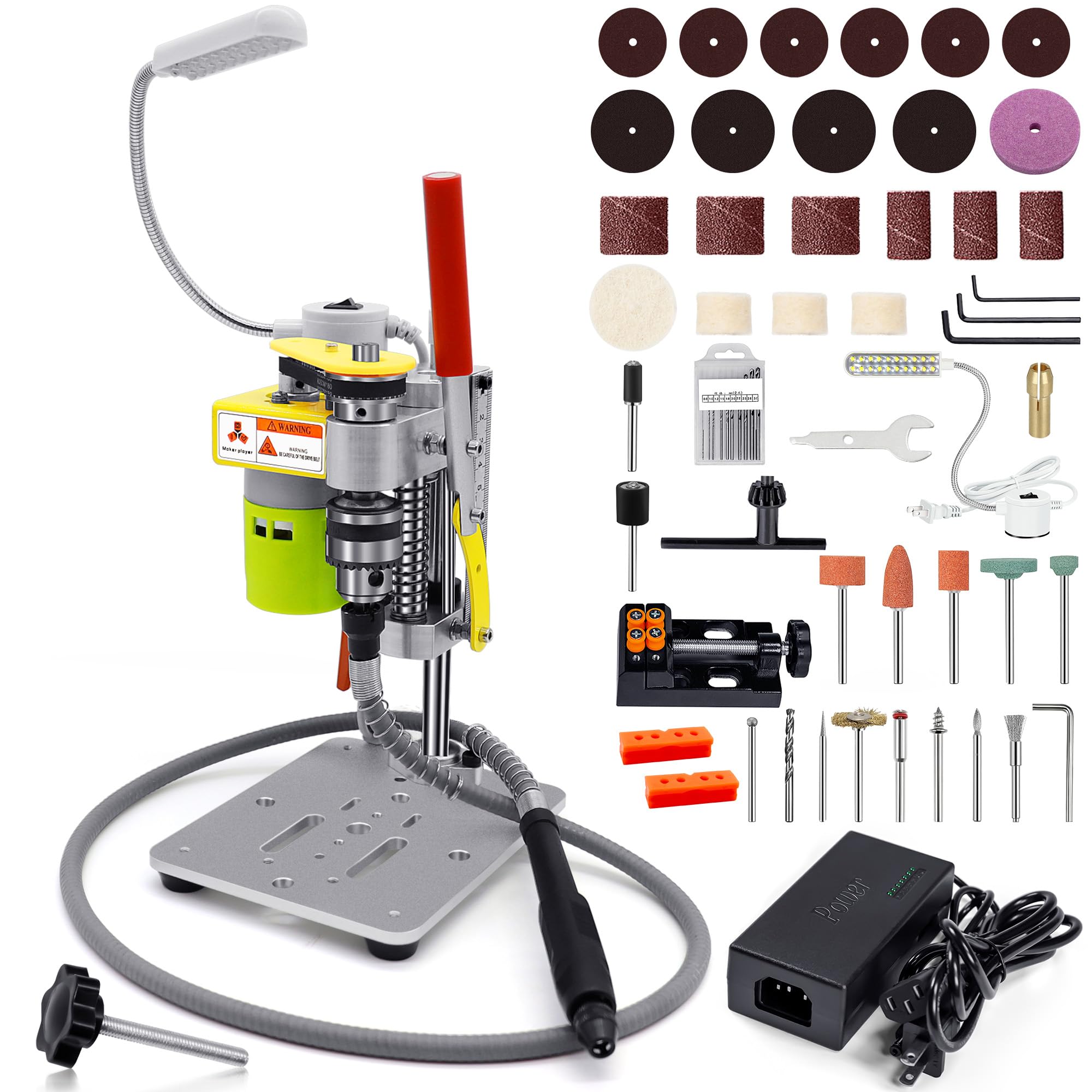
Not a hand tool at all — the answer when a bead needs a hole that goes straight through.
Handheld drilling wanders. This press solves that with a solid metal frame, 3-axis stability, two linear bearings and dual springs, so the bit descends on a fixed line. Maximum drilling stroke is 40mm, and the drilling capacity is listed at 6 millimeters for both wood and metal, which covers bead, finding and stone work.
Power comes from a 795 DC motor with a 24V adjustable supply, maxing at 7,000 rpm. Those two figures tell the story: this is a low-speed, high-control machine, not a high-rpm carver. Shoppers say drilling three rocks and finding it faster than a Dremel on the same material. The base takes a mini bench vise or a CNC sliding table on two slot types, so it grows with you.
Speed control runs off the voltage supply rather than a belt, so lower speeds carry less torque and hard steel needs small bites with frequent clearing. It is also a press, not a rotary tool — you will still want a handpiece for polishing. Pairing it with the SE flex shaft gives you both halves of a bench.
What it fixes: 3-axis stability with two linear bearings and dual springs on a 7,000 rpm, 795 DC motor, so holes land where you mark them.
The trade-off: low-speed torque is limited by voltage control, so drill in small steps on hard material.
Right choice for: anyone drilling repetitive holes in beads, stone or resin blanks who is tired of a wandering bit.
Not needed if: your work is all polishing and engraving with no drilling.
10. SE Flex Shaft Grinder with Foot Pedal

Hang the motor overhead, hold only the slim handpiece, and let your foot set the speed.
The design moves the weight off your hand entirely. A 1/4 HP motor hangs overhead on a shaft, and the handpiece stays thin and light at the end of it. Foot pedal control is variable, so you set speed with your toe and never take your eyes off the piece. Maximum speed is 22,000 rpm. The handpiece runs thicker than a jewelry-school flex shaft but thinner than a Dremel body.
Control at low speed is where this beats a standard rotary. It can run slowly with torque still behind it, which is the range you want for polishing a setting without burning the metal. It takes standard Dremel attachments, so your existing bits transfer over, and it ships with a 55-piece accessory set plus spare motor brushes.
The pedal is the recurring gripe. It engages partway through its travel and has a hard plastic-and-metal base that can mark a floor, so a mat underneath is worth it. The included case is also basic, and the bits are on the coarse side for fine jewelry. The cord is short, so measure your bench before you commit to a spot.
Why bench hands like it
- Overhead motor keeps the handpiece light for hours of work
- Foot pedal frees both hands for the piece
- Runs slow with torque behind it — the polishing range that matters
- Takes standard Dremel attachments, plus 55 pieces and spare brushes
Before you set it up
- Pedal engages only partway through travel
- Hard pedal base can scratch a floor
- Short cord, basic case, and coarse starter bits
For the maker who: polishes at a bench for long stretches and wants both hands on the work.
Consider a corded rotary first if: you are starting out and still testing which bits you like.
Know the Specs
RPM range and the slow end
RPM means revolutions per minute — how many times the bit turns in one minute. The low number matters more than the high one for jewelry work, because polishing and edge cleanup happen at a slow spin. A tool that reaches 5,000 rpm has a usable slow setting. One that starts at 8,000 rpm is livelier and harder to hold steady on a thin resin edge.
Chuck and collet size
Chucks and collets are the jaws that grip the bit shank. Most jewelry burs and diamond bits use a 3/32 inch shank, so a tool with a 3/32 inch chuck takes them directly. A kit that ships with only one collet size can limit which bits you load — check the spec before buying.
Flex shaft and handpiece weight
A flex shaft is a flexible cable that moves the spinning motion from a motor to a slim handpiece. It lets you work at awkward angles and keeps the weight off your hand. That matters when you sit over a piece for an hour.
Foot pedal control
A foot pedal sets the speed with your toe while both hands stay on the piece. Variable pedals let you move smoothly through the range. Fixed ones only switch on and off. The type of pedal changes how precisely you can feather the speed during a polish.
Common Questions
Will a Dremel chuck hold standard jewelry burs?
Is a cordless rotary tool strong enough for polishing resin jewelry?
Why do my bits wear down so quickly?
Do I need a flex shaft for jewelry making?
Is a drill press better than a handheld rotary tool for drilling beads?
How long does a cordless rotary tool battery last on one charge?
What is the difference between a flex shaft grinder and a standard rotary tool?
Can I use the same bits across different brands?
How quiet are these tools for a home workbench?
Do I need variable speed settings or just one speed?
The Bottom Line
For most jewelry benches, the rotary tool for jewelry making winner is the Dremel 4000-2/32, because it puts a usable 5,000 rpm floor and a steady 35,000 rpm top end in the same body. The flex shaft in the HYCHIKA kit is the better starter set if your project lives in tight settings. And if you need holes that run truly straight through a bead, the BERXOL mini drill press does a job no handpiece can.
How we choose
We do not accept paid placement. Every pick is matched to a real buyer and a real use-case; we do not hands-on test units.
Sources
Specifications: manufacturer listings and product documentation. Review insights: verified customer reviews, as of October 2026. Pricing: not shown on this page (it changes often); check the current price via the retailer link.
As an Amazon Associate, Aappliancez earns from qualifying purchases. This does not affect which products we feature.