Disclosure: Some links in this post are affiliate links. As an Amazon Associate I earn from qualifying purchases, at no extra cost to you. Learn more
Specs are compiled from manufacturer listings and verified buyer reviews and can change over time — please confirm the key details on the product page before buying.
You have a drip coming through the ceiling or a seam peeling up on the roof, and you want it sealed before the next rain without paying a roofer to come out. The right roof flashing sealant seals that drip in an afternoon. This guide covers the tapes and coatings that actually hold, matching each one to the surface you are repairing and the shape of the leak, so you pick the tape or coating that fits your roof surface instead of guessing at the hardware aisle.
This guide is built by comparing the manufacturers’ published specifications and the patterns across verified customer reviews, so you get each pick’s real strengths and trade-offs instead of marketing spin.
You will see which roll goes on a curve, which coating fills a hairline crack, and which reinforcement keeps a patch from splitting later. Every pick here is a real repair product you lay on a wet or dry surface, and each one suits a different kind of damage. Choose the right roof flashing sealant for your leak and the repair can outlast the roof it sits on.
Top Picks


How To Choose The Best Roof Flashing Sealant
The first decision is not brand or price, it is tape versus liquid. A tape is a thick, self-sticking membrane you press onto a seam, corner, or flashing edge; a liquid coating is brushed or rolled on and cures into a skin over a crack. Most leaks around flashing want a tape because the membrane bridges the gap and holds its own shape. A hairline crack or a porous concrete wall wants a liquid because it can soak into the surface.
Match the sealant to the surface it touches
EPDM rubber, TPO, metal, vinyl, wood, OSB, and fiberglass all accept a butyl or asphalt tape, but each type of coating has its own preferred surface. If your flashing is a rough concrete or block wall, no tape will conform well, and a liquid coating applied in several coats covers it. If you are sealing a curved corner around a window or pipe, you want a stretchable tape that conforms around the bend, not a rigid roll that crimps and lifts.
Check the temperature range before you buy
A sealant that stays flexible in the cold is the one that survives a winter freeze-thaw cycle. Look for a stated lower operating temperature in degrees Fahrenheit so you know whether the product still bends rather than snaps on an icy morning. A wide temperature window means the tape still bends on a cold fall morning and does not soften in high summer.
Do not confuse a coating with a sealer and a tape with a patch
The common wrong assumption is that any product labeled waterproof will bond anywhere. Surface prep decides that, and a dusty, oily, or wet surface will defeat even a high-tack tape. Clean and dry the area first, and the product’s own adhesive does the rest. If you are sealing a wide crack instead of a seam, plan on a fabric or a multi-coat system rather than a single strip.
Side-by-Side Comparison
| Model | Best For | Form | Size | Key Strength | Amazon |
|---|---|---|---|---|---|
| Cofair UBE625 Quick Roof Extreme★ Best Overall | RV and camper roof seams | White TPO tape roll | 6″ x 25′ | 2.3 lb, made in USA | Amazon |
| BXI Flashing Roll Tape MembraneLongest Roll | Attic and flat roof leaks | SBS asphalt with foil backing | 4″ x 32′ x 0.06″ | 5°F to 158°F range | Amazon |
| Wadities Invisible Waterproof Sealant | Clear coating over cracks | Water-based rubber liquid | 2 kg (70oz) | Clear finish, 28 sq ft coverage | Amazon |
| ZIP System Stretch Tape | Curves and window corners | Acrylic stretch tape | 3″ x 20′ | 180-day exposure, 30-year warranty | Amazon |
| Liquid Rubber Geo-Textile Fabric Roll | Bridging wide cracks and seams | Stitch-bonded polyester fabric | 4″ x 160′ | 0.62 kg, embeds into wet coating | Amazon |
Detailed Reviews
1. Cofair UBE625 Quick Roof Extreme White 6″ x 25′
Our pick — 4.5+★ from 850+ verified ratings; the strongest balance of quality and price.
The white rubber roll that peels off and sticks with almost no prep, and it is the crowd favorite across a long run of RV and camper roof repairs.
Six inches wide and 25 feet long, this is a white TPO-surface flashing tape that self-adheres to EPDM, TPO, metal, fiberglass, vinyl, wood, OSB, and most building materials. That list matters because it means the same roll you buy for a camper roof edge also covers an awning repair or a cracked shower floor. It weighs 2.3 pounds, so a roll is easy to carry up a ladder and easy to cut down to a short strip. Made in the USA, the tape is sold as permanent, waterproof, and weatherproof.
The surface is white rather than black or silver, which keeps the patch from turning into a dark slab on a white roof. A wide 6-inch face means one pass covers a seam and overlaps both sides. If you are comparing widths, the Cofair runs 6 inches against the BXI’s 4 inches. In raw length the BXI wins, 32 feet to 25. The trade goes the other way on weight: the Cofair is 2.3 pounds against the BXI’s 4 pounds, so it is easier to maneuver along a roof edge. Buyers report a single patch that held on a camper roof for three years and still looked good, and the pages regularly note it works better than the other brands people had tried.
The catch is the adhesion itself. This tape is extremely sticky and very hard to reposition once it touches a surface, so plan the placement before you peel the backing. Short 3-foot lengths go down far easier than long 6-to-8-foot runs. For cutting, a blade works better than scissors because the adhesive grabs at the blades. Watch out for the surface, too: the bond is best on a clean, oil-free area. Someone who wants a repositionable patch will find that lack of forgiveness annoying.
What Wins People Over
- A 6-inch face and 2.3-pound roll that handles camper roof seams, awning repairs, and shower floors alike.
- White TPO surface suits white and light roofs where a dark patch would stand out.
- Self-adhesive application needs no primer, torch, or extra tools.
- Sticks to EPDM, TPO, metal, fiberglass, vinyl, wood, and OSB.
Where It Asks For Patience
- Once it touches the surface it will not slide, so placement has to be right first time.
- Long runs are harder than short strips; 3-foot lengths are more manageable than 6-to-8-foot ones.
- A blade cuts cleaner than scissors because the adhesive clings to the blades.
Reach for this if: you are patching a camper or RV roof, an awning, or a cracked shower floor and want one roll that handles all three.
Know first: this is a one-shot placement, so measure, dry-fit, and peel only when you are ready to press it down.
2. BXI Flashing Roll Tape Membrane, 4 inches X 32 Feet
Thirty-two feet of foil-backed asphalt tape built for attic leaks and flat-roof cracks, with a stated range from 5°F to 158°F.
The long run is the point here. At 32 feet, this roll gives you more continuous coverage than the Cofair’s 25 feet, and the 4-inch width means it fits tighter spaces like a narrow seam or an attic rafter gap. The material is SBS polymer modified rubber asphalt, a rubberized asphalt blend that stays stretchy at low temperatures, and the backing is a smooth silver aluminum foil that is paintable and UV-resistant. The foil also blocks flame and resists punctures and abrasion. It is 0.06 inches thick, so the membrane is not thin enough to tear when a shingle edge presses on it. It weighs 4 pounds, heavier than the 2.3-pound Cofair, but that weight is mostly the longer length.
What earns this roll its place is the temperature flexibility. The 5°F to 158°F range means the asphalt still bends in a cold snap instead of cracking, and it does not soften and run in summer heat. The practical use: press it on a flashing edge or a roof-window seam and the bitumen works its way into small cracks as it seats, which is what makes it effective on leaks you can locate but not fully expose. Buyers describe a crack near a skylight sealed in about ten minutes with this tape, then surviving several multi-day storms over two years. That is a flat-roof patch that held without a roofer. The aluminum face also gives you a paintable surface if you want it to match later.
The honest trade is adhesion consistency. The tape runs very tacky and grabs hard on smooth, flat, dry surfaces, but the pages show a split in how well it holds, with some installs reported as extreme and others where it did not stick at all. The fix is surface prep: the manufacturer states it adheres best to smooth, flat, dry areas, and any dust or moisture under the strip will ruin the bond. Peeling the protective film is fiddly, so rubber gloves help, and a brayer roller is worth having to press the tape into nooks and odd angles. If you are sealing a rough concrete wall, this is not the right product.
Thirty-two feet of headroom: the length and 4-inch width suit a run of attic rafters or a flat-roof crack that needs more than one strip.
The real limit: the bond is only as good as the surface under it, so prep and dry conditions decide whether this tape holds.
Best matched to: flat-roof and attic repairs where you can reach the crack and want a long continuous strip.
Look elsewhere if: your surface is rough or damp, since the adhesion here needs a smooth, dry, clean area to bond.
3. Invisible Waterproof Sealant Clear 70oz

A clear rubber coating that goes on like paint, so a roof leak gets sealed without a patch you can see from the yard.
This is a liquid, not a tape. The formula is water and rubber, brushed or rolled on and left to cure into a waterproof skin. At 2 kg (70 ounces) one bucket covers about 28 square feet across two to three coats. The clear finish is the headline: it dries transparent on roof tiles, window sills, and gutters, so the repair disappears into the surface. It is UV stabilized so summer sun does not break it down, and it is formulated not to crack or peel in cold winter months. The product is rated for flat roofs, sloped roofs, foundations, sheds, basements, metal, wood, concrete, gutters, skylights, chimneys, PVC pipe joints, RVs, and exterior walls.
The practical value shows up in the double-check. Apply it above 50°F including overnight temperatures, roll it evenly, and let it dry to the touch with no moisture underneath before the next coat. After 48 to 72 hours the waterproof layer forms, and the maker says it becomes stronger over time. Buyers describe sealing a basement wall leak after two coats with a clear, non-yellowing finish, and a balcony stucco-tile joint that survived three days of torrential rain after three coats. The dryness between coats is the whole job; rush it and the layers trap moisture and peel.
What to plan around is the consistency and the coverage. The liquid is thin and watery, so on a vertical wall it runs and drips and needs patience for an even coat. The bucket arrives smaller than the label size suggests for a lot of buyers, and at 28 square feet per 2 kg, a large roof area needs more than one container. The clear finish means you cannot see coverage gaps until after the rain test. If your problem is one spot you can see from the ground, a tape is faster; this is for a crack you want to disappear, or a surface you need to seal without a visible patch.
Where it earns its keep: sealing cracks inside or outside where a visible patch would look wrong, and it dries clear on any surface.
Temper the expectation: thin, watery consistency means vertical surfaces need patient coats, and the 28 square foot coverage is per 2 kg bucket.
Worth choosing when: the leak is a crack or a porous surface you want sealed invisibly with a brush or roller.
Think twice if: you want to cover a wide gap in one go, because this liquid needs coats and drying time between them.
4. ZIP System Flexible Stretch Tape 3″ x 20′
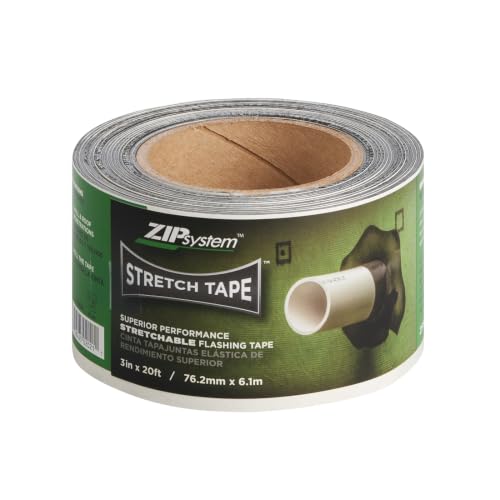
The tape that bends around a window corner or a pipe without crimping, because the acrylic adhesive stretches to follow the shape.
Most flashing tapes are stiff and want a flat run. This one is built for the awkward details: a 3-inch wide, 20-foot roll of flexible acrylic tape on a wood-compatible substrate, made for curves, corners, window and door rough openings, and sills. It comes from Huber Engineered Woods under a 180-day Exposure Guarantee and a 30-year limited warranty, with an install range of 0 to 120 degrees Fahrenheit. It weighs 1.5 pounds, so it stays manageable on a ladder, and the 3-inch width is sized for penetrations and rough openings rather than a full seam.
The function is a one-step sill installation: press the tape over an uneven surface and it conforms to the bumps instead of bridging them with a gap. That makes it the right tool when the lead pan under an exterior door is uneven, or when an attic vent opening has multiple corners around it. Buyers describe using it to seal a vent opening that had multiple corners, fitting one piece and getting strong adhesion, and using it over an uneven door pan to restore a water-tight seal. It also covers wall seams and conforms to just about any surface, with stretchability that lets it negotiate a corner in a single application.
The honest limit is that this is premium-priced relative to a plain roll, and the 3-inch width and slow going on the backing mean large flat seams are not its job. It is for the corner, the curve, and the small penetration. Durability under long-term UV is not something the product claims outright, so tuck the tail ends under siding or trim rather than leaving them in the sun. If you need a wide flat run, the BXI’s 4-inch face and 32-foot length will cover it faster. If the surface is a hard, non-wood material, the acrylic adhesive is formulated for wood-compatible substrates, so test a small piece first.
The Case For The Stretch Roll
- Stretchable acrylic adhesive follows curves, corners, and irregular surfaces in one piece.
- 180-day Exposure Guarantee and a 30-year limited warranty from the maker.
- 3-inch width suits penetrations, sills, and rough openings.
- 1.5-pound roll stays easy to handle up a ladder.
The Fair Caveats
- Narrow 20-foot length and 3-inch width make it a detail tape, not a seam runner.
- Removing the backing takes patience, which slows a long application.
- Formulated for wood-compatible substrates, so check other surfaces first.
It beats a stiff roll for: curving around a window pan, a vent opening, or any corner where a flat tape would buckle.
The one caveat: for a long flat seam you want a wider, longer roll, because this one is cut for detail work.
5. Liquid Rubber Geo-Textile Fabric Roll, 4 Inch x 160 Foot
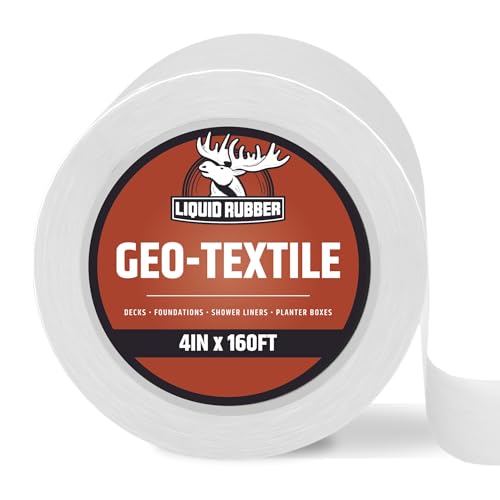
A 160-foot roll of polyester fabric you embed into wet roof coating so a wide crack gets a structural bridge instead of a thin skin.
This is not a tape in the usual sense. It carries no adhesive of its own, and that is deliberate. The fabric is stitch-bonded polyester, a material the maker calls one of the strongest available in the roofing industry, and its job is to sit inside a wet coat of liquid rubber and turn a coating into a reinforced ply. You apply a heavy coat of Liquid Rubber coating, cut a length of geo-textile, lay it into the coating and work it through until saturated, then add more coating on top. The maker compares it to doing a drywall joint: lay the tape into the mud and bed it in. It works with waterproof sealant, color sealant, RV roof coating, foundation sealant, polyurethane deck coating, MetalSafe sealant, and Neopond sealant.
The scale is the selling point. A 4-inch by 160-foot roll is a lot of reinforcement for the money compared with a 25-foot tape, and it weighs 0.62 kg so you can carry it easily. The system is meant to bridge gaps, cracks, joints, seams, skylights, and vents. Where that matters is a crack too wide for a plain coating to span: the fabric gives the wet rubber a scaffold so the repair does not just crack along the same line again. Buyers describe using it for a pond interior that held water with zero leaks over three days of testing, and taking a basement wall through three years with no water intrusion. The geo-textile fabric is what the long-term repairs in those cases had in common.
The catch is right in the design: you need the wet coating under it, and the adhesive bond comes from that liquid, not the fabric. On uneven, rough, or crumbling surfaces the fabric gaps and will not stick, which wastes short lengths. It also needs disposable gloves and gets messy, and it must go over a coating that is still wet. If you want an all-in-one roll you peel and press, this is not it. To stop a crack from reopening, bed the fabric into wet coating so it becomes the reinforcing ply that bridges the gap.
The long-term play: embed this fabric in a wet coat and a wide gap gets a bridge instead of a thin film that splits again.
Plan around: there is no adhesive on the roll, so it only works when bedded into a wet coating on a solid, dry surface.
Pair it with a coating when: you need to bridge a wide crack, seam, or joint and want the repair to hold for the long haul.
Do not buy it alone if: your plan is peel-and-press, because this fabric needs liquid coating under it to bond.
Know the Specs
Temperature Range
The stated low and high numbers tell you whether a tape bends or snaps in the cold. A range like 5°F to 158°F means the rubber stays supple through a winter freeze and does not soften in summer sun. A tape with no stated range may snap in a freeze or run in summer heat.
Width and Length
Width decides what the roll can cover in one pass: a 3-inch roll is for penetration detail, a 4-inch roll for seams, a 6-inch roll for a wide flashing edge. Length decides how many strips you get. Match width to the detail and length to the number of strips, not to the biggest number on the label.
Self-Adhesive Versus Coating-Reinforced
Self-adhesive tape has its own glue and presses directly onto a surface. Geo-textile fabric has none, so it must be bedded into wet liquid coating. They are not interchangeable: a geo-textile fabric laid on bare roofing has no glue of its own and will not hold.
Coverage Per Container
A liquid sealant is bought by weight, and the stated coverage per container tells you how much surface one bucket covers. Two to three coats are often required, so plan the area you need to cover and allow for more than one bucket for a large roof.
Common Questions
Will flashing tape stick to a wet roof?
How long should a roof flashing repair last?
Can I use flashing tape on a curved corner or pipe?
What is the difference between the flashing tape and the clear liquid sealant?
Does the Geo-Textile fabric stick on its own?
Can I apply the clear waterproof sealant in cold weather?
How many coats does a liquid sealant need?
How much surface does the clear sealant cover per bucket?
Will flashing tape work on a metal roof?
Why does my flashing tape tear or bunch when I unroll it?
The Bottom Line
If you want the one roll most likely to handle a camper roof, an awning, or a crack in the shower floor, the Cofair UBE625 Quick Roof Extreme is the easiest to live with, and its white 6-inch face covers a seam in one pass. If you are patching an attic or flat roof and want a long continuous strip, the BXI Flashing Roll Tape gives you 32 feet with a 5°F to 158°F range. For a corner or a window pan, the ZIP System Stretch Tape bends where the flat rolls buckle. And if you want a crack to disappear, brush on the clear Wadities coating over it. Keep a roll of flashing tape on the shelf, and the next drip becomes a ten-minute patch instead of a contractor call.
How we choose
We do not accept paid placement. Every pick is matched to a real buyer and a real use-case; we do not hands-on test units.
Sources
Specifications: manufacturer listings and product documentation. Review insights: verified customer reviews, as of October 2026. Pricing: not shown on this page (it changes often); check the current price via the retailer link.
As an Amazon Associate, Aappliancez earns from qualifying purchases. This does not affect which products we feature.