Disclosure: Some links in this post are affiliate links. As an Amazon Associate I earn from qualifying purchases, at no extra cost to you. Learn more
Specs are compiled from manufacturer listings and verified buyer reviews and can change over time — please confirm the key details on the product page before buying.
You want a robot that grips the glass, sprays, wipes, and gets the outside panes you cannot reach without a ladder. Here is the short answer before you read anything else: the Yoolax Window Cleaning Robot 2.0 is the pick for most people because it runs at a 2.85min/㎡ cleaning speed (about 2.85 minutes per square meter) across 6 intelligent cleaning modes, holds the glass with a 2600Pa fall-protection system (2600 pascals of suction to keep it stuck to the glass), and comes with 8 upgraded microfiber cloths in the box. Everything below explains which of the ten robots suits your windows, your reach, and your patience.
This guide is built by comparing the manufacturers’ published specifications and the patterns across verified customer reviews, so you get each pick’s real strengths and trade-offs instead of marketing spin.
Most of these machines are corded with a backup battery, so the real question is grip and pad coverage, not runtime. Read on for the best robotic window cleaners ranked by how they actually hold glass.
Top Picks


How To Choose The Best Robotic Window Cleaners
Buying one of these robots is really a question about your glass. If a robot cannot hold on, nothing else matters — not the spray pattern, not the app, not the price tier. So you check grip, surface fit, and pad shape first, and you treat cleaning speed as the last thing on the list.
Start With Suction, Because Gravity Never Stops
Suction is measured in pascals (Pa) — the pulling force the vacuum motor uses to pin the robot to vertical glass. The robots here run from 2600Pa on the Yoolax up to 7000Pa on the Mamibot W120-DP. More suction helps on dusty or slightly damp glass, but every unit also ships an edge-detection sensor and a safety rope that acts as the physical backstop if grip fails.
Match The Machine To Your Frame And Glass Type
Framed windows are the easy case, and most of these robots are built for them. Frameless panes need boundary detection sensors that read the glass edge itself, which the Lite model and the Ecovacs Winbot both address. Beveled sliding-door seals, thin weatherstripping, and curved or textured glass are where suction breaks most often, so walk your windows and note anything that is not flat and smooth.
Understand What The Backup Battery Actually Does
Almost every robot on this list is corded for continuous power, and the internal lithium battery is a UPS reserve (a backup battery) — it keeps suction alive for around 20 to 30 minutes if the power fails so the robot does not fall. The Ecovacs W2 PRO Omni is the exception, offering a battery mode rated at up to 110 minutes. Do not read a 20-minute figure as cleaning time.
Side-by-Side Comparison
| Model | Best For | Suction | Water Tank | Control | Amazon |
|---|---|---|---|---|---|
| Yoolax Window Cleaning Robot 2.0★ Best Overall | Overall grip and speed balance | 2600Pa | — | App + Remote | Amazon |
| CHOVERY 3500Pa Window Cleaner RobotLong-Run Specialist | Long sessions and big glass runs | 3500Pa (2700–3300Pa operating) | Dual-side auto spray | Remote | Amazon |
| FRUITEAM Automatic Window Cleaner RobotBudget Entry | Quiet runs and tight spaces | 3000Pa | 50 ml | App + Remote | Amazon |
| Tosima Window Cleaning Robot W2 | Path planning on tall panes | 3800Pa | 80 ml | App + Remote | Amazon |
| KKI Window Cleaning Robot X3 | Big window counts in one session | 2200–3200Pa auto | 85 ml | Remote | Amazon |
| Obito X2 Window Cleaning Robot | Best value on paper | Max 6400Pa | 60 ml | Remote | Amazon |
| Schbot Wind X3 | Wide window size range | 3500Pa | 60 ml | App + Remote | Amazon |
| Mamibot W120-DP | Maximum suction and modes | 7000Pa | 60 ml | App + Remote + Button | Amazon |
| Lite Window Cleaning Robot | Edge-to-edge pad coverage | 5300Pa | Dual-side spray | Remote | Amazon |
| ECOVACS WINBOT W2 PRO Omni | Battery freedom and big glass | — | Triple nozzle spray | App | Amazon |
Detailed Reviews
1. Yoolax Window Cleaning Robot 2.0
The fastest pass in this group, with 6 modes and 8 cloths in the box — but the small pads need swapping every two to three panes.
Speed is the headline here, and it comes from a 2.85min/㎡ cleaning pace across 6 intelligent cleaning modes. On a standard picture window that translates to a short supervised run rather than an afternoon with a squeegee. The 2600Pa fall-protection system, edge detection, and anti power failure circuit work together as the grip layer, and the body is shaped to reach into window edges instead of stopping short.
Owners describe two speeds of work: a basic pattern for a quick pass and deep-clean patterns for grimy glass. Expect the microfiber pads to load up — the box includes 8 upgraded cloths, and heavy windows want a fresh pad every two to three panes. The cord is long enough that most rooms need no extension, and staying corded means you never sit waiting on a charge.
The app is where this one shows its limits. It runs over Bluetooth only, so its range is short and you need to stay nearby. Figure on roughly a one-inch rim left at the very edge, and plan to wipe that yourself. Buyers report it cleans about 98% of the window and misses edges and corners, which is an honest description of what a supervised robot does. A one-year warranty backs it.
Where It Earns Its Place
- 2.85min/㎡ cleaning speed with 6 intelligent modes, so a standard pane finishes quickly
- 2600Pa fall protection plus edge detection and anti power failure for high glass
- 8 upgraded microfiber cloths included, so you are not hunting refills on day one
- Corded power with a long cord — no waiting on battery between windows
The Honest Friction Points
- Bluetooth-only app control has short range — you cannot wander off
- Small pads need frequent swapping on a full house of windows
- Leaves roughly a one-inch rim at edges and corners you finish by hand
- The manual says no exterior use
Reach for this if: you have framed windows at reachable-to-moderate height and want the fastest supervised pass with a full cloth kit in the box.
Look elsewhere if: you intend to send it up the outside of a building — the manual rules that out, so a model with exterior-rated suction would serve you better.
2. CHOVERY 3500Pa Window Cleaner Robot
Built for a whole-house window day, with a bigger body and a longer power-loss reserve than most rivals.
Two numbers separate this from the FRUITEAM model. The power-loss battery here holds suction for 30 minutes versus 20 minutes on the FRUITEAM, and the body measures 11.81″L x 5.9″W x 2.95″H against the FRUITEAM’s 8″L x 4″W x 1″H. That extra footprint means more pad on the glass per pass, and it is a big part of why the working suction range runs 2700pa-3300pa with a 3500Pa peak.
The dual-side auto spray wets both directions of travel, and the water-saving side is genuinely impressive: owners mention cleaning 40 sq ft with under 1/2 cup water. The recommended routine is a dry fiber pad pass first to lift dust, then a fresh pad with the spray on for the finish. Do the two-step order and the eco-fiber mat leaves no marks even in direct sun.
Where it asks for your patience is on setup and supervision. Pads are tight to install and need changing every few windows, the water reservoir level is hard to read, and it defaults to wet mode on every power cycle — so you remote it into dry mode each time. The safety rope also wants a hook per window. On beveled or 45° slanted gaskets (angled seals around the glass) it can slide off on the bottom run, so treat unusual frames as a manual job. The remote’s accuracy at the top and corners is the surprise strength.
The suction story: a 2700pa-3300pa auto range grips glass and mirrors firmly, and the 30-minute lithium backup keeps the fan alive through an outage so the unit does not drop.
What to expect: efficient on 8ft panes and tall crank-out windows, but it needs babysitting as you move it from one window to the next.
Right machine if: you have a batch of large framed windows, want the longest power-loss reserve in this group, and do not mind steering a remote.
Think twice if: your windows have slanted gaskets or beveled seals — this is the setup that keeps costing you a hand-wash on the bottom edge.
3. FRUITEAM Automatic Window Cleaner Robot
The smallest body here at 8 by 4 inches, sized for narrow sidelights and bathroom glass, and the quietest at 58dB from 4.9ft.
Size is the defining spec. At 8″L x 4″W x 1″H this is a full 48% smaller in footprint than the CHOVERY machine, which matters if you are working small bathroom glass or narrow sidelights where a large body will not fit the frame. It is also the quietest robot in this group on paper, at 65dB (decibels, a sound measure) measured 6 inches away and 58dB at 4.9ft — quiet enough to run while someone is on a video call in the same room.
The 3000Pa suction edges the Yoolax’s 2600Pa, and the mist nozzles release 0.05ml per spray to pre-wet tough stains before the pad arrives. Triple safety protection covers the suction, the safety rope, and a 20-minute reserve that holds the robot after a power cut. Control runs through the included remote or the app, with scheduling and fault alerts that flash on the unit.
The catch is consistency. Cleaning performance is the most-discussed thing about this robot and it splits two ways — some panes come out clean, and there are reports of a unit quitting early. Round pads miss corners, the remote is sensitive with nowhere to store it, and the safety lanyard trails where you do not want it. A beveled sliding-door seal or a dusty pane can break the hold. If your glass is flat and framed, it is a sensible low-risk entry.
Function first: app scheduling, remote control, and self-diagnostic reminders make it easy to run without reading a manual twice.
The honest caveat: it is a light-to-moderate-dirt machine, and unpredictable results are the price of the entry tier.
Suits you when: your windows are standard framed glass, you want a 58dB motor, and you prefer to test the whole idea of a window robot before spending more.
Not the fit: if you have a house full of beveled sliders and expect one-pass perfection, this machine will frustrate you.
4. Tosima Window Cleaning Robot W2

A 3800Pa planner for second-story glass — more hold than the 2600Pa Yoolax and the 3000Pa FRUITEAM, with an 80 ml tank.
At 3800Pa this robot has more hold than the 2600Pa Yoolax and the 3000Pa FRUITEAM, and it pairs that with an 80 ml tank and AI 3.0 Path Planning that maps a full route before it starts. The pads revolve rather than sit still, which is the reason owners who compared it against a stationary-pad machine say the rotating approach cleans better on set-in grime. Two passes on three-year-dirty glass and the panes come up sparkling.
Where it shines practically is height. It removes the ladder from second-story windows and the entire job of calling a professional out. Owners run it on French doors inside and out, and the battery’s 25-minute figure is a suction-retention reserve so the robot holds the glass if the cord loses power — not a cleaning runtime. Plan on two passes for badly soiled panes and a fresh pad between them.
The friction is real and specific. Round pads cannot reach corners, the unit is heavy enough that a fall is loud, and pads are hard to attach if your hands are stiff. Beveled sliding-door seals break suction and cause drops, so those panes need supervision. On the smallest beveled windows it simply will not perform. The remote also needs a full pause before you take manual control, which reads as confusing until you learn it.
Why It Makes The Cut
- 3800Pa suction — firmer hold than the Yoolax and FRUITEAM picks
- 80 ml tank with AI 3.0 Path Planning and edge detection sensors
- Revolving wheels bite into grime that stationary pads skate over
- Takes the ladder out of second-story and high-window work
Before You Commit
- Round pads leave corners untouched
- Beveled sliding-door seals cause suction loss and falls
- Pads are fiddly to seat, especially with arthritic hands
- Remote requires a full pause before manual direction
Choose it for: tall, unobstructed framed windows where planning a clean route and holding hard matter most.
Skip the gamble: if you mostly clean small beveled sliders, because that is the exact surface this robot handles worst.
5. KKI Window Cleaning Robot

The widest path here at 11.8 inches and the largest tank at 85 ml, rated to clean 20+ square meters per fill.
The width is the giveaway: an 11.8-inch cleaning path is the widest here, and the 85 ml tank is the largest on this list. Together they mean fewer passes and fewer refills, and a single tank is rated to clean 20+ square meters. Suction adjusts itself between 2200 and 3200Pa depending on how dirty the surface reads, which is the anti-drop brain doing its job rather than a fixed fan setting.
Atomized dual-spray nozzles push 0.05ml per spray — the maker raised the output from 0.03ml specifically to cut clogging and cover the pane — and the nozzles run in both directions. It handles 35 to 145 degree smooth surfaces, so glass, ceramic tile, mirrors, and wooden doors all qualify. The kit is generous: 10 cloths, an adapter, a safety rope, batteries for the remote, and an empty bottle.
Owners who ran a 53-window house say the efficient path and eight pads carried a full session. The counterpoint is pace: because the robot returns to its start point and you shuffle it between windows, a 15-minute human job can stretch to about 45 minutes of supervised time. It is a better window cleaner than it is a time-saver. On exterior windows, thin weatherstripping can break fan suction — the unit beeps and flashes first, which is your warning to reseat it. One unit did lose suction and strike a wall despite the rope, and that owner found support slow to respond.
The throughput case: 11.8-inch path plus 85 ml tank adds up to whole-house sessions with minimal stopping.
The realistic picture: plan to babysit it on vertical glass, and keep the safety rope correctly length-matched to where you are working.
Buy this one when: your window count is high, you want the biggest tank and widest pad in the group, and you can give it your attention for an hour.
Better elsewhere if: speed is your whole reason for buying — this robot cleans glass well but does not compress your schedule.
6. Obito X2 Window Cleaning Robot, Max 6400Pa, Path Planning
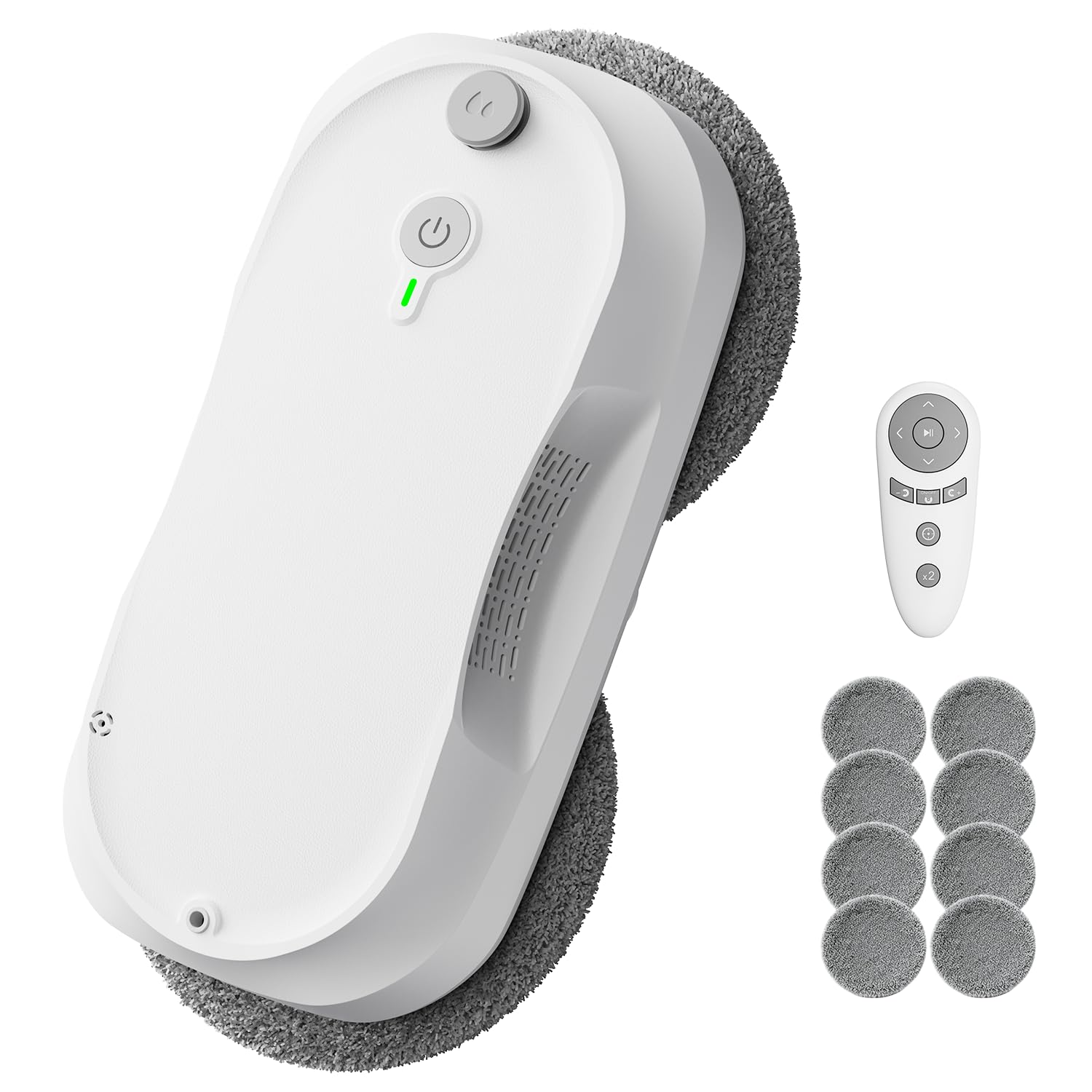
6400Pa of suction at the low end of the price range, with a 60 ml tank that sprays twice per move.
On paper, 6400Pa is the second-highest suction here, behind only the Mamibot’s 7000Pa, and it sits at the lower end of the group on cost. The 60 ml tank sprays twice per move through bidirectional ultrasonic nozzles that turn water into fine particles for even coverage, and edge detection stops the spray near the frame to keep it off your sill. An air pressure sensor handles anti-drop duty alongside an extra-long safety rope.
Where the value shows up is in the working ritual. Fill the tank to roughly 90 percent, not all the way, or the soap spray misbehaves. Then let it run — practitioners with seven floor-to-ceiling windows and two sets of French doors say the corners are the only place it consistently needs help, and it can wedge itself there and wait for a nudge. Rounded-top windows need manual repositioning too.
The one thing to clear up before you buy is the power story. This is not a battery-powered robot in any useful sense: it wants constant AC power, and the battery is a backup that keeps suction alive during an outage. It also handles light to moderate dirt far better than baked-on grime, so plan a pre-wipe on the worst panes. One owner reports lint left behind and a return that did not produce a refund.
The strong case: 6400Pa peak suction and a 60 ml auto-spray tank are real grip and coverage for the money.
The setup note: it is a plug-in machine with a short battery reserve, and the 90-percent fill habit is not optional if you want clean glass.
Pick it for: tall interior windows and French doors where you value peak suction per unit of cost and can supervise a run.
Pass if: you want to work from an outlet-free balcony — this robot needs the cord for the actual job.
7. Schbot Wind X3 Window Cleaning Robot with Auto Spray
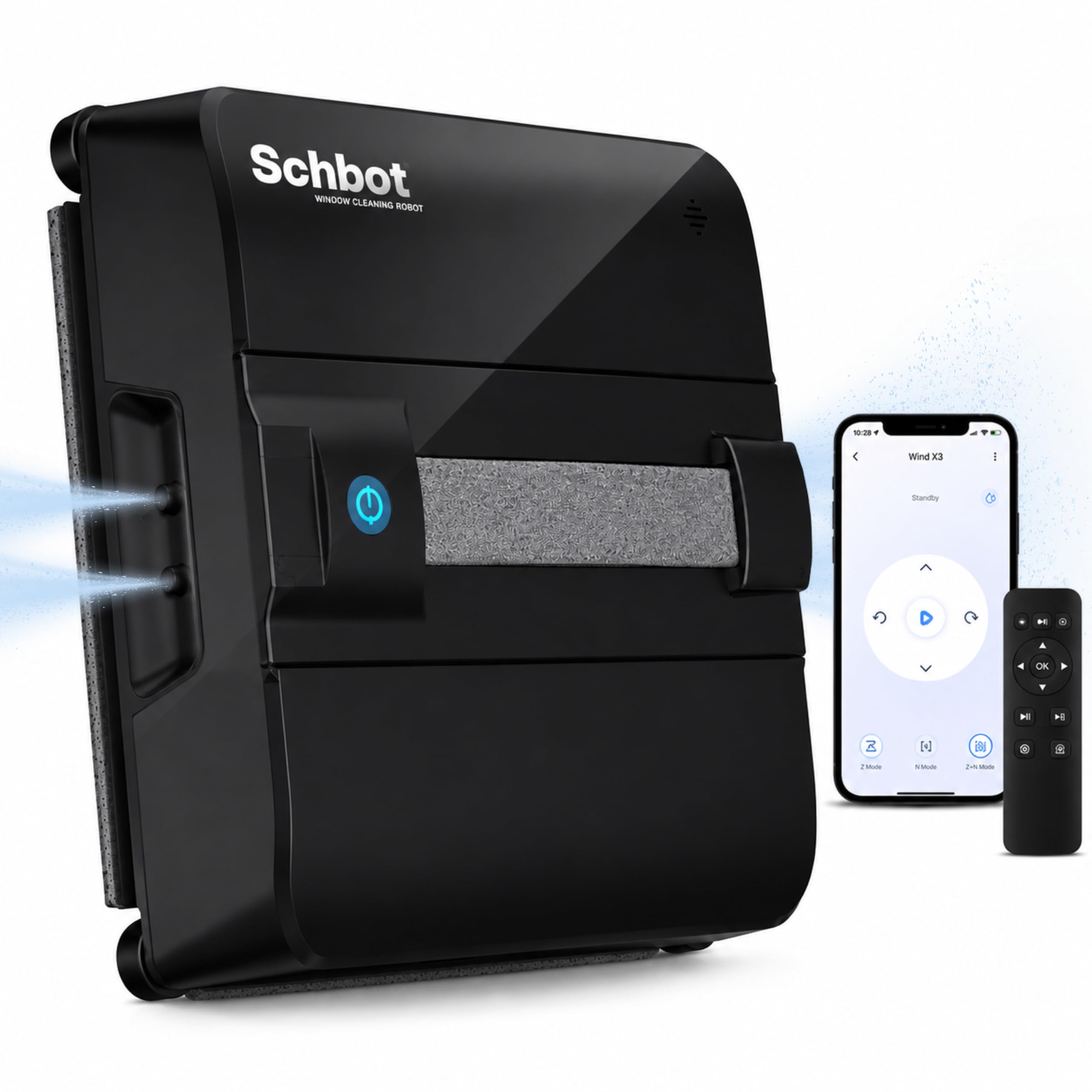
Rated for glass from about 15.7 inches up to 32.8 feet, with no thickness limit because the hold is vacuum-based.
The spec that matters here is range: an optimal window size of roughly 40 cm (15.7 in) up to 10 m (32.8 ft). Because attachment is vacuum-based rather than magnetic, glass thickness is not the limiting factor — which is exactly why you can put it on a normal household pane and a conservatory panel in the same weekend. Suction holds at 3500Pa and the integrated 60 ml tank auto-sprays, with a full tank typically covering 2 to 3 windows depending on spray frequency.
The working parts are simple. Four sensors navigate and spot edges, and you pick Auto, Manual, or Z+N mode on the remote or the Smart Life app. A typical window takes about 2 to 10 minutes of machine time, which is your cue to go do something else. The 20-minute UPS reserve holds suction in a power cut, and the safety rope is the second layer. It is designed for framed windows, one side at a time, and it wants temperatures between roughly 10°C and 30°C (50°F–86°F).
Noise runs at 68 dB from the vacuum motor — a real vacuum-hum, not a whisper. The failure pattern is worth knowing: an early unit can stop attaching if air is trapped in the spray jets, which clears by removing the jets and purging them. One replacement machine cleaned around 15 windows before the fan quit entirely and it could no longer grip the glass, and that buyer was past the return window. Edges and corners also wear down on coverage.
What It Gets Right
- Sized for roughly 15.7 inches up to 32.8 feet of glass, with no thickness limit
- 3500Pa suction and a 60 ml tank that covers about 2 to 3 windows per fill
- 20-minute UPS battery plus a safety rope for high-window confidence
- 100–240 V adapter and Auto, Manual, or Z+N modes on remote or app
Where It Asks For Care
- 68 dB motor noise makes it a background-presence machine
- Spray jets can trap air on arrival and stop misting until purged
- Corners and edges get less coverage than the field of the pane
- Frameless glass is out of scope — framed windows only
It fits: households with mixed glass sizes — normal panes, big panels, conservatories — who want one machine to handle all of it.
Not for you: if you have a frameless wall of glass or a whisper-quiet house, this one and its 68 dB motor are the wrong match.
8. Mamibot W120-DP Window Cleaning Robot, 4-Spray

The highest suction here at a variable 7000Pa, in a 2.7-inch body built for narrow frames.
7000Pa is the highest suction figure on this list, and it is variable rather than fixed, so the machine clamps harder when it needs to. Four spray nozzles with a dual cross jet wick water across the pane, and 10 cleaning modes give you more patterning control than the 6-mode Yoolax or the 3-mode KKI. It works on flat glass at least 3 mm thick and from 60 x 40 cm, including tall indoor windows, and it also handles mirrors, tile, marble, and wooden doors.
The physical design is thought through: a 2.7-inch body and 3.2 lb weight for narrow frames, a leather handle for carrying it between windows, and a leak-resistant tank so water does not trail onto your sill. Control runs three ways — the remote, the iGLASSBOT app for scheduling and route monitoring, or buttons on the unit. Edge-detection sensors steer the cleaning path and stop it at boundaries.
The honest split is on deep cleaning. Suction and build quality draw the praise, but the water sprayer is the weak link and performance feedback splits both ways — some owners say it does an amazing job, and others report the sprayer failing, which is why the deep-clean complaints centre on bug spots and long-neglected crud. Only 2 cloths ship in the box, which is thin for large dirty windows, and replacements can be hard to find. It also does not wash into the frame corners. Prime very dirty glass with ammonia and a mop first and the machine does its best work.
Grip and versatility: 7000Pa variable suction across glass, mirror, tile, marble, and wood doors is the broadest surface list on this page.
The caveat that matters: it is a surface-film cleaner — bug spots and baked grime still need a pre-wash from you.
Right choice for: homes with a mix of glass, mirrors, and tile where maximum suction and a compact 2.7-inch body are the priorities.
Wrong choice if: you are buying it to attack a decade of outdoor grime — that job needs your hands first.
9. Lite Window Cleaning Robot, 5300Pa with Pressured Wiping

A cloth that overhangs the body by 1cm, so the pad reaches the frame line other robots leave dirty.
Most robots on this page leave a rim at the frame because the pad stops where the housing stops. This one extends its cleaning cloth by 1cm so it can make contact with the frame edge — a direct answer to the corner gap that owners of the Tosima and Yoolax machines finish by hand. Underneath, 5300Pa of suction presses down with 35N of downward force while the upper and lower discs rotate alternately, and one disc is always adsorbed while the other turns.
On frameless glass it has a specific advantage: advanced boundary detection sensors let it navigate floor-to-ceiling windows and mirrors without a frame to bump against. Spray nozzles sit on both sides and use ultrasonic misting to break water into fine particles, so it wets along its path instead of puddling. The kit includes a 6.5m combined power cord and a 5m security tether, 10 cloths, and a remote for the 3 automated modes. It must be plugged in to run.
Reliability is the open question, and it is the reason this sits mid-pack. There are reports of a unit that died on its second use, and of glass left with water marks and finger smudges with untouched areas. The discs do clean effectively on flat, unobstructed panes — noticeable after one pass, better after a second with a clean cloth. The round footprint lets it work smaller windows than square robots can, and owners in commercial settings describe the change it made to their business.
The edge advantage: a 1cm overhanging cloth plus 35N of downward pressure is the most direct fix for frame-line grime here.
The risk you accept: this is the least proven machine on the list, so buy where returns are simple.
Best fit: frameless floor-to-ceiling glass and mirrors, or any window where the frame line is the part that always looks dirty.
Second thoughts if: you want a track record behind your purchase — this model’s durability is the least established in the group.
10. ECOVACS WINBOT W2 PRO Omni Window Cleaning Robot

The only robot here that unplugs — up to 110 minutes of cleaning without a cord trailing behind it.
Every other machine on this page treats its battery as a drop-guard. This one runs two power modes: battery mode for areas without outlets, rated up to 110 minutes of cleaning or 55 square meters on a full charge, and plugged-in mode for continuous work on large glass. That single difference changes which windows are in play — the balcony, the bathroom, the awkward corner with no socket within reach. A 6-in-1 multifunction station doubles as control panel, storage, and stabiliser.
The cleaning hardware is the most developed here too. Three wide-angle nozzles raise water pressure by 100 percent, and WIN-SLAM 4.0 path planning with an upgraded brushless motor is rated to lift cleaning efficiency by 30 percent. The 12-stage protection system layers hardware and software safeguards, and Ecovacs backs it with insurance protection. Practically, quick cleans run about 4 minutes and thorough ones 6 to 7 minutes per window, which is why a 25-plus-window two-story house is a weekend job rather than a season.
The trade-offs are weight and fuss. The dock weighs 19 lb, which is not a one-hand carry up a ladder, and the back compartment and cord door are awkward to get into. Pads need cleaning between windows or you get streaks, corners still hold dirt, and it does not return to its start point at the end of a run. It also gets stuck on door handles and blinds, and tiny panes are not its strength. Occasional faults and early pressure warnings appear if a pad is misaligned.
Why It Costs More And Does More
- True battery mode rated up to 110 minutes, or 55 square meters per charge
- Plugged-in mode for continuous cleaning on large glass
- Triple wide-angle nozzles with 100 percent more water pressure
- WIN-SLAM 4.0 planning rated to raise efficiency by 30 percent, plus 12-stage protection
What You Carry Along With It
- A 19 lb dock that is awkward to move room to room
- Pads must be cleaned between windows or streaks appear
- Does not return to start; can snag on handles and blinds
- Poor fit for very small or divided panes
Made for: large homes with outlet-free glass and tall windows, where the ability to run cordless is worth the station’s bulk.
Think again if: your windows are small, divided, or tiny-paned — this robot’s strength is a big uninterrupted pane.
Know the Specs
Suction In Pascals (The Grip Number)
Pascals measure the vacuum force holding the robot against vertical glass. Higher figures resist slipping on dusty panes, but 2600Pa and 7000Pa both fail the same way — on a beveled seal, thin weatherstripping, or a curved surface where the pad cannot sit flush. Read suction as headroom, not a guarantee, and always attach the safety rope.
Backup Battery Versus Battery Mode
Most robots here are corded, and their lithium battery is a UPS reserve rated around 20 to 30 minutes to keep suction alive during an outage. Battery mode, offered on the Ecovacs W2 PRO Omni at up to 110 minutes, is a different thing entirely — it powers the cleaning itself. Check which one a listing means before you assume cordless freedom.
Water Tank And Spray Output
Tanks run from 50 ml to 85 ml here, and spray volume is quoted per spray in millilitres. A larger tank with atomized nozzles means fewer refills and less streaking, since fine particles wet the pane evenly. Use the maker’s recommended solution — concentrated cleaners can clog a sprayer, and several manuals advise spraying the glass directly instead.
Pad Shape And Corner Coverage
Round pads leave untouched corners; an extended cloth can reach the frame line; rotating discs bite harder into grime. No design reaches every corner, so budget a quick hand-wipe at the edges. Pad count matters too — a large window session can eat several cloths, so a kit with 8 or 10 pads saves you mid-job washing.
Common Questions
Will a window cleaning robot work on frameless glass?
Do I need to stay in the room while the robot cleans?
What happens if the power goes out mid-clean?
Why does my robot keep falling off the window?
Why does my robot keep falling off the window?
Can a window robot use vinegar or dish soap in the tank?
How long does it take to clean one window?
Do these robots clean exterior windows too?
How many pads do I need for a whole house of windows?
Is a window cleaning robot worth it over a squeegee?
Will it work on mirrors, tiles, and shower doors?
What is the difference between the Omni station and a standard robot?
The Bottom Line
For most people working framed windows at reachable-to-moderate height, the Yoolax Window Cleaning Robot 2.0 is the cleanest answer — a 2.85min/㎡ pace over 6 modes, 2600Pa of fall protection, and 8 microfiber cloths in the box. It is the one that balances speed, grip, and a complete kit without pushing into the higher tiers.
If your priority is cordless freedom and you have large uninterrupted glass, the Ecovacs WINBOT W2 PRO Omni is the only machine here that cleans on battery, rated up to 110 minutes. Own the awkward station bulk and you own the windows no cord can reach.
And if maximum suction is what you are after, the Mamibot W120-DP puts 7000Pa against the glass with 10 cleaning modes and a 2.7-inch body for tight frames. Whichever you choose, attach the rope, expect to finish the corners by hand, and check your window seals for bevels before the box arrives — that is where these robots live or fall.
How we choose
We do not accept paid placement. Every pick is matched to a real buyer and a real use-case; we do not hands-on test units.
Sources
Specifications: manufacturer listings and product documentation. Review insights: verified customer reviews, as of October 2026. Pricing: not shown on this page (it changes often); check the current price via the retailer link.
As an Amazon Associate, Aappliancez earns from qualifying purchases. This does not affect which products we feature.