Disclosure: Some links in this post are affiliate links. As an Amazon Associate I earn from qualifying purchases, at no extra cost to you. Learn more
Specs are compiled from manufacturer listings and verified buyer reviews and can change over time — please confirm the key details on the product page before buying.
Your eyes go gritty and tired by mid-afternoon, and by 4 p.m. you are tilting your head back to read the screen. That usually is not a magnification problem — it is a lens problem. The wrong pair makes you squint and tilt; the right pair keeps your monitor, your keyboard, and the paper beside it all readable without taking them off. Here are five pairs screen workers keep on their desks, from a 5-pack you can scatter around the house to a patent-lens pair built for all-day monitor time.
This guide is built by comparing the manufacturers’ published specifications and the patterns across verified customer reviews, so you get each pick’s real strengths and trade-offs instead of marketing spin.
Below you will find what separates a comfortable computer reader from one that drives you nuts by lunchtime, plus a straight comparison of lens type, frame material, and blue light filtering. (Blue light filtering is a lens coating that cuts the harsh blue part of a screen’s light.) The best reading glasses for computer use are the ones you forget you are wearing at 4 p.m.
Top Picks


How To Choose The Best Reading Glasses for Computer Use
A book sits in your lap; a monitor sits about an arm’s length away. Your eyes flick between screen, keyboard, and printed page all day, and that switching is what wears you out. These are the four things worth checking before you buy.
Match the magnification to your screen distance, not your book distance
Magnification (the plus number on the frame, like +2.00 or +2.5x) sets how far away things stay in focus. A strength that feels perfect for a novel often feels too strong at a monitor, because the screen sits farther away. If you constantly lean in toward the display, your magnification is running high for that distance — so the screen feels too close and you crowd it. If you push the screen back, it is running low.
Half-frame, full-frame, and progressive lenses behave differently
A half-frame reader (also called a semi-rimless or half-rim reader) leaves the top of the lens clear, so you can glance up at a whiteboard or a person without tipping your head. A full-frame reader covers the whole eye and gives a steadier image. A progressive multifocus lens tries to do both in one sheet of glass, with a gradual change from near to far. Each has a trade-off, and one of the picks below shows exactly where progressives start to struggle.
Blue light filtering is a coating, not a superpower
Most computer readers carry a blue light blocking coating and a UV400 rating (UV400 means the lens filters ultraviolet light up to 400 nanometers). It cuts glare and takes the hard edge off a bright monitor, so long sessions feel less tiring. Treat it as comfort, not medicine — it is not correction, and a few buyers genuinely cannot tell the difference.
Spring hinges and frame weight decide how long a pair lasts
Spring hinges let the arms flex outward and spring back, which matters if you pull glasses off one-handed or park them on top of your head. Frame material decides weight: a metal or TR90 frame (TR90 is a flexible, memory-style plastic that bends instead of snapping) keeps the pair light enough to forget, while cheap rigid plastic tends to crack at the hinge. If you want a pair in every room, a lightweight multi-pack usually beats one expensive pair.
Side-by-Side Comparison
| Model | Best For | Frame Style | Magnification | Blue Light Blocking | Amazon |
|---|---|---|---|---|---|
| JOLISU 5PCS Reading Glasses Men 2.00★ Best Overall | Scattering pairs everywhere | Half-frame metal | +2.00 | UV400 with anti-glare | Amazon |
| KONHAGO Half Frame ReadersLightest Pick | Car, desk and bedside sets | Semi-rimless metal | — | UV400 with glare reduction | Amazon |
| SKYOAK Progressive Multifocus +2.5x | Near-to-far switching | Half-frame metal with TR90 temples | +2.5x | Anti-blue light coating | Amazon |
| AQWANO 4 Pack TR90 Readers +2.5 | Hours-long sessions | Full-frame TR90 | +2.5 | Anti blue ray with UV protection | Amazon |
| GUNNAR Vertex | Heavy screen workloads | Precision engineered polymer | — | Blocks 65% blue light | Amazon |
Detailed Reviews
1. JOLISU 5PCS Reading Glasses 2.00
Our pick — 4.5+★ from 850+ verified ratings; the strongest balance of quality and price.
Five metal half-frame readers at +2.00, priced so losing one does not sting.
Five pairs of +2.00 half-frame metal readers with UV400 lenses and an anti-glare coating is the whole pitch: you can park one at the monitor, one by the printer, and one in the car, and never carry glasses between rooms again. Durability is what earns this set the top spot — the frame quality is the single most praised thing about it by a wide margin, ahead of the value of getting five pairs in one box.
Each pair folds to 5.51 x 5.51 x 1.3 inches, with spring hinges that flex outward instead of pinching, plus soft silicone nose pads. At 3.53 ounces, it is not the lightest build in this article — the KONHAGO half-frame set comes in at 0.71 ounces, so if featherweight on your nose is the priority, that one is the better target. Pick this set if you want a pair you can abuse rather than baby.
Buyers treat these as workhorse glasses rather than precious objects, which tells you a lot about the hinge and frame. As one buyer reports: “I tend to leave them all over the house so I didn’t need expensive ones. I also hang them from the front of my shirt and drop them on the floor.” The honest limits are simple: this is a single-vision +2.00 lens, so it is tuned for close work and reading, not for looking across a room at 20 feet. And the anti-reflective coating keeps glare down without the deep amber tint some people prefer on a bright screen.
What earns its keep
- Five +2.00 half-frame metal pairs with UV400 anti-glare lenses
- Spring hinges that flex instead of pinching
- Silicone nose pads cut pressure during long desk sessions
- Frame durability is the most-praised quality of the set
Worth knowing first
- 0.71 ounces heavier than the KONHAGO half-frame set
- Single-vision +2.00 only — not a multifocus lens
- Lighter tint than a dedicated gaming or screen lens
Reach for this if: you want a reader in every room and you would rather replace a pair than guard it.
Think twice if: your monitor sits far enough away that a +2.00 lens makes the screen feel too close.
2. KONHAGO Blue Light Blocking Reading Glasses
A five-pack of semi-rimless readers that barely registers on your nose.
At 0.71 ounces, this is the lightest build in the group — so light that people report wearing a pair straight through a workday with no red mark on the bridge of the nose. The JOLISU set weighs 3.53 ounces, so if you want the pair you truly forget is there, this is the one. You get five semi-rimless readers with UV400 lenses, glare reduction, and spring hinges that open outward to about 25 degrees, so the arms sit flat against a wide head instead of pressing in.
The half-rim design is the practical win for desk work. With no frame across the top of the lens, you can lift your eyes to the screen or to someone in your doorway without pushing the glasses up your forehead. The lenses use a high-transmittance material (a glass mix that lets more light through) aimed at accurate magnification, and the semi-rimless shape keeps your view looking professional rather than bulky.
One grip worth knowing before you commit, and it is about fit rather than quality: because the arms sit on their springs, a pair parked on top of your head will slide off when you lean down to a drawer. The lenses themselves hold up — the recurring theme in owner feedback is that these stay clear and consistent after a year of daily use, with no loosening at the hinges. As buyers report: “The best readers I’ve ever tried… the quality is far superior.”
The case here: at 0.71 ounces with five pairs in the box, this is the lightest and most spreadable set in the group, and the semi-rimless lens makes screen-to-desk eye movement easy.
Where it gives ground: the spring arms do not clamp, so if you want glasses that stay put on top of your head while you bend down, that job suits the JOLISU set better.
It beats most of this list on: nose comfort for long stretches — five nearly weightless pairs with flexible hinges.
It falls short for: anyone who wants a strong top-of-head grip, since those spring arms let go when you tip forward.
3. SKYOAK Progressive Multifocus Reading Glasses +2.5x

One lens that shifts from keyboard to monitor so you stop taking them off.
A progressive multifocus lens at +2.5x is designed so you never slide the glasses down your nose to see what you are typing. The lens is built for prolonged screen work at roughly 3 feet, and each set includes two progressive readers, two protective bags, a microfiber cloth, and an eyeglasses strap — so you stop the on-and-off cycle between reading and typing.
The frame is where the engineering shows: TR90 temples (a flexible, memory-style plastic) paired with a metal front frame, which the maker claims is 50% lighter than comparable glasses, and the construction is designed not to break under normal daily handling. The box measures 6.73 x 2.56 x 1.85 inches, slightly larger than the KONHAGO set’s 6.18 x 3.23 x 2.01 inches — not a spec that changes how they wear, but it does tell you the front frame has some bulk to it. Standard prescription-style anti-scratch lenses with an anti-blue light coating round out the build, and the set is FSA and HSA eligible (FSA and HSA are pre-tax health spending accounts you can pay from).
Not every progressive reader nails the full range, and this one is honest about its lane. Past roughly 20 feet — a glance out the window or across an open office — the mid-range and distance clarity soften, the standard complaint about multifocus readers rather than a flaw unique to this pair. Owners mention it solves that annoyance: “I love being able to wear the glasses all day long without constantly having to either take them off to see around me or put them back on to read.”
Best for the switcher: a progressive +2.5x lens and a 3-foot working range mean the keyboard, the screen, and the page in front of you all stay sharp without a single removal.
The trade-off to accept: distance past roughly 20 feet goes soft, so this is a desk-and-close-work pair, not a pair for walking outside or driving.
Choose these for: a desk job where the glasses never leave your face and you want two pairs plus a strap and cloth from the start.
Look elsewhere for: a single clear-vision lens at a fraction of the complexity — the AQWANO TR90 set keeps things simple.
4. AQWANO 4 Pack Computer Reading Glasses +2.5

A bendy TR90 frame built for the person who never takes their readers off.
At 14 grams per pair — about half an ounce on your face — a six-hour work session stops feeling like a weight on your nose. That number is the direct answer to the most common reader complaint: a heavy metal frame pressing into the bridge of your nose by early afternoon. The frame is TR90, a flexible memory-style plastic that bends to the shape of your head and springs back, so it survives being sat on, shoved in a bag, or worn while you lie on your side with a pillow.
You get four pairs at +2.5, each with an anti blue ray coating and UV protection aimed at cutting screen glare, so your eyes hold up through TV and monitor time. The dimensions are unusually complete for a multi-pack: a 49mm lens width, a 19mm bridge, 135mm temple length, and a total width of 130mm. That 130mm total width is the one buyers should check against their own head, because this is a closer-fitting frame rather than a wide one — it stays put rather than sliding down mid-sentence.
Flexibility is what holds up over time here, the second-most talked-about trait of this set after its overall durability. The flexible arms and rubbery temple tips (the ends that hook behind your ears) keep them from pinching and from snagging hair, and owners lean on that over years rather than months. Two limits are worth saying out loud: this is a reading lens, so you still take them off to see distance, and while some buyers use the blue filter for an iPad, that coating is there to ease tired eyes — not to replace a prescription.
Why it survives office life: a 14-gram TR90 frame that bends and rebounds, plus molded nose pads that do not clamp down on the bridge.
Fit note: at a 130mm total width it suits most faces comfortably, but if you have a notably wide head, the KONHAGO set’s spring hinges give you more give.
Pick these if: your readers live on your face from morning standup to evening emails and you want four pairs that forgive rough handling.
Skip if: you want a progressive or multifocus lens — this is a straightforward +2.5 reading lens.
5. GUNNAR Blue Light Reading Glasses Vertex
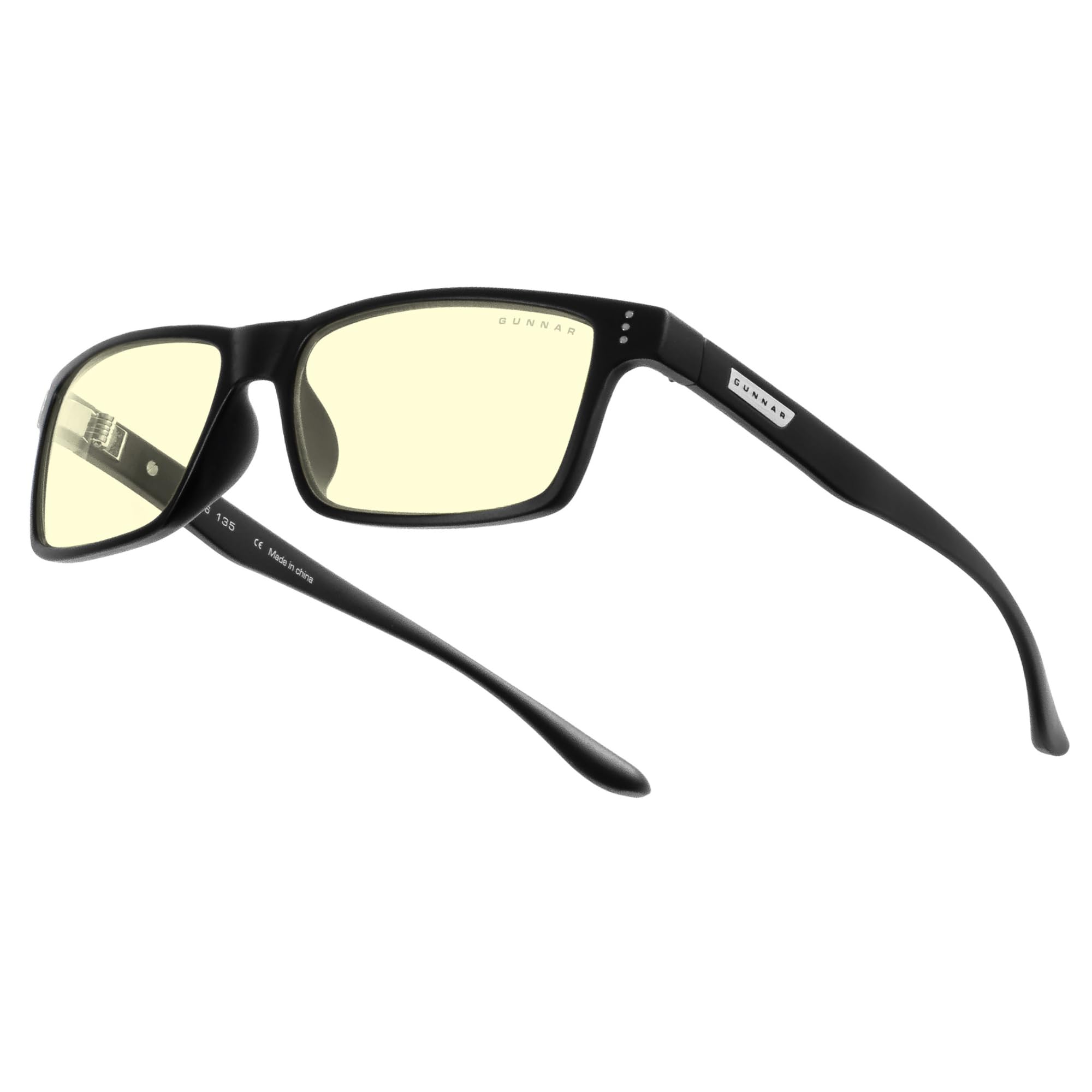
The one pair here built for screens first and reading second.
The GUNNAR Vertex does something no other pick in this group does: the maker states it blocks 65% of blue light, rather than carrying the light anti-glare coating the rest of the list uses. It pairs that with a precision engineered polymer frame, patented lens technology, and an external scratch-resistant hard coat. That deeper filter is why it earns its higher rung on the shelf — it is aimed at taming a bright monitor for someone who is genuinely on screen all day.
The lens does more than filter. The tint is a deliberate slight yellow, and it is what changes the feel of a screen on a gray afternoon — one buyer specifically favors it in rooms lit by fluorescent tubes. It is also prescription compatible, so a pair can carry your own correction along with the firm’s optical design. The catch is the care it demands: owners repeatedly flag scratch resistance as the weak point, so you keep these with the cloth and case they come with, not loose in a bag next to keys.
How it behaves with your own vision is the part to weigh hardest. Customers note that a strong magnification can throw reflections on the lens during a presentation, and this model does not carry an anti-glare coating to knock them back. For everyday monitor work at a moderate strength, though, the image is the deepest-filtered on the list — real screen comfort, a comfortable frame, and a look that holds up in a meeting room.
what separates it: a stated 65% blue light block, a scratch-resistant hard coat, and prescription compatibility all in a light polymer frame.
The honest catch: no anti-glare coating, so a strong magnification can bounce reflections during presentations — and the lenses demand careful handling.
The pick for: heavy screen users and gamers who want the deepest blue light filtering on the list and will treat the optics with care.
A better fit elsewhere if: you want a light, cheap pair you can lose without a thought — the multi-packs above serve that job.
Know the Specs
Magnification and Screen Distance
The plus number on the frame — +2.00, +2.5 — controls how far away things stay in focus. The stronger the number, the closer your comfortable working distance becomes. That is why the same +2.5 that feels perfect for a paperback can feel too close at a monitor an arm’s length away, making the screen feel uncomfortably near. Check your distance before you buy.
Blue Light Blocking and UV400
A blue light blocking coating takes the hard edge off a bright screen so long sessions feel less tiring. UV400 means the lens filters ultraviolet light up to 400 nanometers. Coatings vary widely — some pairs carry a light anti-glare layer, and some, such as the GUNNAR Vertex, are made to block a stated 65% of blue light.
Frame Material and Weight in Ounces
Frame material decides two things: durability and how heavy the glasses feel after an hour. TR90 is a flexible memory-style plastic that bends instead of snapping and keeps pairs light. Metal frames are stiffer and often more rugged, but they usually weigh more, so the trade is grip and solidity against all-day lightness.
Half-Frame and Progressive Lenses
A half-frame lens stays clear across the top, so your eyes move between keyboard and screen without tipping your head. A progressive multifocus lens does that and adds a gradual change from near to far, letting you keep the glasses on all day. The cost of a progressive is clarity at distance — that range tends to soften.
Common Questions
What magnification do I need for computer use rather than reading books?
Do blue light blocking reading glasses actually help with computer eye strain?
Can I wear computer reading glasses all day without taking them off?
What is the difference between a progressive multifocus reader and a regular reading glasses pair?
Will these computer readers stay on my head when I lean down?
Are these reading glasses compatible with a prescription?
How light should computer reading glasses be for long sessions?
Will a strong magnification cause glare or reflections on my screen?
Should I buy a multi-pack or a single premium pair for computer work?
Do these readers hold up to daily use over a year?
The Bottom Line
For most people, the best reading glasses for computer use is the JOLISU 5PCS Reading Glasses Men 2.00 — five sturdy +2.00 half-frame metal pairs with UV400 lenses, spring hinges, and silicone nose pads, so you can keep a reader at every screen in the house. If you want to stop the on-and-off cycle between the keyboard and the screen, the multifocus SKYOAK Progressive +2.5x is the pair to reach for. And for the heaviest screen workloads, where a stated 65% blue light block matters most, the GUNNAR Vertex is the specialist. If all-day nose comfort is your first concern, the light TR90 and semi-rimless picks above cover it — and a multi-pack means you never hunt for a pair again.
How we choose
We do not accept paid placement. Every pick is matched to a real buyer and a real use-case; we do not hands-on test units.
Sources
Specifications: manufacturer listings and product documentation. Review insights: verified customer reviews, as of October 2026. Pricing: not shown on this page (it changes often); check the current price via the retailer link.
As an Amazon Associate, Aappliancez earns from qualifying purchases. This does not affect which products we feature.