Disclosure: Some links in this post are affiliate links. As an Amazon Associate I earn from qualifying purchases, at no extra cost to you. Learn more
Specs are compiled from manufacturer listings and verified buyer reviews and can change over time — please confirm the key details on the product page before buying.
The short answer: the SKYROVER X1 is the best all-around sub-249 g drone here. It pairs a 48 MP main sensor with a 1/1.32-inch CMOS chip (a relatively large light-gathering surface for this class) and three batteries for a stated 96 minutes of total flying time. Everything below is sorted so the machine that fits your actual flying matches the machine you buy. That matters, because a drone that drifts in a breeze or quits at minute twelve stays in the closet. The picks here range from true beginner trainers to stabilized 6K shooters.
This guide is built by comparing the manufacturers’ published specifications and the patterns across verified customer reviews, so you get each pick’s real strengths and trade-offs instead of marketing spin.
Every drone here weighs under 249 g (about 8.8 ounces), so in the United States you skip FAA registration (the government’s drone sign-up list). That one number shapes the whole market, so start there. Your pick then depends on two things: how steady you need the footage, and how long you want to stay in the air. This breakdown of the best rated drones covers both.
Top Picks


How To Choose The Best Rated Drones
Buying a drone is mostly a decision about two numbers: how stable the camera is and how long you can stay in the air. Get those two right and the rest is learnable detail. Here is what separates a keeper from a closet ornament.
Match the weight to your flying plans
Anything under 249 g avoids FAA registration and Remote ID requirements in the US. That is why nearly every model on this list hovers right at the same weight. Cross that line and the paperwork starts, so unless you need a bigger airframe, staying under is the smarter move for a first real drone.
Separate mechanical gimbals from electronic steadying
A 3-axis gimbal uses small motors to physically hold the camera level as the drone tilts and turns. Electronic image stabilization, by contrast, smooths the footage after the fact in software and tends to crop the edges. If smooth cinematic video matters to you, a mechanical gimbal is worth prioritizing over a higher-sounding resolution.
Read flight-time claims carefully
A listing that says 96 minutes usually means three batteries running about 32 minutes each, not a single nonstop session. Always check whether the headline number is per-battery or a total across the batteries in the box. Two batteries is the practical minimum for a real outing.
Side-by-Side Comparison
| Model | Best For | Camera | Max Flight Time | Max Range | Amazon |
|---|---|---|---|---|---|
| SKYROVER X1★ Best Overall | All-around best | 48 MP / 4K/60fps | 96 min (3 batteries) | 50000 feet | Amazon |
| Potensic ATOM SEBest Value | Best value | 12 MP / 4K@30fps | 62 min (2 batteries) | 4 km | Amazon |
| Ruko F11PRO 2Beginner’s Gift | Beginner-friendly gift | 19 MP / 4K/30fps | 70 min (2 batteries) | 10000 feet | Amazon |
| DJI Flip (RC-N3) | Best camera | 48 MP / 4K/60fps HDR | 31 min (1 battery) | 13 km | Amazon |
| Bwine F7MINI | Cinematic stability | 48 MP / 4K/30fps | 96 min (3 batteries) | 20000 feet | Amazon |
| G11PRO | Biggest photo files | 19 MP / 4K/30fps | 70 min (2 batteries) | 10000 feet | Amazon |
| UranHub G30 | Complete starter kit | 12 MP / 4K UHD | 31 min (1 battery) | — | Amazon |
| PLEGBLE | Controller screen, no phone | 8.3 MP / 4K@30fps | 70 min (2 batteries) | — | Amazon |
| REDRIE HK33 (B0DG9VCNG7) | Cheapest 4K starter | 12 MP / 4K photos | 40–45 min (2 batteries) | 500 meters | Amazon |
| REDRIE HK33 GPS (B0F37MYK6N) | Budget GPS return | 12 MP / 2048x1088P | 45 min (2 batteries) | 1640 feet | Amazon |
| Oddire 4K | Thin data caution | 12.3 MP / MP4 | — | 1640 feet | Amazon |
Detailed Reviews
1. SKYROVER X1 Drone with Camera Combo for Adults
Our pick — 4.5+★ from 300+ verified ratings; the strongest balance of quality and price.
The one that pairs a large camera sensor with three batteries and a serious safety system.
What earns the SKYROVER X1 the top spot is camera hardware you rarely see under 249 g. It uses a 1/1.32-inch CMOS sensor — a relatively large light-catching chip — alongside a f/1.7 aperture, which means the lens opens wide to pull in more light. The payoff is 48 MP stills and 4K/60fps HDR video. That 48 MP figure is four times the 12 MP of the GPS drone further down this list, so detail holds up far better when you crop or print. You also get 4K/100fps slow motion for water, bikes and crowd scenes.
Range is the other headline. SkyBridge transmission reaches a stated 9.32 miles, paired with a 1080p/60fps live view so you can frame shots without lag. For comparison, the sub-249 g GPS drone below tops out at 1640 feet, so this one gives you far more room to roam in open country. Three batteries carry 2560 mAh of capacity each and deliver a claimed 96 minutes of total flight time, about 32 minutes per pack. The package even includes a shoulder bag and a battery hub, so you can charge all three at once.
Buyers report it holds steady in 15 knots of wind, which is a genuinely useful trait for coastal or open-field flyers. The 360° obstacle sensing and Smart Return to Home add a real safety net when you push into unfamiliar terrain. Now the honest part: at 5.9 by 3.66 by 2.6 inches folded, it packs small, but this is still an adult-focused craft with a learning curve on linking. You must follow the app’s on-screen pairing steps in order and keep the drone and controller close during setup. Budget a calm first session to learn the handshake before you fly far.
Where it earns its keep
- 48 MP stills from a 1/1.32-inch sensor give you crop room most sub-249 g drones lack
- Three 2560 mAh batteries and a hub for a stated 96 minutes total
- 360° obstacle sensing plus Smart Return to Home for confident exploring
- 9.32-mile SkyBridge range with smooth 1080p/60fps live view
Where you should pause
- Linking demands a strict step-by-step order in the app, so the first flight takes patience
- Three batteries mean a longer pre-flight charge routine than a single-pack craft
Reach for this if: you want the most camera and the most airtime in a legal-everywhere package.
Look elsewhere if: you want a first drone you can fly in five minutes flat — start simpler.
2. Potensic ATOM SE GPS Drone with 4K EIS Camera
The crowd favorite that folds into a jacket pocket and stays up for two batteries’ worth.
The ATOM SE is the drone most people should start with, and the reason is simple arithmetic. Two 2500 mAh batteries run up to 31 minutes each for a stated 62 minutes of total flight, all in an airframe under 249 g that folds small enough to slip into a jacket pocket. The camera pairs a 1/3-inch Sony CMOS sensor with 12 MP stills and 4K@30fps video. ShakeVanish electronic stabilization smooths the footage across a 118° field of view, and the camera tilts from +20° to -90° so you can shoot straight down.
Where this one pulls ahead of its price peers is trust. People who fly it at high altitude and in gusty weather keep coming back to one point: the footage stays usable. The SurgeFly control system gives you a Beginner Mode plus Video, Normal and Sport profiles, and Sport Mode tops out at 16 m/s in 2.8s. The ATOM SE’s 4 km range (about 13,123 feet) dwarfs the 1640 feet of the GPS drone near the bottom of this page.
The trade-off is battery life, which is the one area the reviews call mixed rather than glowing. You get the stated per-pack time, but real cold-weather flying will shave minutes off it. It also needs a micro SD card for 4K capture, and none is included, so order one with the drone. Set your expectations on the 4K footage too: it is genuinely good for the class, not cinema-grade. For a first GPS drone that will not punish a clumsy landing, the equation still favors it heavily.
The value read: two batteries, GPS return, 4K, and a pocket-fold airframe — the balance most beginners are chasing.
The one thing to buy alongside it: a micro SD card, since 4K video will not record without one.
The smart first drone: if you are learning to fly and want GPS safety without overpaying, this is the one.
Not for you if: you demand mechanical gimbal smoothness or all-weather battery performance.
3. Ruko F11PRO 2 Drone with 6K Camera
A gimbal-stabilized 6K shooter built so a total novice can fly it on day one.
If you are buying for someone who has never flown, the F11PRO 2 removes most of the fear. One-Key Takeoff/Landing and a dedicated Beginner Mode mean the first flight is a button press, not a manual. A 3-axis mechanical gimbal physically holds the camera level, so it shoots 4K/30fps video and 6K photos without the shake that plagues cheaper craft. The 19 MP still resolution and 3200 mAh batteries are the concrete numbers behind its staying power.
Flight time is where this one shines in daily use. Two intelligent batteries combine for a stated 70 minutes, which covers a full family outing or an afternoon scouting a large property without a mid-session charge. GPS Auto Return-to-Home brings it back on its own when the battery runs low or the signal drops, which takes a lot of stress out of the learning phase. Its 10,000-foot transmission range keeps a live view going well across open land.
The recurring note is that this is a big airframe — it folds out to 15.16 by 13.78 inches — and it has real learning overhead in one spot. The data port lives on top of the remote under the phone holder, and plugging the cable into the side charging port by mistake kills your video feed. Learn the ports once and this is a genuinely forgiving, gimbal-steady floater. What it is not is a pocket drone for impromptu snaps.
Why families like it
- 3-axis gimbal delivers smooth 4K/30fps video and 6K photos
- Two 3200 mAh batteries for a stated 70 minutes of flight
- One-Key Takeoff and Beginner Mode for a gentler learning curve
- GPS Auto Return for confidence over large properties
Small print to know
- The data port sits on top under the phone holder — mix it up with the charging port and video stops
- At 15.16 inches unfolded it is a fuller-size craft, not a pocket travel drone
Gift-ready choice: hand it to a parent or newcomer who wants stable, gorgeous footage without piloting lessons.
Skip the gimbal here if: you need something that disappears into a small sling bag.
4. DJI Flip (RC-N3) Drone With 4K UHD Camera

Carbon-fiber propeller guards and a large sensor in one travel-friendly package.
The DJI Flip is the pick for anyone who cares most about the picture. It uses a 1/1.3-inch CMOS sensor — a large chip for a sub-249 g drone — which pulls in more light and holds detail in shade and sunset. The result is 4K/60fps HDR video and 48 MP stills, with subject tracking that keeps a person or pet in frame while you hike or host. Full-coverage propeller guards made from lightweight carbon fiber turn it into a craft you can fly near people with less worry.
Range is exceptional. The DJI Flip reaches 13 km (about 44,000 feet) of video transmission, which is the farthest on this page and well beyond what you will use in practice. One battery delivers up to 31 minutes, so a second pack is a smart addition for a real outing. Its performance is the quality people notice most, with camera and value trailing close behind. As owners put it, it flies like a much pricier DJI model without the registration hassle.
The honest catch is battery life, which the reviews call mixed, and the DJI Fly app has been pulled from Google Play for platform reasons — you must download it from the official DJI website. That is a one-time setup detail, not a daily headache. Weighing in at 643 g in the listing’s own figures, it is also heavier in hand than the tiny numbers on the top picks might lead you to expect. For a stabilized 4K/60fps HDR camera you can fly without paperwork, it is the most capable option here.
The camera case: a 1/1.3-inch sensor and 4K/60fps HDR are the top-tier combination on this list.
The setup note: source the DJI Fly app from DJI’s own site before your first flight.
For shooters first: this is the one for anyone who buys a drone to make the best-looking video they can.
Consider twice if: you want maximum total airtime from a single box — one battery is a short session.
5. Bwine F7MINI 4K Video 8K Photo Drone
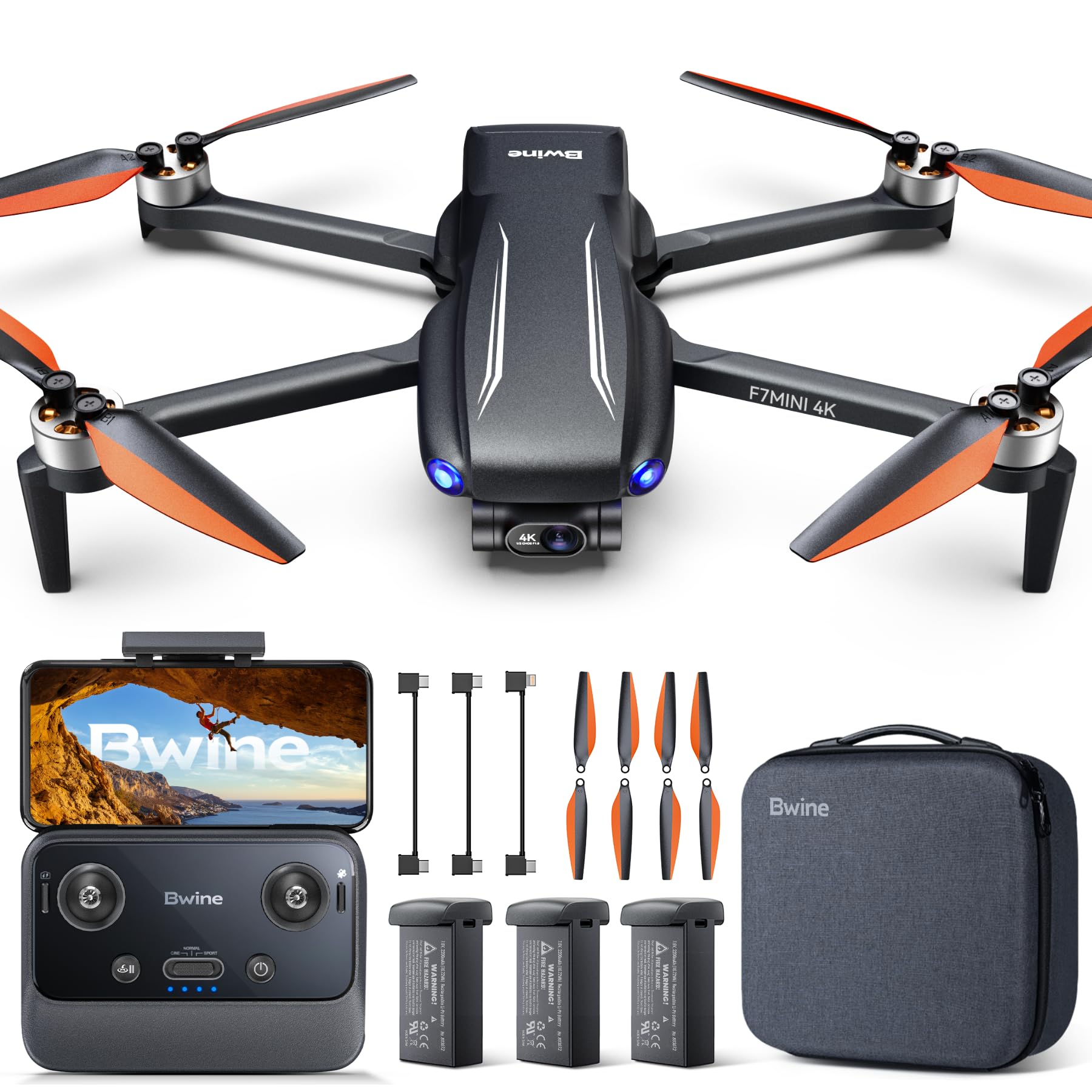
Three batteries, a mechanical gimbal, and a locator buzzer for when things go wrong.
The F7MINI is built around camera steadiness. A 3-axis brushless gimbal uses motors and sensors to counter the drone’s motion in real time, keeping the horizon level even when the airframe tilts in the wind. That pairs with a 48 MP 1/2-inch CMOS and an F1.8 aperture for 8K photos and 4K/30fps video. Its 1503 brushless motors push a top speed of 31 mph, so it stays composed on breezy mountain flights.
Where it beats most rivals is total time in the air. Three 2200 mAh batteries run about 32 minutes each for a stated 96 minutes, and PD 3.0 fast charging cuts the wait between packs. Its 20,000-foot range gives you plenty of exploring room, and the 120dB locator buzzer is a genuinely smart addition if a landing goes wrong in tall grass. GPS follow, orbit, waypoint and optical-flow indoor positioning round out the flying modes.
Quality is clearly the thing owners value most, with value for money a close second. The recurring point about battery life is that some flights run shorter than the headline, so treat 32 minutes as the optimistic end. The controls are also sensitive, which rewards a steady hand — especially in wind or at night. Bwine’s replacement support earns real praise for sorting out a lost or faulty unit. For a stabilized 8K-photo craft with three packs in the box, it is a strong cinematic pick.
What makes it cinematic
- 3-axis brushless gimbal keeps the camera level in real time
- Three 2200 mAh batteries for a stated 96 minutes total
- 120dB locator buzzer helps you find a downed drone
- 20,000-foot range with optical-flow indoor positioning
What to watch for
- Sensitive joysticks reward a light touch in wind or low light
- Battery life can fall short of the stated per-pack maximum
Best for steady footage: buyers who want mechanical stabilization and three packs without the big-brand price tag.
Think twice if: you prefer a forgiving, slow-reacting controller — this one responds sharply.
6. G11PRO 6K Drone with Camera for Adults

A 6K photo shooter with a fast-charging battery system and a genuinely complete kit.
The G11PRO leads with the biggest photo number on this page: 6K stills and 4K/30fps video from a 1/3.2-inch CMOS sensor. A 3-axis brushless gimbal holds the camera level across pitch, roll and yaw, so footage stays smooth in wind and steep turns. The GQ2.0 digital transmission is a two-way, dual-antenna design reaching a stated 10,000 feet with a plug-and-play wired connection to your phone. Cruise Control lets the flight system hold a steady line so you can concentrate on framing.
The battery side is unusually thoughtful. Two batteries give a stated 70 minutes total, and fast charging takes about 2.5 hours, so you are not waiting all afternoon. The system is rated for over 300 charge cycles with 80% performance retention, and a breathing alert light warns you before power becomes a problem. It also flies with FAA Remote ID compliance, with a QR code right on the drone for the remote ID. The 40-piece kit even includes a carrying bag and a camera protector.
Quality is the aspect buyers single out most, with camera quality right behind it. The honest caveat is signal reliability, which reviews call mixed — some flights lose the link closer than the range figure suggests. Treat the long-range claim as open-country headroom, not a guarantee you will hold a feed through dense trees or city clutter. For sharp 6K stills and a gimbal-steady 4K feed, it delivers real capability for the money.
The photo advantage: 6K stills give you more room to crop and rescale than any 4K-native rival here.
The signal caution: keep line of sight and expect shorter links in cluttered terrain.
Pick it for stills: buyers who want large 6K photos and a fast-charging gimbal setup.
Look past it if: you fly in dense trees or urban clutter where a stable signal at all costs matters more.
7. UranHub G30 Drone with 4K UHD Camera
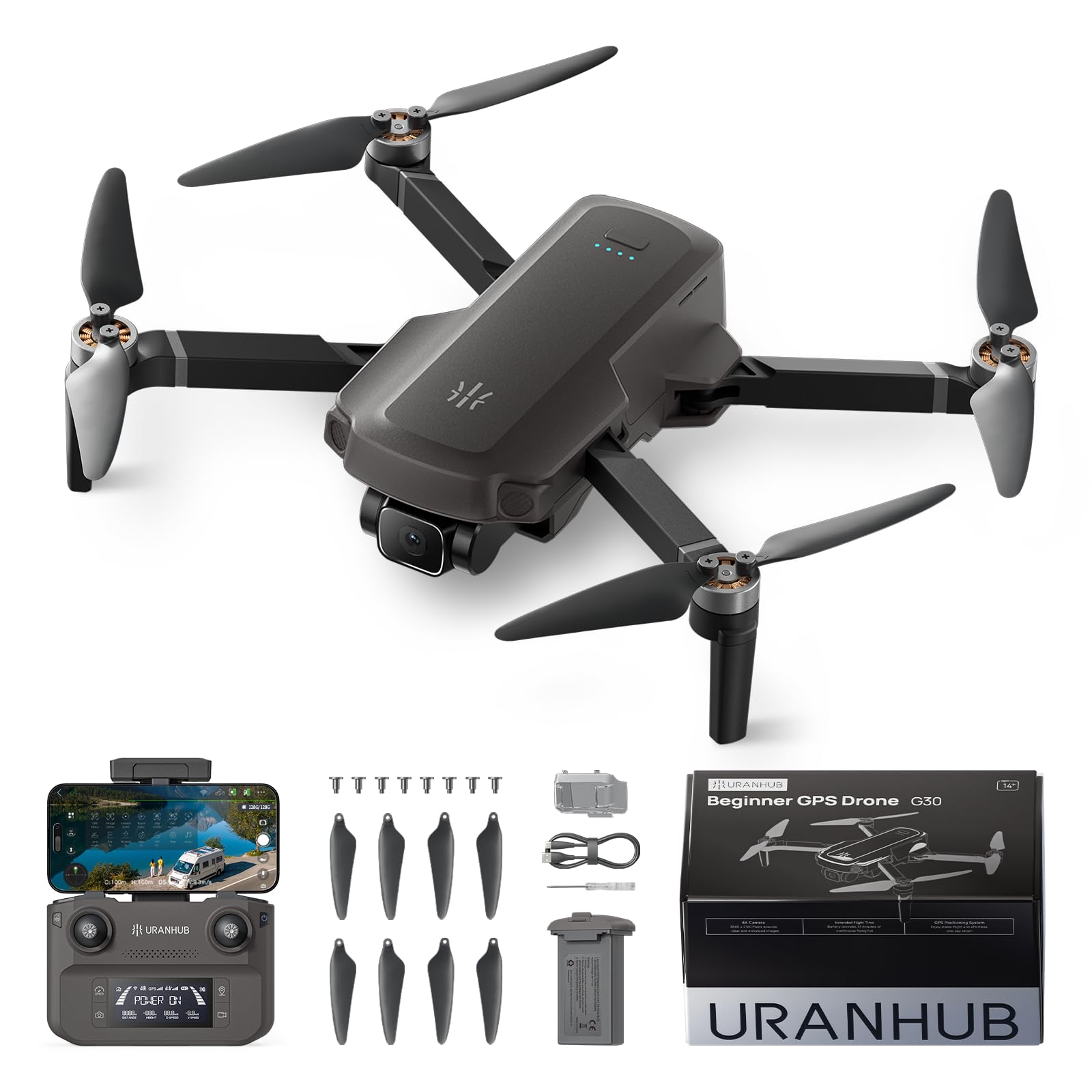
The learner’s drone that leans on beginner modes and a 12MP Sony sensor.
The G30 is the one to hand a total beginner, and it is built around that job. Beginner Mode, Optical Flow Positioning (a downward camera that reads the ground to hold position) and One-Click Landing take the panic out of the first flight. A 12MP Sony CMOS sensor captures 3840 x 2160 4K, with a 90° adjustable lens and 5G FPV transmission for a live view. GNSS positioning means it locks onto satellites and hovers precisely.
One 2300 mAh battery carries it for a stated 31 minutes, with smart low-battery alerts and real-time monitoring so you land before it drops. If it loses signal or the power runs low, it flies itself home, and One-Key Return brings it back on demand. Brushless motors add wind resistance and smoother running. Suitability for kids and beginners is clearly the thing buyers value most, with fun a close second.
Now the fair warning the data spells out. Battery life gets a negative read, so 31 minutes is optimistic and best treated as a single short session. Functionality, control and stability are all mixed rather than universally praised, which fits a budget-friendly trainer. Buy it as a first drone to learn on, not for paid work. For the money, the safety features make learning far less scary.
Why learners take to it
- Beginner Mode plus One-Click Landing for a stress-free start
- 12MP Sony CMOS sensor shooting 3840 x 2160 4K
- GPS and optical flow for stable, precise hovering
- Auto Return on lost signal or low battery
Where it stays modest
- One 2300 mAh battery means a single short session per charge
- Stability and control read mixed, so it suits calm-day practice
The training wheels: best for a newcomer or a kid who needs a forgiving first craft to grow into.
Not for serious shooting: step up if you need long sessions or consistently rock-steady footage.
8. PLEGBLE Drones with Camera for Adults 4K
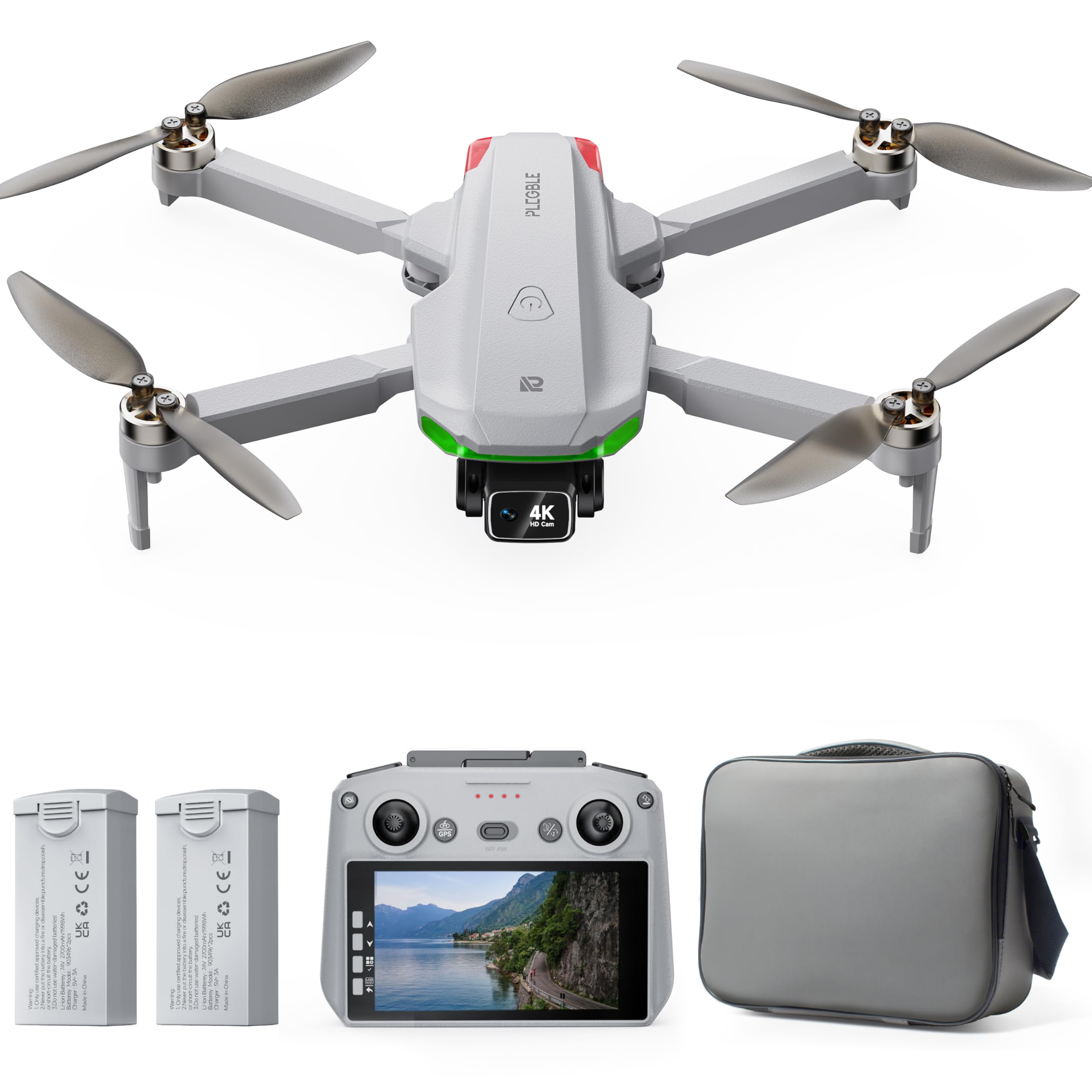
A built-in 5-inch controller screen that cuts the phone out of the loop entirely.
If you are tired of clipping a phone to a controller, the PLEGBLE answers directly. It puts a 5.0-inch HD screen right on the remote for real-time FPV, so you fly with zero app and zero phone. You can preview local photos and video and format SD cards straight from the controller. Suitability for beginners is what draws people in, with ease of use a close second. The camera shoots 4K@30fps with a 130° wide-angle lens and 90° adjustable tilt, steadying footage with EIS stabilization.
Flight time is generous for the tier. Two 2700 mAh batteries combine for a stated 70 minutes, and USB-C fast charging with overcharge and short-circuit protection keeps recharges safer. GPS gives you Smart Return to Home, low-battery return and signal-loss return, plus position lock for a steady hover. It weighs under 249 g for FAA and Remote ID exemption in the US, and brushless motors claim Level 5 wind resistance.
The honest part is where the reviews split. Value for money and reliability both read mixed, and the manual’s stated range runs far shorter than the marketing figure on the listing. Expect roughly fifteen minutes of real flight per battery rather than the headline number, and budget for the fact that the small screen can be hard to read in direct sun. The 8.3 MP effective still resolution also lags the higher-MP picks here. Buy it for the 5.0-inch controller screen that removes the phone from the loop.
The standout: a 5.0-inch on-controller screen makes this the simplest one to fly without a phone.
The realistic read: real-world flight per battery lands near fifteen minutes, and the range claim runs optimistic.
Best phone-free pick: choose it if you want a self-contained controller and hate fussing with an app.
skip it if: you need the sharpest stills or the most uniform reliability.
9. REDRIE Drones with Camera for Adults 4K (HK33)
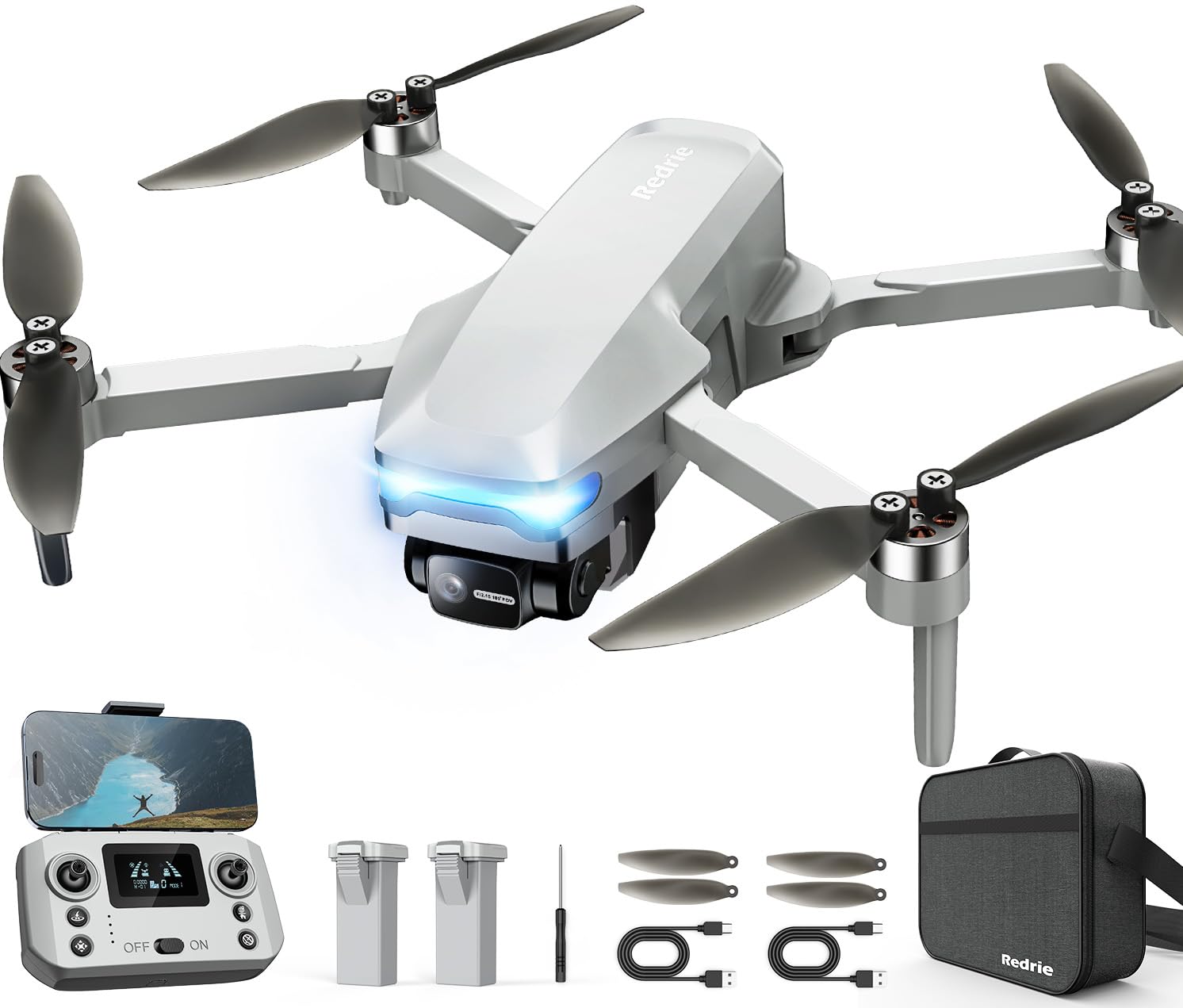
The no-registration beginner package that comes with two batteries and a case.
The HK33 earns its spot as the entry-level pick by covering the basics cleanly. It weighs under 249 g, so no FAA registration is needed, and it folds into a carrying case for travel. A 2-axis gimbal with an F2.15 aperture and 110° ultra-wide lens smooths out shaky footage, while a 90° remote-controlled adjuster lets you switch between horizontal and vertical framing on the fly. It shoots 4K photos (4096x3072P) and 2K video (2048x1088P) to a micro SD card or straight to your phone.
Two 1800 mAh batteries give a stated 40 to 45 minutes of total flight, with a real-time battery indicator on the remote or app so you are never guessing. Its suitability for a starter is clearly the thing buyers value most, with value for money right behind it. GPS brings auto return when the signal drops, the drone flies out of range, or the battery runs low. Brushless motors hold steady in Level 5 winds, and 5G WiFi feeds a low-latency live view within a 985-foot transmission range.
Stability gets a mixed read, so treat calm days as its home turf. The 5G WiFi spec is not an efficiency number — it simply means the drone uses that wireless band to stream video. For a first drone you can pack in a backpack and fly without paperwork, the combination of two batteries and a case makes it an easy, low-risk start.
The beginner math
- Under 249 g, so no FAA registration
- Two 1800 mAh batteries for a stated 40 to 45 minutes
- 2-axis gimbal with 110° wide lens and 90° adjustable tilt
- GPS auto return on lost signal or low battery
The calm-day caveat
- Stability reads mixed, so it is happiest in light wind
- 2K video is a step below the 4K capture of pricier picks
A low-risk first buy: ideal if you want a foldable, registration-free trainer with two packs included.
Outgrow it fast if: you quickly want sharper video and steadier hold in a breeze.
10. REDRIE GPS Drones with Camera for Adults 4K
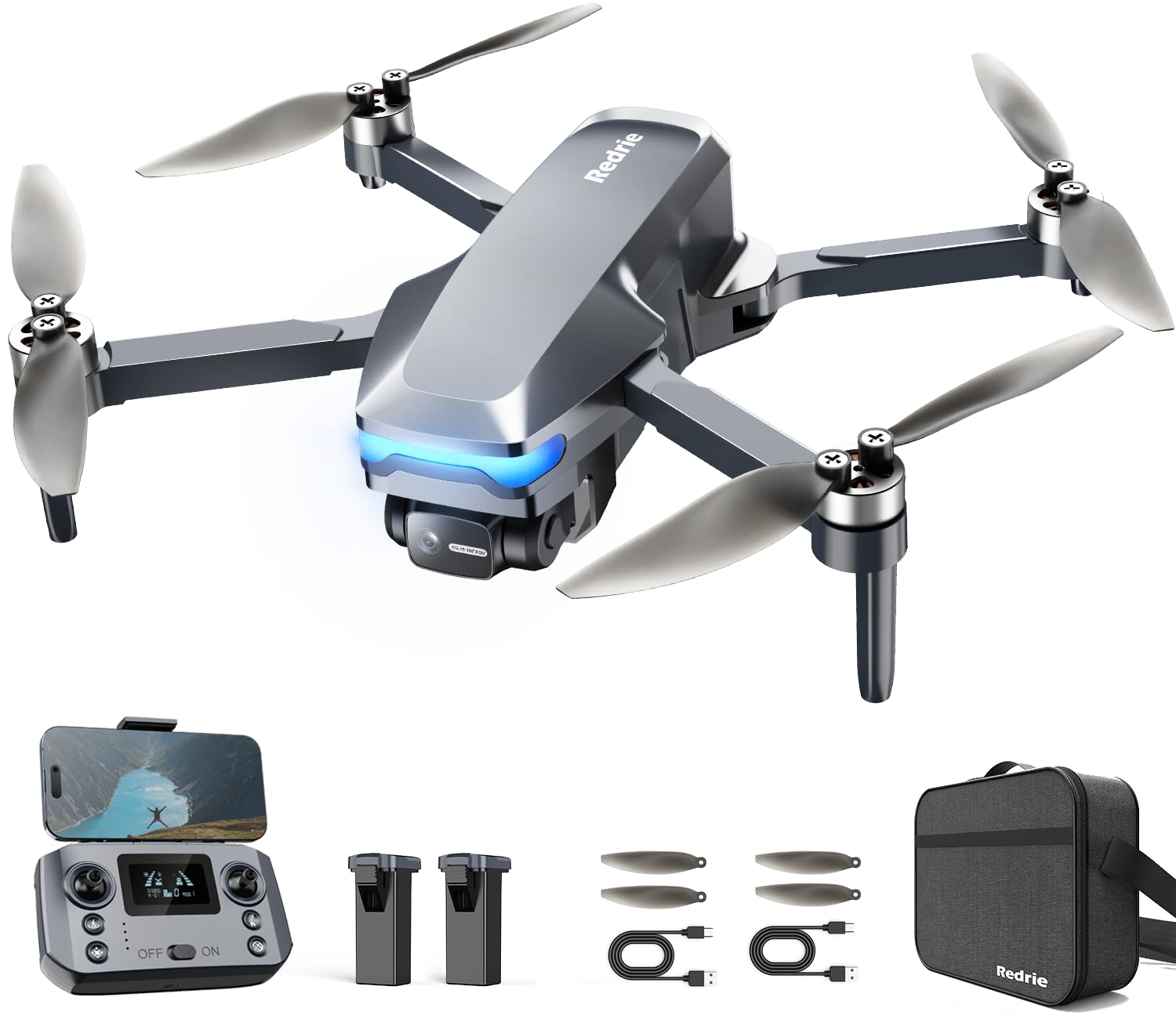
An adjustable anti-shake camera and a GPS brain at the sparsest end of the market.
This GPS variant brings the return-home safety net to the lowest tier. An advanced GPS module handles GPS Auto Return, Follow, Route Planning and Fly Around, and the drone flies itself home if it loses signal or the battery dips. The camera uses an F2.15 110° wide lens with physical vibration reduction and a 90° remote adjuster, capturing 4096x3072P images and 2048x1088P video. Brushless motors give it Level 5 wind resistance for steadier holds.
Two 1800 mAh batteries add up to a stated 45 minutes of flight, with an indicator light that keeps you posted on remaining power. Its 5G WiFi streams a live view up to 985 feet, and a built-in repeater in the controller extends flight range to 1640 feet. At under 250 g it sidesteps FAA registration, and it folds into an included case.
Flying is easy to pick up, and picture quality lands in the good-enough range. The fair caveat is that flight performance and value split down the middle, with some reports of units that would not fly right from the start. That makes buying from a seller with easy returns the smart move. As a budget GPS trainer for open, low-wind flying, it covers the essentials without overpromising.
What you get: GPS return-home, a vibration-reduced wide camera, and two batteries at the entry tier.
The measured caveat: flight performance reads mixed, so lean on the return policy.
Budget GPS safety: worth it if you want auto return and a wide camera without a big outlay.
Step up if: you need consistent reliability and a clearer video spec.
11. Oddire Drone with 4K Camera
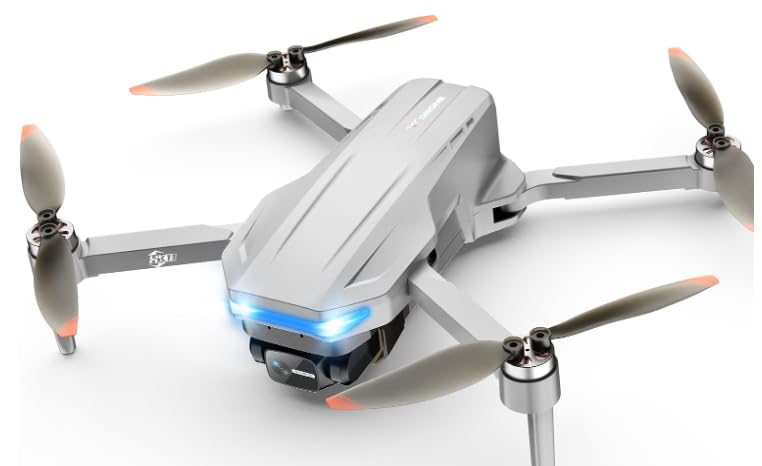
A compact 12.3 MP shoot with a CMOrMOS sensor and a 1640-foot range figure.
The Oddire stands out for a single, simple reason in the data: a 12.3 MP effective still resolution on a CMOS sensor, with video captured in MP4 format. On paper it hits the familiar marks for the category — a 1640-foot maximum range and lithium polymer power. Its 12.3 MP figure sits just above the 12 MP of the two budget REDRIE options, a minor edge on still resolution alone.
Where this one differs is how little printed detail the listing shares. There is no per-battery flight time, no confirmed battery capacity, and no published set of owner reviews to draw on. That does not make it a bad machine; it just means you are choosing it largely on its camera resolution and price tier. The remote-control operation and plastic build are standard for a beginner craft.
Because the data is thin, treat this as the option for a buyer who is comfortable doing their own due diligence. Confirm the flight time and battery capacity in the listing questions before you commit, and set expectations around the documented range. If the printed specs line up with what you need, its 12.3 MP camera is the reason to consider it.
Its one clear edge: 12.3 MP stills on a CMOS sensor, a touch above the 12 MP tier.
What is missing: no published flight time, capacity, or review history — verify specs before buying.
For the self-sufficient buyer: consider it if you will check the printed specs yourself before committing.
Better to skip if: you want a well-documented, review-backed first drone.
Know the Specs
Gimbal versus electronic stabilization
A 3-axis gimbal uses motors to physically steady the camera, so the footage comes out smooth without software cropping the edges. Electronic stabilization smooths the frame in software after the fact and can trim the corners. Mechanical gimbals tend to cost more and add a little bulk, but they are the reason cinematic footage looks floating rather than jittery.
Flight time per battery versus total
A 96-minute figure often means three batteries of roughly 32 minutes each, not one long flight. Always read whether a listing means per-pack or total across the pack count in the box. Cold air and hard flying shorten any drone’s real time, so plan on landing before the battery nears empty.
Sensor size and aperture
A larger sensor (measured in inches, like 1/1.32-inch) gathers more light than a smaller one. A lower f-number aperture (like f/1.7) opens wider to let in more light too. Together they mean clearer dusk shots and cleaner detail, which is why cameraquality and sensor size often matter more than the headline megapixel count.
Range and transmission type
The listed range is the maximum signal distance in open, interference-free air. Digital transmission systems hold a stable feed better than older analog links, but trees, hills and buildings shrink any range in practice. Treat a big range figure as headroom you may never fully use, not a promise of a clear feed through clutter.
Common Questions
Do I need to register a drone under 249 g with the FAA?
Is a mechanical 3-axis gimbal better than electronic stabilization?
Does “96 minutes of flight” mean one long flight?
Will these drones return home on their own if I lose signal?
Do I need a micro SD card to record video?
Can a beginner fly the SKYROVER X1 or DJI Flip right away?
How far can these drones actually fly?
Is the DJI Flip harder to buy because of the app issue?
Which drone takes the sharpest photos?
Should a total novice start with a budget drone or a premium one?
The Bottom Line
For most buyers, the rated drones winner is the SKYROVER X1. It packs the most camera power into a body under 249 g: 48 MP stills (48-megapixel photos, sharp enough to crop and still print) from a 1/1.32-inch sensor (the camera’s light-catching chip), 4K/60fps HDR video (smooth, high-detail footage with wider brightness range), and three batteries for a stated 96 minutes of flight. Want the sharpest picture and can live with a single battery? The DJI Flip leads on its 4K/60fps HDR feed and 1/1.3-inch sensor. And if you’re a beginner after a pocket-friendly first drone with two packs and GPS safety (satellite positioning that holds the drone steady and brings it home), reach for the Potensic ATOM SE.
Whichever way you go, match the drone to how you fly: a beginner trainer to learn on, a gimbal craft for cinematic footage, a large-sensor shooter for stills. Every pick here weighs under 249 g, so you skip FAA registration and focus on the shot.
How we choose
We do not accept paid placement. Every pick is matched to a real buyer and a real use-case; we do not hands-on test units.
Sources
Specifications: manufacturer listings and product documentation. Review insights: verified customer reviews, as of October 2026. Pricing: not shown on this page (it changes often); check the current price via the retailer link.
As an Amazon Associate, Aappliancez earns from qualifying purchases. This does not affect which products we feature.