Disclosure: Some links in this post are affiliate links. As an Amazon Associate I earn from qualifying purchases, at no extra cost to you. Learn more
Specs are compiled from manufacturer listings and verified buyer reviews and can change over time — please confirm the key details on the product page before buying.
If your dog shares a yard with a rat problem, you need bait that kills rodents without turning your pet into a casualty. The honest answer: no rodent bait is truly dog-proof, but the picks below use lower-toxicity formulas with a known antidote (vitamin K1) and are meant to be locked inside a tamper-resistant bait station. Everything here is built around that one rule.
This guide is built by comparing the manufacturers’ published specifications and the patterns across verified customer reviews, so you get each pick’s real strengths and trade-offs instead of marketing spin.
You will see exactly which active ingredient each option uses and how to place it away from curious noses. The short version: match the formula to your yard, lock it in a station, and pick the right one for you with the rat poison safe for dogs shortlist below.
Top Picks


How To Choose The Best Rat Poison Safe for Dogs
The single biggest thing you can do for your dog is not the bait itself — it is where the bait sits. Every formula on this list becomes dramatically safer the moment it lives inside a tamper-resistant bait station (a locked plastic box only a rodent can squeeze into). Choose the formula second, and the placement first.
Read the active ingredient before anything else
Anticoagulant baits (the most common type) thin a rodent’s blood over days until it dies. These are the ones with a known antidote, vitamin K1, which a vet can give if your dog ever gets into the bait. Lower-toxicity, first-generation formulas like warfarin and diphacinone are the usual choice for homes with pets, while single-feeding formulas act faster but demand stricter containment.
Match the bait form to where you are placing it
Blocks and hot-extruded pellets hold up in damp spots like burrows and crawl spaces. Liquid concentrate is for dry indoor conditions where you can control the water source. Packets suit routine refills inside stations. Pick the form that survives your actual placement, or the bait will spoil before it works.
Plan for the dead-rodent cleanup
Rodents often die out in the open or inside walls, and a dog may find a carcass before you do. Secondary poisoning — where a dog eats a poisoned rodent — is a real risk with any anticoagulant bait. Walk your yard daily during treatment and remove any bodies immediately, wearing gloves.
Side-by-Side Comparison
| Model | Best For | Active Ingredient | Form | Weight / Size | Amazon |
|---|---|---|---|---|---|
| LIPHA TECH FirstStrike★ Best Overall | Fast knockdown in hot, dry spots | Difethialone | Bar | 4 pounds | Amazon |
| MOTOMCO Tomcat Liquid BaitBest Liquid Option | Dry indoor spaces with no other water | Diphacinone | Liquid | 1.68 oz × 8 pack | Amazon |
| Kaput Rat & Mouse Bait | Voles and yard rodents near buildings | Warfarin (0.025 %) | Loose grain packets | 7.5 pounds | Amazon |
| Neogen Ramik Green | Wet, damp, outdoor placements | Diphacinone (.005%) | Pellets | 20 pounds | Amazon |
| Contrac Blox | Heavy infestations and long-term baiting | Bromadiolone | Blocks | 18 pounds | Amazon |
Detailed Reviews
1. LIPHA TECH FirstStrike Rodent Bait 10g – 4lb Bag (31113)
Our pick — 4.5+★ from 1,000+ verified ratings; the strongest balance of quality and price.
The bait that keeps its kick in a hot shed and empties a rat run fast.
For a dog owner dealing with a serious rat or mouse problem, this is the one to start with. It is built around difethialone at 25 ppm (a potent blood-thinning active ingredient), and it is a single-feeding formula — meaning a rodent only has to eat once for the bait to do its job. The formula is designed to stay palatable and hold its integrity in hot environments, so a bait station tucked in a summer garage or along a sunny foundation stays appealing instead of going stale.
The 4-pound bag lets you load multiple stations and keep refilling along runs. That is a bigger working quantity than the MOTOMCO Tomcat’s eight 1.68-ounce liquid packs, so you are not remixing concentrate every few days. The label also allows you to peel the paper and lay the bar directly on a feeding device, which keeps the bait where you put it. As with all anticoagulants here, vitamin K1 is the antidote, so a vet has a known reversal if a dog ever eats bait.
Placement beats everything around pets. Keep it in a locked bait station, wear gloves from the moment you open the bag, and pop bricks on top of outdoor boxes so a dog cannot nose them open. Owners who run a baiting campaign with several stations report the yard going quiet within days. The honest catch is that this is a high-potency single-feeding bait: keep the bag sealed and stored well above a dog’s reach, and do not scatter it loose where a curious snout can find it.
What earns its top spot
- Single-feeding difethialone formula at 25 ppm for quick knockdown.
- Stays palatable in hot conditions, so summer placements keep working.
- 4-pound bar bag loads many stations and refills them economically.
- Vitamin K1 antidote gives a vet a known reversal path.
Where you need to be careful
- High-potency bait must stay sealed, stored, and inside locked stations around dogs.
- Bar form needs a station or feeding device, not loose scattering.
Grab this if: you have a real infestation and want fast, single-feed control in dry or hot spots, with the discipline to lock it all in stations.
Think twice if: you want to scatter bait openly — this one demands containment.
2. MOTOMCO Tomcat Liquid Concentrated Bait 8 Pack
A drink-instead-of-eat bait for dry rooms where rodents still find water.
Rodents in a dry space are already hunting for water, and this concentrate turns that habit against them. You mix a pack with water and set it out in a feeder, so the bait becomes the rodent’s water supply. It uses diphacinone (a first-generation anticoagulant, the slower class with a well-known vitamin K1 antidote), and the brand positions it for exceptional control under dry conditions. Eight single packs come in the box, giving you several mixing rounds across a season.
This is the pick for a garage, attic, or shed where a bait block keeps getting ignored. One buyer described mixing a pack per 16 ounces of water and said it beat the blocks their mice favored. Another reported finally sleeping through the night because the mice had “really guzzled this down.” Ease of use is what draws the warmest feedback, and the liquid format is genuinely simple: mix, pour into a feeder base, and monitor the level.
Here is the catch, and it is a big one for a dog household. This product’s own labeling says it is not for use in residential settings and should not be used outdoors. That makes it a specialist tool for outbuildings and controlled dry spaces, not a yard treatment around a pet. Liquid bait can also be knocked over or spilled where a dog could reach it, and one buyer warned about mist and skin-contact risk during mixing. Use it in a sealed feeder, keep a second water source away from the area, and keep dogs entirely out of that space.
The water trick that works: diphacinone liquid meets rodents on the exact behavior they have in a dry building — searching for a drink — and the eight-pack sizing stretches a treatment out.
The catch you cannot ignore: the label rules it out of residential and outdoor use, so reserve it for a dog-free outbuilding and a locked feeder.
Suited to: dry, dog-free outbuildings where you can control the water supply and contain the feeder.
Steer clear if: you need a yard bait or share the space with a free-roaming dog.
3. Kaput Rat & Mouse Bait 60 Packets
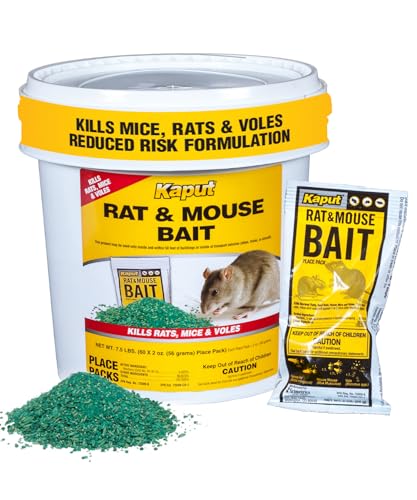
The low-toxicity warfarin bait built for homes and farms that keep pets.
If your main worry is what happens if a dog finds the bait, this is the formula to study closely. Kaput runs on warfarin at 0.025 % — a first-generation anticoagulant the brand markets as low-toxicity to non-target animals, including pets and wildlife. It targets rats, mice, and voles in one bait. The 7.5-pound haul of 60 ready-to-use 2-ounce packets means you can seed dozens of placements without measuring anything. Compared with the Neogen Ramik Green’s 20 pounds, it is a lighter bucket to carry around a yard.
The selling point is what wins people over: this is a bait that clears voles out of lawns and garden beds, where other products get ignored. The brand’s instructions are strict for good reason — place packets in a tamper-resistant station, indoors or within 50 feet of buildings, so pets and children never meet the bait directly. Doing that turns a low-toxicity formula into a genuinely pet-aware setup.
Two honest things to know. Some buyers consider it overpriced for the volume, and the taste draws mixed remarks — meaning non-target animals, squirrels included, can be attracted to it. It works slowly over about a week rather than overnight, so patience is part of the plan. Follow the label carefully to avoid harming other animals, and keep every packet inside a locked station.
Why dog owners gravitate here: warfarin at 0.025 % is the low-toxicity end of the anticoagulant scale, and the brand explicitly markets it for pets and wildlife when used in a station.
The slow, watchful trade-off: expect roughly a week before rodents drop off, and keep squirrels away since the taste attracts more than rats.
Reach for this if: you are clearing voles or yard rodents around a pet-keeping home and want the gentler formula plus ready-made packets.
Look elsewhere if: you need an overnight knockdown or a fast-responding single-feed bait.
4. Neogen Ramik Green Rodenticide Pellets 20-Pound

Fish-flavored pellets that shrug off damp burrows and wet crawl spaces.
Damp ground is where most bait fails, and Neogen solves it with a hot-extruded pellet that resists weather without any wax coating. It is made of diphacinone at.005% (a first-generation anticoagulant, so the vitamin K1 antidote applies here too). The fish-flavored grain mix is designed to appeal to rats, mice, and meadow voles. Twenty pounds of pellets fills a lot of stations and burrow mouths, and the bucket itself opens with a pull tab around the rim rather than a fight with a lid.
This is the workhorse for outdoor placements in wet or damp areas, where pellets stay intact instead of turning to mush. The bucket’s 20 pounds beats the Kaput’s 7.5 pounds if you are treating a large yard or farm perimeter and do not want to reorder soon. Pour pellets straight from the bucket into a station or burrow opening, and refill along runs until the bait stops disappearing.
The mixed reality: effectiveness varies. Some yards see rodent activity drop sharply within a week or two, while others describe mice treating the pellets like a buffet. In residential areas, rats can grow resistant over time, so rotating to a different active ingredient between treatments is worth planning. For a dog, the concern is the same as any anticoagulant pellet: keep the bucket sealed, load only tamper-resistant stations, and walk the yard for carcasses.
The weatherproof advantage: hot-extruded pellets resist damp without wax, so burrows and wet crawl spaces keep a usable bait where softer forms fail.
The honest catch: results are inconsistent across yards, and resistance can build, so plan a rotation rather than relying on one bucket forever.
Best fit for: large, damp yards and farm perimeters where you need volume and weather resistance, with strict station discipline around a dog.
Skip if: you only need a small indoor placement — this bucket is overkill.
5. 18 LB Contrac Blox Rodenticide
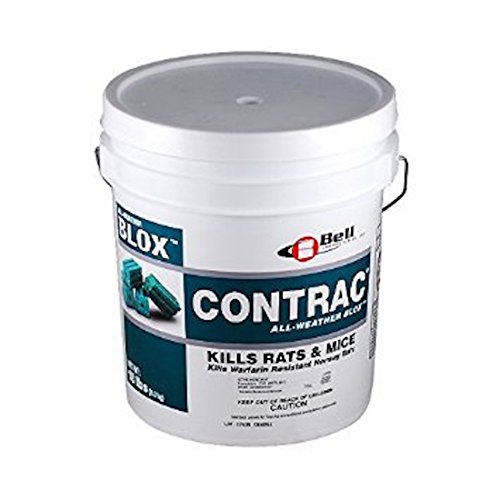
A block bait built to hold its shape in wet or dry conditions and last a season.
For a heavy, long-running infestation, Contrac Blox is the heavyweight of this list. It uses bromadiolone (a single-feeding anticoagulant) blended with food-grade ingredients and a small amount of paraffin, so the blocks stay palatable yet withstand wet and dry conditions. Eighteen pounds of blocks give you a long baiting campaign in one bucket. A single feeding does the job, which is why people treating stubborn rat colonies keep coming back to it.
The brand states directly that Contrac is less toxic to non-target animals than other single-feeding baits, in both primary and secondary poisoning situations. That statement describes its toxicity relative to other single-feed baits — it is not a claim that it is safe for dogs to eat. Vitamin K1 is the readily available antidote, and the label insists on a tamper-resistant bait station. Treat that last point as the whole ballgame around a pet: the blocks are the bait, but the station is the actual protection.
Owners treating a chronic cabin or greenhouse problem report the signs vanishing and the blocks being eaten nightly until they stopped. Others note it is pricey for the bucket, and that safety is a real concern if left reachable. Change bait out every 40 to 60 days during an active campaign, and keep it locked away from noses. For a dog household in the middle of a big infestation, this is the pick with the most staying power — as long as you commit to the stations.
The staying power: bromadiolone blocks hold shape in wet or dry conditions and 18 pounds supports a long, patient baiting campaign against a large colony.
The safety caveat sized fairly: less toxic than other single-feed baits per the brand, but still a serious product — keep every block in a locked station and refresh it every 40 to 60 days.
Worth it if: you are fighting a large or persistent infestation and want one long-lasting block bait to see it through.
Not for: anyone who cannot commit to locked bait stations and routine yard checks around a dog.
Know the Specs
Active Ingredient and Toxicity
The active ingredient is the chemical that kills the rodent. Warfarin and diphacinone are first-generation anticoagulants — they work more slowly but are generally considered lower-toxicity to pets. Difethialone and bromadiolone are single-feeding anticoagulants that act faster but demand stricter containment. Whichever formula you choose, vitamin K1 is the standard antidote and can reverse an anticoagulant poisoning if a dog is treated promptly.
Bait Form and Weather Resistance
Blocks and hot-extruded pellets hold up in damp spots, while liquid concentrate is best for dry indoor conditions. Weather resistance matters most outdoors — a bait that turns to mush in a wet burrow will not be eaten. Choose the form that survives where you actually place it, and load it into a tamper-resistant station so pets and children cannot reach the bait directly.
Bait Stations
A tamper-resistant bait station is a locked box that lets a rodent in but keeps a dog out. It is the single most effective way to make any bait safer in a pet household. Place stations along rodent runs, against walls and foundation lines, and weigh them down or anchor them so a determined dog cannot tip them over.
Placement and Cleaning
Keep bait indoors or within the label’s allowed distance of buildings for outdoor formulas, away from open areas a dog roams. Wear gloves when handling bait so your scent stays off it and your skin stays off the active ingredient. Remove dead rodents promptly, since a dog eating a poisoned carcass risks secondary poisoning.
Common Questions
Is any rat poison actually safe for dogs?
What should I do if my dog eats rat poison?
Which active ingredient is the safest around dogs?
Can a dog get poisoned by eating a dead rat that ate bait?
Do I need a bait station for rat poison around a dog?
Is the liquid bait from MOTOMCO safe to use outside?
How long does rat bait take to work?
Can rodents become resistant to rat poison?
Will rat poison harm squirrels or wildlife?
The Bottom Line
For most dog-owning homes, the rat poison safe for dogs winner is the LIPHA TECH FirstStrike — its single-feeding difethialone formula at 25 ppm clears a run fast while holding its appeal in hot spots. If your main worry is what happens if a dog finds the bait, the Kaput Rat & Mouse Bait runs on the low-toxicity warfarin formula with ready-to-use packets. And for a wet, large yard or a heavy colony, reach for the Contrac Blox or the Neogen Ramik Green, both of which hold up in damp placements. Whichever you choose, the containment plan is what keeps your dog safe — lock the bait in a station, store it high and sealed, and check the yard daily.
How we choose
We do not accept paid placement. Every pick is matched to a real buyer and a real use-case; we do not hands-on test units.
Sources
Specifications: manufacturer listings and product documentation. Review insights: verified customer reviews, as of October 2026. Pricing: not shown on this page (it changes often); check the current price via the retailer link.
As an Amazon Associate, Aappliancez earns from qualifying purchases. This does not affect which products we feature.