Disclosure: Some links in this post are affiliate links. As an Amazon Associate I earn from qualifying purchases, at no extra cost to you. Learn more
Specs are compiled from manufacturer listings and verified buyer reviews and can change over time — please confirm the key details on the product page before buying.
If your phone sits against your body all day, you need a barrier between the device and you — not a sticker on the back. The picks below do that job in three ways: a leather folio with a shielded wallet, a neoprene pouch lined on one side, and slim cases and stick-on shields for people who refuse to give up their phone’s shape. The best overall is the SafeSleeve wallet case, the crowd favorite at 4.0+ stars across 900+ ratings.
This guide is built by comparing the manufacturers’ published specifications and the patterns across verified customer reviews, so you get each pick’s real strengths and trade-offs instead of marketing spin.
Below you get the honest picture on one-sided shielding, signal retention, and sizing traps that decide whether a blocker actually stays in your pocket. Read on for the picks that make the most sense when you are shopping for the best radiation protection for cell phones.
Top Picks
How To Choose The Best Radiation Protection for Cell Phones
Most people assume a blocker blocks the whole phone. It almost never does. The shielding is a metal-fiber or copper-infused fabric on one side of a pouch or case, and that side has to face your body to do anything useful. Everything else follows from that one fact — where you carry the phone, whether the front stays open, and how much signal you need to keep for calls and data.
One-sided shielding and why the phone still works
A pouch like the SYB or the RadiArmor is lined on the back only, so the phone keeps its normal reception and battery life. If a product blocked every direction, it would work like a Faraday bag (a sealed conductive enclosure that kills signal entirely). That is a different tool, and it means you could not take a call while the phone is inside. For daily carry, you want a directional shield: the lining between you and the device, the open face pointed away.
Where you carry the phone matters more than the marketing number
If the phone rides in a pocket or on a belt, the pouch approach earns its keep because the lining stays where it needs to be. If it lives in a purse, a car mount, or your hand, a liner does less for you. That is also why sticker-style shields are the most contested category — a small patch on the back of the phone cannot create a barrier between the screen side and your hand.
Sizing: measure with the case on
Every pouch here is sized to a phone length or width, and the fit is where buyers get burned most. Measure the phone with its case installed before ordering. A sleeve built for phones up to 6.1 inches is not the same product as an XXL holster built for bodies up to 4.33 inches wide — and neither one is a universal fit.
Price tier is not a quality signal here
A budget-friendly sleeve and a mid-range leather folio can both use a shielded liner; what changes is the shell, the closure, the card storage, and the magnets. Pay for the build and the carry style you want, not for a bigger percentage printed on the box.
Side-by-Side Comparison
| Model | Best For | Form | Side Shielded | Materials | Amazon |
|---|---|---|---|---|---|
| SafeSleeve EMF Blocker Leather Wallet Case (iPhone 17)★ Best Overall | One case that covers the phone and your cards | Flip folio case | Front cover between phone and body | Faux leather, smooth glossy finish | Amazon |
| SYB Shield Your Body EMF Blocker Pouch (XXL)Best for Belt Carry | Belt or purse carry without signal loss | Open-top pouch holster | Rear lining only | Neoprene, smooth finish | Amazon |
| RadiArmor EMF Blocking Sleeve (Black, Large) | Sliding a phone into a pocket or bag | Enclosed sleeve, 7 x 4.2 x 0.2 in | Backside liner only | Neoprene, matte finish | Amazon |
| WAVEBLOCK EMF Protection Case (iPhone 15 Pro) | Keeping a normal slim case feel | Basic slim case | Patented blocker built into the case | Silicone, matte finish | Amazon |
| WAVEBLOCK EMF Blocker Sticker (iPhone 17 Pro Max) | Discreet protection under any case | Adhesive sticker | Single patch on the phone back | Polypropylene, smooth finish | Amazon |
Detailed Reviews
1. SafeSleeve EMF Blocker Leather Wallet Case
Our pick — 4.0+★ from 900+ verified ratings; the strongest balance of quality and price.
The folio that shields your body and tidies your wallet in one flip.
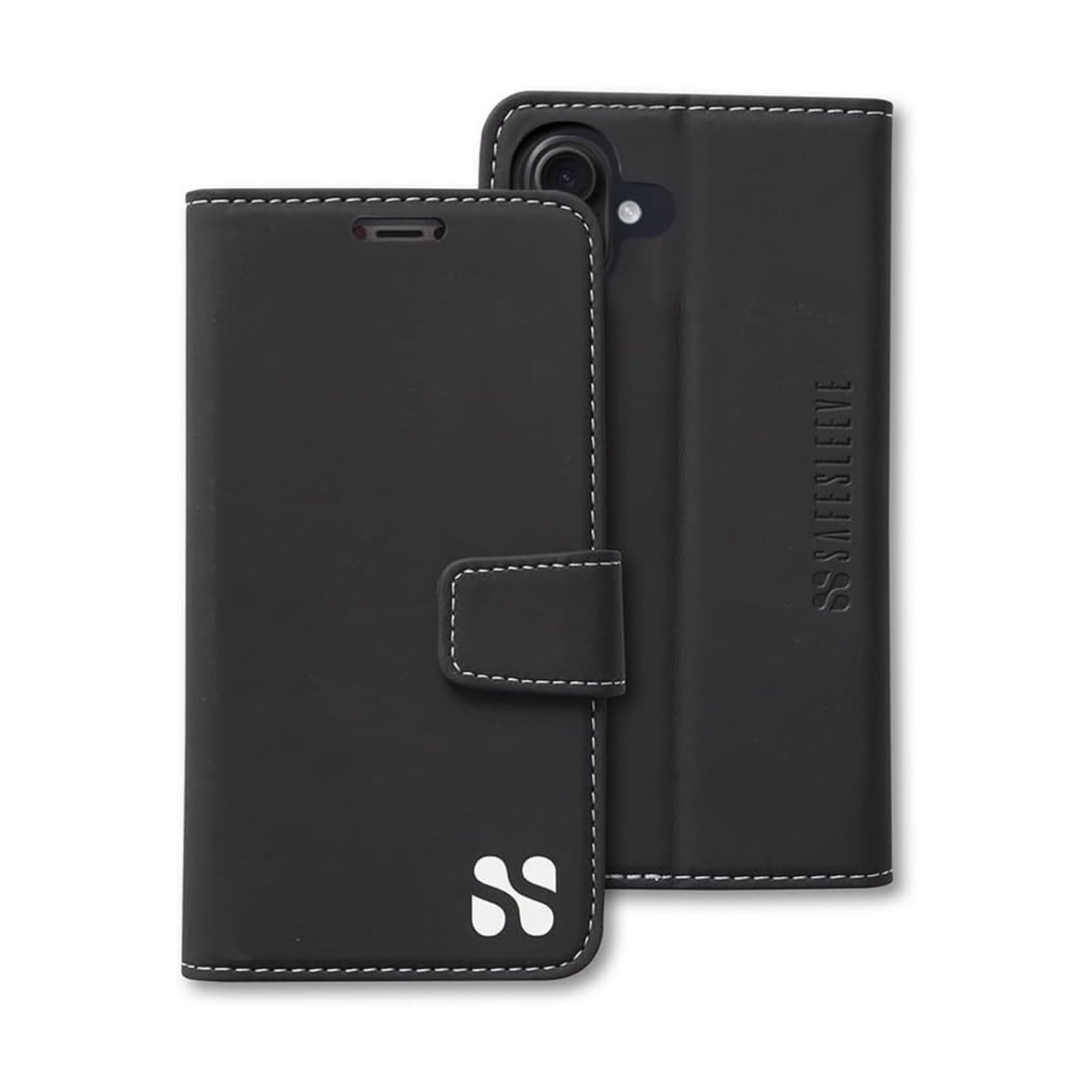
This is the pick if you already carry a wallet case and want the shield built in. The flip cover closes over the screen, so the barrier sits between the phone and you whenever the case is shut — the same one-sided idea as a pouch, applied to a case you actually want to own. It holds up to three cards plus a cash pocket, and the cover folds back as an adjustable stand for videos or video calls.
What wins people over is the protection story: it is the most-discussed strength of the case by a wide margin. Buyers describe drops that left the screen intact, and several say they confirmed the blocking with a handheld EMF meter. The look lands too — a smooth glossy faux-leather finish that reads as professional rather than rugged. It is built for the iPhone 17 and supports magnetic accessories through a MagSafe-compatible construction.
The catch is the flip itself. With the cover closed you cannot use the screen, and taking a picture one-handed means holding a loose flap out of the way. People who shoot a lot of quick photos tend to switch to a slim case for that reason. Sizing also runs large for some, and a few buyers found the edges did not hold up long-term. Treat the shell gently and it is a good everyday case; treat it like a tank and it will show.
What holds up well
- Shielded flip cover sits between the phone and your body whenever it is closed
- Three card slots plus a cash pocket replace a separate wallet
- Cover doubles as an adjustable stand in portrait or landscape
- MagSafe-compatible build keeps magnetic accessories working
Where it asks patience
- No screen access with the cover shut — calls mean flipping it open
- One-handed photos are awkward with the flap loose
- The faux-leather finish is not real leather, which some buyers object to
- Some report the shell running large or wearing at the edges over time
Right call for: anyone who wants a wallet case with a shield over the screen and does not mind flipping it open to answer.
Think twice if: you shoot photos constantly or insist on genuine leather — the faux-leather build and the loose flap will bother you daily.
2. SYB Shield Your Body EMF Blocker Phone Case XXL
An open-top holster that keeps the shield against your hip and the screen facing out.
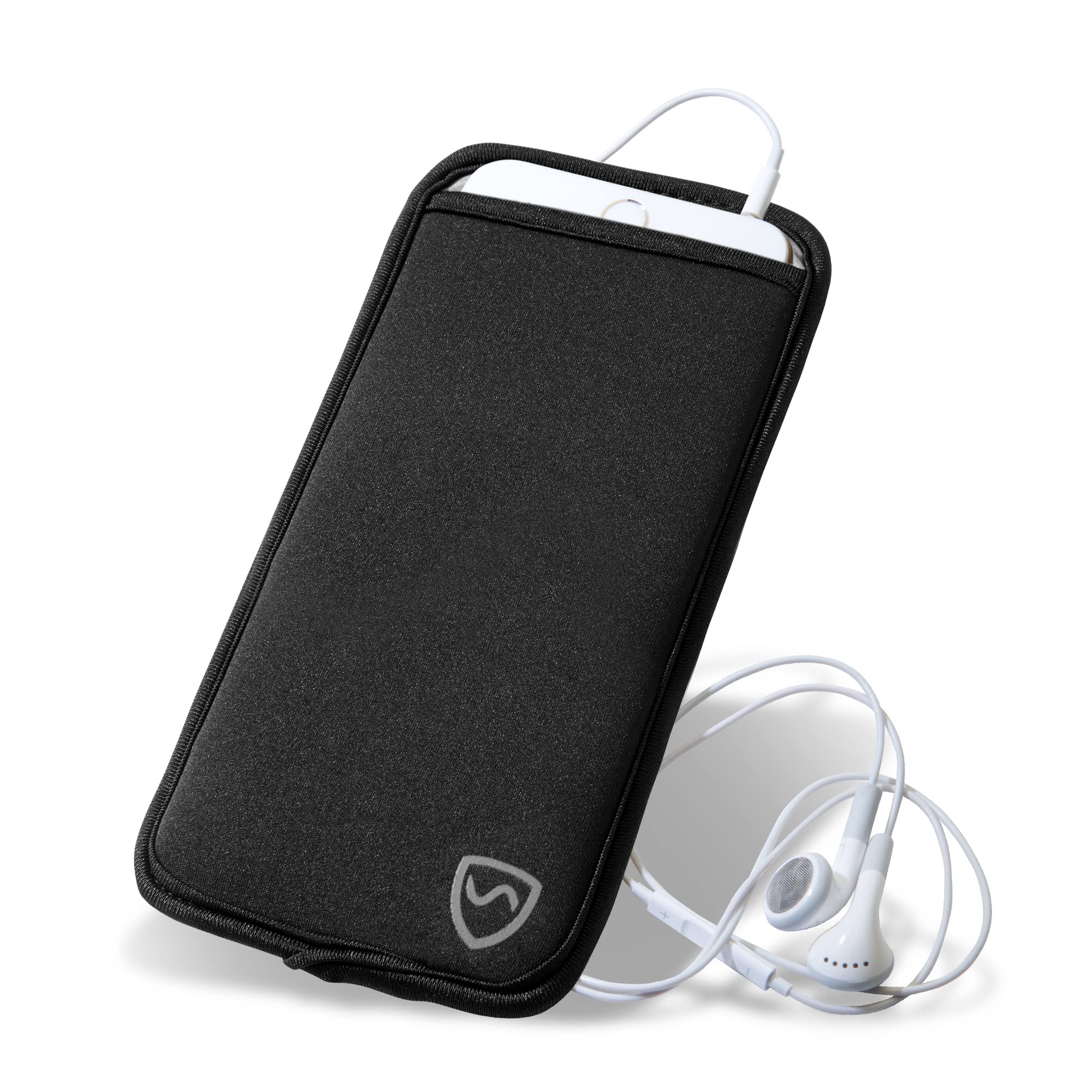
Here is the idea in one line: a neoprene pouch lined on the rear with a fine mesh of metallic fibers, so the blocked side faces your body and the open face points away. The open top means you can plug in a charger or headphones and pull the phone out without undoing anything. A belt loop straps it to your waistband or bag, and the XXL size is built for the largest phones with cases — up to 4.33 inches wide and 7.5 inches tall.
The measured numbers are the interesting part. Buyers who tested the SYB pouch with a meter report magnetic fields cut roughly 90-99% and RF reduced about 75-85% from the shielded back — not the 99% the listing advertises. That gap is worth knowing before you buy any blocker. Portability is the other consistent win: the pouch slips into a dress pocket better than a bare phone and keeps a secure seat in shallow ones. It is made from durable neoprene with stitched edges.
The honest trade-off is fit. Some phones swim in it and some are tight, so measure yours with the case on and match it to the 4.33 by 7.5-inch opening. A few buyers also wanted a folding flap or a horizontal option, since the vertical belt carry is the only way it hangs. If you carry in a pocket or purse rather than on a belt, a different form makes more sense.
Where the value lands: a belt-friendly, open-top holster with a rear metallic-fiber liner that keeps reception and battery life normal, at the budget-friendly end of this list.
The honest gap: it shields one side only, so the reduction is directional — the measured 75-85% RF figure is real-world, not the 99% on the box.
Reach for this if: the phone rides on your belt or in a pocket and you want an open-top holster you can pull the phone out of one-handed.
Look elsewhere if: you want full-wrap shielding or a case that stays on the phone — this is a pouch, and it only covers the rear.
3. RadiArmor EMF Blocking Cell Phone Sleeve (Black, Large)
A soft sleeve sized to a phone length, built around one shielded back panel.
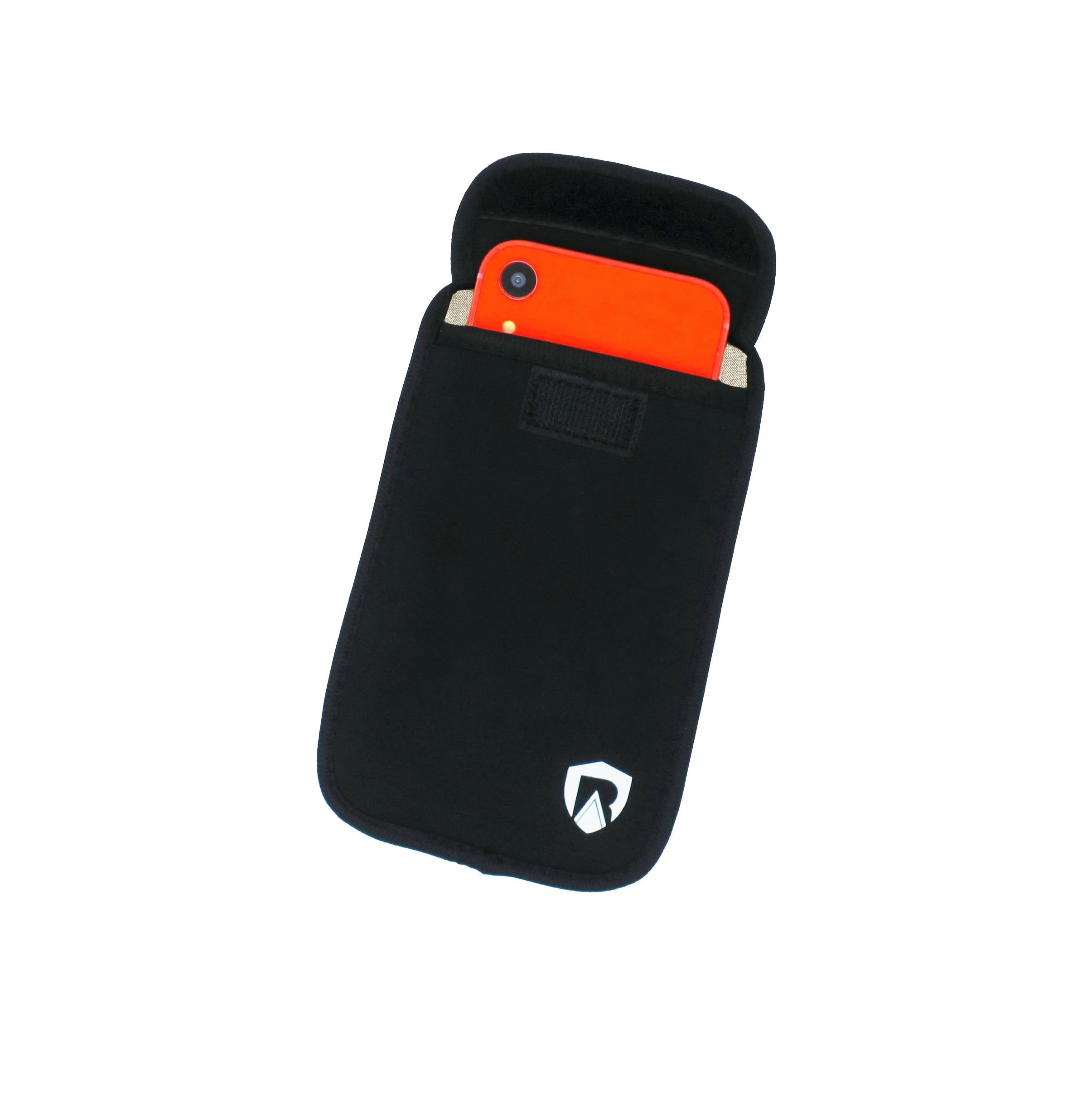
This one is for the pocket carrier who wants the phone fully enclosed. It is a neoprene sleeve with the blocking fabric on one side only, and the maker puts the real numbers out front: the fabric blocks over 99% of high-frequency RF and microwave radiation, while the reduction reaching the user works out to between 91% and 96%. It is not intended to kill all signal like a Faraday bag (a pouch that blocks all wireless signals) — the backside liner creates the barrier while normal reception continues. The Large fits phones up to 6.1 inches in total length with the case on.
The sleeve also carries RFID blocking (a liner that stops card-skimming readers), which is a small bonus if you keep a transit card in the same pocket. Buyers like the soft feel compared with hard clip-on holders, and the flap tucks inside so it stays put rather than swinging loose. Worth knowing: the closure is Velcro, and it is the wear point — plan on a replacement after heavy daily use rather than decades of service.
Sizing is the real gate. Measure your phone with its case and confirm it is under 6.1 inches; if it is 6.1 inches or longer, this Large is the wrong sleeve and you want the XL instead. Some buyers find it tight even at the right length. The protection question also draws split views — a paper-thin liner leaves one side wide open, and buyers who expected full-wrap shielding come away unimpressed. Judge it as a directional sleeve, because that is what it is.
Reasons it earns a slot
- Maker publishes the user-level reduction — 91% to 96% — not just the fabric number
- Encloses the whole phone while leaving call and data signal intact
- RFID blocking liner adds card-skimming protection
- Soft neoprene and a tucked flap that stays closed
What to plan around
- Velcro closure is the weak point and wears out with hard daily use
- Fit runs tight for some phones even at the stated length
- One side is unlined, so it is directional protection only
- You have to pull the phone out for calls and scrolling
The short verdict: the sleeve to pick if your phone lives in a pocket and you want it fully enclosed with a known 91-96% user-level reduction.
One caveat up front: check your phone-with-case length against 6.1 inches before ordering — the XL is the correct call for anything longer.
4. WAVEBLOCK EMF Protection Case for iPhone 15 Pro, Black

The blocker for people who refuse to give up a normal slim case.
If a pouch and a flip folio both feel like too much fuss, this is the compromise: a silicone case for the iPhone 15 Pro with WaveBlock’s patented blocker built in. It works with MagSafe (Apple’s magnetic attachment system), so chargers and mounts snap on as usual. The build is silicone with a matte finish.
What owners talk about first is the design and the grip — a comfortable hold that keeps the phone stable, with raised edges around the screen and camera. It installs easily and comes off easily for cleaning, and buyers mention buttons that press cleanly. The smooth matte texture feels nice in the hand, and one long-term owner reported no fading, yellowing, or wear after months of use and a few drops. It is the pick for someone who wants a case first and a blocker second.
Two things to weigh. The surface is smooth, and buyers have flagged that it can feel slippery in a dry hand. The other is the material’s longevity — a few reports describe the silicone fraying at the edges after several weeks, so treat it as a case that will eventually need replacing rather than a lifelong one. The blocking effect is also hard to verify at home; most owners describe it as confidence rather than a measured change. That is the honest limit of any case-style blocker.
Why it places here: a genuine slim case with MagSafe, raised screen and camera edges, and a patented blocker behind the back panel.
The trade: silicone edges can fray with time, and the smooth finish feels slick in a dry palm.
For the case-first buyer: someone on an iPhone 15 Pro who wants MagSafe and a slim feel, with the blocker as a bonus.
Not for you if: you want measurable, one-sided shielding you can test at home — a case-style blocker is the hardest kind to confirm.
5. WAVEBLOCK EMF Blocker Sticker for iPhone 17 Pro Max, White
A peel-and-press patch that disappears under your existing case.
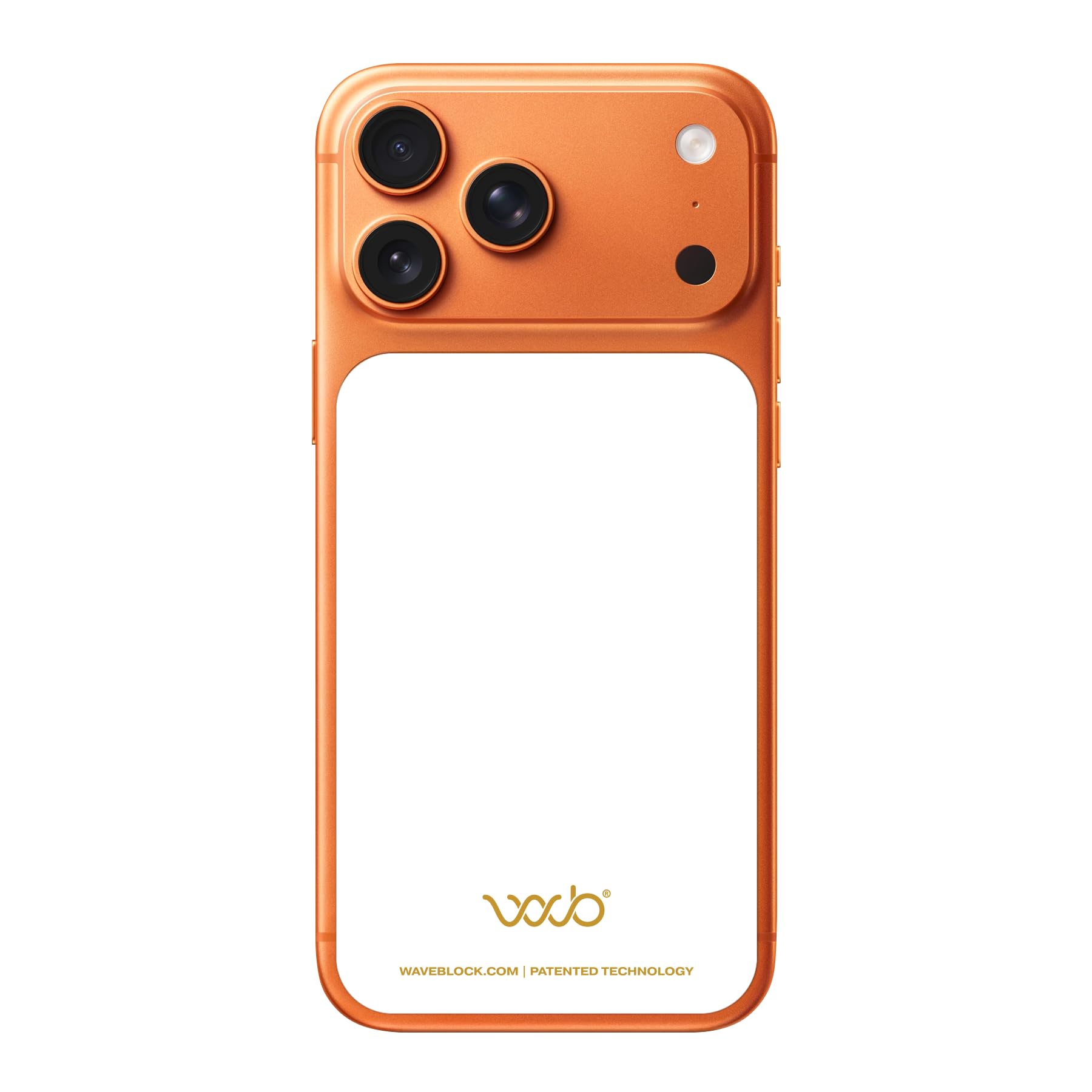
This is the most divisive product on the list, and it deserves a straight answer. It is a thin adhesive sticker sized for the iPhone 17 Pro Max, designed to sit on the back of the phone and stay hidden under a case. You keep whatever case you already like — the sticker just goes underneath.
For owners who like it, the appeal is the total convenience: peel, press, forget. Quality is the aspect that draws the most praise, and buyers describe it as easy to apply with no interference to calls, scrolling, or charging. The peace-of-mind angle is strong here — people describe waking with fewer headaches and less head pressure after applying one, and it sits invisibly under a favorite case. That is the sticker’s pitch: back-panel protection without changing your case or setup.
Now the hard part. A sticker covers the back and nothing else, so it cannot put a barrier between the screen side and your hand or ear. Independent testing in the reviews found the reduction tiny — one owner measured about a 1% decrease on the back of an iPhone 16 Pro and pointed to a fabric pouch as the stronger option. That tracks with how directional shielding works: the bigger the covered area between you and the phone, the more it does. If you want a measured change, a sleeve beats a sticker; if you want zero fuss and a blocker for the back panel, this is the one.
Pick it when: you love your current case and want a discreet patch on the back with no bulk and no change to your phone’s shape.
Pass it up when: you want the biggest reduction you can get — a full pouch covers far more of the phone than a single back panel ever can.
Know the Specs
One-Sided vs Full-Wrap Shielding
A pouch or folio lined on one side creates a barrier between you and the phone while leaving the open face free, so calls and data keep working. A full-wrap shield behaves like a Faraday bag and kills signal entirely. For daily carry, one-sided is the practical choice — the lining must face your body to do its job, which is why where you carry the phone matters as much as the product itself.
Fabric Rating vs User Reduction
When a brand says “blocks up to 99%,” it usually means the blocking fabric itself, not the reduction you receive. The number that matters is the user-level figure — the RadiArmor sleeve lists 91% to 96%, for example. Ask which number is being quoted before comparing two products. A high fabric rating on a small patch can deliver far less to your body than a modest rating across a full back panel.
Sizing a Pouch or Sleeve
Pouches are sized to phone length or width, and the fit is the most common complaint across this category. Measure the phone with its case installed. A sleeve built for phones up to 6.1 inches is a different product from an XXL holster built for bodies up to 4.33 inches wide. If your phone measures 6.1 inches or longer, step up to the XL version rather than forcing the standard size.
Signal and Battery Retention
A directional shield that leaves the front open keeps reception and battery life normal, which is the whole point. If you notice dropped calls or faster drain after adding a blocker, check that you are not covering the phone on all sides. The open face is supposed to point away from your body, and the phone should still work exactly as it did before.
Common Questions
Do phone radiation blockers actually block anything?
Will a blocker stop my phone from getting calls or data?
Is a pouch better than a sticker for blocking radiation?
How do I know which size sleeve to order?
Will the shield interfere with MagSafe charging?
Is a case with a built-in blocker as effective as a pouch?
Do these blockers work with Android phones?
Can I keep my credit cards in the same case?
How long does the blocking material last?
Can I use a blocker while the phone is in my bra or pocket?
The Bottom Line
The verdict for most people is the SafeSleeve EMF Blocker Leather Wallet Case, because it pairs a shielded flip cover with three card slots and a kickstand in a case you would carry anyway. If you want the most coverage per dollar and carry on a belt, the SYB Shield Your Body pouch gives you a rear metallic-fiber liner, a belt loop, and a measured 75-85% directional RF reduction. And for a phone that lives in a pocket, the RadiArmor sleeve encloses the whole device with a user-level reduction the maker puts at 91% to 96%. The WaveBlock case wins if you refuse to give up a slim case, and the sticker is the one to skip if measurable shielding is the goal. Pick the form you will actually carry — a folio, a belt pouch, a sleeve, or a slim case — and you will keep using it.
How we choose
We do not accept paid placement. Every pick is matched to a real buyer and a real use-case; we do not hands-on test units.
Sources
Specifications: manufacturer listings and product documentation. Review insights: verified customer reviews, as of October 2026. Pricing: not shown on this page (it changes often); check the current price via the retailer link.
As an Amazon Associate, Aappliancez earns from qualifying purchases. This does not affect which products we feature.