Disclosure: Some links in this post are affiliate links. As an Amazon Associate I earn from qualifying purchases, at no extra cost to you. Learn more
Specs are compiled from manufacturer listings and verified buyer reviews and can change over time — please confirm the key details on the product page before buying.
If your heels snag on your socks and the cheap stone from the drugstore isn’t doing anything, the problem is usually the tool, not how hard you scrub. Match the tool to the callus: a nickel file for thick cracked heels, a cone-shaped stone for the gaps between toes, or a rechargeable electric roller for salon results without the elbow work. This guide compares five highly rated Amazon options and explains which fits your feet.
This guide is built by comparing the manufacturers’ published specifications and the patterns across verified customer reviews, so you get each pick’s real strengths and trade-offs instead of marketing spin.
Shop-owners and home users both sort these tools the same way: by grit, shape and how much skin they take off per pass. Below are the picks, sorted by what each does best.
Top Picks

How To Choose The Best Pumice Stone for Feet
Start with your skin, not the shelf. A stone that’s too fine for a thick heel callus just slides over the hard layer without touching it. A file that’s too coarse for thin or sensitive skin can bite before you feel it. Match the texture to the callus and the shape to the spot, and you’ll get smooth skin in one or two sessions.
Texture and grit — the coarse-then-fine rule
Foot files work like sandpaper. A coarse side, often around 60 grit (a rough abrasive grade), shaves down hard callus fast. A medium or fine side, roughly 100 grit, smooths and polishes so the surface doesn’t feel scratchy afterward. The smart routine is coarse first on the thick build-up, then fine to finish — and never bear down hard, because a sharp file cuts quickly on its own.
Shape decides which spots you can actually reach
A flat oval stone covers large heel areas in a few passes. A cone-shaped stone reaches into the tight seams between toes and around the nail edges where a flat tool simply can’t fit. If your problem is mostly the heel, an oval or a wide file does the job. If it’s the sides and tips of toes, the cone shape earns its place.
Manual stone or rechargeable electric roller
Manual stones and files are quiet, need no charging, and clean up in seconds — but they rely on your arm. A rechargeable electric roller spins a textured head at set speeds and does the work for you, which helps if you have limited grip strength or a lot of callus built up. Electric models also cut down the time per session, but they add a battery and a head to maintain.
Side-by-Side Comparison
| Model | Best For | Type | Grit / Texture | Key Detail | Amazon |
|---|---|---|---|---|---|
| Probelle Double Sided Nickel Foot File★ Best Overall | Cracked heels, heavy callus | Manual nickel file | Coarse ~60 / fine ~100 grit | Double-sided, non-cutting | Amazon |
| CopesFuda Natural Volcanic Pumice SetBest for Between Toes | Between toes, fine detail | Volcanic pumice, 2 stones | Fine, natural abrasive | Oval + cone shape | Amazon |
| DeEnti Double Pumice Pack | At-home pedicure kit | Gel + 2 pumice stones | Natural pumice, mint gel | 8oz gel + 4 pairs gloves | Amazon |
| Japanese Natural Pumice Stone (Fine Smooth) | Multi-use fine smoothing | Natural volcanic rock | Extra fine texture | Ergonomic round-dent heel fit | Amazon |
| PRITECH Electric Foot Callus Remover | Fast powered callus removal | Rechargeable electric | 3 roller heads | 1900/2200 speed, IPX6 waterproof | Amazon |
Detailed Reviews
1. Probelle Nickel Foot File
Our pick — over 4.5★ from 12,000+ verified ratings; the strongest balance of quality and price.
The nickel file that turns a rock-hard heel into powder without a single soak.
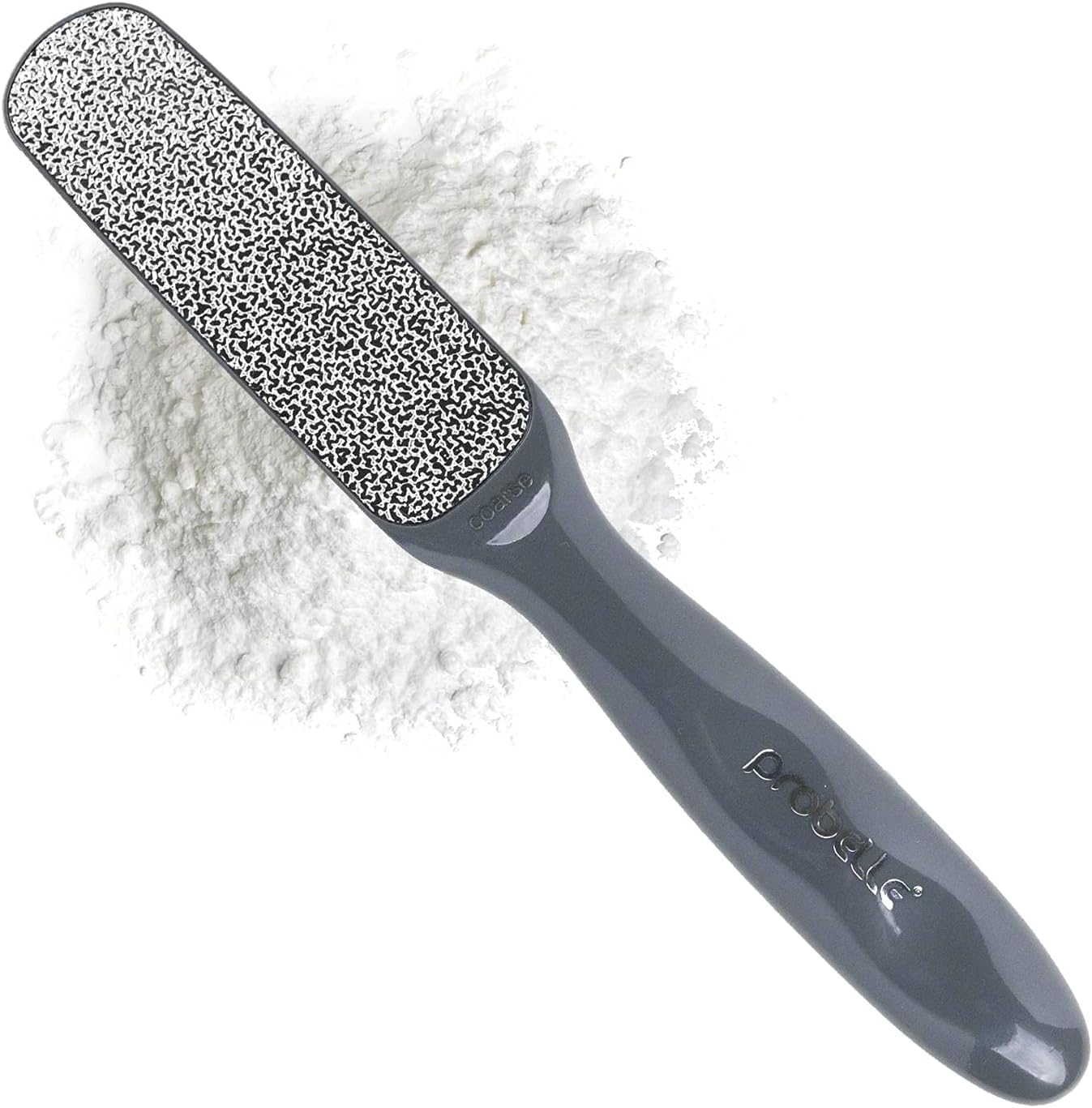
For a heel that’s cracked, jagged or genuinely thick, this is the tool that does the heavy lifting. It carries two long-lasting nickel metal surfaces — one coarse, one medium — so you rough down the build-up on one side and polish smooth on the other. At 2.2 ounces it’s light enough to keep a firm, comfortable grip in the shower, and the non-cutting design is built to take off dead skin without slicing healthy skin. It’s the crowd favorite here by a wide margin — 4.7 stars across 12,000+ ratings — and what owners praise most is raw effectiveness, echoed by the sheer volume of quality praise beside it.
What makes the removal so fast is the bite of the coarse side, which sits around 60 grit, with the fine side closer to 100. That same sharpness is the one thing to respect: on numb or thin-skinned toes, a light touch is all you need, because the file works on contact rather than pressure. Do a few gentle passes, check the skin, and repeat — most people are better served by pausing between sessions than by scrubbing harder.
Compared with an electric roller, this file is silent, needs no charging, and rinses clean in seconds. Compared with a basic pumice stone, it removes far more skin per pass — which is why the rough finish on the coarse side reads as a real upgrade to thick calluses. It’s 2.2 ounces here versus 8 ounces for the DeEnti kit, so this one tucks into a travel bag without stealing space.
What earns it first place
- Two working surfaces — coarse for heavy callus, fine for the smooth finish — so one tool covers the whole routine.
- Works dry on cracked heels, so no soaking session needed before you start.
- Non-cutting and made with hypoallergenic materials, and it’s easy to clean after use.
- Light 2.2 oz handle keeps a steady grip even in the shower.
Where it asks for care
- The coarse side is genuinely sharp — thin or numb-skin users should go lightly and let the grit do the work, not pressure.
- Skin can look dry or flaky in the first couple of days as the top layer settles.
Reach for this if: you have thickened heel callus or cracks and want one quiet tool that removes skin fast without electricity.
Look elsewhere if: your skin is thin, sensitive or numb underfoot — the sharp bite is more than you need, and a fine-grit stone is the kinder match.
2. CopesFuda Volcanic Pumice Stone
Two stones with one clever trick: a cone tip that finally reaches the gap between toes.
If the callus you’re chasing lives between your toes or around a nail edge, a flat stone won’t get there — and that’s exactly the problem this set solves. You get two pieces: a larger regular-shape stone for broad areas of dead skin, and a small cone-shape stone for hard-to-reach spots like toe seams and the rim of the heel. The stones are made from natural volcanic rock, crushed, mixed with bamboo charcoal powder and re-fired, which keeps the original mineral composition while adding a deep-cleansing action.
The routine is simple and gentle: soak your feet in warm water for 10 minutes, then rub the stone over the calluses and dry skin and rinse it afterward. The thing owners rave about is the exfoliating power — 18 separated reviews single it out — and the conical shape draws consistent praise for slipping into awkward angles a bar won’t touch. One honest fit note: the highly textured surface is harder to clean between uses, so rinse it thoroughly and hang it to dry to keep it fresh.
Where this stone earns its keep is reach, not brute force. The coarse nickel file beats it on raw callus removal, but this cone tip goes places that file can’t. At 6.42 x 4.02 x 2.01 inches, the package is compact enough for a shelf or a travel pouch, and it ships as a ready-to-gift two-piece set with a 30-day money-back guarantee behind it.
Fine detail: the two-shape system covers big areas with the oval and tight crevices with the cone — a smart pairing for anyone whose dry skin isn’t only on the heel.
Worth knowing: the natural stone texture needs a proper rinse and dry each time; skip that and residue builds up in the pores.
Best matched to: dry skin between toes, around nails and along heel edges where a flat file just slides past.
Think twice if: you want maximum callus removal per pass — this is a fine, gentle stone, and the sharp nickel file is the stronger remover.
3. DeEnti Double Pumice Pack
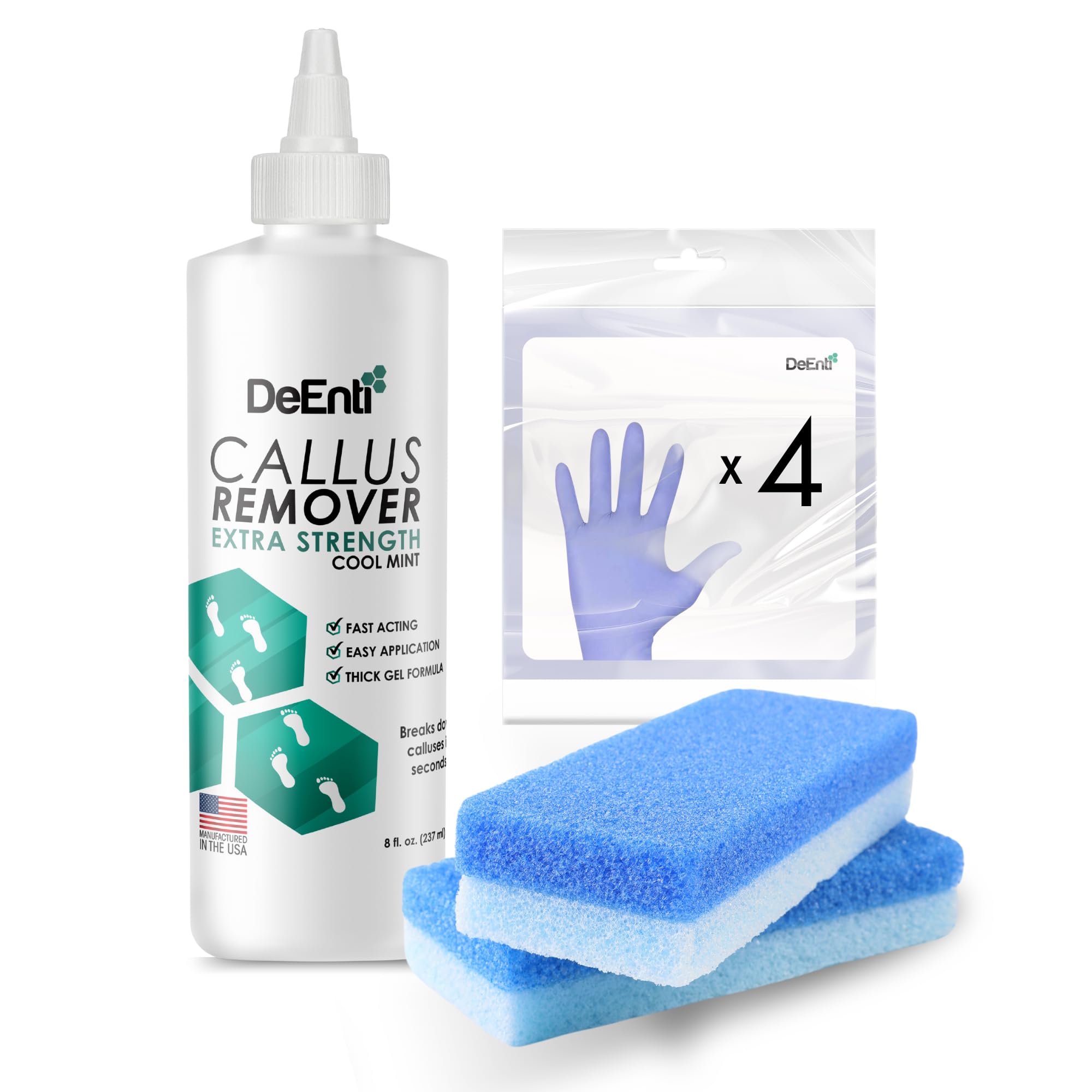
The full at-home pedicure in one box — mint gel, two stones and gloves to do it cleanly.
This is the pick for anyone who wants the whole ritual in one buy rather than sourcing pieces separately. The box holds one 8oz bottle of mint-scented callus remover gel, two pumice stones for feet, and four pairs of disposable gloves — the makings of a home pedicure with salon-style results. The gel is made to soften dry, rough, cracked skin and help break down corns without a callus shaver, and the stones then work over the softened skin for a smooth finish on heels, hands and elbows.
The owner method that keeps coming up is soak, gel, scrub: soak your feet in warm water for about five minutes with epsom salt, apply the gel to the calluses for three to four minutes, then scrub. Used that way, it removes a lot of dead skin in one sitting and leaves feet instantly soft. Effectiveness is the headline here — 37 reviews call it out — and the whole package reads as salon-grade to owners who’ve paid for salon work before.
The trade-off is size and kit-dependence. This pack weighs 8 ounces versus the 2.2-ounce Probelle file, so it’s a stay-at-home set rather than a travel tool. And the result leans on the gel doing its softening job first — go straight to scrubbing without the soak-and-gel step and you lose much of the advantage. For a gift, though, the ready-made combination is hard to argue with, especially for a nail tech building out a mani-pedi kit.
Best in class for: anyone who wants one purchase to cover soak, soften and scrub — plus gloves to keep hands clean while you work.
The honest catch: the softer, kit-based approach is more of a spa session than a quick shower touch-up, and it needs the gel and soak time to shine.
The kit for you if: you want the whole pedicure pieces together and don’t mind a five-minute soak as part of the routine.
Pass if: you want a single fast-pass tool for the shower — the gel-and-stone process is more steps than a quick file.
4. Pumice Stone Natural

A gentle Japanese stone for elbows, knees and heels when you want smooth, not stripped.
For thinner skin and spots beyond the heel, this is the softer option. The set pairs a coarse-for-heel stone with a fine-smooth stone for multi-use — elbows, knees and heels — and both are crafted from 100% pure natural volcanic rock with no chemicals added. The heel stone features a unique round dent that cups the curve of your heel for easier removal of dry skin, and the fine stone uses an extra-fine surface suited to softer areas of the body. It’s made in Japan with the deliberate, precise feel of a hand-finished tool.
The kindness here is the entire point. Owners rate the quality and effectiveness highly — 12 reviews flag quality as the standout — and the draw is removing dry, calloused skin without the aggression of a sharp file. The one thing to know before you buy: the texture is a talking point, and how it lands depends on your skin. On thicker callus some find it too fine, while on sensitive or thin skin it’s the comfortable choice. That’s a fit question, not a fault.
Where this stone separates itself from the pack is material and build. The fine-smooth piece in this set weighs 2.46 ounces and the coarse heel piece is 1.58 ounces, so both sit light in the hand and easy to maneuver. If you want one tool for a whole-body routine rather than a heel-only tool, the extra-fine surface is the reason to choose it. Just bring patience to hard calluses — this stone polishes and smooths over repeated use rather than shaving skin away in one pass.
What it does best: light, precise smoothing on elbows, knees and heels with a round-dent heel shape that follows the curve rather than fighting it.
Skin-type note: texture is a genuinely divided topic — soft-skinned users love it, tougher calluses may want more aggressive grit to see quick change.
Choose this when: your priority is a gentle, chemical-free natural stone for multi-use smoothing and you don’t mind working in layers over time.
skip it if: you need a fast cut through thick cracked callus — the coarser Nickel-file is the faster tool for that job.
5. PRITECH Electric Foot Callus Remover

A rechargeable roller that does the scrubbing for you, with a light to spot the thick spots.
If your hands tire quickly or you just want the salon roller experience at home, this is the powered pick. It’s cordless and rechargeable: you charge the battery for 2-3 hours and get up to 45 minutes of runtime per charge, so one charge covers several foot sessions. Three roller heads give you varying roughness levels, so you can step down from heavy callus to a finer finish, and it runs at two speeds, 1900 and 2200 turns, so you can slow it down on tender spots. A built-in LED light automatically lights up hard-to-see areas, so you can aim precisely at calluses and dead skin.
The waterproofing is generous: an IPX6 rating means it can be rinsed under running water or even submerged, though the maker recommends avoiding frequent submersion to head off any issues. It works dry, but the maker notes it can be used after a bath, when softened calluses are easier to handle and the risk of injury drops versus manual tools. What owners respond to is the speed and smoothness — the power removes calluses and corns faster than a manual file, and the finish leaves feet soft after a few sessions.
Being honest about the trade-offs: battery life and power are the two points that divide owners. Some love that it’s rechargeable and holds up through a session; others find the charge doesn’t last as long as they’d like, and a few feel it can pinch or snag skin at the edges if rushed. The head is also one more thing to clean and replace over time, and there’s no storage bag included. Treat it as a quick, comfortable power tool that rewards patience, not a brute-force sander.
Why power wins here
- Cordless with up to 45 minutes per charge, so you’re not tied to a cord near an outlet.
- Two speeds (1900/2200 turns) and three roller heads let you dial the aggression down for tender skin.
- Built-in LED light makes it easy to see and target problem calluses.
- IPX6 waterproof, so it can be rinsed under running water after use.
Set your expectations
- Battery life and power are debated by owners — some units lose charge faster than they’d like.
- It can pinch or snag skin at the edges if you press too hard, so keep the passes light.
- It costs more per unit than a manual stone and needs a charge before use.
Ideal for: anyone who wants the work done for them — limited grip strength, thick callus, or a preference for salon-style tools at home.
Consider the alternatives if: you’d rather not deal with batteries, heads or charging, and are happy to keep a simple stone in the shower.
Know the Specs
Grit and texture
Grit is the roughness of the abrasive surface, measured a lot like sandpaper. A coarse grade around 60 grit shaves hard callus down fast, while a fine grade near 100 grit smooths and polishes. Natural pumice stones don’t carry a grit number, but their feel matters just the same — an extra-fine stone glides over thinner skin, and a coarser natural stone bites more. Match the texture to your callus thickness and you’ll need fewer sessions.
Shape and reach
Shape decides which parts of the foot you can actually work on. A flat oval stone covers large heel areas, while a cone-shaped tip fits the tight seams between toes and around nail edges. An ergonomic round-dent shape cups the heel curve for a steadier pass. If dry skin sits mostly on the heel, an oval or wide file serves you best. If it sits between toes or along the nail edge, a conical shape is the one that reaches.
Manual vs electric
Manual stones and files are quiet, need no charging, and clean up in seconds — but they rely on your arm strength and patience. A rechargeable electric roller spins a textured head at set speeds (this category’s models run at two speeds such as 1900/2200 turns) and does the work for you. Electric models can cut down session time and are easier on tired hands, but they add a battery, replaceable heads and a charging routine to maintain.
Waterproofing and cleaning
Whether a tool can be rinsed determines how sanitary it stays. An IPX6 waterproof rating means the device can be rinsed under running water or even submerged, though the maker of one pick here recommends avoiding frequent submersion to prevent issues. Manual pumice stones and files simply need a thorough rinse and a hang to dry after each use — skip that and residue can build up in the pores and promote odor. Rinse thoroughly and dry completely after each use.
Common Questions
How do I pick the right grit for my calluses?
Can I use a pumice stone on wet feet or does it have to be dry?
What shape pumice stone is best for between the toes?
How do I keep a pumice stone clean and hygienic?
Is an electric foot callus remover better than a manual stone?
How long does it take to see a difference with a callus remover?
Can I use the same tool on my hands, elbows and knees?
Does an electric foot file really remove calluses faster than a file?
What is the difference between a pumice stone and a metal foot file?
The Bottom Line
For most feet, the best pumice stone for feet depends on one thing: how much skin you need to remove and how tough your callus is. The Probelle Double Sided Nickel Foot File takes the top spot because its coarse-and-fine surfaces remove thick heel callus to powder and finish smooth in one quiet, cordless tool — the strongest all-round remover here. If your problem sits between the toes, the CopesFuda Natural Volcanic Pumice Set with its cone-shape stone reaches where a flat file can’t. And when you want the work done for you, the rechargeable PRITECH Electric Foot Callus Remover rolls the callus away with a built-in light to guide you. Whichever you pick, match the grit to your callus and the shape to the spot.
How we choose
We do not accept paid placement. Every pick is matched to a real buyer and a real use-case; we do not hands-on test units.
Sources
Specifications: manufacturer listings and product documentation. Review insights: verified customer reviews, as of October 2026. Pricing: not shown on this page (it changes often); check the current price via the retailer link.
As an Amazon Associate, Aappliancez earns from qualifying purchases. This does not affect which products we feature.