Disclosure: Some links in this post are affiliate links. As an Amazon Associate I earn from qualifying purchases, at no extra cost to you. Learn more
Specs are compiled from manufacturer listings and verified buyer reviews and can change over time — please confirm the key details on the product page before buying.
If your stock DualSense has started drifting across the screen on its own, you already know why people go looking for a pro pad. The fix is a controller with Hall Effect or TMR sticks (magnetic sensors with no friction contact to wear down) or swappable stick modules, plus back buttons so your thumbs stay on the sticks. This guide breaks down nine PS5 Pro Controllers by what they actually solve: drift, trigger travel, button count, and whether they can even wake your console.
This guide is built by comparing the manufacturers’ published specifications and the patterns across verified customer reviews, so you get each pick’s real strengths and trade-offs instead of marketing spin.
Below you’ll find the honest ranking of the ps5 pro controllers worth your money.
Top Picks


How To Choose The Best PS5 Pro Controllers
A pro controller costs more up front so you stop replacing drifting stock pads every year. The stock DualSense uses potentiometer sticks (physical wiper contacts that wear a groove into the track), which is why drift shows up after months of heavy play. The pads below solve drift in different ways — magnetic sticks, swappable modules, or both — and the right pick depends on your main genre and hand size.
Stick technology decides how long the pad lasts
Hall Effect and TMR sticks (magnetic sensors that read position without touching surfaces) are the single biggest reason to upgrade. They can’t grind themselves down the way contact-based sticks do, so a Hall Effect pad stays centered far longer. If drift is what pushed you here, only buy a pad that names Hall Effect or TMR in its spec sheet.
Back buttons versus back paddles
Paddles are lever-shaped and sit under your middle fingers; buttons are small clicky nubs. Both let you jump, crouch, or reload without lifting your thumbs. Buttons can be too sensitive if you grip hard, and paddles can be too easy to bump if your hands are large. Count matters too — most pads here offer four, though total programmable inputs range widely.
The license limits nobody mentions up front
Sony’s third-party license usually blocks two things: the PS button powering on your console, and rumble in some models. That is not a defect — it’s a licensing rule — but it changes how you start a session. Read each review below for which pads have that limit, because it’s the thing buyers complain about most after the fact.
Side-by-Side Comparison
| Model | Best For | Buttons | Stick Type | Connectivity | Amazon |
|---|---|---|---|---|---|
| PlayStation DualSense Edge★ Best Overall | Plug-and-play PS5 native | 4 | Swappable modules | USB / Wireless | Amazon |
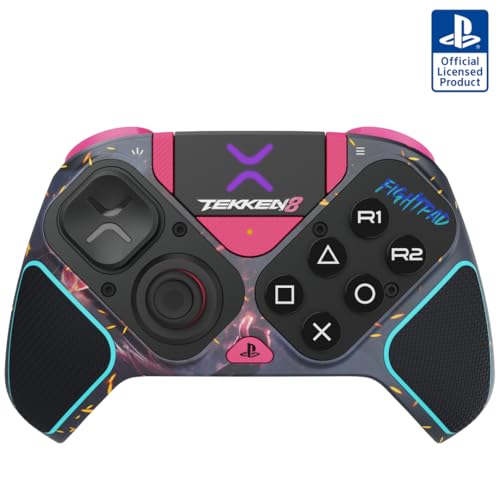
| Victrix Pro BFG (Tekken 8)Most Modular | Fighting game modularity | 17 | Interchangeable | Bluetooth | Amazon |
| HEXGAMING ULTIMATEClickiest Face | Clicky FPS response | 22 | Hall Effect | Wireless | Amazon |
| Nacon Revolution 5 Pro | Big-hand comfort | 30 | Hall Effect | USB-A dongle | Amazon |
| Razer Raiju V3 Pro | Esports ergonomics | 20 | TMR | 2.4GHz / USB-C | Amazon |
| HEXGAMING PHANTOM | Trigger tuning | 22 | Hall Effect | Wireless | Amazon |
| Corsair NOVABLADE PRO | Leverless fighting | 15 | Hall Effect keys | Wired / 2.4GHz / BT | Amazon |
| Victrix Pro KO Leverless | Street Fighter fans | 16 | Cherry MX Silver | USB-C wired | Amazon |
| Razer Raiju V3 Pro (Black) | Tournament travel | 16 | TMR | 2.4GHz / USB | Amazon |
Detailed Reviews
1. PlayStation DualSense Edge Wireless Controller
Our pick — 4.5+★ from 6,500+ verified ratings; the strongest balance of quality and price.
The one pro pad Sony built itself, and the only one that wakes your PS5 without a workaround.
You get everything the stock DualSense does — haptics, adaptive triggers, the built-in speaker — plus the three things a serious player actually needs. Swappable stick modules let you pop in a fresh unit the moment drift appears. Two swappable sets of back buttons take over any button input. And trigger travel adjusts manually, so a fast shooter gets a short pull while a racer keeps the long analog throw.
You feel the build quality in your hands first, and it shows in the controls — the trigger switches have a short, crisp stop you can fine-tune through the PS5’s own settings. The four-button count looks small on paper, but the two back paddles plus two front keys cover the essentials without cluttering the underside. Buyers back that up: 4.5+ stars across 6,500+ reviews.
The recurring gripe is battery life, and it’s a fair one — heavy haptic and adaptive-trigger use drains the cell fast enough that long sessions need a charging cable within reach. The glossy faceplate collects fingerprints, and the controller weighs 2.6 pounds, which is noticeably heftier than a standard pad. Replacement stick modules sell separately, and stock on the single modules has been patchy.
What earns it the crown
- Swap stick modules the moment drift shows up — no soldering, no new controller
- Adjustable trigger travel toggles between short FPS pull and long racing throw
- Quick-swap control profiles store your layouts and switch on the fly
- Full PS5 feature set retained: haptics, adaptive triggers, built-in mic
Where it asks for patience
- Battery drains quickly under sustained haptics and adaptive triggers
- Glossy faceplate holds fingerprints and smudges
- Only four buttons total, which is lean next to the 22-button HEXGAMING ULTIMATE
Reach for this if: you want native PS5 features and a clean, Sony-made build without fighting a third-party license.
Plan around this: the short battery, which is the one spec that bites during marathon sessions.
2. Victrix Pro BFG Wireless Gaming Controller
A controller you rebuild for each game, with 17 buttons and a fight-pad module in the box.
This is the pad for the player who bounces between Tekken and a shooter in one night. The left module flips, a six-button fight pad module drops in, and you get four interchangeable sticks, three different D-pads, and four gates to swap. That’s 17 buttons total against the DualSense Edge’s 4 — a real gap once you want dedicated inputs for every command. Audio is handled well too, with Sony 3D audio support on PS5 and low-latency output with selectable EQ profiles.
Owners consistently point to the back paddles and fightpad buttons as the reason it stays in their bag, and the ergonomics suit larger hands. It’s an officially licensed Bandai Namco and PlayStation product, so fighting-game fans get a Tekken 8 shell that looks the part. The swappable stick modules also solve drift the practical way — a worn stick is a cheap part swap, not a new controller.
The honest catch is wireless connection stability. Buyers report constant disconnections and trouble pairing through the dongle, and it connects over Bluetooth rather than a dedicated low-latency link. You also cannot power on your PS5 with it. At 298 g it feels substantial in hand, and the tool-based swaps mean setup takes a minute, not a second.
Fighting-game specialist: the six-button module and circular D-pad options are what separates this from the FPS-focused pads on this list.
Setup trade-off: modularity means small parts and a tool, so swapping layouts mid-session is deliberate rather than instant.
Built for: the player who plays three different genres and wants one pad to reconfigure for each.
Heads up: plan on wired play if your room is crowded with 2.4GHz gear.
3. HEXGAMING ULTIMATE Wireless Controller
Twenty-two buttons and mouse-click everything, built for shooters where a millisecond is a death.
Hall Effect joysticks remove drift by design, and mouse-click triggers and bumpers give you the same instant activation as a gaming mouse button. Four rear buttons can be mapped to any of 15 inputs — the face buttons, D-pad, L1/L2/R1/R2, L3/R3, and the touchpad all become programmable. Eight swappable thumbsticks come in two heights and three styles, so you can dial in the exact grip your hand wants.
Owners praise the feel of the pad first and the ergonomics second, and the clicky L1/R1/L2/R2 buttons get the most attention. You get both stick shapes in the box — a domed stick for aiming and a concave widened one for grip. The trade-off is open: the clicky face buttons can be picky to press, and the pad runs heavier than a stock controller at 330 g. A handful of units have also drawn durability complaints. This is the pad for the player who rates trigger response above all else.
Why shooters like it
- Hall Effect sticks eliminate the drift problem at the source
- Mouse-click triggers and bumpers give you instant, audible activation
- Four rear buttons map to any of 15 inputs — including the touchpad
- Eight swappable sticks in two heights and three styles
What to weigh first
- Not compatible with the official charging dock
- Cable and other accessories not included
- Clickier face buttons can take more force to press than a stock pad
Best fit: competitive FPS players who want a click on every input and drift-proof sticks.
Second thought: the heavier 330 g body is a real adjustment coming off a stock DualSense.
4. Nacon Revolution 5 Pro Wireless Controller
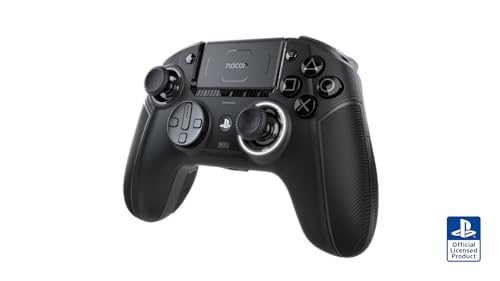
Xbox-shaped grips in a PlayStation package, with magnetic sensors in both sticks and triggers.
Hall Effect technology lives in the joysticks and the triggers here, so both parts resist wear. You also get four Omron micro-switch back paddles, trigger blockers that switch between long and short pulls, and a D-pad developed with professional fighting game player Mister Crimson that swaps between specialized and traditional designs. A PC/Mac app handles remapping, profiles, and firmware. Battery runs up to 10 hours, and a 3-meter USB-C to USB-A cable is included for wired play.
Comfort is where this pad earns its keep. The Xbox-style grip shape and 0.3 kg weight suit players whose hands never felt right around a DualSense, and the interchangeable weights let you shift the balance. Bluetooth audio support means you can pair earbuds or a headset straight to the pad in PS4 or PS5 mode, with a 3.5mm port as backup.
Two things will shape your experience and neither is fixable. First, wireless play needs the USB-A dongle, and the pad won’t wake your console — the same license limit that hits most third-party pads. Second, the recessed USB-C port sits deep enough that some standard cables won’t seat, and the audio features drop away entirely in PC mode. Accept the dongle and the recessed port, and the Hall Effect sticks deliver drift-free aim session after session.
The comfort argument: if a standard PS5 controller leaves your hands cramped, the extra palm room and swappable weights here are the point.
Dongle dependency: no dongle, no wireless — so budget a USB-A port and don’t bury the receiver in a rear slot.
Pick this when: you want Xbox-style ergonomics and Hall Effect internals on a licensed PS5 pad.
Go elsewhere if: you need rumble in PS5 games, which this pad doesn’t deliver.
5. Razer Raiju V3 Pro Wireless Esports Controller
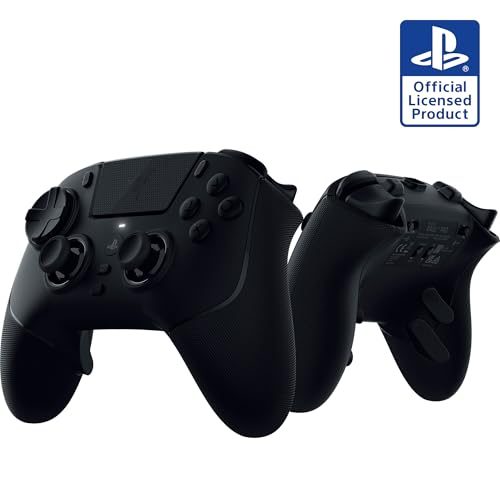
Six remappable controls and TMR sticks tuned for tournament play, wired or over 2.4GHz.
Razer’s esports angle is the HyperTriggers, which flip each trigger between a fast mouse-click actuation for shooters and a full analog pull for racing and sports. The Mecha-Tactile PBT action buttons combine microswitch speed with a rubber membrane feel, and the 8-way floating D-pad gives clean directional inputs. Thumbsticks use TMR magnetic sensors, so drift isn’t a wear item. Over a 2.4GHz dongle you get low-latency wireless on PS5; on PC, a 2000 Hz wired polling rate is available.
Owners describe a comfortable, balanced-weight pad that stays drift-free through months of use, and the six remappable inputs — four mouse-click back buttons plus two claw-grip bumpers — land where your fingers naturally rest. Weight sits at 9.12 ounces, lighter than the HEXGAMING ULTIMATE at 330 g. A carrying case, 2-meter USB-C cable, and back-button removal tool come in the box.
Two limits are baked into the license and worth knowing before you spend: there’s no rumble, and the PS button won’t wake the console. Rear buttons also need mapping through the Razer app before they do anything. Map the rear buttons in the Razer app first, or they stay dead in competitive play.
Go for it: if you compete and want adjustable trigger feel plus magnetic sticks in a lighter frame.
Know before you buy: you lose rumble and console-wake, and rear buttons are dead until you open the app.
6. HEXGAMING PHANTOM Wireless Controller

Switches that flip your triggers between a 1.5mm click and full analog throw, mid-match.
A trigger-mode switch sits on the pad, and that’s the defining feature. Digital mode gives you a short travel range of 1.5 to 2mm for mouse-click firing, while adaptive mode hands back the full analog pull for throttle control in racing games. Six swappable profiles let you hop between layouts without menu diving, and Hall Effect joysticks with adjustable centering points handle drift and hand fatigue.
Eight interchangeable textured sticks in concave, domed, and extended shapes round out the tuning. The soft rubber grips matter over a three-hour session. Owners rate the clicky triggers and the overall quality highly, and the calibration tool for the Hall Effect sticks gets specific praise for accuracy. The 22-button layout is identical to the ULTIMATE, so if you want more programmable inputs than the DualSense Edge’s four, both HEXGAMING pads deliver.
Durability is the recurring caution. There are reports of triggers failing, and back buttons softening into double-registers after heavy use. Support has replaced faulty units for some buyers without charge, so the warranty path matters. The four back buttons are also soft enough to bump during a tight grip, which is a love-it-or-fight-it trait rather than a defect.
The trigger argument
- Toggle between 1.5–2mm digital pull and full adaptive throw
- Six switchable profiles for different games and layouts
- Hall Effect sticks with adjustable centering and outer range
- Eight textured sticks across three shapes
What to plan for
- Back buttons sit soft and can trigger accidentally under a firm grip
- Durability is the open question — buy with the warranty in mind
- No cable or accessories in the box
Made for: players who want to switch trigger feel game-by-game without a second controller.
Weigh this: the clicky back buttons reward a lighter grip than most claw players use.
7. Corsair NOVABLADE PRO Wireless Controller

No stick at all — 15 keys and 8 G-keys with actuation you can set as shallow as 0.1mm.
MGX Hyperdrive Hall Effect switches are rated for 150M keystrokes, and Rapid Trigger resets from 0.1mm so a held direction releases the instant you lift. Per-key actuation adjusts from 0.1mm to 4.0mm, and FlashTap SOCD tech handles opposing directional inputs cleanly. Eight programmable G-keys with up to 5 onboard profiles cover macro work. Tri-mode connectivity means wired, 2.4GHz wireless, or Bluetooth, with 1000Hz polling over 2.4GHz on PC and over wired on PC and console.
What earns the most praise is the quality of the build — an anodized aluminum top plate and a metal body that feels like a piece of equipment, not a toy. Responsiveness ranks right behind it, and several owners rank the Hall Effect feel above other leverless options. One button shifts the pad into Game Mode for tournaments, which activates Rapid Trigger and cuts the risk of unintended inputs.
Two honest notes. The buttons are loud — a sharp clack that’s the price of this switch feel, and the loudest complaint on the page. And a few advanced remap behaviors depend on firmware; the pad’s remapping semantics have shifted between versions, so check the current firmware before relying on input duplication. At 3.9 pounds it stays put on a desk rather than your lap.
Where it stands apart: Hall Effect keys plus 0.1mm actuation is precision no analog stick pad on this list can match.
Adjustment period: going leverless means relearning inputs from muscle memory — plan on a few sessions before it clicks.
For the committed: fighting game players ready to trade a stick for keys and gain milliseconds.
The honest cost: loud switches and a keyboard-style adjustment curve.
8. Turtle Beach Victrix Pro KO Leverless Fight Stick
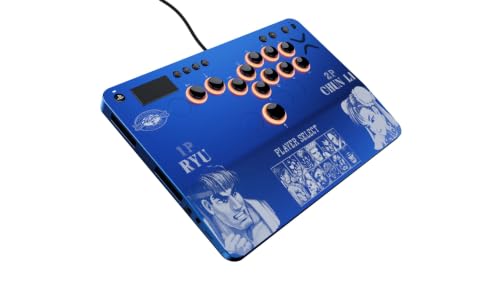
Street Fighter II art on a slim aluminum plate, with hot-swappable switches under every button.
Sixteen movable and mappable buttons sit on a removable top plate, so you can reposition the layout or change switches entirely. Cherry MX Speed Silver RGB switches come installed, and each button gets a customizable RGB light ring adjusted on the stick or through the Victrix Control Hub app. The 6.28° wrist slope is built for long sessions, and a Tournament Lock Switch disables system buttons when you don’t want a stray press to cost you.
The Street Fighter II: Champion Edition Player Select design is the reason to pick this over other leverless pads, and the build quality backs the badge. A 3-meter braided USB-C cable handles wired-only play, keeping latency as low as the connection allows. A 3.5mm port carries stereo output and mic input. A drawstring bag is in the box for travel.
Connectivity is the problem to plan for. The pad is wired only, and there are multiple reports of it dropping its connection entirely or failing to work on PS5. The stock switches also draw complaints about laggy inputs before you swap them. A unit that works from the start rewards you with crisp 24mm buttons and a comfortable 6.28° wrist slope; the risk is quality control, not the design.
Ergonomics first: the sloped wrist rest and slim profile make it easier on your forearms than a thick arcade deck.
The gamble: quality control varies unit to unit — buy from a seller with an easy return path.
For the fan: Street Fighter loyalists who want a licensed-looking deck and don’t mind swapping switches.
Not for you if: you need wireless freedom or can’t handle a return cycle.
9. Razer Raiju V3 Pro Wireless E-Sport Controller
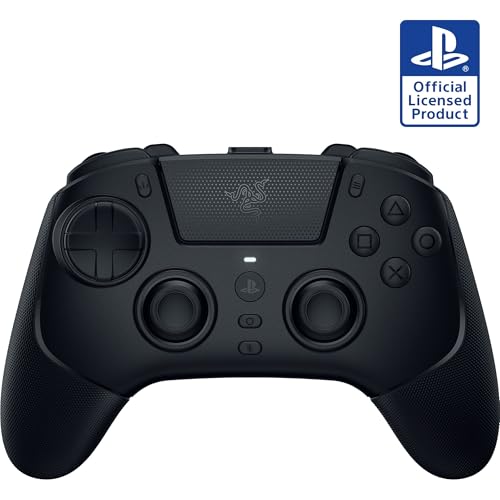
The same tournament spec sheet packed into a bag, with two covers and a tool kit.
Symmetrical TMR thumbsticks with interchangeable heads are the headline grabber — anti-skid magnetic sensors tuned for micro-aiming, with a design built to resist drift. Four removable mouse-click back buttons plus two claw retention pads give you six remappable inputs, and Razer Pro HyperTriggers flip each trigger individually between instant click and full analog. A carrying case, 2-meter cable, two interchangeable covers, and a tool set for removing rear buttons all come together.
Owners describe a comfortable layout that doesn’t fatigue hands the way the stock DualSense does after a long session, and the thumbsticks get called out as smooth for FPS tracking. The Mecha-Tactile PBT action buttons combine microswitch speed with a rubber-membrane cushion, so holding a button doesn’t beat up your thumb. At 258 g it’s lighter than the Victrix Pro BFG at 298 g, which matters when you’re carrying it plus a case.
Two things are non-negotiable before you game. There’s no rumble motor, which is standard among licensed third-party pads. And the PS button must be held around five seconds to power the console rather than a quick tap. Front button presses also take extra force thanks to the resistance in the mecha-tactile switches. Adjust to the no-rumble, long-press power-on, and stiffer face buttons, and the TMR sticks hold drift-free aim every session.
What carries it
- Symmetrical TMR sticks with swappable caps for drift-free aiming
- Six remappable inputs across back buttons and claw pads
- Per-trigger switch between instant click and full analog
- Full kit included: case, covers, 2m cable, removal tool
The fine print
- No rumble motor at all
- Powering on requires a several-second hold on the PS button
- Front buttons need extra force compared to a stock pad
Suits you if: you want a tournament-ready kit that travels as well as it plays.
Might not suit: anyone unwilling to trade rumble for a lighter, drift-free frame.
Know the Specs
Hall Effect and TMR Sticks
Both use magnetism to read stick position instead of physical contact, so there’s nothing to wear into a groove. Hall Effect sensors are the more common upgrade, while TMR (tunneling magnetoresistance) is a newer magnetic type that Razer uses for fine aiming. Either way, this is the spec that decides whether a pad survives years of competitive play.
Actuation Distance
Measured in millimeters, this is how far a key or trigger must travel before it registers. A shorter distance means faster input, which is why leverless pads advertise values like 0.1mm and why trigger stops matter in shooters. Too short, and a resting finger can fire a command by accident.
Polling Rate
Reported in hertz, this is how many times per second the pad sends its state to the console. Higher means less lag between your input and the game. It’s a wired-versus-wireless distinction worth checking on any pad you plan to compete with.
Button Count and Programmability
Raw button count matters less than how many are remappable. A pad with 30 buttons but no software mapping is less useful than a 17-button pad with four back paddles and three profiles. Check which buttons can be reassigned, and whether the app works on your platform.
Common Questions
Why do pro controllers still get stick drift?
Can a third-party controller turn on my PS5?
What is a leverless controller and who should buy one?
Do I lose rumble or adaptive triggers with a pro controller?
How many back buttons should a pro controller have?
Will a pro controller work on PC as well as PS5?
What does SOCD mean on a leverless controller?
Are trigger stops worth it for racing games?
How long should a pro controller last?
Do I need the companion app to use back buttons?
The Bottom Line
For most players, the ps5 pro controllers winner is the PlayStation DualSense Edge because it keeps every PS5 native feature while adding swappable sticks and tuneable triggers — no license workarounds, no missing rumble. If drift is your specific enemy and you want magnetic sensors, grab the HEXGAMING ULTIMATE, which puts Hall Effect sticks under clicky triggers. And if fighting games are the reason you’re shopping, the Corsair NOVABLADE PRO turns your inputs into keys with actuation as shallow as 0.1mm. Whichever you choose, pick the one whose trade-offs you can live with — losing rumble or needing a USB-A dongle hurts more in daily play than any spec sheet shows.
How we choose
We do not accept paid placement. Every pick is matched to a real buyer and a real use-case; we do not hands-on test units.
Sources
Specifications: manufacturer listings and product documentation. Review insights: verified customer reviews, as of October 2026. Pricing: not shown on this page (it changes often); check the current price via the retailer link.
As an Amazon Associate, Aappliancez earns from qualifying purchases. This does not affect which products we feature.