Disclosure: Some links in this post are affiliate links. As an Amazon Associate I earn from qualifying purchases, at no extra cost to you. Learn more
Specs are compiled from manufacturer listings and verified buyer reviews and can change over time — please confirm the key details on the product page before buying.
If your doctor has told you to watch sodium, potassium, or phosphorus, every bar label becomes a checklist. This guide focuses on protein bars with lower sodium counts, clear protein numbers, and gluten-free, low-sugar profiles that fit a renal-friendly eating plan.
This guide is built by comparing the manufacturers’ published specifications and the patterns across verified customer reviews, so you get each pick’s real strengths and trade-offs instead of marketing spin.
You will see which bar earns the top spot for lower-sodium mornings, which pick leads on protein per serving, and which variety pack suits days when you want choice. Every pick below names a top protein bar for kidney patients, with the honest catch you need before you buy.
Top Picks

How To Choose The Best Protein Bars for Kidney Patients
Kidney-friendly snacking starts with one number on the back of the label, not the front. Sodium is the easiest mineral to overdo in a bar — it hides in coatings, nut butters, and added salts — so a bar that lists low sodium on its own packaging earns an instant look. From there, you weigh protein against sugar and carbs, check phosphorus additives, and only then think about flavor and texture.
Start With Sodium, Then Look At Protein Per Bar
Sodium is the mineral most people with kidney concerns are told to cap first, so check the sodium number per serving before anything else. Protein is the second dial: bars here range from 8g up to 20g per serving, so pick a number that matches what your care team has told you to hit. A mid-range protein bar with low sodium beats a higher-protein bar loaded with added salt for most people in this situation.
Watch Phosphorus Additives And Added Sugar
Phosphorus is the sneaky one, because it often arrives as an additive rather than a whole-food mineral. On a label, scan the ingredient list for words starting with “phos” — phosphoric acid, dicalcium phosphate, sodium phosphate — and treat those as a signal to check with your dietitian before buying. Added sugar matters too: bars that lean on sugar alcohols or zero-sugar formulas can drop the sugar count while keeping the protein reasonable, which is often the exact combination a kidney-conscious snacker wants.
Texture, Freshness, And Format
Chewiness and freshness are the two texture dials real snackers notice first. Some bars arrive chewy and cookie-like; others turn grainy or hard after a few weeks in a hot car. Individually wrapped bars hold up better in a desk drawer, and a box that ships as a single sealed carton tends to arrive fresher than a loose multi-pack. If you travel or commute, look for a bar that holds its shape in a lunch bag rather than one that melts on the seat.
Side-by-Side Comparison
| Model | Best For | Protein Per Bar | Sugar Profile | Count | Amazon |
|---|---|---|---|---|---|
| KIND Breakfast Protein Bars, Peanut Butter Banana Dark Chocolate★ Best Overall | Lower-sodium breakfast on the go | 8g | Low sodium, gluten free | 30 Count | Amazon |
| Quest Nutrition Overload Protein Bars, Chocolate ExplosionTop Performer | Chocolate cravings with a protein hit | 20g | 1g sugar, 3g net carbs | 12 Count | Amazon |
| Special K Bar Protein Meal Bars, Chocolate Peanut Butter | Meal-replacement portability | 12g | Real peanut butter, coated | 18 Bars | Amazon |
| RXBAR Protein Bars, 10-Flavor Variety Pack | Simple ingredient lists and variety | 12g | Date-sweetened, gluten free | 10 Bars | Amazon |
| Extend Sugar Free Protein Bars | Steady energy between meals | 12g | Zero sugar, keto friendly | 12 Count | Amazon |
Detailed Reviews
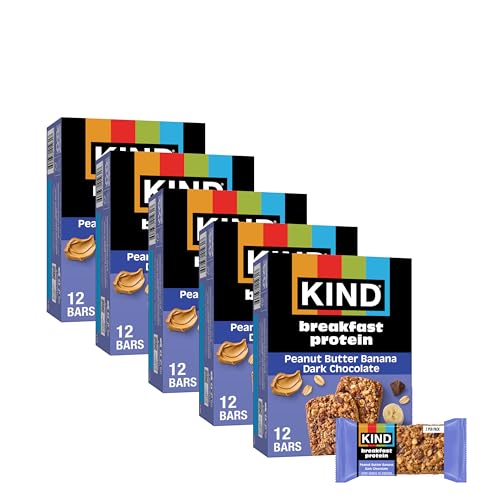
1. KIND Breakfast Protein Bars, Peanut Butter Banana Dark Chocolate, Gluten Free, Low Sodium, 30 Count
Our pick — over 4.5★ from 750+ verified ratings; the strongest balance of quality and price.
The breakfast bar that leads the list on low sodium and easy mornings
If you want the simplest swap for a rushed morning, this is the bar that earns it. Each 1.76 oz two-bar pack carries 8g of protein and the box is labeled low sodium and gluten free — the two labels kidney-conscious snackers look for first. The whole case holds 30 packs, which works out to 52.8 ounces of bars, so it lasts through a full month of breakfasts before you have to think about it again.
What wins buyers over here is the chewy-crunchy texture. Buyers describe the peanut butter banana dark chocolate as chewy and crunchy at the same time, and the bar gets praised for not being overly sweet. And the format is a quiet advantage: each pack contains two bars, which buyers report gives them a real choice in the morning — have one now, save one for later, or eat both if it is a heavy day.
The honest catch is texture. Some buyers find these bars too hard, and a few say freshness varies depending on how long the case sat before it shipped. Sizing is the other common note: the bars are smaller than the wrapper photo suggests. For most people this is a minor trade for the low sodium count and the delivery convenience — but if you want a soft, cake-like bar, look to the RXBAR pick instead.
What Lands On Your Counter
- Low sodium and gluten free — the two labels this list prioritizes
- 30 two-bar packs, so both a light and a heavier morning are covered
- Made with 5 super grains including oats, buckwheat, millet, amaranth, and quinoa
- 16 grams of whole grains per serving, so it holds until lunch
Where It Runs Into Trouble
- Texture runs firm — some buyers find them too hard
- Bars look smaller in hand than the packaging suggests
- Flavor is intentionally mild, so chocolate lovers will want a richer pick
Reach for this if: you want one reliable low-sodium breakfast bar with 8g protein and a whole-grain base, in a box that lasts the month.
Look elsewhere if: you need a firmer protein hit — the Quest and Special K picks both carry more protein per bar.
2. Quest Nutrition Overload Protein Bars Chocolate Explosion 12 Count
The chocolate bar that hands you 20g of protein without the sugar spike
When you want chocolate and a real protein hit in the same bite, the number that matters here is 20g. That is per bar — 2.5x what the KIND breakfast bars deliver — with 1g of sugar and 3g of net carbs alongside it. For a kidney-conscious snacker managing protein targets and sugar, that combination is why this one sits near the top of the list.
What wins buyers over is the chocolate flavor engineering. The Chocolate Explosion bar is packed with chocolatey cookie chunks, dark chocolate flavored chips, and milk chocolate flavored chunks, and buyers describe it as tasting like a brownie or a candy bar rather than a protein bar. The chewy, soft texture gets called out too, along with the fact that it satisfies chocolate cravings without the sugar rush.
Two honest catches. Texture is chewy enough that a few buyers find it hard to eat — drink water alongside. And value for money is the recurring gripe: some shoppers say the price on the 12-count has crept up since they started buying it. Size-wise this bar is compact at 1.73 x 4.31 x 5.62 inches and only 1.65 pounds for the whole carton, so it slips into a backpack pocket without weighing you down.
The protein math: 20g per bar, 1g of sugar, 3g of net carbs — that is a chocolate snack that carries real protein weight rather than sugar weight, which is exactly the equation this list rewards.
The texture reality: owners mention chewy and satisfying, with a small contingent who find it a bit of a jaw workout — keep a glass of water within reach and the bar holds up fine.
The call: the strongest pick for anyone who wants their protein bar to taste like dessert and their sugar count to stay at 1g.
The trade: the 12-count carton is small and the price has been creeping up — buy it when the chocolate craving outweighs the value math.
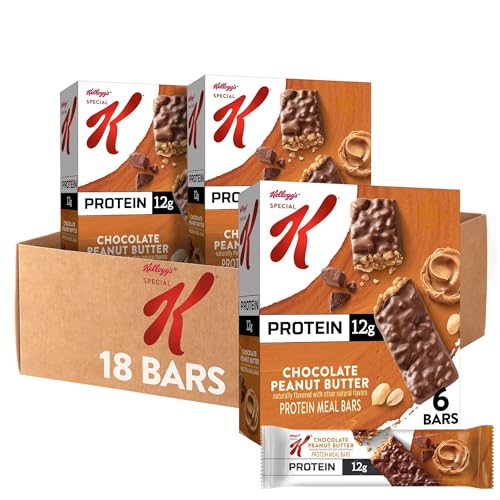
3. Special K Bar Protein Meal Bars Chocolate Peanut Butter 18 Bars
The desk-drawer meal bar that tastes like candy but carries a real protein load
Picture grabbing one of these on the way to the car and calling it breakfast. Each bar brings 12g of protein — that is 22% of daily value, with 4.5g of saturated fat — wrapped in a chocolatey coating with creamy peanut butter inside. Made with real peanut butter and containing soy, peanut, milk, almond, and wheat ingredients, so if you have a nut allergy in the household this one stays out of the rotation.
What earns it a spot here is how long it suppresses hunger. Customers note the bar satisfies hunger longer than other protein bars they have tried, and one went so far as to hand their old bars to the office team because this one became the bar they actually kept for themselves. The chocolate peanut butter flavor is the frontrunner, and the bar works as a snack, a pre-workout bite, or a full meal-swap when your schedule skips lunch.
The two catches worth knowing. Freshness varies between batches — a few buyers notice the texture getting grainier and sweeter recently, so taste-test the first bar before committing to the whole case. And the formula does not like heat: a warm car or glove box softens the chocolate coating fast. The whole case is 1.79 pounds across three 9.5 oz boxes, so it stores neatly in a pantry or desk without taking over the shelf.
Where the value sits: 18 bars across three boxes, individually wrapped, and a 12g protein hit that works double duty as a snack and a meal replacement.
The batch snag: a handful of reviewers point out the recipe has shifted grainier and sweeter, and the coating softens quickly in a hot car — keep it in the shade.
Pick this for: anyone who wants a genuinely candy-flavored meal bar with 12g protein that actually holds off hunger between meals.
skip it if: you need protection from heat or you are avoiding wheat, soy, or almond — the ingredient list carries all three.
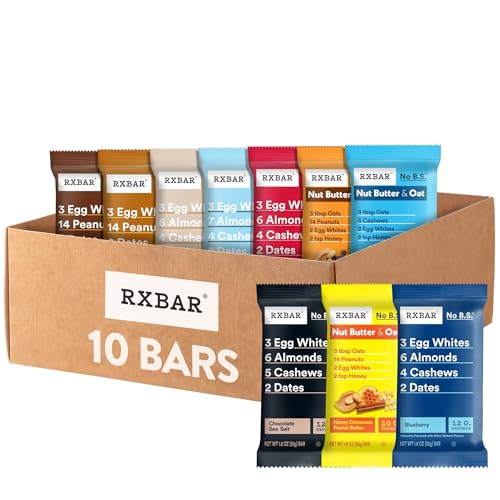
4. RXBAR Protein Bars 10-Flavor Variety Pack 10 Bars
The ten-flavor sampler for anyone who cannot commit to a single bar
The reason to start here is variety — ten flavors in one box, so you can sample Peanut Butter Chocolate, Blueberry, Chocolate Sea Salt, and the rest before buying a full case of any one. Each bar carries 12g of protein and is gluten free, with whole ingredients and a simple ingredient list. The box includes 7 classic RXBAR bars and 3 RXBAR Nut Butter and Oat bars, which gives you a taste of both recipes before deciding.
What keeps buyers coming back is the clean ingredient list and the chewy bite. Owners describe the bars as rich, not too sweet, and filling enough to hold longer than a standard granola bar. The chocolate, peanut butter, and fruit flavors all show up, and the ingredient panel reads like a short list rather than a paragraph — which is exactly what most people on this list are looking for when they scan a wrapper.
The honest note is sweetness rhythm. Because date paste is the sweetener, most flavors taste pretty similar once you have had a few, and daily eating leads to flavor fatigue. A few buyers also flag texture as firmer than expected, and the coconut one specifically gets called out as a bit strong. Warm environments soften the blueberry and chocolate bars fast, so keep the box in a cool spot.
What earns the slot: ten flavors, 12g of protein each, a short ingredient list, and a mix of classic RXBAR plus Nut Butter and Oat bars in the same box.
The date-sweetener trade: flavors blur together if you eat one daily, and a couple of bars melt quickly in the heat — treat the box as a sampler, not a daily driver.
Worth picking when: you want to explore flavors and read a short ingredient panel, and you would rather not commit to 30 bars you have never tasted.
Pass if: you already know your flavor and want a longer-lasting case — the KIND and Special K picks ship far more bars per box.
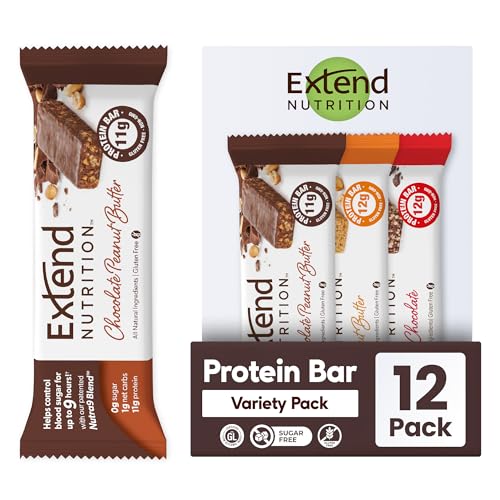
5. Extend Sugar Free Protein Bars 12 Count
The zero-sugar bar built for steady energy between meals — with one flavor twist to know
If the goal is to keep hunger and energy on an even keel between meals, this is the bar built for that job. Each bar carries 12g of protein, 6g of fiber, 1 net carb, and 160 calories, in a sugar-free, gluten-free, keto-friendly formula that mixes four bars each of Rich Chocolate, Chocolate Peanut Butter, and Peanut Butter. The whole 12-count box is compact — 9 x 6.75 x 2 inches and 1.35 pounds — so it slides onto a shelf or into a work bag without a fuss.
What earns this the value slot is the no-artificial-sweetener formula. The bars use erythritol-free formulation with no artificial flavors or sweeteners, which is why buyers who track labels speak well of the ingredient list. Owners describe the bars as a functional snack rather than an indulgent treat — a bite you take to keep energy steady, not a dessert substitute. They work as an on-the-go breakfast, a between-meal snack, or a pre-exercise bite.
Here is the honest catch, and it is a big one: flavor swings hard by variety. The Peanut Butter bar is the one buyers keep coming back for — moist and satisfying — while the Rich Chocolate bar gets described as dry with subpar taste. Texture also gets flagged as chalky or gritty by a small group. If you are unsure, treat the mixed box as a taste test and then buy straight Peanut Butter once you know.
Where it shines: zero sugar, 12g protein, 6g fiber, 1 net carb, and 160 calories — plus an erythritol-free, no-artificial-sweetener formula that label-readers appreciate.
The flavor roulette: Peanut Butter is the clear winner; Rich Chocolate reads dry, and some buyers find the texture chalky — buy the mix first, then commit to the flavor that lands.
Best fit for: anyone managing sugar and carbs closely who wants a functional 12g protein bar rather than a candy swap.
Know before you buy: the mixed box is not a uniform experience — go straight to Peanut Butter if you want the safest flavor bet.
Know the Specs
Sodium Per Bar
Sodium is the mineral most people with kidney concerns are told to cap first, so a bar carrying a “low sodium” label earns a spot on this list before flavor ever gets a vote. When you scan a wrapper, compare the sodium number per serving across the bars on your shortlist and pick the one that fits the daily ceiling your care team has set for you. Convenience sometimes costs you sodium — a bar with a salty coating may taste great and still blow the budget.
Protein, Sugar, and Net Carbs
Protein per bar is the number you want to line up against your daily target: on this list, the range runs from 8g to 20g, which is a real spread. Sugar matters alongside it, because a bar can hit a high protein count while still loading sugar — the zero-sugar and 1g-sugar options here solve that problem. Net carbs matter most for anyone eating low-carb or keto, and fiber is the quiet bonus: 6g of fiber per bar keeps you full longer than a low-fiber alternative.
Common Questions
Are protein bars safe for kidney patients?
How much protein should a kidney-friendly protein bar have?
What should I look for on a protein bar label if I have kidney concerns?
Is the KIND Breakfast Protein Bar really low sodium?
Can I eat protein bars if I am diabetic and watching kidney health?
Do gluten-free protein bars also help with kidney health?
How many protein bars per day is reasonable?
Which protein bar has the most protein per serving?
Are sugar-free protein bars better for kidney patients?
Should I check with a dietitian before starting a protein bar routine?
The Bottom Line
For most people scanning this list, the protein bars for kidney patients pick to start with is the KIND Breakfast Protein Bars because it carries the low-sodium and gluten-free labels together with 8g of protein and 30 two-bar packs. If your priority is a real protein hit with almost no sugar, reach for the Quest Nutrition Overload Protein Bar at 20g protein, 1g sugar, and 3g net carbs. And if steady, sugar-free energy between meals is the goal, the Extend Sugar Free Protein Bar is the one built for the job — buy the mixed box once to find your flavor, then commit to the Peanut Butter.
How we choose
We do not accept paid placement. Every pick is matched to a real buyer and a real use-case; we do not hands-on test units.
Sources
Specifications: manufacturer listings and product documentation. Review insights: verified customer reviews, as of October 2026. Pricing: not shown on this page (it changes often); check the current price via the retailer link.
As an Amazon Associate, Aappliancez earns from qualifying purchases. This does not affect which products we feature.