Disclosure: Some links in this post are affiliate links. As an Amazon Associate I earn from qualifying purchases, at no extra cost to you. Learn more
Specs are compiled from manufacturer listings and verified buyer reviews and can change over time — please confirm the key details on the product page before buying.
If you want a fridge that runs on a propane tank with no generator humming outside, the Dometic CFX is the one to beat. Its VMSO3 compressor holds –7 °F as a deep freezer, so one 100-liter box covers both ice and milk. Everything else on this list is a true absorption fridge: a flame and a sealed coolant loop instead of a compressor. That difference decides almost every trade-off below, so keep it in mind as you scroll.
This guide is built by comparing the manufacturers’ published specifications and the patterns across verified customer reviews, so you get each pick’s real strengths and trade-offs instead of marketing spin.
More than brand name, what decides whether an absorption fridge lasts is rear airflow and a regulator set to the maker’s stated LPG pressure. Every pick below earned its spot on owner reports from a full season of use, so this propane refrigerator roundup weighs venting and clearance as heavily as capacity.
Top Picks


How To Choose The Best Propane Refrigerator
You are buying a fridge that makes cold from a flame. There is no compressor to do the hard pushing, so the appliance has to give up heat on its own — that single fact explains the sizing, the venting, and the patient cooldown of every unit here. Start with capacity, then vent clearance, then gas pressure, and you will avoid the three things that actually spoil food off grid.
Capacity: size it for food, not for the wall
A 6.1 cubic foot cabin fridge is fine for two people and a long weekend of drinks. A 9.4 cubic foot unit with a 2.1 cubic foot freezer holds a week of meat for a family. That 19 cubic foot model splits into 14 cubic feet of fresh food and 5 cubic feet of freezer, which is whole-house territory. Buy a bit smaller than your kitchen fridge if the cabin is seasonal — an under-filled absorption box recovers temperature faster when you open the door.
Rear clearance is not optional
These fridges dump heat out of the back, so an inch or two of breathing room is not decorative. One Smeta unit calls for 4 inches on top and 1 inch on the back and sides. A Smad owner needed roughly 12 inches of rear clearance and reported the back running hot. Cut that clearance and the flame has to work harder to reach the same temperature. Your vent must lead outside, not into the same cupboard.
Gas pressure: the number that decides whether food spoils
Several of these fridges specify an LPG pressure of 2.8 Kpa (28 mbar). Pressure that is too low gives you a weak flame and a fridge that never quite reaches temperature. Pressure that is too high can freeze the fresh-food box while the freezer is fine. A regulator set correctly to the maker’s number protects both your food and the burner.
Side-by-Side Comparison
| Model | Best For | Capacity | Cooling Method | Power Source | Amazon |
|---|---|---|---|---|---|
| Dometic CFX★ Best Overall | Deep freeze and camping | 100 liters | Compressor | AC / DC / Solar | Amazon |
| Galanz GLR12TS5FBest for Small Spaces | Small office and apartment | 12 cubic feet | Compressor | 110V mains | Amazon |
| BLACK+DECKER BR1460HBBest for Garage Storage | Garage and bulk storage | 14.6 cubic feet | Compressor | 110V mains | Amazon |
| BLACK+DECKER BR1210HS | Two people in a small kitchen | 12.1 cubic feet | Compressor | 110V mains | Amazon |
| Smad 6.1 Cu.Ft Off Grid | Backup propane cooling | 6.1 cubic feet | Absorption | 110V / LPG | Amazon |
| Norcold N8DCSSR | Motorhome replacement | 8 cubic feet | Compressor | 12V DC | Amazon |
| Norcold N10DCSSR | Solar RV conversion | 10 cubic feet | Compressor | 12V DC | Amazon |
| RecPro RV 6.3 | Direct swap for an old RV unit | 6.3 cubic feet | Absorption | 110V / 12V / LPG | Amazon |
| Techomey 6.1 Cu.Ft. | Quiet bedroom-side cooling | 6.1 cubic feet | Absorption | 110V / LPG | Amazon |
| Dometic DM2862RB | RV fridge cavity replacement | 8 cubic feet | Compressor | 110V mains | Amazon |
| SMETA 9.4 Cu.Ft | Full-time off-grid living | 9.4 cubic feet | Absorption | 110V / LPG | Amazon |
| Techomey 9.4 Cu.Ft | Silent, roomy cabin food | 9.4 cubic feet | Absorption | 110V / LPG | Amazon |
| Techomey 19 Cu.Ft | Whole-house off-grid storage | 19 cubic feet | Absorption | 110V / LPG | Amazon |
Detailed Reviews
1. Dometic CFX Electric Cooler, CFX5 & CFX3 Series
Our pick — 4.5+★ from 60+ verified ratings; the strongest balance of quality and price.
The 100-liter box that deep-freezes to –7 °F on 55 watts of DC power.
This is the pick for someone who wants real deep-freeze cold without a flame, a tank, or a vent. The VMSO3 compressor is a motorized cooling engine rather than an absorption loop, so it pulls temperature down fast instead of waiting hours on a burner. It will hold –7 °F as a deep freezer, and it runs from AC, a DC cigarette-lighter socket, or a solar panel on the 100-liter body.
For off-grid owners, the headline is power draw. On AC it idles at 7 watts and pulls 80 watts while the compressor is running; on DC that drops to 0 watts at standby and 55 watts while running, quoted as “AC standby 7W, compressor 80W; DC standby 0W, compressor 55W.” In plain terms, that is a fridge you can park on a battery without watching the gauge all night. One classic camping scenario — a 30+ hour run on a small Jackery 240 and 72+ hours on a 500 — matches the numbers. A three-stage dynamic battery protection system cuts the cooler off before it drains your starter or house battery flat.
The catch is the build itself. The ExoFrame shell and aluminum handles are made for bouncing around a truck bed, not for hiding under a counter, and at 65.3 pounds the 100-liter version is a two-person lift. The temperature display has read about 2 °F colder than the set point in real use, so trust the food, not the last digit. Bluetooth pairing has been the flakiest part — some units connect, some never do — so treat the CFX3 app as a bonus rather than the way you run the fridge. The trade-off for compressor speed is that this is not an absorption unit: it needs electricity from somewhere, so it does not run on propane alone.
What earns its place
- Deep-freeze down to –7 °F with no ice, no propane, no open flame.
- Low draw: 55 watts on DC while running, 0 watts at DC standby.
- ExoFrame construction and aluminum handles for rough transport.
- Three-stage battery protection prevents a dead battery.
- High-resolution color display with soft-touch controls for easy reading.
Where it asks patience
- 65.3 pounds on the 100-liter model — heavy for one person to move.
- Bluetooth and WiFi pairing is the weakest link on some units.
- Needs a power source; it does not burn propane.
Go for it when: you are camping, tailgating, or running a van and want genuine freezer temperatures off a battery or solar panel.
Look elsewhere when: your cabin has a propane line and no reliable electricity — an absorption fridge is the right tool there.
2. Galanz GLR12TS5F Dual Door Refrigerator, 12.0 Cu.Ft
A 12-cubic-foot stainless two-door that slips into a dorm, office, or small kitchen.
At 12 cubic feet and 23.58 × 27.68 × 64.84 inches, this Galanz fits where a full kitchen fridge will not — behind a desk, beside a breakroom counter, or in a garage bay. It uses a compressor and the high-efficiency R600a refrigerant, so cooldown is quick and the compressor is tuned for low noise. The freezer sits on top, and the adjustable electrical thermostat splits control between the two compartments.
Compared with the BLACK+DECKER BR1460HB, this unit gives up space: 12 cubic feet against 14.6 — a real gap of about five cubic feet short of forty percent more room. But it claws some of that back on power. It consumes 346 kilowatt hours per year against the BLACK+DECKER’s 333, so the bigger box is actually the slightly more efficient one. An extra cabinet for a family often depends on that trade: more capacity or a slightly smaller annual draw.
The honest caveat is cooling consistency. Owners describe a freezer that runs very cold on one unit and a fridge that never quite reaches temperature on another, and one owner bought in and watched the box “worked 2.5 months then quit cooling.” That is a warranty story, not a reason to avoid every unit — but the warranty handoff between seller and manufacturer has been the sore point, so register your purchase on day one. Stainless doors look good; be sure to check the depth measurement before you buy, since at least one buyer found the listed depth and width reversed.
Where it shines: the removable glass shelf and crisper drawer let you split produce from drinks, and the interior light makes night grabs easy. For a dorm, small office, or a second fridge beside a counter, it hits the balance.
The real risk: the cooling and reliability reports are mixed across units, so buy with a clear return path and keep your paperwork.
Worth choosing for: a one- or two-person setup where 12 cubic feet is enough and a full-size fridge simply will not fit.
Hold off if: you need the box to be dead reliable in a high-traffic kitchen — go up to the BLACK+DECKER if a few more cubic feet will keep you calm.
3. BLACK+DECKER BR1460HB Top Mount Refrigerator, 14.6 Cu.Ft
The full-size top-freezer that brings cold drinks and frozen meat to a hot garage.
This is the pick for the person who has already decided a second fridge belongs in the garage and wants one that stays out of the way of the milk. At 14.6 cubic feet with a 3.2 cubic foot top freezer, it swallows cases of drinks and family-size frozen entrees without crowding the fresh-food shelves. Shelf spaces and a removable wire freezer shelf let you drop in bulk boxes or a whole turkey, and the door holds four shelves of bottles and jarred goods.
Against the Galanz GLR12TS5F, the BLACK+DECKER wins on storage: 14.6 cubic feet versus 12 — about 22% more room. It gives up a little on efficiency, drawing 333 kilowatt hours per year against the Galanz’s 346, so it is actually the more frugal of the two in daily running. Frost-free auto-defrost means you will never chip out ice with a screwdriver, and Energy Star certification tells you the compressor is rated for low draw. A Sabbath Mode can pause displays and sounds for holiday use.
There is one practical thing a garage owner has said plainly: unbox it outside. Once a full-size fridge is inside a narrow one-car garage, you barely have room to tip it and pull the packaging off. The other honest note is a compressor complaint from one buyer who got no cold air and felt stuck between the seller and Amazon — so plug the unit in the moment it arrives and let it run a full twenty-four hours before you commit to your layout.
The bulk-space answer: 14.6 cubic feet total with a 3.2 cubic foot freezer and four door slots means garage-level stockpiling without a second trip to the store.
The garage reality check: get the box in position empty, then test it — a dead compressor on day one is a pain to move back out.
Reach for this if: you want maximum food and drink storage for a room-temperature garage or a small home kitchen.
Think twice if: your garage door area is tight enough that you cannot drag a full-size fridge in and out safely.
4. BLACK+DECKER BR1210HS Top Mount Refrigerator, 12.1 Cu.Ft
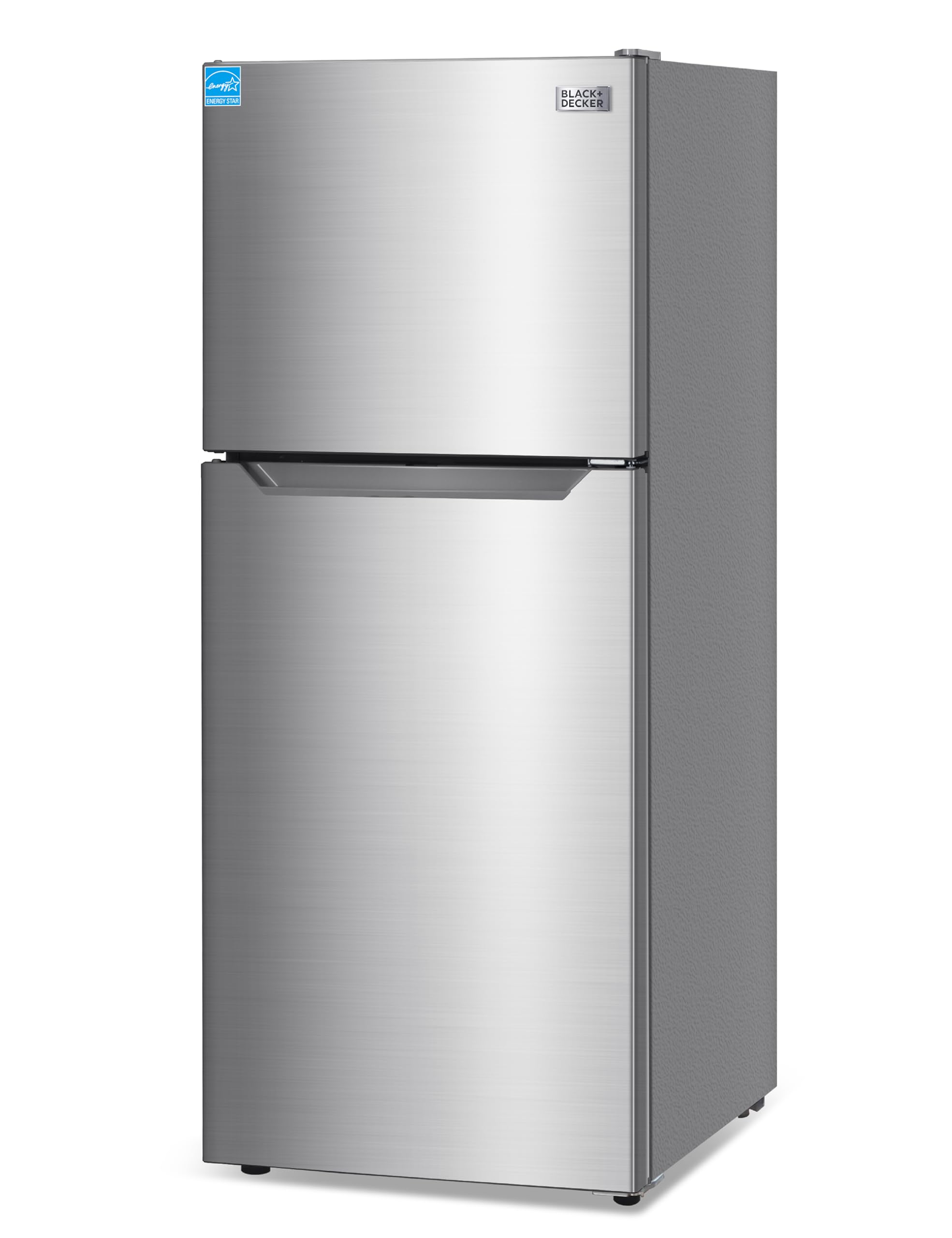
The smaller BLACK+DECKER that skips the garage and fits a 600-square-foot apartment.
If the garage unit is too big and the Galanz too tall, this one lands in the middle. It delivers 12.1 cubic feet with a top freezer, a stainless-look finish, and a reversible door you can swing left or right to match your counter run. Energy Star certification and frost-free auto-defrost are both here, and the adjustable thermostat keeps the fridge and freezer on separate settings. At 316 kilowatt hours per year it is the lightest consumer in this group, so a small household will feel it least on the bill.
The size is the point. Owners call it right for two people in roughly 600 square feet, with the freezer running cold and enough interior room to keep a week’s groceries. If you are six feet tall, though, you will want a low stand — one owner planned to build one about a foot high to avoid bending for the crisper. Short users should think the opposite: the lower height is a benefit for them.
The weak spot to know before you buy is the door seal. The magnetic gasket has needed a firm shove to close on some units, and on one it drifted open on its own until the buyer added child-safety locks. Check that the door snaps shut on its own weight before you load it. A motor that shut off unpredictably was reported on the same unit, though the vast majority of these run without that drama.
Why it fits an apartment: 12.1 cubic feet, 316 kilowatt hours a year, and a reversible door that clears a narrow kitchen layout.
What to check at delivery: close the door slowly in the first hour and make sure the gasket pulls itself shut.
Best fit for: two people in an apartment or a small home kitchen who want full-size features without full-size footprint.
Skip if: you are tall and unwilling to add a riser — the crisper is down low.
5. Smad 6.1 Cu.Ft Off Grid Propane Refrigerator

A silent absorption box that cools on a propane flame where the grid has quit.
For a deer camp, a trailer, or a cabin with no power line, this is the budget way into true propane cooling. It is a 2-way absorption fridge — 110V electric or LPG propane — and the absorption loop has no compressor and no fan, so it stays silent and vibration-free. The LPG side takes 2.8 Kpa (28 mbar) of gas pressure. Total capacity is 6.1 cubic feet, split into 4.5 cubic feet of freezer and 1.6 cubic feet of fridge, and the door can be flipped to open left or right.
The dial is famously coarse. Three settings do the damage: high will freeze the fridge box, low will spoil food, and the middle is the one to live on. A 30-pound tank lasted about a month on one owner’s setup, but it ran dangerously low before the swap; a 40-pound tank covers a month with room to spare. Propane-only operation is the draw — one owner in a wildfire-replacement trailer valued that it needed no 12V battery at all.
Now the part to weigh. The burner has been hard to relight only when a tank runs dry, so swap tanks before empty rather than after. The convertible door does not always seal cleanly when reversed — one owner ended up with a 5 mm gap — and tech support is slow and scripted. If your cabin is remote enough that a return is impractical, buy from a seller with a clean return path and a local propane technician on call.
The off-grid case: 6.1 cubic feet of 110V-or-propane cooling, no compressor noise, and a flame that keeps running through a grid outage.
Who should think harder: buyers who need a precise thermostat or a clean door seal after reversing the hinge.
Pick it if: you need real propane cooling on a tight budget and can live with a three-position dial.
Pass if: you need fine temperature control or plan to reverse the door — the seal is the weak point there.
6. Norcold N8DCSSR Refrigerator

The 8-cubic-foot drop-in that turns a tired motorhome fridge back into a real freezer.
This is a compressor fridge, not an absorption box, and that is exactly why it is here: it cools like your kitchen unit instead of waiting for a flame. It slots into the space of an older Norcold, which makes it the easiest swap for a motorhome owner tired of warm milk. It runs on 12V DC straight from the house battery, and the stainless door and chrome finish blend into a modern RV interior.
Owners replacing a three-way absorption unit are clear that the cooling is the big win — the freezer gets cold enough to freeze ice cream, which a tired propane unit often cannot manage. The install is a straight lift-and-slide for a matching cavity, though removing the doors and bumpers to get it through the entry door takes patience. Expect to call the freight company with a phone number for delivery: this ships on a pallet, not in a parcel van.
The one thing that trips up new owners is wiring. The unit is very sensitive to 12V voltage drops, so a thin existing line will cause “E3” error codes and beeping. Running a heavier-gauge 12V line — or a separate converter — is the fix, and it is the difference between a fridge that works and a fridge that complains. A dual-compressor unit means the fridge and freezer have their own cooling systems, so a single fault can show up as one compartment underperforming.
Why owners stay happy: it fits the old cavity, freezes ice cream, and runs off the 12V house battery instead of burning propane.
What the job really needs: new, heavier wiring from the battery to the fridge — shortcut it and you will see E3 errors.
Choose it for: a motorhome with a worn-out 8-cubic-foot absorption fridge and a battery bank ready to feed it.
Not for: off-grid cabins with no 12V system — this box has no propane mode.
7. Norcold N10DCSSR Refrigerator
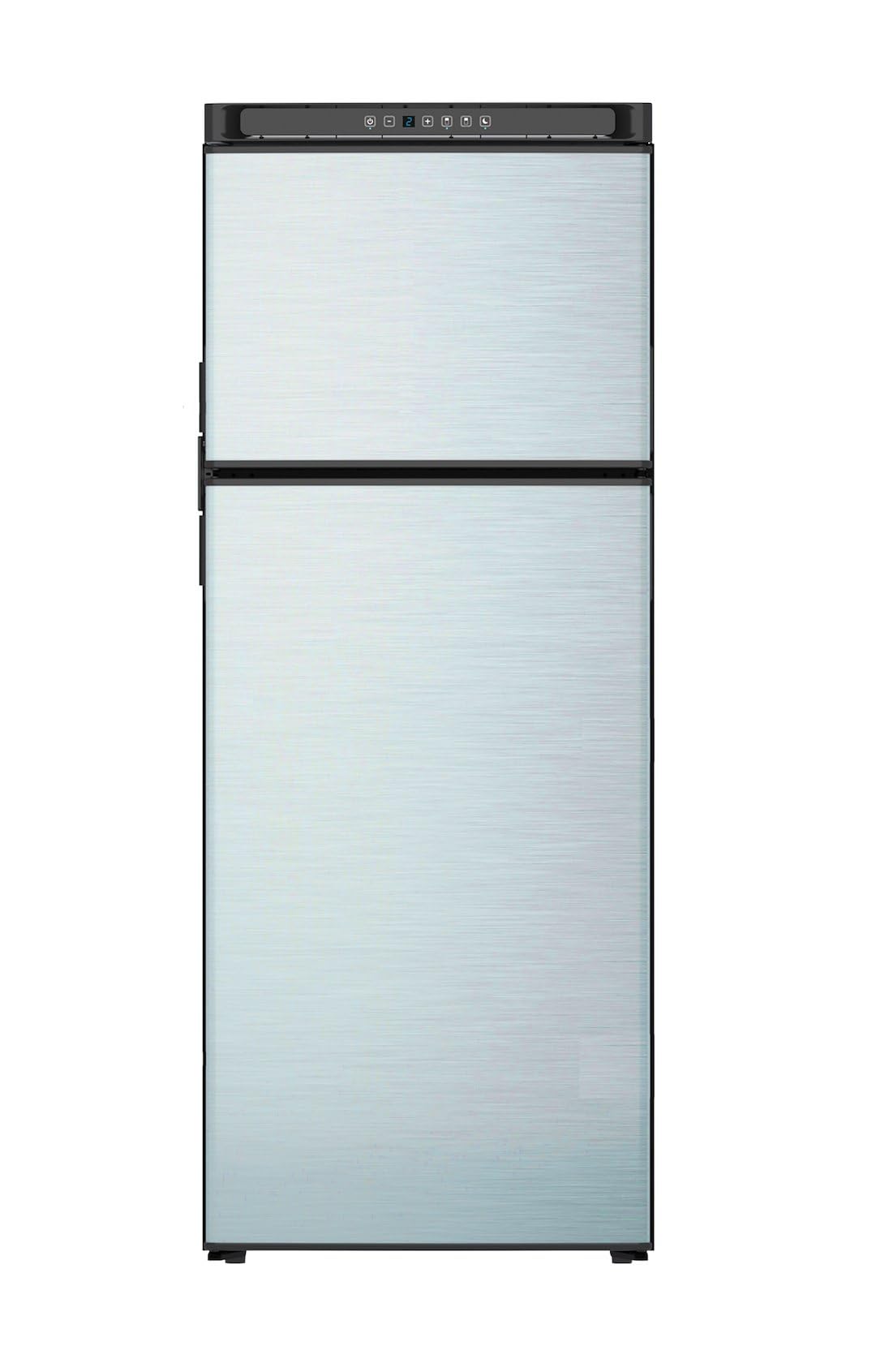
Ten cubic feet that runs on 12 volts and a solar panel instead of a propane bottle.
If your RV has switched to lithium and solar, this is the fridge that leans into it. The 10-cubic-foot DC compressor unit uses just under 5 amps at 12V in real use. It pulled down to 32 °F in the fridge and 0 °F in the freezer within about five hours on one owner’s setup, and it held 37–39 °F on the road. A night mode quiets the already-quiet compressor for a bedroom-adjacent install, and the LCD panel with touch control puts the temperature at eye level. Reversible stainless doors with curved edges and a travel latch finish the built-in look.
Compared with the 8-cubic-foot Norcold above, this gives you two more cubic feet of food space for a modest jump in the cabinet — the same swap trade, bigger. Owners who moved from a propane unit often report gaining interior space and sealing up the old exterior vent, which improves the whole wall’s insulation and stops winter drafts. It runs on a 200W solar panel and a 400Ah battery bank without draining it on one documented setup.
The honest catch is two-fold. First, installation wants 10-gauge wiring and a proper 12V run, so the electrical work is half the job. Second, the mounting scheme uses screws through the interior, which some owners dislike, and a few units arrive freight-damaged — inspect the pallet before signing. Longevity has been reported at around a year and a half by one frustrated buyer, so it is worth pricing the extended coverage if this is your full-time home.
The solar-friendly numbers: just under 5 amps at 12V, 32 °F fridge and 0 °F freezer in roughly five hours, quiet enough for a night mode.
The install warning: budget for 10-gauge wiring, and check the unit for dents before the driver leaves.
Right for you if: you are converting an RV to solar and want a bigger DC fridge with a proper travel latch.
Reconsider if: you are not ready to run new 12V wiring — the fridge will be unhappy on an old circuit.
8. RecPro RV 6.3 Cu. Ft. Gas & Electric Refrigerator

The three-way swap that slides into an old Dometic opening with barely a screw turned.
What wins people over here is the fit. This 6.3-cubic-foot absorption fridge drops into the cavity left by an older Dometic unit, so an outright replacement can be a one-day job with no cabinet surgery. The gas-absorption loop runs on propane for silent cooling, and it will also take 110V-120V or 12V. Pre-chill for about 12 hours before you load food — the maker calls for that, and it is the difference between a cold box and a struggling one. Interior capacity is 180 liters of fresh food.
The two practical knobs are the thermostat and the wiring. Setting 3 has not been cold enough for some owners, who settled on 4; expect to fine-tune to your climate. And here is the part the listing buries: the propane mode still needs a 12V DC feed for the ignition and controls, so off-grid cabin use without a battery will disappoint. One owner put it plainly — “Description completely misleading on power source.” Plan for a dedicated 10AWG 12V line to the battery plus a second 12V connection for the heater.
Installation is praised as an easy hookup for a handy person, though a first-timer may want to remove the doors to clear the RV entry. The manual is thin on operating instructions, so the settings are learned by trial. On the value side, opinions split — the fit and cooling are loved, the price is debated — so judge it against the cost of a new cabinet, not just the appliance.
Where it earns praise: drop-in fit for a Dometic cavity, absorption silence, and a switchover that moves between electric and propane when the power drops.
What nobody tells you: the propane burner still needs 12V DC, so bring a battery even if your cabin has gas.
Ideal for: an RV owner replacing an older Dometic fridge who wants three power sources and a reversible door.
Wrong pick if: you are fully off grid with no 12V battery at all — the propane side will not ignite.
9. Techomey 6.1 Cu.Ft. Propane Refrigerator with Freezer

The dual-fuel six-footer that draws 300 watts on the wall and burns 0.56 kg of propane a day.
Two numbers tell you what this 6.1-cubic-foot absorption fridge gives you: 300 watts of electric input, or 0.56 kg of propane per 24 hours on the flame. Split the space into 4.5 cubic feet of fridge at 32–50 °F and 1.6 cubic feet of freezer at 3.2 °F, and you have enough for a couple on an off-grid cabin or a camper. It runs on AC 110V or LPG/NG at 2.8 Kpa (28 mbar) — no 12V. The absorption loop means no compressor, no fan, no Freon, so it is silent. Adjustable shelves and four door bins keep the interior manageable.
The real-world performance is strong for the size. On 110V it easily reaches 30 °F in the fridge and 1 °F in the freezer on one long-term setup, so dial it carefully — these boxes can run colder than the dial implies. On propane it drops the fresh-food box to about 40 °F with a 0 °F freezer, which is ideal. Propane use is described as easy, which matters if you have a tank but no power line.
The quirks show up once the unit is rolling down the road. There is no door lock, so doors open in transit unless you anchor the fridge and secure them. The ignition is manual piezoelectric — a press-button spark, not auto — and the control-panel labels are confusing on first read. Shipping damage has been a genuine complaint, so inspect the crate and never sign for a dented box without photographing it.
For the cabin kitchen: 6.1 cubic feet split into a 32–50 °F fridge and a 3.2 °F freezer, on 300W or 0.56 kg of gas a day, with zero compressor noise.
For the RV: add a door lock at the hinges before travel — these units slide and the doors swing open.
Settle on this if: you want small-capacity propane cooling with a clean, quiet interior for a cabin or stationary camper.
Not ideal if: you tow often and want factory door locks — you will be adding your own.
10. Dometic DM2862RB 8.0 Cubic Feet Refrigerator
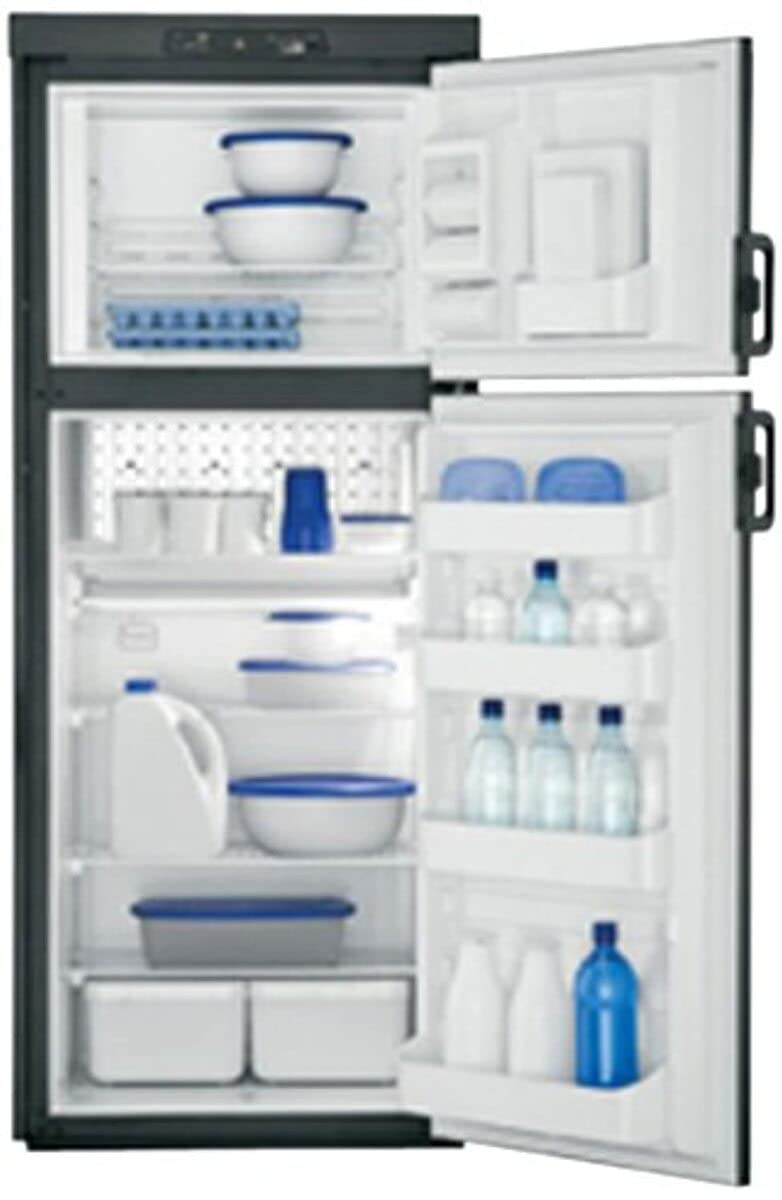
The 8-cubic-foot Dometic that slots into an RM2862 cavity and gets back to cold.
This one is for a very specific buyer: someone whose RV already has the Dometic cavity and wants a direct fit without cutting cabinetry. The 8-cubic-foot unit swings either left or right a full 180 degrees, and the automatic locking handles keep doors closed in transit. Adjustable and removable shelving plus four door bins give you flexible packing. Eye-level controls sit where you do not have to bend.
Owners who have made this swap report it drops right into the old opening and runs at about 35 °F in the bottom compartment with a –3 °F freezer. One replaced a 13-year-old Dometic that had finally leaked and failed; another replaced a 12-year unit and found the new box performed identically. The Dometic absorption system runs quiet and holds up for years; the failures buyers report tend to come after a decade or more, not months.
The gotcha is the door panels. The fridge arrives without the decorative front panels, and buyers have been shocked that those are sold as a separate part. That is the line between a smooth install and a shock: if you are ready to re-use or buy the door panels, the fit is excellent. If you expect a complete fridge on arrival, check the parts list before ordering. One buyer also found a bottom trim piece wasn’t included.
The replacement story: drops into an RM2862 cavity, holds about 35 °F in the fridge and –3 °F in the freezer, and swings fully for right- or left-hand opening.
Order-day homework: confirm whether door panels are included — they are frequently sold separately.
Buy this if: you are replacing an existing Dometic cavity and want the shortest possible install path.
Check first if: you are a first-time buyer expecting a complete finished front — budget for door panels.
11. SMETA 9.4 Cu.Ft Propane Refrigerator, 2-Way

A 9.4-cubic-foot absorption fridge that runs full time on propane and barely complains.
For a cabin or cottage that stays occupied, this is the largest true propane box here that is built to run on gas as a daily fridge. Total capacity is 9.4 cubic feet, split into 7.3 cubic feet of fresh food and a 2.1 cubic foot freezer, plus a vegetable crisper and door bins that take two-liter bottles. It runs on 110V or LPG propane, and gas consumption is listed at roughly 1.6 pounds per day. No compressor, no fan, no Freon, and no vibration — just a silent loop that keeps food cold.
On the living-with-it side, owners running it on propane only report flawless, quiet service over six months, and one tested a 1-inch flexible stainless exhaust pipe to vent the flue outside; the wall never got above 90 °F. Another notes it burns less gas than expected in a renovated camper and simply turns it off overnight because it can over-chill on high. The manual control panel brings the igniter, safety valve, and thermostat together in one spot, and adjustable feet help you level it for faster pull-down.
The honest limit is installation. The unit is heavy and needs 4 inches of clearance above and 1 inch at the back and sides for proper airflow, so do not box it into a tight alcove. A small number of units arrive with dents or door misalignment — check the crate and the door gaps before install, and know that filing a return from a remote site is painful. Set up stationary with its 4-inch top and 1-inch side clearance, this is one of the hardest-working propane fridges you can buy.
The off-grid workhorse: 9.4 cubic feet, 7.3 fresh food plus a 2.1 freezer, roughly 1.6 lb of gas a day, and a silent absorption loop.
The install discipline: leave 4 inches on top and 1 inch at the sides for airflow — cram it and the flame struggles.
Pick it if: you live or stay long-term off grid and want a large, quiet propane fridge with a usable freezer.
skip it if: you only need a backup box or have no room for proper venting around the unit.
12. Techomey 9.4 Cu.Ft Propane Refrigerator with Freezer
This is the bigger sibling to the compact Techomey, and it fixes the one thing that bugged people about the six-footer: space. You get 7.3 cubic feet of fridge held at 32–50 °F and a 2.1 cubic foot freezer that drops to 3.2 °F, so a family can keep a week of fresh food and frozen meat in one box. It takes either 110V AC or LPG at 2.8 Kpa (28 mbar), and the absorption loop means no compressor, no fan, and no Freon — it just sits there silently making cold.
Running costs are quoted two ways, and both are useful. On electricity it draws 4.13 kWh per 24 hours; on propane it burns 0.9 kg (1.9 lbs) per day. That gas figure is the one to plan your tank around if you are off grid. In a camper or cabin bedroom, the absorption loop’s silence is the selling point — no compressor cycling to wake you at 2 a.m. The reversible door flips left or right to match the layout, and adjustable shelves let you stack tall bottles and jars.
What you should know before ordering is that this family of fridges has recurring install quirks, not cooling failures. The instructions are thin, the control-panel labels are not intuitive on first use, ignition is manual piezoelectric rather than auto, and there is no factory door lock, so doors swing open in transit. Anchor the unit to the floor and secure the doors for travel, and read the panel labels against the manual before your first light-up. Set aside a half hour to learn the controls rather than guessing.
Why people pick the big one: 9.4 cubic feet of silence, a 2.1 cubic foot freezer down to 3.2 °F, and a 0.9 kg per day gas habit that is easy to budget.
What to prep for: manual ignition, thin instructions, and a door that needs your own lock — plan a short learning curve on day one.
Made for: a family cabin or off-grid home that wants a big silent fridge and does not mind a manual light-up.
Choose another if: you want automatic ignition and factory door locks straight out of the crate.
13. Techomey 19 Cu.Ft Propane Refrigerator, Stainless Steel
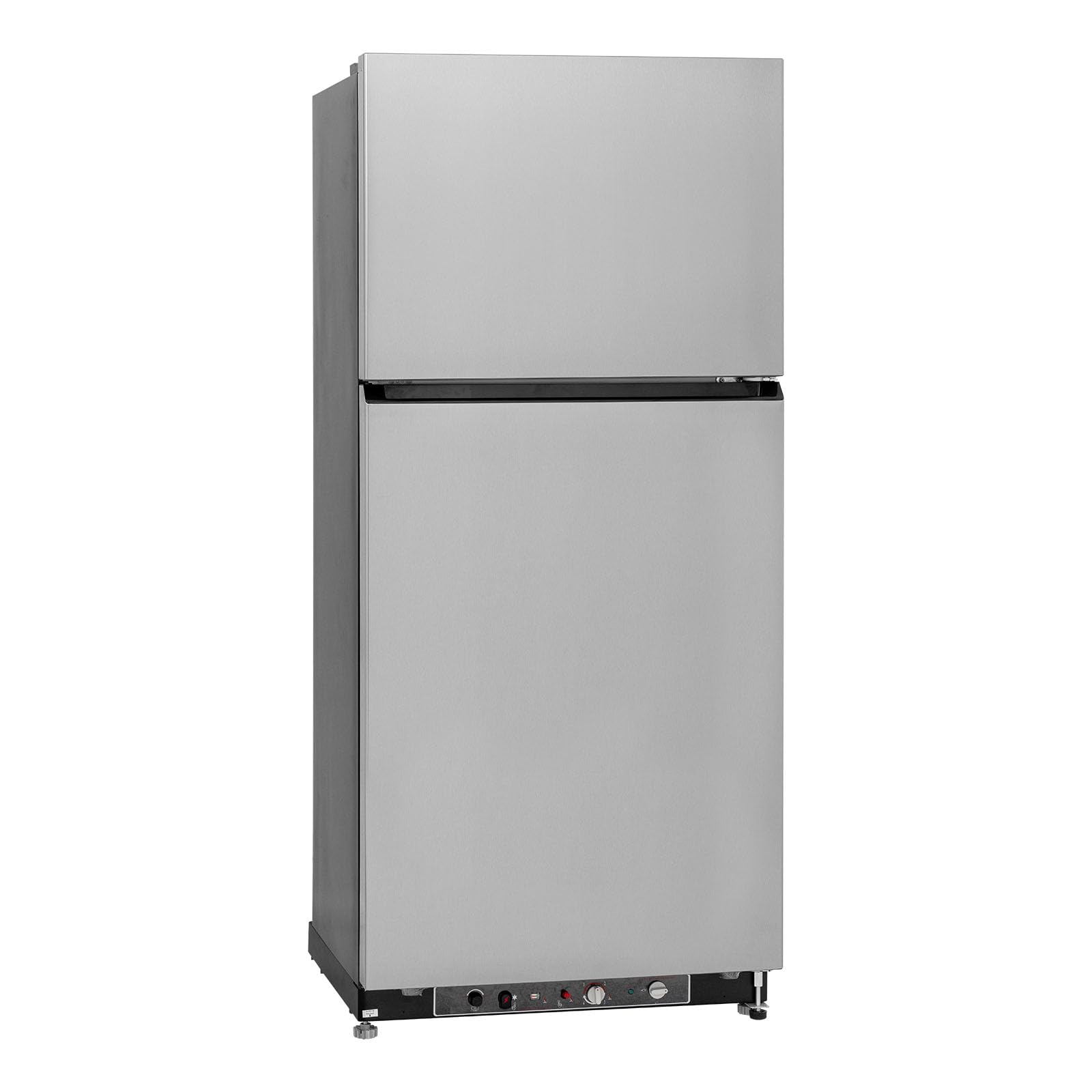
A whole-house 19-cubic-foot propane fridge that runs on a flame with zero decibels.
If your kitchen is off grid and you want a fridge that looks like a normal one, this is the biggest box here that still runs on propane. It splits into 14 cubic feet of fresh food and a 5 cubic foot freezer, all on a 32.7-inch-wide, 75.6-inch-tall stainless body, so it fills a real kitchen footprint. It runs on LPG or 110V AC, uses an absorption loop with no compressor or fan, and is rated at 0 decibels — silent enough for a living room or a bedroom-side wall. Four adjustable glass shelves rated at 5 kg each, three door bins, two vegetable crispers, two egg trays, and an ice tray make it feel like a full kitchen appliance.
The practical extras are built for a stationary install. Two adjustable feet and two rolling wheels make it easier to level and slide into place, and the reversible door hinge lets you open left or right to match your counters. On 110V it can overcool — one owner measured 30 °F in the fridge and 1 °F in the freezer — so dial carefully after the first 24 hours. Running on gas, it is the same quiet flame-and-loop system, and with a 14 cubic foot fridge section it holds a family’s groceries for a week of trips.
Two honest caveats come with a box this size. First, annual energy use is listed at 1900 kilowatt hours, so electrical running costs add up if you keep it on the wall outlet full time. Second, the same install quibbles apply: thin instructions, confusing control labels, manual piezo ignition, and no factory door lock. A unit this tall is heavy to move and to level. Plan a spot with clearance behind it, bring help to set it, and lock the doors before any road trip.
The whole-house play: 19 cubic feet total, 14 fresh food plus a 5 cubic foot freezer, 0 dB absorption cooling, and stainless to match a real kitchen.
The running-cost catch: 1900 kilowatt hours a year on electric means this fridge wants a propane tank as its daily driver, not a wall outlet.
Best for: a large off-grid home or cabin that needs full-kitchen capacity and total silence, with a propane tank to run it.
Rethink if: you plan to run it on electricity full time — the annual draw is high enough to matter.
Know the Specs
Absorption vs. Compressor Cooling
An absorption fridge makes cold with a small flame heating a sealed loop of coolant, plus a bit of electric or gas power to move it along. There is no compressor, so it is silent — but it cools slowly and must shed heat out of its back. A compressor fridge, like the Dometic CFX or the Norcold Polar units, has a motor that drives the coolant, so it pulls temperature down fast and deep. Choose absorption if you need a propane-only flame and silence; choose compressor if you have steady electricity and want freezer-grade cold quickly.
LPG Pressure in Kpa and Mbar
LPG pressure here is quoted as 2.8 Kpa (28 mbar) — the same number written two ways. That is the force your regulator must feed the burner. Too low and the flame is weak, so the fridge never reaches temperature and food spoils. Too high and the fridge over-cools, freezing fresh food while the freezer looks fine. A regulator set to the maker’s stated pressure protects both your groceries and the burner, and it is the single most overlooked setup step.
Common Questions
How much propane does a propane refrigerator use per day?
Can a propane refrigerator run without electricity at all?
How much clearance does a propane fridge need behind it?
Why does my propane refrigerator freeze the food in the fridge section?
Is an absorption fridge louder than a compressor fridge?
Why does my RV propane fridge show an E3 error code?
Do propane refrigerators need a 12V battery to run?
How long does a propane refrigerator take to get cold?
Can I put a propane refrigerator in a garage or hot climate?
Is propane or 12V better for off grid cooling?
The Bottom Line
For most people shopping for a propane refrigerator, the Dometic CFX is the strongest overall bet if you have power — it freezes to –7 °F and draws as little as 0 watts on DC standby. If a flame is your only fuel, the SMETA 9.4 cubic foot model is the one to reach for, with 9.4 cubic feet of silent absorption cooling and a 2.1 cubic foot freezer. For an RV cavity swap, the Norcold N10DCSSR gives you 10 cubic feet on 12V DC and a travel latch. Match the fridge to your power source — propane tank, 12V battery bank, or wall outlet — before you compare cubic feet.
How we choose
We do not accept paid placement. Every pick is matched to a real buyer and a real use-case; we do not hands-on test units.
Sources
Specifications: manufacturer listings and product documentation. Review insights: verified customer reviews, as of October 2026. Pricing: not shown on this page (it changes often); check the current price via the retailer link.
As an Amazon Associate, Aappliancez earns from qualifying purchases. This does not affect which products we feature.