Disclosure: Some links in this post are affiliate links. As an Amazon Associate I earn from qualifying purchases, at no extra cost to you. Learn more
Specs are compiled from manufacturer listings and verified buyer reviews and can change over time — please confirm the key details on the product page before buying.
If you already smell gas, you do not need a detector — you need to get out and call someone. A propane leak detector earns its place in your toolbox for the moment before that, so you can check a connection, a valve, or a grill line and know for certain. The short answer: a handheld sniffer finds the exact spot, and a plug-in alarm watches the room while you sleep. Most homes with a gas range, water heater, or RV should have one of each.
This guide is built by comparing the manufacturers’ published specifications and the patterns across verified customer reviews, so you get each pick’s real strengths and trade-offs instead of marketing spin.
You will see two very different jobs here — the pinpoint tool you carry to a suspect fitting, and the fixed alarm that never stops watching. Below, each unit is matched to the job it does best, with the numbers that actually decide the call. Below, each propane leak detector is matched to a kitchen, garage, or camper job, with the specs that decide the pick.
Top Picks


How To Choose The Best Propane Leak Detector
The first decision is not brand or budget — it is job. A handheld sniffer is a diagnostic tool you point at a fitting for thirty seconds. A fixed alarm is a watchdog that sits on a wall for years. Buying a sniffer when you need a wall alarm — or the reverse — is the most common mistake, and no spec sheet flags it.
Sniffer or fixed alarm — pick the job first
A handheld detector tells you where the gas is coming from. You carry it to a stove, a water heater, a dryer connection, or a propane grill regulator and move the sensor tip along the joint until the alarm ramps. That makes it the right tool for confirming a repair, chasing a smell, or checking work a technician just finished.
A fixed alarm does not point at anything. It sits plugged into a wall or wired into a 12-volt circuit and sounds an 85-decibel alert when gas builds up in the room. It is the one that matters at 3 a.m., when nobody is holding a tool.
Reach is the spec that decides if the tool is useful
Propane connections hide in bad places: behind a cabinet, under a burner cap, deep in an RV compartment. A detector you cannot physically get to the joint is useless. A short pen-style body works for surface fittings, while an extendable probe of 12 inches or a bendable 17-inch gooseneck reaches around corners and keeps your hand away from the leak.
Note the sensor rule the makers themselves publish: hold the tip 1 to 5 cm from the suspected point. That is point-to-point leak hunting, and it is not the same as a smoke alarm that senses a whole room.
Read the %LEL display, not just the beep
%LEL stands for the percentage of the lower explosive limit — the smallest concentration of gas in air that can actually ignite. A reading near the bottom of that scale is a trace. A climbing number is a warning that the air is getting dangerous. Detectors here show anywhere from 1%LEL up to 10%LEL or 20%LEL depending on the model, and a bar graph or changing screen color shows you which way it is moving.
Power: disposable batteries, rechargeable pack, or wall power
Disposable AAA batteries mean the tool can sit for months and still work, and you can pull the cells for long storage — which matters for a seasonal RV. A rechargeable pack skips battery corrosion and costs nothing to top up. A plug-in alarm never needs feeding but dies in an outage unless it has a battery backup.
Side-by-Side Comparison
| Model | Best For | Detection Range | Probe Reach | Power | Amazon |
|---|---|---|---|---|---|
| TopTes PT205★ Best Overall | All-round handheld sniffer | 1%LEL–10%LEL | Pen-style body | 2x AAA | Amazon |
| TopTes PT299Best for Tight Spaces | Reaching tight spaces | — | 2.20″–6.30″ pole | 2x AAA | Amazon |
| TopTes PT760 | Dark cabinets and RV bays | 1%LEL–20%LEL | 12-inch probe | Type-C rechargeable | Amazon |
| TopTes PT520A+ | Deep, bendable reach | — | 17-inch gooseneck | Type-C rechargeable | Amazon |
| Kidde KN-COEG-3 | Whole-room standby alarm | States “GAS” on display | Plug-in unit | 120V + 9V backup | Amazon |
| Safe-T-Alert 35-742-BR | RV propane plus CO | Dual LP/CO | Flush mount | 12 VDC | Amazon |
| Safe-T-Alert 30-441-P-WT | Simple propane-only RV alarm | < 25% LEL | Surface mount | 12 VDC | Amazon |
Detailed Reviews
1. TopTes PT205 Natural Gas Detector
Our pick — 4.5+★ from 1,000+ verified ratings; the strongest balance of quality and price.
The pocket sniffer that turns a gas smell into a precise address on the pipe.
Here is the number that makes this the pick for most people: the PT205 reads gas concentration as a %LEL value — that is the percentage of the lower explosive limit, the smallest amount in air that can ignite — anywhere from 1%LEL to 10%LEL, which the maker equates to 100ppm to 5,000ppm based on methane. A single beep tells you gas is present. A rising bar graph on the LCD tells you it is getting worse, and a red screen tells you it is serious.
It reacts in 0.5 seconds, so you sweep the tip slowly along a joint and hear the tone change the moment you pass over the leak. Accuracy is what wins people over here — the review pages keep circling back to how reliably it finds the spot, and it earns 4.5+ stars across 1,100+ ratings. It takes 2x AAA batteries, which come in the box, and the 30-second warm-up shows a countdown so you are not standing there wondering if it is on.
The form factor is the quiet win. It is pocket-sized with a pen hook and a non-slip texture, plus a storage bag, so it lives in a drawer and gets pulled out when a connection starts to smell. One buyer, chasing a stove leak, said it “helped me isolate the leak on my Samsung gas stove… instead of having to call out a tech.” One honest limit: this is a diagnostic tool for zeroing in on a suspected leak, not a set-and-forget monitor you leave running on a wall.
What it does well
- Reads 1%LEL–10%LEL so you see severity, not just presence
- 0.5-second response while you sweep a fitting
- Pocket-sized with pen hook, storage bag, and batteries included
- Handles LPG, methane, propane, butane, natural gas, and coal gas
Where it asks a little care
- Runs on AAA cells — keep spares if it lives in a cold garage
- Not a continuous room monitor; it is for checking, not watching
Settle on this one: homeowners, DIYers, and RV owners who want to check a connection and see how bad the leak is, not just that one exists.
Hold off if: you want an alarm that stays plugged in and watches the room overnight — that is the Kidde pick further down.
2. TopTes PT299 Gas Leak Detector with Extendable Rod
A telescoping wand that gets your hand out of the blast zone and into the crawlspace.
The specification to start with is the pole: it extends from 2.20 inches to 6.30 inches, letting you drive the sensor into pipeline runs, storage tanks, fireplaces, basements, and RV compartments without leaning your face near a suspected leak. That reach is the whole reason to pick this over the PT205 above — same 30-second warm-up, same dual audible and visual alarm, but a body that stretches into the gap instead of a pen you point at a surface.
It runs on 2x AAA batteries, weighs 170 grams, and shuts itself off after 5 minutes of inactivity, which saves the cells if you forget. The sensor is a gas-sensitive semi-conductor type — that is the sensing element that reacts to combustible gas molecules and triggers the alarm.
What it will find may surprise you. Buyers report it caught a misaligned dryer connection by flashing red when the nose detected nothing, and one owner tracked a wall-oven leak that a soapy bubble test had missed, right down to the leaking shutoff valve. There is a 4-star note worth repeating honestly: the first unit can fail to power on, and the battery diagram in the manual is confusing — read it twice before deciding the tool is dead.
Depth you can trust: the combination of a working probe and a clear visual alarm means you can confirm a repair from the other side of the room, and the value here is that it does the job without a service call.
Small friction: the manual’s battery-insertion diagram is muddled, and an occasional unit arrives needing a return — the maker stands behind it with a 36-month warranty.
Reach for it when: the gas line lives somewhere your arm will not go — under a tank, behind a panel, deep in an RV bay.
Look elsewhere if: you want a %LEL numeric readout; this one alarms rather than grades the leak.
3. TopTes PT760 Gas Leak Detector

A rechargeable sniffer with a light built in, for the cabinet you cannot see into.
Squeezing under a sink or behind a cabinet usually means one hand on a flashlight and one on the tool. The PT760 folds that into one body. Its 12-inch stainless steel telescopic probe retracts into the case, and a built-in flashlight lights the bay you are crawling through. Throw in a Type-C charging port and you stop hunting for AAA cells before every job.
The detection range is the widest here: it reads 1%LEL to 20%LEL, which the maker equates to 100ppm to 10,000ppm. That means it can grade a leak as it grows, and it raises both an audible and a visual alarm within 0.5 seconds. The alarm tone frequency and screen color shift as the concentration climbs, so you can hear and see severity change as you move the tip.
The maker is explicit about the technique that matters: keep the sensor 1 to 5 cm from the suspected point, unlike a smoke alarm that covers a whole room. What keeps this pick in heavy use is how it holds up — owners lean on a 12-inch probe that stays accurate, and one 40-year RV technician pinpointed a propane leak in under three minutes and credited the built-in light. A few find the rechargeable pack runs down faster than they expect, so charge it before a long job.
The case for carrying this one
- 12-inch probe reaches behind cabinets and into pipe runs
- Built-in flashlight for basements and poorly lit bays
- Reads a wide 1%LEL–20%LEL range and reacts in 0.5 seconds
- Type-C rechargeable with a protective case in the box
What to plan around
- Rechargeable pack drains between charges — top it off before big jobs
- Costs more than the AAA-powered models, so it suits repeat use
The one to buy if: you inspect gas equipment often and want a light, a long probe, and no battery shopping in one tool.
Not for: the occasional checker who wants to pull a tool out of a drawer once a year and never charge it.
4. TopTes PT520A+ Gas Leak Detector
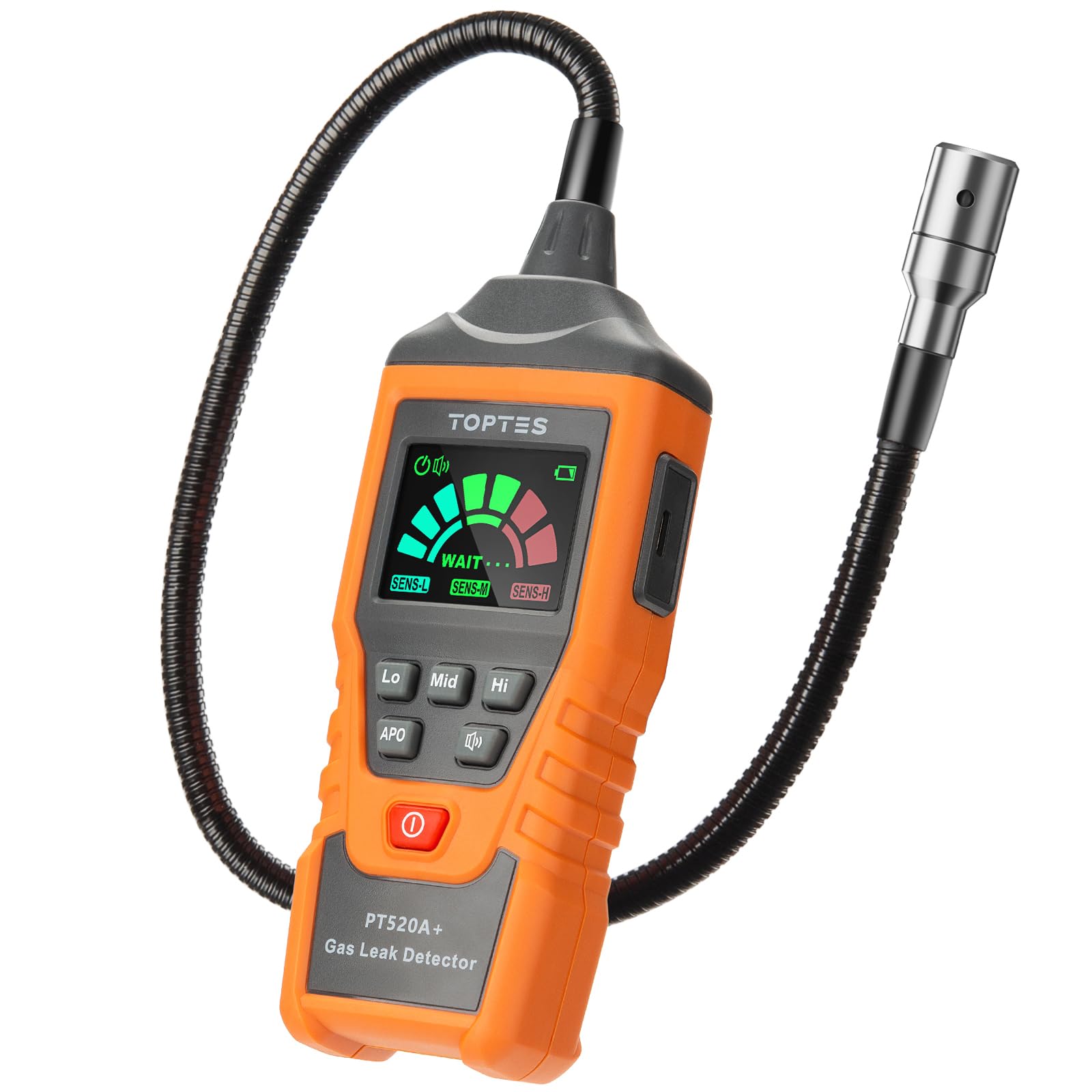
The gooseneck that bends around the water heater so your knuckles do not have to.
Seventeen inches is the number. This gooseneck bends, so you can shape it around a water heater, drop it behind a dryer, thread it past a kitchen stove, or reach into a fireplace and a propane grill without contorting yourself. The lengthy sensor tip also lets you measure gas levels without your hand near the leak — a real benefit when the fitting you are testing is the one you are unsure about.
The rechargeable pack is rated for over 3000 recharge cycles, so the battery is not something you replace, it is something you plug in. It auto-shuts off after 10 minutes of inactivity, and an APO button cancels or reactivates that. There is also a Mute button, useful when a false alarm tone in a quiet kitchen is drowning out the job.
Field experience backs the design. Owners mention placing the tip at a dryer gas outlet and hearing it beep immediately, pinpointing a leaking gas valve a bubble test had missed. The build is easy to hold, wear-resistant, and carries a double-sided bar-shaped groove plus non-slip material so it grips in a gloved hand. The honest trade-off is scale: this has the smallest review base of the handhelds here, so you are trusting a well-reviewed but newer design rather than a long track record.
Why the reach matters: a gooseneck of 17 inches lets you test from a safe angle, so hard-to-reach connections stop being hard to check.
The trade-off: fewer built-in readings than the PT760 — no %LEL number — so it is a locator first and a severity gauge second.
Best match for: RVers and DIYers who work around water heaters, dryers, and grills where the fitting sits just out of arm’s reach.
Think twice if: you want a long-proven sniffer with a big review base — the PT760 has more years of field reports behind it.
5. Kidde Carbon Monoxide & Explosive Gas Alarm

The one that keeps watching after you put the tools away and go to bed.
Everything else on this list is a tool you hold. This is the alarm that stays. Plug it into a standard 120V outlet and it watches for both carbon monoxide and explosive gas, showing a digital LED readout of the CO level it is sensing or flashing the word “GAS” when combustible gas is present. An 85-decibel alarm sounds when either is detected — loud enough to wake the house.
Two small features do a lot of work here. The 9-volt battery backup keeps protection running during a power outage, which is exactly when a pilot light or a furnace can misbehave. The Peak Level Memory records the last time CO was detected or the unit was last tested, so you can see what happened while you were out. It is rated for 5 to 95% relative humidity non-condensing, which suits a kitchen or a basement.
The reason it belongs in a propane-focused list is the gap it closes: a CO alarm only reacts once gas has burned, so raw propane sitting in the air slips past it until this unit detects it directly. Owners lean on that distinction — one owner, after a natural gas near-miss, calls it the alarm every family should have. The recurring gripe is the size: it is bigger than a lot of people picture, and it can look bulky above a counter. The battery that ships with it occasionally arrives flat, so check it on day one.
Why it belongs on the wall
- Catches both raw explosive gas and carbon monoxide in one unit
- 9V backup keeps it live through a power outage
- Digital display and Peak Level Memory show what it sensed
- 85-decibel alarm and simple plug-in installation
What to know before mounting
- Bulky — measure the spot before committing to a visible wall
- Check the backup battery on arrival; some ship depleted
Buy this alongside a sniffer if: your home has a gas range, furnace, or water heater and you want protection that does not depend on you holding a tool.
skip it if: you need to find the exact source of a leak — this tells you gas is present, not where it is coming from.
6. Safe-T-Alert 35-742-BR Dual LP/CO Alarm

A drop-in replacement for the alarm your camper came with, watching propane and CO at once.
If you own a travel trailer or motorhome, the wall alarm is usually a specific size, and this one is built to drop into that cutout. It runs on 12 VDC at 108 mA, tolerates an operational range of 12 volts plus or minus 15%, and has an operating temperature window from -40° F to +158° F — the kind of spread that matters when the rig sits in a summer lot or a winter storage yard. The case measures 6.375″W x 2.875″H x 1.25″D.
It watches two hazards in one housing: liquid propane gas and carbon monoxide, with an audible alarm and a low-voltage power warning so you know when the 12-volt supply is sagging. That dual coverage is the reason to reach for it over the propane-only unit below — one device, two threats, same wall cutout.
One startup quirk is worth knowing before you panic. On power-up, a flashing green LED can look like an end-of-life signal, but the manual confirms flashing is normal during initialization and steady green means it is running properly. Expect only one LED to light in normal operation. That documentation gap is the main thing people trip over — read the manual before you decide the unit is faulty.
The fit advantage: the dimensions match a standard flush-mount opening, so swapping a tired RV alarm is a screwdriver job rather than a remodeling one.
The honest snag: the startup LED behavior is genuinely confusing, and the manual is the only thing that clears it up.
Made for: trailer and motorhome owners replacing an existing flush-mount alarm who want propane and CO covered in one slot.
Wrong pick if: you are outfitting a house — the 12-volt wiring suits a vehicle, not a kitchen wall socket.
7. Safe-T-Alert 30-441-P-WT Propane/LP Gas Alarm
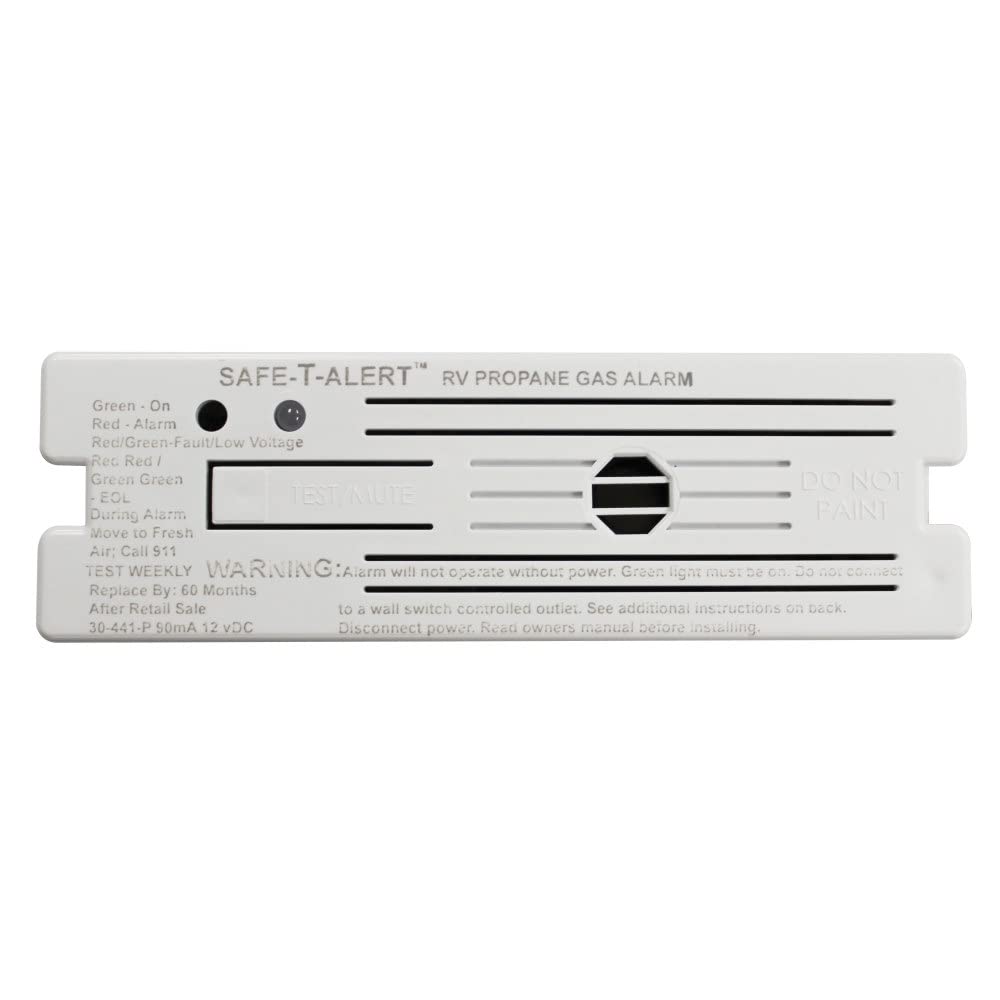
The plain white box that replaces the propane alarm already screwed to your camper wall.
Some jobs do not need a screen. This alarm has one purpose: sound an 85-decibel alert when propane builds up in a 12-volt camper. It trips below 25% LEL — that is 25% of the lower explosive limit, the point where the gas in air could ignite — which means it warns you well before the air reaches a dangerous mix, not after. It draws 90 mA at 12 VDC and runs on a 12-volt range of plus or minus 15%.
The surface-mount housing goes straight onto the wall, no cutout needed, and it holds up to the same wide temperature spread as its sibling above: -40° F to +158° F. That is the sort of range a camper sees between a July afternoon and a January storage lot.
Most buyers are here for one reason: a direct replacement, and they get it. Functionality and installation are what owners talk about most, and it installs with basic electrical knowledge — pull the fuse, unscrew the old unit, cut and strip about an inch of four wires, twist with wire nuts, and remount. It fits exactly where the old OEM alarm sat. Two things are worth sizing before you buy: a handful note a roughly five-year lifespan, and reviews split on whether the price is fair for a propane-only alarm. Check the date stamp when it arrives so you get full use of it.
Why it earns the wall slot
- Trips below 25% LEL, early enough to act on
- Surface mount goes on without cutting a hole
- 85 dB alarm is hard to sleep through
- Straight swap for a factory RV unit
Keep in mind
- Propane only — no carbon monoxide coverage
- Like most alarms in this class, it has a finite service life; check the date stamp on arrival
The right call for: an RV owner who wants a straightforward propane-only alarm that screws onto the existing wall and gets on with it.
Look to the dual alarm if: you also want carbon monoxide covered — this unit watches propane alone.
Know the Specs
%LEL — the number that tells you how bad it is
%LEL stands for the percentage of the lower explosive limit, the smallest concentration of gas in air that can ignite. A detector that reads %LEL shows how close the air is getting to that line, usually on a bar graph or a changing screen color. Trace readings near the bottom are a small leak. A climbing number means the air is heading toward danger. Not every unit displays %LEL — some only beep — so if you want to grade a leak rather than just locate it, pick a model that shows the number.
Probe reach — whether you can get to the joint at all
A sniffer is only as good as the spot its sensor can touch. Pen-style bodies work on surface fittings like a stove connection or a valve cap. An extendable pole or a bendable gooseneck reaches behind cabinets, into pipe runs, past a water heater, or into an RV compartment, and it keeps your hand a safe distance from the suspected point. The makers all publish the same technique: hold the tip 1 to 5 cm from the leak point and sweep slowly.
Power source — batteries, rechargeable, or wall power
Disposable AAAs let a tool sit unused for months and still work, and you can pull the cells for long storage, which matters for a seasonal camper. A rechargeable pack with a Type-C port avoids battery corrosion and costs nothing to top up, but it needs charging before a job. A plug-in alarm runs on household current with a battery backup, and a 12-volt alarm runs on the camper’s wiring with a low-voltage warning so you know when the supply is sagging.
Alarm versus sniffer — why you may want both
A sniffer is a diagnostic tool you point at a suspect fitting for a few seconds. A fixed alarm is a watchdog that sits on a wall and sounds an 85-decibel alert when gas builds up in the room, which is the one that matters while you sleep. A carbon monoxide alarm alone will not catch raw gas, because CO is only produced when gas burns. So the pairing that actually covers your home is a handheld detector for pinpointing and a fixed alarm for standby protection.
Common Questions
Will a propane leak detector find a leak that a soapy water test missed?
Will a carbon monoxide alarm detect a propane leak before the gas burns?
Can a handheld propane sniffer be used on an RV and a home gas stove?
How close should the sensor tip be to the suspected leak point?
Do these detectors need a warm-up before they read gas?
Battery or rechargeable propane leak detector — which is better for occasional use?
How long does a wall-mounted propane alarm last before it needs replacing?
Can a detector tell me how serious a leak is, not just that one exists?
Will a propane detector work in a cold garage or an unheated RV?
Should I buy a handheld sniffer or a fixed alarm first?
The Bottom Line
The propane leak detector that covers the most ground for most people is the TopTes PT205, because it shows %LEL severity on a screen, reacts in half a second, and slips into a drawer with batteries already inside. If your gas line hides where your arm will not go, the TopTes PT760 adds a 12-inch probe and a built-in light for the same job in the dark. And for the protection that does not depend on you holding anything, the Kidde combo alarm plugs in, backs itself up on a 9-volt battery, and watches both explosive gas and carbon monoxide around the clock. Use the handheld to find the leak and the plug-in alarm to watch the room overnight — together they cover both jobs.
How we choose
We do not accept paid placement. Every pick is matched to a real buyer and a real use-case; we do not hands-on test units.
Sources
Specifications: manufacturer listings and product documentation. Review insights: verified customer reviews, as of October 2026. Pricing: not shown on this page (it changes often); check the current price via the retailer link.
As an Amazon Associate, Aappliancez earns from qualifying purchases. This does not affect which products we feature.