Disclosure: Some links in this post are affiliate links. As an Amazon Associate I earn from qualifying purchases, at no extra cost to you. Learn more
Specs are compiled from manufacturer listings and verified buyer reviews and can change over time — please confirm the key details on the product page before buying.
If your arms have stopped being long enough to read a menu, you already know the real problem: one pair of readers fixes close-up work and ruins everything past the armrest. Progressive reading glasses put three distances on one lens — near at the bottom, mid-range in the middle, distance up top — so you stop taking glasses on and off between your laptop, your phone, and the television. The catch is that not every cheap pair grinds those zones properly, and the difference shows up in the first five minutes of wearing them. This guide covers the picks worth putting on your face, what actually separates a good progressive lens from a blurry one, and which pair fits your particular mix of desk work, driving, and reading in bed.
This guide is built by comparing the manufacturers’ published specifications and the patterns across verified customer reviews, so you get each pick’s real strengths and trade-offs instead of marketing spin.
A progressive lens only works if the reading zone lands where your eyes naturally drop. Below you’ll find the seven pairs that get that geometry right, plus the fit notes that decide which one suits your face, your screens, and your outdoor hours — the shortlist for Progressive Reading Glasses that keeps one pair on your nose all day.
Top Picks
How To Choose The Best Progressive Reading Glasses
Forget brand prestige. What matters is whether the lens geometry matches how you actually spend your day, and whether the frame stays on your face while you do it. Get those two right and a modest pair will beat an expensive one that fights your nose.
Match the lens to your main distance
A progressive multifocal lens stacks three powers into one piece of glass. The bottom carries your full reading magnification for small print and writing. The middle carries a reduced strength built for computer distance. The top is either half magnification or no magnification at all, which is what lets you glance up at a television or across a room without removing the glasses. If your day is mostly a laptop and a notebook, a workspace-focused lens with a 3-5 foot clear zone is the shape you want. If you drive or watch a lot of television, prioritize a pair whose top zone is genuinely clear rather than slightly magnified.
Understand the adaptation period before you judge a pair
No-line lenses ask your eyes to relearn where to look, and that takes roughly a week for most people. Expect a stretch where stairs look odd and your peripheral vision feels softer at the edges. That is the geometry of the lens, not a defect. The mistake first-time buyers make is deciding in ten minutes that the glasses are broken. Give any progressive a fair week of wear before you form a verdict.
Check the hardware that keeps them on your face
Spring hinges let the temples flex outward, which keeps the frame seated during long sessions and survives being shoved into a bag. Adjustable nose pads are the other half of the equation, because a pair that slides down your nose drops your reading zone below where your eyes land. A metal or titanium frame generally holds its shape better than a soft plastic one over months of daily use.
Decide if you need tint and blue-light filtering
Photochromic lenses darken automatically in UV sunlight and clear again indoors, which removes the swap between readers and sunglasses on a patio or a walk. Blue-light filtering is a separate coating aimed at screen hours. Both are conveniences layered onto the lens, not the core reason the glasses work, so weigh them after you have settled the fit and the magnification.
Side-by-Side Comparison
| Model | Best For | Lens Type | Frame | Extra Coating | Amazon |
|---|---|---|---|---|---|
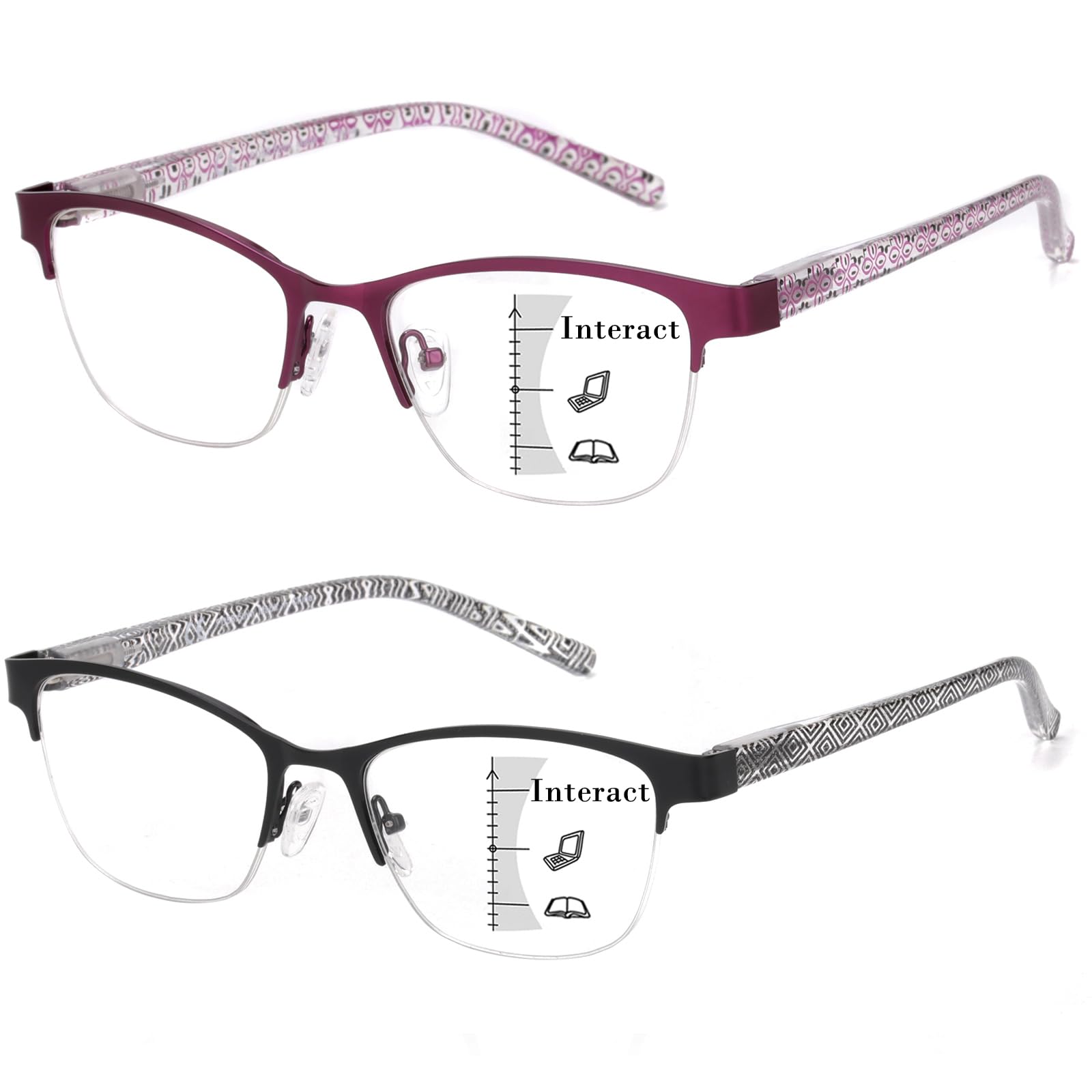
| Missfive 2 Pack Women Progressive Multifocus★ Best Overall | Desk and home-office work | No-line multifocus, 3-5 ft near range | Semi-rimless cat eye, spring hinges | Blue light + UVA/UVB | Amazon |
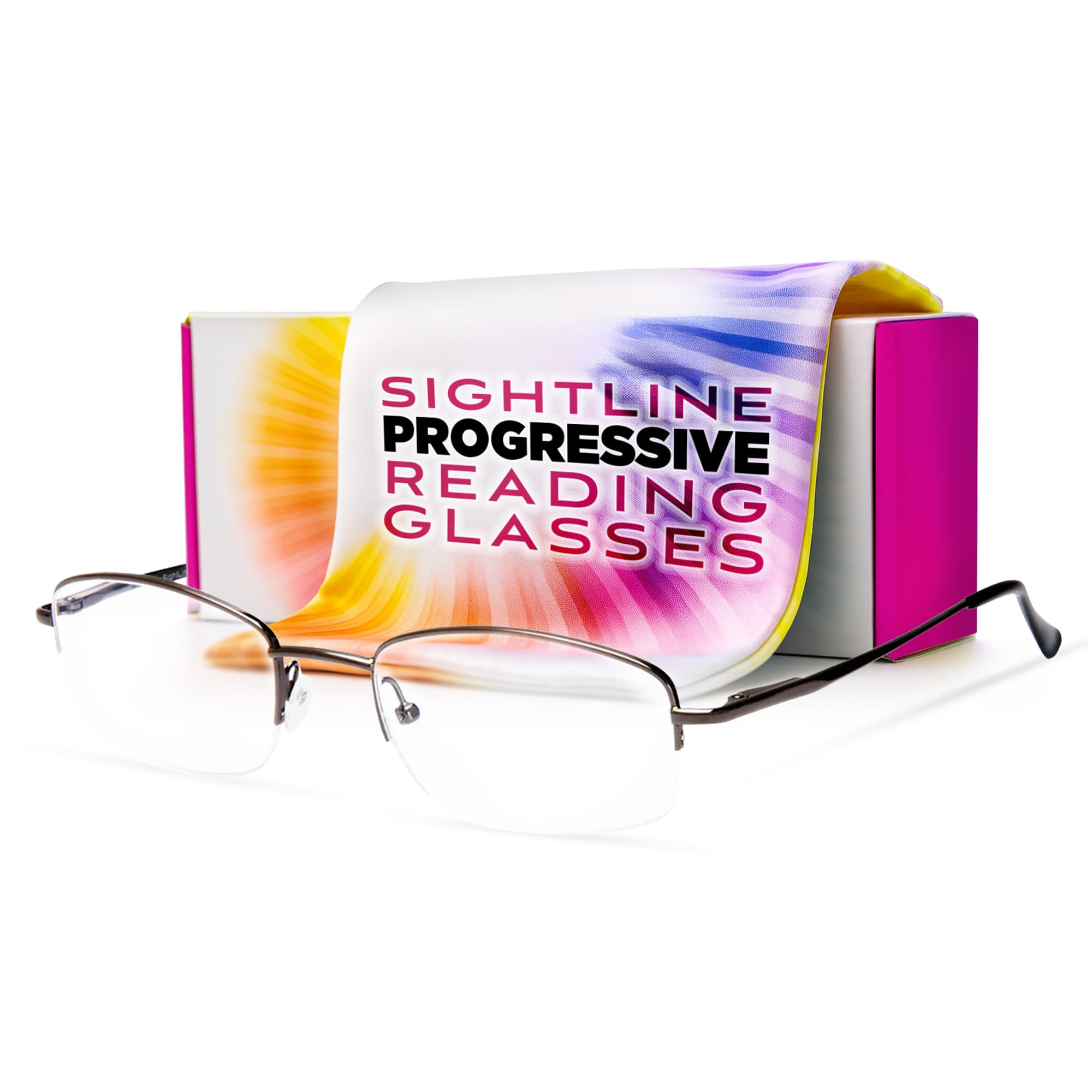
| Sightline 6002 Progressive MultifocalTop Performer | All-day wear with distance viewing | No-line progressive, gradual transition | Semi-rimless metal, spring hinges | — | Amazon |
| YIMI Rimless Progressive Multifocus | Hearing-aid wearers and rimless fans | No-line multifocus | Titanium rimless | Blue light, anti-glare, anti-scratch | Amazon |
| MODFANS Progressive Multifocus | Small faces and everyday reading | No-line multifocus, aspherical | Wood-look, metal spring hinges | Blue light | Amazon |
| Photochromic Progressive Multifocus Readers | Indoor-to-outdoor transitions | No-line multifocus, 3 magnifications | Rimless memory titanium | Photochromic + anti-blue light | Amazon |
| Missfive Photochromic Bifocal Retro | Balcony and yard reading | Bifocal dual-zone (far and near) | Full-rim rectangular, metal hinge | Photochromic, UV400, blue light | Amazon |
| Peepers To the Max Progressives | TV plus phone without swapping | Progressive, zero-power top zone | Full frame, women’s styling | — | Amazon |
Detailed Reviews
1. Missfive 2 Pack Progressive Reading Glasses 2.5x
Our pick — 4.0+★ from 90+ verified ratings; the strongest balance of quality and price.
Two pairs, one for the office and one for the kitchen drawer — the desk-range lens that ends the swap.
The number that decides this pick is the 3-5 foot clear vision zone Missfive built the lens around. That is the exact distance between your eyes and a laptop screen, or your eyes and a notebook propped on a coffee table. The lens stacks half magnification on top for glancing across the desk, a reduced strength in the middle for monitor work, and full magnification at the bottom for crisp reading and writing. You get the whole workday without touching your glasses.
The second reason it takes the top spot is arithmetic: two complete pairs arrive together, each with its own microfiber pouch, plus a hanging rope for portability. Keep one at the office and one at home, or park one in the car. Spring hinges in the semi-rimless stainless steel cat-eye frame flex as you put them on and off, and the graphic-print temples make them look like a deliberate style choice rather than a medical device. The lenses carry an anti-blue-light coating and shield against UVA/UVB rays, which matters if your evening is a phone screen in a dim room.
What wins people over is two usable pairs in one order — buyers wear them as daily drivers and reorder the same model when a pair wears out. The honest catch sits in the weakest area of the lens. A handful of pairs have also lost their hinge pins after a few weeks of steady use; the seller’s response to that has been replacement, so keep your order handy. If your face is narrow, the cat-eye runs on the snug side. For a wide face, look at the Sightline frames below instead. Rating-wise this is a 4.0+ star set, and the crowd of owners behind it is honest about the mixed zone rather than glowing.
What earns the top slot
- Two pairs plus two pouches and a hanging rope in a single order
- 3-5 foot clear zone tuned for desk and laptop work
- Spring hinges and a semi-rimless stainless steel cat-eye frame
- Anti-blue-light coating plus UVA/UVB shielding
Where it asks patience
- The reduced mid-zone reads clear for some wearers and soft for others
- Hinge pins have worked loose on a few pairs after a few weeks
- Narrow cat-eye fit runs snug on wider faces
Reach for this if: your day is a screen, a notebook, and a coffee cup, and you want a spare pair already paid for.
Think twice if: you need a genuinely clear top zone for driving — the half-magnification top is not built for that.
2. Sightline 6002 Progressive Reading Glasses +2.50
The lens grind is the story here — no hard lines, no double image, just a gradual slide from distance to print.
Sightline builds these to optical-grade standards, and it shows in what owners do not report: thick lenses, sharp edges, blurred periphery, the usual hallmarks of a cheap progressive. The lens grind carries this pair: owners run it for computer work and reading in the same hour without the out-of-focus jump that ruins cheaper multifocals. It is also the more compact package of the two, measuring 5.8 x 2.2 x 1.7 inches against the Missfive set’s 6.65 x 2.64 x 1.93 inches, so it slips into a shirt pocket or a small bag with room to spare.
The frame is a lightweight metal semi-rimless with spring hinges and adjustable nose pads, which is the combination that keeps a pair seated through an eight-hour shift. A cleaning cloth and a storage pouch come in the box, plus a six-month warranty and USA-based customer service. This is the pair to reach for if you want to wear readers like regular glasses and glance up at a room without perching anything on the tip of your nose.
The recurring gripe is the top third of the lens. It carries some magnification rather than sitting at zero, and that has cost this pair goodwill from people who wanted a truly clear distance zone. Buyers report the frame can also arrive too large for a smaller face — one of them spotted it through the packaging and never opened it. An occasional pair reads blurry right from the start, which is the nature of buying magnification online rather than a pattern. It is a 3.5+ star product with a loyal repeat base, and the split almost always traces back to the top-zone expectation.
What the lens gets right: the transition between zones is smooth enough that long-time multifocal wearers stop noticing it by the end of the first day.
The expectation to set: the top third magnifies slightly, so this is a works-by-glancing pair, not a clear-distance pair.
Suits you best when: you want premium-feeling lens construction without paying for a prescription, and your face is average to large.
Better to skip when: you need genuine zero magnification at the top for any real distance work.
3. YIMI Rimless Progressive Reading Glasses

A titanium rimless frame so minimal it disappears on your face — and sits out of the way of hearing aids.
The rimless titanium build is what makes these distinctive. There is no frame rim framing your field of view, so the lens edges fade into your face rather than box them in. The thin temple arms are the detail that matters if you wear hearing aids behind your ears, and owners with aids report the fit works cleanly with them in place. The lenses carry blue-light blocking plus a stack of anti-glare, anti-scratch, anti-reflective, anti-dust, anti-smudgy, and anti-oil coatings, which is a lot of surface protection for a rimless pair.
YIMI ships their own adaptation guidance, and it is worth reading before you put them on: most people need about a week to adjust, and if you feel dizzy you should walk slower rather than tearing them off. That is an unusually honest note in a category that usually promises instant comfort. The included case and cleaning cloth round out the kit.
The weight here is the trade-off, and it is not small. At 3.53 ounces this is a dense pair compared to the Missfive set at 0.81 ounces, and the heft is noticeable on the bridge of the nose over a long afternoon. Magnification is genuinely mixed: some wearers call the vision as good as their prescription, while others hit a narrow clear-focus window that tired their eyes. A few wearers were bothered by blue-light glare at certain angles, and the fit runs large. This is a 3.5+ star pair for people who prize the rimless look and the hearing-aid clearance above all else.
Why it earns a spot
- Titanium rimless frame keeps the lens edge off your field of view
- Thin temple arms sit comfortably alongside hearing aids
- Six coatings including anti-reflective and anti-scratch
- Stylish enough that buyers reorder the same pair
The honest trade-offs
- 3.53 ounces is heavy on the bridge over a long day
- The clear magnification window is narrow for some eyes
- Blue-light coating throws visible glare at certain angles
The pair for you if: a rimless look and hearing-aid clearance matter more than a feather-light nose feel.
Look past it if: you want a big forgiving clear zone across the whole lens.
4. MODFANS Progressive Reading Glasses
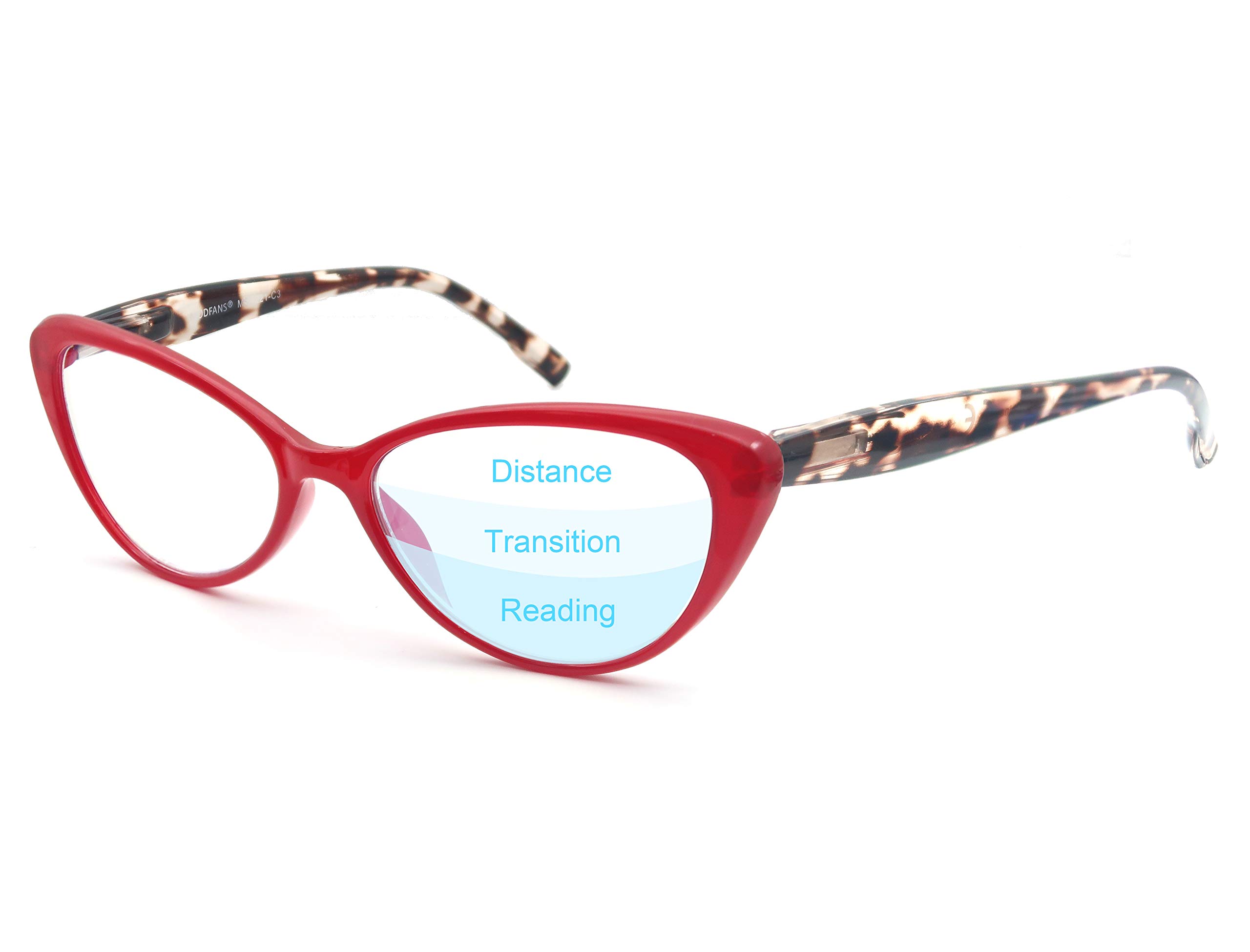
Built for the narrow face — the one pair on this list that starts with fit instead of lens.
Fit is the reason this pair exists on the shortlist. Buyers with small faces talk about these sitting properly without pressing on the temples or sliding, and that is a rarer outcome in progressive readers than it should be. The frame is a wood-look design available in blue, yellow, black, tortoise, and grey, with metal spring hinges built around a stainless steel mechanical spring that resists the wear-and-tear of constant on-and-off use.
The lenses are aspherical, which is a curved-surface grind meant to reduce the edge distortion you get from a flat lens, and they carry blue-light blocking. The top-center of the lens lets you glance at distance without looking over the frame entirely — the working magnification holds at +2. The package comes with a case, plus a 90-day money-back guarantee and a 1-year manufacturer’s warranty behind it, which is a confident backing for a mid-tier pair.
Lens quality is the most-discussed issue by a wide margin, and reviews split on it. Some wearers describe the vision as right for them and the glasses as comfortable all day. Others find the blue-light coating gives everything a slight yellow cast and the lenses too poor for anything beyond stationary reading — safe for a book, not for walking around. The bottom of one frame cracked apart during ordinary use at dinner, which the seller moved to replace. Be gentle putting these on and take them off by the temples. At 4.0+ stars, this is a fit-first pair that asks you to accept a lens compromise.
The small-face advantage: correct seating on a narrow head is the whole point, and the metal spring hinges keep the temples from biting.
The lens caveat: a slight yellow tint and weaker optical clarity mean these are reading glasses, not walking-around glasses.
Worth it for: a smaller face that has given up on frames sliding around, plus a generous warranty behind the purchase.
Not the pair for: anyone who wants near-prescription crispness across the whole lens.
5. Photochromic Progressive Reading Glasses

Clear indoors, dark in the sun — the pair that means you never hunt for your shades on the patio.
The photochromic lens is the headline and it works the way a sun-sensitive reader needs it to. The lens stays clear indoors or at night, then darkens to a sunglasses tint when UV sunlight hits it, and begins clearing again as soon as you are out of the sun. Owners consistently note how quickly the tint activates — one review describes it going dark on a hazy day — and that is the difference between a usable transition pair and a gimmick. Three magnifications sit in that one lens: up top for distance, the middle for computer work, and down low for close reading.
Underneath it all is a rimless memory titanium frame, which flexes and springs back rather than bending permanently. The lenses carry a 5-layer anti-reflective coating to cut glare from screens and fluorescent lighting, plus anti-blue-light filtering. YIMI-style adaptation advice applies here too: the brand suggests ramping up wear over the first week rather than diving into a full day, and that guidance is worth following because the multi-zone lens does take adjustment.
Reviews split hard on lens quality, so buy this one for the tint, not the optics. The lenses are genuinely clear and functional for some wearers — reading small print, watching television text, using an iPad. For others the top clear portion is no clearer than their natural vision and the middle zone does nothing, which makes the pair feel like a simple magnifier with a premium label. The frames themselves feel flimsy, and a few owners mention the tint not responding in sunlight at all. At 3.5+ stars, this is the pick for a specific job — indoor-to-outdoor transition — not an all-rounder.
The one thing it does better than the rest: fast photochromic tinting that turns readers into sunglasses without a second pair in your pocket.
The risk to weigh: the frame is light and adjustable only to a point, and the transition performance has not been consistent for every buyer.
Pick it for: the person who reads on a balcony and is tired of switching to shades for a walk.
Choose another if: you want a single pair that can do everything, including walk safely down stairs.
6. Missfive Photochromic Bifocal Reading Glasses 1.5x

The bifocal that turns into sunglasses on the balcony — retro frame, two clean zones, no line to squint at.
This is a bifocal rather than a full three-zone progressive, and the difference matters. There are two zones: the non-magnifying top half for distance viewing like watching television or driving, and a precise reading zone at the bottom for small print, writing, or eating. Because the split is cleaner than a progressive, it is often easier for a first-time multifocal wearer to adapt to, and the sharp bifocal edge is less pronounced than a hard line. The Missfive professional lens darkens automatically when UV rays reach it, and once indoors or at night it goes back to colorless and transparently clear.
UV400 protection sits on the lens alongside a blue-blocking coating, and the full-rim rectangular frame in glossy black with a durable metal hinge is designed to suit a variety of face shapes. The one-piece nose pads are a small but useful touch — they let you flip the glasses up onto your head and drop them back down without catching hair or skin. The frame is impact-resistant and built to shrug off the knocks that come with outdoor use.
The bifocal edge is the honest catch. Some wearers wish the transition were smoothed out so the jump from far to near is gentler — that hard division between the two zones is the nature of the design, and it takes a few days of wear to stop noticing it. Beyond that, the fit and build land well. Owners describe a quality feel for the money and genuinely clear vision, and nobody is complaining about the frame holding together. At 4.0+ stars, this is the outdoor reader’s pick, and the retro styling is the reason to put it in your bag rather than a drawer.
Why outdoor readers reach for it
- Photochromic lens goes colorless indoors and tints in sunlight
- UV400 plus blue-light coating on the same lens
- Clean two-zone bifocal is easier to adapt to than a three-zone lens
- Impact-resistant frame and one-piece nose pads that flip up easily
The edges to mind
- The hard bifocal line takes a few days of getting used to
- Only two zones — no dedicated computer middle
- Tint depth depends on how strong the UV is outside
Buy this if: you read in the yard or on the balcony and want one pair that handles glare and print together.
Consider a true progressive if: you need three smooth zones for desk work and distance in the same frame.
7. Peepers Progressives for Women, To the Max Progressives
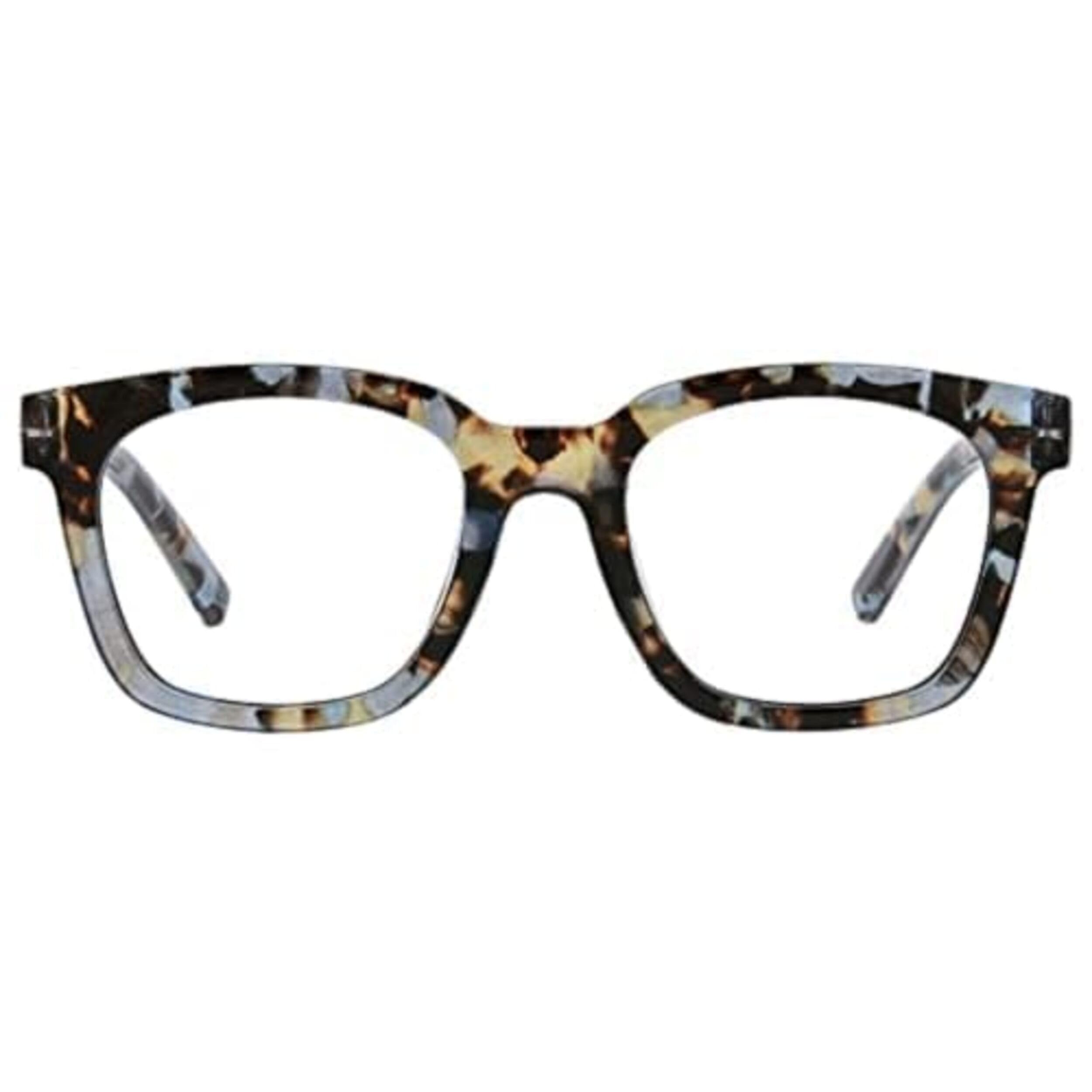
Zero magnification up top so you can watch the screen and read your phone in the same glance.
The defining feature here is the zero-power top zone. Where most cheap multifocals put half a magnifying power up top, Peepers leaves the top truly clear, so you can watch television and check your phone without tilting your head or taking the glasses off. That is the exact scenario a home reader lives in, and it is why this pair earns its place near the top of the list despite the higher tier. Owners describe the frames as solid and the lenses as genuinely comfortable for all-day wear.
The frame styling gets consistent compliments, and there is a practical trick worth knowing: the reading zone sits low in the lens, so ordering a higher vision level than you normally would pulls the reading zone up into a more comfortable position for some wearers. If your first pair has you tilting your head back to find the print, that adjustment is the fix.
Clarity is the split that decides whether these suit you. Some wearers get perfect vision from top to bottom, while others find the clear top zone blurry enough that they cannot walk around the house in them. A few note the lenses are not anti-reflective, which shows up as glare in a bright room. It is a 4.0+ star product for people who want a single pair to bridge the television and the phone — the most common praise is that you can finally see both without constantly shifting your glasses.
What makes it different: the genuine zero-power top zone is a rarer find in over-the-counter progressives than it should be, and it solves the TV-while-texting problem cleanly.
The trade-off: clarity in the top zone is not universal, and a pair that blurs the distance view is not one you want to walk around in.
Your pair if: the couch-and-phone routine defines your reading, and you want a top zone that stays clear.
Look elsewhere if: you need to move confidently around the house with the glasses on — the low reading zone makes that awkward.
Know the Specs
No-Line Progressive vs. Bifocal
A progressive lens blends three zones smoothly, so there is no visible dividing line to distract your eye as you look from the top of the room to the bottom of a book. A bifocal has two zones with a defined edge between them. Progressives feel more like regular glasses; bifocals are often easier for a first-time multifocal wearer to adapt to because the reading zone is unmistakable. Neither is better — the choice depends on if you want the smooth slide or the clear split.
Magnification and the Number
The number on a reading lens tells you how strongly it magnifies close work. A stronger number brings small print into focus but narrows the clear window and increases distortion at the edges. The practical move is to order the strength you actually need for the distance you read at most, not the strongest number you can find. If a pair has a zero-power top zone, you can often go one step higher than you expect because the reading zone sits lower in the lens.
Spring Hinges and Nose Pads
Spring hinges are the flex points at the temples that let the arms swing outward when you put the glasses on and survive being folded into a bag. Adjustable nose pads are the small rests that sit either side of your nose and can be bent to match its shape — that adjustment is what keeps the reading zone where your eyes actually land. Frames without adjustable pads rely on the frame’s shape to hold the glasses still.
Blue Light and Photochromic Coatings
Blue-light filtering reduces the high-energy blue portion of screen light and often adds a faint yellow or amber cast to what you see. Photochromic lenses change how dark they get based on UV light, going clear indoors and tinting in sunlight. The two are often stacked on the same pair, which is useful for someone who reads on a patio in the afternoon and at a screen in the evening.
Common Questions
How long does it take to get used to progressive reading glasses?
What is the difference between progressive and bifocal reading glasses?
Can I wear progressive reading glasses for driving?
Do photochromic reading glasses clear up quickly when I go inside?
How do I choose the right magnification for progressive readers?
Will blue light blocking glasses make everything look yellow?
Can I wear progressive readers on top of contact lenses?
Why does the weakest part of my progressive lens look blurry?
How should I clean progressive reading glasses without damaging the coating?
Are rimless progressive glasses more fragile than full frames?
The Bottom Line
For most people, the progressive reading glasses winner is the Missfive 2 Pack Women Progressive Multifocus because it pairs a desk-tuned 3-5 foot clear zone with a spare pair, a pouch, and a hang rope in one order — the practical answer for anyone whose day runs between a laptop, a notebook, and a phone screen. If a genuinely clear top zone matters more than the spare pair, the Peepers To the Max Progressives cost more but solve the watch-the-TV-and-text problem cleanly, with the highest rating on this list to back it. And if you read on the balcony or in the yard, the Missfive Photochromic Bifocal handles the sun with a simple two-zone lens that is easy to adapt to.
The short version: match the lens zones to your daily distances and the frame to your face, and the brand barely matters. Every pair here was checked against verified owner reviews, and the Missfive set backs up its top slot with a 4.0+ star rating plus a second pair in the box. Whichever you choose, wear it a full week before judging it, and bend the nose pads until the reading zone sits where your eyes drop.
How we choose
We do not accept paid placement. Every pick is matched to a real buyer and a real use-case; we do not hands-on test units.
Sources
Specifications: manufacturer listings and product documentation. Review insights: verified customer reviews, as of October 2026. Pricing: not shown on this page (it changes often); check the current price via the retailer link.
As an Amazon Associate, Aappliancez earns from qualifying purchases. This does not affect which products we feature.