Disclosure: Some links in this post are affiliate links. As an Amazon Associate I earn from qualifying purchases, at no extra cost to you. Learn more
Specs are compiled from manufacturer listings and verified buyer reviews and can change over time — please confirm the key details on the product page before buying.
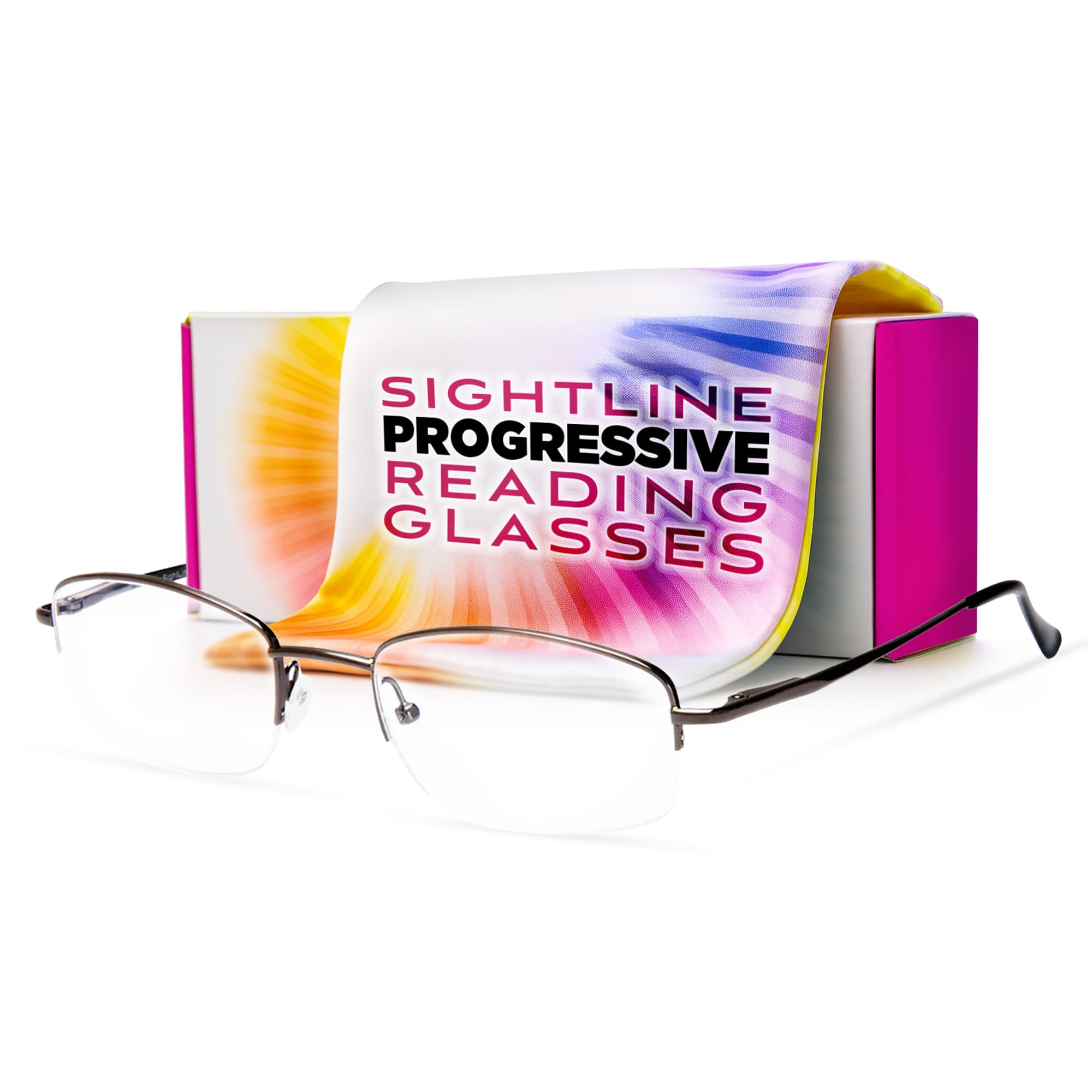
You want to read a menu close up and still see the TV across the room, so look for a lens with no magnification at the top and full reading power at the bottom. That clear top zone stops the on-and-off shuffle. This guide covers seven progressive reading glasses that work that way. Each one is judged on the zone width, the frame fit, and how honest the photo-chromatic tint (the tint that darkens in sunlight) really is.
This guide is built by comparing the manufacturers’ published specifications and the patterns across verified customer reviews, so you get each pick’s real strengths and trade-offs instead of marketing spin.
Expect the honest limits too: a no-line lens asks your eyes to move into the reading zone, and some frames put that zone lower than others. Below you’ll find the fit notes that matter before you commit to a progressive reading glasses clear on top pair.
Top Picks

How To Choose The Best Progressive Reading Glasses Clear on Top
A progressive lens splits one piece of glass into three jobs. The top stays clear so you can see across the room. The middle carries a lighter power for computer screens. The bottom holds your full reading power for close text. Your whole decision depends on how wide each band is and how high up the lens it starts.
Where the reading zone begins
The reading zone is the magnified band at the bottom of the lens. If it starts very low, you have to tilt your head back to find it. Some owners deal with this by ordering a stronger power than they normally wear, which pulls the reading band higher up. That trick works, but it is worth knowing before you order your usual number.
How clear the clear top really is
The top band should give you true distance vision with zero magnification. Buyers who drive or walk stairs care about this most. A blurry top turns a progressive into a pair of glasses you can only wear at a desk. Check the published description for a top zone that is unmagnified for walking and distance.
Photo-chromatic tint, sized honestly
Photo-chromatic lenses darken when UV light hits them. They are handy on a sunny walk, but they generally do not get as dark as prescription sunglasses. Treat the tint as a convenience, not as sun protection you can trust on a bright drive. The lenses also take a minute or two to darken, so the change is gradual.
Frame weight, spring hinges, and nose pads
A light metal frame sits easier for long sessions at a screen. Spring hinges let the arms flex outward so the frame stays put without pinching. Adjustable nose pads change the height of the lens on your face, which shifts the reading zone up or down. All three matter more than the frame color.
Side-by-Side Comparison
| Model | Best For | Lens Design | Frame | Photo-Chromatic | Amazon |
|---|---|---|---|---|---|
| Peepers Progressives, To the Max★ Best Overall | All-day wear and TV plus phone | No-line progressive | Solid acetate-style frame | — | Amazon |
| Sightline 6002 ProgressiveComputer Pick | Computer work and reading | No-line progressive multifocus | Lightweight metal, spring hinges | — | Amazon |
| Photochromic Progressive Multifocus (Blue Light) | Sun and screen mixed days | No-line progressive multifocus | Light frame | Yes | Amazon |
| Progressive Round Metal Frame Reader | Budget trial of progressives | No-line progressive | Round metal frame | Yes | Amazon |
| K.LAVER Progressive Photochromic (Men) | Outdoor work with a phone | No-line progressive multifocus | Full-frame metal, 20g | Yes | Amazon |
| K.LAVER Rimless Progressive Photochromic | Face-fit flexibility | No-line progressive multifocus | Rimless, adjustable nose pads | Yes | Amazon |
| DEHOTRE Progressive Half Frame | Half-frame style preference | No-line progressive | Half metal frame, nose pad | — | Amazon |
Detailed Reviews
1. Peepers Progressives for Women, To the Max Progressives
Our pick — 4.0+★ from 150+ verified ratings; the strongest balance of quality and price.
The frame people compliment you on, that also ends the reader shuffle.
These are the pair to buy if you want to watch the TV and answer a text without swapping glasses. The frame is built solid and the styling gets noticed, which is more than most no-line readers can claim. The one spec that matters most here is the clear top band — it sits at zero power so your distance view stays open while the reading power lives down the lens.
What wins people over is how they carry the whole day. Wearers describe them as comfortable through long hours and solid in the hand, and the frames draw compliments often enough that it comes up again and again. The review pages sum it up in one line: “I can watch TV and see my phone without constantly shifting my reading glasses!” That is the exact job this lens design is for — desk work, screen glances, and the sofa, all without a swap.
The honest catch is the reading zone placement. On these, the bottom zone sits low enough that a few wearers have to tilt their head back to find it, and one three-star note calls out that the top clear zone felt blurry rather than truly clear. If you are a heavy walker or stair-taker who needs a perfect top band, this is a fit question, not a defect. For reading and screen work at a desk, these are the ones that deliver.
What Earns The Crown
- Zero-power top band keeps your distance view clear for TV and across the room
- Solid frame that draws compliments on how it looks
- Comfortable enough for all-day wear
- No more swapping between a reader and bare eyes
The Fit Question
- Reading zone sits low — some wearers tilt their head to find it
- Top clear band drew a mixed report from one buyer
- Style and frame size run large, so check the fit
Made for: the desk-and-sofa reader who wants one pair for the screen, the phone, and the TV.
Think twice if: you need a razor-sharp top band for walking the house — that is where the head-tilt comes up.
2. Sightline 6002 Progressive Reading Glasses +2.50
The metal-frame workhorse for the person chained to a monitor.
Sightline builds the 6002 for the screen-and-paper day. The lens quality is what buyers praise most — 27 of them single it out, with functionality right behind at 13. That reputation rests on a no-line multifocus grind that moves smoothly from near to intermediate with no hard edge you have to jump across.
The frame is a lightweight metal build with spring hinges, and the adjustable nose pads let you sit the lens exactly where your eyes want it. That matters because the top third here does carry magnification — one four-star buyer wished the top third had zero power instead. If you need a crystal distance view for driving, the Peepers above keep a clearer top band. If you want a steady computer lens, this is the one. As a buyer put it: “these fit, lenses were correct and best of all they’re crisp.”
The trade-off is weight at the edges. The lenses run thicker than cheap single-power readers, and off-angle viewing can distort a little. The earpiece ends also bend sharply enough to crack the coating over time, which one owner fixed with heat-shrink tubing. For the price, though, owners who switched from costly prescription progressives tend to keep wearing them.
Computer-day comfort: Spring hinges flex the arms so the frame holds without pinching, and the nose pads let you raise or lower the whole lens on your face.
Edge note: Thick lens material means slight distortion when you look well off to the side — park your work straight in front.
Grab these for: a full workday switching between monitor and paper.
Pass on these for: driving and far-distance walking, where the magnified top band will fight you.
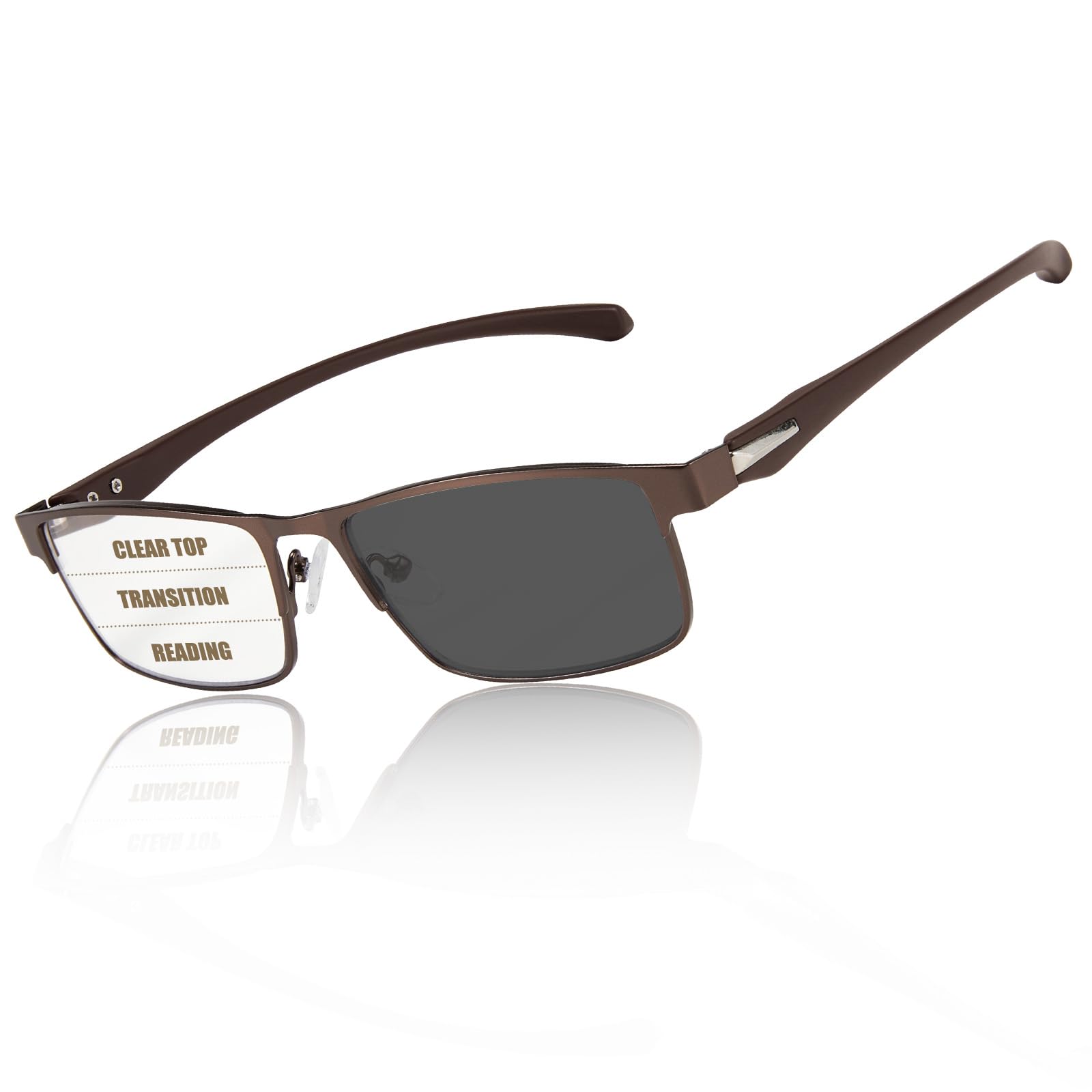
3. Photochromic Progressive Multifocus Reading Glasses
One pair for the sunny walk and the laptop back inside.
This is the transitional pair — clear indoors, tinted outdoors, with three focus zones stacked in one lens. The size spec runs compact: the package measures 6.14 x 2.05 x 1.34 inches, which is a touch longer than the Sightline above at 5.8 x 2.2 x 1.7 inches. In the hand it feels like a light everyday frame.
Adjustment time is the headline for most owners. A five-star note puts it at about 15 minutes to settle in, after which the distance, mid, and reading zones behave as promised. The transition tint does help on sunny days. But expect it to lag behind prescription sunglasses — the lenses do not reach that depth of darkness. The top zone carries zero magnification, so you keep a clear view ahead while the bottom handles close text.
The thing to weigh is the peripheral edge. Buyers report narrow side vision compared with prescription progressives — you see well straight ahead but the corners soften. Distortion also shows up at off-center angles. And the arms are the weak point in this design: a few owners mention a break from simply taking the glasses off. Fold the arms at the hinge rather than yanking them off one-handed, and the clear top and outdoor tint hold up.
What it gets right: The clear top band plus the gradual transition gives you a real all-distance lens that shifts with the light — no need to pull a second pair out of your bag.
What to know: The tint stops short of prescription-sunglass darkness, and the side vision is tighter than a prescription progressive.
Best match for: the buyer who steps in and out of sunlight all day and wants one lens to do both jobs.
Look elsewhere if: you need wide peripheral vision or a frame that shrugs off routine handling — this one asks for care.
4. Progressive Reading Glasses Blue Light Blocking
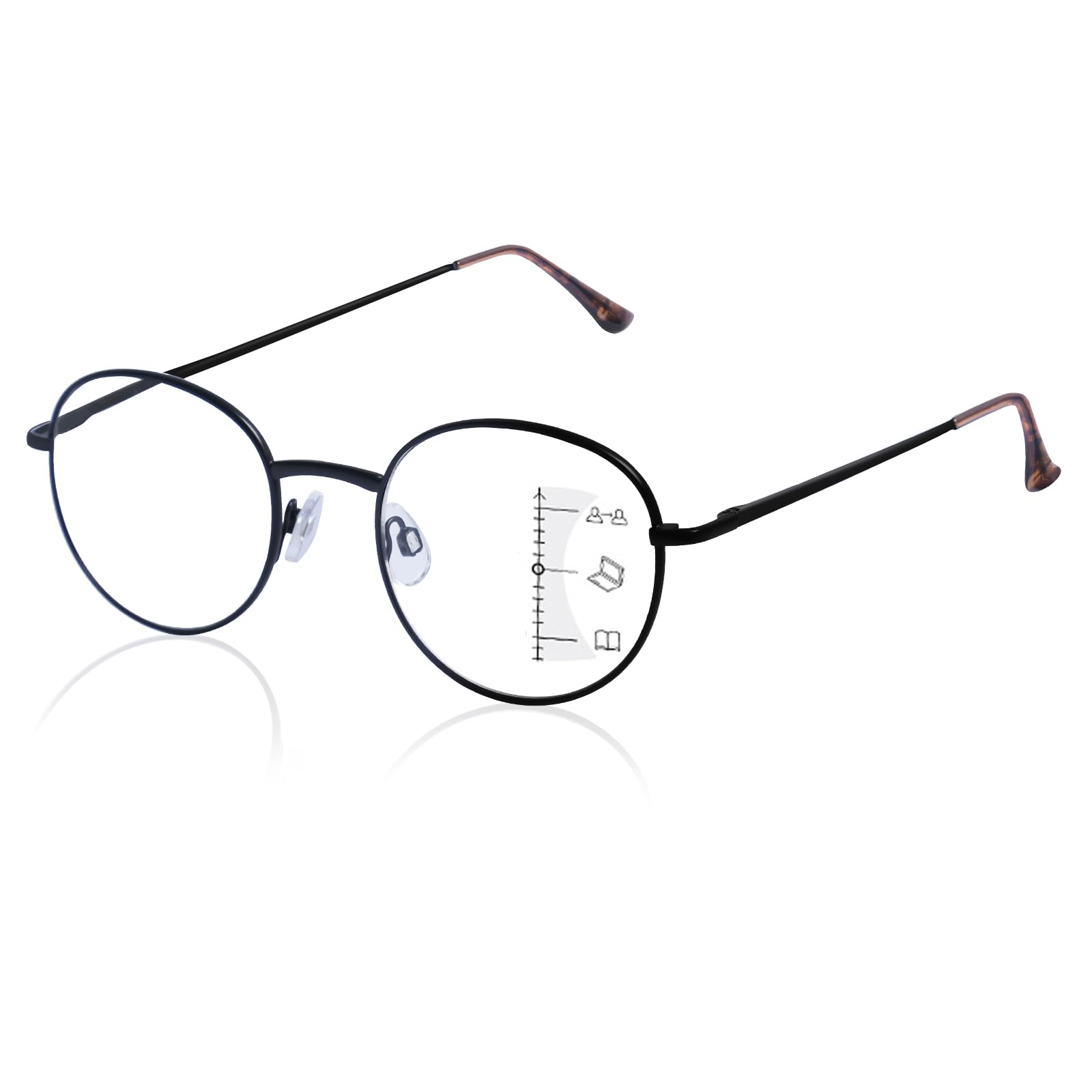
A round-frame try-out for anyone testing the clear-top idea on a budget.
If you have never worn a no-line lens and want a low-cost way to find out if it works for you, this is the one to test the water with. Functionality is the part people like most here — 7 buyers call it out, with value for money close behind at 5. One buyer signed off on “Good value and price per pound is good,” which sums up the pitch.
The optics are where it gets split. Some frames arrive with true zero magnification on top and work fine for a full day at the computer. Others show distortion across the whole lens — one buyer found only a tiny center spot in focus, with objects appearing smaller and farther away than they are. Another says the top clear zone is simply not enough and the view warps unless you look straight on. This is a budget lens, and the optical quality is where the savings show up.
The frame itself feels better than the price tag suggests. It is a round metal build with a decent weight and, in at least some pairs, spring hinges. The catch is consistency — the lens grind from pair to pair is not uniform. Buy it to test whether a no-line lens suits you, not as your everyday pair.
The Budget Case
- Low outlay to test whether a no-line progressive suits you
- Blue light blocking plus a transition tint in one lens
- Round metal frame with a decent feel for the tier
- Clear top on some pairs gives true zero-power distance
The Reality Check
- Optical quality varies from pair to pair
- Some lenses distort across the entire view
- Top clear zone can fall short of a true distance band
- Transition tint does not match prescription depth
Sound choice for: a first-time progressive wearer who wants to see if the clear-top layout agrees with them.
Not for you if: you need the same sharp lens every single day — consistency is the gamble here.
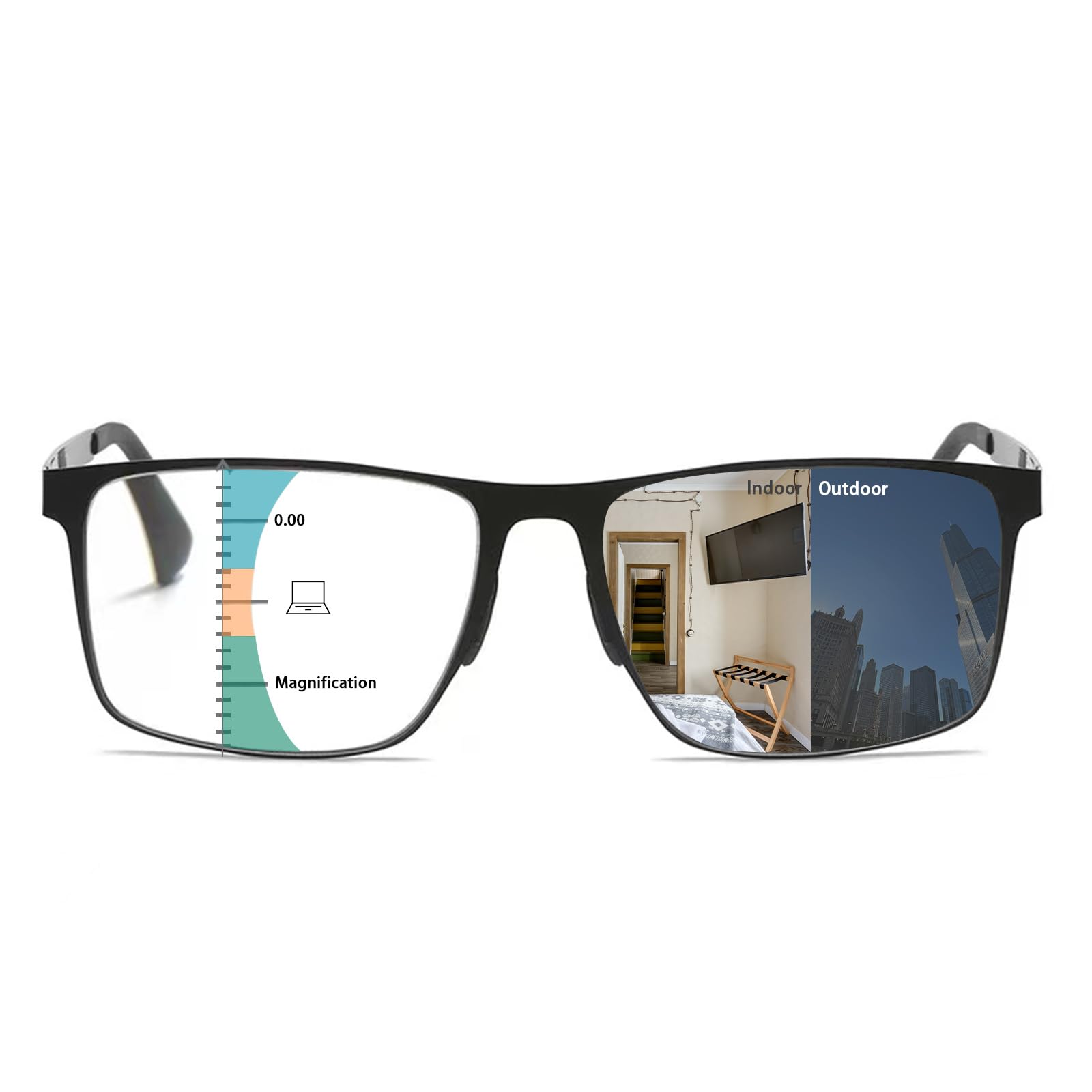
5. K.LAVER Progressive Photochromic Reading Glasses
A featherweight metal frame built for the person moving between indoors and out.
The number that sets this pair apart is 20 grams — light enough that you forget you are wearing it through a whole shift. The full-frame metal build adds stiffness that cheaper flexy frames lack. The lens is a no-line progressive with a clear top and a transition coating that darkens outdoors and clears back up when you step inside.
This is the pair that stays on when you dash outside on a break. Customers note wearing it from the phone to the computer to a run outdoors at work without pulling it off. The darkening happens gradually, so you get a light tint rather than a deep sun shade. The blue-light coating handles screen glare during the indoor half of the day.
Where the fit can go sideways is the focal zone. One buyer found the transition line unmarked and hard to locate, which caused head-tilting and some dizziness. Another describes an inconsistent focal area across the lens. This is the nature of an unmarked reading zone — your eyes have to learn where it sits. Most wearers adapt within a couple of weeks, but if you are prone to motion sickness the adjustment can be rough.
Weight and build: At 20 grams the frame all but disappears, and the metal construction holds its shape better than a thin resin arm.
Adjustment cost: The reading line is invisible, and finding it can mean some initial head-tilting before your eyes adapt.
Reach for these when: your day moves between the desk and the outdoors and you want one pair that stays on throughout.
Skip these if: you get dizzy easily from head-position changes — the hidden reading zone may take too long to learn.
6. K.LAVER Progressive Rimless Photochromic Reading Glasses

The rimless frame with nose pads you can nudge until the lens sits right.
Two features do the work on this K.LAVER. The first is the rimless build, which trims the edge weight and gives the glasses a lighter look on your face. The second is the adjustable nose pads — you can raise or drop the lens until the clear top band and the reading zone line up with your eyes. For anyone whose face shape makes fixed-frame progressives sit wrong, that flexibility is the reason to choose this pair over the fuller frames above.
The lens is a no-line multifocus with a clear top for distance, a middle band for the computer, and full reading power at the bottom. The transition coating darkens within 1-2 minutes of UV exposure and clears in a few minutes once indoors. Anti-slip temples curve to grip without snagging hair, and the whole thing is built for a light feel on long wear. Four verified owners have put it to work already and the notes are steady — clarity, fit, and a fair value.
The honest limit is the frame’s fragility risk. Rimless glasses depend on the mounting points holding firm, and there is less structure to shield the lens edge than a full frame provides. Store them in a case rather than a pocket, and the adjustable nose pads keep earning their keep. There is also less review history here than on the heavier picks, so you are buying somewhat on the spec.
The fit win: Adjustable nose pads let you change the lens height on your face — a real fix for progressives that normally sit too high or too low.
The care note: Rimless construction leaves the lens edges exposed, so store these in a case rather than a pocket.
A smart fit for: a face shape that fights fixed-frame progressives, where moving the lens height changes everything.
Better elsewhere if: you want a burly frame that survives being tossed in a bag — rimless asks for gentler handling.
7. DEHOTRE Progressive Multifocal Reading Glasses
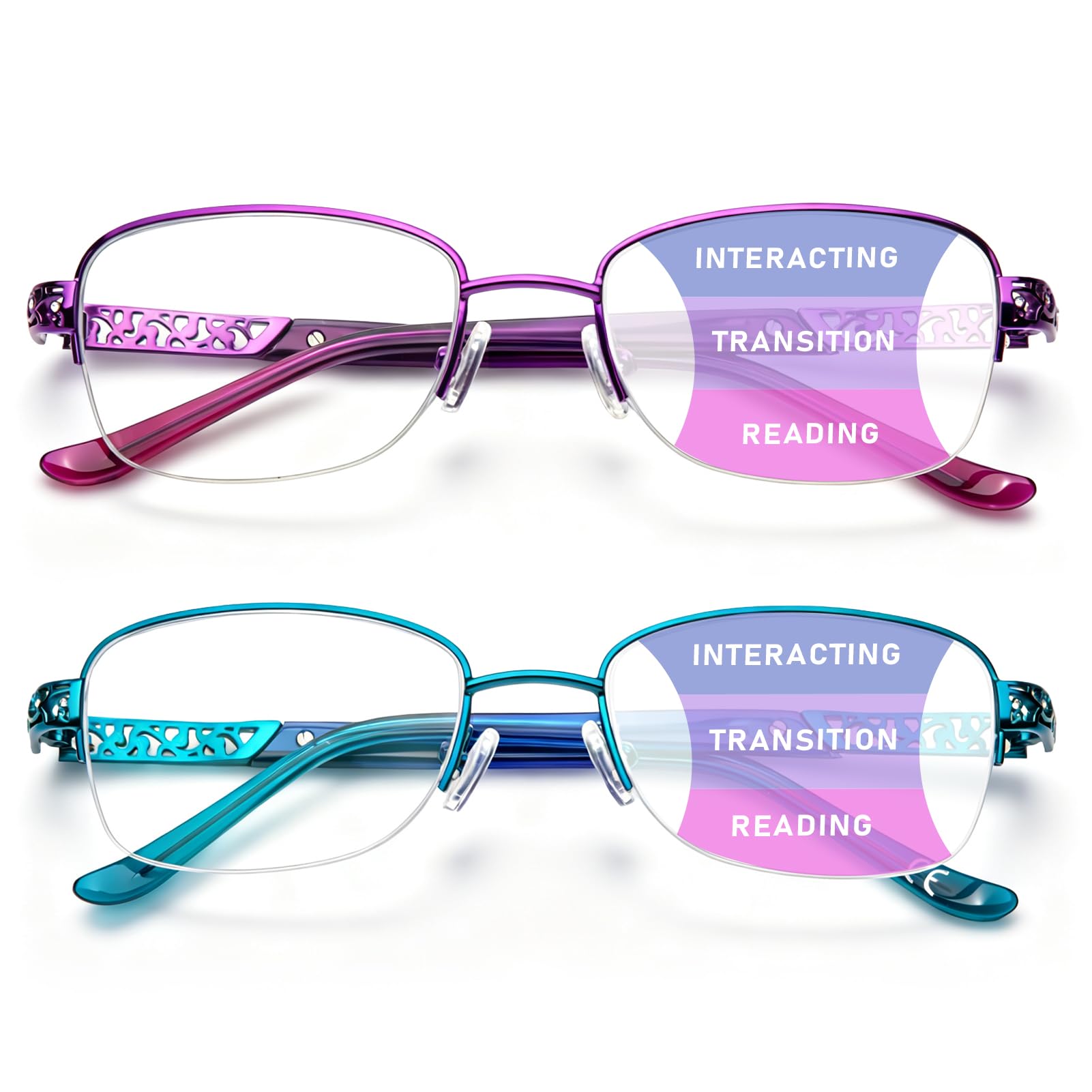
A half-frame reader that skips the full rim for a lighter look.
This DEHOTRE pair leans on its frame design. The metal half-frame keeps the top edge open so the lens reads lighter on your face, and the arms carry a decorative pattern. A comfort nose pad sits at the bridge, and the temples are bent to hook behind the ear for a more secure hold. The lens is a no-line multifocal aimed at the mid-to-near range — computer distance down to close text.
Compared with the full metal frame on the K.LAVER above, the half frame here is the pick for someone who wants a dressier, less chunky look. The trade-off with a half-frame build is that there is less rim to protect the lower lens edge, so the frame relies on the top bar and the nose pad to keep everything aligned. The bent temples help the glasses stay put through the day.
Here is the honest part: this is the newest listing of the group and has the thinnest track record for buyer feedback. If you want the reassurance of a long history behind a pair, the earlier picks carry more of it. If the half-frame styling is what you have been hunting for, this is the pair built around that look, and the nose pad plus bent temples give it a comfortable, secure fit.
Style-led pick: The half metal frame and patterned arms give a dressier alternative to a full rim, with a nose pad and bent temples for a secure, comfortable hold.
Newer to the market: It has less buyer history behind it than the older picks, so you lean more on the listed specs than on a long review trail.
Worth a look if: the half-frame look and a secure bent-temple fit are what you have been shopping for.
Lean on older picks if: you want a long history of buyer feedback before you buy.
Know the Specs
Reading Power and the Clear Top Zone
Reading power is the magnification at the bottom of the lens, usually written as a plus number like +2.50. In a clear-top progressive, that power only lives in the lower band — the top carries zero magnification so your distance view stays sharp. Some buyers find the reading band sits low on the lens and order a stronger power than usual to pull it higher. That shifts the whole zone up so you tilt your head less. It is a fit trick, not a cure, so pair it with the right frame shape.
Photo-Chromatic Lenses and Blue Light
A photo-chromatic lens carries a coating that reacts to UV light and darkens when you step into the sun. The change is gradual — the lens takes a minute or two to reach its tint, then clears again indoors in a few minutes. These lenses do not reach prescription-sunglass darkness, so treat the tint as a comfort perk for a sunny walk, not as reliable sun protection for a drive. Blue-light blocking is the other coating on many of these readers. It filters the blue portion of screen light, which some reviewers point out cuts glare during long monitor sessions.
Common Questions
What does “clear on top” actually mean in progressive reading glasses?
Why is the reading zone so low on some progressive readers?
How long does it take to adjust to a no-line progressive lens?
Do photo-chromatic lenses get as dark as prescription sunglasses?
Can I wear clear-top progressive readers while driving?
Is a progressive reading glass the same as a bifocal?
What is the difference between the full-frame and rimless options here?
Why do some reviews say the optical quality varies from pair to pair?
Should I order a higher power than my usual reader?
The Bottom Line
For most people, the progressive reading glasses clear on top winner is the Peepers To the Max Progressives because the zero-power top band lets you watch the TV and check your phone without swapping glasses, and the frame draws compliments while it does it. If your day is anchored at a computer, the Sightline 6002 earns its place with its metal frame, spring hinges (hinges that flex to fit), and a lens quality that buyers single out most. And for a face shape that fights fixed frames, the K.LAVER rimless pair lets you move the nose pads until the lens sits right. Every pair here has the same clear-top layout, so the deciding factor is frame fit — nose pads and lens height decide where the reading zone lands on your face.
How we choose
We do not accept paid placement. Every pick is matched to a real buyer and a real use-case; we do not hands-on test units.
Sources
Specifications: manufacturer listings and product documentation. Review insights: verified customer reviews, as of October 2026. Pricing: not shown on this page (it changes often); check the current price via the retailer link.
As an Amazon Associate, Aappliancez earns from qualifying purchases. This does not affect which products we feature.