Disclosure: Some links in this post are affiliate links. As an Amazon Associate I earn from qualifying purchases, at no extra cost to you. Learn more
Specs are compiled from manufacturer listings and verified buyer reviews and can change over time — please confirm the key details on the product page before buying.
Poison ivy does not politely die. It climbs fences, re-sprouts from cut stumps, and returns stronger when a leaf-only spray or a weak mix leaves the root alive. The right product to kill poison ivy has to reach the root so the vine does not return, and stay off the lawn beside it. This guide covers five concentrates and sprays that do that job, sorted by how deep they work, how fast they show results, and how much ground each bottle covers.
This guide is built by comparing the manufacturers’ published specifications and the patterns across verified customer reviews, so you get each pick’s real strengths and trade-offs instead of marketing spin.
Below are the coverage numbers, active ingredients, and fit notes for each pick, so one bottle finishes the job.
Top Picks


How To Choose The Best Product to Kill Poison Ivy
The biggest buying mistake is spraying poison ivy with a dandelion-grade weed killer. A broadleaf lawn weed killer yellows the leaves but leaves the root alive, and the vine returns within weeks. You want a brush killer with triclopyr, mixed per the label strong enough to travel down the stem into the root.
Read the active ingredient before anything else
Look for triclopyr on the label. It is the ingredient built to move through woody tissue into the root system, which is why the stump-painting method works. A formula that lists several actives, such as the Roundup concentrate with its triclopyr, fluazifop-P-butyl, and diquat dibromide blend, is aiming at both top growth and root at the same time.
Concentrate or ready-to-spray
A concentrate means you mix your own batch in a tank or hose-end sprayer. You get more control over strength and cost per square foot, but you supply the sprayer. A ready-to-spray bottle saves mixing, yet the built-in sprayer is the part most likely to give out mid-job.
Match coverage to the size of the job
Coverage is quoted in square feet per bottle, and it varies widely. A 32-ounce concentrate can treat 1,500 square feet, while a ready-to-spray 32-ounce bottle lists up to 4,000 square feet. Measure your fence line and brush patch in square feet before you buy so one bottle finishes the job.
Check how soon rain can fall
Rain washes a fresh spray off the leaf before it absorbs. Rainproof times differ: one formula claims rainproof in 2 hours, another in 4 hours, and the Roundup concentrate in as fast as 30 minutes. Spray on a calm morning with no storm in the forecast.
Side-by-Side Comparison
| Model | Best For | Format | Coverage | Rainproof In | Amazon |
|---|---|---|---|---|---|
| Roundup Poison Ivy Plus Tough Brush Killer2 Concentrate 32 fl. oz.★ Best Overall | Fast results on fences and stumps | Concentrate, 32 fl oz | 1,500 sq ft | 30 minutes | Amazon |
| Bonide Poison Ivy & Brush Killer BK-32, 16 oz ConcentrateBest Value | Lawn-safe broadleaf and stump work | Concentrate, 16 fl oz | Over 240 weed species | — | Amazon |
| BioAdvanced Brush Killer Plus Ready-to-Spray – 32 oz | Big patches with zero mixing | Ready-to-spray, 32 fl oz | 4,000 sq ft | 4 hours | Amazon |
| The Scotts Ortho Max Poison Ivy Tough Brush Killer, 32-Ounce | Deep-rooted vines and stumps | Concentrate, 32 fl oz | ~1,000 sq ft per gallon of mix | 2 hours | Amazon |
| Monterey Brush and Vine Control, 1 Qt with Spoon | Small targeted jobs with a measuring spoon | Concentrate, 1 qt | — | — | Amazon |
Detailed Reviews
1. Roundup Poison Ivy Plus Tough Brush Killer2 Concentrate 32 fl. oz.
Our pick — 4.5+★ from 950+ verified ratings; the strongest balance of quality and price.
Three actives in one bottle that go after leaves and root at the same time.
If a thunderstorm is rolling in and you still have half a fence line to spray, this is the bottle you reach for. Rainproof in as fast as 30 minutes is the standout number, and that beats the 4 hours the BioAdvanced bottle needs and the 2 hours the Ortho concentrate asks for. It also puts visible results in hours rather than weeks, so you know within a day whether the mix landed.
What makes this formula distinct is the combination: triclopyr at 2.50%, fluazifop-P-butyl at 2.00%, and diquat dibromide at 1.50%. The first goes after the root, the second handles grasses, and the diquat dibromide knocks down the top growth fast. It is built for poison ivy, poison oak, poison sumac, wild blackberry, kudzu, and tough weeds on trails, fences, foundations, and vine-covered poles. One 32-ounce bottle covers 1,500 square feet, and the label allows planting 1 to 30 days after spraying.
The honest catch is effectiveness and value. Some sprays take a plant down in one pass and some need a second application, and the price is treated as a real consideration rather than a bargain. It also is not a lawn-friendly bottle — it is a brush killer, so keep overspray off the grass and desirable plants. Mix per the label and spot-treat so you stay in control of where it lands.
What earns it the top slot
- Rainproof in as fast as 30 minutes, the quickest set time here
- Visible results in hours, not weeks
- Three active ingredients cover top growth and root in one pass
- 1,500 square feet of coverage per 32-ounce bottle
Where it asks patience
- Effectiveness runs one-spray-plus-follow-up rather than guaranteed one-shot
- Not formulated to spare your lawn; keep it off turf
Reach for this if: you want fast visible dieback and a formula that will not wash away in rain within the half hour.
Look elsewhere if: the vines run through your lawn and you need a bottle that spares grass — the Bonide above fits that job better.
2. Bonide Poison Ivy & Brush Killer BK-32, 16 oz Concentrate
The half-pint concentrate that treats grass as a friend, not collateral damage.
Most brush killers are lawn enemies. This 16-ounce concentrate is built the other way: it is meant for residential turf lawns like bluegrass, fescues, rye, bent, Bermuda, Bahia, and Zoysia, and it kills broadleaf weeds in those lawns when you follow the directions. That makes it the one to pick when the poison ivy is creeping out of a bed and into the grass you care about.
The coverage claim is a species count rather than a square-foot number: over 240 tough weeds, from poison ivy and poison oak to kudzu and wild blackberries. It doubles as a stump killer too — apply the undiluted product straight onto the entire freshly cut stump with a paintbrush and it works down from there. Buyers report success on thick stuff, with one saying it “killed an intrusive THICK Vine that’s been choking out the fence.”
Here is the part that matters for a lawn owner: that same review ends with a warning that a splash on the lawn “ruined a spot of land.” This is still a brush killer, and drift or overspray does not spare grass. Some users also find bind weed and heavier brush overgrowth shrug it off after one pass. Mix it carefully, spray on a calm day, and treat it as a targeted tool rather than a blanket spray.
The lawn-safe angle: if preserving turf while clearing weeds is the whole reason you are shopping, this is the pick that lists actual lawn grasses as safe ground.
The trade-off to respect: undiluted stump work and concentrated mixing both demand a steady hand — a careless splash is what turns this into a lawn repair job.
Suited to: homeowners clearing brush that overlaps a cared-for lawn, and anyone who also needs to kill a stump cheaply.
Not the one for: heavy, tangled overgrowth where one application has to finish the job alone.
3. BioAdvanced Brush Killer Plus Ready-to-Spray – 32 oz
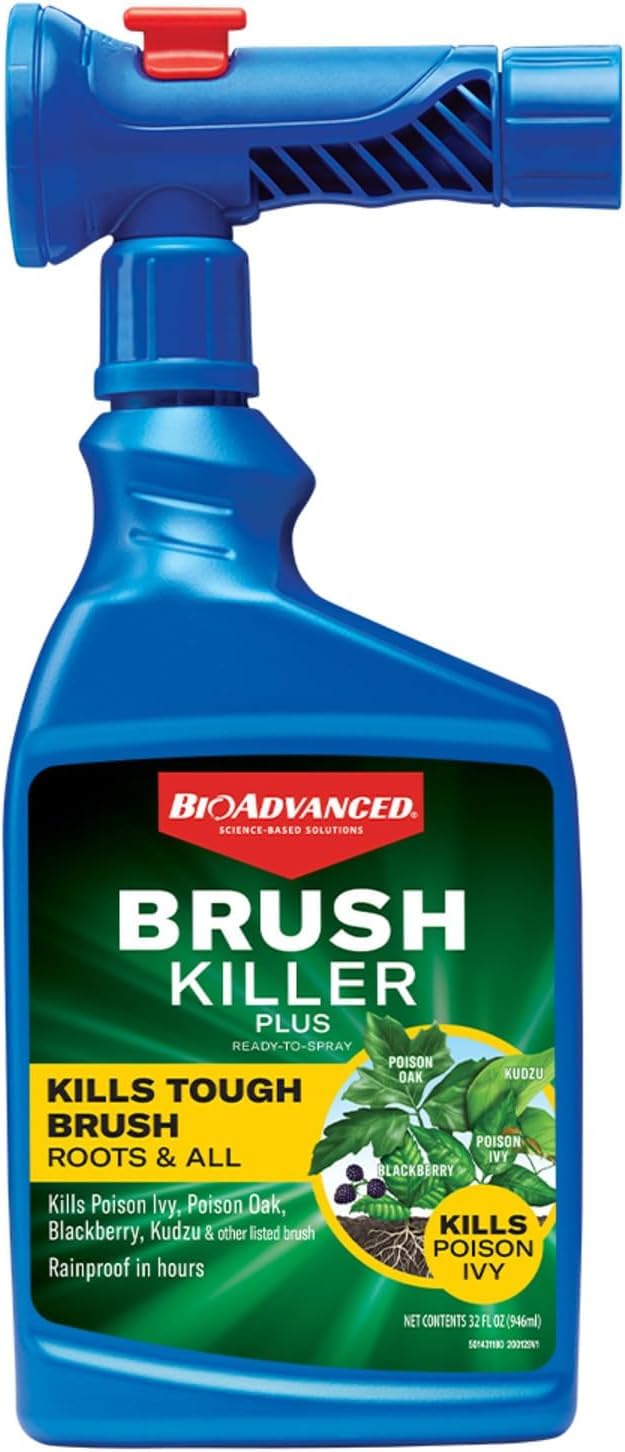
Four thousand square feet from one bottle, with no tank and no mixing math.
Sheer reach is the reason this bottle makes the list. A single 32-ounce ready-to-spray container treats up to 4,000 square feet of actively growing weed targets, which is the largest coverage figure among these five. If you are fighting a long hedge line, a fence row, or a brushy back lot, that reach means fewer bottles and fewer refill trips.
The active ingredient is triclopyr, the root-killer that takes down listed roots and vine weeds including poison ivy and poison oak, plus blackberry and over 75 other types. Visual results show in 1 to 6 weeks, so it is a patience product rather than an instant one. Rainproof protection holds after 4 hours, so you do have some weather buffer once it dries.
The recurring story on this one is the sprayer itself. The nozzle and mechanism are the weak point for a stretch of buyers, with reports of the sprayer giving out after a few uses. That is worth planning around — buy it for the formula and coverage, and be ready to pour the contents into your own sprayer if the head quits. A few also find the kill simply does not take on their particular weed.
Why it earns a slot: the 4,000 square feet per bottle and the no-mix format make large areas genuinely manageable for a first-timer.
The fix-it reality: treat the attached sprayer as a bonus, not a guarantee, and keep a spare tank on hand.
Pick this when: the job is big and you would rather not calculate mix ratios for an afternoon.
Think twice if: you expect the built-in sprayer to be the reliable part of the purchase.
4. The Scotts Ortho Max Poison Ivy Tough Brush Killer, 32-Ounce

Built for woody vines, stumps, and the roots that keep coming back.
The label that sets this concentrate apart is depth of kill: it targets over 60 types of tough brush and weeds, and it goes after woody plants including stumps and vines. Poison ivy, poison oak, kudzu, and wild blackberries are all named on the box. It is the bottle for the vine that has wrapped its own tree trunk and the stump you want dead before it re-sprouts.
Owner reports back that up in the field. Mixed strong, it has taken down established vines and poison ivy within weeks with no regrowth after two years, and it has cleared ivy climbing a wall where other sprays failed. You mix 6 fluid ounces per gallon to cover roughly 1,000 square feet, and it is rainproof in 2 hours. A separate note: 32 fluid ounces against the Bonide’s 16 fluid ounces gives you twice the liquid to mix with.
Two cautions belong here. First, it does not discriminate — overspray kills desirable plants and shrubs on contact, and one user got a severe skin burn through a pinhole glove, so wear real gloves and goggles. Second, the mix strength matters: at the light end, results are slow and some stubborn weeds like English ivy and dollarweed survive. Mix it to the label and give it weeks, not days.
Where the Ortho pull ahead
- Kills over 60 types of tough brush and woody plants
- Handles stumps, vines, and roots rather than just leaves
- Rainproof in 2 hours
- Strong owner record on established vines and wall ivy
What to count on losing
- Kills desirable plants on contact if overspray drifts
- Demands gloves and goggles — it is a harsh mix
Best for: the stubborn rooted vine, the stump, and anyone willing to mix a strong batch and wait a few weeks.
skip it if: the ivy sits among perennials you want to keep — contact kill makes precision a must here.
5. Monterey Brush and Vine Control, 1 Qt with Spoon

A pre-measured spoon and a triclopyr base for the targeted, small-scale job.
Sometimes the job is one vine at the edge of a walkway, not a whole fence. This quart of concentrate is built for that scale: targespo woody plants and vines around homes, cabins, and walkways, and it can kill stumps as well as prevent resprouting. The active ingredient is triclopyr, the same root-killing chemistry that the stronger picks rely on, so you are not trading away the mechanism.
The included measuring spoon is the practical difference. Mixing the chemical with water yourself is how this bottle works, and freshly cut tree stumps take the undiluted product directly. That makes it a good fit for someone killing a single stump or spot-treating a few patches of poison ivy, alder, blackberry, cottonwood, poison oak, or honeysuckle without committing a whole tank to one job.
The limits are worth naming clearly. This is for outdoor residential use only and must not touch edible crops. Rain within 24 hours of application can reduce how well it works, which is a longer dry window than the other bottles here ask for. Keep people and pets off the area until the spray is dry, and guard against drift onto plants you want alive. For a single targeted job, those rules are easy to follow; for a sprawling brush clear, they are a lot of babysitting.
The spoon advantage: a built-in measure removes the guesswork from small mixes, so you can stay precise without a full tank setup.
Keep it scoped: treat this as a point-treatment bottle — big open brush work belongs to the larger-coverage picks above.
Made for: one stump, one walkway vine, or a handful of spots where you want measured control and no waste.
Wrong tool when: you are clearing a large brushy area — the 24-hour rain window and small volume will slow you down.
Know the Specs
Active Ingredient: Triclopyr
Triclopyr is the weed-killer chemistry built to travel through woody stems and into the root, which is why it is the go-to for poison ivy, poison oak, and stumps. Look for it on the label of any serious brush killer. Glyphosate-only sprays tend to burn the leaves and leave the root alive, so the vine bounces back.
Coverage in Square Feet
Coverage tells you how far a bottle stretches, and it is the number that decides how many you need. A concentrate may cover 1,500 square feet per bottle, a ready-to-spray bottle up to 4,000. Measure your fence line and brush patch first so you are not caught short halfway through.
Rainproof Time
Once you spray, the leaf has to absorb the formula before rain washes it off. Rainproof times range from as fast as 30 minutes to 4 hours for the ready-to-spray bottle here, and one concentrate advises that rain within 24 hours may cut effectiveness. Spray on a dry, calm morning.
Concentrate Versus Ready-to-Spray
A concentrate is undiluted liquid you mix with water in a tank or hose-end sprayer — more control, more strength options, more setup. Ready-to-spray arrives mixed with its own sprayer attached. Ready-to-spray saves the mixing, but the attached sprayer is often the first part to fail.
Common Questions
Will a brush killer kill my lawn grass too?
How long until poison ivy actually dies after spraying?
Can I spray a poison ivy vine that is climbing a tree?
What is the best way to kill a poison ivy stump so it does not re-sprout?
How soon can it rain after I spray?
Can I plant vegetables or flowers after spraying poison ivy?
Do I need protective gear to spray these?
Is a concentrate better than a ready-to-spray bottle?
Why does poison ivy come back after I spray it?
The Bottom Line
For most yards, the product to kill poison ivy winner is the Roundup Poison Ivy Plus Tough Brush Killer2 Concentrate because its three-actives formula hits top growth and root at once and it is rainproof in as fast as 30 minutes. If the ivy runs into a lawn you care about, grab the Bonide Poison Ivy & Brush Killer for its turf-safe design. And for the stubborn stump or the vine wrapped around a tree, the Scotts Ortho Max Poison Ivy Tough Brush Killer is the one to reach for. Pick the bottle that matches where the vine grows, mix it to the label, and give the root a few weeks to die.
How we choose
We do not accept paid placement. Every pick is matched to a real buyer and a real use-case; we do not hands-on test units.
Sources
Specifications: manufacturer listings and product documentation. Review insights: verified customer reviews, as of October 2026. Pricing: not shown on this page (it changes often); check the current price via the retailer link.
As an Amazon Associate, Aappliancez earns from qualifying purchases. This does not affect which products we feature.