Disclosure: Some links in this post are affiliate links. As an Amazon Associate I earn from qualifying purchases, at no extra cost to you. Learn more
Specs are compiled from manufacturer listings and verified buyer reviews and can change over time — please confirm the key details on the product page before buying.
If you are taking a broad antibiotic and want to protect your gut from a C. diff overgrowth, the probiotic that matters most is a yeast-based one — Saccharomyces boulardii — because it survives the antibiotic that wipes out ordinary bacteria strains. That single fact reshuffles most shopping lists: the standard multi-strain capsules people buy for everyday digestion are often the wrong tool for this job, and the picks below lean heavily on the yeast side for that reason.
This guide is built by comparing the manufacturers’ published specifications and the patterns across verified customer reviews, so you get each pick’s real strengths and trade-offs instead of marketing spin.
You will see which strains survive stomach acid, how CFU (colony-forming unit — a live-cell count) and capsule count differ between bottles, and which formula suits a post-antibiotic routine. Here is how the probiotics to prevent c. diff options actually stack up when you strip the labels down to what each bottle delivers.
Top Picks


How To Choose The Best Probiotics to Prevent C. Diff
The first thing to get straight is that Clostridioides difficile is a bacterium, and most probiotic capsules on the shelf are bacteria too. A bacterial probiotic taken alongside the antibiotic that is meant to clear C. diff can be neutralized by that same drug. That is why the yeast strain Saccharomyces boulardii gets so much attention in this specific situation — it is a living yeast, not a bacterium, so it is not wiped out by the antibiotic course.
Strain type comes before strain count
A bottle that lists four or twelve bacterial strains is not automatically better here than a single-strain yeast capsule. Look at the genus first: Saccharomyces is the yeast family that survives stomach acid and holds its ground during antibiotic use. Lactobacillus and Bifidobacterium are the bacterial families you see in everyday digestive blends. Both have their place — just not as a direct swap for each other.
Read the CFU number, then read it again
CFU stands for colony-forming units — the live-cell count the maker guarantees. A bottle may say 5 billion CFU or 30 billion CFU, and those numbers are not measured the same way across brands. What matters more for this category is whether the maker states the count “through expiration” rather than “at time of manufacture,” because a live-cell count that fades on the shelf is not a count you can rely on.
Capsule count and dosing rhythm
A 60-count bottle at one capsule daily lasts two months; a 120-count bottle at the same dose lasts four months. Some formulas are dosed every third day once you are established, which stretches a bottle further than the headline capsule count suggests. Work out your real monthly rhythm before you compare two bottles side by side.
Side-by-Side Comparison
| Model | Best For | Strain Focus | Live-Cell Count | Capsule Count | Amazon |
|---|---|---|---|---|---|
| Master Supplements Theralac★ Best Overall | Multi-strain daily gut rebuild | Lactobacilli + Bifidobacteria | 30 billion CFU | 30 capsules | Amazon |
| Now Saccharomyces BoulardiiBudget Pick | Budget yeast-strain support | Saccharomyces boulardii | — | 120 capsules | Amazon |
| Nordic Naturals Nordic Flora Probiotic Daily | Everyday immune and digestive upkeep | Four strains incl. L. acidophilus DDS-1 | 12 billion cultures | 60 capsules | Amazon |
| Biotics Research Saccharomyces boulardii | Post-antibiotic yeast routine | Saccharomyces boulardii | 4 billion CFU | 60 capsules | Amazon |
| SFI Health Klaire Labs Saccharomyces Boulardii | High-count yeast bottle for long routines | Saccharomyces boulardii | 5 billion CFU | 60 capsules | Amazon |
Detailed Reviews
1. Master Supplements Theralac – 30 Capsules
Our pick — 4.5+★ from 800+ verified ratings; the strongest balance of quality and price.
The multi-strain bottle that earns its keep by actually surviving the trip through your stomach
Here is the trade-off nobody puts on the label: a bacterial probiotic is only useful if it gets past stomach acid alive. Theralac’s answer is 30 billion CFU — a live-cell count of 30 billion colony-forming units — wrapped in its own acid-proof delivery, plus a prebiotic called LactoStim the brand says feeds those cultures once they land.
The bottle asks for refrigeration for long-term storage, though the capsules are shelf-stable for travel. Clinical reviews of the label also point to a formula built around colonizing strains (bacteria that settle in and stay rather than pass through), which is why the effectiveness is the thing that gets talked about most in the review pages. It is vegan, non-GMO, and free of gluten, dairy, nut and soy — a short list of allergens that matters if you read every label.
One reviewer on chronic pain medication reports more regular bowel movements and less antacid use about a week after two weeks on Theralac, then stretches the bottle by dosing every third day. That last detail is worth holding onto: a 30-capsule bottle does not have to mean a 30-day bottle. The thing that divides opinion is the price per capsule — this is not the budget route, and it is not a yeast strain, so it is doing a different job than the Saccharomyces picks below.
What it brings to the shelf
- 30 billion CFU across a multi-strain Lactobacilli and Bifidobacteria blend
- Acid-proof delivery plus a prebiotic (LactoStim) to support the cultures
- Third-party lab tested for potency through expiration
- Free of gluten, dairy, nut and soy; vegan and non-GMO
What to weigh up
- 30 capsules only — one of the shortest bottles here
- The cost per capsule feels steep next to single-strain bottles
- Not a yeast strain, so it is not the antibiotic-safe swap this category often needs
Pick this when: you want a well-protected multi-strain bacterial blend and can stretch a 30-capsule bottle with every-third-day dosing.
Think again if: you specifically need a yeast strain that outlasts a course of antibiotics.
2. Now Saccharomyces Boulardii – 120 VCaps
One yeast strain, a hundred and twenty capsules, and the least fuss in the whole group
If the single most useful spec in this category is a strain that survives stomach acid, Now delivers it plainly: Saccharomyces boulardii, a probiotic yeast the label says survives stomach acid and colonizes the intestinal tract. That is the whole pitch. What makes this the value entry is the count — 120 capsules in one bottle, double the 60 in the Biotics Research bottle, so your routine runs twice as long between reorders.
Weigh it in your hand and the difference is obvious too: at 2.4 ounces it sits light in a toiletry bag, and it is a fraction of Theralac’s 4.2 ounces. The small bottle size makes it easy to keep in a travel kit or a desk drawer without feeling like you are carrying a pharmacy. Where it loses out on paper is information — the label gives you the strain and the benefit but not a stated CFU figure, so if you want an exact live-cell count on the label, look at the Biotics or Klaire Labs bottles instead.
Effectiveness is what carries this one with the people taking it. One reviewer reports a chronic fungal rash improving after about four days and nearly clearing within just over a week when the yeast was paired with a second probiotic. Others have used it as a straight replacement for a well-known brand and report no issues. The honest limit: it is a single-strain product, so it does not carry the prebiotic support the Theralac formula builds in.
Where the value lands: 120 capsules, one yeast strain, the lowest fuss-to-count ratio in the group. If you want a simple S. boulardii routine that lasts months without a big outlay, this is the one to start with.
The honest gap: no stated CFU figure on the label, so it asks a little trust on potency that the Biotics and Klaire Labs bottles answer with a number.
Reach for this if: you want a long-running single-strain yeast bottle at the friendliest entry cost in this group.
Look elsewhere if: you want an exact live-cell count printed on the label before you commit.
3. Nordic Naturals Nordic Flora Probiotic Daily 60 Count

The daily-maintenance bottle for people who want a gentle, well-tested blend rather than a heavy hitter
Nordic Flora is not built for the antibiotic fight — it is the “keep things steady” option. The formula runs four probiotic strains with 12 billion cultures plus prebiotics in a vegan capsule, and one of those strains is Lactobacillus acidophilus DDS-1, a name you will see a lot when people read up on gut bacteria. If your aim is a low-key daily probiotic for general digestive and immune upkeep, this is the gentle route; if your aim is specifically guarding against C. diff during antibiotics, a yeast strain is the better fit.
What gets noticed here is honesty of labelling as much as effect. Buyers report there is no aftertaste and no intestinal upset after starting — an unusually quiet experience for a probiotic. Others have latched onto the brand and stuck with it for years, which is not nothing in a category where people switch constantly because one bottle did not sit well. The capsules are also small and easy to swallow, which buys you less day-to-day friction than a large capsule.
The one thing the crowd does not agree on is the price per capsule. Some call it worth the money for the third-party purity testing and the absence of artificial colors or flavors; others feel it is a premium they would rather not pay for a daily product. For a longer antibiotic course you would also need a yeast-based formula alongside it rather than this one alone.
Why people stay on it
- Four research-backed strains with 12 billion cultures plus prebiotics
- Includes Lactobacillus acidophilus DDS-1, a strain the maker says survives the GI tract
- Third-party tested; non-GMO, gluten, dairy, corn, soy and wheat free
- Small, easy-to-swallow capsules with no reported aftertaste
Where it is not enough
- Bacterial strains only — no yeast strain to outlast an antibiotic course
- The price per capsule splits opinion among people who buy it
Best for: someone after a trustworthy, easy-to-take everyday probiotic for general digestive and immune support.
Not the one for: a targeted post-antibiotic routine, where a Saccharomyces bottle is the better match.
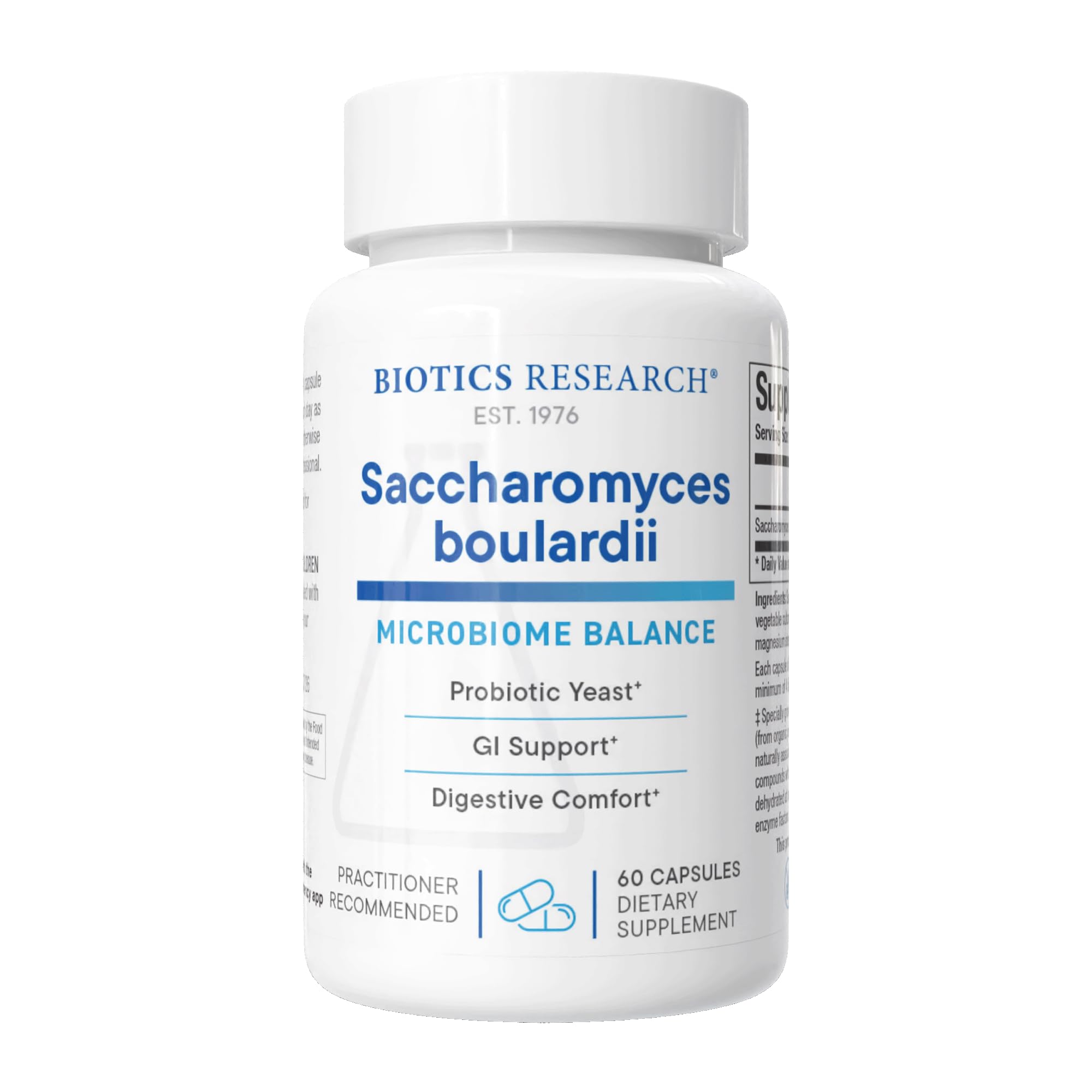
4. BIOTICS RESEARCH Saccharomyces boulardii Probiotics 60 Capsules
The yeast bottle that names its number and gets out of the antibiotic’s way
The spec that matters here is right on the capsule: 4 billion CFU of Saccharomyces boulardii — a living yeast, genetically different from baker’s yeast — and the label says it survives stomach acid and is antibiotic resistant. Those two lines are exactly what you want in a C. diff conversation. An antibiotic cannot wipe out a yeast the way it clears ordinary bacteria, so this is the category’s logical partner for antibiotic use, travel-related upset, or rebuilding after a course.
Look at the physical packaging and this is a boxed bottle rather than a big tub — 1.13 ounces, with dimensions of 3.03 x 1.42 x 1.34 inches. It is the smallest and lightest object in this lineup, easy to throw into a bag or a hospital overnight kit. One thing to get straight: the strain is dairy-free, but the label is not the same as every other bottle on this page, so read it rather than assume.
Quality is the thing that wins people over here — Bio-Tract and the labs behind it push heavy on the testing, and the results show in the reviews. One reviewer who worsened on a Lactobacillus blend reports a sharp turnaround within days of switching to this yeast strain. Others have taken it after antibiotic courses for years at a time and come back for the same reason. The mixed note: a 60-capsule bottle at one daily capsule is a two-month supply, so reorder timing can sneak up on you if you double up during a tough stretch.
Why this is the gut-focused one: a stated 4 billion CFU, a dairy-free yeast strain, and antibiotic resistance on the label — the three markers that matter for a post-antibiotic routine. It is also the middle ground on cost, sitting above the Now bottle and below the premium pick.
One limit to plan for: 60 capsules means a fairly short bottle for a long routine, so stock up if you are dosing through a full antibiotic course.
The right call for: anyone pairing a probiotic with a course of antibiotics or recovering after one, and wanting a stated CFU figure on the label.
Skip if: you want a multi-strain blend for general gut diversity — this bottle stays on the yeast side of the aisle.
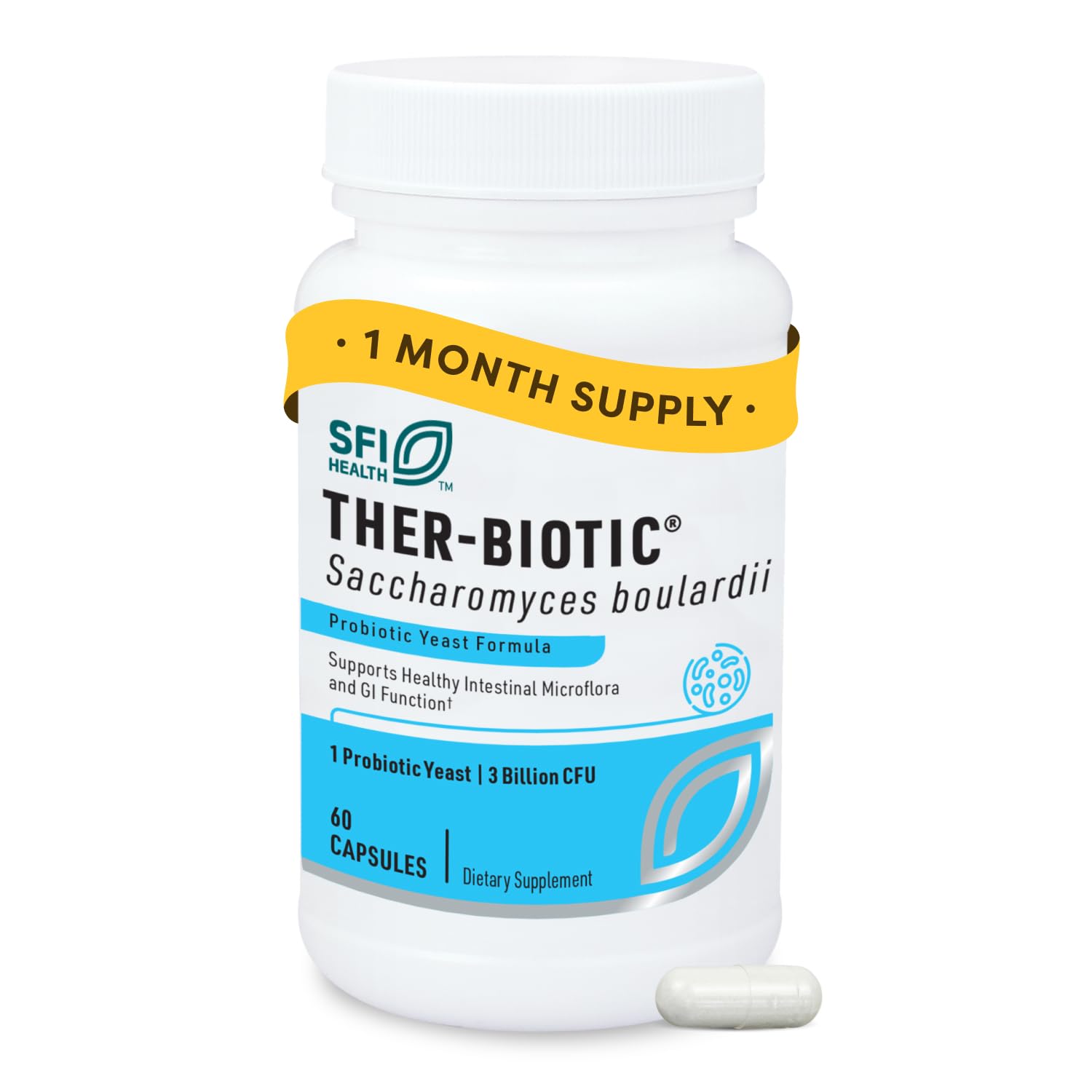
5. SFI Health Klaire Labs Saccharomyces Boulardii, 60 Count
The practitioner-cabinet yeast bottle, with the highest CFU count in the group
Klaire Labs is the bottle that people generally find through a practitioner rather than a browse — and the label reflects that: 5 billion CFU of Saccharomyces boulardii, one capsule daily or as directed by your healthcare professional. Five billion is the highest stated live-cell count among the yeast-bottle picks here, and it matches the higher price tier. If you are on a routine already and simply want the most CFU per capsule, that is the number to weigh.
On the counter it is a small bottle, 1.4 ounces with a 3 x 3 x 3 inch base, and it stocks neatly next to the other bottles. The maker positions it for balanced microbiome function, normal bowel movements and a healthy inflammatory response — a broad gut brief rather than one symptom target. The company now sits under the SFI Health umbrella, and it is keen to point out that the formulation itself has not changed through that rebrand, which matters if you are used to an older label.
What keeps this one in the conversation is the quality of the ingredient itself — the label is short and the review pages lean on trust more than novelty. One reviewer who began it on a doctor’s direction stayed on it ten months, with less bloating and gas. Others simply say it works and they trust what is inside. The cost is the sticking point: this sits at the top of the price tier here and the value verdict really depends on whether the higher CFU count and the practitioner branding are worth it to you.
Where the premium is justified
- 5 billion CFU per capsule — the highest stated count among the yeast picks here
- Single-strain Saccharomyces boulardii for antibiotic-safe gut support
- Simple one-capsule daily dosing, or as directed by a professional
- Short ingredient list that people are comfortable trusting over time
The part to be honest about
- The priciest bottle in this lineup, so the value is a personal call
- No multi-strain or prebiotic extras here — this is a pure single-strain product
- Rebranded under the SFI Health name, which can confuse people used to the old label
Worth it for: the routine that wants maximum CFU per capsule from a practitioner-style single-strain yeast bottle.
Overkill if: you are new to probiotics and just want the lowest-cost entry to a S. boulardii routine — the Now bottle does that job for less.
Know the Specs
CFU (colony-forming units)
CFU is the live-cell count on the label — how many viable organisms the maker says are in each capsule or dose. A higher CFU does not automatically make a bottle better for this category; whether the cells survive the trip through your stomach matters just as much. Look for a maker who guarantees the count “through expiration” rather than “at time of manufacture.”
Yeast vs bacterial strains
The genus name is the fastest read on what a bottle does. Saccharomyces boulardii is a yeast and survives stomach acid and antibiotic exposure, so it is the strain family most often discussed for C. diff support. Lactobacillus and Bifidobacterium are bacterial families for daily gut upkeep and are more likely to be disrupted by an antibiotic itself.
Stated strain count
A four-strain blend is not better than a single-strain one in every case. For a targeted post-antibiotic routine, a single yeast strain can do a more specific job than a mixed bacterial blend. A multi-strain bottle still has value for general digestive support and gut diversity.
Shelf stability and refrigeration
Read the storage line before you buy: some bottles are shelf-stable for travel but ask for refrigeration for long-term storage. A bottle that travels well in a bag but lives in the fridge at home is common, and it matters if you are stockpiling before a course. Check the packaging for moisture and oxygen-absorption packets — they are part of how the live cells stay alive.
Common Questions
Which probiotic strain is actually used for C. diff support?
Can I take a probiotic at the same time as my antibiotics?
Is a higher CFU count always better?
Do I need to refrigerate an S. boulardii probiotic?
How long does a bottle of probiotic capsules last?
Are these probiotics safe if I have a dairy or gluten sensitivity?
What is the difference between a single-strain and multi-strain probiotic?
Does a probiotic for gut health also support my immune system?
How quickly will I notice a difference from an S. boulardii probiotic?
The Bottom Line
For most people looking at probiotics to prevent c. diff, the one to start with is the Master Supplements Theralac if you want a well-protected multi-strain bacterial blend for general gut rebuilding — it is the strongest overall pick here by consistency and the widest stated strain coverage. If your goal is specifically the post-antibiotic window, reach for the Biotics Research Saccharomyces boulardii instead: 4 billion CFU of yeast, a dairy-free formula and antibiotic resistance on the label, in the middle of the cost range. And if you want the simplest, longest-running single-strain bottle at the entry point, the Now Saccharomyces Boulardii gives you 120 capsules of the same yeast family without the premium outlay. One honest nudge: whichever you choose, check the storage line on the bottle before you buy — a live culture that sits warm in transit is the one variable you can actually control.
How we choose
We do not accept paid placement. Every pick is matched to a real buyer and a real use-case; we do not hands-on test units.
Sources
Specifications: manufacturer listings and product documentation. Review insights: verified customer reviews, as of October 2026. Pricing: not shown on this page (it changes often); check the current price via the retailer link.
As an Amazon Associate, Aappliancez earns from qualifying purchases. This does not affect which products we feature.