Disclosure: Some links in this post are affiliate links. As an Amazon Associate I earn from qualifying purchases, at no extra cost to you. Learn more
Specs are compiled from manufacturer listings and verified buyer reviews and can change over time — please confirm the key details on the product page before buying.
Feeding a cat with kidney disease is stressful enough without guessing which probiotic helps and which one just gets sniffed and walked away from. The picks below are sorted by what they actually do: some support the gut, some target kidney function directly, and one is built so picky cats and fussy dogs both say yes. The short answer: FortiFlora is the safest first scoop because it has the broadest track record for simply getting eaten. The Azovast liquid paste is the smartest choice if you want kidney-focused support a cat will actually lick off the bowl.
This guide is built by comparing the manufacturers’ published specifications and the patterns across verified customer reviews, so you get each pick’s real strengths and trade-offs instead of marketing spin.
Kidney disease in cats changes the math on every supplement, so this guide focuses on what actually gets eaten and what supports renal health, all in one place for probiotics for cats with kidney disease.
Top Picks
How To Choose The Best Probiotics for Cats With Kidney Disease
The first thing to understand is that a probiotic does not treat kidney disease. What it can do is support the gut, and the gut matters a great deal in a kidney cat — it is where waste products get handled and where appetite starts. So your job as a buyer is narrower and simpler than the marketing suggests: pick a formula your cat will eat every single day, and pick one that either backs up kidney function or keeps digestion steady. Everything else is noise.
Start with the form, not the CFU number
A scoop of powder you stir into wet food is the easiest thing to hide. A capsule means opening it and tipping the contents in, which adds a step but lets you split the dose. A paste in a dial-a-dose tube is the fastest route with a cat that turns its nose up at anything mixed into dinner. Pick the form your cat will accept five days out of seven, because a skipped day is a wasted day.
Know what the kidney-specific extras are for
Several formulas on this list go beyond plain bacteria and add herbs or fatty acids aimed at the kidneys. Astragalus root, nettle seed, rehmannia, and cordyceps are the ones you will spot most often. Omega-3 fatty acids and B vitamins show up too. These are what separate a general gut probiotic from a renal-focused supplement, and they are the reason a kidney-specific product costs more than a drugstore probiotic.
Refrigeration and shelf life will decide your routine
Live bacteria fade faster when they are warm, so some formulas demand the fridge and some are built to sit on the shelf. A shelf-stable bottle or paste means you can dose in the kitchen, pack it for a trip, and not worry about the power going out. Check that before you buy, because a tub that needs refrigeration will change where you keep it.
Side-by-Side Comparison
Every row uses the same three measures so you can scan straight down. CFU tells you the live-bacteria strength where the label states it, form tells you how you will dose it, and refrigeration tells you whether the bottle lives on the counter or in the fridge.
| Model | Best For | Live Bacteria Count | Form | Refrigeration | Amazon |
|---|---|---|---|---|---|
| Pro Plan FortiFlora★ Best Overall | First-time probiotic buyers | Not stated on label | Powder sachet | — | Amazon |
| Purina Pro Plan Multi CareDual-Action Pick | Gut plus immune support | 2 x 10^8 CFU/g | Powder sachet | — | Amazon |
| Rx Vitamins Rx Biotic | Multi-pet households | Not stated on label | Powder tub | — | Amazon |
| VetriScience Kidney Health | Kidney-focused herb blend | Not a CFU formula | Powder | — | Amazon |
| Azovast Plus Paste | Cats that refuse powder | Four named strains | Oral paste | Not required | Amazon |
| Azovast Plus Capsules | Higher-strength daily dosing | 24 Billion CFU per capsule | Capsule | Not required | Amazon |
| NEPHROMAX Synbiotic | Prebiotic plus probiotic combo | 36 Billion CFU per capsule | Capsule | Shelf stable | Amazon |
Detailed Reviews
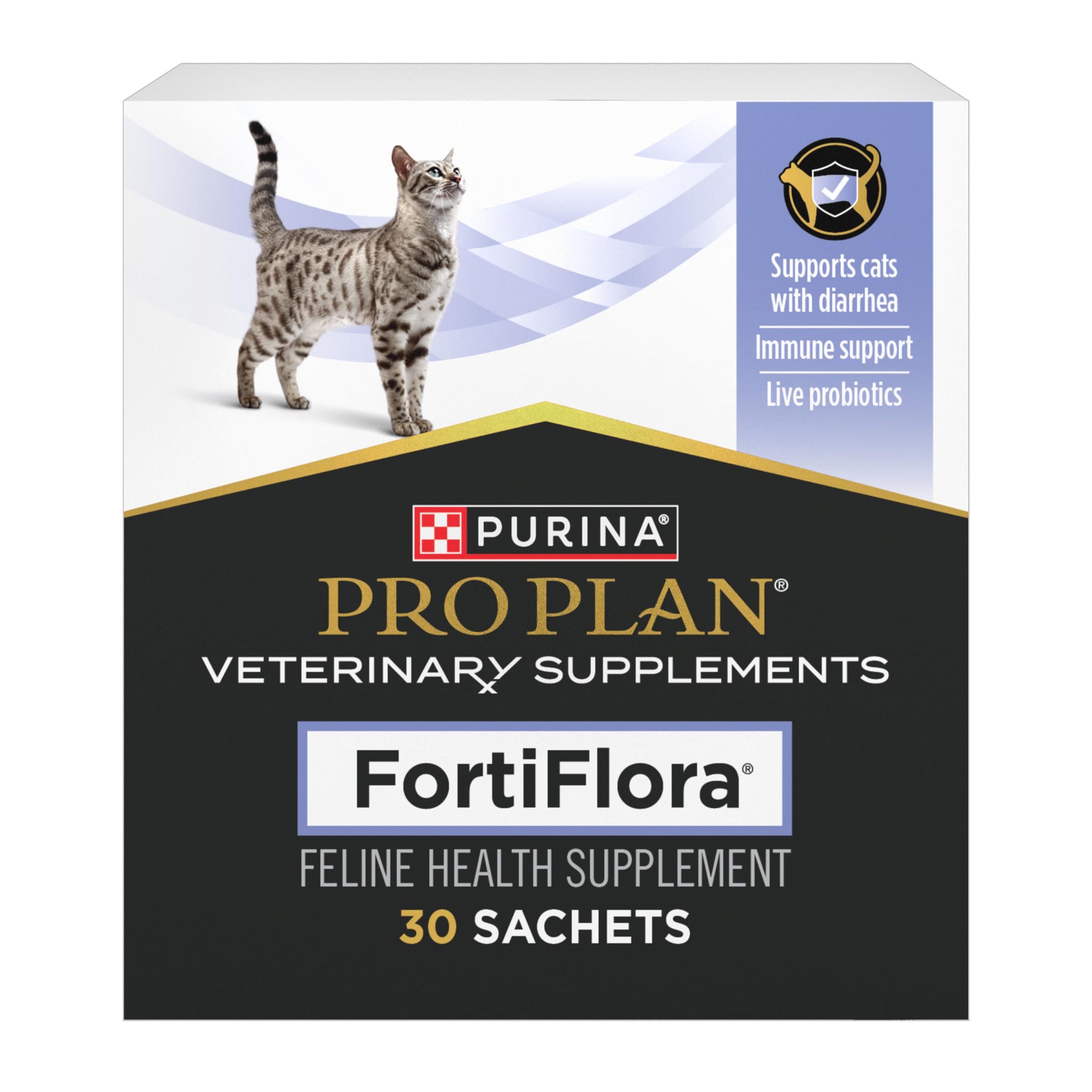
1. Pro Plan Veterinary Diets FortiFlora Daily Probiotic Powder
Our pick — 4.5+★ from 20,000+ verified ratings; the strongest balance of quality and price.
The single-serve sachet most cat owners on this list reach for first when diarrhea hits.
If your cat has just been handed a kidney diagnosis and you want one simple thing that supports the gut while you get your bearings, this is the safest first packet. Each sachet is a single 1-gram serving of powder, so there is no measuring, no half-scoops, and no guessing at a dose. You tear it and stir it in.
The manufacturer describes FortiFlora as containing a probiotic strain that supports normal intestinal microflora, and it is positioned as a product for cats and kittens with diarrhea. In the real world, that is exactly what owners use it for. Owners talk about it most for the core job — getting digestion back on track — with digestive effects and how readily cats accept the powder coming up again and again. Cats tend to lick it up straight from the saucer, which is the part that keeps you buying it. Unlike the compressed capsule options further down, there is nothing to swallow and nothing to cut.
Here is the honest catch. This is a digestive probiotic, not a renal formula — it contains no astragalus, no nettle seed, and no kidney-specific herb blend. That makes it the right pick for the cat whose appetite and stool need steadying while the kidney plan is handled elsewhere. It is also not a zero-risk item: a small share of cats do react badly to it, so watch the first few days.
What earns it first place
- Single-serve sachets mean zero measuring and zero waste on a small cat dose
- Powder vanishes into wet food, so cats that hate pills still get it
- The most trusted name in the category for simply getting eaten
- No prescription needed for a supplement your vet may already stock
What to weigh before you buy
- No kidney-specific ingredients — it supports the gut, not the renal system directly
- Sachets add up fast in a multi-cat home, so you will rebuy often
- A minority of cats react poorly, so test slowly
Reach for this if: you want the most proven everyday gut support for a cat that is fussy about pills but easy about food.
Hold off if: your vet has specifically asked for a renal formula with kidney herbs — that is a different product entirely.
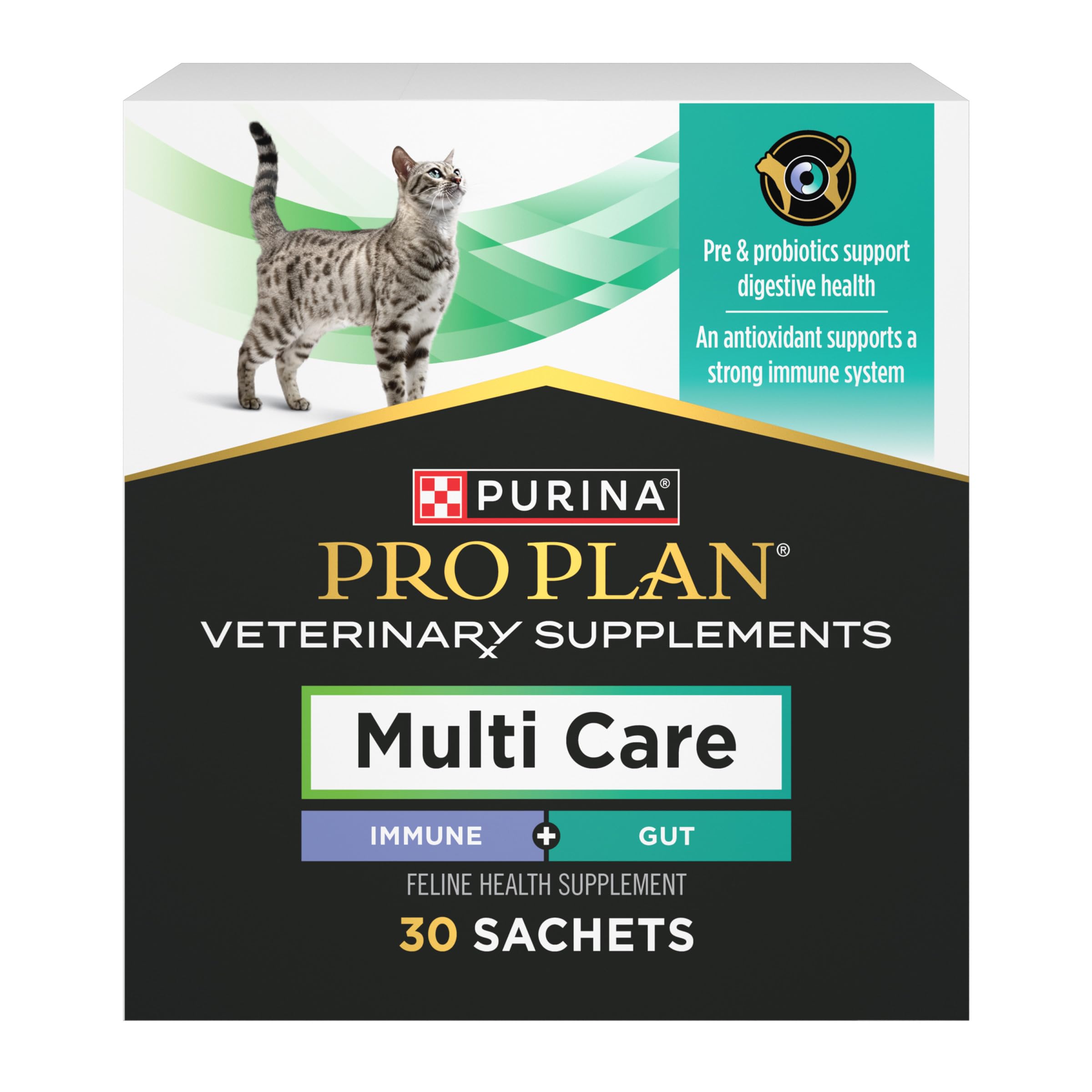
2. Purina Pro Plan Veterinary Supplements Multi Care for Cats, 30 ct
Two kinds of gut help in one sachet — a prebiotic and a probiotic working as a team.
This is the version of the Purina formula that does more than feed bacteria. Each 1-gram sachet carries inulin — a prebiotic fiber that feeds the good gut bugs already in your cat — at 315 mg, plus Bacillus coagulans at 2 x 10^8 CFU/g as the live probiotic. There is 15 mg of vitamin E in there too, aimed at immune support. Think of it as laying down both the seed and the fertilizer at once. For a kidney cat whose digestion has gone wobbly on a new prescription diet, that pairing makes a real difference.
The liver flavor is the reason this one gets finished. Owners of cats with weeks-long loose stools report firmer poop within about two weeks of daily use. Cats that normally walk away from supplements will take this one folded through wet food. Owners also report less over-grooming once the gut settles.
The trade-off is one of economics. Splitting a sachet across two cats is common in households with more than one, because a full packet each day gets through the box quickly. And not every cat agrees it is dinner — a stubborn minority refuse it outright. It is also a gut-and-immune formula rather than a dedicated kidney product, so pair it with whatever your vet has recommended for renal care. The crowd has clearly made up its mind on it: this is a 4.5+ star rating across 700+ owners, and the liver flavor is a big part of why.
The sachet math: with a prebiotic fiber and a live probiotic both inside one packet, you save the step of buying and mixing two separate products.
The honest limit: this is not a renal supplement, so it is a gut partner to your kidney plan rather than a replacement for it.
Go with it when: the goal is a steadier stomach and stronger immune support for a cat that eats willingly.
Look elsewhere when: you need targeted kidney ingredients in the same scoop.
3. Rx Vitamins Rx Biotic Probiotic Powder for Dogs and Cats

A flavorless powder your cat cannot taste and your dog cannot smell, so the dose always goes down.
Flavorless is the headline and it is the whole point. Rx Biotic is a 2.12-ounce tub of powder that stirs into wet food without leaving a scent trail a fussy cat can detect. If your kidney cat has started inspecting every bowl before committing, that invisibility is the feature you are paying for. It also handles a household with one cat and one dog in a single tub, so you are not buying two different supplements.
This one is a general gut-support formula rather than a renal-specific blend, and it earns its place on quality. When owners rate what they value, quality and effectiveness dominate the conversation, with digestive effects close behind. Among pet owners, quality and effectiveness are the strongest terms tied to this formula. It is also used as a long-term maintenance scoop, which is the setting you want with a cat on a chronic kidney plan. Recent experience with a poodle prone to diarrhea and a calmer gut after daily use shows the pattern holds. At 4.5+ stars across 900+ ratings, this is the most-reviewed option in this main list.
The real limit is that a tub is a scoop-and-guess routine until you get the measure right — there is no single-serve packet here. And because the powder is flavorless, you cannot hide it in a treat; it must go into the food, which means a cat that free-feeds dry kibble all day needs a wet-food anchor. It is also not kidney-targeted, so treat it as gut backup.
The reason owners stick with it: easy mixing and results over the months, not just week one, is what keeps this tub on the counter for a cat that has had a long-term gut plan since day one.
What to plan for: you need a scale or a steady scoop and a daily wet-food meal to make it work.
This is your match if: you want one flavorless tub to serve a cat and a dog with no taste drama.
Another route is better if: your cat’s problem is specifically kidney function and you want herbs in the mix.
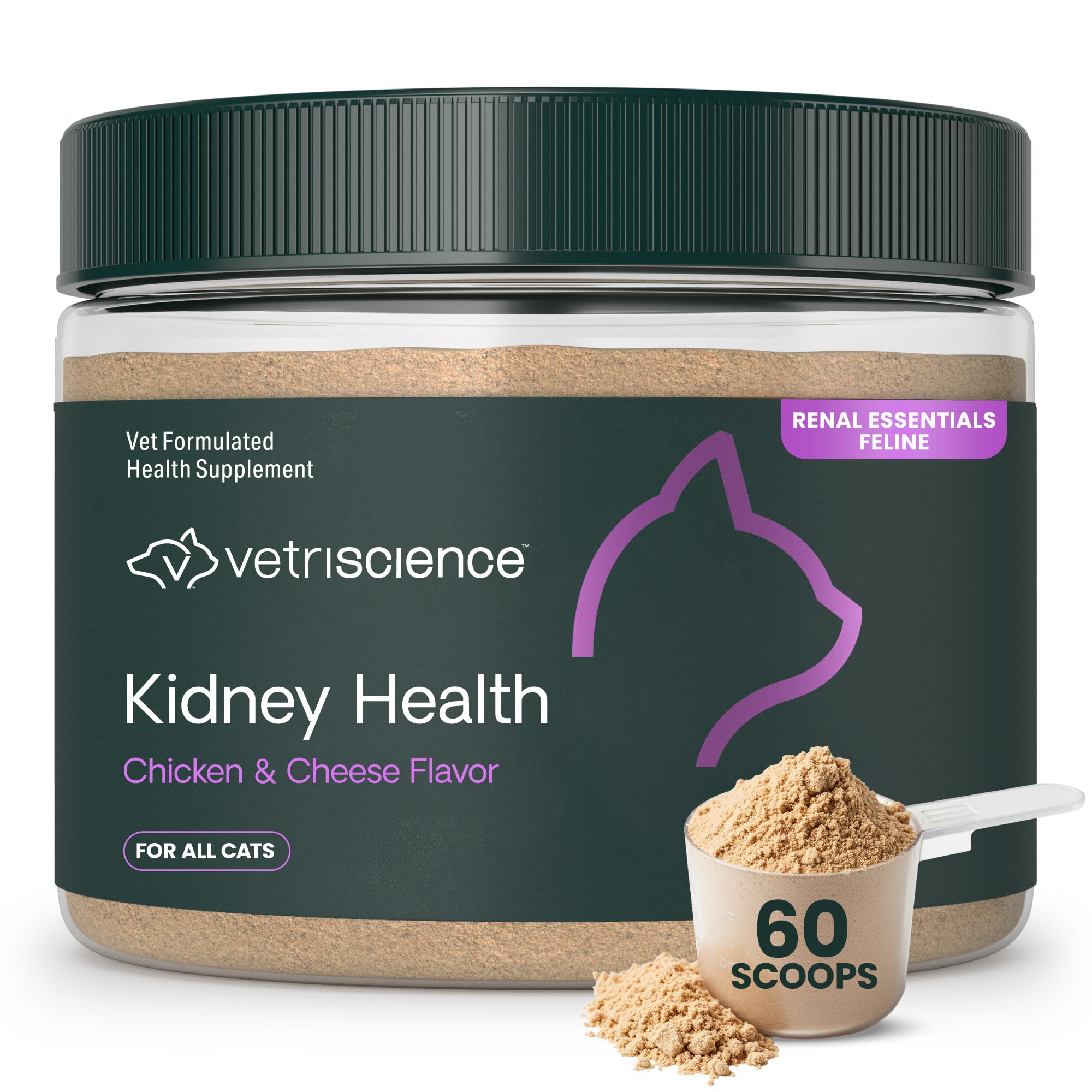
4. VetriScience Kidney Health Powder for Cats, Chicken & Cheese
A renal-focused powder that leans on herbs and mushrooms instead of raw CFU counts.
This is the one pick built around kidney support rather than gut support. Each 1.2-gram serving (two scoops) carries astragalus root powder at 30 mg, rehmannia root extract at 25 mg, nettle leaf extract at 25 mg, and cordyceps extract at 25 mg — a botanical quartet aimed at supporting healthy blood circulation to and from the kidneys. It also has L-arginine at 25 mg, DMG at 12.5 mg, and small amounts of EPA and DHA (omega-3 fatty acids, fats that support general health). For a cat already in a renal care routine, that is a very different product from a plain probiotic.
The manufacturer describes the flavor as chicken and cheese. It also says more than eight in ten cats who tried it in its taste testing accepted it — a supplier claim, not a guarantee. The practical question is simpler: will your cat lick it off the plate? Owners rate effectiveness as the quality they value most here, so it does a real job for buyers who stick with it. The formula also adds B vitamins — B6 at 4 mg, B1 and B2 at 2 mg each, folic acid at 90 mcg, and B12 at 27.5 mcg — plus inositol and a small amount of potassium citrate at 4.1 mg.
The trade-off is real and worth knowing in advance: this is not a CFU-count probiotic, so if a strong live-bacteria dose is your main need, this is a complement and not a substitute. A few buyers also object to the smell, and some cats turn their noses up at it. At 3.5+ stars across 300+ ratings, it is the more polarizing pick on this list, which makes the “test a small scoop first” rule especially worth following.
Where it fits: a cat already on a kidney-care plan whose owner wants botanical support with some B vitamins in the bowl.
The catch to size up: this is a supplement for a cat that will eat it — picky cats may need it folded into a strong-smelling wet food.
Choose this pick if: you already have gut support sorted and want a kidney-focused blend instead.
Keep looking if: your main goal is a high-CFU live probiotic for digestion.
5. Azovast Plus Kidney Health Supplement Oral Paste (60 cc)

The chicken-flavored paste that lets you dose a kidney cat without hiding a single grain of powder.
The format here is the whole story. Instead of a powder to mix or a capsule to open, you have a dial-a-dose tube of chicken-flavored paste. That means you can put the dose straight on the paw or straight in the mouth — no food involved, no chance your cat susses out a chemical taste in the wet food and stops eating entirely. For the cat that has gone off its dinner since the kidney diagnosis, that is a lifeline.
What is inside is four named strains: S. thermophilus, L. acidophilus, B. longum, and L. casei. Those four naturally occurring strains are what the maker says support kidney function and help manage renal toxins. Buyers report better appetite and energy in cats that take the paste, and effectiveness is the quality they rate highest. It is also fully shelf-stable — no refrigeration required — which means it can ride along in a travel bag or sit in a cabinet without spoiling. For a renal care routine, that practicality counts for a lot.
The honest trade-off is the texture and the taste. A few cats refuse it, and it takes some cats a few tries to get used to the jelly-like consistency once it settles. It is chicken flavored, which helps many cats and turns off a few. At 4.5+ stars across 800+ ratings, the majority of owners are satisfied, but this is a product where the first serving is a test of acceptance rather than a guaranteed slam dunk.
Why owners pick the tube: the whole volume of paste comes out easily and there is no measuring beyond the dial — and no refrigeration, so it never takes up fridge space.
The single caveat: cats vary on the texture, so be prepared to trial it on the paw before committing to the full routine.
Reach for it if: your cat is a food-refuser and you need kidney support that goes in directly.
Skip the paste if: your cat happily eats anything mixed into its bowl — the capsule gives you more precise dosing.
6. Azovast Plus Kidney Probiotic Capsules, 120 Caps

A capsule with a number on it: 24 billion live bacteria per cap, and no fridge needed.
If you want a precise dose, this is the pick. Each capsule holds 24 billion CFU — colony-forming units, meaning the live bacteria count — across the same four strains you will find in the paste: S. thermophilus, L. acidophilus, B. longum, and L. casei. The maker says the formula helps maintain normal BUN and creatinine, the two blood markers vets track most closely in kidney disease. It is acid-resistant, so the capsule is designed to get past the stomach, and it is shelf-stable with no refrigeration required.
The flexibility is where this one earns its keep. You can give the capsule whole, pull it apart and tip the powder into food, or split the dose between meals. With a cat that needs a tiny dose and a dog on a maintenance plan, that adaptability is the difference between a supplement you actually use and one that sits in the cupboard. Owners mention steadier digestion and more energy over time, and effectiveness is the quality buyers rate highest. At 4.5+ stars across 800+ ratings, it is a proven part of the Azovast family.
The catch is the pill itself. The capsules are too big to comfortably swallow for many cats, so the pull-apart method is the realistic path. A few owners also dislike the taste once the powder is out and the texture going jelly-like as it sits in liquid. If your cat will simply refuse a capsule of any size, go for the paste in the pick above instead — it delivers the same four strains through a format a fussy cat will accept.
what separates it: a stated strength on the label and a dose you can split make it the most controllable option for a cat on a tight regimen.
The catch to plan around: expect to open the capsule and mix the powder rather than hand a capsule to a cat.
Pick the capsules if: you want a measured daily CFU dose and the option to split it between two pets.
Go with the paste instead if: your cat refuses to eat anything that has powder stirred through it.
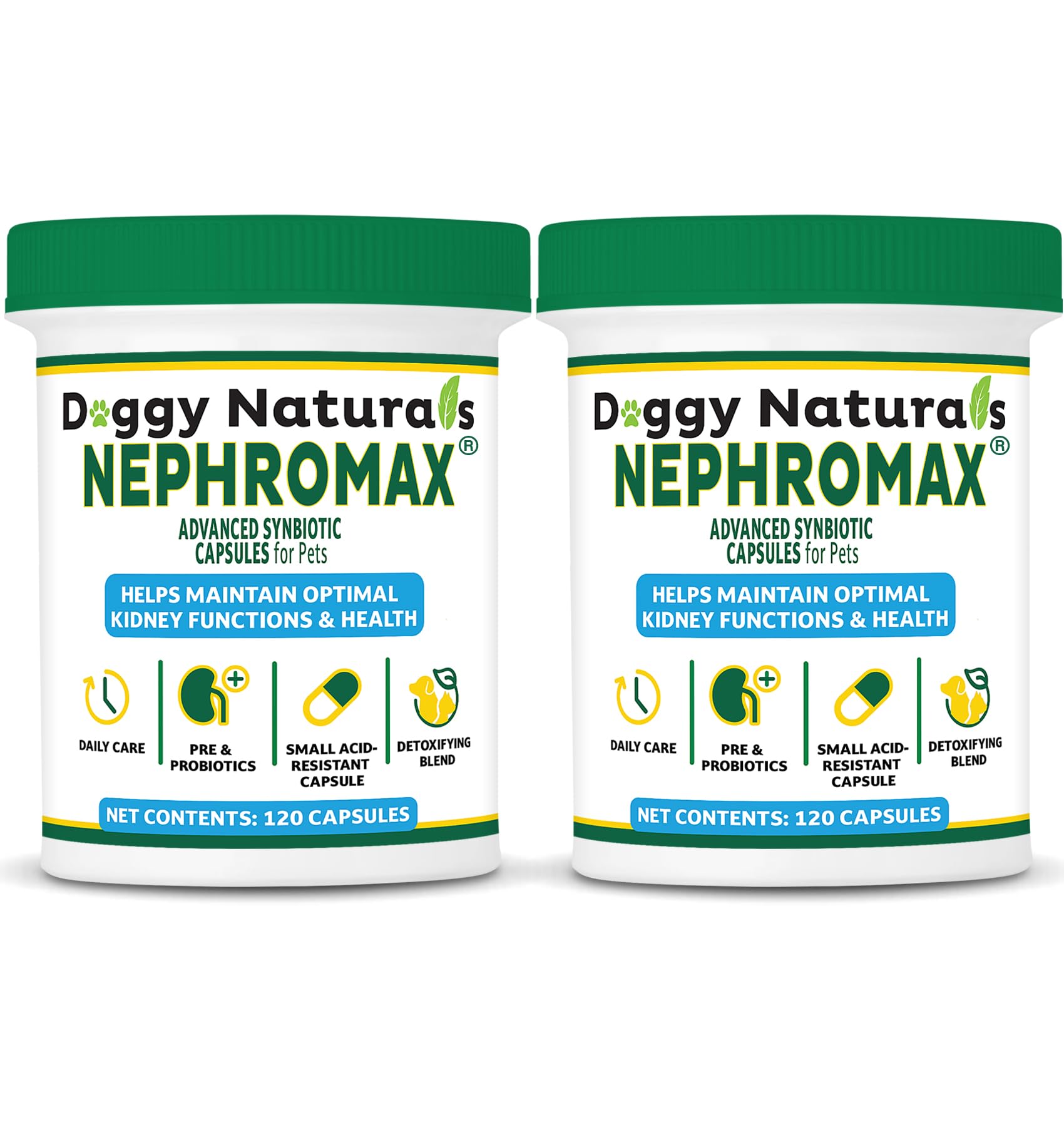
7. NEPHROMAX Synbiotic Capsules, 36 Billion CFU
Thirty-six billion bacteria per capsule, plus prebiotics — a synbiotic, not just a probiotic.
NEPHROMAX pairs live bacteria with prebiotic fiber, which is what the word “synbiotic” means: the bacteria and their food, together in one capsule. Each capsule offers 36 billion CFU from four strains — S. thermophilus, L. acidophilus, B. longum, and L. casei — which is the highest per-capsule count on this list. The maker says the formula metabolizes nitrogenous waste, eases stress on the kidneys, improves gut flora, and removes toxins. That is the kidney-support story it is built around, and it is the reason this is the most renal-focused capsule here.
It is also simple to dose, which is a real selling point in a house with multiple pets. A pet under 10 lbs gets one capsule a day, and a pet of 10 lbs or more gets one capsule twice daily, morning and evening. The capsules are small and acid-resistant, and the bottle is shelf-stable with no refrigeration required. Add the two prebiotic strains feeding the four probiotics and you have a combination meant to stick around in the gut. It is also made at a facility in the USA, with the maker stating that openly.
The trade-off is transparency. NEPHROMAX is the newest name on the list, so it has less of a public track record than Purina or VetriScience. The reviews so far do not give a full picture next to a product with thousands of owner reports. If you want a formula built around 36 billion CFU (colony-forming units, the standard count of live bacteria) and are ready to trial it, this is the one. Treat the first weeks as a test, and know the pill is small enough to pull apart for a cat dose.
The strength behind it: 36 billion CFU from four named strains, with added prebiotics, makes it the highest-strength capsule on this list.
What to keep in mind: a proven name is a good thing when you are dealing with kidney disease, and this one is newer to the market.
Best fit for: a pet parent who wants the highest per-capsule strength and a built-in prebiotic in one bottle.
Not the easiest bet if: you want the reassurance of a name that well-established veterinary circles have carried for years.
Know the Specs
CFU counts: what 24 or 36 billion actually means
CFU stands for colony-forming units, which is how the label measures live bacteria. A higher number sounds better, but a kidney cat is often small and sensitive, so the dose on the label matters more than the biggest number on the market. The Azovast capsules and the NEPHROMAX option state their strengths directly, which is helpful when you want to keep the dose constant from day to day. For a cat under 10 lbs, follow the label’s small-pet direction.
Kidney ingredients you will see on labels
Astragalus root, nettle seed, rehmannia, and cordyceps are herbs a kidney-specific formula may include, and they usually appear in the renal blends rather than the plain probiotics. Omega-3 fatty acids like EPA and DHA and B vitamins show up too. These ingredients are what separate a renal supplement from a general gut supplement, and they are why a kidney product tends to cost more. None of them replace the prescription diet your vet has planned.
Common Questions
Can I give a probiotic to a cat with kidney disease?
Is a probiotic powder or a kidney herb blend better for a cat with CKD?
How long does it take to see a change after starting a probiotic?
Will my cat eat the powder, or will it refuse it?
Do these probiotics need to be kept in the fridge?
Can I open a capsule and mix it into my cat’s food?
What is the difference between a probiotic and a synbiotic?
How do I dose a probiotic for a cat under 10 pounds?
Can I give the same kidney probiotic to my dog too?
What if my cat has a reaction to a new probiotic?
The Bottom Line
For most owners, the safest first scoop is Pro Plan FortiFlora. It is one packet, one stir, and a cat that has already swallowed it more often than not. A 4.5+ star rating across 20,000+ reviews backs that up, and the single-serve packet means no measuring errors on a small cat dose. If you want a gut formula that also carries prebiotic fiber (fiber that feeds good gut bacteria) and a liver taste picky cats take to, the Purina Multi Care is the stronger daily choice. If kidney function itself is the focus and your cat is fussy about food, reach for the Azovast paste — chicken flavor, no refrigeration, and a dial-a-dose tube that goes in even when the bowl comes back untouched.
How we choose
We do not accept paid placement. Every pick is matched to a real buyer and a real use-case; we do not hands-on test units.
Sources
Specifications: manufacturer listings and product documentation. Review insights: verified customer reviews, as of October 2026. Pricing: not shown on this page (it changes often); check the current price via the retailer link.
As an Amazon Associate, Aappliancez earns from qualifying purchases. This does not affect which products we feature.