Disclosure: Some links in this post are affiliate links. As an Amazon Associate I earn from qualifying purchases, at no extra cost to you. Learn more
Specs are compiled from manufacturer listings and verified buyer reviews and can change over time — please confirm the key details on the product page before buying.
Red is one of the hardest wall colors to bury, because its pigment keeps creeping back through fresh white coats for weeks. The fix is not more topcoat — it is the right primer underneath. This guide covers the primers and stain-blocking base coats that actually stop red from bleeding, plus the practical steps that make the difference between a clean white wall and a pink one.
This guide is built by comparing the manufacturers’ published specifications and the patterns across verified customer reviews, so you get each pick’s real strengths and trade-offs instead of marketing spin.
Below you’ll find coverage numbers, dry and recoat times, and finish types side by side, so you can match a base coat to your wall rather than guessing. The right base coat turns a stubborn red wall into a straightforward repaint; this shortlist covers the best primer to cover red paint on walls.
Top Picks


How To Choose A Primer For Red Walls
Covering red is a blocking job first and a painting job second. If the primer does not seal the pigment, no amount of white topcoat will hide it. Start by deciding whether your wall is a painted drywall surface or a piece of furniture — the answer changes which product on this list fits.
Stain blocking versus plain hiding
A stain-blocking primer does two jobs at once. It creates a sealed barrier over the old pigment, and it gives the new topcoat something even to grip. Shellac- and oil-based blockers are the heavy hitters here. Water-based primers are easier to live with indoors but can let a strong red tint creep back, so they usually want two coats.
Coverage per can decides how many you buy
Coverage is listed as square feet per quart, per gallon, or per can, and that number is the one that tells you whether a single container finishes the wall. A quart that covers 125 sq ft handles a small room or a furniture piece. A gallon rated at 250-400 sq ft is built for a full ceiling or a large wall run. Measure your wall height by width before you order.
Dry time and recoat time
Dry-to-touch time is how long before the film stops feeling wet. Recoat time is when you can safely add the next layer without lifting what is already there. A blocker that dries in half an hour lets you lay two coats in an afternoon. A slower product pushes the job into the next day.
Side-by-Side Comparison
| Model | Best For | Coverage | Dry Time | Finish | Amazon |
|---|---|---|---|---|---|
| Rust-Oleum Classic White Milk Paint★ Best Overall | Furniture and trim | 125 sq ft | 0.5 hours | Matte | Amazon |
| Glidden Interior Paint + PrimerBest Two-in-One | Paint-and-primer in one | 100 sq ft | — | Eggshell | Amazon |
| Montana Colors MTN PRO Matt White Base Primer | Spot sealing small areas | 20 Square Feet | 4 hours | Gloss | Amazon |
| SEM 42043 White High Build Primer | Filling scratches and chips | 11 sq. ft. at 2 mil DFT | 1 hour | Primer | Amazon |
| KILZ Stainblocking Ceiling Paint | Whole ceilings and large walls | 250-400 sq. ft. | 1 hour | Flat | Amazon |
| General Finishes Stain Blocking Primer | Bleed-through on cabinets | — | — | Matte | Amazon |
| KILZ Original PRIMER13OZ (Pack of 6) | Touch-ups and small walls | Up to 12 sq ft per can | 1 hour | White | Amazon |
Detailed Reviews
1. Rust-Oleum Classic White Milk Paint
Our pick — 4.5+★ from 6,500+ verified ratings; the strongest balance of quality and price.
A one-step milk paint that skips separate primer and builds to full coverage in two or more coats.
Rust-Oleum markets this as a one-step buildable coating with excellent adhesion, which means it grips an old painted surface without a separate primer underneath. Each quart covers up to 125 sq ft. That is more square footage per quart than the Glidden interior paint below, which lists 100 sq ft. Dry-to-touch lands in 0.5 hours and a recoat is ready in 1 hour, so two coats fit inside a single afternoon.
What wins people over is the quality of the finished film — more owners bring that up than any other topic on the listing, and by a wide margin. Application comes next, with a creamy self-leveling consistency that brushes and rolls without dragging. It also cleans up with soap and water and carries a low-VOC, low-odor formula, so indoor work stays comfortable. The matte finish layers well: brush it in a “V” pattern for a washed, vintage look, or sand lightly after it dries for a weathered texture.
Here is the honest catch for a red wall specifically. One coat is deliberately semi-transparent, so covering strong red takes two passes or more. The color itself is the most-discussed topic with a mixed split — some buyers call the white perfect and others say it does not read as white at all. Buyers report: “I really like the color of this, but it took about four coats to cover a light blue bookshelf.” A red surface is a similar fight, so budget the extra coats before you start.
Where This Base Coat Delivers
- No separate primer needed — one-step adhesion onto painted and sanded surfaces
- 125 sq ft per quart, with a recoat window of just 1 hour
- Water-based, low odor, soap-and-water clean up
- Layers into a washed or distressed matte finish
What To Plan Around
- First coat goes on semi-transparent, so deep red needs multiple passes
- Color reads inconsistently — some cans land cooler than expected
- Brush strokes can show on large flat surfaces
Go for it when: you are refinishing furniture, trim, or a small wall and want to skip a separate primer step entirely.
Order extra instead if: your wall is saturated red — the buildable coats are the whole point, and one quart will not finish it.
2. Glidden Interior Paint + Primer White Eggshell 1 Quart
An eggshell paint-and-primer combo that hides old color and lays the new finish in one can.
The pitch here is fewer steps: Glidden combines exceptional hide and stain block into the topcoat itself, so a red wall moves straight from prep to white without a separate primer can. It comes in eggshell for a low-sheen finish that wipes clean, which matters on hallway and kitchen walls that catch fingerprints. Coverage is listed at 100 sq ft per quart, and the white shades are hand-picked rather than one flat white.
The hiding power is the part owners keep coming back to. A thick first coat plus a normal second got one buyer through a 14-ft black wall using about a quarter of the can, with two more planned coats. Contractors on the listing call it a true one-coat paint. Clean-up is straightforward, the finish is scrubbable, and the low-VOC formula keeps indoor odor down.
The trade-off is that full cure is listed at 720 hours — that is the long tail before the film reaches its hardest state, so treat the wall gently for a while even though it feels dry sooner. A few buyers also hit a finish mismatch, receiving flat when they ordered eggshell. And the paint divides opinion on spread: some find it smooth as butter, a few find it thick and hard to work. At 4.0+ stars, it sits below the other picks here — the hiding is strong, the finish is the variable.
The realistic read: if you want a single container that primes and colors in one go, this earns its place. Just confirm the sheen on the label before you open it, and plan on the full cure window before hanging anything against the wall.
Reach for this if: you are painting a wall a fresh white and want to skip the separate primer step.
Steer elsewhere if: you are sealing a heavy bleed-prone red — a dedicated blocker gives you more certainty.
3. Montana Colors MTN PRO Matt White Base Primer 400ml

A 400 ml aerosol that seals trim, frames, and small red patches with no brush, roller, or tray.
Spray primers are built for the areas a roller cannot reach cleanly — door frames, trim edges, small panels, and tight corners where red paint tends to peek through. This one is formulated to work as a primer or as a final matt white topcoat when you want the flat look. Each can is rated at 20 Square Feet of coverage, with a 4-hour dry time. That is much slower than the Rust-Oleum milk paint, which touches dry in 0.5 hours — so a spray session is a next-day job, not an afternoon one.
The coverage is the strength. Buyers describe it as covering a great deal with no bubbles and a soft velvety texture, and one noted it gave two coats on a mountain bike frame. The finish recommendation is dark surfaces, which is exactly the job of covering old deep color under a lighter coat.
An honest limit: 20 Square Feet will not get you across a full red accent wall. This is a detail and spot-sealing tool, not a room-scale base coat. The gloss designation in the spec sheet also surprises people expecting a flat spray — check that against the matt white finish you actually want.
Sharpest use case: trim, frames, and small panels where a brush introduces drips you would rather avoid. The catch: the 20 Square Feet rating means you measure the patch, not the wall, before ordering.
Pick it for: small red zones and details that need a clean, brushless coat.
Not your can if: the job is a full wall — you would burn through several of these.
4. SEM 42043 White High Build Primer – 16 oz.

A high-build white primer that fills scratches and chips before you hide the color.
High build means the primer is formulated to lay down a thicker film, which lets it fill minor scratches and chips instead of just sitting over them. That matters when the red wall you are covering also has patched holes, old dings, or a rough surface — you want the base coat to smooth while it seals. Coverage is listed at 11 sq. ft. at 2 mil DFT, a dry-film thickness spec that tells you a relatively small area per pass. Dry time is 1 hour.
Adhesion is the aspect the listing’s reviews single out, and it holds up. Buyers describe it as working well right to the end of the can, with a body-shop-grade feel and a straightforward application for someone used to primer.
The honest note is that the product’s overall quality and effectiveness get a split reaction. Some praise it, others are less impressed, and sanding is another point of divide. For a red-wall job, the practical limit is the coverage number: 11 sq. ft. per 2 mil coat is patch and panel territory, not a whole room.
Why It Holds Its Slot
- Builds enough film to fill minor scratches and chips
- 1-hour dry time keeps repair work moving
- Strong adhesion on prepared surfaces
- Body-shop quality behind it
Where It Falls Short
- 11 sq. ft. at 2 mil DFT per can — tiny for a wall
- Reactions to overall quality and sandability are split
- Not designed as a room-size color blocker
Best matched to: patch repairs and surface smoothing before the color coat goes on.
Wrong tool for: large red wall runs, where the coverage simply will not stretch.
5. KILZ Stainblocking Ceiling Paint, Interior, White, 1 Gallon

Rolls on pink, dries white in under an hour, and covers 250-400 sq ft of ceiling per gallon.
The coverage is what puts this one in a different class. A single gallon covers 250-400 sq ft, so one can handles most bedroom and living-room ceilings without a second run to the store. The color-change trick is the other standout: it rolls on with a subtle pink tint and dries to white in under an hour, so you can see exactly where you have been. Dry to touch is 1 hour, and recoat is 2 hours.
The formula is spatter-resistant and low odor, and it carries a soap-and-water clean-up. Quality and effectiveness are the strongest parts of the product’s story — owners describe it as doing exactly what it says, and one bathroom ceiling application left only a handful of tiny specks a year instead of the constant wiping before.
The catch is honest and specific to your project. The ceiling paint is built for ceilings, not walls, and for a red wall you would pair it with a dedicated KILZ primer — the listing itself points toward KILZ Original or KILZ 3 Premium for severe stains. Coverage and discoloration both draw a split reaction: some say it covers well, others find water stains still show through and two coats are needed for bigger marks. Durability is the weakest topic on the page.
The value read: at 250-400 sq ft per gallon, this is the most square footage per container on the list. The limit: it is a ceiling product, so treat it as the finish coat and bring a blocker for the red itself.
Pair it with your red seal coat if: the ceiling above the wall also needs refreshing.
Look for a wall-specific blocker instead if: the red is on the wall itself and you need maximum hiding in one pass.
6. General Finishes Stain Blocking Primer, 1 Quart

A water-based white primer built to lock in stain, dye, and tannin so red cannot creep through your fresh white.
This water-based white primer exists for one reason: to protect a new finish from stain, dye, and wood tannin bleeding through. On a red wall, that is the whole job. It goes over an existing finish, raw wood, or MDF, and works as a base coat under milk paints, chalk-style paints, and pigmented polys. Full cure is listed at 21 days, which is the patience window before the film reaches its hardest state. The quart holds 32 fluid ounces and weighs 2.7 pounds.
Bleed blocking is where it earns the price. It has taken old mahogany dressers that other primers could not seal and stopped the pink streaks in a single coat. Kitchen cabinets stained very dark came out clean before a milk-paint topcoat, with no bleed-through worries and no clumps in the can. One owner summed the value up against a 70-plus-hour repaint.
Two things to respect. The can carries an explicit warning: do not mix it with any other paint, stain, or topcoat, because contamination causes product failure — rinse brushes with clean water, not with brush cleaner. And a small number of buyers found coverage and adhesion below their expectations, so prep still matters. Note that coverage is not given as a square-foot number.
Where it shines: the hardest bleed cases — heavy red, tannin-rich wood, and dark cabinet paint. The caveat: it is a one-product system, so keep foreign finishes out of the can and off your brush.
The strongest match: you are covering deep red or dark pigment and you want the seal to hold on the first serious attempt.
Think twice when: you plan to mix leftover products together to stretch a can — this one forbids it.
7. KILZ Original PRIMER13OZ (Pack of 6)
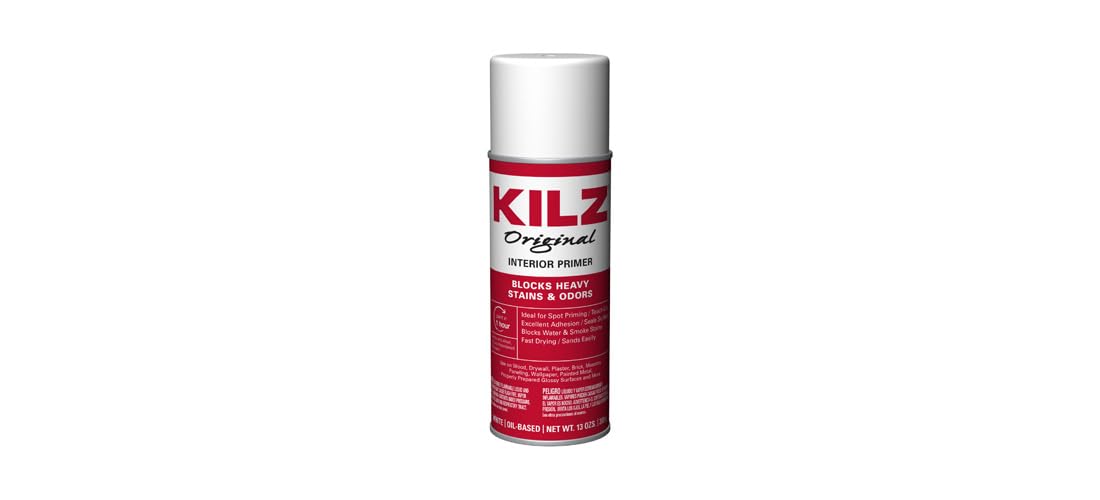
Six 13 oz oil-based spray cans for edges, corners, and quick red patches up to 12 sq ft each.
This is the spray-can version of the classic oil-based KILZ formula, sold as six 13 oz cans. That format suits touch-ups and detail work where a brush would leave marks — around trim, behind radiators, in tight corners. Each can covers up to 12 sq ft, with a 1-hour dry time. The stain blocking is aimed at water stains, smoke, tannin, and ink, which covers the same class of stubborn pigment that red paint falls into.
The six-pack math works in your favor. Owners mention that a multipack like this comes out at a fraction of what the same cans cost individually at a home-improvement store. Shipping arrives on time and matches the order, and one painter’s household rates the quality highly.
The honest limit is the per-can coverage. At up to 12 sq ft per can, six cans give you a real but modest total — enough for touch-ups and one small accent area, not a full red wall. Oil-based primer also carries a stronger solvent odor than the water-based options here, so ventilate while you work.
Why The Six-Pack Makes Sense
- Oil-based stain blocking for water stains, smoke, tannin, and ink
- Six 13 oz cans — good for a batch of touch-ups
- 1-hour dry time keeps a detail session short
- Multipack format beats buying singles one at a time
What To Weigh First
- Up to 12 sq ft per can — small reach per container
- Solvent odor from the oil base needs ventilation
- Spray drift means masking off nearby surfaces
Reach for it when: the red shows up in corners, edges, and small patches that need sealing fast.
Not the one for: a broad wall face — the per-can coverage will not take you far enough.
Know the Specs
Coverage Per Container
Coverage tells you the square footage one quart, gallon, or can will handle. It is listed differently across products — some quote square feet per quart, others per can, and one quotes square feet at a specific dry-film thickness. Measure your wall’s height and width, multiply them, and compare that to the coverage figure before you buy. A red wall that needs two coats effectively halves the listed coverage.
Stain Blocking and Bleed-Through
Stain blocking is the primer’s ability to seal old pigment so it cannot migrate up into the new coat. Oil-based and shellac-style blockers are the strongest sealers; water-based primers are gentler indoors but often need two coats on strong color. Red paint is a strong dye, so a primer rated for water stains, smoke, or tannin is usually the right family.
Dry Time vs. Recoat Time
Dry-to-touch is when the surface stops feeling wet. Recoat time is when you can add the next layer safely. A short recoat window lets you get two coats down in one session. Full cure is the much longer window before the film reaches its hardest state — some products list this in hours, others in days, so read the label before you hang shelves or tape against the wall.
Finish Type and Sheen
Finish describes the surface look: matte, eggshell, flat, gloss, or simply “primer.” Matte and flat finishes hide wall imperfections best and are the usual choice under a topcoat. Eggshell adds a slight sheen that wipes clean more easily. Gloss reflects more light and shows surface flaws, so it is rarely the pick for a large red wall you are trying to flatten out.
Common Questions
How many coats does it take to cover a red wall with primer?
Will a water-based primer stop red paint from bleeding through?
Is it better to use a primer or a paint-and-primer in one on red walls?
Can I spray primer on a red wall instead of rolling it?
How long should I wait before painting over primer on a red wall?
Do I need to sand or prep a red wall before priming?
Will a stain-blocking primer hide red from a wood cabinet too?
How much primer do I need to cover a whole red wall?
Is low-VOC primer safe to use in a room with furniture still in it?
What finish should the primer be if I am painting the wall white?
The Bottom Line
For covering a red wall, the primer to cover red paint on walls winner is the Rust-Oleum Classic White Milk Paint because it skips a separate primer step, covers 125 sq ft per quart, and lets you recoat in 1 hour — you just need to plan on more than one pass for a saturated red. If bleed-through is your real enemy, the General Finishes Stain Blocking Primer is built to seal pigment and tannin before the topcoat goes on. And for edges, corners, and small patches, the KILZ Original spray pack seals up to 12 sq ft per can without a brush in your hand. Start with the coat count you actually need, and the white will land clean.
How we choose
We do not accept paid placement. Every pick is matched to a real buyer and a real use-case; we do not hands-on test units.
Sources
Specifications: manufacturer listings and product documentation. Review insights: verified customer reviews, as of October 2026. Pricing: not shown on this page (it changes often); check the current price via the retailer link.
As an Amazon Associate, Aappliancez earns from qualifying purchases. This does not affect which products we feature.