Disclosure: Some links in this post are affiliate links. As an Amazon Associate I earn from qualifying purchases, at no extra cost to you. Learn more
Specs are compiled from manufacturer listings and verified buyer reviews and can change over time — please confirm the key details on the product page before buying.
Vinyl and the hard plastics around it fight back against paint. They are slick, waxy-feeling surfaces, so ordinary primer sits on top and flakes off within a season. The fix is an adhesion promoter — a thin clear or grey liquid that changes the surface itself so your topcoat has something to bite into. Below are the five products that actually do that job for vinyl, plastic trim, bumpers, and cladding, sorted by what they are best at.
This guide is built by comparing the manufacturers’ published specifications and the patterns across verified customer reviews, so you get each pick’s real strengths and trade-offs instead of marketing spin.
You will see where each one wins and where it makes you work harder. By the end you should know exactly which can belongs in your garage before you sand another panel, which is the whole point of picking the right primer for vinyl.
Top Picks

How To Choose The Best Primer for Vinyl
The single mistake that ruins most vinyl and plastic paint jobs is skipping the promoter and hoping a good primer will cope. It will not. On a polyolefin surface — the family that covers TPO bumper covers, PP trim, and a lot of vinyl wraps — paint has almost nothing to grab. An adhesion promoter is a chemical bridge, and without it your topcoat is living on borrowed time.
Clear promoter or grey self-etching primer
A clear promoter goes on invisible and stays invisible, which makes it the right call when you are spraying plastic trim, a bumper cover, or anything where a grey film would show through a thin topcoat. A grey self-etching primer does two jobs at once: it bites into bare metal and it lays down a flat, sandable base you can block smooth. If you are painting bare metal or filling scratches, the grey route saves you a step. If you are painting a coloured plastic panel and want the original tone to survive, go clear.
Watch the flash time and the recoat window
Flash time is how long the promoter needs before it stops being wet and starts being ready. Too short and your topcoat traps solvent; too long and the surface goes past its active window. A promoter that stays active for a full day lets you prep on Saturday and spray on Sunday, which saves a re-scuff on multi-panel jobs. Check the flash time on the can before you commit a whole afternoon to masking.
Match the can to the job
A 15-ounce aerosol covers trim, mirror caps, and small repairs comfortably. A 4-fluid-ounce bottle of liquid goes much further per ounce because you apply it with a brush or swab, which suits precise work around emblems and seams. Buy the format that matches how you actually spray: a 15 oz aerosol for full panels, a 4 fl oz bottle for emblems and seams.
Side-by-Side Comparison
| Model | Best For | Format | Size | Dry / Cure Time | Amazon |
|---|---|---|---|---|---|
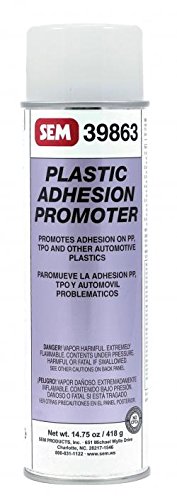
| SEM 39863 Plastic Adhesion Promoter★ Best Overall | All-round plastic and vinyl prep | Aerosol spray | 14.8 oz | — | Amazon |
| 3M 4298UV Adhesion PromoterBest for Trim and Tape | Tape, trim, and emblem bonding | Liquid bottle | 4 fl oz / 118 ml | Approx. 30 seconds | Amazon |
| SEM 39683 Grey Self Etching Primer | Bare metal and sandable base coats | Aerosol spray | 15.5 oz | 3 hours dry / 1 hour full cure | Amazon |
| EternaBond EternaPrime | Dirty, dusty, and cold surfaces | Aerosol spray | 12.2 oz | Fast drying | Amazon |
| KLEAN-STRIP Bulldog Adhesion Promoter | Filling scratches before topcoat | Aerosol spray | 15 oz | 5 minutes | Amazon |
Detailed Reviews
1. SEM 39863 Plastic Adhesion Promoter Aerosol – 14.8 oz.
Our pick — 4.5+★ from 700+ verified ratings; the strongest balance of quality and price.
The can that turns a slick bumper cover into a surface paint will actually grip.
What makes this one the pick for most people is the plastic it was built for. It is formulated to promote adhesion on problem plastics such as PP and TPO — the two families that cover bumper covers, cladding, and a large share of interior trim. Those are exactly the surfaces where standard primer fails. A 14.8 oz aerosol can gives you enough to work around a full bumper cover in light passes.
You clean the panel first, then spray this on before your colour coat, because it is a prep step rather than a finish. Buyers report it holding up in real repair work, including this note: “Did its job helping me epoxy and patch a hole in a plastic bumper on a 2020 Traverse.” People who paint trim panels for a living reach for it when they swap an interior from one colour to another. The consensus is that paint sticks to the promoter far better than it sticks to bare plastic.
One honest limit sits in the durability reports — some owners find it holds up for years, others report chipping. That split usually tracks back to surface prep and topcoat choice rather than the promoter alone, but it means you should not treat this as a one-spray-and-forget step. Clean the panel thoroughly and give it a proper topcoat, and the odds move heavily in your favour.
What earns it the top slot
- Purpose-built for PP and TPO plastics — the hard-to-paint surfaces on bumpers and cladding
- Clear finish means it will not tint your topcoat on visible trim
- 14.8 oz aerosol gives full-panel coverage in light passes
- Consistently reported to improve adhesion on both plastic and vinyl
Where it asks more of you
- Durability reports split between long hold and chipping, so prep quality matters
- No listed dry time on the can data, so you will be following your topcoat maker’s recoat window
Grab this one: if you are painting a bumper cover, cladding, or vinyl trim and need a promoter made for the plastic families that reject paint.
Think twice: if you need a sandable grey base or a scratch-filling formula — the grey SEM and the Bulldog can do that, and this one does not.
2. 3M 4298UV Adhesion Promoter
A four-ounce bottle that goes where a spray can never should.
Here is the number that decides this one: 3.84 ounces. That is the whole bottle, against 16 ounces for the SEM aerosol — and the gap is the point. This is a liquid you apply with a brush, swab, or felt tip, so it lands exactly on an emblem outline or a trim seam instead of misting over your paint. It dries in approximately 30 seconds, which means you can tape almost immediately.
The job it was designed for is not paint — it is tape. It increases the bond strength of acrylic adhesive tapes to most substrates, including plastics, which makes it the right promoter for reattaching vinyl trim, window louvers, and body side mouldings. The clear light yellow liquid is detectable under UV light, so you can check coverage with a blacklight before you commit. That matters when you are laying a bead along a trim seam you can barely see.
What wins people over is the value per job: the bottle is equivalent to 47 sponge applicators, and you only use a few drops at a time. Just plan around its personality. It is expensive per bottle, but a little goes a long way — and once something is stuck, it is stuck, so place the part where you want it the first time.
The real trade-off: this is not a spray-and-walk-away promoter. You are applying it by hand, which is slower on a large panel but far more precise on trim, and it will discolour some plastics if you get it where it shows.
Then the honest ceiling: shelf life is the one area where opinions divide, so buy it when you have a job ready rather than stockpiling it for a project two years out.
The right bottle for you: reattaching trim, emblems, or vinyl mouldings where a spray can would overshoot the target.
Not your answer: if you are priming a whole bumper cover for paint — that is a spray-can task, and the SEM 39863 is built for it.
3. SEM 39683 Grey Self Etching Primer – 15.5 oz.

The grey coat that bites bare metal and gives you something to sand smooth.
The self-etching formula does the biting; the grey pigment gives you a flat, even base that shows you exactly where your surface is still rough. A dry time of 3 hours and a full cure of 1 hour are listed on the spec sheet, so you can plan a same-day topcoat around it.
Adhesion reports stay consistently strong on bare metal, fibreglass, and plastic, and the coverage holds up on real jobs. Owners put the coverage plainly: “15.5 oz can offers excellent coverage.” The spray nozzle gets its own praise for laying down a uniform wide pattern instead of chunky splotches. That is the difference between a base coat you can block flat with 400 grit and one that clogs the paper.
The one thing to know before you buy is the colour. This is a grey primer, and one buyer’s can arrived black rather than grey — a reminder that you should always test the colour on a scrap before committing to a visible panel. The other recurring note is value: plenty of painters find it worth the outlay, some find it on the expensive side. Either way, it earns its place when metal is in the job.
Why it earns a slot: the widest spread of reported strengths here — quality, performance, adhesion, drying speed, and coverage all draw steady approval, and it covers metal and plastic in one pass.
The catch to plan for: colour can vary from the grey shown, so check your can on a test panel before you spray anything visible.
Reach for this if: your job includes bare metal, welded repairs, or a scratched frame that needs a sandable grey base under colour.
Look elsewhere if: you need an invisible clear promoter for coloured plastic trim — that is the SEM 39863’s job.
4. EternaBond EternaPrime Adhesive and Surface Conditioner Spray

When the surface is too dirty to clean, this spray makes it stickable anyway.
Most promoters assume you can get the panel clean first. This one is built for the times you cannot. It works by coalescing loose particles into a solid platform the tape can adhere to, which is why it is the promoter of choice for oxidized roofing, dusty tar-and-gravel, and old rubber that will not come up clean. That is a roofing and tape job, not a paint job, so do not buy it for a bumper cover.
The temperature range is the other reason it earns a place. It was specifically developed for installing EternaBond tapes in low ambient temperatures from 40° F down to -20° F, so a winter roof repair is still on the table. It also doubles as a surface conditioner for self-adhered modified bitumen membranes and butyl tapes. Fast drying and a simple spray nozzle make it forgiving to apply.
The clearest limit is materials: it is not suitable for PVC, and it will not stick to wet surfaces. If your vinyl job is a PVC-backed panel, this is the wrong can. If your job is a weathered rubber roof or a dusty seam that needs a sticky base, the effectiveness is what people talk about most, and leak-proof performance backs it up in the field.
Where it does the work
- Prepares surfaces too dirty or oxidized to clean properly
- Rated for low temperatures from 40° F down to -20° F
- Fast-drying spray with a simple nozzle
- Doubles as a surface conditioner for butyl and modified bitumen tapes
Read this before you order
- Not suitable for PVC, and it will not bond to wet surfaces
- Value opinions divide — some find it expensive for the can size
Built for: roof patches, weathered rubber, and any seam where the surface is dusty, oxidized, or cold.
Wrong tool for: a clean indoor vinyl panel headed for paint — a paint-oriented promoter will serve you better there.
5. KLEAN-STRIP Bulldog Adhesion Promoter
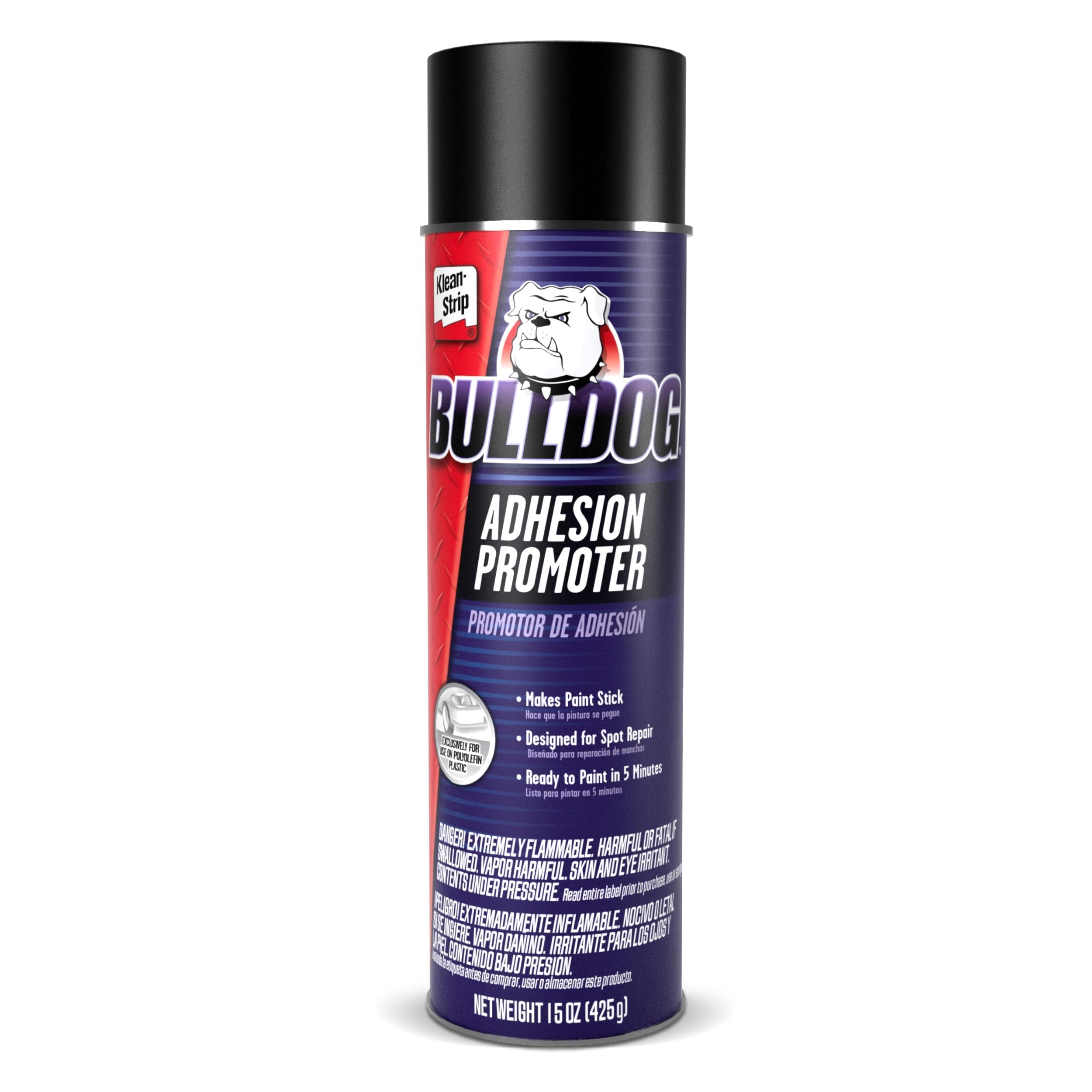
Five minutes to dry, and it quietly erases the fine scratches you were about to sand again.
The headline here is the combination of a 5-minute tack-free dry time and a formula that fills fine 320 grit sanding scratches. That means you can prep a panel, let it flash, and be spraying topcoat inside the same coffee break. It stays active for up to 24 hours after application, so you can prep one day and paint the next without redoing the whole surface.
It is built for polyolefin plastics and plays nicely with acrylic lacquers, basecoats, epoxies, primers, sealers, and solvent-based urethanes. It also improves flake orientation and colour consistency, which matters on metallic finishes where patchy flake shows up as blotches. The 15 oz can arrives ready to spray. A two-year shelf life means you can keep it on the shelf between jobs, and it dries clear so it will not fight your colour.
This is the most expensive can on the list, and the honest question is whether the scratch-filling and 24-hour window justify it for you. What owners mention suggests it does on real body work: it helped hold paint on chrome and plastic without chipping or peeling, and one painter noted it works over leather and vinyl before airbrushing. The clear colour also lets you apply it before or between coats, which is a flexibility the grey primers cannot match.
What makes it stand out: the 5-minute flash, the 24-hour active window, and the scratch-filling make it the most schedule-friendly can here.
What to weigh: it carries the highest outlay of the group, so it makes the most sense when you are prepping visible trim and want to skip a sanding pass.
Best fit: body work on visible trim and chrome where fine scratches need filling and you want to save a sanding step.
Only if it matters: the scratch fill and clear finish are the reason to pay more — if you just need plastic prep, a simpler promoter will do.
Know the Specs
Adhesion Promoter vs. Primer
A promoter is not a paint. It is a thin tie-coat that changes the surface chemistry so your topcoat has something to hold. A primer, by contrast, builds film you can sand. Grey self-etching primers like the SEM 39683 do both jobs — they etch bare metal and lay down a sandable base. Clear promoters like the SEM 39863 and the Bulldog do only the tie-coat job, but they do it without hiding the surface underneath. Decide clear versus grey before you scuff a single panel.
Polyolefin and Why It Matters
Polyolefin is the family name for plastics like PP (polypropylene) and TPO (thermoplastic olefin). They have very low surface energy, which is a technical way of saying paint has almost nothing to grab. That is why a promoter formulated for polyolefin — the Bulldog and the SEM 39863 both are — is the right starting point for those surfaces. A general-purpose primer will still fail on them, no matter how carefully you spray.
Flash Time and Recoat Windows
Flash time is how long the promoter needs before the solvent stops being wet. The Bulldog lists a tack-free 5-minute dry time and stays active for up to 24 hours, so you have a generous recoat window. The 3M 4298UV dries in approximately 30 seconds, which is fast enough for tape work but leaves little margin. Always follow the topcoat maker’s recoat window along with the promoter’s own timing.
Can Size and Coverage
A 15 oz or 15.5 oz aerosol handles a full bumper cover or a set of trim panels in light passes. A 4 fl oz bottle of liquid goes further per ounce because you apply it with a brush or swab, so it suits small, precise areas. Match the format to the job rather than the price: a 15 oz aerosol for a bumper cover, a 4 fl oz bottle for emblems and seams.
Common Questions
Will an adhesion promoter work on vinyl wrap film?
Can I paint over an adhesion promoter without a separate primer?
How long does a can of adhesion promoter stay usable?
Do I need to sand the plastic before applying a promoter?
What is the difference between a clear promoter and a grey self-etching primer?
Will a promoter stop paint chipping on a plastic bumper?
Is adhesion promoter safe on gelcoat or fibreglass?
How soon can I spray colour over the promoter?
Will the promoter damage the plastic if I leave it on too long?
Does EternaPrime work as a paint primer on vinyl?
The Bottom Line
For most people painting plastic or vinyl, the primer for vinyl to reach for is the SEM 39863 Plastic Adhesion Promoter. It is purpose-built for PP and TPO — the bumper-cover and cladding plastics that reject paint — and it sprays on clear. If you need a promoter for tape, trim, or emblems rather than paint, the 3M 4298UV bottle puts it exactly where you want it. And if your job includes bare metal or a scratched frame, the SEM 39683 Grey Self Etching Primer gives you a sandable base under all of it.
How we choose
We do not accept paid placement. Every pick is matched to a real buyer and a real use-case; we do not hands-on test units.
Sources
Specifications: manufacturer listings and product documentation. Review insights: verified customer reviews, as of October 2026. Pricing: not shown on this page (it changes often); check the current price via the retailer link.
As an Amazon Associate, Aappliancez earns from qualifying purchases. This does not affect which products we feature.