Disclosure: Some links in this post are affiliate links. As an Amazon Associate I earn from qualifying purchases, at no extra cost to you. Learn more
Specs are compiled from manufacturer listings and verified buyer reviews and can change over time — please confirm the key details on the product page before buying.
OSB (oriented strand board) is the one panel that swallows paint unevenly — its wax-rich, resin-glued strands soak up a first coat along the edges, then spit a fuzzy, raised surface back at you. The fix is a primer built to grip those slick, thirsty strands before your topcoat goes anywhere near them. Below are five primers that actually bond to engineered wood, ranked by how they behave on real OSB surfaces.
This guide is built by comparing the manufacturers’ published specifications and the patterns across verified customer reviews, so you get each pick’s real strengths and trade-offs instead of marketing spin.
Two of these primers are INSL-X formulas that cure in temperatures as low as 35 °F and bond to glossy tile, PVC, and galvanized metal, which matters when you are priming OSB in a cold garage. If you want the short answer, the primer for osb pick below dries hard enough to sand and works on cabinet-grade surfaces too.
Top Picks


How To Choose The Best Primer for OSB
OSB is not plywood, and it is not MDF. It is a mat of wax-coated wood strands pressed together with resin, and that surface behaves like a sponge with a raincoat on. A primer for OSB has to do two jobs at once: soak into the thirsty wood fibres so the topcoat has something to hold, and bridge the waxy resin that would otherwise let paint flake off in sheets. Get the primer wrong and your beautiful finish will peel in a season.
Bonding primers versus stain-blocking primers
A bonding primer is formulated to stick to slick or hard-to-coat surfaces — glossy tile, PVC, galvanized metal, and sealed wood panels. A stain-blocking primer is built to stop tannins, knots, or old stains from bleeding up through your finish. Most OSB projects want both: a primer that grips the waxy strand surface and locks down any colour that might creep through. If your OSB has knots or old water stains, favour a primer with explicit stain-blocking properties.
Dry time and recoat window
Dry time tells you how long before the surface is touch-safe; full cure time tells you how long before the primer has finished hardening. Those two numbers can be very different. A primer that dries in 1 hour might still need more time before it is fully cured. Follow the recoat instructions on the label — topcoating too early traps solvent and causes the topcoat to lift.
Coverage and can size
A quart of primer typically covers 75 to 100 square feet; a gallon stretches to hundreds of square feet. OSB soaks up more primer than a smooth panel, so buy slightly more than you think you need, especially on a first coat over raw board. A quart handles a small cabinet or door job; the gallon covers a whole subfloor or wall of OSB.
Side-by-Side Comparison
| Model | Best For | Coverage | Dry Time (hrs) | Base Type | Amazon |
|---|---|---|---|---|---|
| INSL-X Stix Acrylic Waterborne Bonding Primer★ Best Overall | Best overall OSB and tricky-surface primer | 75–100 sq ft / quart | 24 | Acrylic-urethane | Amazon |
| INSL-X Aqua Lock Plus 100% Acrylic Stain Blocking PrimerFastest Recoat | Fast-recoat projects needing stain block | 75–100 sq ft / quart | 1 | 100% acrylic | Amazon |
| Stone Coat Countertops Epoxy Undercoat (Black) | MDF and plywood under epoxy pours | 40 sq ft | 4 | Epoxy undercoat | Amazon |
| Stone Coat Countertops Bonding Primer & Sealer | Slick laminate and stone before epoxy | — | — | Urethane modified acrylic | Amazon |
| Zinsser 60001 Peel Stop Clear Binding Sealer & Primer | Chalky, peeling OSB edges and old paint | 300–400 sq ft / gallon | 2 | Water-based clear | Amazon |
Detailed Reviews
1. INSL-X SXA11009A-04 Stix Primer
Our pick — over 4.5★ from 2,500+ verified ratings; the strongest balance of quality and price.
The acrylic-urethane bonding primer that grips OSB’s waxy strands and cures at 35 °F.
If your OSB is going to get wet, sit in a cold shop, or be topcoated with trim paint later, this is the one to start with. It is an acrylic-urethane bonding primer-sealer, and that “bonding” word is the job description: it grips the waxy, resin-sealed strands on OSB just as firmly as it does glossy tile, PVC, vinyl, glass, galvanized metal, and glazed block. For a surface that resists ordinary paint, that is exactly what you need.
The reason painters love it on OSB is the cure window: it fully cures at temperatures as low as 35 °F, which means a cold garage or unheated shop in the cool months is not a dealbreaker. The dry time is 24 hours, which is slow compared to the Aqua Lock Plus below — that one topcoats in as little as 1 hour. If you want to prime overnight and topcoat first thing, Aqua Lock is the faster route. If you want a hard, sandable base that will take almost any topcoat over it, this is the primer that earns the extra wait.
Buyers consistently cite its bonding strength as the reason they keep it on the shelf. Buyers report using it on everything from kitchen cabinets to a bathroom wall covered in green ceramic tile, and the response, in one buyer’s words, is: “this is incredible stuff! It worked amazingly well in covering green ceramic tiles on a bathroom wall. I am really pleased with the results.” That same bonding strength is what makes it a smart pick for OSB, where the challenge is getting anything to hold onto the strand surface at all.
Coverage is 75 to 100 square feet per quart, so a single can handles a full cabinet run or a section of subfloor. It is low VOC and cleans up with warm soap and water. The trade-off is the price-to-volume ratio: this is premium primer in a quart can, and the coverage expectations are the thing that splits owners. Most surfaces take a single coat beautifully; a few people found their boards drank it faster than the label promised, so plan on a second coat over raw OSB and buy enough to cover it.
Where this primer earns its keep
- Acrylic-urethane formula bonds to glossy tile, PVC, glass, galvanized metal, and other slick surfaces OSB shares DNA with
- Fully cures at temperatures as low as 35 °F, so cold-shop OSB work is on the table
- 75–100 sq ft coverage per quart stretches across a cabinet set or subfloor patch
- Low VOC and soap-and-water cleanup keeps the job simple
The catches worth knowing
- 24-hour dry time is the slowest here — plan overnight between coats
- Coverage varies by surface; raw OSB may pull more primer than the label suggests
- Quart-only sizing means bigger jobs need multiple cans
Reach for this if: you need a hard, sandable base coat that will take any topcoat over OSB, cabinets, tile, or metal.
Look to Aqua Lock Plus instead if: your schedule actually matters and you want to topcoat the same day.
2. INSL-X Aqua Lock Plus Primer Sealer
The 100% acrylic stain-blocking primer that topcoats in 1 hour.
Here is the number that decides this pick versus the Stix above. This primer dries to a full cure in 1 hour, against 24 hours for the Stix. That is the entire argument for keeping a quart of Aqua Lock Plus on the shelf: when you want to prime a run of OSB shelves or a subfloor at 8 a.m. and topcoat by lunch, this is the primer that gets out of your way. It is a 100% acrylic water-based sealer, tack-free in 30 minutes with the topcoat window opening in as little as 1 hour.
On OSB specifically, the stain-blocking angle is worth flagging. Engineered wood panels sometimes carry colour that creeps up through light topcoats — old paints, tannins under the surface, or aged resin. Aqua Lock Plus is built as a stain-blocking primer sealer, and its coverage sits at 75 to 100 square feet per quart, the same rating as the Stix. Applied when the surface and air are between 50 °F and 90 °F, it lays down a uniform base coat for either latex or oil finishes on top.
Reviewers most often praise how it seals old paint and bare wood in a single coat. People use it over stucco, wood, old paint, galvanized steel, new sheetrock, plaster, and raw plywood floors, all with success. A long-time user’s summary: “Comes well packaged without leaks or dents to the can. The primer goes onto stucco or wood in a thick coat without much dripping. It seals and covers old paint with a single coat.” That single-coat sealing property is exactly the behaviour you want under OSB topcoats.
Two honest notes. First, the coverage label is 75 to 100 sq ft per quart, but the fine print matters on OSB because it drinks primer faster than a painted surface — buy a little more than you think you need. Second, if your OSB is chalky or has peeling edges, this is not the right tool; that job belongs to a binding sealer like the Zinsser, not a stain-blocking primer.
The case in one line: 1-hour dry time and 100% acrylic stain-blocking, sized in a quart for one-room OSB jobs rather than full-sheet runs.
What to watch: coverage is advertised at 75–100 sq ft per quart but raw OSB is thirsty — plan on a second coat on fresh board.
Best for: same-day priming plus painting on OSB cabinets, subfloors, and shelves where the clock is your real constraint.
Skip if: you need an ultra-hard bonding primer for glossy tile, glass, or metal — the Stix does that job better.
3. Stone Coat Countertops Epoxy Undercoat Black

The black epoxy undercoat that fills MDF and plywood grain into a flat base for epoxy pours.
OSB shows up a lot under epoxy projects — bar tops, workshop counters, garage floors where the board is structural rather than decorative. This undercoat is the layer that fills the strand texture and gives you a smooth, sealed, opaque base so the epoxy resin on top flows flat instead of soaking into open grain. It is a black epoxy undercoat that dries in 4 hours, with a full cure of 4 hours as well, against the 1-hour cure of the Aqua Lock Plus in position 2. In practice the difference disappears in the pour schedule — you mix and pour the epoxy next day, so a 4-hour cure window is comfortable.
Coverage is 40 square feet per quart, and that is the important number. A quart covers a typical countertop or a small table; a wider OSB surface will need more than one can. The finish is gloss, so the base has a visible sheen before your epoxy topcoat ever touches it — which is why the black undercoat reads as such a solid foundation under a clear resin.
Owners mention the finished epoxy pour looks dense and deep, because the smooth base coat shows through. One buyer who used it on a countertop wrote: “This undercoat went on super smooth and gave me the perfect solid black base for my epoxy project. Great coverage, low odor, and it dried evenly.” Another buyer used it on an MDF countertop and finished with epoxy the next day, and reviewers often note it rolls on easily if you mix it first.
The catch is hiding power. Coverage is generous on smooth surfaces, but one reviewer noted that over a sanded countertop it reached almost 85% opacity after two coats. That means you may need a third coat or a heavier second coat on the spots that still show through. Plan on two coats with a light sand between them, and you get the smooth base this undercoat is known for.
Why epoxy installers keep this on hand
- 4-hour dry and full cure, so an OSB or MDF substrate can be sealed and poured the same day or next morning
- Gloss finish creates a dense, flat foundation under clear epoxy
- Low odor and roller-friendly texture makes application fast on flat panels
- 40 sq ft per quart handles a standard countertop or small table top
Where it asks more of you
- Coverage is only 40 sq ft per quart — larger OSB surfaces need multiple cans
- Black pigment may need a second or third coat to fully hide lighter substrates
- It is designed for epoxy systems, so it is not a standalone decorative finish
Who this is for: anyone pouring epoxy over OSB, plywood, or MDF — cabinets, bar tops, shop counters, garage floors.
Look elsewhere if: you want a white finish coat on top of raw OSB with no epoxy going over it — this is a primer, not a paint.
4. Stone Coat Countertops Bonding Primer & Sealer

A urethane-modified acrylic bonding primer that grips laminate, tile, and OSB edges.
Urethane modified acrylic is a mouthful of a spec to read, but here is what it buys you on OSB. The urethane in the formula adds toughness to the film; the acrylic carries the water-based, low-VOC convenience. Together they make a primer and sealer that bonds to slick surfaces like laminate, tile, granite, quartz, solid surface, and cultured marble. OSB is a different animal from those stone-and-laminate surfaces, but the same slick-surface bonding technology is what makes this primer a smart choice on OSB edges where the wax-rich strands resist ordinary latex topcoats.
For epoxy over OSB, this is the highest-rated Stone Coat primer of the two here. Like the black undercoat above, it is designed as the foundation layer before an epoxy pour. You roll on this translucent white coat in two passes with light sanding between them, so the OSB strands are sealed flat before the resin goes on. Cleanup is warm soap and water because the formula is water-based.
Reviewers consistently report the cured film holds up. What shows up again and again across its user reports is how well the coat holds up once cured. A user who refinished a bathroom countertop — “Bathroom countertop looks amazing! Decently thick primer. Could use a little more opacity. Easy to apply. Very durable. Will buy again!” — captures the trade-off and the payoff in the same breath. Coverage across a yellowed laminate counter was noted as excellent with no bleed-through of the original colour, which is the property OSB owners care about when light topcoats go over darker substrate.
The main limitation is opacity. This translucent white formula is not designed to fully hide a dark substrate in one coat, as the user notes above show. Plan the second coat or topcoat before you start. The other adjustment is physical: this is a 1.24 kg (about 2.7 pound) can of liquid primer, so decide where you set it down. On flat OSB, that is a minor detail.
The standout spec: urethane modified acrylic bonds to laminate, tile, granite, quartz, and cultured marble — surfaces that make ordinary primers flake.
The honest caveat: translucent white needs more than one coat to hide darker substrates, so plan for two passes on OSB.
Reach for this when: you are priming OSB for an epoxy pour and want the strongest-adherence water-based formula in the Stone Coat line.
Go with the black undercoat instead if: you want a pigmented base layer that reads dark on the first coat.
5. Zinsser 60001 Peel Stop Sealer & Primer
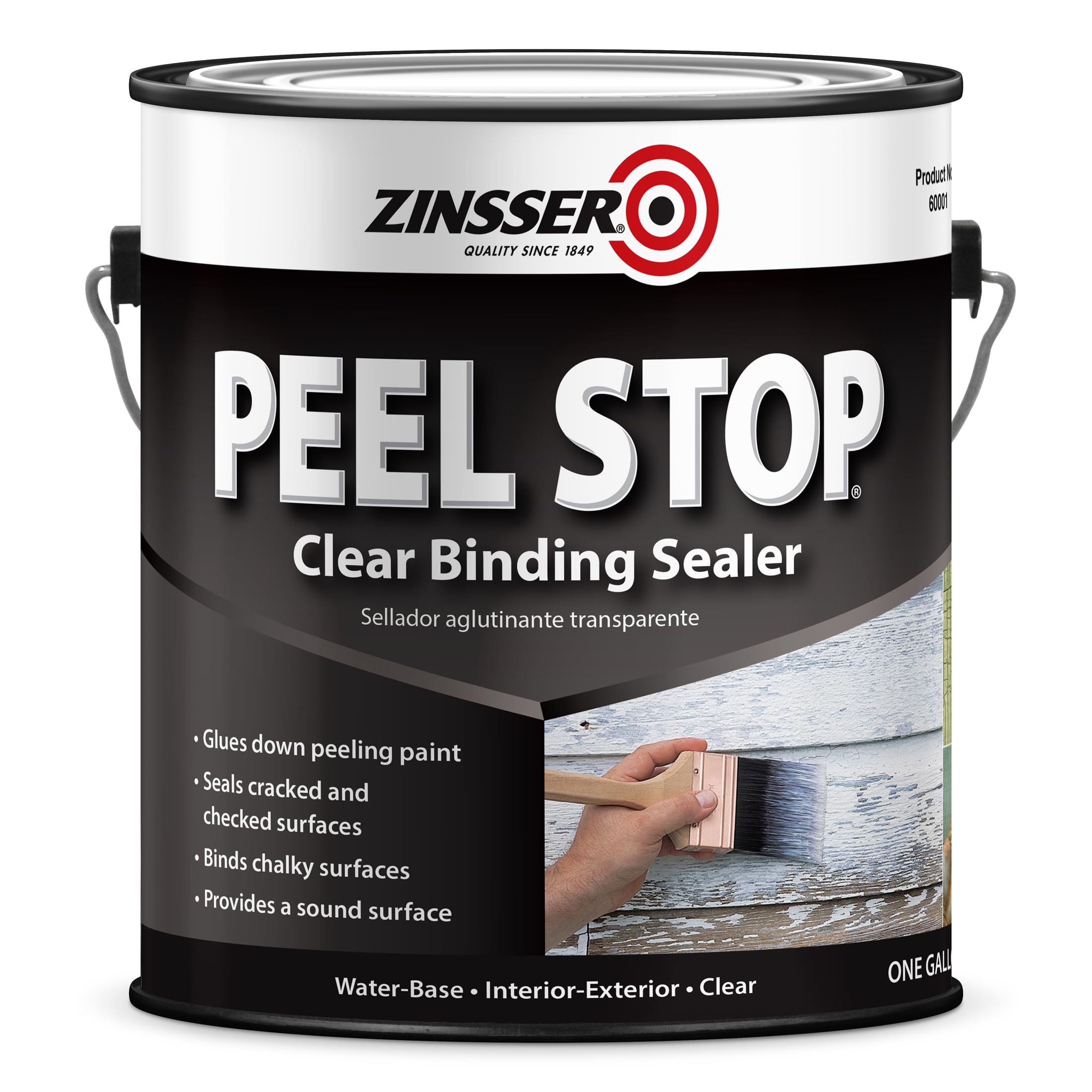
The clear water-based binding sealer that glues down flaking paint and chalky OSB edges.
OSB that has been painted once and then weathered is a different problem from raw board. Its old paint layer chalks, cracks, and lifts, and a fresh topcoat on top of it will peel within a season. Peel Stop is built for exactly that failure mode: it is a water-based clear binding sealer that glues down peeling edges, binds cracks, and seals chalky surfaces. It dries to the touch in 30 minutes, sets fully in 2 hours, and creates a uniform flat-finish surface ready for any alkyd or latex topcoat.
The headline number here versus the other primers is coverage. For OSB shed walls, subfloors, or full panel runs where you just want to seal the surface before topcoating, that economy is the reason to reach for the gallon over the quart. If you want one can to do a big exposed-OSB job, this is the one.
Its standout property is the thin, low-viscosity consistency that lets it wick under lifted paint edges, re-glue them flat, and stop the chalking that raw OSB edges develop. What owners praise the most is how it handles peeling paint — the primary reason people buy it. The user reports back it up on jobs from solid wood doors with flaking paint to small areas where a fresh topcoat would not otherwise stick. On the point of the thin consistency being a genuine plus: “It does the job for flaky paint. It is low viscosity so it feels like it can wick under any remaining loose edges.”
One practical caveat from the same source — that low viscosity also means it can drip if you load the brush too heavily, so apply in thin, even passes and keep a rag nearby. Peel Stop is a bonding and sealing primer, not a pigmented hiding coat; it goes on clear and stays clear, so if you want a colour base before topcoat, this is not the right primer.
Where this primer earns its keep
- Water-based clear formula glues down peeling edges, binds cracks, and seals chalky surfaces
- 300–400 sq ft coverage per gallon stretches across a full OSB wall or floor
- Dries to the touch in 30 minutes and full-cures in 2 hours for fast topcoating
- Topcoat with any alkyd or latex paint over the flat-finish base
What to know before you buy
- Clear, not pigmented — it seals but does not hide the substrate
- Thin low-viscosity formula drips if you overload the brush or roller
- Not a stain-blocking primer; deep stains need a dedicated blocker underneath
Best for: OSB with old chalky or peeling paint, where you want a clear binding sealer that glues the surface flat before topcoating.
skip it if: your OSB is raw and you need a pigmented base coat to build opacity — this primer is clear by design.
Know the Specs
Coverage per Quart vs per Gallon
Coverage tells you how much surface a can will treat in one coat. A quart-rated primer like the INSL-X formulas covers 75 to 100 square feet; a gallon-rated primer like the Zinsser Peel Stop covers between 300 and 400 square feet. The Stone Coat Epoxy Undercoat is rated for 40 square feet, which sounds small until you remember it is a pigment-dense undercoat, not a standard primer. On OSB, expect the thin end of these ranges because the strand surface absorbs more than a smooth panel will. Buy for the worst case and you will not run short mid-job.
Dry Time versus Full Cure Time
Dry time and full cure time are often quoted as different numbers, and both matter. Dry time is when you can touch the surface or apply the next coat; full cure is when the film has finished hardening to its final strength. The INSL-X Aqua Lock Plus is the fastest at 1 hour dry and 1 hour full cure. The Zinsser Peel Stop sets in 2 hours, and the two Stone Coat primers cure in 4 hours. The INSL-X Stix takes the longest at 24 hours dry, but its low-temperature cures at 35 °F make it the pick for a cold shop.
Common Questions
Does OSB need to be primed before painting?
Can I use regular wall primer on OSB?
How long should I wait before topcoating primer on OSB?
Will primer cover the OSB strand texture?
What is the difference between a bonding primer and a stain-blocking primer?
Is the INSL-X Stix or Aqua Lock Plus better for OSB?
Can I use clear Zinsser Peel Stop on bare OSB?
How much primer do I need for an OSB subfloor?
Does Stone Coat undercoat work on OSB under epoxy?
Can I tint the INSL-X Stix primer before using it on OSB?
The Bottom Line
For most OSB projects, the top pick is the INSL-X Stix Acrylic Waterborne Bonding Primer. It bonds to the slick, resin-rich strand surface that makes OSB hard to coat, cures in temperatures as low as 35 °F for a cold shop, and covers 75 to 100 square feet per quart. You can topcoat it with nearly any product. If your timeline is the real constraint, choose the INSL-X Aqua Lock Plus and its 1-hour topcoat window. For OSB with old chalky or peeling paint, the Zinsser Peel Stop is the clear binding sealer that glues the surface flat before topcoat day. If you plan an epoxy pour, either Stone Coat primer — the black undercoat or the translucent white bonding primer — is built as the sealed foundation for exactly that job.
How we choose
We do not accept paid placement. Every pick is matched to a real buyer and a real use-case; we do not hands-on test units.
Sources
Specifications: manufacturer listings and product documentation. Review insights: verified customer reviews, as of October 2026. Pricing: not shown on this page (it changes often); check the current price via the retailer link.
As an Amazon Associate, Aappliancez earns from qualifying purchases. This does not affect which products we feature.