Disclosure: Some links in this post are affiliate links. As an Amazon Associate I earn from qualifying purchases, at no extra cost to you. Learn more
Specs are compiled from manufacturer listings and verified buyer reviews and can change over time — please confirm the key details on the product page before buying.
If you are painting a gate, a trailer frame, a set of wrought-iron railings, or a car panel, the primer is the part that decides whether that finish lasts or peels off in sheets. Bare metal fights paint. It holds moisture, it flashes surface rust within hours of sanding, and glossy galvanized or aluminum surfaces shrug off most topcoats. The picks below solve that specific problem — each one is built to grip bare steel, aluminum, or galvanized metal and hold a topcoat in place.
This guide is built by comparing the manufacturers’ published specifications and the patterns across verified customer reviews, so you get each pick’s real strengths and trade-offs instead of marketing spin.
Some dry in minutes, some need a full day to cure, and one is a rust converter that does two jobs at once. Here is what separates a good primer for metal from one that fails in the first season.
Top Picks


How To Choose The Best Primer for Metal
Metal primer is not one product. It is a small family of coatings, and picking the wrong member of that family is the single most common reason a repaint fails. The three questions below settle most of it before you open a single product page.
Start with the metal, not the color
Bare steel and cast iron are the easy customers — almost any oil-based metal primer will bite into them. The difficult surfaces are the smooth ones: aluminum, galvanized steel, and previously painted panels with a glossy finish. Those need a bonding primer, which is a formulation designed to grab slick surfaces that ordinary primer slides off.
If the metal already has rust on it, you have a decision to make. You can sand the rust back to bare metal and use a standard primer, or you can leave the rust in place and use a rust converter — a coating that reacts with the corrosion and seals it under a hard film. The second route saves a lot of sanding on things like trailer frames and tractor implements.
Dry time is not the same as cure time
Dry-to-touch is when the film stops feeling wet. Full cure is when the coating has hardened all the way through and can take a topcoat, a sanding block, or a bump without moving. A primer that dries to the touch in half an hour may still need hours before it is fully cured, and recoating too early traps solvent underneath. That trapped solvent is what causes the wrinkled, lifted finish people blame on the topcoat.
On a big metal project in cold or damp weather, always give the primer longer than the label suggests. Chemical cure slows down as the temperature drops.
Match the applicator to the shape of the job
A quart can and a brush are right for a run of railings, a gate, or a machine frame where you want to work the primer into pits and corners. An aerosol can wins on anything with curves, grille slats, or small parts, because it puts down a thin, even coat without brush marks. The trade-off is coverage per container — a spray can covers a fraction of what a quart does, so buy accordingly.
Side-by-Side Comparison
| Model | Best For | Form | Dry Time | Volume | Amazon |
|---|---|---|---|---|---|
| Rust-Oleum 7780502 Stops Rust Clean Metal Brush On Primer★ Best Overall | Large exterior metal and masonry jobs | Brush-on liquid | 2 hours | 32 fl oz | Amazon |
| Rustins Red Oxide Metal PrimerBudget Champion | Gates, railings, and small metalwork | Brush, roller, or spray | 0.5 hours | 500 ml | Amazon |
| Rust-Oleum Automotive Universal Bonding Primer Spray | Automotive trim, bumpers, and plastics | Aerosol | 0.5 hours | Aerosol can | Amazon |
| Seymour 20-1672 PBE Professional Primer | Bare metal and body-shop sanding work | Aerosol | 0.08 hours | 500 ml | Amazon |
| Meuvcol 2 in 1 Rust Converter & Metal Primer | Rusted frames, chassis, and outdoor iron | Brush-on liquid | — | 35 fl oz | Amazon |
Detailed Reviews
1. Rust-Oleum Stops Rust Primer
Our pick — over 4.5★ from 500+ verified ratings; the strongest balance of quality and price.
The quart that turns a whole weekend of railings and gate posts into one flat, topcoat-ready surface.
A 32 fl oz can with a brush-on oil-based formula is the right tool when the job is bigger than a spray can can handle and the surface has pits, welds, and corners a spray pattern would miss. This one is rated for interior and outdoor use, so the same can covers a garage door frame, a set of concrete steps, masonry, wood, and the metal gate itself. Drying to the touch in 2 hours with a full cure in 4 means you can usually get a topcoat on the same day you prime.
What wins people over here is the sheer consistency of the finish. The general reaction after a full recoat is that the primer both grips and hides — a heavily rusted section comes back flat and even, and topcoats sit on it without bleeding through. Coverage of up to 90 sq. ft. per can is realistic for a job with any texture to it, and the flat white finish is easy to cover with any color you have in mind.
The trade-off is speed at the pump. This is a slow, work-it-in primer, and the oil base means a mineral-spirit cleanup and real ventilation. Compare it to the Seymour below and the gap is stark — 2 hours to the touch versus 0.08 hours, roughly a 25x difference. If you are chasing a fast-turnaround automotive spray job, this is the wrong can; if you are brushing a whole fence of metal posts in one afternoon, it is the right one. It carries a 4.6-star score, the joint highest on this list.
What earns it the top spot
- One 32 fl oz can covers up to 90 sq. ft. of real surface
- Dries to the touch in 2 hours, fully cured in 4
- Oil-based formula with strong rust prevention on heavy-use metal
- Interior and outdoor rated, and works on wood, concrete, and masonry too
Where it asks patience
- Slow to apply and slow to dry next to an aerosol
- Oil base means mineral-spirit cleanup and open ventilation
- One coat sometimes leaves thin patches on pitted steel
Buy it for: anyone priming a fence line, gate, railing run, or mixed metal-and-masonry surface in one pass.
Pass it up if: you need a fast-turnaround spray finish on automotive panels.
2. Rustins Red Oxide Metal Primer 500ml/16.9fl oz – single pack
The classic red-oxide base coat for ferrous metal, and the fastest-drying brush-on formula in this lineup.
If your project is a set of garden gates, steel railings, a machine frame, or small fabricated parts, this 500 ml can does the job with the least fuss. It is designed for ferrous metals — the iron and steel family — and offers high adhesion so the topcoat stays put. Application is flexible: brush, roller, or spray, so the same can suits a fiddly bracket and a wide flat panel. It handles indoor and outdoor exposure on gates, railings, and machinery.
What the red-oxide crowd tends to appreciate is how quickly it stops being sticky. It dries to the touch in 0.5 hours and reaches full cure in 4, which means a bristle mark sets fast and you can get topcoats moving the same day. The matte red finish is also the traditional undercoat color for wrought-iron work, so if you are matching an existing red-oxide layer you will not see a shade jump.
The honest catch: this is a small container at 500 ml, and the coverage of 12-15 sq. metres per litre depends on how absorbent the surface is. Cold shipping can leave the pigment separated, so buy from a shipper that will not let the can freeze in transit. It carries a 4.5-star score across hundreds of purchases.
What tips the scale: 0.5-hour dry time, a coverage figure that will clearly scale a small-to-medium metalwork job, and a red-oxide finish that already matches traditional ironwork undercoats. The 4-hour full cure is short enough to layer a topcoat the same day.
The small print: the 500 ml can goes quickly on a big project, and cold shipping can leave the pigment separated.
Reach for this if: you are priming ferrous metal in the classic red oxide color and want the fastest brush-on dry in this group.
Look elsewhere if: you are priming aluminum, galvanized steel, or plastic, which need a bonding primer instead.
3. Rust-Oleum Bonding Primer Spray

The spray can that makes slick automotive surfaces want to hold paint — bumpers, trim, aluminum, galvanized steel, and plastic.
This is the primer you reach for when the metal is not the easy kind. Bare steel takes almost anything, but the difficult surfaces in an automotive job — bumpers, plastic trim, fiberglass, galvanized steel, and aluminum — need a formulation designed to bond to something slick. That is precisely what this can announces itself for, and it is why it earns its place in a metal-primer lineup even though its center of gravity is the car world.
Drying is fast: 0.5 hours to the touch, and the flat finish lays down as a smooth, ready-to-coat surface. It covers up to 10-12 sq. ft. per can, which is enough for a bumper or a set of small trim pieces. Owners who have used it on a chrome-adjacent grille surround report the primer both fills quickly and holds the topcoat, and a specific review from a Tahoe chrome-delete project describes it as: “Excellent coverage on plastic; used for chrome delete grille priming on Tahoe. Covers quickly, dries fast at right temperature.”
Two real considerations. The color is flat white — that is what the can says, and buyers expecting a grey primer undercoat have not always gotten that. And the spray pattern is known to run if you load it heavily, so thin passes are the rule. The bonding strength earns the most consistent praise, with coverage and general performance close behind. Spray quality is the most uneven part of the feedback, so a test card before the real panel is smart practice.
Why you reach for it: it is the one spray in this group built specifically for the surfaces that resist ordinary primers — aluminum, galvanized steel, plastic, and fiberglass — with a 0.5-hour dry and a flat finish ready for topcoat.
Where it bites back: the flat white color is non-negotiable, coverage is only 10-12 sq. ft. per can, and heavy application runs. Light passes and a test panel fix both.
Built for: an automotive or mixed-material job where the surface is not plain carbon steel — bumpers, trim, aluminum panels, plastics.
Not the pick for: anyone wanting a grey undercoat or a neutral spray color to hide under light topcoats.
4. Seymour 20-1672 PBE Professional Primer, Sandable Black

A body-shop primer that feels sandable within minutes, not hours — and the fastest film-set time in this group.
Listen for the number here: 0.08 hours to the touch. That is under five minutes, and it is why this primer sits at the professional end of the shelf even though the metal it is aimed at is plain bare steel. Sandable in five minutes, heat resistant up to 250°F, and sprayed through a large head built to imitate a spray gun, it behaves more like a shop tool than a consumer aerosol.
The reason that matters in a body shop is turnaround. You can prime a bare-metal repair, let it flash off, and get a sanding block onto it inside the same session, rather than waiting out a 2-hour cure. A five-star review captures it: “This stuff dries soo fast and actually coats on really nice, this is one of the best sandable primers I’ve used.” Coverage gets consistent praise too — buyers report it fills low spots extremely well, which saves filler work on pitted panels.
The recurring gripe here is adhesion, and it is genuinely mixed in the feedback — most owners mention strong grip to bare and scuffed metal, but a share of reports say it does not bite evenly on less-prepared surfaces. Which is consistent with what the can tells you: this is a primer formulated for bare metal, not for plastic or smooth trim. It is also a fan-spray pattern, and one commenter on the review pages put it plainly: “I wish it wasn’t a fan spray cause sometimes you want to cover a smaller area.” If your job is a wide, flat panel, the fan spray is an advantage; if it is a cluster of small brackets, it becomes a nuisance.
Why the shop crowd keeps it around
- Under five minutes to the touch — the fastest dry on this list
- Sandable in five minutes, so you can block it down the same session
- Heat resistant up to 250°F
- Large spray head mimics a gun for a smoother lay-down
- Fills low spots on pitted bare metal
What to know before the first pass
- Adhesion reports are genuinely mixed — prep the metal first
- Fan-spray pattern is awkward for small, tight parts
- Noticeable solvent smell during application
For the impatient job: bare-metal repairs and body panels where you want to prime and sand in a single session without waiting out a cure.
Think twice if: the metal is plastic, painted, or smooth trim — this one wants bare steel and proper prep.
5. Meuvcol Rust Converter & Metal Primer
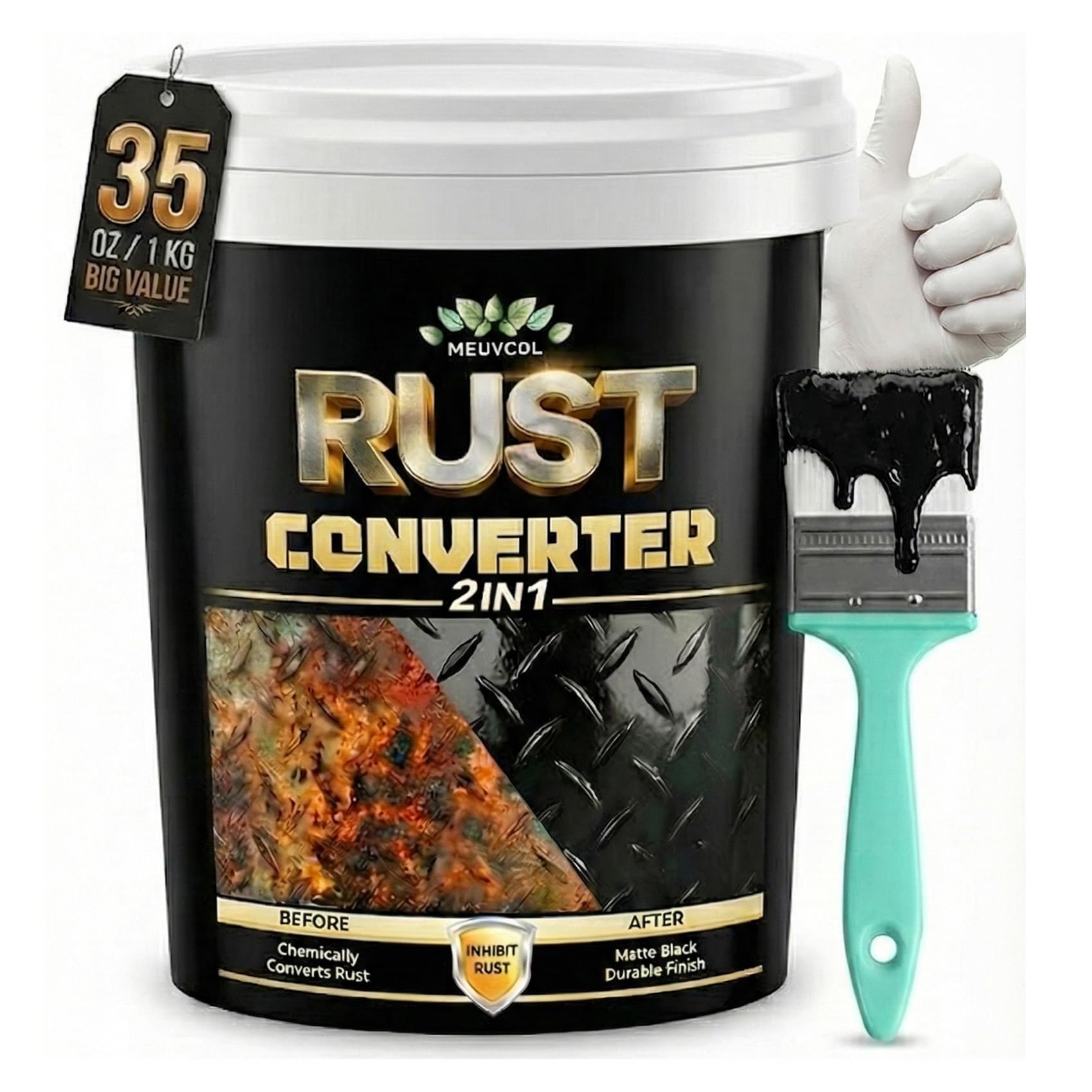
A quart-sized brush-on that skips the sanding step entirely and seals rusted metal under a black, topcoat-ready film.
When the metal is more rust than paint, this is the pick. It is a two-in-one — a rust converter and a primer in one can — designed to be painted directly onto corroded surfaces, trailer frames, truck chassis, and outdoor iron, without stripping back to bare steel first. It arrives as a 35 fl oz liquid with a brush, gloves, and instructions, and it is rated as waterproof for interior and outdoor use.
The application process laid out on the can is simple: clean grease and oil off the metal, wipe dry, and brush the coating on in thin layers — at least two — allowing 24 hours for the film to form. The result is a matte black finish on both rusted and bare metal that is ready to topcoat. Customers note it covers oxidized surfaces well: an antique statue with green oxidation took two coats and showed no seepage, and a truck-frame job returned positive feedback. Coverage stretches to a full set of front fenders, core support, and frame rails per the manufacturer’s stated figures.
Two honest caveats. The coating is on the stronger end of the smell spectrum, so brush it outdoors or in a well-ventilated space. And some buyers describe the finish as looking more like a black paint than a converted, chemically dark layer — which is fine if you are topcoating, less fine if you expected a bare-metal look underneath. Rust coverage and value for money are the two aspects with the most mixed feedback; quality and raw functionality lead the positive side. It carries the largest volume of feedback of any brush-on or spray option here.
What the black finish delivers: 35 fl oz of space-grade rust-sealing coverage in a single container, brush and gloves included, and no need to sand corroded surfaces back to bare metal before priming.
The caveat to plan around: it takes two thin coats and 24 hours to cure, the solvent smell is strong during application, and the finish reads as black paint rather than an exposed converted-metal look.
The go-to for: trailer frames, chassis rails, farm equipment, and heavily rusted outdoor iron where sanding every pit is not realistic.
skip it if: the metal is clean and bare already — a standard primer does the job without the 24-hour cure window.
Know the Specs
Dry Time versus Full Cure Time
Dry time is when the primer stops feeling wet to a light touch. Full cure time is when the coating has hardened all the way through and can take a topcoat, a sanding block, or a physical scrape. The two numbers are often very different — one primer in this group is dry in 2 hours but fully cures in 4, another is dry in 0.08 hours but takes longer before it is truly settled. Recoating at the dry time instead of the cure time is the single most common cause of a wrinkled, lifted finish, because solvent stays trapped under the new layer.
Brush, Roller, or Aerosol
Brush-on primers work into pits, welds, and corners where a spray pattern cannot reach, and they put down a thicker film per pass. Aerosols lay down a thinner, more even coat over curves and small parts, without brush marks or bristle texture. The trade-off is coverage: an aerosol can covers a small fraction of what a quart or 35 fl oz container does, so match the applicator to the surface area of the job rather than buying the cheapest option on the shelf.
Bonding Primers and Difficult Surfaces
Bare carbon steel is easy to prime. Smooth aluminum, galvanized steel, plastics, and fiberglass are the hard cases, because ordinary oil-based primers struggle to bite into a slick surface. A bonding primer is formulated specifically to grab those materials and hold a topcoat. If your project has any of those surfaces in it, use a bonding formulation designed for them rather than a general-purpose metal primer.
Rust Converters and Rust Encapsulators
A rust converter is a coating that reacts with existing corrosion and seals it under a hard film, so you can prime and topcoat a rusted surface without sanding back to bare metal. An encapsulator locks rust in place without the chemical conversion step. Both save labor on large, pitted surfaces like trailer frames and chassis rails. The trade-off is a longer cure window — often a full day — before a topcoat can go on, and a finish that reads as paint rather than exposed converted metal.
Common Questions
Do I need a special primer for galvanized steel?
Can I paint directly over rust with a metal primer?
How long after priming can I apply the topcoat?
Will metal primer work on aluminum?
Brush-on or spray primer for a metal gate?
Can I apply metal primer below freezing?
Is a rust converter better than a metal primer for a trailer frame?
Do I need to sand the primer before the topcoat?
What color should a metal primer be?
Is it worth paying more for a professional-grade primer?
The Bottom Line
The winner on the merits is the Rust-Oleum 7780502 Stops Rust Clean Metal Brush On Primer, because it covers the widest range of surfaces — metal, wood, masonry, and concrete, indoor and outdoor — and does it in one 32 fl oz can with a 4-hour full cure that lets you topcoat the same day. If your metal is not bare carbon steel — bumpers, aluminum panels, plastics, galvanized trim — the Rust-Oleum Automotive Universal Bonding Primer Spray is the right bonding formulation instead. For a rusted trailer frame or chassis that would take all day to sand, the Meuvcol 2 in 1 Rust Converter & Metal Primer does the priming and rust-sealing in one brush-on step.
How we choose
We do not accept paid placement. Every pick is matched to a real buyer and a real use-case; we do not hands-on test units.
Sources
Specifications: manufacturer listings and product documentation. Review insights: verified customer reviews, as of October 2026. Pricing: not shown on this page (it changes often); check the current price via the retailer link.
As an Amazon Associate, Aappliancez earns from qualifying purchases. This does not affect which products we feature.