Disclosure: Some links in this post are affiliate links. As an Amazon Associate I earn from qualifying purchases, at no extra cost to you. Learn more
Specs are compiled from manufacturer listings and verified buyer reviews and can change over time — please confirm the key details on the product page before buying.
Galvanized metal is the one surface that makes ordinary paint fail — the slick zinc coating sheds topcoats like wax paper, and a primer that cannot bite into it will flake off within a season. The fix is a primer built for slick, non-porous metal: an etching primer (one that mildly bites the surface so paint can grip), a galvanizing primer (one that lays down a zinc-rich layer so rust cannot start), or an epoxy primer (a two-part coating that seals the metal). For railings, gates, gas meters, and farm equipment that live outside, that single product choice decides whether your repaint lasts years or weeks.
This guide is built by comparing the manufacturers’ published specifications and the patterns across verified customer reviews, so you get each pick’s real strengths and trade-offs instead of marketing spin.
Below you’ll find five primers that hold up on galvanized steel, matched to the job in front of you rather than a spec sheet. Every entry is here because it earns a place on a galvanized or rusted-metal job, so this is the shortlist worth your time when you want the primer for galvanized metal that actually holds.
Top Picks

How To Choose The Best Primer for Galvanized Metal
Galvanized metal wears a thin zinc skin that protects the steel underneath — but that same zinc skin is smooth and non-porous, so standard paint has nothing to grab onto. That is the whole problem in one sentence. The right primer either etches into the zinc or lays down an adhesive layer the topcoat can grip. Get that choice right and the repaint sticks; get it wrong and you are scraping flakes off the railing by spring.
Etching vs galvanizing vs epoxy
An etching primer contains an acid ester that bites microscopically into bare or galvanized steel, giving the topcoat a rough surface to lock onto. A galvanizing primer paints on a zinc-rich layer that acts as a sacrificial coating — it rusts first so your steel does not. A 2K epoxy primer (a two-part product you activate before spraying) seals the surface with a tough, sandable film and blocks rust hard. If your metal still shows its factory zinc shine, an etch or galvanizing primer is the natural first move. If you are sealing bare steel or rust you have already cleaned back, the epoxy route holds up best.
Dry time vs cure time
Dry-to-touch is when you can carefully handle the surface; full cure is when the coating has hardened for the long haul. These are not the same number, and the gap matters — a product that flashes dry fast can still need far longer before it is truly set. Plan your topcoat and reassembly around the full-cure figure, not the touch test, or you risk wrinkles and soft spots under the finish coat.
Rust and prep reality
No primer fixes rust that is still flaking. Scrape loose rust back, clean the surface, and wipe off oil before the can opens. Heavily rusted metal actually wants a rust-converting oil-based primer rather than a bare-metal etch, while clean galvanized steel wants the etch or galvanizing type. Match the primer to the metal’s actual condition now, not to what it was when new.
Side-by-Side Comparison
| Model | Best For | Application | Dry Time | Full Cure | Amazon |
|---|---|---|---|---|---|
| Rust-Oleum Stops Rust Brush On Rusty Metal Primer, Flat★ Best Overall | Heavily rusted gates and railings | Brush, roll, or spray | 1 hour | 4 hours | Amazon |
| Krylon Rust Tough Galvanizing PrimerFastest Touch-Up | Quick touch-ups on fences and meters | Aerosol spray | 1 hour | 20 minutes | Amazon |
| Raptor Acid Etch Primer 1K Aerosol, 13.2 OZ | Galvanized and aluminum panels | Aerosol spray | 1 hour | — | Amazon |
| SEM 39683 Grey Self Etching Primer – 15.5 oz. | Bare-metal panel prep | Aerosol spray | 3 hours | 1 hour | Amazon |
| SprayMax 2K Epoxy Primer Black | Sealing cleaned steel before topcoat | Aerosol spray | 12 hours | 12 hours | Amazon |
Detailed Reviews
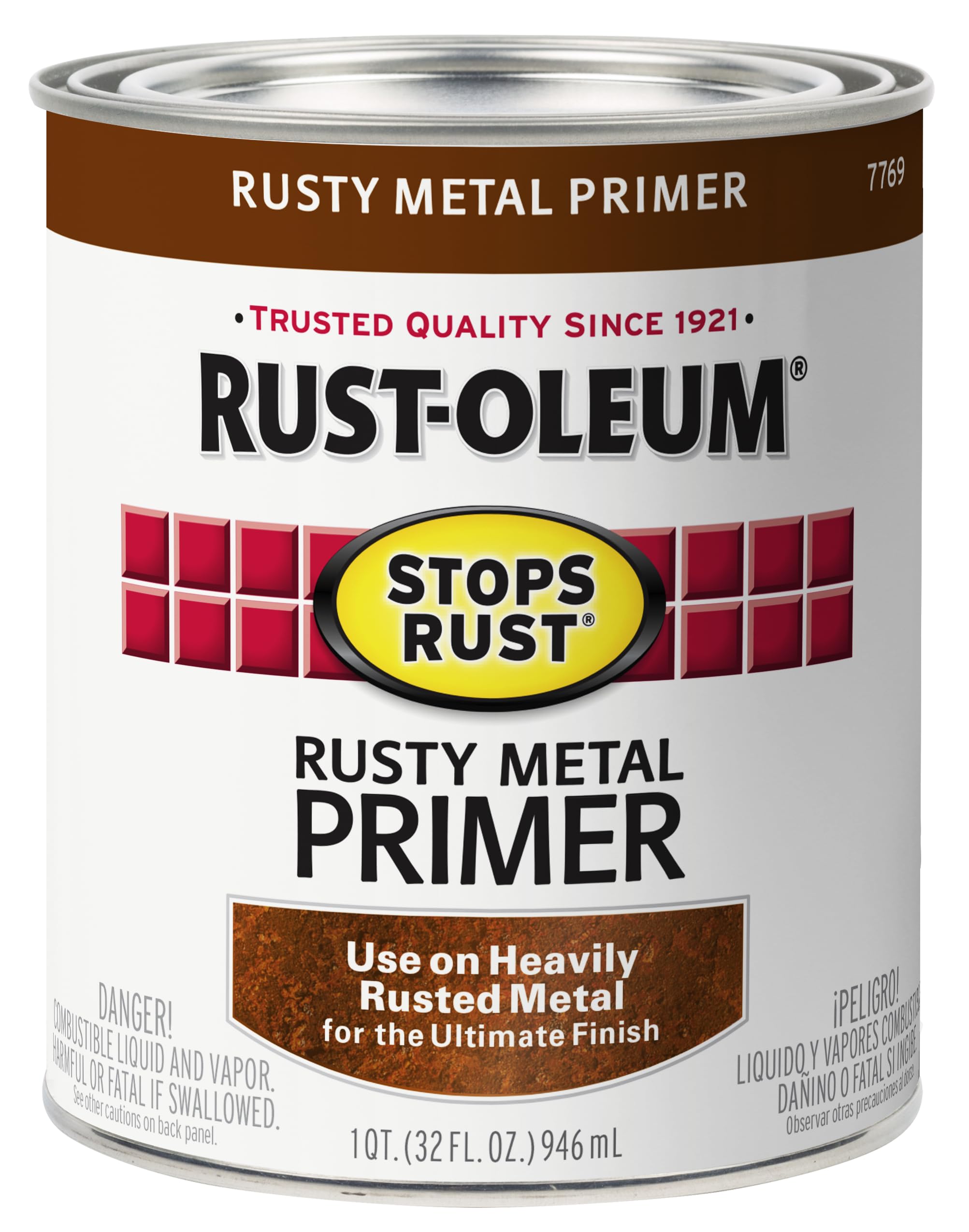
1. Rust-Oleum Stops Rust Brush On Rusty Metal Primer, Flat
Our pick — over 4.5★ from 800+ verified ratings; the strongest balance of quality and price.
The oil-based workhorse that grabs rusted galvanized metal and does not let go.
If your galvanized gate or U pipe has already started spotting rust, this is the primer to reach for first. It is an oil-based formula made to prime heavily rusted metal, and it lays down a protective coating that stops the corrosion from spreading under the topcoat. You can brush it, roll it, or spray it, so awkward railings and pipe joints are not a problem. It is the crowd favorite here — 4.7 stars across 800+ owners.
The coverage story is straightforward. A single can covers 65–110 sq. ft. per the brand’s own figure, so a typical porch railing or gate frame is well within one container. It dries to the touch in 2–4 hours and full-cures in 4 hours — a schedule you can work around on a Saturday. Compared with the SEM self-etching primer, the Rust-Oleum takes far longer to set, but it is also the one built for the metal you already own, rust and all. What wins people over is raw performance on corrosion: the rust-control and coverage results are the two things that earn the most praise among the ratings, with ease of application close behind.
The honest catch sits in the tin, not the formula. Several owners note the packaging arrives dented or the lids are taped over in ways that peel the instructions, and one reported a can leaking in transit. Treat the shipping box as part of the job and inspect on arrival. The drying-time figure also draws mixed feedback — some find it slower than expected in cooler weather.
What It Nails
- Handles heavily rusted galvanized pipe and railings instead of needing bare metal
- Brush, roll, or spray — one can covers 65–110 sq. ft.
- Full cure in 4 hours, so a same-weekend topcoat is realistic
- Oil-based film is waterproof and rated for indoor and outdoor use
Where It Bites Back
- Drying time draws mixed reports — slower than expected in cold weather
- Cans can arrive dented and taped; inspect the delivery
- Thinning for storage needs care — add thinner to what you keep
Reach for this if: your galvanized surface has rust spots and you want a brush-on primer that clings to the metal you already have.
Look elsewhere if: you want a fast-drying spray for a small touch-up — a quick-dry aerosol suits that job better.
2. Krylon Rust Tough Galvanizing Primer
Thirty-minute dry time and no primer underneath — spray it straight onto the metal.
For a gas meter, chain-link fence, or any galvanized surface you want to cover and walk away from, this is the fastest route. It is a galvanizing primer that goes on direct to metal with no separate primer step, and it dries to the touch in just 30 minutes. That is far quicker than the Rust-Oleum’s 2–4 hour touch dry — a real difference when you are working outdoors and watching the sky. Coverage runs up to 25 square feet, so a meter box or a short fence section is a one-can job.
The finish is a zinc-gray that reads as bare galvanized steel rather than a pastel undercoat. Sprayer layup earns consistent praise — owners describe even, predictable coverage from the nozzle, and the quick dry and clean silver appearance are the two things that get the most positive ink. A Jeep owner repainting rust spots on a bright metallic silver body found the match close, and another found the semi-flat finish hides surface defects on wrought iron far better than gloss. The one caveat on that front: it is not as thick as some rival paints, so plan on two light coats rather than one heavy pass.
Ventilation matters here more than most. The can carries zinc, and a welder’s note in the reviews warns that inhaling zinc fumes without a mask can leave you with “zinc fever, rash” — so spray outside or wear a chemical mask regardless of the job’s size. Finish options also affect the result: on a smooth surface, gloss will show every defect and dull in strong sun, while the flat finish hides more.
The rapid-fire pick: the standout is 30-minute dry-to-touch when speed is the priority.
Spray it safe: the zinc content means ventilation or a mask is non-negotiable on any job, big or small.
Built for: quick outdoor touch-ups on galvanized fences, meters, and handrails where you want the job done in one afternoon.
Not the one for: restoring a heavily rusted surface that needs a rust-converter base — this is a coverage and sealing primer, not a rust-stopper.
3. Raptor Acid Etch Primer 1K Aerosol, 13.2 OZ

A phosphoric-acid etch built specifically for slick zinc and aluminum panels.
This is the one that names galvanized steel outright in its formula. The acid-etch chemistry uses a phosphoric acid ester to bite into hard-to-bond surfaces like galvanized steel and aluminum, creating a foundation a topcoat can actually grip. It etches and primes in a single step, so there is no separate sanding stage — you spray it onto bare metal and go straight to color. Repeat buyers confirm it drops a two-light-coat finish that boosts durability, and that the same-brand gray lines up neatly with Stingray paint.
Bare-metal jobs are exactly what this is designed for. Owners who repainted running boards without stripping factory paint first reported the primer refused to bubble the finish underneath — a sign it plays nice with the metal rather than fighting it. It dries fast enough that a next-day install is realistic. The flat-fan nozzle gives a wide, even spray pattern for coverage without drips, and it topcoats directly with most paint systems.
What this is not is a rust-converter. If your galvanized surface is already pitted and flaking, you want the Rust-Oleum oil-based primer above rather than an acid etch, which is built for sound metal. It also does not list a coverage figure, so buying the right amount takes a little judgment per panel. And the checkered finish — it is a matte gray etch, not a finished look — means it is meant to be covered, not left bare.
The galvanized specialist: this is the only pick here that names galvanized steel as a target surface in its own formula.
Bare metal only: it etches sound metal beautifully, but a rusted, flaking surface needs an oil-based converter instead.
Right call when: you have clean galvanized or aluminum panels, no sanding planned, and want a single-step etch that takes a topcoat directly.
Wrong tool for: pitted, heavy rust — that calls for the Rust-Oleum brush-on primer up top, not an etch meant for sound metal.
4. SEM 39683 Grey Self Etching Primer – 15.5 oz.

The uniform-spray etch that panel beaters trust for a smooth bare-metal base.
For a bare-metal job where the finish quality has to be even, this is the etch to beat. Self-etching means the product primes bare metal, fiberglass, and plastic, and it cures in just 1 hour — notable when the Rust-Oleum oil-based primer needs 4 hours to fully set. That quick harden pairs with a nozzle that lays down a wide, uniform pattern, so you get a smooth base rather than the chunky splotches that cheaper etch cans can leave. Quality is the aspect that earns the most praise among the ratings, with performance and adhesion right behind it.
The coverage is worth knowing too. Owners find a single 15.5 oz can goes a good distance on panel work, which helps blunt a recurring gripe: the price. Value-for-money is marked mixed — many owners consider it well worth it, while some find it overpriced for a single can. If you are priming a bare-metal project where the finish has to be flawless, the smooth layup justifies itself; if you are touching up a whole fence, the Rust-Oleum can goes much further for the same money.
One honest note on color. Despite the Grey label, at least one owner opened the can to find the pigment itself was black — a reminder to test a small area before committing on a visible surface. The spray is not perfectly clean either; a minority report a little spitting. But adherence, the thing that actually matters for a primer, is consistent.
Why Painters Like It
- 1-hour full cure — the fastest hardening of the five primers here
- Uniform wide-pattern spray means a smooth base without splotches
- Adheres to bare metal, fiberglass, and plastic
- 15.5 oz can covers a good amount of surface area
What to Weigh
- Value-for-money is mixed — some find a single can pricey
- Minor spitting reported on some cans
- Color confused one buyer who expected grey pigment
Ideal for: bare-metal restorations and panel work that will be seen up close, where the fastest clean etch matters.
Skip it for: whole-fence coverage or rusty heavy metal — a brush-on oil-based primer stretches further and handles rust this etch is not made for.
5. SprayMax 2K Epoxy Primer Black

A two-part epoxy that seals steel and galvanized metal under a sandable black film.
This is the professional-grade option in the group: a 2K epoxy primer, meaning two parts you activate inside the can before spraying, which cures into a tough sandable coating. That two-part chemistry is what gives it its hard-sealing claim on steel, aluminum, and galvanized metal. You get a variable nozzle for control and a dust-dry time of just 15 minutes, ready to sand within hours. Owners who spray it consistently describe even coverage and clean black adhesion on bare, cleaned metal, with good corrosion resistance under the finish.
Where it stands out is sandability and workflow. One owner primed both halves of a motorcycle fairing from a single can and sanded flat with 600 grit without cutting through anywhere — the kind of result that makes an epoxy primer worth its price. It plays well on truck-bed coating and bare cleaned metal, and does not carry the clog or run problems some cheaper 2K cans suffer. The adjustable tip makes control easy for a DIYer spraying their first two-part product.
But be honest about the ceiling. The cure time is the longest here at 12 hours, so a quick turnaround is out. Of the four products here with a mixed rating, this one’s trade-off is sharpest — the two-part system clashes with shortcuts, and while it is designed for the job, the primary complaint from some owners is that it does not match the quality of the same brand’s 2K clear coat. Simply put, it is expensive for a single can, and it is not the forgiving, one-shot aerosol you would grab for the garage railing.
Best for: automotive and motorcycle work where the surface will be sanded and topcoated for a professional result.
Not for quick jobs: 12 hours of cure time means this is a plan-ahead primer, not a same-day touch-up.
Know the Specs
Application Method
Brush, roll, spray — the format decides how you work. A brush-on oil-based primer reaches into railings and pipe joints a spray cannot, and it lays on heavy coats for heavy rust. An aerosol gives you a controlled, even pattern for panels and touch-ups but thinner coats, usually called in two passes. Match the format to the shape of the metal, not to the label.
Dry Time vs Full Cure
Dry-to-touch is your handling window; full cure is when the film is actually hard. A primer can flash dry in 15–30 minutes yet still need hours before it is ready for a heavy topcoat. Stack your work around the full-cure figure — spray or brush, let it harden fully, then topcoat — or the finish will wrinkle and stay soft.
Coverage Per Can
Coverage is your per-can reach — often listed in square feet or as a fluid-ounce volume. A tight coverage figure means more cans for a big job; a generous one means less waste. Know your surface area before you buy, and add a can’s worth of cushion so you do not run short halfway through a fence or a frame.
Etch vs Seal Chemistry
Acid-etch and self-etch primers bite into sound bare metal to improve grip, while galvanizing and epoxy primers coat the surface with a protective layer that blocks rust. Etches suit clean panels; sealers suit steel you have already cleaned and want sealed. Choose by what your metal is, not by which can sounds tougher.
Common Questions
Do I really need a special primer for galvanized metal?
Can I paint directly over galvanized metal without any primer?
How long should I wait before topcoating a metal primer?
Does a self-etching primer work on galvanized steel?
Can I use a paintbrush instead of a spray can on a galvanized railing?
What is the difference between a 1K and a 2K primer?
Do I need a respirator when spraying a zinc-based primer?
Will one can cover a whole galvanized fence?
What is the best primer if the galvanized metal is already rusted?
Can I leave an etch primer unfinished as a topcoat?
The Bottom Line
For most people taking on galvanized metal, the primer for galvanized metal winner is the Rust-Oleum Stops Rust Brush On Rusty Metal Primer, Flat because it handles the rusted, heavy-use reality of galvanized gates and railings that no rapid aerosol can touch, and its oil-based film is rated waterproof for indoor and outdoor use. If you want the fastest clean-etch option for a bare panel, the SEM 39683 Self Etching Primer is the one that hardens in an hour and lays down the evenest spray. And if you are sealing cleaned steel before a professional topcoat, the SprayMax 2K Epoxy Primer is the sandable epoxy that earns its keep. Start with the one that matches your metal right now — sound or rusted — and the repaint will hold.
How we choose
We do not accept paid placement. Every pick is matched to a real buyer and a real use-case; we do not hands-on test units.
Sources
Specifications: manufacturer listings and product documentation. Review insights: verified customer reviews, as of October 2026. Pricing: not shown on this page (it changes often); check the current price via the retailer link.
As an Amazon Associate, Aappliancez earns from qualifying purchases. This does not affect which products we feature.