Disclosure: Some links in this post are affiliate links. As an Amazon Associate I earn from qualifying purchases, at no extra cost to you. Learn more
Specs are compiled from manufacturer listings and verified buyer reviews and can change over time — please confirm the key details on the product page before buying.
If your well pump clicks on and off every time you open a tap, or your water pressure surges and drops, the pressure switch bolted to your tank is usually the culprit. A pressure switch is the part that tells your pump when to start and when to stop. Picking the right one depends on three things: the cut-in and cut-out pressure settings your system needs (the psi at which the pump turns on and off), the thread size on your pipe, and if you want a mechanical switch or a digital controller that shows you the actual number. This guide covers the pressure switches and controllers worth bolting onto a well tank right now.
This guide is built by comparing the manufacturers’ published specifications and the patterns across verified customer reviews, so you get each pick’s real strengths and trade-offs instead of marketing spin.
Most well owners just need a like-for-like replacement that matches the pressure settings already on their tank. The trick is reading the old switch before you order, so you match the setting and the thread instead of guessing. Matching the setting and thread before you order turns a five-minute swap into a week of troubleshooting.
Top Picks


How To Choose The Best Pressure Switch for Well Pump
A pressure switch is a small box with a spring-loaded diaphragm inside that senses the water pressure in your tank. When pressure drops to the cut-in point, it flips the pump on. When pressure climbs to the cut-out point, it flips the pump off. Get those two numbers wrong and your pump either short-cycles or never reaches full pressure. Here is what to check before you buy.
Match the pressure setting to your system
Well systems run on a standard ladder of settings: 30-50 psi or 40-60 psi are the two most common pairs, and they are usually printed right on the old switch. Check the label before you shop and buy the same pair — a 40-60 switch cannot be easily dialed down to a 30-50 system without fiddling with the adjustment nut. The cut-out is the top number the pump stops at, and the cut-in is the bottom number the pump restarts at; the gap between them is the differential.
Check the thread, not just the brand
Most residential pressure switches mount on a 1/4-inch pipe port on the tank tee, but larger tank tees and some well setups use 1-inch male NPT and 3/4-inch female NPT threads. A mismatched thread will not seal, no matter how much teflon tape you wrap. Take a photo of your existing fitting before you order so you can compare thread type side by side.
Decide between mechanical and digital
Mechanical switches use metal contact points that eventually pit and stick, which is why they eventually need replacing. Digital pressure controllers replace those points with a sensor and a screen, let you set high and low pressure with a button press, and show the live pressure reading so you do not need a separate gauge. They cost more, but they can also add dry-run protection that shuts the pump off when your well runs low.
Look for low-pressure cut-off if your pump is expensive
On a standard switch, if a pipe bursts or the well runs dry, the pump keeps running until someone notices. A low-pressure cut-off feature trips the switch off when pressure falls roughly 10 psi below the cut-in point, which protects the motor from running dry and burning out. If your pump is a submersible or jet pump that would be painful to pull and replace, that feature alone is worth paying a bit more for.
Side-by-Side Comparison
| Model | Best For | Pressure Setting | Thread / Connection | Key Feature | Amazon |
|---|---|---|---|---|---|
| Telemecanique Sensors 9013FSG2J24★ Best Overall | Exact replacement on 40-60 psi systems | 40-60 psi (20-65 psi cut-out) | 1/4 inch FNPS port | Phosphor bronze contacts, 40 A rating | Amazon |
| Square D FSG2J24CPEasiest Install | Arrives pre-set and ready to wire | 40-60 psi | Standard tank tee port | Stainless steel body, pre-set from the factory | Amazon |
| Square D 30-50 FSG2 (9013FSG2J21) | Submersible pump systems on 30-50 psi | 30-50 psi | Standard tank tee port | Stainless steel body, submersible style | Amazon |
| Telemecanique Sensors 9013FSG2J21M4 | Protecting a pump from dry-run damage | 30-50 psi (20-65 psi cut-out) | Clamp connector | Low-pressure cut-off, 60 A rating, IP20 | Amazon |
| Schneider Electric 9013FSG2J24M4 | 40-60 psi systems that need dry-run protection | 40-60 psi (20-65 psi cut-out) | Clamp connector | Diaphragm actuated, low-pressure cut-off | Amazon |
| GamaTech 110V 145PSI Digital Adjustable | Anyone who wants to see the actual pressure number | 0-145 PSI, adjustable by button | 1/2 inch male NPT | Digital display, IP66 waterproof, dry-run shut-off | Amazon |
| Miumoon 1″x 11″ Well Pressure Tank Tee Kit | Building or rebuilding a tank tee from scratch | 40-60 psi switch included | 1 inch male NPT, 3/4 inch female NPT | Full kit with gauge, relief valve, drain valve | Amazon |
Detailed Reviews
1. Telemecanique Sensors 9013FSG2J24 Air-Pump Pressure Switch
Our pick — 4.5+★ from 650+ verified ratings; the strongest balance of quality and price.
A straight swap for the Square D switch most well tanks already wear.
If your tank is already running a 40-60 psi setup, this is the buttoned-up choice for a drop-in replacement. It ships with a 40-60 psi pressure setting, a 20-65 psi cut-out range, and a 15-30 psi adjustable differential, so the whole band of pressure your pump lives in is covered. The body also carries a 40 A current rating, which is plenty of headroom for a typical residential well pump motor.
For owners swapping out an old Square D unit, that match matters most — the mounting pattern and pressure range mirror what was already there. Buyers report it is an “exact duplicate of my old SquareD model” that is built exactly the same with no visual difference, and the review pages carry plenty of car-wash and multi-tap setups where the pump runs hard and often. The 1/4 inch FNPS port (a standard pipe thread size) is the standard well-tank fitting, so it threads onto a typical tee without an adapter. The phosphor bronze contact points inside (a metal that resists wear) are the reason these switches keep working across thousands of on-off cycles.
One honest catch: a few buyers have flagged water-pressure accuracy as hit-or-miss from the start, and the model is now assembled in Mexico rather than France as older units were. Neither is a dealbreaker — it is still a mechanical switch that needs the adjuster nut dialed to your tank’s balance after install. If you want zero adjustment and a live number on a screen, skip ahead to the GamaTech digital pick further down.
Where it earns its keep
- 40-60 psi setting covers the most common residential well setup
- 40 A contact rating handles a typical well pump motor
- 1/4 inch FNPS port threads onto standard tank tees
- Adjustable 15-30 psi differential lets you tune cycle length
What to know before you buy
- Cut-in pressure sometimes needs adjustment right from the start
- Requires basic electrical safety knowledge to swap
- Mechanical contact points will eventually pit and need replacement
Best for: well owners on a 40-60 psi system who want a straight like-for-like swap without rewiring or reconfiguring anything.
Look elsewhere if: you want to set pressure from an app or see a live PSI number and would rather not touch an adjustment nut.
2. Square D FSG2J24CP 40 To 60 PSI Water Pump Pressure Switch
Set at the factory, so most installs finish before you need a screwdriver.
For anyone replacing a switch that has not been touched in decades, the appeal here is that the 40-60 psi range is dialed in at the factory and usually matches what was already there. It weighs 13.76 ounces and has a grey stainless steel body, so it feels solid in hand without being heavy enough to strain a plastic tank tee when you thread it on. It plays with jet pumps, submersible pumps, and reciprocating pumps — the three pump types most residential wells actually use.
The adjustability is where it shines if your tank has quirks. The instructions walk you through setting specific pressure needs, so if 40-60 is not quite right for your setup, you can tune it. One recurring theme in home plumbing forums is switches arriving either too tight or too loose; here, owners mention it as good quality with adjustability that actually lets you hit your target numbers. For a rusty 25-year-old switch being retired, this is a straightforward “replace and forget” pick.
Solid build, honest limits: the stainless steel body and 13.76 ounces of heft feel sturdier than the plastic-bodied budget options, but the fit is a standard tank-tee mount — measure your port before you buy so you do not end up with a thread mismatch.
Reach for this if: you have a 40-60 psi system and want a same-day replacement that arrives pre-set and skips most of the adjustment work.
Look elsewhere if: your tank runs 30-50 psi — you would be fighting the factory setting the whole way.
3. SQUARE D 30-50 FSG2 Pressure Switch

The 30-50 psi workhorse for deep well submersible setups.
If your well pulls from deep and the pump is down the hole, a 30-50 psi band is usually the factory setting you want, and that is exactly what this Square D delivers. It is built as a submersible-style switch in stainless steel, weighs 0.36 kg, and runs on standard AC/DC power. Customers note it works cleanly with 230-volt well systems, which is the typical voltage for a deep-well submersible pump.
The reason it wins so many repeat swaps is fit — the mounting pattern matches the old switch almost exactly. Reviewers point out quality and reliability as the two things they notice first, and the 30-50 psi band means your pump cycles less aggressively than a 40-60 setup would force it to on a lower-pressure well. If you have been chasing leaks or air-lock and your switch is original equipment from the 1990s, this is a simple match-and-replace.
Real-world caveat: a handful of units have not gone the distance — some shoppers say it lasted around a year before it stopped cycling correctly.
Who it suits: deep-well submersible owners running 30-50 psi who want a name-brand direct replacement with no wiring changes needed.
skip it if: your setup runs at 40-60 psi — the 30-50 band will not reach the top pressure your fixtures expect.
4. Telemecanique Sensors 9013FSG2J21M4 Pressure Switch
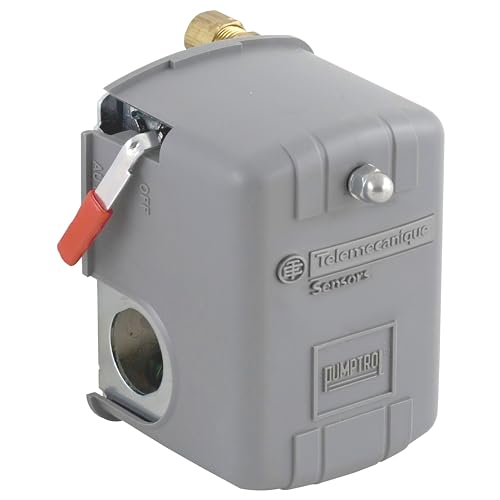
The switch that shuts your pump down before a dry well kills the motor.
If your pump is buried or hard to pull, the low-pressure cut-off is the feature worth paying up for. This switch carries a diaphragm-actuated mechanism with a 30-50 psi pressure setting, a 20-65 psi cut-out range, and an adjustable 15-30 psi differential. Under the hood it has a 60 A current rating, phosphor bronze contacts, an IP20 ingress protection rating, and a low-pressure cut-off that trips roughly 10 psi below cut-in.
That cut-off is the whole point. When a pipe bursts, a fitting leaks, or the well runs dry, the pump keeps running on a standard switch until someone notices — which can cook the motor and take the seal or impeller with it. Here, the switch shuts the motor off as soon as pressure drops below the trip point, and it uses clamp-style connectors for the wire terminations, which is a straightforward hookup for anyone comfortable with 240 VAC. Buyers report a Florida freeze that burst a pump line, where the switch cut power before a burned-out motor resulted — a burst line where the switch cut power before the motor burned out.
A mechanical advantage on this one: the adjustment works on two separate springs. The large spring nut sets the overall range, and the small spring nut controls the cut-off only, changing the differential and how long each pump cycle lasts. The catch is the manual reset — when the low-pressure cut-off trips, you have to walk out and flip the lever back. If a holiday cabin sits empty for weeks, that reset walk is the trade-off.
Pick this if: your well runs dry seasonally, or you want a mechanical safety net that protects the pump motor from running dead.
Consider the alternative if: you want automatic restart without a physical walk out to the tank — the digital controller at position 6 handles that differently.
5. Schneider Electric Square D 9013FSG2J24M4 Pressure Switch

A 40-60 psi switch that pairs the classic Square D feel with dry-run protection.
This is the higher-pressure sibling to the low-pressure cut-off switch at position 4 — same diaphragm-actuated design and same internal safety trip, but set at 40-60 psi instead of 30-50. Contacts are brass rather than phosphor bronze, and it drives water pumps rated 1.5 hp or less. If your well delivers enough volume to keep up with 40-60 psi and you want dry-run protection on top, this is the configuration that matches.
The catch is that adjustment takes patience. Owners find the two-nut spring adjustment fiddly, and the mechanism uses contact points that can stick over time — not on most units, but enough that this is a switch worth re-checking after the first few weeks. When it works, it works well: the low-pressure trip fires roughly 10 psi below cut-in and protects the pump from burnout, and the install instructions walk you through wiring for 120 or 240 VAC systems (standard household voltages) without needing a tutorial.
Here is the honest comparison to keep in mind. The Telemecanique 9013FSG2J24 at position 1 is the same physical switch without the low-pressure cut-off — so if dry-run protection is not a hard requirement, you are paying for a safety feature you may never trigger. If it is a requirement, this one holds the top spot in the category.
Best when: your system runs 40-60 psi and you want pump protection without stepping up to a digital controller.
Not ideal if: you want pressure adjustment to be a one-minute job — budget an evening for dialing in the two spring nuts.
6. GamaTech 110V 145PSI Pressure Switch

Replaces the guesswork of spring nuts with a screen and a button.
If your tank ever short-cycles and you have no idea why, a digital controller removes the black box. This one runs on 110 V, draws up to 10 A, handles pumps up to 1.5 hp (1.1 kW) directly, and covers a 0-145 PSI range with adjustable high and low pressure points set by pressing a button. It fits US and Canada plumbing with a 1/2 inch male NPT connector, shows the live pressure on an onboard screen, and is rated IP66 waterproof for outdoor enclosures. That IP66 rating means dust-tight and protected against heavy water spray — a real benefit for a pump house or outdoor well pit.
The dry-run protection is built in and independent of the pressure settings: if the well runs low, the controller shuts the pump down automatically instead of letting it run dry. Owners mention the setup is straightforward despite the spare documentation, and the most-cited win is being able to set both low and high on-off points in seconds instead of chasing a spring nut with a wrench. For anyone upgrading from an old points-type switch that sticks, the difference in clarity is obvious within the first hour.
The catch is calibration. The pressure reading runs about a couple psi off from a dial gauge in practice, so use a separate gauge to confirm your high and low numbers if precision matters. There is also a small delay built into the high shut-off that can overshoot on fast-pressurizing systems — the fix is adjusting the delay to zero, which takes a minute. And this controller replaces the switch only, not the whole tank tee; you still need the mechanical fittings from your existing setup.
The wins
- Digital display shows live pressure with no extra gauge needed
- Set high and low pressure by pressing a button
- Built-in dry-run protection shuts the pump off if the well runs low
- IP66 waterproof rating for outdoor and indoor installs
- Direct connection for pumps up to 1.5 hp
The trade-offs
- Reading can drift a couple psi from a dial gauge — confirm with a separate meter
- Ships with a small high shut-off delay that needs adjusting on fast-pressurizing wells
- Documentation is thin — plan on looking up the setup steps online
- You still need the tank tee and fittings from your existing setup
Best for: anyone tired of chasing pressure drift with a wrench who wants to see the exact number and set cut-in and cut-out from a screen.
Stay with a mechanical switch if: your well runs slow and steady and you already have a good pulse on the tank’s pressure behavior.
7. Miumoon 1″x 11″ Well Pressure Tank Tee Kit

One box that replaces the whole tank tee, not just the switch.
If you are re-piping a well tank from the ground up rather than swapping one part, this kit bundles the pieces so you are not chasing five separate orders. Inside the box: an 11 inch brass tank tee with union, a 40-60 psi pressure switch, a 100 psi pressure gauge, a 100 psi pressure relief valve, a drain valve, and a ball valve. Both ends of the tee carry 1 inch male NPT and 3/4 inch female NPT threads, and the tee fits pressure tanks up to 16 inches in diameter.
One warning before you install: the pressure relief valve ships unset, and the manufacturer calls out that you must turn the adjustment screw until the pop-off reads 75 PSI before use. That target is safe for all tanks rated at 100 PSI or higher and for both 30-50 and 40-60 psi switches, so it applies whichever pressure band you are running. Skipping that step risks a valve that either weeps constantly or fails to relieve pressure when you need it to.
The brass body is corrosion-resistant and lead-free, and everything threads together cleanly on a fresh install. The honest caveat: the included 40-60 psi switch is a basic generic unit with limited labeling, so if you want a name-brand switch or a low-pressure cut-off, plan on swapping that single component. Buyers who have used the kit more than once stick with it because it covers all the fittings in one box.
Value read: buying the tee, gauge, relief valve, drain, and switch together usually costs less than sourcing them piece by piece, and the lead-free brass body is a legitimate upgrade on older galvanized tees.
Who it suits: anyone building or rebuilding a well tank tee who wants all the fittings in one box and a brass body that resists corrosion.
pass on it if: you only need to replace the switch and already have a working tee, gauge, and relief valve.
Know the Specs
Pressure Setting (Cut-In and Cut-Out)
The pressure setting on a well pump switch is a pair of numbers — the cut-in, which is the low point where the pump restarts, and the cut-out, which is the high point where it stops. A 30-50 psi switch turns on at 30 and off at 50; a 40-60 psi switch turns on at 40 and off at 60. The gap between them is the differential. A wider differential (as in a 40-60) usually means fewer on-off cycles per shower, but the pump has to work harder to reach the top number. Match the pair to whatever the old switch was labeled; moving the band is possible with the adjustment nut but it is a slow, iterative process.
Pressure Range and Cut-Out Ceiling
Do not confuse the pressure setting with the switch’s pressure range. A switch rated “40-60 psi setting” might still have a 20-65 psi cut-out range — meaning the diaphragm and housing can physically handle pressure anywhere in that band before the mechanism gives up. That ceiling matters if your pump runs slightly hot or if a pressure spike hits during a well recovery surge. A switch rated to a higher cut-out ceiling has more margin for that abuse. On a digital controller, the equivalent is the top end of its adjustable pressure range — for example, 0-145 PSI covers nearly every residential well.
Amperage and Contact Rating
The amperage rating on a pressure switch is about electrical capacity, not water pressure. A switch rated to 40 A can safely carry a pump motor that pulls up to that much current at the moment of startup. Most residential well pumps draw in the 10-20 A range, so a 40 A rating gives plenty of headroom. Digital controllers often carry a lower amperage rating (for instance 10 A), which is why a separate relay is sometimes required to protect the electronics. Match the switch’s amperage to your pump’s full-load amps with a margin in mind.
Connection Type and Thread Size
Pressure switches mount to the tank tee, and the thread size must match the tee port or the install stops dead. Most residential switches use a 1/4 inch FNPS (female national pipe straight) port, which threads onto a 1/4 inch nipple. Larger tank tees and some submersible wells use 1 inch male NPT and 3/4 inch female NPT threads. Digital controllers like the GamaTech listed above use a 1/2 inch male NPT connector, so they fit different plumbing. Bring your old switch to the store or take a photo of the fitting before you order.
Common Questions
How do I know if I need a 30-50 psi or 40-60 psi pressure switch?
Will a 40-60 psi pressure switch work with a 30-50 psi system?
What thread size fits a standard well pump pressure switch?
What does a low-pressure cut-off actually do?
Can I use a 30-50 psi switch on a submersible pump?
How long does a well pump pressure switch usually last?
Is a digital pressure switch better than a mechanical one?
Do I need a pressure tank tee kit or just the switch?
How do I adjust the pressure setting on a mechanical pressure switch?
Why does my well pump keep short cycling?
The Bottom Line
For most well owners, the pressure switch for well pump winner is the Telemecanique Sensors 9013FSG2J24 because it swaps straight into a 40-60 psi well tank and matches the Square D mounting and settings that most systems already use. If you want dry-run protection built in, the Telemecanique Sensors 9013FSG2J21M4 cuts the pump off before a dry well kills the motor. And for a total tank-tee rebuild with the tee, gauge, and relief valve all in one box, the Miumoon 1″x 11″ Well Pressure Tank Tee Kit is the one to reach for.
One last nudge: before you order anything, snap a photo of your existing switch and its label, then match the pressure setting and thread size to what is already on the tank. Matching the pressure setting and thread size before you order turns a week of guesswork into a same-day swap.
How we choose
We do not accept paid placement. Every pick is matched to a real buyer and a real use-case; we do not hands-on test units.
Sources
Specifications: manufacturer listings and product documentation. Review insights: verified customer reviews, as of October 2026. Pricing: not shown on this page (it changes often); check the current price via the retailer link.
As an Amazon Associate, Aappliancez earns from qualifying purchases. This does not affect which products we feature.