Disclosure: Some links in this post are affiliate links. As an Amazon Associate I earn from qualifying purchases, at no extra cost to you. Learn more
Specs are compiled from manufacturer listings and verified buyer reviews and can change over time — please confirm the key details on the product page before buying.
If you want the short answer: the Presto 01781 23-Quart is the safest bet for most households, and the All American 921 is what you buy if you plan to can for the next thirty years. Everything else on this list is a variation on those two ideas — more jars, fewer jars, induction burners, or a commercial-size pot that will not fit under your cabinets. The rest of this article shows you exactly which one matches your stove, your batch size, and your patience level.
This guide is built by comparing the manufacturers’ published specifications and the patterns across verified customer reviews, so you get each pick’s real strengths and trade-offs instead of marketing spin.
You will learn how jar capacity actually stacks up, why a dial gauge and a weighted regulator behave differently, and how to match a canner to your burner before you lift one onto it. Read on for the pressure cookers for canning that earn their cupboard space.
Top Picks

How To Choose The Best Pressure Cookers for Canning
Most first-time canners buy the biggest pot they can find, then discover it will not heat evenly or fit in the cupboard. Quart capacity is the easiest spec to compare and the least useful on its own: a pot that holds twenty pints is worthless if your burner cannot heat it evenly or your cabinet cannot store it. Start with your stove and your batch size, then work backward to the pot.
Match the canner to your cooktop first
A heavy aluminum canner spreads heat well on a gas flame or an electric coil. Smooth-top glass and ceramic ranges are fussier, and induction ranges will not heat a plain aluminum pot at all — you need a canner with a magnetic stainless base bonded to the bottom, like the Presto 01784. If you are unsure what you have, hold a magnet to the bottom of your current pot; if it sticks, induction-compatible cookware is what you are shopping for.
Decide between a dial gauge and a weighted regulator
A dial gauge shows you the exact pressure inside the pot on a numbered face. A weighted regulator is a small metal weight that sits on the vent and rocks or jiggles at a set pressure — that sound is your signal. Weighted systems do not need an annual accuracy check the way a dial gauge does, which is why serious canners gravitate toward them. Some models, like the All American 921, give you both a dial and a weight in one unit.
Count jars, not quarts
Manufacturers list capacity in quarts and liters, but what you actually care about is how many jars fit on the rack. Pint jars stack two high in most 22- to 23-quart canners; quart jars usually sit in a single layer. If you mostly put up tomatoes and pickles in quarts, a pot that stacks pints is not saving you a second batch — it is just a taller pot.
Think about the lifting weight
An empty canner feels manageable. A full one, with jars and water, is a different object entirely, and you will be moving it from the counter to the stove and back. Check the dry weight before you buy and picture it full. If you have wrist or shoulder issues, a lighter aluminum body is worth more than an extra quart of capacity.
Side-by-Side Comparison
| Model | Best For | Capacity | Stated Weight | Pressure Control | Amazon |
|---|---|---|---|---|---|
| Presto 01781 23-Quart★ Best Overall | Most home canners | 23 quarts | 12 pounds | Dial gauge | Amazon |
| All American 921 21.5 QtBuilt For Life | Lifetime durability | 21.5 quarts | 20 pounds | Gauge plus weighted regulator | Amazon |
| Presto 01784 23-Quart InductionInduction Ready | Induction ranges | 23 quarts | 5.67 kg | Dial gauge | Amazon |
| Mirro 92122A 22-Quart | Gaugeless simplicity | 23.24 liters | 15 pounds | 3 weighted settings | Amazon |
| TSTQH 25 Quart Kit | Beginners wanting tools | 25 quarts | 6.58 kg | Gauge plus regulator | Amazon |
| IMUSA 22 Qt Aluminum | Everyday pressure cooking | 22 quarts | 10 pounds | Regulator, 10 PSI | Amazon |
| Supa Ant 23 Qt Starter Kit | Complete first setup | 23 quarts | 17.4 pounds | Weighted regulator | Amazon |
| Universal 53-Quart Commercial | Commercial kitchens | 53 quarts | 12.5 kg | 5.8 PSI regulator valves | Amazon |
Detailed Reviews
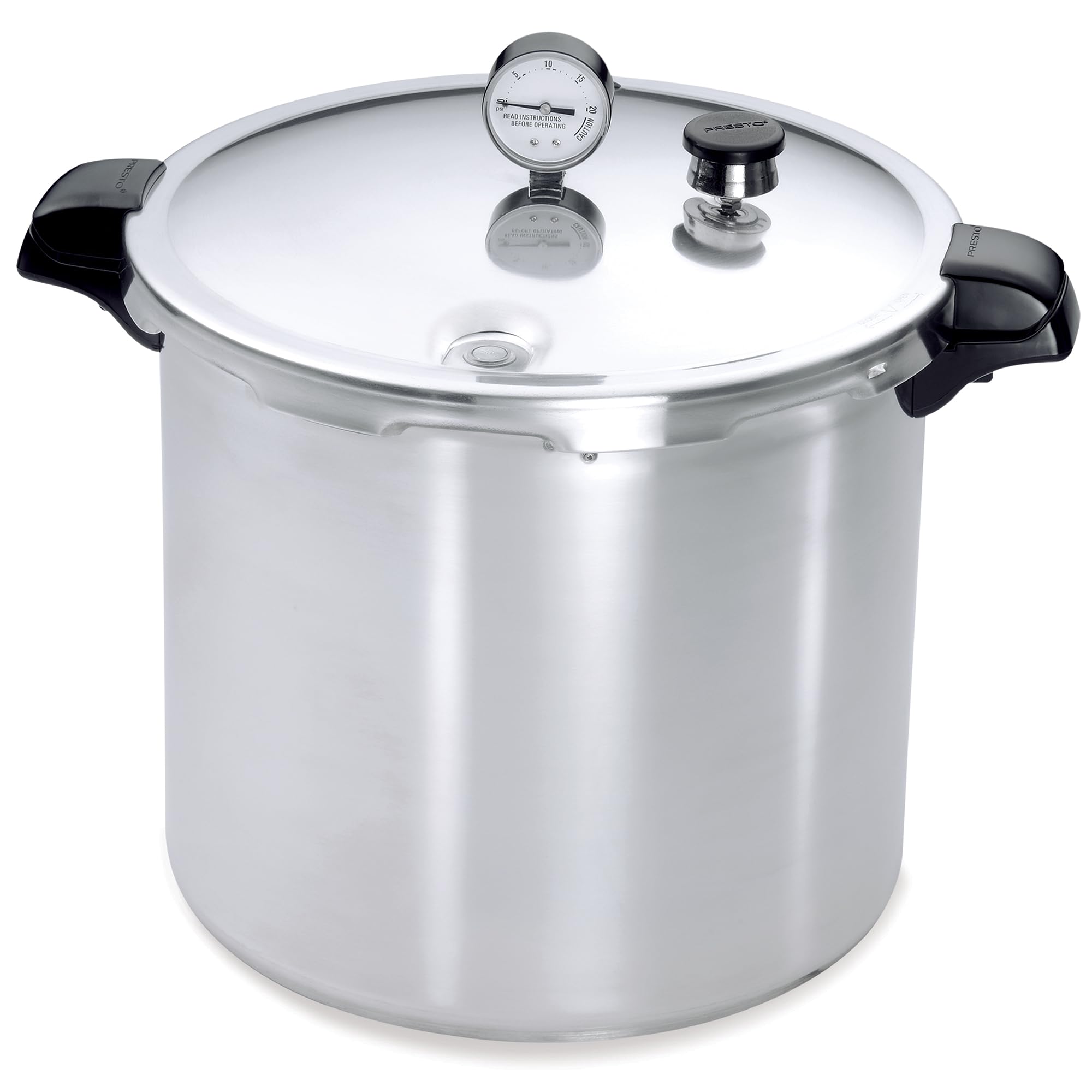
1. Presto 01781 23-Quart Pressure Canner and Cooker
Our pick — 4.5+★ from 20,000+ verified ratings; the strongest balance of quality and price.
The everyday workhorse that fits seven quarts, twenty pints, or twenty-six half-pints in one go.
This is the canner most people should start with, and the reason is simple arithmetic. The jar capacity reads 7 quarts, 20 pints, or 26 half-pints of regular Mason jars, so a single Saturday covers a full season of salsa in half-pints or a batch of tomatoes in quarts. The body is heavy-gauge aluminum — a thick, warp-resistant metal that spreads heat evenly across the base — and Presto rates it for regular and smooth-top ranges. Off-season, it doubles as a 23-quart pressure cooker for chili, beans, or stock.
At altitude, the deluxe pressure dial gauge is the part that earns its keep. A dial gauge (a numbered face that shows the exact pressure inside the pot) gives you a real reading instead of a weight that just jiggles. Presto notes that precise measurement matters most above sea level, where you need to add pounds of pressure to your processing time. The gauge reads the complete range of processing pressures, so you are not guessing between fixed settings.
What wins people over is the value and the ease of it. The instruction book runs 76 pages and walks a first-timer through processing times and recipes line by line. As owners put it: “This was one of the best purchases! We have had this canner for a year, used it for water bath and pressure canning.” The honest catch is the gauge itself: a handful of units read low at the top of the range, and dial gauges in general want an annual accuracy check. Weigh that against the price and it is still the easiest recommendation here.
What earns it position one
- Holds 7 quarts, 20 pints, or 26 half-pints of regular Mason jars per batch
- Heavy-gauge warp-resistant aluminum heats fast and evenly across regular and smooth-top ranges
- Deluxe dial gauge reads the full pressure range, which matters most at higher altitudes
- Ships with a canning and cooking rack plus a 76-page instruction and recipe book
- Works double duty as a large-capacity pressure cooker for everyday meals
Where it asks for your attention
- Dial gauges want a periodic accuracy check; some units read low near the top of the range
- It gets genuinely heavy once filled with jars and water, so plan your lifting
- Needs a burner wide enough to support the base evenly
Start here if: you want one canner that handles pints and quarts, works on a normal home stove, and comes with instructions that assume you have never done this before.
Look elsewhere if: you cook on induction — plain aluminum will not heat there, and you want the induction-ready version instead.
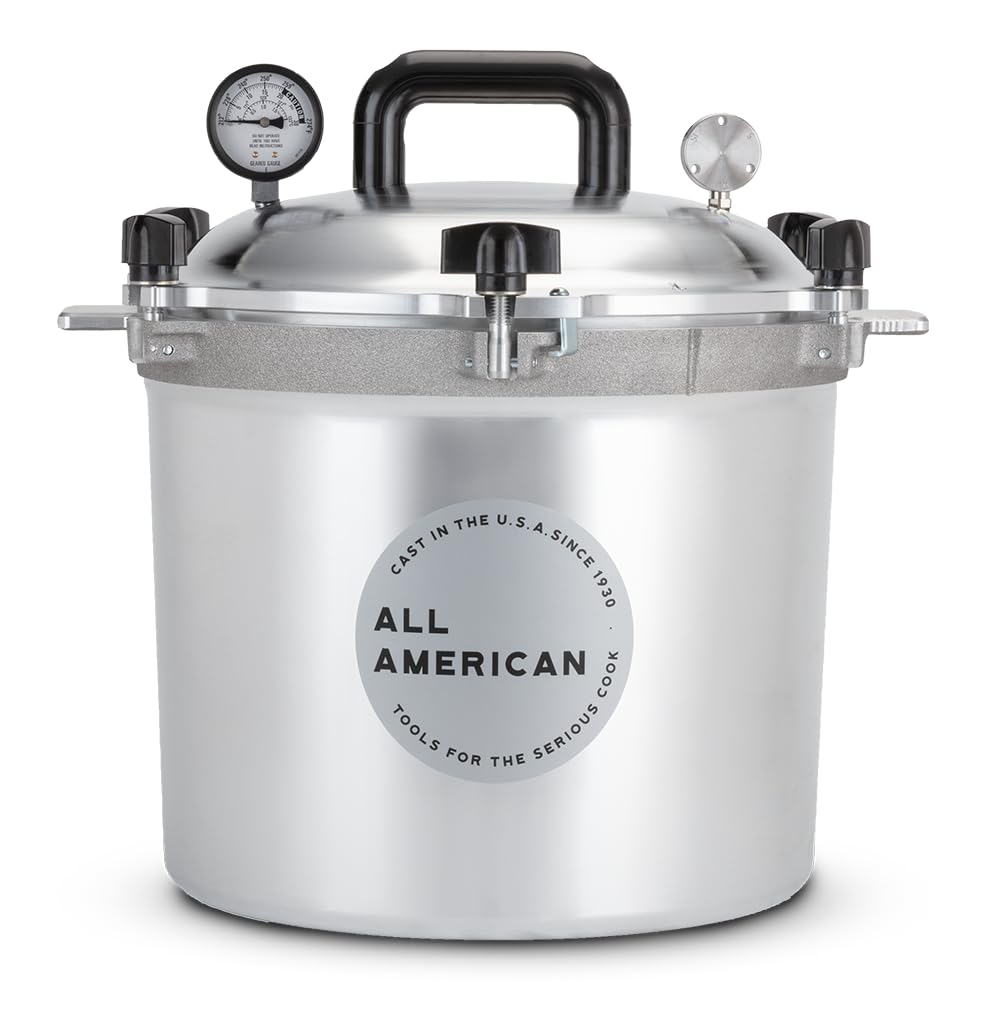
2. All American 1930 Pressure Cooker 921
No rubber gasket, no annual gauge test, and a cast aluminum body that outlives the jars.
If you have ever replaced a dried-out rubber sealing ring mid-season, you already understand why people pay more for this one. The 921 seals metal to metal — the lid and pot body machine together directly, with no rubber gasket in between that can harden, crack, or disappear from a drawer. That design is why durability is the thing everyone raves about here: it is a cast aluminum canner built with reinforced edges and a phenolic handle, cast in Wisconsin, and it holds 18 pints or 7 one-quart jars.
The trade-off is weight, and it is not a small one. At 20 pounds dry, this canner is 8 pounds heavier than the Presto 01781 at 12 pounds, and that gap matters a lot once you add jars and water. Owners describe loading the jars into the pot while it already sits on the stove rather than lifting a full canner across the kitchen, and that is the right habit with this unit. It also wants a sturdy burner — opinions on small burners and flat cooktops run cautious.
Here is the spec most people miss before buying: the 921’s quart capacity is tighter than its pint capacity. As buyers report, “921 holds 18 pints but only 7-8 quarts; 930 better for quarts.” If your pantry runs on quart jars of tomatoes, size up or accept the smaller quart batches. For everything else, this is the last canner you will buy. It has a weighted regulator (a metal weight that rocks at a set pressure) with a reference dial, and the audible jiggle tells you pressure is holding. You can also can without a gauge recalibration every year.
Where the money goes: into the metal-to-metal seal, the cast aluminum body, and a pressure system that pairs a dial gauge with a precision regulator weight so you can can by ear or by number.
The lifting reality: at 20 pounds empty versus the Presto’s 12, this is a pot you fill where it sits; the latches feel intimidating on day one and routine by the third batch.
Worth it for: the canner who plans to process hundreds of jars a season and never wants to hunt down a replacement gasket again.
Reconsider if: you put up mostly quarts — the pint count far outstrips the quart count here — or if lifting a 20-pound pot is a real strain.
3. Presto 01784 23-Quart Induction Compatible Pressure Canner
The same 23-quart Presto body, now with a base that an induction burner can actually read.
Induction cooking heats the pot itself through a magnetic field, which means a plain aluminum canner simply will not work on an induction range. Presto solved that by bonding a stainless steel clad base to the bottom of the heavy-gauge aluminum body, so this canner runs on induction, gas, electric, and smooth-top stoves. Same 7 quarts, 20 pints, or 26 half-pints of regular Mason jars per batch as the standard model. Same extended 12-year limited warranty.
Where this one pulls ahead is the lid hardware. The air vent and cover lock mean pressure only builds once the cover is properly seated. The cover will not open again until pressure has dropped to a safe level — a physical interlock (a built-in lock) rather than a habit you have to remember. There is a precise pressure gauge for accuracy, and the canner doubles as a boiling-water bath canner for fruit, jam, jelly, pickles, and salsa. Off-season, it doubles as a 23-quart pressure cooker for beans, stews, and stock.
The practical gap against the standard Presto 01781 depends on your stove and nothing else. Owners on both gas and glass-top report it running cleanly. Budget separately for the jar lifter basket and a full weight set — the canner ships with a canning and cooking rack only. If you have an induction cooktop, the premium over the regular model is the cost of being able to use the pot you already wanted.
Who this exists for: induction-range owners who were quietly locked out of the best-selling aluminum canners and needed a stainless-clad base to get back in.
Not included: a jar lifter basket and a full multi-weight set; the rack is there, but plan to add the lifting tools.
Pick this one if: your range is induction and you refuse to give up the 23-quart Presto format because of it.
Save the difference if: you cook on gas or a coil burner — the standard Presto 01781 does the same job for less.
4. Mirro 92122A Pressure Cooker 22-Quart

Three brass weights, no dial, and a mirror-polished body that hands you the pressure by ear.
The big draw here is what is missing: there is no dial gauge to send off for a yearly accuracy check. Instead you get three weights for 5, 10, and 15 PSI and a weighted toggle that rocks audibly when the pot is at pressure. You pick the weight that matches your elevation, set it on the vent, and listen. That design covers sea level through 5000 feet with the three weights alone, and it means you can walk away from the stove instead of standing over a needle.
At 23.24 liters it edges out the Presto 01781’s 21.8 liters, and the practical result is a full 18 pints stacked across the two included racks — with 7 quarts when you switch to the larger jars. The canner is 15 pounds dry, so it is manageable to lift even for a shorter cook, and the dual cool-touch handles help when it is warm. It is spec’d for gas and electric ranges; check your glass-top manual before committing.
The honest note is build consistency. The aluminum is thinner than older Mirro models, and the lid can need a specific orientation before it seats properly, so a little repositioning is normal on early batches. The included manual is also thin on processing times and water amounts — plan to use a separate canning reference for those numbers. Get past that and this is a genuinely simple, reliable unit: the gaugeless design is the whole pitch, and it delivers on it.
The case for skipping the dial
- Three weights cover 5, 10, and 15 PSI — enough range for sea level up to higher elevations
- Audible rocking toggle lets you monitor pressure without watching a needle
- 23.24 liters of capacity holds 18 pints stacked or 7 quarts
- Two cooking racks included to boost the stacking space
- Dual cool-touch handles and a 15-pound dry weight that is realistic to lift
What to plan around
- Aluminum is thinner than earlier Mirro builds, so avoid rapid cold-water cooling
- The lid seats in essentially one orientation and may need nudging
- The included manual skips processing times and water amounts
Reach for this if: you object on principle to annual gauge testing and prefer a canner you can read by sound.
Think twice if: you want a manual that tells you exactly how much water and how many minutes — this one does not.
5. TSTQH 25 Quart Pressure Canner
A 25-quart canner that arrives with the lifting tools most pots make you buy separately.
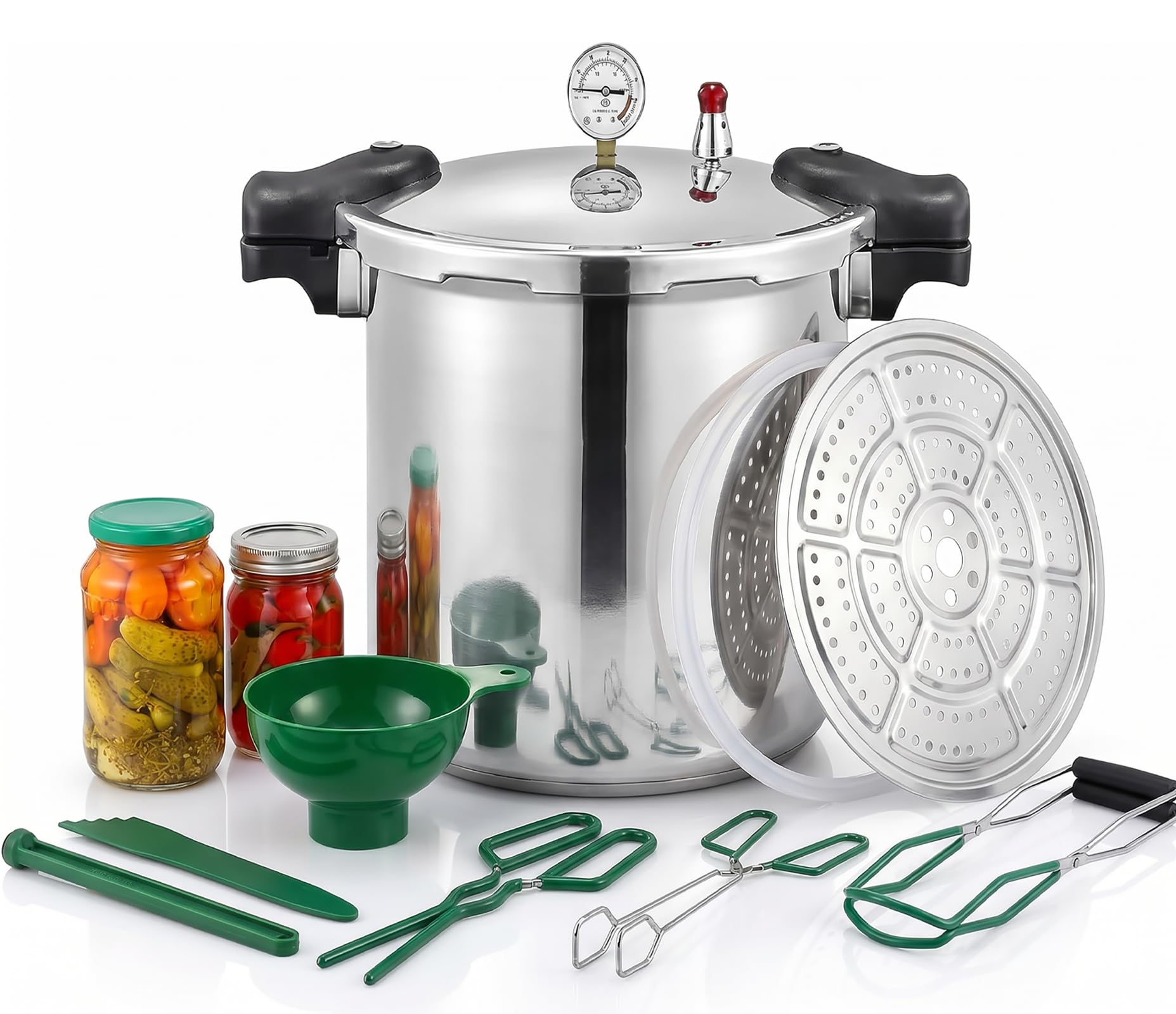
Buying a first canner usually means a second shopping trip for a jar lifter, a funnel, and a lid magnet. This set skips that. You get the canner itself, a large canning rack, a spare seal ring, a canning funnel, canning tongs, a jar wrench, a jar lifter, a bubble remover, and a magnetic lid lifter — nine items in total. For someone starting from zero equipment, that bundle is the reason to look here.
The pot runs 25 quarts and tops out at 110 KPA/15.5 PSI (pounds per square inch, the pressure inside the pot) with a tolerance of plus or minus 5 percent. The base is induction compatible and also works on gas, open flame, and electric ceramic hobs. There is an emergency valve and an automatic safety valve to release excess pressure, a multifunctional safety lock, and a scald-proof heat-insulating handle. A pressure gauge on the lid records the reading, which matters most at altitude where you need to hold a higher number.
Be clear-eyed about what this is: a big, generously equipped pot with a mixed reputation on consistency. The size that makes it useful for large batches is also what makes it too tall for some stoves and cabinets — measure your clearance before you order. The gauge is one place buyers have reported trouble, with at least one saying it never reached standard pressure. It also is not a USDA-endorsed unit the way the Presto models are specified. If you want a kit and a big batch, it is a reasonable start; if you want a known quantity, spend the same money on the Presto.
The bundle argument: a rack, spare seal, funnel, tongs, jar wrench, lifter, bubble remover, and magnetic lid lifter all in the box — no second order required.
The clearance check: 25 quarts is taller than a standard 23-quart canner; confirm it fits under your cabinets and on your burner before committing.
Best for: the brand-new canner who wants every tool in one box and has a large, tall space for the pot.
Look past it if: you want a pressure gauge you can trust at first light — the gauge is the weak link here.
6. IMUSA 22 Qt Aluminum Pressure Cooker

An enormous aluminum pot for beans, soups, and stews — but read the label before you plan a canning season.
Start with the honest part: IMUSA sells and describes this as a pressure cooker, not a pressure canner. There is a 10 PSI regulator and a safety locking lid with safety valves, but the manufacturer’s own copy never claims the USDA-recommended canning method and never lists jar counts. If you want to put up shelf-stable vegetables and meats, buy a canner that says so. If you want a very large pressure cooker for beans and stock, this is a serious piece of equipment for the money.
The 22-quart body is polished aluminum with cool-touch handles and even heat distribution, and it is listed at 10 pounds dry — light enough to move around the kitchen with one hand when empty. At 22 quarts it cooks a full batch of beans, a stockpot of broth, or a party-sized pot of stew in one go. Owners who use it for that everyday cooking consistently report good results.
Where it earns its place in this list is as the value alternative for someone whose “canning” is really water-bath pickles and whose weekday cooking is pressure-cooked beans. Just do not push past 10 PSI expecting canning-grade pressures — that regulator caps what the pot will do. And check your stovetop’s guidance on large aluminum cookware before you commit, because this is a wide pot.
What it is great at: volume cooking — 22 quarts of beans, broth, or stew at 10 PSI, with a polished aluminum body and cool-touch handles at 10 pounds empty.
What it is not: a pressure canner. A 10 PSI regulator is not canning-grade pressure for low-acid foods, and IMUSA makes no canning claims for it.
Choose it for: huge batches of beans, soups, and stews, where 22 quarts and a 10 PSI regulator do exactly what you need.
Skip it for: pressure canning low-acid foods — you want a canner rated for canning, which this one is not sold as.
7. Supa Ant 23 Qt Canning Pot with Canning Supplies Starter Kit
One box with the pot, the rack, and every fluorescent-green tool a first canner forgets to buy.
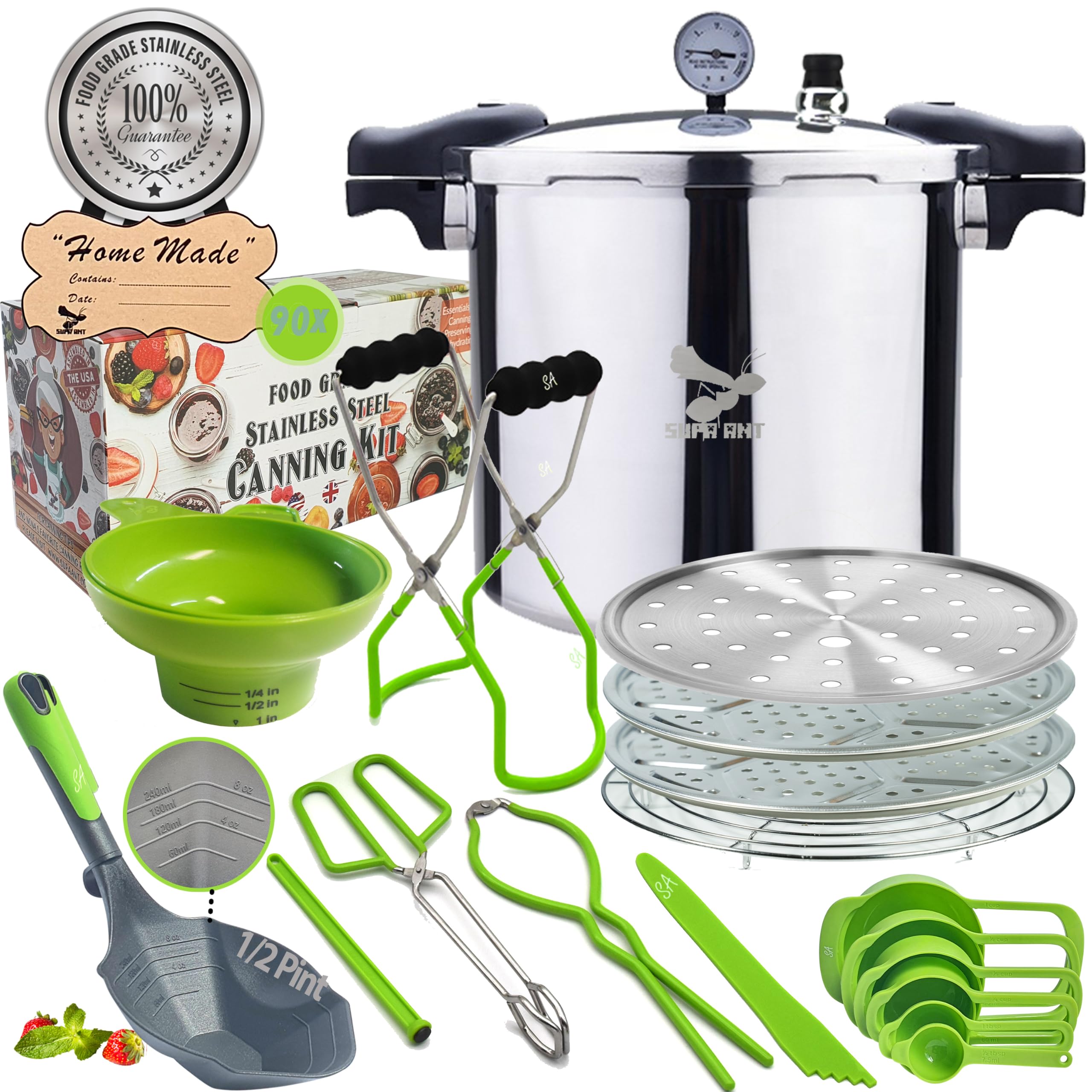
First canners consistently under-buy. They get the pot and then discover they have no jar lifter, no funnel, and no way to pull a hot lid out of boiling water. This kit handles it: a 23-quart pot, a wire rack and canning base for water circulation, a jar lifter, a canning funnel, a magnetic lid lifter, a bubble remover, and a jar wrench, all in one box. There is even a storage box so the tools live together between seasons.
The 23-quart pot is a genuinely useful size. Owners have used it to process two stacks of pint and half-pint jars, and one buyer reports it large enough to handle roughly half a bushel of corn at a time. It comes with an easy-to-read instruction manual aimed at getting you started. The wire rack keeps jars off the bottom of the pot so water circulates and jars heat evenly.
Two things to know before you order. First, this is a water-bath pot, not a pressure canner; it will not safely process low-acid foods like green beans or meat. Second, the lid is the recurring complaint. The manual does not clearly explain that you use the pressure lid without the weight for water-bath work, and a few units have needed support help to get the seal sorted. Support is reported as responsive, which counts for something on a first canner.
Bundle you actually use: pot, rack, base, lifter, funnel, lid magnet, bubble remover, and wrench — plus a storage box, which is a small thing that matters in January.
Scope limit: a water-bath pot only; it does not process low-acid foods at pressure, and the manual is thin on lid operation.
Good fit for: jams, salsas, pickles, and fruit, especially for a first-timer who wants all the small tools in one order.
Not the one for: green beans, corn, or meat — those need a true pressure canner, not a water-bath pot.
8. Universal 53-Quart Aluminum Pressure Cooker

Half a hundred quarts of aluminum — and the manufacturer will tell you it does not belong in your kitchen.
You have to respect a listing that opens by telling you not to buy it. Universal is explicit that this 53-quart pressure cooker is too large and too powerful for a typical home kitchen, and that it is built for restaurants, hotels, and catering operations with the burners and space to handle it. Take that seriously. This is an industrial pot for high-volume batches of meats, soups, beans, and stews, and it needs a burner to match.
The hardware is commercial through and through: two safety valves and two pressure regulator valves holding a 5.8 PSI (40 kPa) operating pressure, reinforced burn-resistant handles, and an easy-open lid with an aluminum knob. It works on gas, electric, and glass-ceramic cooktops, but not induction. Several hundred liters of capacity in one vessel makes it ideal for large events and prep days for a small business, and it lets one kitchen turn out a weekend’s worth of product in a single cook.
Be honest with yourself about the fit. The pressure it runs is well below canning pressures for low-acid foods, so despite the pressure-cooker title this is a volume-cooking vessel, not a jar canner. The weight and footprint make it a permanent installation, not something you pull out seasonally. For a restaurant kitchen that is fine. For a home canner it is the wrong tool entirely, no matter how impressive the number looks.
Why commercial kitchens buy it
- 53 quarts in a single vessel, for event-scale batches of stews, soups, and meats
- Two safety valves plus two pressure regulator valves holding 5.8 PSI (40 kPa)
- Reinforced burn-resistant handles and an easy-open lid for fast turnover
- Works on gas, electric, and glass-ceramic cooktops
Where it will not suit you
- Explicitly not designed for typical home kitchens — needs a large burner and clearance
- 5.8 PSI is a cooking pressure, not a canning pressure
- Not induction compatible, so induction ranges are out
Built for: restaurants, caterers, and hotels that need one enormous pot and have the burner and floor space for it.
Wrong tool if: you are canning jars at home — the operating pressure and the footprint both rule it out.
Know the Specs
Quarts, Liters, And Jars
Capacity is listed on the box in quarts or liters, but the number that actually matters is how many jars fit once the rack is in. A 23-quart canner typically holds 7 quarts, 20 pints, or 26 half-pints of regular Mason jars, which is the specification Presto publishes for its 23-quart models. A 21.5-quart canner may hold 18 pints but fewer quarts, because quart jars stand taller and cannot stack two high. When comparing pots, look for the jar count in the specifications rather than the pot volume, or you will buy more pot than you need.
PSI, Altitude, And The Gauge Question
PSI stands for pounds per square inch, and it measures the pressure inside a sealed canner. That pressure is what lets you safely process low-acid foods at higher temperatures than boiling water alone. Altitude changes the pressure you need, which is why a dial gauge is valuable — you can read the exact number instead of accepting a fixed weight setting. A weighted regulator instead uses a metal weight that rocks at a set pressure. It does not need the annual accuracy check a dial gauge does, but it only gives you the pressures for which you own a weight. Many serious canners run both: a gauge for reading pressure and a weight for holding it.
Common Questions
Can I use the Presto 01784 on an induction cooktop?
What is the difference between a dial gauge and a weighted regulator?
How many jars does a 23-quart canner hold?
Do I need a pressure canner or a water bath canner?
Why does the All American 921 hold fewer quarts than pints?
Do pressure canners need a rubber gasket replaced?
Will a large pressure canner work on my glass-top stove?
What does 15 PSI mean on a pressure canner?
Can I use a big pressure cooker like the IMUSA for canning jars?
Is a commercial pressure cooker like the Universal 53-quart suitable at home?
The Bottom Line
For most households, the pressure cookers for canning pick that makes the most sense is the Presto 01781 23-Quart. It covers 7 quarts, 20 pints, or 26 half-pints of regular Mason jars per batch, comes with a deluxe dial gauge and a 76-page instruction book, and works on regular and smooth-top ranges. If your range is induction, take the Presto 01784 instead. It brings the same 23-quart jar capacity with a stainless-clad base and an air vent and cover lock. And if you want a canner you will hand down rather than replace, the All American 921 is the one — gasket-free, cast aluminum, and built to outlast the pantry shelves.
Choose capacity by the jars you actually process, not by the biggest number on the box. A 23-quart canner you can lift and that fits your burner will put up more jars in a season than a 53-quart pot you cannot get onto the stove.
How we choose
We do not accept paid placement. Every pick is matched to a real buyer and a real use-case; we do not hands-on test units.
Sources
Specifications: manufacturer listings and product documentation. Review insights: verified customer reviews, as of October 2026. Pricing: not shown on this page (it changes often); check the current price via the retailer link.
As an Amazon Associate, Aappliancez earns from qualifying purchases. This does not affect which products we feature.