Disclosure: Some links in this post are affiliate links. As an Amazon Associate I earn from qualifying purchases, at no extra cost to you. Learn more
Specs are compiled from manufacturer listings and verified buyer reviews and can change over time — please confirm the key details on the product page before buying.
Here is the answer most shooters need first: if you want one pair that does the most work, the Wiley X Saber Advanced is the safest buy — it meets MIL-PRF-32432 ballistic standards (a military impact test for eye gear), wraps a foam insert inside a changeable lens, and costs a fraction of the range-brand names. Everything else on this list solves a narrower problem: a bigger head, a tighter budget, or the need to clip your own prescription inside the frame instead of wearing contacts under your eye protection.
This guide is built by comparing the manufacturers’ published specifications and the patterns across verified customer reviews, so you get each pick’s real strengths and trade-offs instead of marketing spin.
Prescription shooting glasses solve one problem above all: your corrective lenses and your impact protection are two separate pieces of gear, and keeping both on your face through a full round is the hard part. Below, every frame is measured on lens thickness, swap speed, nose-piece clearance, and whether an optical insert or your own optician’s lenses will actually fit inside it. Read on for the honest breakdown of the prescription shooting glasses worth your money.
Top Picks


How To Choose The Best Prescription Shooting Glasses
Prescription shooting glasses are a two-part purchase, and that trips up most first-time buyers. The frame is the impact shield; the prescription is a separate lens that has to live inside or behind it. Get the order wrong and you end up with a beautiful pair of safety glasses you cannot see through.
Decide how your prescription gets in there
There are two routes. One is a dedicated optical clip that snaps inside the frame — that is what the Bertoni SH890N kit uses, with a removable clip frame an optician fits lenses into. The other is ordering prescription lenses directly in a high-impact polycarbonate, which the ESS CDI notes will maximise impact resistance well beyond CR-39 resin. If you wear contacts on the range, you can skip both and treat the frame as pure protection, which opens up every pick here.
Check the ballistic rating wording, not the badge
ANSI Z87.1+ and MIL-PRF-32432 are impact standards, and they are not the same test. The “+” on Z87.1 means the lens passed a higher-velocity impact test than the base rating. MIL-PRF specs are the military version. For trap, skeet, and hunting, any rated frame beats a fashion sunglass. For anything with flying brass or fragmentation nearby, the military-rated frames are the ones to look at.
Match the lens tint to your targets and sky
Clays are orange, grass is green, and the sky above the trap house can be deep blue — each tint fights a different background. Brown blocks blue light and lifts orange contrast. Yellow is the low-light and overcast choice. Violet makes orange stand out against a deep blue sky and green background. Red highlights orange while neutralising greens. A kit with four lenses covers a full season; a single dark tint does not.
Fit beats everything on the last station
Glasses that press on your temples under ear muffs will fail you on the twentieth target. Look for rubber-tipped arms, a flexible nose piece, and enough vertical clearance that the frame does not sit on your cheeks. A frame that fits loose enough to slide is equally bad — you want pressure spread out, not concentrated behind the ears.
Side-by-Side Comparison
| Model | Best For | Impact Rating | Prescription Route | Lens Kit | Amazon |
|---|---|---|---|---|---|
| Wiley X Saber Advanced★ Best Overall | All-round range and outdoor duty | MIL-PRF-32432 | — | Changeable lens with foam insert | Amazon |
| Wiley X WX ValorBest for Large Heads | Big heads and ear-muff wearers | MIL-PRF-32432A | Replacement lenses available | Clear, orange, gray | Amazon |
| ESS CDI Ballistic Eyeshield | Military, LE, and fragmentation-adjacent work | U.S. MIL SPEC | CDI Rx Insert; polycarbonate lenses advised | Smoke and clear | Amazon |
| ESS Crossbow 3LS Kit | Shooting sports with heavy debris | ANSI Z87.1+, MIL-PRF-31013, CE EN 166 | Prescription inserts used by some owners | Clear, Smoke Grey, Hi-Def Yellow | Amazon |
| Leupold Becnara | Everyday carry that doubles as range gear | — | — | Polarized | Amazon |
| Bertoni SH890 | Colour-coded tint matching for trap | ANSI Z87.1, ECE, EN166, Drop Ball | — | 4 anti-fog lenses, 3.1 mm | Amazon |
| Bertoni SH890N with RX Carrier | Prescription first, tint second | ANSI Z87.1, ECE, EN166, Drop Ball | Removable optical clip, optician-fitted | 4 anti-fog lenses, 2.4 mm | Amazon |
Detailed Reviews
1. Wiley X Saber Advanced Sunglasses ANSI Z87.1+
Our pick — 4.5+★ from 2,000+ verified ratings; the strongest balance of quality and price.
A modular frame that shrugs off rocks and hot brass and still fits under your muffs.
The Saber Advanced is the pair that earns the top slot because it does the boring thing brilliantly: it stays on your face and keeps debris out. It is built to MIL-PRF-32432 ballistic standards, a military impact test for eye protection, so the lens and frame are engineered to take a hit rather than crack. A foam insert sits against the changeable lens, which seals the gap between your brow and the frame — the exact spot where a mower-thrown rock or a spent case finds its way in. For prescription shooting glasses, that foam ring is also the detail that decides whether your eye protection works over contacts or over an insert.
What keeps this at the top is how the frame behaves over a long session. The wrap-around arms stay secure and the nose bridge spreads weight instead of pinching, so a morning on the range does not leave a pressure mark behind your ears. Owners run these far past the firing line — the range, night biking, weed-whacking, mowing, and flying all show up in the same review pages. There is genuine UV protection in the lens and no distortion in the field of view, which is the part that matters once you are tracking a clay across the sky. Put next to the Bertoni SH890N, which asks you to accept thinner 2.4 mm lenses, this frame carries noticeably chunkier glass.
The honest catch is the lens swap. Changing tints means swapping the nose piece along with the lens, and there is a faint refraction quirk at the edge of the glass some people notice in daylight. Fogging is the other fair warning — it depends on your body heat against outside temperature and clears with a wipe, so a cold morning in a warm car will show it. Buyers do call it out, and the answer is a microfiber cloth in your pocket rather than a new frame.
What earns it the crown
- MIL-PRF-32432 ballistic rating means the glass is built around impact, not just glare
- The foam insert closes the brow gap where rocks and brass get in
- Comfortable nose bridge that stays put under masks and ear protection
- UV protection with no distortion across the lens
Where it asks patience
- Swapping tints means switching the nose piece too — fiddly on a cold morning
- Fogging shows up when body heat meets cold outside air
- Edge refraction is faintly visible to some wearers in bright light
Reach for this if: you want one rated frame that handles clays, hunting, mowing, and a bike ride without changing your routine.
Look elsewhere if: you plan to swap tints every hour — the nose-piece step will wear on you.
2. Wiley X WX Valor Tactical Sunglasses
Built for the shooter whose old safety glasses left red marks on their temples.
If the Saber Advanced above fits most faces, the WX Valor is the one that fits the faces the Saber leaves pinched. It uses a semi-rimless frame with reduced vertical height, so the bottom edge clears your cheeks instead of riding on them — the sizing detail that matters most for a wide head. Owners in a size 8 hat report it fits comfortably and clears the cheekbone — the exact complaint that sends big-headed shooters hunting. It meets MIL-PRF-32432A ballistic standards, the same military impact family as the top pick.
The arms carry rubber tips, and that is the fix for the slip you get when you sweat through a summer match. Clarity through the lens is the other thing people come back for — sharp enough for the range and clean enough to leave on for the drive home. The kit ships with a hard case and lens sheaths, so the interchangeable set travels without rattling around loose in your bag. Lenses flex out of the frame for a swap, and the clear, orange, and gray tints cover bright sun, flat light, and everything between.
Set your expectations on two things. The arms fit tight at first and break in over roughly a couple of weeks, so day one feels snugger than day thirty. Fogging creeps in if you push the lens right up against your eyes, which is a fit adjustment rather than a flaw. And the smart buy is to order direct from the maker if you can — boxed arrivals through marketplace sellers have shown up with a dented case.
The fit story: reduced vertical frame height is what lets a large face wear these without the lower rim digging into a cheek.
Break-in reality: a tight first week relaxes into a comfortable fit, and the rubber temple tips then hold through sweat.
Fits you best when: standard frames leave dents on your temples or sit on your cheeks at the trap line.
Worth knowing: the tight opening fit takes a couple of weeks to settle, and the included case is basic.
3. ESS Eye Safety Systems CDI Ballistic Eyeshield, Black

The eyeshield with the longest track record in hostile places, and the only one here built around an Rx insert.
The CDI is the pick for anyone whose prescription has to go inside the frame rather than behind it. ESS builds it around a CDI Rx Insert, and the manufacturer is explicit on the material: high-impact polycarbonate prescription lenses maximise the impact resistance of the whole system well beyond CR-39 resin or other common lens materials. That sentence is the reason this frame exists on a prescription shooting glasses list. The U.S. MIL SPEC high-impact lenses are also exchangeable, so you swap the outer tint to match the ground you are standing on without touching the insert.
Protection is the thing it is known for, and the record backs the reputation up — this is gear that has been carried in military and law-enforcement settings, which is a different bar than a weekend trap league. In field use, the lens has taken a direct rock strike without cracking. Nose pieces hold on without dropping off. Owners reorder replacement pairs instead of switching brands, a sign the fit and lens-swap routine hold up over years.
Medium fit is the limit to plan around. It suits small heads and flexes for larger ones, but if you know you need a wide frame, the WX Valor above is the better bet. The sizing is the reason this one lands third rather than first — the protection is excellent, the head it fits is narrower.
Prescription-first design: the dedicated Rx insert path is the cleanest route here for a shooter who needs corrective lenses at the line.
Medium-fit caveat: small and average heads, yes; extra-wide faces should look at the Valor instead.
Built for you if: you are running an insert or working in a role where fragmentation is a real risk, not a hypothetical.
Check the fit first: it is a medium frame, so measure your head against that before committing.
4. ESS Eyewear Cross Series Crossbow 3LS Kit 740-0387, Black

Three lenses in one kit, and a coating that fights fog on the inside while shrugging off scratches on the outside.
Fog is the enemy that quietly ruins a round, and the Crossbow attacks it at the coating level. ESS calls it ClearZone FlowCoat — engineered to stop fog forming on the inside of the lens and resist scratches on the outside. Combined with the lens coverage that wraps past your eyebrows, you get the one thing that keeps your sight picture clean when your face heats up on the line. The 2.4 mm polycarbonate lenses are interchangeable and give 100% UVA/UVB protection.
The specification sheet is unusually thorough for safety glasses. This frame is compliant with U.S. Federal OSHA, ANSI Z87.1+, CE EN 166 and U.S. MIL-PRF-31013 — a stack of ratings that covers workplace, European, and military impact standards at once. The Tri-Tech Fit frame is built to sit without pressure points, and the DedBolt Lens Lock pivots up to release a lens then clamps back down so it holds under impact. The 3LS kit arrives with the frame plus Clear, Smoke Grey, and Hi-Def Yellow lenses, a hard storage case, a microfiber pouch, and a snap-on elastic retention strap.
Two catches worth knowing before you buy. The lens lock is secure, but snapping lenses in and out is not a one-handed move — that security is the trade. And the hard case is the piece that divides opinion: some kits ship with the heavy-duty nylon case and some arrive with a cheaper clip-together holder, so confirm what you are getting if the case matters to you. The coating resists scratches better than most under heavy debris, but lenses this exposed still belong in a pouch.
Why it wins on the line
- ClearZone FlowCoat fights fog inside and scratches outside
- Rated to ANSI Z87.1+, MIL-PRF-31013, CE EN 166, and OSHA at once
- Coverage wraps past the eyebrows, closing the debris gap
- DedBolt lock clamps the lens for rock-solid retention under impact
The honest trade-offs
- Lens swaps need two hands and a moment of patience
- The included case varies — some kits arrive with a basic clip holder rather than the nylon case
Pick this one when: fogging is what has been costing you targets, and you want three tints plus a hard case in one box.
One thing to verify: check which carrying case ships with the kit before you order.
5. Leupold Becnara Performance Eyewear with Polarized Lenses
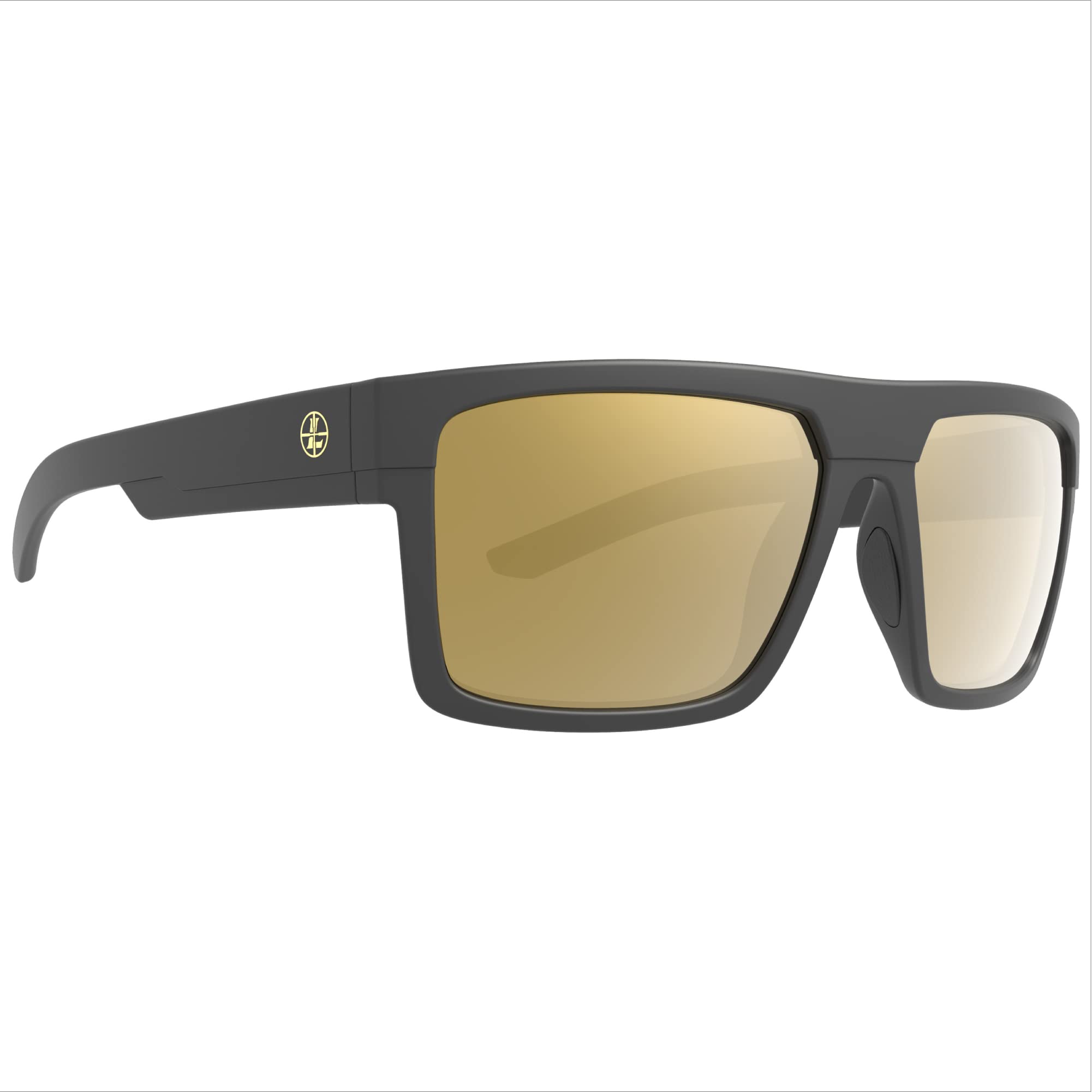
The pair that looks like everyday eyewear and behaves like range gear when you need it to.
Polarized lenses are the feature that earns the Becnara its slot. Polarization cuts the flat glare that bounces off a wet range floor or a car hood, which is the kind of light that tires your eyes out over an afternoon. Leupold builds the lens shatterproof rather than shatter-resistant-sounding, and the frame is described as rugged for field use. Polarized shatterproof lenses in a rugged frame make it the one pair for a shooter who does not want two in the truck.
Comfort on a bigger head is where this one has established itself. Owners with larger heads report the fit lands well, which is rare in a style-first polarized frame. It looks clean enough for casual wear and still holds up at an outdoor range, so the versatility is real. If you already own a dedicated ballistic frame and just want a refined polarized pair for practice and everyday carry, this fills that gap cleanly.
The trade-off is scope. This is a polarized sports frame, not one with a dedicated prescription insert path, so if an optician-built RX carrier is non-negotiable for you, the Bertoni SH890N below is the one to look at. Treat the Becnara as the versatile everyday-and-range pair, and save the insert-ready frame for match days.
Glare control: polarization cuts reflected light off water and pavement, which is what makes it comfortable for long outdoor sessions.
Head-fit note: larger heads report a good fit, so a wide face is not a reason to pass on it.
You’ll want this if: you split one pair between the range and the road and want polarized glare control while you do it.
Not your pair if: you need an optical clip inside the frame — there is no RX carrier here.
6. Bertoni Shooting Glasses SH890
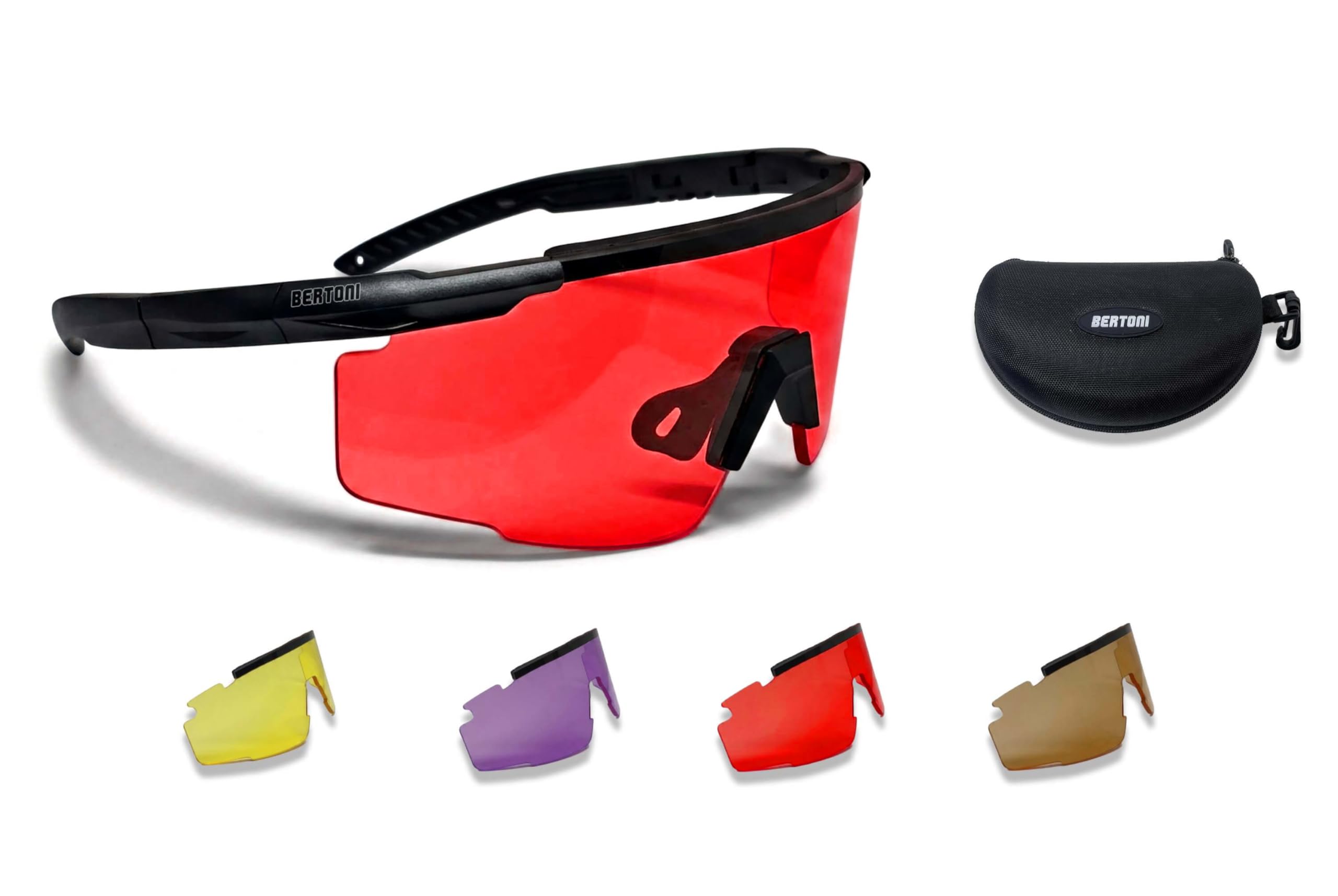
Four tint-matched lenses and two frame colours, aimed squarely at trap shooters who chase the orange clay.
This is the most complete tint set on the list, and the colours are specified for shooting specifically. Brown blocks blue light and improves contrast on the orange target. Yellow carries you through low light and overcast skies. Violet pulls the orange clay forward against a deep blue sky and a green background. Red highlights orange while neutralising greens. The lenses are 3.1 mm anticrash, shatterproof polycarbonate with an anti-fog coating, and they are decentered so you avoid optical distortion across the view. Frameless construction promotes ventilation, and there is 100% UV protection built in.
The kit is generous beyond the glass. You get two frames — matte black and mat military green — plus two extra military-green arms, an additional nosepiece, a strap, a neoprene carrying case with the Bertoni logo, and a microfiber cloth. It exceeds the Drop Ball Test military standard and carries ECE, EN166 and ANSI Z87.1 ratings. The slip-resistant soft rubber on the arms keeps the frame planted when you sweat. For a trap shooter who wants to change tint with the sun, that is a lot of ground covered by one purchase.
The one wrinkle is the first swap. The arms are a little stubborn to remove until you learn the motion, and a few buyers find the nose piece fights them the first time they pull a lens. It gets easier with repetition. Lenses are the same colour-matched story in the SH890N below, though that model uses thinner 2.4 mm glass and trades this model’s spare arms for a prescription clip.
Tint-matching done right: the brown, yellow, violet, and red set is chosen for clays, not for style — each tint names the background it fights.
First-swap friction: the arms are stubborn on day one, and the lens change takes practice before it feels natural.
Made for you if: you shoot trap or sporting clays and want every light condition in one case.
Worth a beat of patience: the arm and lens swap is stiff until you get the rhythm down.
7. Bertoni Shooting Glasses SH890N

The kit that puts your optician’s lenses inside the frame, then gives you four tints to look through.
If the whole point of your search is prescription shooting glasses, this is the model built directly for it. A removable optical clip for prescription sits inside the frame, and an optician fits the lenses into the clip — the kit includes two nose pieces, one shaped to work with the adapter and one for regular wear. The 45x40mm clip takes your corrective lenses, while the four interchangeable anti-fog lenses handle the light. Brown, yellow, violet and red do the same clay-popping work as the standard Bertoni above, and the lenses carry the same certifications: Drop Ball Test, ECE, EN166 and ANSI Z87.1.
The frame details are tuned for the range. The wrap-around shape protects your eyes from wind and weather and widens peripheral vision. Slip-resistant rubber tips on the arms and nose piece keep the frame from migrating. Vented lenses help push fog out. And the size is stated for narrow to large faces, so the insert-driven design is not locked to one head shape. For clays, the violet lens draws praise for brightening black clays and pulling the target off the background.
Be honest with yourself about the frame before buying, because the records here are genuinely mixed on durability. The polycarbonate lenses are clear and distortion-free, but the frame material has been reported brittle — a temple can snap under light handling, and replacements are not sold separately. Treat this as a frame to handle gently, especially when pulling it off. If abuse is part of your routine, the ESS CDI above is the sturdier shell.
What makes it the RX pick
- Removable optical clip lets an optician fit your prescription inside the frame
- Four color-matched anti-fog lenses for every light condition
- Wrap-around design widens peripheral vision and blocks wind
- Two nose pieces and slip-resistant rubber tips handle narrow to large faces
Where it needs care
- Optional lens swaps take practice, and the frame has been called brittle
- Replacement frames are not sold separately, so a snapped temple is a setback
The right call if: you cannot wear contacts on the line and want your prescription clip along with four shooting tints in one kit.
Treat it carefully: the polycarbonate frame wants gentle handling, and there is no spare frame to fall back on.
Know the Specs
Ballistic ratings (MIL-PRF and ANSI Z87.1+)
A ballistic rating is a test result, not a marketing badge. MIL-PRF-32432 and MIL-PRF-31013 are military impact tests for eye protection, designed to prove the frame and lens survive a high-velocity hit without shattering. ANSI Z87.1 is the workplace-safety standard, and the “+” after it means the lens passed a higher-velocity impact test than the base rating. For prescription shooting glasses, the frame rating matters because your corrective lens sits behind it — if the shield cracks, the shield has failed. Buy the rated frame first, then fit your prescription into or behind it.
Lens thickness and polycarbonate
Lens thickness in millimetres is the number that tells you how much material stands between your eye and the world. The Bertoni SH890 kit uses 3.1 mm polycarbonate lenses; the SH890N uses 2.4 mm. Polycarbonate is the material to insist on for any prescription lens, because ESS specifically notes that high-impact polycarbonate prescription lenses maximise impact resistance well beyond CR-39 resin or other common prescription lens materials. When your optician makes up a lens, name polycarbonate. Thinner glass is lighter on the nose; thicker glass takes more of a beating.
Interchangeable lens tints
Shooting tints are chosen to fight a background, not to look sharp. Brown blocks undesirable blue light and lifts the orange target. Yellow is best in low light and overcast conditions. Violet is the choice against a deep blue sky and green background. Red highlights the orange target while neutralising greens. A four-lens kit lets you match the sky on the day instead of squinting through the wrong tint, which is why the Bertoni and ESS Crossbow kits are built around interchangeable sets.
Optical inserts and nose clearance
An optical insert, or RX carrier, is a small clip frame that sits inside the shooting glasses so an optician can fit your correction to it. The Bertoni SH890N includes one plus a second nose piece to accommodate the extra depth. Clearance is the thing to watch — an insert sits closer to your eye, and the nose piece has to be shaped so it does not push the frame off your face. Check that the kit ships with both nose pieces before you hand it to an optician.
Common Questions
Can I put my own prescription lenses into shooting glasses?
What does the mean after ANSI Z87.1?
Which lens tint is best for trap and sporting clays?
Will shooting glasses fog up on the line?
Do these frames fit over or under ear protection?
What is the difference between the Bertoni SH890 and the SH890N?
Are prescription shooting glasses as safe as plain safety glasses?
How do I stop the frame from sliding when I sweat?
Can I wear contacts with shooting glasses instead of a prescription insert?
Do these glasses block UV rays?
The Bottom Line
For most shooters, the prescription shooting glasses winner is the Wiley X Saber Advanced because it meets a military ballistic standard, seals the brow gap with a foam insert, and stays comfortable under hearing protection across a long day on the range. If you need your prescription inside the frame, grab the Bertoni SH890N with its removable optical clip — just treat the polycarbonate frame gently. And for trappers chasing changing light, the Bertoni SH890 puts four clay-matched tints and two frames in one case.
How we choose
We do not accept paid placement. Every pick is matched to a real buyer and a real use-case; we do not hands-on test units.
Sources
Specifications: manufacturer listings and product documentation. Review insights: verified customer reviews, as of October 2026. Pricing: not shown on this page (it changes often); check the current price via the retailer link.
As an Amazon Associate, Aappliancez earns from qualifying purchases. This does not affect which products we feature.