Disclosure: Some links in this post are affiliate links. As an Amazon Associate I earn from qualifying purchases, at no extra cost to you. Learn more
Specs are compiled from manufacturer listings and verified buyer reviews and can change over time — please confirm the key details on the product page before buying.
You want a handheld that turns on and plays, without hunting for downloads first. That is the whole promise of a preloaded console: the games ship inside the device. The catch most buyers miss is that “preloaded” means very different things from one unit to the next — some arrive with a curated, officially licensed library, others with thousands of files of mixed quality. This guide sorts out which is which, so you can pick the one whose built-in games you will actually play.
This guide is built by comparing the manufacturers’ published specifications and the patterns across verified customer reviews, so you get each pick’s real strengths and trade-offs instead of marketing spin.
Some ship as plug-and-play machines with recognizable titles already installed, while others expect you to tinker with emulators. The differences matter most once you leave the store page, which is why this breakdown of preloaded handheld game consoles focuses on what you play day to day.
Top Picks

How To Choose The Best Preloaded Handheld Game Consoles
Decide on the game library before the screen or the processor. It is whether the built-in library matches the games you actually want to replay. A console with 200 famous arcade names is worth more to an Atari kid than one with 5,000 files of unclear origin. Read the listing for named titles, not just a big count.
Licensed names versus bulk counts
A licensed machine lists recognizable titles and the companies behind them, so you know the library is legal and complete. A bulk machine promises thousands of games but may omit the ones you loved. Either can work — just match the listing to the specific titles you want to replay before you buy.
Screen size and resolution
Older portable games were drawn for small, low-resolution panels. A 3.5-inch screen at 640*480 keeps those sprites sharp. A 720*480 panel on a 3.4-inch screen is even denser. A 7-inch display is best for playing at home or over HDMI, because it is not pocket-sized.
Controls must fit the games
An arcade trackball game plays badly on a D-pad. A pinball table needs bumpers. A Game Boy-style platformer only needs a D-pad and two buttons. Check that the machine has the specific control the games in your head were built around.
Battery and portability
Look at the stated battery capacity in mAh alongside the claimed play hours. A 3500mAh pack claiming 8 hours is a bigger ask than a 3200mAh pack claiming 7. Weight matters too — a 188g console slips into a jacket pocket, while a 3.8-pound unit stays home.
Side-by-Side Comparison
| Model | Best For | Preloaded Games | Screen | Battery | Amazon |
|---|---|---|---|---|---|
| My Arcade Atari Gamestation Go★ Best Overall | Licensed Atari arcade play | 200+ | 7-inch | Built-in rechargeable | Amazon |
| Anbernic RG40XX HTop Performer | Bigger screen and stick play | 5000+ | 4.0-inch IPS, 640*480 | 3200mAh, 8 hours | Amazon |
| G350 Handheld Game Console | Entry-level emulation | 4371 | 3.5-inch IPS, 640*480 | 3200 mAh, 7 hours | Amazon |
| RG34XX Retro Handheld | Game Boy Advance fans | 5000+ | 3.4-inch IPS, 720*480 | 3500mAh, 8 hours | Amazon |
| RG34XXSP Flip | Clamshell portability | 5532 | LCD | 3300 mAh, 7 hours | Amazon |
Detailed Reviews
1. My Arcade Atari Gamestation Go
Our pick — 4.0+★ from 400+ verified ratings; the strongest balance of quality and price.
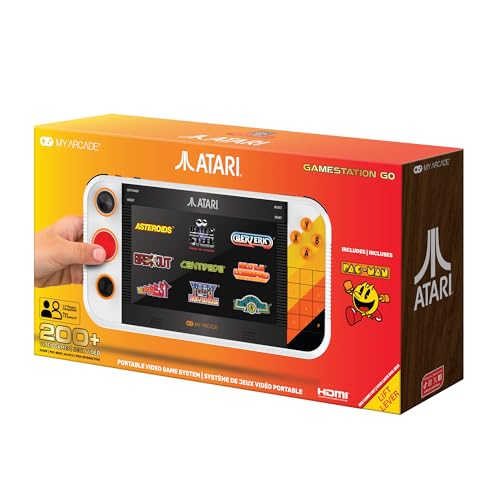
The one with a real paddle, trak-ball and keypad built in, not a D-pad standing in for arcade controls.
This is the only pick here that ships with a genuine license behind its library, and that changes what you get. You are buying 200+ games drawn from Atari 2600, 5200, 7800, Arcade, Recharged and Balls of Steel pinball tables, plus licensed titles from Jaleco and PIKO Interactive. Names like PAC-MAN, Asteroids, Breakout, Centipede, Missile Command, Tempest, Warlords and Yars Revenge are confirmed on the machine before it arrives.
The hardware is built around playing those games the way they were designed. You get an integrated paddle, a D-pad, a trak-ball, a numeric keypad, bumpers and classic gamepad buttons (A, B, X, Y) all on the unit itself. A 7-inch full-color display is far bigger than the 3.4 and 3.5-inch panels on the other picks here, which makes it the natural choice for playing at home. It also connects to a TV over HDMI and has built-in Wi-Fi for firmware updates.
Reviewers keep coming back to the gameplay and the 80s nostalgia hit, and the 7-inch screen draws praise for being “lightweight, good ergonomics, large 7″ screen.” As buyers put it, it is “lightweight, good ergonomics, large 7″ screen.” Two things to know honestly. The controls draw mixed feedback: the trackball needs finesse, the spinner feels stiff for Tempest, and a few players miss key 2600 titles like Pitfall and Frogger. At 3.8 pounds and with a 5 GB storage capacity, it also is not the pocket companion the smaller consoles are.
Where it earns its keep
- 200+ games with real Atari and arcade licensing behind them, including PAC-MAN and Centipede
- Paddle, trak-ball, keypad and bumpers built in, so the games use the controls they were made for
- 7-inch full-color display and HDMI output for playing on a TV
- Built-in Wi-Fi keeps firmware current without a cable
What to weigh first
- At 3.8 pounds it stays home rather than riding in a pocket
- Trackball and spinner take practice on games like Tempest and 5200 Centipede
- Library skips some famous 2600 titles you may expect
Best fit: anyone whose childhood was spent in an arcade rather than on a Game Boy — the licensed Atari collection plus real paddle and trackball controls is exactly the machine that audience wanted.
Think twice if: you want a console that disappears into a jacket pocket; at 3.8 pounds this one lives on a shelf or a TV stand.
2. Anbernic RG40XX H Retro Handheld Game Console
Four inches of screen, thumbsticks, and 5,000 games waiting when the box opens.
You get the biggest screen here outside the Atari unit: a 4.0-inch IPS display (a bright LCD panel with wide viewing angles). It runs at 640*480 with OCA full lamination (the glass is bonded directly to the panel so light does not scatter between layers), so the picture stays brighter and clearer when you tilt the console. The joystick also lights up in 16 million color RGB (red, green, blue) lighting, which you can set to constant, breath, rainbow, marquee, chasing or gaming effects, with adjustable brightness and custom color.
The chip underneath is a quad-core ARM Cortex-A53 paired with a quad-core PowerVR SGX544MP GPU and 1GB of RAM. In plain terms, that is enough to run older 2D systems smoothly and only the lighter 3D libraries. Reviews back that up: it handles DC and PSP mostly, runs PSX, SFC, FC, SG and everything older perfectly, and its 4-inch screen and trigger layout beat the 35XXH. The bundled 64GB Kioxia card arrives with a working OS and thousands of old games already on it.
Compared with the RG34XX above it, you trade some screen sharpness for size — the RG40XX H is 640*480 on a 4.0-inch panel, while the RG34XX is 720*480 on 3.4 inches. Reviewers single out the build quality and the 4-inch screen with its trigger layout, which they rate above the 35XXH. The honest caveats: Nintendo games are absent from the library, some users see a game stop halfway through, and the shoulder buttons are clicky rather than soft. It weighs about 200g and claims up to 8 hours from a 3200mAh battery.
Screen over sharpness: if you would rather have a bigger picture than the densest one, this is the pick — 4.0 inches and thumbsticks make longer sessions kinder on your hands than the 3.4-inch alternatives.
The follow-up question: what you get preloaded is a working starting library, not a complete one. Expect to add your own ROMs for the blockbuster titles.
Reach for this if: you want a bigger display and analogue thumbsticks without stepping up to a home-console-sized unit.
Look elsewhere if: a spotless, no-tinkering library on day one matters more to you than screen real estate.
3. RG34XX Retro Handheld Game Console
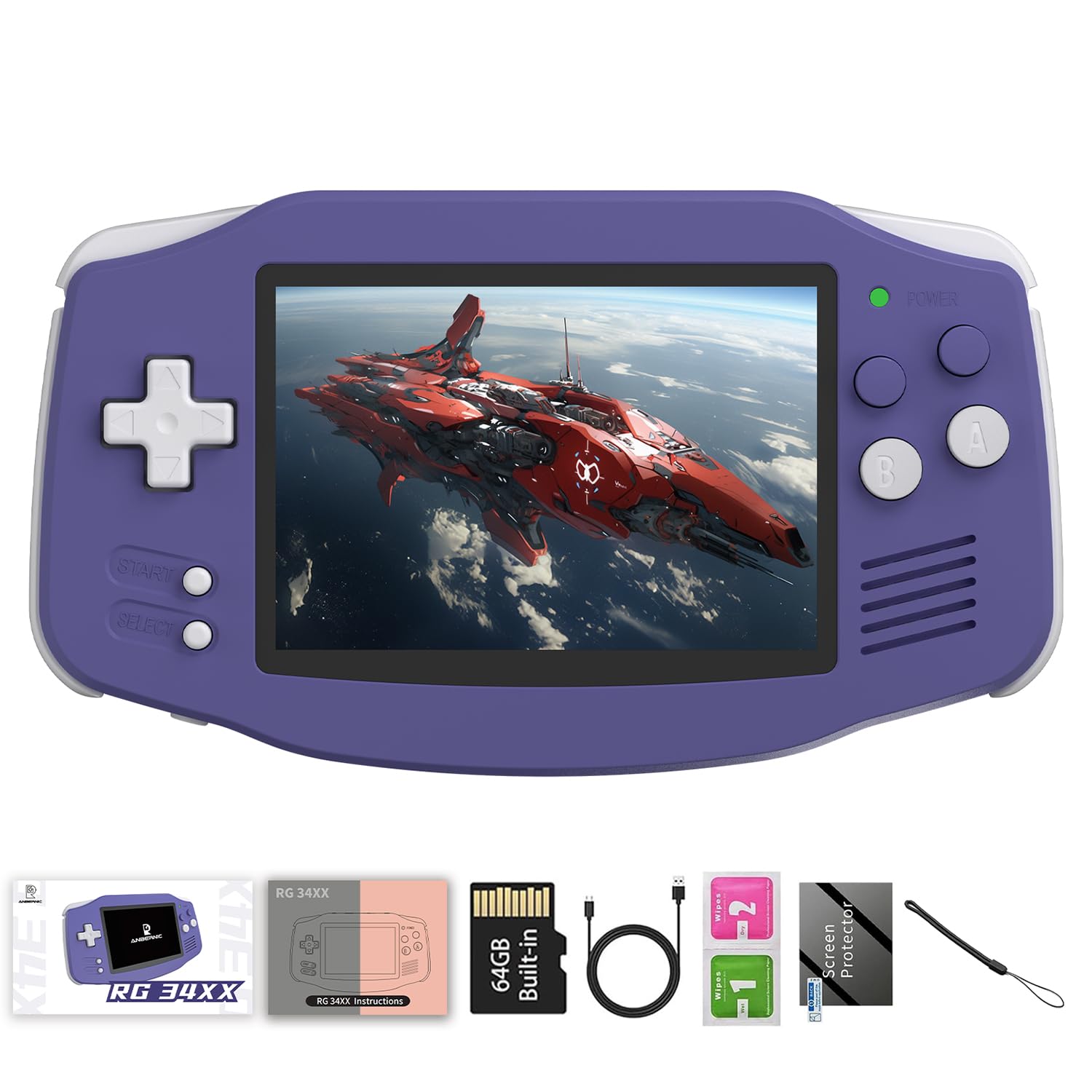
A pocketable Game Boy Advance in spirit, with a screen that outclasses the original by a mile.
The spec that decides this one is the panel: a 3.4-inch IPS display at 720*480 with OCA full fit. That resolution closely mirrors what Game Boy Advance games were drawn for, so sprites land crisp instead of smeared. Owners who came for GBA confirm the match — the screen lines up with the GBA’s native resolution, and it is brighter and sharper than the dark, reflective screen they remember. That is the difference between the GBA’s dark, reflective screen and artwork you can actually see.
You get 5000+ games on a 64GB card, and the memory storage capacity is listed at 32 GB. Under the hood sits an H700 quad-core ARM Cortex-A53 with 1GB of RAM, which keeps the system response quick. Battery is a 3500mAh polymer lithium-ion pack rated for up to 8 hours of continuous play, and the whole thing weighs about 188g — light enough for a jacket pocket. Connectivity is broad: 2.4G wireless and wired controllers, Bluetooth controllers, HD output to a TV, a vibration motor, and Wi-Fi for online multiplayer and streaming.
Against the G350 below it, the RG34XX is the stronger of the two on stamina — 8 hours versus 7 — and it carries the larger 3500mAh cell against that model’s 3200 mAh. The honest catch is that the shipped ROM set is hit or miss, and enjoying it fully means tinkering with a custom OS rather than plugging in and playing. Reviews praise the performance most: it runs PSX, SFC, FC and SG perfectly, with the 720*480 screen matching the GBA’s native resolution. A few mention missing games and uneven battery reports, so go in expecting to curate your own library.
Where the value sits: a 720*480 screen and an 8-hour battery in a 188g body is a lot of handheld for the mid-range tier.
The work it asks: this is not a plug-and-play machine. If you are comfortable installing a custom OS and adding ROMs, it rewards you; if not, it frustrates.
Pick this one if: Game Boy Advance is the system you love and you do not mind a little setup work to open up the library.
Pass it by if: you want every game working from the start with zero tinkering.
4. RG34XXSP Flip Retro Handheld Game Console, 64G, 5532 Games
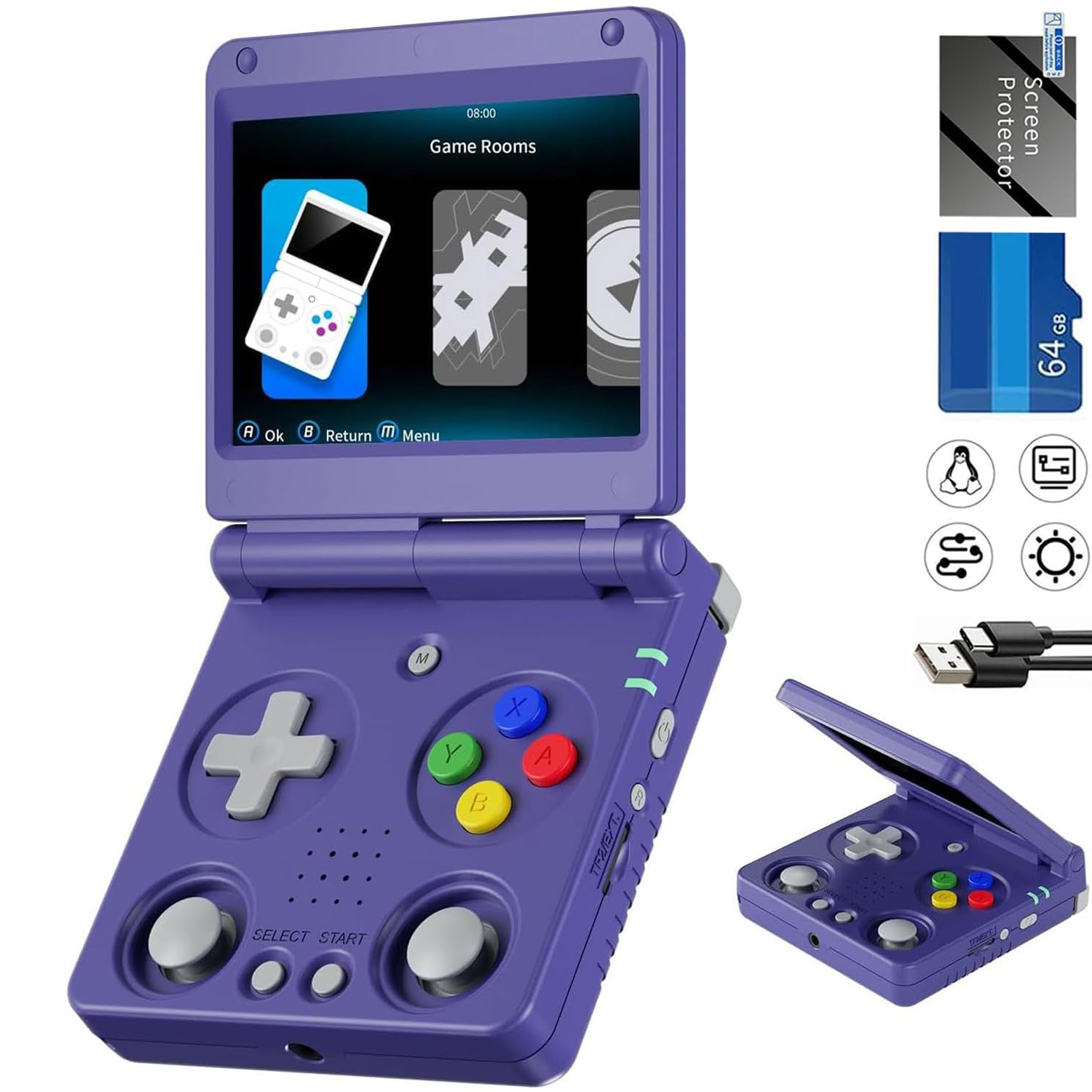
A clamshell that folds shut and protects its own screen, which is the point of the whole design.
The hinge is the feature here, and it is a genuinely smart one. The upper and lower covers hold together with built-in magnets, and a quality alloy shaft lets the lid hover at any angle between two presets, 190 degrees and 155 degrees, where it auto-locks. A Hall switch chip handles open-cover bright-screen and closed-cover rest-screen automatically. In daily use that means you snap it shut, drop it in a bag, and the display stays protected.
The library is the largest count in this list at 5532 games, spread across 64GB and more than 30 supported game formats. A second card slot takes TF expansion up to a maximum of 512GB, so you are not stuck with what ships. Inside you get 2.4/5G Wi-Fi, support for 2.4G wireless, wired and Bluetooth controllers, HDMI output to a TV, a vibration motor, online multiplayer and streaming. It also carries a video player, file manager and e-book reader for txt files. The battery is a 3300 mAh lithium-ion polymer pack rated at 7 hours, and the folded body measures 3.27 x 3.27 x 0.98 inches.
Owners rate the gameplay and value highest, and the folded 3.27 x 3.27 x 0.98-inch body makes it the easiest of the bunch to actually carry. Where it needs honesty is durability: the recurring theme in feedback is the hinge, with cases of a hinge breaking from minimal use. One 5-star note describes it as “easy for use, is easy to carry,” which matches the form factor well. Treat the lid gently, use a case, and this is a very usable pocket console.
What makes it carryable
- 5532 games preloaded across 30+ formats, the biggest built-in library here
- Magnetic flip lid protects the screen with no case needed
- Dual card slots expand storage up to 512GB
- 2.4/5G Wi-Fi and Bluetooth controller support round out the connectivity
The hinge is the worry
- Multiple reports of hinge failure, including one after five months of careful use
- Some units arrive faulty and stop powering on early
- The preloaded game selection is called mediocre by several owners
The case for it: a folding console with a protected screen, 5532 built-in games and a 512GB expansion ceiling fits anyone who wants the most library per square inch.
The catch to accept: this is the one pick where the hinge deserves real care — open and close it deliberately rather than tossing it around.
5. G350 Handheld Game Console
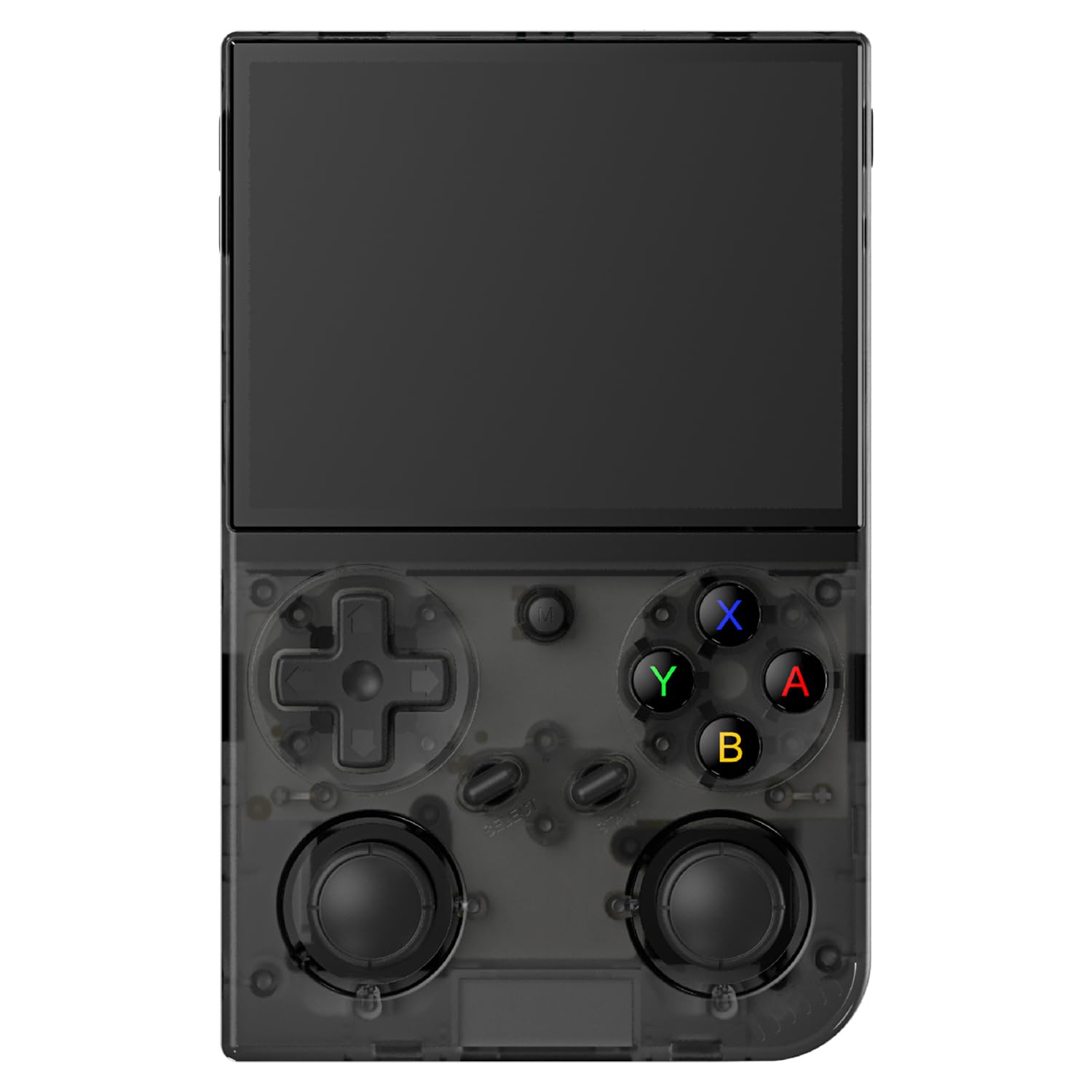
The cheapest way in, and the one that asks the most patience in return.
This is the cheapest way into retro emulation (running old console games in software) on this list. Its 3.5-inch IPS panel at 640*480 has a full viewing angle and OCA full lamination (glass bonded to the panel so light does not scatter), so the screen stays sharp and bright at this price. It is the largest screen among the small consoles here, edging the RG34XX’s 3.4 inches. An RK3326 quad-core chip at 1.5GHz, a dual-core Mali-G31 MP2 GPU (graphics chip) and 1GB of LPDDR3 RAM (low-power memory) are aimed at keeping the frame rate stable on older systems.
You get 4371 games preloaded, a 3200 mAh lithium-ion battery rated up to 7 hours of play, USB Type-C charging, and support for an external controller plus a Wi-Fi module for multiplayer. It weighs 6.7 ounces and measures 5 x 3.2 x 0.9 inches, so it slips into a small bag without fuss. Ships with the console, a USB charging cable and a user manual.
Against the RG34XX above, it plays a shorter game — 7 hours against 8 — and carries a smaller 3200 mAh battery against that model’s 3500mAh, so this budget pick gives up a little stamina. Its track record is also the shakiest of the group: reliability feedback is mixed, and buyers report that “this product no longer charges when plugged in.” Some units arrive fine and play smoothly up to PS1, while a few simply fail. The preloaded list can also be incomplete, which is where adding your own ROMs (game files) comes in.
What it delivers at entry level: a sharp 3.5-inch IPS screen, 4371 games and a 7-hour battery in a 6.7-ounce body.
What you accept: the reliability lottery — if a unit works, it is a fine starter machine; if not, the return window is your safety net.
Start here if: you are testing the retro waters and want the lowest-cost way to see whether the hobby sticks.
Step up if: you need consistent charging and a dependable library — the RG34XX and RG40XX H are the safer bets.
Know the Specs
Battery Capacity and Play Hours
Capacity is measured in mAh — the size of the fuel tank. Play hours are the claimed drain rate. A 3500mAh pack claims up to 8 hours on the RG34XX, while a 3200 mAh pack claims up to 7 on the G350. Larger capacity does not automatically mean longer play, because the screen and chip also draw power. Treat both numbers together as a rough guide.
Screen Size versus Resolution
Resolution is the number of pixels the panel draws, written as width by height. A 640*480 screen on a 3.5-inch panel keeps older sprites sharp. A 720*480 panel on a 3.4-inch screen packs more detail into a smaller area. Size matters for comfort at home; resolution matters for crispness of old games.
Chip and RAM
The processor (chip) and the running memory (RAM) decide what systems a console emulates without lag. A quad-core ARM Cortex-A53 with 1GB of RAM is the common spec here. In practice that runs 2D systems smoothly and only the lighter 3D libraries, so expect smoother play on older titles than on newer ones.
Emulators and Preloaded Libraries
An emulator is software that mimics an old console, letting a new device play its games. A preloaded library bundles ROM files with those emulators. Quality varies — licensed titles are named and complete, while bulk counts can be missing favorites or poorly organized. Check for named games rather than a big total.
Common Questions
What does preloaded actually mean on these consoles?
Can I add my own games to a preloaded handheld?
Do these consoles connect to a TV?
What is the difference between an IPS and an LCD screen here?
How long does the battery last on a handheld like this?
Will a preloaded console play PlayStation games?
Is a big game count better than a licensed library?
Do these need Wi-Fi to play the preloaded games?
What age is a handheld console like this meant for?
How fragile is a clamshell handheld like the RG34XXSP?
The Bottom Line
Which one to buy depends on if you want a ready-made collection or a project. For most buyers the winner is the My Arcade Atari Gamestation Go, because its 200+ games are licensed, named and matched to real paddle, trackball and bumper controls — no downloads, no setup, no guessing what is inside. If you want a bigger screen and analogue sticks (thumbsticks that move smoothly in any direction) for smooth 2D play, reach for the Anbernic RG40XX H. And if a pocket-sized clamshell with more built-in games than anything else here sounds right, the RG34XXSP Flip earns its place — just mind the hinge.
How we choose
We do not accept paid placement. Every pick is matched to a real buyer and a real use-case; we do not hands-on test units.
Sources
Specifications: manufacturer listings and product documentation. Review insights: verified customer reviews, as of October 2026. Pricing: not shown on this page (it changes often); check the current price via the retailer link.
As an Amazon Associate, Aappliancez earns from qualifying purchases. This does not affect which products we feature.