Disclosure: Some links in this post are affiliate links. As an Amazon Associate I earn from qualifying purchases, at no extra cost to you. Learn more
Specs are compiled from manufacturer listings and verified buyer reviews and can change over time — please confirm the key details on the product page before buying.
Buying a powerful flashlight is not about chasing the biggest lumen number on the box. What actually matters is how bright it stays after the first minute, how far the beam really reaches, and whether the battery still has charge when you need it. This guide covers five lights that do those three things well, and it tells you plainly which one suits a pocket, which one suits a toolbox, and which one suits a job site.
This guide is built by comparing the manufacturers’ published specifications and the patterns across verified customer reviews, so you get each pick’s real strengths and trade-offs instead of marketing spin.
You will see where each light wins and where it genuinely falls short, from heat to weight to battery quirks. Read the short version in the comparison table, then use the reviews to find the one that matches how you actually use a light: powerful flashlight buying gets much easier once you know what to ignore.
Top Picks


How To Choose The Best Powerful Flashlight
Most buyers compare two numbers — lumens and price — and stop there. That habit is why so many bright lights end up in a drawer after a week. Three figures decide whether a light is genuinely useful to you: how far the beam reaches, how long it holds its top output, and how much it weighs in your hand or pocket.
Read the lumen rating together with the beam distance
Lumens measure total light output — think of it as how much light leaves the lens in every direction. Beam distance, given in meters or yards, tells you how far that light stays usable. A light can be rated at a very high lumen count and still fail to show you a fence post at the end of your yard, because its beam is wide and shallow. Look for both figures before you commit.
Expect the brightest setting to be a short burst
On almost every compact high-output light, the top setting is called turbo. It runs for seconds rather than minutes, because a small metal body cannot shed that much heat. The light then steps down — dropping to a lower, sustainable level — and comes back up once it cools. Judge a light by its sustained high mode, not its headline burst.
Decide between a built-in and a removable battery
A sealed built-in battery usually charges faster and keeps a flatter output as the charge drops. A removable cell lets you carry a spare and keep going when the first one dies. Match it to your habit: if you charge once a week and never plan for long outages, sealed is fine. If you work nights or hike multi-day routes, a swappable battery is the safer call.
Weigh the switch layout against your grip
Two-switch lights put on/off at the tail and brightness at the side, so you can run the light and change levels with one hand. That layout suits a tactical grip and gloved hands. Single-button lights cycle every mode in sequence, which is simpler to learn but slower to skip past. Try to picture the actual moment you will click it — in the dark, probably one-handed, possibly wearing gloves.
Side-by-Side Comparison
| Model | Best For | Max Output | Beam Distance | Weight | Amazon |
|---|---|---|---|---|---|
| Nitecore MH12 Pro★ Best Overall | One light for everything | 3300 lumens | 552 yard | 5 ounces | Amazon |
| Nitecore EDC29Peak Output | Highest output, flat carry | 6500 lumens | 437 yards | 5.6 ounces | Amazon |
| sofirn SP35T | Wide flood on a budget | 3800 lumens | 918 feet | 3.07 ounces | Amazon |
| ThruNite Archer 2A C | Pocket backup and outages | 1018 lumens | 167 meters | 101 g | Amazon |
| YiaMia 2-Pack Work Light | Hands-free work lighting | 1000 lumens | 100 meters | — | Amazon |
Detailed Reviews
1. Nitecore MH12 Pro Tactical Flashlight
Our pick — 4.5+★ from 300+ verified ratings; the strongest balance of quality and price.
Five ounces of anodized aluminum that throws a beam more than 550 yards down the road.
The MH12 Pro is the easiest recommendation here because it balances three things most lights trade away against each other. It pushes 3300 lumens out to a 552-yard beam distance — enough to light a tree line at the far edge of a field, not just the path at your feet. And it does that at 5 ounces, short enough that the manufacturer’s own phrasing about a pen-style pocket holds up in ordinary jeans.
What wins people over is plain performance. The beam is focused rather than a wide wash, so the hotspot carries a long way while a surrounding flood circle still lights the ground around it for walking. Buyers report roughly two days of use between charges with low idle drain, so it still has power when you grab it in an emergency.
Honesty time: the top setting gets hot fast. Turbo steps down within several seconds and the body becomes noticeably warm by about the twenty-second mark, then recovers once it cools. That is thermal protection doing its job on a body this small, and the high mode below turbo is still very bright. The other small trade-off is the finish — it is slick in a bare hand, and one drop onto pavement leaves a mark. Charge time from two bars runs two to three hours over USB-C. For a light with this much reach in this little metal, that is a fair swap.
Where it pulls ahead
- 552-yard throw from a body you can pocket, so distant objects are identifiable rather than just lit.
- Visible power-level indicator beside the mode button, so you know the charge before you leave.
- Two-way clip works on a hat brim or pocket edge, giving you a hands-free option.
- Tail switch with momentary on, plus a proximity sensor that stops it firing inside a pocket.
- USB-C charging with a removable battery, so you can swap cells instead of waiting.
What you give up
- Turbo lasts only seconds before stepping down, so the sustained level is what you really use.
- The special modes sit behind a memorized click pattern that takes practice to reach.
- Smooth finish is slippery, and the tail-stand ring is not perfectly stable on a flat surface.
Built for: the person who wants one light on the nightstand, in the truck, and in the toolkit without owning three separate torches.
Look past it if: you need a sustained, non-stop blaze of light for long stretches rather than a burst plus a strong high mode.
2. Nitecore EDC29 Flashlight
A flat-bodied torch that fires 6,500 lumens — and slips into a front pocket like a phone.
If the idea of a light that turns night into day from a pocket is what you are after, this is the one that delivers it. The EDC29 is rated at 6500 lumens with a 437-yard beam, and the body is only 0.76 inches thick at 5.6 ounces. That flat rectangular shape is the whole point — it lies alongside a wallet or a phone instead of rolling around in a cylinder. A screen on the body shows the current output and status, so you can see what you have selected before you point it anywhere.
The gap between this and the MH12 Pro is worth naming plainly. The Nitecore MH12 Pro gives you 3300 lumens and 552 yards of throw, while this one answers with 6500 lumens over 437 yards — far more total light and a shorter reach. In practice that makes the EDC29 the choice for flooding a wide area, and the other pick the choice for picking out a single object far off. Its spotlight, floodlight and strobe modes are separated rather than blended, and a paddle button gives instant turbo or strobe when you need a reaction rather than a setting.
Two lockouts — a mechanical slide and a rapid lock — are the feature that keeps this usable as a pocket light, because a light that fires accidentally against your leg is worse than useless. Charging is quick: a full top-up takes one hour and fifteen minutes over USB-C, and the low mode runs 61 hours. What you should know before buying: the battery is sealed in, so you cannot carry a spare, and the top turbo is a burst measured in seconds before the body heats up. Owners also note the four-level cycle can feel fiddly to click through. The digital display and the responsiveness of the two tail buttons undercut most of that frustration in everyday use.
Why it earns the premium slot
- 6500-lumen maximum sits at the very top of this group, for when you want a wall of light.
- 0.76-inch thickness means it carries flat against the thigh rather than printing through a pocket.
What to know first
- Sealed battery cannot be swapped, so a dead cell ends the session.
- Turbo is limited to seconds, and this body builds heat faster than the others here.
Reach for this if: you want the most raw light output you can carry in a front pocket, with a display that tells you what mode you are in.
Think again if: you want to pack spare cells for a long night out, since the battery here does not come out.
3. sofirn SP35T Tactical Flashlight

The mid-range light that floods a whole yard instead of poking one bright hole in it.
Where the MH12 Pro is built to reach, the SP35T is built to cover. It is rated at 3800 lumens with a 918-foot beam distance, and it leans the mix toward flood — a broad spread of light across a wide area. For dog walks across an unlit park, checking a fence line, or lighting up a campsite while you cook, that wider spread does more for you than a narrow spear of light. The dual-switch layout does the hard work: the tail switch turns it on with a momentary press, and the side switch steps through brightness levels without cycling the whole list.
What wins people over here is the build. The hard-anodized aluminum body is rated IPX8 for water resistance, meaning it can be submerged, and the rubber charging-port lid is a design detail owners genuinely notice because cheap lights leak there. The 21700 lithium-ion battery inside is a physically larger cell than the slimmer lights here, and the medium mode holds a non-diminishing brightness for six hours and fifty-eight minutes — a real working stretch, not a burst.
Here is the honest limit. The SP35T is not a pocket light. Owners who know these cells describe a 21700 light as noticeably larger than an 18650, so this one lands in the toolbox or bedside drawer rather than your jeans. Output also dims gradually as the cell drains, which shows up when you are tracking something through the woods for a long while. Turbo heats quickly and fades back to the high level. Think of it as an excellent backup, emergency and around-the-house light rather than a professional duty carry. At 3.07 ounces on the spec sheet it is still easy to grab, and the included USB-C port means no charging cradle to lose.
The sharpest value angle: you are getting a 3800-lumen, IPX8-rated, dual-switch light with the battery in the box, and the wide beam covers ground faster than a tight hotspot ever will.
The catch worth weighing: the battery is sealed in, so you cannot swap it; the light dims gradually on a long run; and the body is sized for a bag or a shelf. This is a light you keep somewhere useful, not one you forget is in your pocket.
Suits: the household that wants one serious light for storms, camping and the backyard, kept charged and ready on a shelf.
Not for: anyone shopping for a forget-it’s-there pocket carry, because the 21700 body is too chunky for that job.
4. ThruNite Archer 2A C LED Rechargeable Flashlight
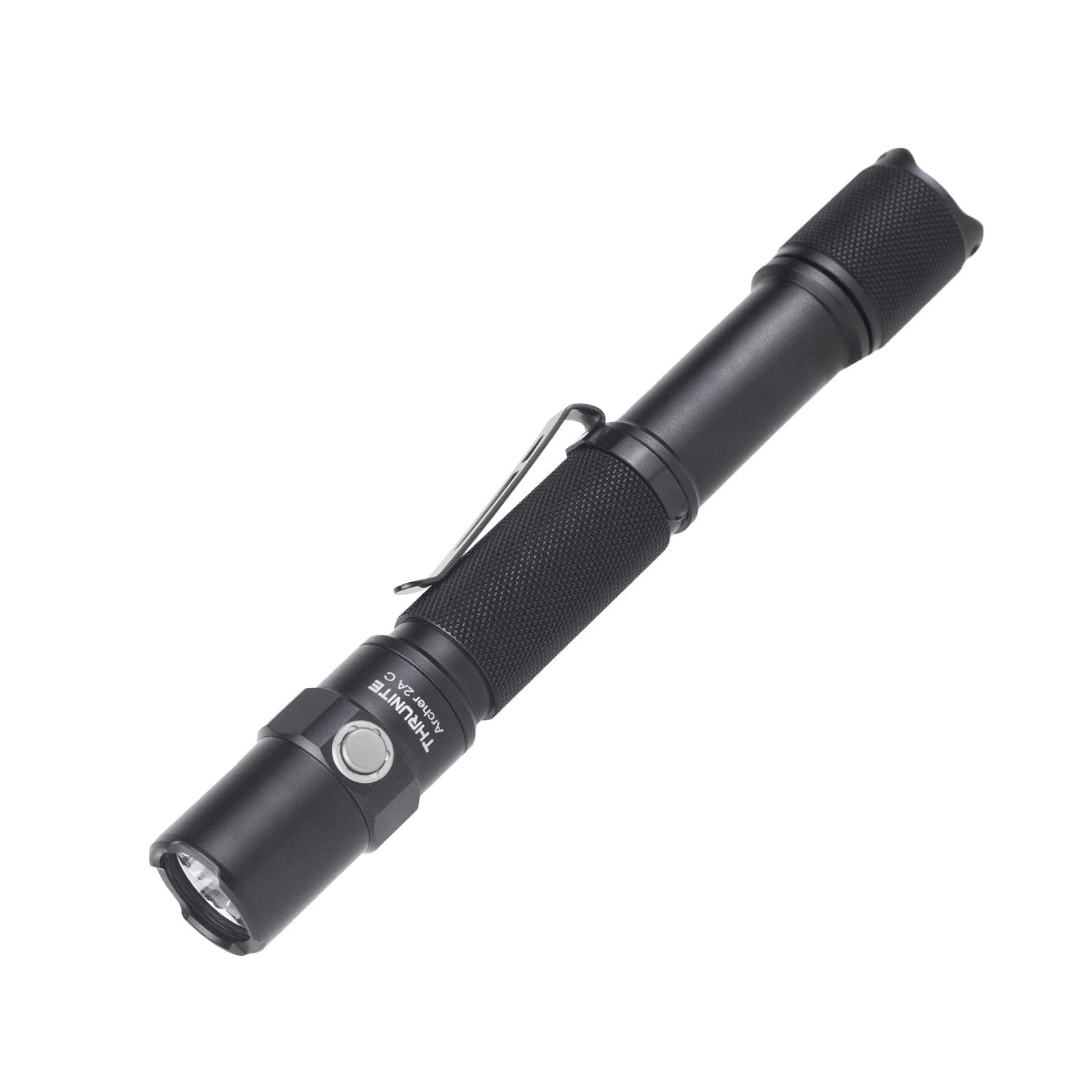
At 3.56 ounces and under an inch wide, this one disappears into a jeans pocket until you need it.
The Archer 2A C is the sensible small light — the one you put in a glove box, a backpack, or a kitchen drawer and forget about until the power goes out. It puts 1018 lumens down a 167-meter beam at 7000 candela, which is bright enough to light a backyard or a dark trail. Candela is the figure that tells you how hard the beam punches in one direction, and 7000 is a solid number for a light this small.
The everyday modes are where it earns its place. A side switch cycles through four levels — Firefly, Low, Medium and High — plus a one-press strobe, while a tail switch gives instant momentary light. Firefly is the lowest setting, and it runs a stated 27 days on a single charge, which is the setting you want for reading a map or finding a keyhole without wrecking your night vision. The rechargeable cell pairs with AA compatibility, so you can drop in an alkaline battery when there is no outlet anywhere near you. That dual-fuel option is the single most useful thing about this light for emergency kits.
What brightens the case further is the size and weight. At 3.56 ounces and six inches long, it sits in a pocket or a hat clip without pulling your waistband down. The main gripe across longer-term owners is the metal pocket clip, which can rotate or pop off after months of daily carry. Neither of those matters much for an emergency drawer light. It matters more if you plan to run it on high for an entire night shift.
The case for it: a 27-day Firefly mode plus AA backup is genuine outage insurance, and the 3.56-ounce body means you will actually keep it with you.
Worth knowing: the pocket clip is the weak link over time, and sustained high output fades — treat it as a dependable backup rather than a workhorse for hours of continuous high.
Go with this if: you want a light that lives quietly in a bag or drawer and works on ordinary batteries when the rechargeable cell is empty.
Pass if: you need a beam that reaches across a hundred yards or a light you can run on high for hours without dimming.
5. YiaMia Rechargeable Magnetic Work Light 2-Pack

Two palm-sized lights that stick to a hood, hang off a pipe, and leave both hands free.
This is a different kind of flashlight, and it answers a different question. You are getting two lights, each rated to 1000 lumens with a 100-meter range, built to stick where you need them rather than be held. A strong magnet on the back and a 270-degree folding hook let you clamp one to a car hood, a steel beam or a pipe, and a 360-degree swiveling stand tilts the beam wherever you point it. That is the reason a mechanic or a home renovator reaches for these instead of a torch.
The modes are what make them flexible. Each light carries 7 lighting modes across three sources: 2 XPE spot LEDs, 24 COB white LEDs for a wide flood, and 12 COB red LEDs that run steady or flashing. COB means chip-on-board, where many small LEDs sit on one panel — that is why the flood mode covers a whole work area evenly rather than throwing a hot dot. The red light is useful when you need to be seen rather than to see clearly. A 2200mAh battery inside runs 3-8 hours depending on the mode, and charges over USB-C.
There are two honest catches. The first is the port cover: the rubber flap that covers the charging port doubles as the power switch, and once the light is mounted sideways, that flap can catch and tear. The second is charging — a few owners find these will not draw power from a plain USB-C phone charger, only from the supplied cable, which is worth knowing before you head out. On the practical side, the power-bank function lets you top up a small device from the battery in an emergency. Owners widely praise the magnets for gripping flat surfaces firmly, and each light is compact enough to ride in a motorcycle tank bag.
Why two beats one here
- Two lights in one pack, so you can mount one and pocket the other.
- Magnet, hook and swiveling stand combine for hands-free light in awkward spots.
- COB flood, XPE spot and red LEDs cover close work, wide lighting and visibility.
- 2200mAh battery doubles as an emergency power bank.
Where it asks for care
- The rubber port cover doubles as the switch and can tear when mounted sideways.
- Charging can be fussy — some units only top up from the supplied cable.
- 1000 lumens per light cannot match the reach of the dedicated torches above.
Pick this if: you need light thrown onto a job rather than carried in a fist, and two matching units means one lives in the car and one lives in the toolbox.
Don’t pick it if: you want to spot something far across a field — for that you want the throw of a dedicated torch.
Know the Specs
Lumens vs candela
Lumens are the total amount of light a torch puts out in every direction — a raw volume figure. Candela is how intensely that light is focused in one spot, and it is what decides real reach. A light with a very high lumen count but a low candela will light a wide circle brightly but fade out before it reaches the far side of a field. When you compare lights, read both, then glance at the beam distance the maker publishes. The ThruNite Archer 2A C, for example, lists 1018 lumens alongside 7000 candela and a 167-meter reach — three figures that tell one consistent story.
Turbo step-down and heat
Every compact high-output light here has a turbo or top setting that runs far brighter than the rest. Small aluminum bodies cannot shed the heat that setting generates, so the electronics throttle the output down to a sustainable level and let it climb back once the metal cools. Practical advice: judge a torch by whether the level below turbo is still bright enough for your work, because that is the level you will spend most of your time in. Most of these lights also get warm on high, which is normal operation rather than a warning sign.
IP ratings explained
An IP number rates how well a body keeps dust and water out — the first digit covers solids and the second covers liquid. IPX8, the rating on the Nitecore MH12 Pro and the sofirn SP35T, means the X-for-dust is unstated and the second number confirms the light can be submerged in water. In real terms, that means a dropped light in a puddle or a downpour on a night walk is not an emergency. It does not mean you should swim with it. The YiaMia work lights use a different scheme and are described as waterproof and dustproof without the numeric rating.
Built-in versus removable batteries
A removable cell lets you carry a spare and swap it in seconds, so you finish the job instead of going home. A sealed built-in cell often charges faster: the Nitecore EDC29, for instance, tops up in one hour and fifteen minutes over USB-C (a common charging port). A sealed cell also lets the maker control voltage more tightly, so the light does not dim as the charge drains. The trade-off is straightforward: sealed cells mean fewer moving parts and a slimmer body, but no spares. Removable cells mean flexibility, but you have to remember to charge them before you leave.
Switch layout and one-handed use
Two-switch lights split the work: a tail switch for on, off and momentary light, and a side switch for stepping through brightness. That lets you run the light and change a level with one hand, which matters when the other hand is holding a tool or a leash. Single-switch designs cycle a whole sequence, which is simpler to learn but slower to skip past. A momentary function — light only while you hold the tail button — lets you flash a quick check without committing to a full on-state, which is useful for keeping your position hidden.
Runtime, not just maximum brightness
A high maximum output is only useful if the battery can keep up, and most of that runtime comes from the lower modes. The figure to look for is the sustained runtime at a middle setting. The sofirn SP35T holds a non-diminishing brightness for six hours and fifty-eight minutes on medium, and the ThruNite Archer 2A C runs 27 days on its Firefly level. Those numbers describe how the light behaves when you are not blasting turbo — which is the majority of the time. A light with a modest maximum but a generous medium runtime will usually serve a long work session better.
Common Questions
Is 3300 lumens brighter than 1018 lumens in real use?
Why does my flashlight dim after a few seconds on high?
What does IPX8 actually protect against?
Can I use ordinary AA batteries in a rechargeable flashlight?
Is a magnetic work light as bright as a normal flashlight?
How long does the charge last on a powerful flashlight?
Can a flashlight double as a power bank?
What is the difference between a flashlight’s spot and flood modes?
Will a metal flashlight clip wear out over time?
Do these lights need special charging cables?
The Bottom Line
For most people, the powerful flashlight worth buying is the Nitecore MH12 Pro. It balances 3300 lumens (a measure of light output) and a 552-yard throw (how far the beam reaches) at a weight you can carry all day. Its battery indicator means it is charged when you grab it. If maximum light output from a front pocket is the goal, the Nitecore EDC29 answers with 6500 lumens at just 0.76 inches thick. For hands-free work lighting, the YiaMia 2-Pack is the one to reach for. Honest nudge: start with the tight beam on a light built to throw before you chase the highest lumen number you can find.
How we choose
We do not accept paid placement. Every pick is matched to a real buyer and a real use-case; we do not hands-on test units.
Sources
Specifications: manufacturer listings and product documentation. Review insights: verified customer reviews, as of October 2026. Pricing: not shown on this page (it changes often); check the current price via the retailer link.
As an Amazon Associate, Aappliancez earns from qualifying purchases. This does not affect which products we feature.