Disclosure: Some links in this post are affiliate links. As an Amazon Associate I earn from qualifying purchases, at no extra cost to you. Learn more
Specs are compiled from manufacturer listings and verified buyer reviews and can change over time — please confirm the key details on the product page before buying.
If your TV’s built-in speakers mumble every conversation, the fix is a powered speaker set or soundbar that plugs straight into the TV — no separate amplifier, no receiver, no wiring diagram. The one most people should start with is the MEVOSTO 5-inch powered bookshelf pair, because it gives you real stereo separation, physical bass and treble knobs, and a turntable-friendly input for the same money as a basic bar. Below you’ll find six options sorted by what they actually solve: desk-and-console stereo, small-room dialogue, virtual surround, real Dolby Atmos height, and one full floorstanding system for a dedicated room.
This guide is built by comparing the manufacturers’ published specifications and the patterns across verified customer reviews, so you get each pick’s real strengths and trade-offs instead of marketing spin.
Your first decision is simple: a left-right stereo pair, or a bar with a subwoofer (the box that handles bass). That one choice shapes everything else. Here is how the powered speakers for tv line up once you strip the spec sheets down to what you actually hear.
Top Picks


How To Choose The Best Powered Speakers for TV
More channels does not mean better TV sound. It usually means more boxes to place, more cables to hide, and a surround effect that only works if you sit exactly between the rear speakers. What matters far more is if you want a left-right stereo pair or a bar-plus-subwoofer setup, and what your TV can actually output.
Start with your TV’s output, not the speaker’s spec sheet
Check the back of your TV before anything else. An HDMI port labelled eARC (Enhanced Audio Return Channel — a single cable that carries sound from the TV to the speaker and lets the TV remote control the volume) gives you the cleanest handoff. Optical (a square-ish digital audio port that glows red) is the reliable fallback and exists on almost every TV made in the last decade. RCA and AUX are analog and fine for a turntable or an older set. Bluetooth is the easiest to set up and the most likely to drift slightly out of sync with lip movement, so use it for music more than for movies.
Decide how much “surround” you actually have room for
A true multi-channel system needs rear speakers behind or beside your seat. A 7.1 virtual system on a bar fakes that with processing and rear satellites, which is convincing in a small room and much less so in a large open living room. Dolby Atmos adds height by firing sound upward at the ceiling, and it only pays off if your ceiling is flat and your seating is close enough for the reflection to land near you.
Match the driver size to the room
A 5-inch woofer in a bookshelf cabinet moves more air than the tiny drivers inside a slim bar, which is why a stereo pair so often beats a bar on music and male voices. A dedicated subwoofer handles the low end the woofers cannot, and a bar with a built-in subwoofer trades that depth for one less box on the floor. In a bedroom or small den, a compact bar is plenty. In a larger room, plan for a separate subwoofer or tower speakers.
Budget for the cables and the mounting you will actually need
Rear speakers need power outlets near where they sit, plus either a cable run or a wireless link back to the bar. Some bars ship without mounting hardware and some have no mounting points at all, so confirm that before you plan a wall install. Factor in an HDMI or optical cable too — a few sets include one, many do not.
Side-by-Side Comparison
| Model | Best For | Channels | Driver Size | Key Connection | Amazon |
|---|---|---|---|---|---|
| MEVOSTO 5-Inch Powered Bookshelf Speakers★ Best Overall | Stereo desk, PC and turntable setups | 2.0 | 5 inches | Bluetooth 5.4, USB, RCA, AUX | Amazon |
| Samsung HW-B400F 2.0ch SoundbarCompact Pick | Bedrooms and small rooms, simple TV upgrade | 2.0 | 25.23 inches (bar) | HDMI, Bluetooth | Amazon |
| ULTIMEA 7.1ch Sound Bar with Subwoofer | Small-room virtual surround on a budget | 7.1 virtual | — | Optical, AUX, USB, Bluetooth 5.3 | Amazon |
| ULTIMEA 5.1.2ch Dolby Atmos Sound Bar | Real height effects and HDMI eARC | 5.1.2 | 5.25 inches (sub) | HDMI eARC, Optical, Bluetooth 5.4 | Amazon |
| LG S40TR 4.1ch Soundbar | LG TV owners wanting wireless rears | 4.1 | — | HDMI, Optical, Bluetooth | Amazon |
| Klipsch Reference 5.2 Dolby Atmos System | Dedicated home theater rooms | 5.2 | 6.5 inches | Wired to an AV receiver | Amazon |
Detailed Reviews
1. MEVOSTO 5-Inch Powered Bookshelf Speakers
Our pick — 4.5+★ from 700+ verified ratings; the strongest balance of quality and price.
Two real cabinets, a 36W amp built in, and knobs you can turn without an app.
This is the pick for the person who wants their TV, turntable and desktop PC all coming out of one pair of speakers. Inside each cabinet sits a 5-inch woofer (the round driver that produces bass and most voices) and a 1-inch silk-dome tweeter (the small dome that handles cymbals and sibilance). A built-in 36W RMS amplifier drives them — RMS being the honest continuous power figure rather than a peak number. Because the left and right channels sit in separate boxes, dialogue lands where the actor is standing on screen instead of in one flat slab under the TV.
The input selection is broader than any bar here: Bluetooth 5.4, USB digital audio, RCA and AUX. You get Bluetooth 5.4 with a stated 15-meter range (about the length of a large living room, so your phone stays connected from the couch), plus USB digital audio, RCA and AUX. A turntable with a built-in or external phono preamp plugs into the RCA jacks, and buyers report the tuning is the real draw here: “Tuned treble +2 and bass +3 from center for accurate sound. Very loud on PC; 20-30 volume sufficient for daily use.”
Owners consistently point to the sound as the reason they keep them. The recurring theme in owner feedback is full, clear audio that reaches room-filling volume without breaking up, plus a bass knob that goes further than the cabinet size suggests. The honest catch is the volume handling — some listeners find the bass assertive past halfway, and the mixed reports on loudness mean you should expect to trim bass rather than push it. A small practical annoyance: the power supply is a bulky adapter block that eats surge-protector space, and the cord runs short at roughly 3-4 feet. Each cabinet measures 5.9 x 6.1 x 9.7 inches, so measure your shelf before committing to a pair.
Why owners keep them
- Dual 5-inch woofers give stereo music and TV dialogue genuine body that a slim bar cannot match
- Physical bass and treble knobs plus a remote, so you tune by ear instead of digging through menus
- Inputs cover the whole house: Bluetooth 5.4, USB, RCA and AUX, including turntable use
- Walnut wood grain finish reads as furniture rather than plastic gadget
What to plan around
- No subwoofer output, so the low end tops out at what the 5-inch drivers can produce
- Bass can overpower at higher volumes — expect to dial it back from centre
- Bulky external power adapter and a short power cord limit outlet placement
- Dolby Audio is not supported, so surround-encoded movie tracks play as stereo
Reach for this if: you want one pair that handles TV, PC and vinyl with no amplifier in the chain.
Think twice if: you want a separate subwoofer output or a genuine surround field behind your seat.
2. Samsung HW-B400F 2.0ch Soundbar with Built-In Subwoofer
One flat bar, your existing TV remote, and no second box on the floor.
Sized for a bedroom or a small den where a subwoofer would be in the way, this is a 2.0-channel soundbar with the woofer built into the cabinet itself. The bar measures 25.23 inches across according to the product data — compact enough to sit under a smaller set without swallowing the stand. For scale, the MEVOSTO’s 5-inch driver is a fraction of that figure, and the two numbers are not the same measurement: one is cabinet width, the other is driver diameter. What the size buys you is a single tidy piece of hardware that plugs in at one outlet.
What a stereo pair cannot do is hand the remote over: it pairs with your Samsung TV so one clicker powers the bar, changes volume and switches sound modes. It pairs with your Samsung TV so the same remote powers the bar, changes volume and switches sound modes — one fewer clicker on the coffee table. Dialogue gets a dedicated lift: a Voice Enhance feature automatically pushes voices forward, and a night mode drops the volume and trims bass so a late movie does not carry through the house. As owners mention, the effect on a frustrated viewer is immediate: “Gift for mother; greatly improved TV sound, she now uses volume ~50 vs 100.”
The limits show up in the low end. The low end is decent for the cabinet size but not deep, and several owners describe it as a solid bedroom supplement rather than a living-room system. Reviewers also flag the on-bar LED indicators as temporary and the EQ as adjustable only in Standard mode, which limits how far you can shape the sound. A second practical point: because the woofer sits inside the bar, the cabinet is taller than a passive bar, and if you centre it in front of the TV it can block the TV’s remote sensor. Plan to nudge it off-centre or use the included wall brackets.
Who it fits: a small room, a rarely used second TV, or anyone who refuses to juggle two remotes. Setup is a plug and a pair, and the Samsung-to-Samsung handshake is the smoothest part of the package.
The trade-off: it deepens your TV’s sound rather than replacing it, so treat it as a clarity fix — dialogue and music detail — not a home-theater upgrade.
The straightforward call: buy it for a bedroom TV whose speakers mumble, and keep expectations at “clearly better,” not “cinema.”
Where it runs out: a large living room will want the separate subwoofer and rear speakers that a 4.1 or 5.1.2 system brings.
3. ULTIMEA 7.1ch Sound Bar with Subwoofer and Virtual Surround

Four satellites, a subwoofer, and an app with more tuning than most people will ever touch.
If your room is small but you still want sound arriving from behind you, this is the least expensive way to get there from this list. The system pairs a soundbar with a wired subwoofer and four surround speakers — two front, two rear — for a 7.1-channel virtual field. “Virtual” is the key word: the bar uses processing to place effects around the room rather than relying on discrete encoded channels, and the manufacturer’s own SurroundX processing is what does the placement. After a 15-20 minute setup you get rear effects and a subwoofer, which is a genuine step past a plain 2.0 bar.
The wiring is less wireless than the marketing suggests. The two rear speakers connect to each other by cable and share one power supply; only the link from the rear pair back to the bar is wireless, at a stated 15-meter Bluetooth 5.3 range. So you still need one outlet behind the couch and a short cable between the two rear cabinets. Wall mounts and brackets are in the box, which saves a separate purchase. Connection options are optical, AUX, USB and Bluetooth 5.3 — note that this model has no HDMI port, so optical is your path from the TV.
The app goes deep: 121 preset equalizer matrices split across Bass, Pop, Classical and Rock, plus a 10-band equalizer and six modes covering Movie, Music, Voice, Sport, Game and Night. The caveat is the surround itself. Owners consistently describe it as rich for movies and PS5 gaming in a small room but not a true multi-channel presentation, and one long-term listener settled on describing it as “simply stereo but worth the price.” Bluetooth is also the weak link at high volume, with clicking reported; switch to the optical input for movies.
The value read: four satellites plus a subwoofer plus app tuning is a lot of system for an entry-level outlay, and the rear channel is what most buyers are actually chasing when they say their TV sounds flat.
Set your expectation: this simulates surround convincingly in a small room and falls short of a discrete Dolby Atmos system in a big one.
Suits you if: the couch sits close to the TV and you want rear effects without a receiver.
Look elsewhere if: your TV only offers HDMI output and you would rather not add an optical cable.
4. ULTIMEA 5.1.2ch Sound Bar with Dolby Atmos
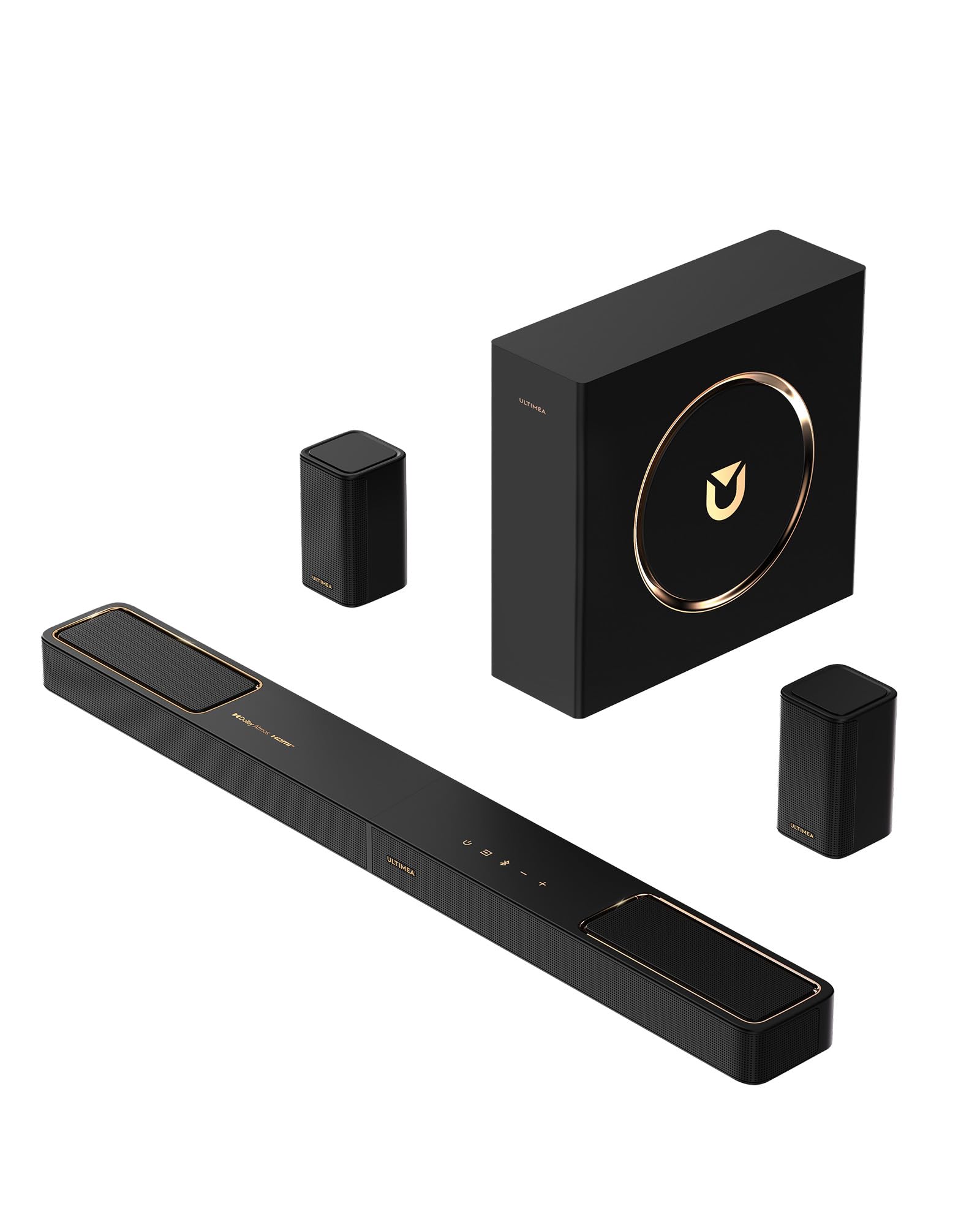
The one that fires sound at your ceiling and calls it height.
Dolby Atmos is the format that adds a vertical layer to a movie mix — rain falling above the characters, a helicopter crossing overhead — and this bar is built specifically to reproduce that layer. The 5.1.2 figure breaks down as five main channels, one subwoofer channel and two up-firing height channels. Those height drivers use neodymium magnets and voice coils per the manufacturer’s spec, and they bounce sound off a flat ceiling to land roughly where you sit. It is a real effect, not a simulated one, and it is the clearest upgrade over the 7.1 model above.
HDMI eARC is what makes it worth the step up. The enhanced version of the audio return channel carries up to 37Mbps of bandwidth according to the product data — a lossless path for the full 5.1.2 mix, where a standard ARC or an optical cable compresses it. CEC rides along on the same cable, so your TV remote controls power, volume and input switching without a second remote. The rear surrounds still need a power outlet, and they connect to the bar with a supplied 6-meter cable. A 5.25-inch wired subwoofer with BassMX handles the low end, with a stated frequency response reaching down to 40 hertz.
Where it stumbles is the low-frequency balance. The sub goes deep and rattles the room on action scenes, yet some listeners want more bark relative to the overall volume. The tuning is easy to reshape through the app — 13 surround levels from -6 to +6, a 10-band equalizer and 121 presets — so most of that gap closes once you spend a few minutes on it. Note that it does not decode DTS (a rival surround format), so a DTS-encoded disc will fall back to another format; Atmos content over HDMI eARC is where it shines.
The Atmos case
- Two up-firing height drivers reproduce the ceiling layer instead of faking it
- HDMI eARC carries a lossless 5.1.2 signal with stated 37Mbps bandwidth
- 5.25-inch wired subwoofer with BassMX adds real low-end weight
- App control with 13 surround steps, a 10-band EQ and 121 presets
Know before you buy
- No DTS decoding, so DTS-encoded sources need another format
- Bass output does not always feel matched to the volume you are running
- Height effect depends on a flat ceiling and reasonably close seating
- Rear surrounds still need a power outlet at the back of the room
Worth the upgrade if: your TV has HDMI eARC and you watch Atmos-tagged films and games.
Stay with the 7.1 pick if: you are running optical only and sit in a small room.
5. LG S40TR 4.1ch Soundbar with Rear Surround Speakers

Wireless rears with no receiver, and one remote for the TV and the bar.
Own an LG TV and this system does something no other pick here can. WOW Orchestra runs your LG TV’s own speakers and the soundbar at the same time, so the TV becomes the centre channel and the bar fills out the sides — you gain the TV’s built-in drivers instead of switching them off. WOW Interface puts volume, modes and connection status on the TV screen, controlled by the TV remote. If you have an LG panel, that integration is the reason to read this paragraph rather than skip to the next one.
Behind the bar sits a wireless subwoofer and a pair of rear surround speakers that also connect without a special receiver, which means no speaker wire running across the room. The 4-channel layout delivers dialogue through dedicated processing called Clear Voice Plus, and a Smart Up-Mixer spreads 2-channel audio across all the speakers for a wider stage. A 3-band equalizer in the LG Soundbar App covers bass, treble and mid-range. The one placement rule to respect: the surround effect only lands properly when you sit directly between the two rear speakers.
The compromises are real but specific. This is a 4.1 system, not a 5.1 one — the centre channel work is handled by processing and the TV’s own speakers rather than a dedicated centre cabinet. One owner found the bar has no mounting points at all, which rules out hanging it under a wall-mounted TV. The remote is also the weaker half of the control story, and the app occasionally needs a fresh Bluetooth pairing each session. Buy it for the wireless rears and the LG handshake, and the rest is fine rather than exceptional.
Standout feature: wireless rear speakers plus WOW Orchestra, a combination that turns an LG TV into half of the home theater for free.
Manage your hopes: it is a solid 4.1 system for a mid-size room, not a discrete 5.1 replacement, and the bar itself is best left on a surface.
The right match: an LG TV, a mid-size living room, and a couch that can sit between two rear speakers.
Wrong match: a non-LG TV, or a setup that needs the bar mounted under the screen.
6. Klipsch Reference 5.2 Dolby Atmos Home Theater System

A whole room of speakers in one box — and a receiver you have to supply yourself.
This is not a plug-into-the-TV product, and it should not be judged as one. In the box you get two R-625FA floorstanding towers, an R-52C centre channel, two R-41M surround bookshelf speakers and two R-12SW 12-inch powered subwoofers, each with a 400W peak all-digital amplifier. The towers carry built-in up-firing elevation channels for Atmos height, so the overhead layer comes from the same cabinet as the front stage. Cabinets are scratch-resistant black textured wood grain over reinforced MDF, with magnetic grilles and a 5-year limited warranty from Klipsch.
The catch is the thing that makes it work: a powered speaker like the MEVOSTO has its amplifier inside the cabinet, while these speakers are passive and need an AV receiver (the amplifier box that powers and switches your sources) to drive them. That is a separate purchase, and it needs to be a capable one. As customers note, the front towers each require two connections — one for the front-facing drivers and one for the ceiling-facing height channels — so a 5.2 receiver will run the system but a 7.2 receiver gets the most out of it. Budget for the receiver and the speaker cable before you commit.
What you get in return is scale. Tractrix Horn technology (a horn-shaped guide that boosts efficiency) and LTS aluminium tweeters give the Klipsch its high-efficiency character, so the system reaches cinema volume without straining. The two 12-inch subwoofers pressurise a large room in a way no bar with a built-in woofer can approach. Nothing here is compact: the towers are floorstanders and they want breathing room, so this suits a dedicated room, not a corner of a shared living space. The 6.5-inch drivers in the Reference lineup carry a 4.5+ star rating across a still-modest number of buyers, since most people audition this system in a store rather than order blind.
What the box delivers
- Complete 5.2 layout — towers, centre, surrounds and two subwoofers — in one purchase
- Built-in up-firing elevation channels in the towers for real Dolby Atmos height
- Dual 12-inch powered subwoofers, each with a 400W peak digital amplifier
- 5-year limited Klipsch warranty and scratch-resistant wood grain cabinets
The commitments it asks for
- No amplifier included — you must buy and configure a suitable AV receiver
- Each tower needs two speaker connections, so a 7.2 receiver is the better fit
- Floorstanding towers need real floor space and room to breathe
- Wired throughout, so plan cable runs for the surrounds and subwoofers
For the dedicated room: a proper home theater build where the receiver is already part of the plan.
Not for a first setup: if you want to unbox and plug into a TV, start with a powered pair or a bar instead.
Know the Specs
What “powered” really means
A powered speaker has its amplifier built into the cabinet, so the only cable between your TV and the speaker is an audio cable plus a power cord. That is what lets the MEVOSTO run a turntable and a PC with no receiver in the chain. A passive speaker like the Klipsch towers has no amplifier, which is why that system needs an AV receiver to work at all. When you see a wattage figure such as 36W RMS, RMS means continuous output rather than a momentary peak — the more honest of the two numbers.
Channel counts, decoded
The number before the decimal is the main channels and the number after it is the subwoofer channel, so a 2.0 bar is plain stereo with no separate sub, and 4.1 means four main channels plus a subwoofer. A third digit signals height channels: 5.1.2 means five main, one sub and two upward-firing drivers for Atmos. A “7.1 virtual” system creates the rear and side placement with processing from fewer physical cabinets, which is convincing in a small room and less so in a large one.
HDMI eARC versus optical
HDMI eARC carries the full lossless audio mix and lets the TV remote control the speaker over the same cable, which is why it is the first choice when your TV has the port. Optical is the universal fallback and works on nearly any TV, but it compresses the signal and cannot carry the height layer of an Atmos mix. Bluetooth is the easiest to pair and the most prone to a slight audio delay, so favour a wired input for films and save Bluetooth for music.
Driver size and room size
A larger woofer moves more air, which is why a 5-inch bookshelf driver gives voice and bass more weight than the small drivers inside a slim bar. A dedicated subwoofer covers the octaves a woofer cannot, and a 12-inch powered sub in a floorstanding system pressurises a room in a way a bar with a built-in woofer never will. Match the size to the space: compact bars suit bedrooms, a separate subwoofer or tower pair suits a living room, and a full 5.2 array suits a dedicated theater.
Common Questions
Can I connect powered bookshelf speakers directly to my TV?
Do I need an AV receiver for the Klipsch Reference system?
Is HDMI eARC better than optical for a TV soundbar?
What does 5.1.2 mean versus 7.1 on a soundbar?
Will a soundbar block my TV’s remote sensor?
Do wireless rear speakers still need power outlets?
Does Bluetooth cause audio delay when watching TV?
Do I need a flat ceiling for Dolby Atmos height effects?
Can I use a powered speaker set for both a turntable and a TV?
Why do some soundbars lack a dedicated subwoofer output?
The Bottom Line
For most people, the powered speakers for tv answer is the MEVOSTO 5-Inch Powered Bookshelf Speakers. Two separate cabinets, a built-in 36W RMS amplifier and RCA, USB and Bluetooth 5.4 inputs cover a TV, a computer and a turntable without adding a receiver to the shelf. It holds a 4.5+ star rating across a healthy body of owner feedback. If your TV has HDMI eARC (the port that sends lossless audio back to a speaker) and you want the ceiling layer in Atmos films, the ULTIMEA 5.1.2ch Sound Bar is the pick that adds real height drivers and a lossless signal path. For an LG TV in a mid-size room, the LG S40TR uses WOW Orchestra to press your TV’s own speakers into service alongside wireless rears. And if you have a dedicated room and a receiver already picked out, the Klipsch Reference 5.2 system delivers towers, a centre, surrounds and two 12-inch subwoofers in one shipment.
How we choose
We do not accept paid placement. Every pick is matched to a real buyer and a real use-case; we do not hands-on test units.
Sources
Specifications: manufacturer listings and product documentation. Review insights: verified customer reviews, as of October 2026. Pricing: not shown on this page (it changes often); check the current price via the retailer link.
As an Amazon Associate, Aappliancez earns from qualifying purchases. This does not affect which products we feature.