Disclosure: Some links in this post are affiliate links. As an Amazon Associate I earn from qualifying purchases, at no extra cost to you. Learn more
Specs are compiled from manufacturer listings and verified buyer reviews and can change over time — please confirm the key details on the product page before buying.
If your speakers hiss, your amp hums, or a click through the monitors makes you flinch, the fault often starts at the wall — not in your gear. A strip built for audio does two jobs a cheap hardware-store bar cannot: it absorbs voltage spikes before they reach a transformer, and it filters the electrical noise that rides along your AC line and leaks into the signal path. Below you will find five strips that owners actually trust with amps, mixers, pedal boards and home-theater racks.
This guide is built by comparing the manufacturers’ published specifications and the patterns across verified customer reviews, so you get each pick’s real strengths and trade-offs instead of marketing spin.
You will see how outlet spacing, joule ratings and isolated filtering banks separate a studio-grade bar from a bargain one — and which trade-offs are worth living with. These are the strongest options for a power strip for audio equipment, chosen for clean delivery and real durability.
Top Picks

How To Choose The Best Power Strip for Audio Equipment
Audio gear is fussy about what comes out of the socket. A guitar amp, a powered monitor or a mixing desk all draw steady current and all react badly to sudden spikes and to the low-level buzz that rides on a noisy AC line. The strip you choose sits between your expensive electronics and the grid, so the purchase is really about two things: how much surge energy it can swallow, and how well it cleans the line before the power reaches your transformer.
Surge energy is measured in joules
A joule is a unit of absorbed energy, and the rating on the box tells you how big a spike the strip can take before it gives up. A strip rated 2880 joules soaks up far more than a basic bar, which matters in storm-prone areas where the lights flicker. For a rack of amplifiers and a mixer, a higher joule number buys you a wider safety margin.
Filtering is what quiets the hum
EMI and RFI are the electrical noise — interference from dimmers, routers and appliances — that a filter stage in the strip works to reduce. If you hear a hiss or buzz even with nothing playing, filtering is the spec to look for. Isolated filter banks take that a step further: outlets are grouped so gear on one bank cannot pollute gear on another.
Spacing, cord and mounting
Wall-wart power supplies are wide and they crowd a normal bar. Look for wide-spaced outlets or a layout that leaves room for bulky adapters so your pedal power brick does not cover the next slot. A long cord — 15 feet on some models here — lets you reach a distant studio outlet, and keyhole slots let you mount the strip on a wall instead of crawling under a desk.
Side-by-Side Comparison
| Model | Best For | Outlets | Surge / Amperage | Cord Length | Amazon |
|---|---|---|---|---|---|
| CCCEI 12 Gauge Heavy Duty Power Strip★ Best Overall | Garage and high-draw gear | 8 | 4800 J / 20 A | 6 ft | Amazon |
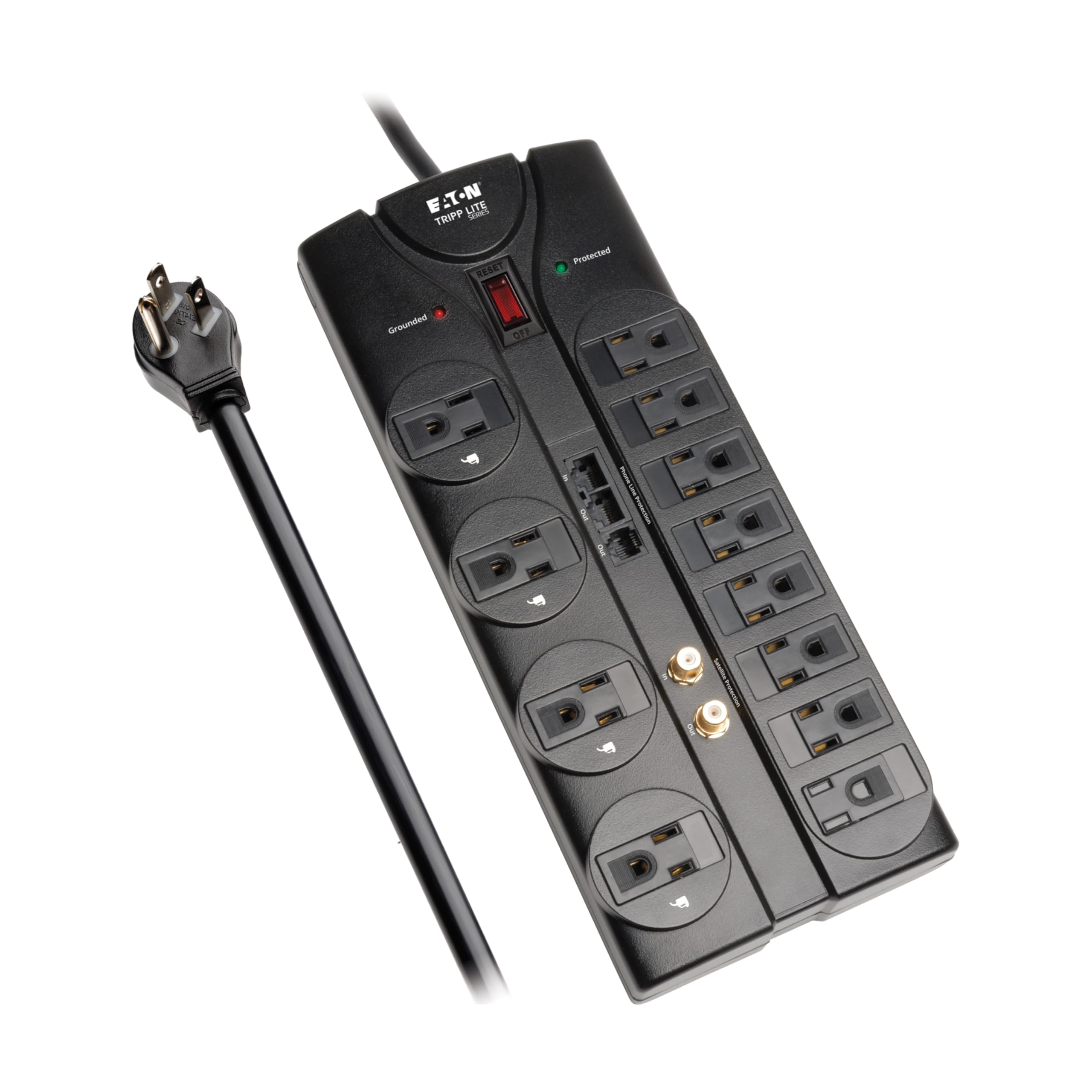
| Eaton Tripp Lite TLP1208SATHome Theater Pick | Home theater and networking | 12 | 2880 J / 15 A | 8 ft | Amazon |
| Furman SS-6B-PRO | Studio hum and voltage swings | 6 | EMI/RFI filter / 15 A | 15 ft | Amazon |
| Monster Pro MI | Pedal boards and amps | 8 | Fireproof MOV / 8.17 A | 15 ft | Amazon |
| Eaton Tripp Lite HT10DBS Isobar | Whole home-theater racks | 10 | 3840 J / 12 A | 8 ft | Amazon |
Detailed Reviews
1. CCCEI 12 Gauge Heavy Duty Power Strip, 8 Ports, Grey, 6FT.
Our pick — 4.5+★ from 1,000+ verified ratings; the strongest balance of quality and price.
The 4800-joule bar that swallows a full rack of gear without breaking a sweat.
The number that earns this pick its place is 4800 joules — the surge energy figure that tells you how big a spike this bar can take before it gives out. Put beside the Eaton TLP1208SAT below at 2880 joules, that is a notably wider safety cushion for gear you cannot cheaply replace. It also runs a 20-amp rating against the TLP1208SAT’s 15 amps, which means more headroom when a power amp and a mixer pull hard at once.
The cord is 12-gauge wire — the heavy stuff that stays cool under a long load — and at 6 feet it runs a little shorter than the 15-footer on the Furman SS-6B-PRO. Owners lean on it for exactly that grunt: as buyers put it, “Loaded this one up in our garage, looks industrial and is a workhorse.” It also has the wall-mount design that gets it off a desk and onto a board where you can reach it, and a single On/Off switch plus a 20 A circuit breaker for when a fault needs killing fast.
The honest catch: eight outlets share those 4800 joules of protection, so stacking a full studio and a space heater on one bar is not what it was built for. The 6-foot cord also stops short of a distant wall outlet in a bigger room, where the longer Furman and Monster runs reach further. For a dense rack next to the socket, that is a fair trade.
Where this bar earns its keep
- 4800 joules of surge absorption — more than double the 2880 J of the Eaton TLP1208SAT.
- 20 A rating gives you headroom over 15 A bars for high-draw audio gear.
- Metal and aluminum enclosure holds up under workshop and studio use.
- Wall-mount design plus a single On/Off switch and a 20 A breaker.
What to think about before you buy
- The 6 ft cord is short next to the 15 ft Furman and Monster cables.
- Eight outlets share one surge rating, so it is not built for a whole room of gear.
Pick this if: you want the biggest joule number and a heavy 20 A bar for a dense rack of amps or a home studio.
Reach further if: your wall outlet is far away — go with the 15-foot cord on the Furman or Monster instead.
2. Tripp Lite TLP1208SAT Surge Protector
For a receiver rack, the twelve-slot bar that also guards the signal cables.
If your listening room has a TV, an AV receiver and a router on the same shelf, this is the bar that fits them all. It carries 12 outlets against the CCCEI’s 8 and the Furman’s 6, so it swallows a full home-theater stack without stacking adapters. A 2880-joule rating covers the surge side, and it comes with 6-foot phone (RJ11), Ethernet (RJ45) and coax cables so the data and antenna lines get protection too, not just the AC.
One of the four rows is spaced for wall warts, so big receiver adapters do not block their neighbours. The 8-foot cord ends in a flat plug that lets a cabinet slide flush against the wall, and the space-saving layout keeps the whole rig tucked back. Buyers report it as “compact sleek design; ample outlets; doesn’t take much space.” The Ethernet port also handles speeds up to 100 Mbps for a router feed.
The recurring gripe on the review pages is plug fit — some outlet slots grip hard and the occasional unit arrives with a dead slot. Mounting also needs screws driven first, then a slide-on, which is less friendly than a removable back plate. Both are the kind of thing you learn once and plan around, not a reason to pass on the surge protection.
Signal-line protection matters: coax, phone and Ethernet ports are the difference between a bar that guards power and one that guards the whole rack.
The trade-off to know: the tight plug fit and 2880-joule ceiling mean this is a room protector, not the heaviest-absorption pick here.
Best if you are building a home theater: the cable-side ports and flat plug suit a receiver, TV and router on one shelf.
Skip if: you only need AC protection for a pedal board and want the biggest joule number.
3. Furman SS-6B-PRO Surge Protector

Six steel outlets and a line filter built for a humming home studio.
Where the CCCEI wins on raw surge energy, the Furman wins on the thing that drives audio owners mad: line noise. The filter stage here is EMI/RFI filtration — a circuit that scrubs electrical interference off the AC line before it can leak into your signal. Owners pick this up precisely to fight hum and buzz, and it is the quietest-running pick in this group. The EVS built into this model adds over- and under-voltage shutdown: it cuts power during dangerous voltage swings and restores it once the line settles, protecting a transformer from a brownout.
It only gives you 6 outlets, so this is a bar for a clean signal chain rather than a whole rack. The steel enclosure is the sturdiest build here — a 3.1-pound metal block with mounting flanges — and the 15-foot cord reaches a distant studio outlet, versus the 6-footer on the CCCEI. It also weighs in at 10.5 by 7.4 inches, so it eats a bit of shelf space.
The honest limit, straight from the maker’s own notes and the review pages: EVS protects against voltage swings, but it will cut power during a serious dip — that is the feature doing its job, not a fault. And one studio owner sums up the reality of a filtered line well: even a good filter trades blows with a noisy dimmer circuit rather than erasing every buzz by itself. Clean up the source and this strip carries what is left.
The quiet-power case
- EMI/RFI filtration targets the hum that rides in on the AC line.
- EVS cuts power during over- and under-voltage swings and restores automatically.
- Steel power block and a 15 ft cord that reaches a distant studio outlet.
- Six widely spaced outlets fit bulky adapters without crowding.
The catch a buyer should know
- The EVS feature can drop power during a serious voltage dip, so amp tone rides on a steady line.
- Six outlets only — and it is a 10.5 by 7.4 inch block on your shelf.
- A filter helps hum but does not replace fixing a noisy dimmer circuit at the source.
Made for the hum problem: a home studio with a persistent buzz should start here.
Not for whole-room power: six outlets leave a full AV rack looking elsewhere.
4. Monster Pro MI Surge Protector
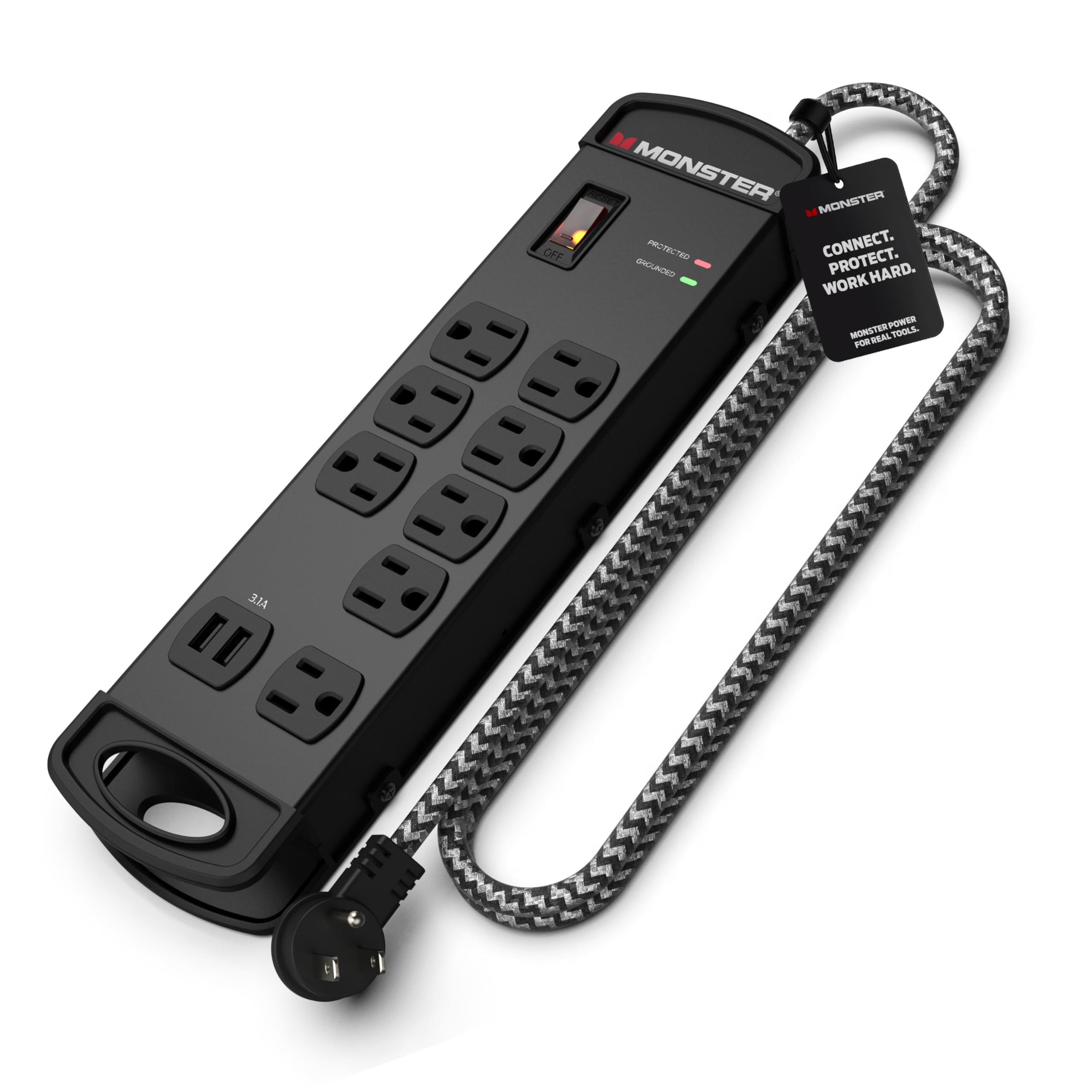
The pedal-board bar that stays silent with two amps and an effects chain plugged in.
Guitar players will recognise the layout here: 8 grounded outlets, one of them wide-spaced for a chunky adapter, plus 2 USB-A ports that charge a phone or a wireless transmitter without hogging a socket. The enclosure is stainless steel, and the fireproof MOV — the component that absorbs a surge — is the approach Monster takes to dual-mode surge and overload handling. A right-angle plug and wall-mount slots keep the run tidy under a board, and the 15-foot cord matches the Furman’s long reach and clearly outruns the 6-footer on the CCCEI.
The audio-focused engineering shows in the field tests owners mention. Owners credit it with cutting high-pitch noise on a recording setup that a grounded wall protector failed to stop, with all gear plugged into the bar and run straight to the wall. Customers note it as “very quiet with 2 amps and an effects pedal plugged in.” It also brings the USB ports as the one extra none of the other bars here matches.
The obvious limit sits on the spec sheet: maximum current is 8.17 A, the lowest in this group, against 15 A on the Furman and 20 A on the CCCEI. That is plenty for pedals, mics and a small amp, but a wall of high-draw gear is not its job. Size it to the load and it behaves.
Why guitarists gravitate to it: the wide outlet, the 15 ft cord and the USB-A ports fit a crowded board better than a plain bar.
Keep the load modest: at 8.17 A it is built for pedals and amps, not a full studio of high-current gear.
Right for a pedal board: the wide outlet plus two USB-A ports cover an amp, effects and a phone in one strip.
Look elsewhere for a power-hungry rack: 8.17 A max current caps how much gear it can carry.
5. Tripp Lite HT10DBS Surge Protector
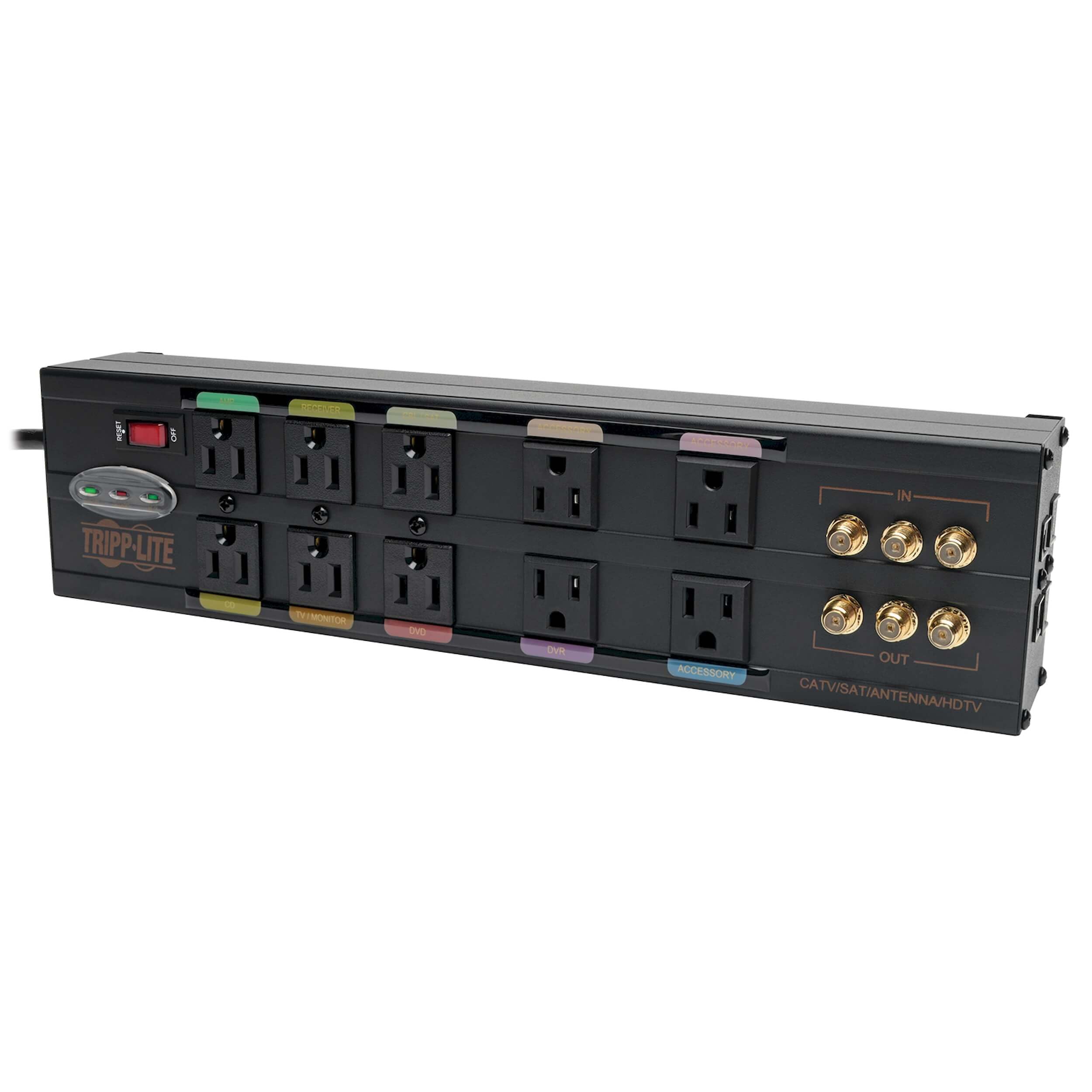
The heavy-steel Isobar that treats each bank of outlets as its own island.
What makes it a different animal for audio is the bank layout: ten outlets are split across isolated filter banks, so a router or a TV on one bank cannot leak its noise into the amplifier on another. On top of that it offers three-line 22 GHz gold coax, phone/modem and high-speed Ethernet protection, plus a 12 A breaker and diagnostic LEDs that confirm grounding and protection at a glance.
The build is what owners rave about: an all-metal, heavy steel housing at about 5 pounds that has survived years of outages and moves in the reports, still guarding AV and hi-fi gear today. The extra-long 8-foot cord and right-angle NEMA 5-15P plug let furniture sit flush to the wall, and colour-coded labels sit above each outlet for fast identification in a crowded rack.
Two honest limits surface. The noise filtration applies to the AC outlets, and the Ethernet side passes only 100BaseT rather than gigabit, so it is not a full-speed network protector. Some setups also report the protection ports attenuating an antenna signal, which can leave a weak HDTV feed looking soft. For a powerful antenna, expect to route that signal outside the bar.
What makes it a rack anchor
- 3840 joules of surge protection with a 12 A breaker and diagnostic LEDs.
- Isolated filter banks keep one bank’s gear from polluting another’s power.
- Heavy all-metal housing and colour-coded labelled outlets.
- Coax, phone/modem and Ethernet protection built in.
Where the ceiling sits
- Ethernet is 100BaseT, not gigabit.
- Some reports put signal attenuation through the antenna port on a weak HDTV feed.
- At 12 A it is the lowest amperage of the heavy bars here.
For the whole rack: buy this if you are protecting a home theater or studio with many pieces of gear and want isolated banks.
Not for a gigging board: it is a heavy fixed-installation piece, so a pedal player is better served by the Monster above.
Know the Specs
Joules (surge energy)
A joule measures how much spike energy the strip can absorb, so a higher number means a wider safety margin for pricey gear. The CCCEI’s 4800 joules and the HT10DBS’s 3840 outrun the 2880 on the TLP1208SAT for that reason. For a single power amp or a home-theater stack, that extra cushion matters when the lights flicker and the mains bite back.
EMI/RFI filtering
This is the circuit that removes electrical noise from the AC line before it reaches your transformer. The Furman and Monster both lean on filtering to fight hum, and the HT10DBS splits its outlets into isolated banks so each group stays shielded from the others. If hiss or buzz is your complaint, filtering is the spec to check before joule rating.
Amperage and breakers
Amps are how much current the strip can carry, so they matter when a rack draws hard. The CCCEI runs 20 A, the Furman and TLP1208SAT 15 A, the HT10DBS 12 A and the Monster 8.17 A. Match the strip’s rating to your load, and you get full power without tripping or overheating.
Outlet spacing and cord
Wide-spaced outlets and a flat or right-angle plug decide whether bulky adapters block their neighbours and whether the strip slides flush to the wall. Cord length sets reach: 6 ft on the CCCEI, 8 ft on both Eaton bars, and 15 ft on the Furman and Monster. In a studio the longer cords save extension runs to distant wall sockets.
Common Questions
Will a filtered power strip stop the hum in my amplifier?
Is a higher joule rating always better for audio gear?
What does an isolated filter bank actually do?
Can I plug a power amp and a mixer into the same strip?
Do I need coaxial or Ethernet protection for my stereo?
What is a flat plug and does it help against a wall?
How long a cord do I need for a studio?
Can a metal power strip protect against voltage swings?
Do USB ports on a power strip affect audio quality?
Is a heavy steel strip better than a plastic bar?
The Bottom Line
For most audio setups, the power strip for audio equipment winner is the CCCEI 12 Gauge Heavy Duty Power Strip, because 4800 joules and a 20 A rating give you the widest guard for a dense rack of amps and a home studio. If hum and buzz are the fight, reach for the Furman SS-6B-PRO and its filtering plus EVS shutdown. And for a whole home-theater rack that needs isolated banks and signal-line ports, the Eaton Tripp Lite HT10DBS Isobar is the anchor to build around.
How we choose
We do not accept paid placement. Every pick is matched to a real buyer and a real use-case; we do not hands-on test units.
Sources
Specifications: manufacturer listings and product documentation. Review insights: verified customer reviews, as of October 2026. Pricing: not shown on this page (it changes often); check the current price via the retailer link.
As an Amazon Associate, Aappliancez earns from qualifying purchases. This does not affect which products we feature.