Disclosure: Some links in this post are affiliate links. As an Amazon Associate I earn from qualifying purchases, at no extra cost to you. Learn more
Specs are compiled from manufacturer listings and verified buyer reviews and can change over time — please confirm the key details on the product page before buying.
Most people buy a car inverter by reading the biggest number on the box, then blow a fuse the first time they plug in a laptop and a tool charger together. Your car’s 12-volt socket caps what any inverter can deliver, so match the unit to what you actually plug in. This guide covers seven inverters that hold up in real vehicles, matches each to a road trip, work truck, or camper, and flags the trade-offs that surface after a few weeks.
This guide is built by comparing the manufacturers’ published specifications and the patterns across verified customer reviews, so you get each pick’s real strengths and trade-offs instead of marketing spin.
You will see how wattage, waveform, and cord length change what each unit can do in practice. Below are seven car inverters, sorted by what each does well rather than by the wattage on the box.
Top Picks

How To Choose The Best Power Inverter for Car
Start with the socket, not the wattage. A car cigarette lighter outlet typically feeds about 10 amps at 12 volts, which is why so many 300-watt inverters cannot run a 300-watt load without popping a fuse. Buy for the devices you plug in on a normal drive, and treat the peak number as a ceiling you rarely touch.
Waveform: modified sine wave vs pure sine wave
A modified sine wave inverter produces a stepped, blocky version of household AC power. It runs laptops, phone chargers, lamps, and simple motors fine, and it costs less. A pure sine wave inverter produces a smooth wave that matches what comes out of a wall outlet, which matters for sensitive gear like audio equipment, some chargers, and medical devices. If your devices are fussy, pay for pure sine wave; if you just need phone and laptop top-ups, modified sine is usually enough.
The real limit of a 12-volt plug
Every inverter here that runs from the cigarette socket is bounded by that socket’s wiring and fuse. Higher-draw appliances — a tool battery charger, a small compressor, a kettle — usually need direct battery connection with clips and a properly rated fuse. Check the vehicle’s fuse rating before you buy, and remember a long, thin power cord can heat up under load.
Ports and charging speed
Look at the USB-C PD and USB-A ratings if phones and laptops are your main load. A PD 65W port can run a modern laptop or charge a phone fast; an 18W or 30W port keeps tablets moving. Also check outlet spacing: two AC sockets placed too close together often accept only one bulky adapter at a time.
Side-by-Side Comparison
| Model | Best For | Continuous Power | Output Waveform | USB-C PD Rating | Amazon |
|---|---|---|---|---|---|
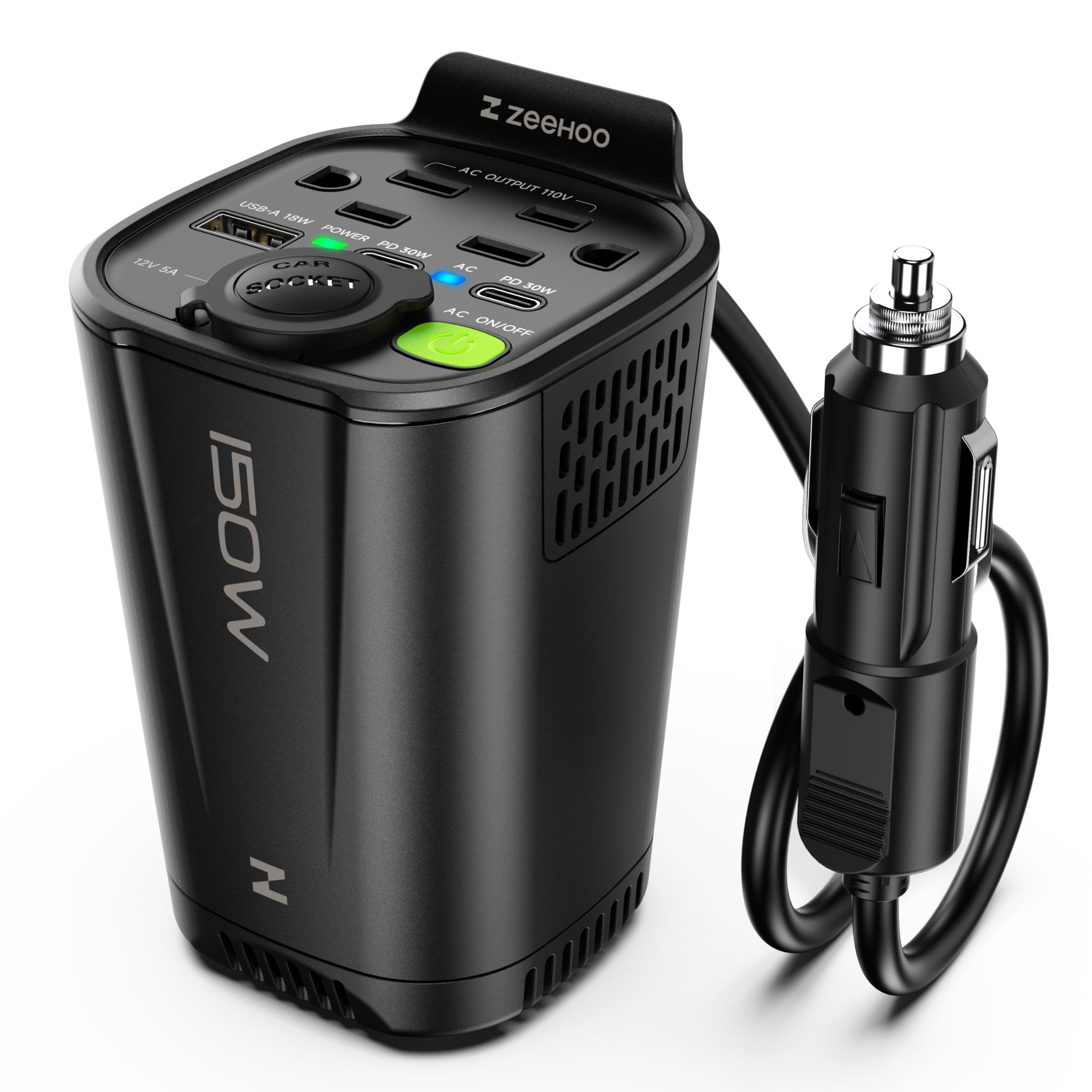
| ZEEHOO 150W Car Power Inverter★ Best Overall | Cup-holder charging for phones and laptops | 150W | Pure Sine Wave | Dual 30W PD | Amazon |
| Giandel 300W Pure Sine Wave (PS-300B)Clean Power Pick | Sensitive electronics on a clean wave | 300W | Pure Sine Wave | — | Amazon |
| ALLWEI 300W Car Power Inverter | Long trips with a reach-friendly cord | 300W | Modified Sine Wave | PD 27W | Amazon |
| PiSFAU 300W Car Power Inverter | Family road trips with lots of tablets | 300W | Modified Sine Wave | 24W fast charge | Amazon |
| BESTEK 300W Car Plug Adapter | EV and Tesla owners needing wide input | 300W | Modified Sine Wave | PD 65W | Amazon |
| Pro Chaser 400W Power Inverter | Higher-wattage appliances on the road | 400W | Modified Sine Wave | PD 65W | Amazon |
| Giandel 600W Pure Sine Wave | Camper and off-grid setups with remote | 600W | Pure Sine Wave | — | Amazon |
Detailed Reviews
1. ZEEHOO 150W Car Power Inverter
Our pick — 4.5+★ from 450+ verified ratings; the strongest balance of quality and price.
The cup-holder inverter that stays put and keeps the whole family topped up.
What makes this one the pick for most cars is that it delivers a pure sine wave — a smooth, wall-outlet-style AC output that sensitive electronics prefer — from a coffee-cup-sized body that drops into a cup holder and stays there. Its 60 hertz output matches what a household outlet gives you, so your laptop adapter or drone charger sees a familiar supply. The form factor is the whole pitch: it fits a Honda CR-V socket snugly and sits in the console without sliding around.
Charging is where it earns its keep. Two AC outlets handle three-prong plugs, and the dual USB-C PD ports run at 30W alongside an 18W USB-A. Owners lean on it for coffee-cup-sized convenience — dead phone to full in about 45 minutes on the fast port, a laptop powered through a road trip, drone batteries topped up between stops. Owners praise its functionality across most reviews, with charging speed a close second.
The honest catch is capacity. At 150W total, it is a phone-and-laptop tool, not an appliance runner — one owner measured it around 75W per AC socket. The fixed 30-40cm car cable is also short for a Mazda CX9 console, and the plastic border around the outlets can block adapters with a large cube. If you need a small compressor or kettle, look at the higher-wattage picks below.
What it brings to the console
- Pure sine wave output at 60 hertz that sensitive chargers like
- Dual 30W USB-C PD plus 18W USB-A for fast phone and tablet refills
- Built-in cooling fan that stays quiet and keeps the body cool
- Cup-holder footprint that locks the unit in place while you drive
Where it asks you to compromise
- 150W overall ceiling, around 75W per AC socket in practice
- Short fixed cable; plan on an extender if your console is far from the socket
- Plastic border around outlets can block bulky adapters
Go for this if: your load is phones, drones, and a laptop, and you want a clean pure sine wave from a cup holder.
Pass on it if: you need to run a small appliance or tool charger that wants more than 150W.
2. Giandel 300W Pure Sine Wave Power Inverter (PS-300B)
A pure sine unit that stays cool and quiet for laptops and tool chargers.
For sensitive electronics, the clean waveform matters, and this Giandel delivers 300W of pure sine wave through two AC outlets and two USB ports. It runs at 60 hertz — the same frequency a wall socket puts out, which many chargers expect — from a 6.22″L x 4.13″W x 1.77″H aluminum body that fits a cubby neatly. Compared with the ZEEHOO above, it holds double the continuous headroom, 300W against 150W, and the aluminum housing takes a knock better than plastic.
Reliability is the story that keeps showing up in the feedback. One owner ran it for two years on loads under 100W and called it well-built and consistently cool, with a fan quiet enough to forget and a clean sine wave on an oscilloscope. Another owner powered a PC and UPS at 260W dropping to 200W through a 16AWG adapter and found the frequency steady at 60Hz. Built quality and quietness are the themes owners repeat most, and the fan only spins when it needs to.
Two things to plan around. First, the cigarette plug sets a real-world ceiling around 120W — cars supply only about 10A, so higher draws blow fuses; use battery clips for anything above that. Second, a power-on self-test briefly pulls a heavy current that can pop a 15A fuse, so check the fuse rating in your vehicle. Idle draw is a low 0.35A, which keeps a parked battery happy.
What’s strong: 300W of pure sine wave, a fan that runs only when hot, and a 0.35A idle draw that is gentle on a parked battery.
What to watch: The 12-volt plug tops out near 120W, and a rough startup pull can pop a 15A fuse — hardwire to battery if you need the full 300W.
Made for: laptops, tool chargers, or any device that behaves badly on a stepped wave.
Think twice if: you expect 300W through the cigarette plug alone — that path needs clips.
3. ALLWEI 300W Car Power Inverter
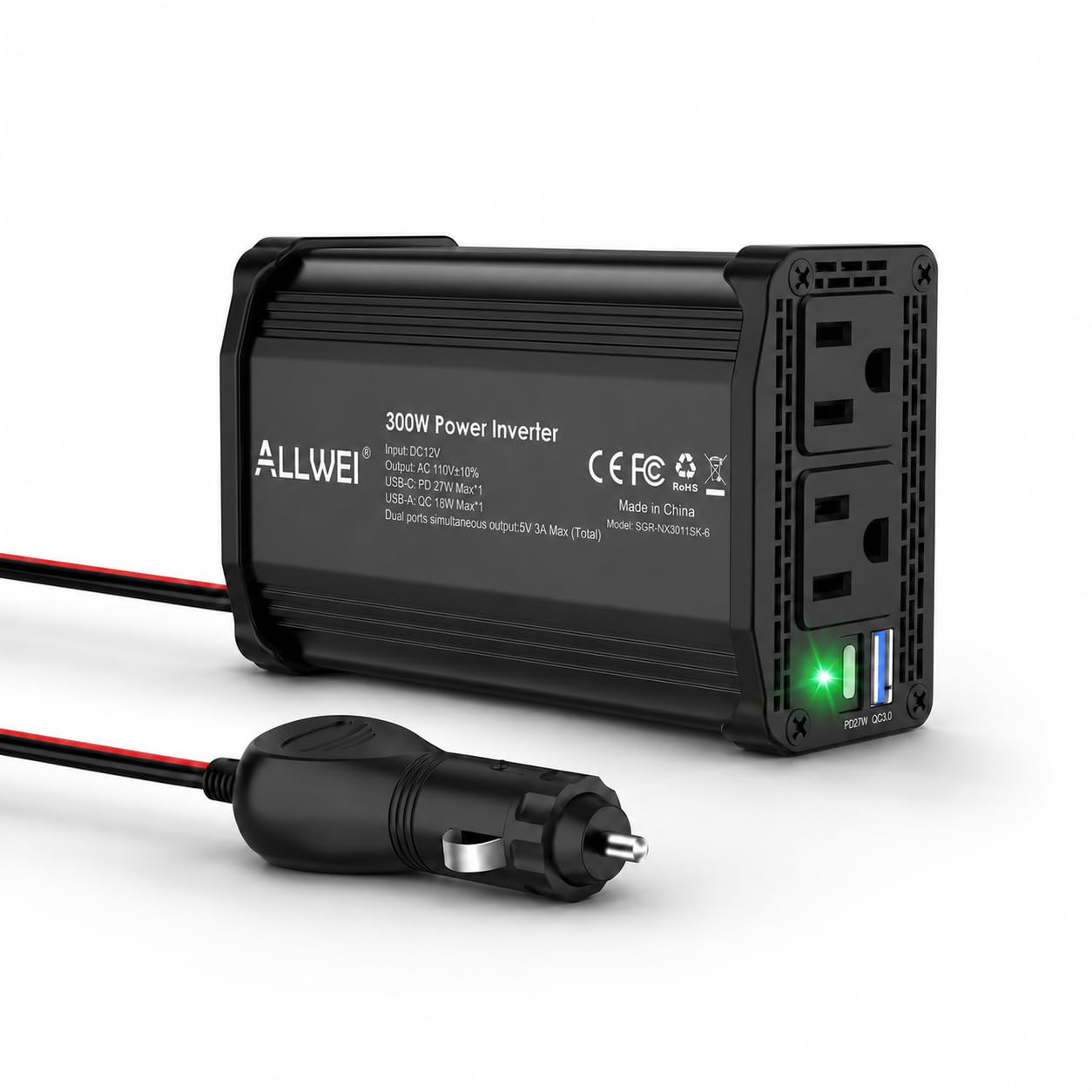
A 33-inch cord that reaches the back seat so passengers stay charged.
The number that solves a real problem here is the 33-inch cord. That is long enough to plug into the front socket and still reach the backseat, which is where kids and tablets actually live on a road trip. The unit itself is 300W from 12V DC to AC 110V, with two AC outlets, a PD 27W USB-C port, and an 18W USB-A QC port, in a 4.7″L x 3.1″W x 1.8″H aluminum body that weighs 15.2 ounces and stows in a glove box.
Multi-device charging is what makes it useful: a family on a long drive can charge a laptop, a phone, and a tablet at once. Owners pump up air mattresses, run small fans, and keep phones topped up through a workday. The cooling fan is temperature-controlled and quiet, and the aluminum housing helps shed heat. Most buyers praise its build quality and value, and it suits long drives with a mix of small devices.
The real limit is the socket. This 300W rating assumes battery-clip connection for anything over 180W, as the maker states, and one owner found the combined load of a shaver and laptop was too much through the lighter plug. The outlets also sit close together, so a bulky adapter takes one slot and then blocks the neighbor. Treat it as a reach-friendly charger, not a power station.
Best feature: The 33-inch cord and fastening tape — genuinely designed for backseats and trucks.
The caveat: Anything over 180W needs battery clips, so a big appliance is out through the cigarette plug.
Reach for this if: you drive a truck or drive a family and need the cord to span the cabin.
Look elsewhere if: a compact cup-holder fit matters more than cord length.
4. PiSFAU 300W Car Power Inverter
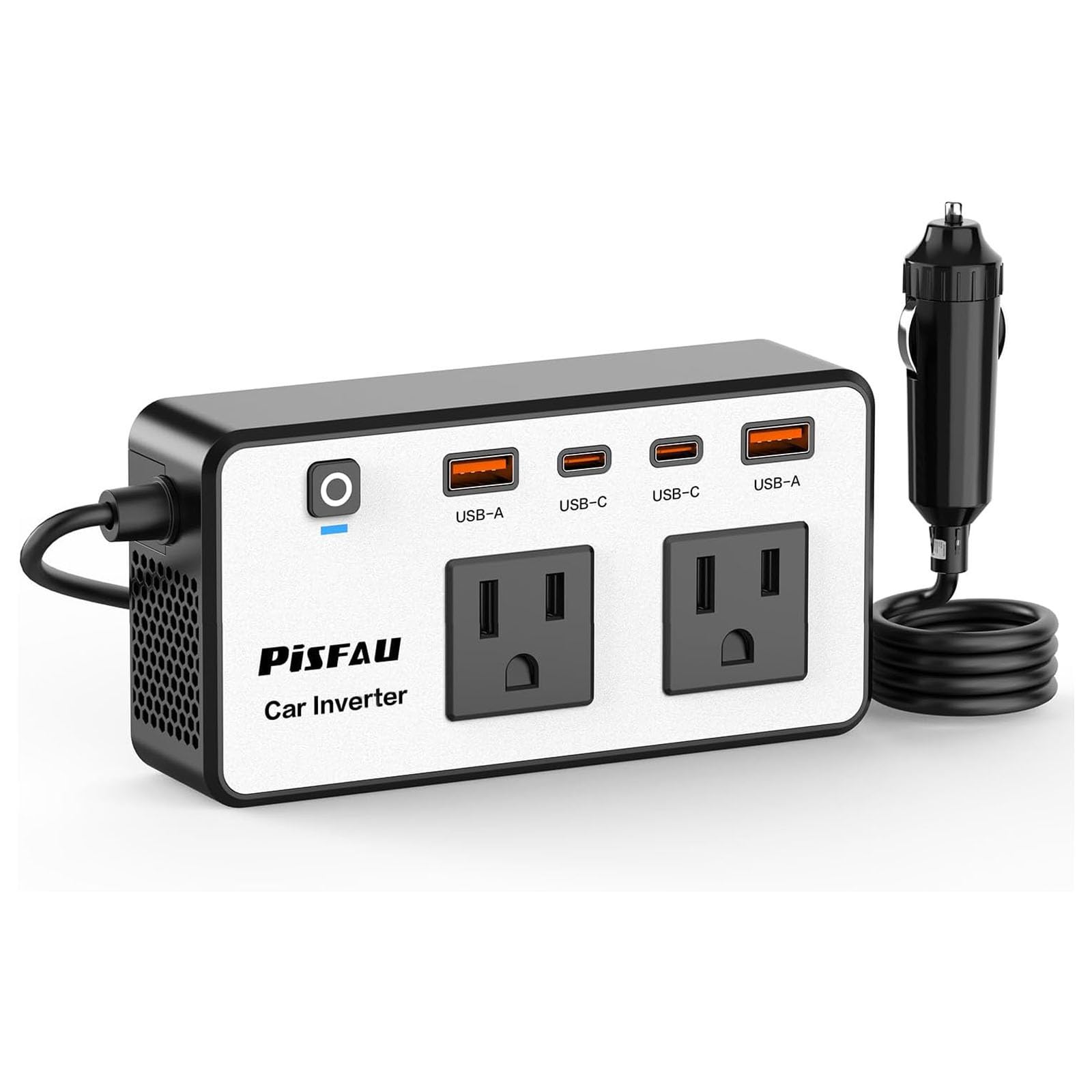
Six ports for the family whose tablets all die at the same time.
Port count is the reason to look here: two AC outlets, two USB-C ports rated 24W fast charge, and two USB-A ports at 24W give a family of four plenty of places to plug in. It weighs 300 g and measures 5.4″L x 2.7″W x 1.3″H, which the maker describes as phone-sized, so it slips into a door pocket without a fight. At 300W modified sine wave, it runs laptops, desk fans, and portable DVD players on long trips with kids.
What owners like is the charging capability — charging a laptop, running a tiny crock pot, inflating things, keeping a phone going alongside three other devices. Portability and compact size are what jump out in the feedback, with value running right behind. The fan is quiet, it auto-shuts off with the car, and it pulls double duty at home when the power goes out.
The honest note is that reliability is the most-discussed topic in the mixed range, and the cigarette lighter caps input at roughly 10A — so big loads are not this unit’s job, and there is no direct 25A+ 12VDC input for hardwiring. If you need to run a large appliance or a 240W laptop at full tilt, the Giandel 300W or a hardwired rig is safer. For everyday device charging, it does the job quietly.
Reasons families keep it
- Six ports: 2 AC, 2 USB-C at 24W, 2 USB-A at 24W
- Phone-sized and 300 g, easy to stow in a door pocket
- Quiet fan and auto-shutoff with the ignition
- Works for home power outages as well as road trips
Points to know before buying
- Modified sine wave, not pure sine — sensitive gear may complain
- Cigarette plug input caps around 10A, so no big appliances
- No direct battery input for hardwiring large loads
Pick this for: multi-passenger trips where every seat needs a charge.
Skip the hard jobs: heavy 12V loads are not what this plug-in unit is built to take.
5. BESTEK 300W Car Plug Adapter Outlet

A wide input range built for EVs, with a 65W USB-C that runs a MacBook.
If your vehicle is electric, the 11V-17V input window is the spec that matters — it is wide enough to accept the range modern EVs feed through a 12V socket. The unit pushes 300W continuous and 700W instantaneous peak through two AC outlets, plus a PD 65W USB-C port and a QC 18W USB-A port, in a 2″L x 4″W x 6″H body that stows near the driver’s seat. It is ETL certified with a built-in fuse and backed by a 5-year warranty — the longest coverage here.
Owners like the fast charging on the high-output ports and the compact shape. A PD 65W port runs a MacBook Pro 13″ or iPad at full speed, and the smart power-distribution tech shares power when both USB ports are live. The 24-inch cigarette plug reaches most vehicle sockets. Quiet cooling is a highlight — the intelligent fan adjusts speed to temperature and load — although the verdict splits, and some find it noisy.
The honest trade-off is heat and long-term durability. One owner reported it getting really hot after long use and a burning-plastic smell at first, while the durability feedback is mixed, with some reporting it breaks down over time. It is also modified sine wave, not pure, so sensitive audio gear may hum. For phones, laptops, tablets, and fast charging, it is a solid daily companion with the best warranty on the list.
The standout: PD 65W fast charging and a 5-year warranty on an ETL-certified body.
The honest catch: It can get hot under long loads, and modified sine wave is not ideal for sensitive audio gear.
Choose this if: you drive an EV or a newer car and want big USB-C wattage with long warranty coverage.
Look elsewhere if: pure sine wave is a must for your devices.
6. Pro Chaser 400W Power Inverter
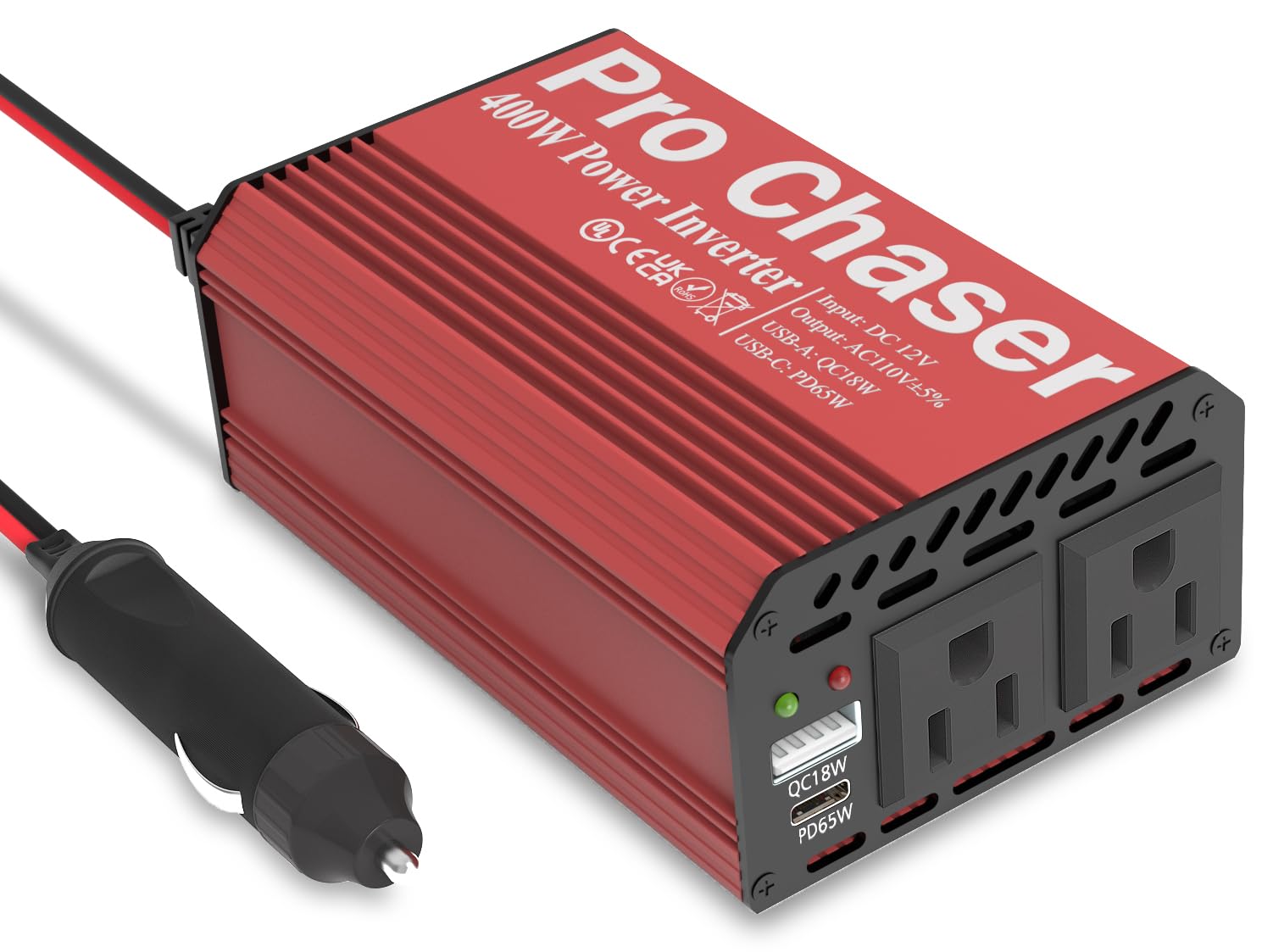
The wattage step-up for appliances that need more than a laptop.
This is the highest continuous rating among the compact plug-in units here at 400W, with 800W of peak surge for startup draws. Two AC outlets handle appliances rated 300W to 400W, a USB-A QC 18W and a USB-C PD 65W cover quick top-ups, and the 30-inch (75 cm) cord reaches from front socket to back seat. The cooling fan kicks on at 113°F (45°C) to keep temperature in check.
Buyers report it handles laptops and phones easily and stays quiet while doing it. The 65W PD port fast-charges a phone and a laptop without the bulky AC adapter, and the AC outlets deliver steady power on road trips. Compared with the ZEEHOO at 150W, it holds more than double the continuous headroom, which is the difference between a phone-only tool and one that runs a small appliance.
Two honest limits. The maker advises connecting one high-power device at a time, since the PD65W port plus a big AC load can exceed the vehicle socket’s limit. And the safety margin assumes a genuine 400W draw, while some owners found near-250W loads tripped it, so check the numbers against what your appliance actually needs. Otherwise, it is a practical step up for heavier loads.
Why it earns its spot: 400W continuous and 800W peak in a body that still fits a cup holder.
What to watch: Run heavy devices one at a time, and confirm your appliance’s real draw before trusting the rating.
Best for: road-trippers with a 300-400W appliance or a small compressor to run.
Look elsewhere if: you need everything on one socket at once.
7. Giandel 600W Pure Sine Wave Inverter with Remote

A 600W pure sine wave with a 15-foot remote for campers and off-grid rigs.
For a camper or a small off-grid setup, the wired 15-foot remote is the detail that solves the daily annoyance — you can switch the unit on and off from the passenger seat or the van’s living area. The 600W pure sine wave output is clean enough for fans, small pumps, laptops, pads, and sensitive audio gear, and the aluminum case with built-in cooling fan and two 40-amp replaceable fuses is built to be wired to a battery. This is the premium pick, and at 4.9 pounds with an 8.5″L x 5.7″W x 2.9″H body it is the biggest unit here.
Owners run these in Sprinter vans and RVs, and the pure sine wave is why: no buzzing from fans, no complaints from precision gear. Someone shooting in the field powered a 300W monolight at full power with wall-outlet recycle speed. Power output that runs a 32-inch LED TV and satellite dish, low idle draw, and quiet fans that only spin when hot are the strengths people call out. Functionality and build quality are the themes that carry the feedback.
The trade-offs are real but specific. It cannot start a freezer or fridge with a compressor, even a 100W one, because of the startup surge. And while this unit is well-rated, fuses can blow under some conditions — keep the two spares on hand and match them to the load. For a camper or van build, it is the one to buy.
Why campers pick it: 600W pure sine wave, a 15-foot remote, and two replaceable 40-amp fuses.
What it cannot do: Start a fridge or freezer with a compressor, even a small one.
Built for: camper, RV, and small off-grid builds that want clean power and a remote switch.
skip it if: you only need to charge phones from the cigarette socket.
Know the Specs
Continuous vs peak wattage
Continuous watts are what the inverter can supply all day; peak watts are a brief surge for motor startup. A 400W inverter with 800W peak can handle the jolt of a small compressor, but continuous is what matters for a laptop or a fan. Match continuous to how much you actually run, and treat peak as a cushion.
Modified vs pure sine wave
A modified sine wave is a stepped approximation of household AC; a pure sine wave is smooth and rounded. Phones, laptops, and simple lamps do not care. Sensitive gear — audio, some medical devices, precision gear — prefers pure sine, and sensitive tools tend to run cool and hum-free on it.
USB-C PD and USB-A ratings
A PD 65W USB-C port can top up a modern laptop or fast-charge a phone; a 27W or 24W port is better than a standard phone charger and handles a tablet. The USB-A ports at 18W are handy for headphones and older phones. More ports make a unit useful for a family, but total USB output is capped by the inverter.
Cigarette lighter vs battery connection
The cigarette lighter socket usually supplies about 10A, which limits practical output even when the inverter is rated higher. Serious loads need direct battery connection with clips or hardwiring, plus a properly rated fuse. The power cord gauge matters: a thin 16-gauge cable can heat up above 15A, so check what the unit ships with.
Common Questions
Can a 300W inverter really run a 300W appliance from my car socket?
Will a modified sine wave inverter damage my laptop or phone?
What is the difference between the ZEEHOO 150W and the Giandel 300W?
How long does a car power inverter last?
Do I need pure sine wave for a CPAP machine or medical device?
Why do my fuses blow when I plug in a laptop and a tool charger?
Can I leave my inverter plugged into the car when the engine is off?
Which inverter is best for charging a laptop on a road trip?
Will a 600W inverter run a small fridge in my camper?
Are these inverters safe to use in an EV?
The Bottom Line
For most drivers, the power inverter for car that suits daily life is the ZEEHOO 150W because a pure sine wave and dual 30W USB-C in a cup-holder body keep phones, drones, and a laptop charged without fuss. If your devices are sensitive or you need 300W of clean power, go with the Giandel 300W Pure Sine Wave. For backseats and trucks, the 33-inch cord on the ALLWEI 300W reaches where others cannot. And if you are building a camper, the Giandel 600W with remote is the one to mount.
How we choose
We do not accept paid placement. Every pick is matched to a real buyer and a real use-case; we do not hands-on test units.
Sources
Specifications: manufacturer listings and product documentation. Review insights: verified customer reviews, as of October 2026. Pricing: not shown on this page (it changes often); check the current price via the retailer link.
As an Amazon Associate, Aappliancez earns from qualifying purchases. This does not affect which products we feature.