Disclosure: Some links in this post are affiliate links. As an Amazon Associate I earn from qualifying purchases, at no extra cost to you. Learn more
Specs are compiled from manufacturer listings and verified buyer reviews and can change over time — please confirm the key details on the product page before buying.
You want a mix that feeds your plants through what is already in the ground, not through a scoop of fertilizer you didn’t ask for. That matters most when you are starting seeds or rooting cuttings, because a hot, fertilizer-loaded mix can burn tender young roots before they ever get going. This guide covers five mixes and media that give you that clean, fertilizer-free starting point — and tells you which one fits your shelf, your pot count, and your watering habits.
This guide is built by comparing the manufacturers’ published specifications and the patterns across verified customer reviews, so you get each pick’s real strengths and trade-offs instead of marketing spin.
Some of these are pure media you blend yourself, and others are ready-to-use mixes that skip the added feed. Below you’ll find what to buy for seed starting, for repotting houseplants, and for stretching an existing mix farther, all built around the potting soil without fertilizer shelf.
Top Picks

How To Choose The Best Potting Soil Without Fertilizer
The single most useful thing to know before you buy: a bag can say “organic” and still carry a starter charge of feed. Organic describes where the ingredients came from — it does not promise the mix is feed-free. So you have to read the ingredient line, not the badge on the front of the bag.
Pure media versus a ready-made mix
A pure medium is one ingredient and nothing else — straight coco coir, or straight peat moss. You hydrate or fluff it, then blend in your own perlite or compost at the ratio you want. That gives you total control, and it is the safest route when you are germinating seeds or rooting a cutting that has no roots to spare.
A ready-made mix already has the perlite and vermiculite blended in, so you open the bag and pot up. The trade-off is that you inherit whatever else the maker put in, which is why checking the ingredient list matters more here than anywhere.
Read the ingredient line, in order
You can tell a lot from the order of the ingredient list, which runs from the largest amount in the bag to the smallest. If peat moss, coir (shredded coconut husk fiber), and perlite (those little white puffed rock bits that keep soil airy) are the first three names, the mix is built to drain well. If a fertilizer name sits near the top, that mix feeds your plants from day one, whether you wanted it to or not.
Drainage and water retention are not opposites
Perlite is the white, popcorn-like granules that open up air pockets so water drains through instead of pooling. Vermiculite is the flaky, sponge-like mineral that holds water and releases it slowly. A mix with both gives roots air and a drink at the same time — which is exactly what a pot-bound houseplant needs.
Match the volume to how much you actually pot
Volume is the number that saves you money or wastes it. A 9-gallon yield of hydrated coir is a season’s worth of potting; a 4-quart bag is a handful of small pots. Buy for the pots you will actually fill this month, not the shelf you plan to build someday.
Side-by-Side Comparison
| Model | Best For | Format | Volume / Yield | Stated Weight | Amazon |
|---|---|---|---|---|---|
| MODELLOR Coco Coir Bricks, 4-Pack★ Best Overall | Seed starting and stretching mixes | Compressed coir bricks | 9 gallons (36 quarts) | 5 pounds | Amazon |
| Miracle-Gro Organic Indoor Potting Mix, 8 qt. (2-Pack)Best for Houseplants | Indoor houseplants and herbs | Ready-to-use bagged mix | 8 quarts per bag | 9 pounds | Amazon |
| Midwest Hearth Potting Soil Mix | Repotting tropicals and aroids | Ready-to-use bagged mix | 4 quarts | 0.88 kg | Amazon |
| Espoma Organic Peat Moss | Blending a custom soilless mix | Pure single-ingredient peat | 8 quarts | 1.4 pounds | Amazon |
| Avalution 9QT Potting Soil Mix | Porous mix for hoyas and hoyas-like epiphytes | Ready-to-use bagged mix | 9 quarts | — | Amazon |
Detailed Reviews
1. MODELLOR Coco Coir Bricks, 4-Pack (5 lb)
Our pick — 4.5+★ from 950+ verified ratings; the strongest balance of quality and price.
Four dry bricks that turn into 9 gallons the moment you add water.
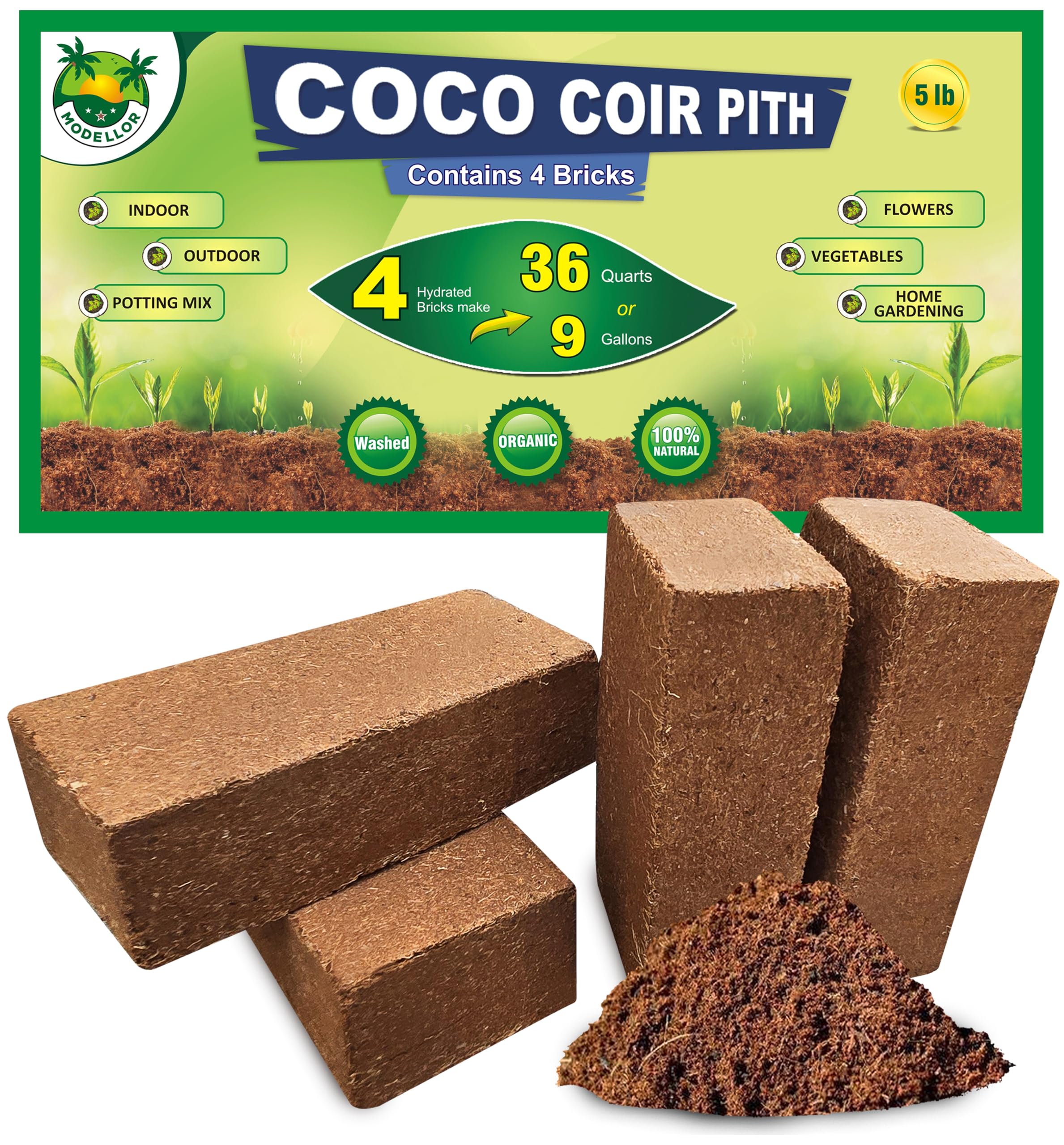
If you want a mix with nothing added at all, a bare coco coir brick is about as clean as it gets. This is compressed coconut husk fiber — a coconut byproduct — and nothing else is blended in. You drop a brick in a bucket, pour water over it, and it swells into a fluffy, soil-like medium you can plant straight into. The four bricks together weigh 5 pounds and expand to 9 gallons (36 quarts), which is a full season of potting from something that stores in a shoebox.
The triple-washing is the detail that matters for young roots. Washing pulls excess salts out of the coir, so what you end up with is low-EC (low electrical conductivity — a plain way of saying the salt level is kept down) and pH-balanced. For seedlings and fresh cuttings that have no reserves of their own, that gentle starting point is the whole reason to choose coir over a charged mix.
What wins people over is how much one brick gives back. A single brick swells into roughly 3 gallons of growing medium, so you can hydrate one at a time and keep the rest dry on the shelf. That portability is exactly why buyers report: “This is a good option if you don’t need a bunch of medium at once. I’m growing potatoes in a plastic bin so can hydrate 1 brick at a time over time. Otherwise, I’d just order the bigger bricks.”
What the bricks do well
- Nothing but washed coco coir, so you control every amendment yourself
- 9-gallon yield from 5 pounds of brick — dense storage, big output
- Holds moisture well and improves airflow around roots with its fluffy texture
- One brick at a time means less waste for small container projects
Where it asks for patience
- Compressed bricks take real effort to break apart and plenty of water to rehydrate
- Hydrate in a much larger container than you think — it swells past expectations
- You still need to blend in perlite or compost for a complete potting mix
Made for you if: you are starting seeds, rooting cuttings, or want to build your own mix from scratch with zero added feed.
Plan ahead if: you expect a bag you can open and pot straight into — these arrive as hard bricks and need a bucket, water, and about an hour.
2. Miracle-Gro Organic Indoor Potting Mix, 8 qt. (2-Pack)
A bagged indoor mix that holds moisture evenly and drains clean.
This one is for the person with a shelf of houseplants and no interest in blending anything. It arrives as two 8-quart bags, and each bag fills two 8-inch containers, so a two-pack covers four medium pots before you dig into the root ball math. The mix itself is responsibly sourced sphagnum peat moss blended with coir — a peat-plus-coco base that holds water without turning into a swamp.
Be clear on one thing before you buy: the listing states this mix includes quick-start natural fertilizer. So if your goal is a completely feed-free medium for germinating seeds or rooting a bare cutting, this is not that product. Where it earns its place is repotting established indoor plants that can handle a gentle starter charge. That is the honest split, and it is worth knowing before the bag shows up.
The moisture control is the real draw. It holds moisture evenly so indoor pots don’t swing between bone dry and waterlogged — the swing that rots roots on one end and crisps leaves on the other. Drainage holds up in practice, and the mix stays workable in the pot rather than compacting into a brick. The recurring gripe is fungus gnats showing up after potting, so keep a sticky trap handy and let the top inch dry between waterings. The nine pounds of this two-pack versus five pounds of the MODELLOR bricks also tells you something practical: this bag arrives with far more water weight and far less air in it.
Where it fits best: established houseplants and herbs in containers, where a gentle starter charge is welcome rather than risky.
Be honest with yourself: if you are germinating seeds or rooting cuttings with no roots to spare, choose a pure medium instead and add feed later once the plant is up.
Grab this one for: repotting a pothos, a fern, or a struggling grocery-store plant that needs steady moisture and decent drainage.
Hold off if: the words “quick-start fertilizer” on the label are a dealbreaker for your seed tray.
3. Midwest Hearth Potting Soil Mix

The three-part blend that lets tropical roots breathe without drying out.
Peat moss, vermiculite, and perlite in one bag is the classic recipe professional growers use, and this is the same formulation in a 4-quart size. Peat holds moisture, perlite opens air pockets, and vermiculite threads water through the mix instead of letting it pool. The result is that light, fluffy texture that roots push through easily rather than fighting.
For scale, this 4-quart bag is half the volume of the Miracle-Gro two-pack’s 8 quarts per bag — which is exactly right if you are repotting one or two tropicals, not a whole shelf. The pH is balanced for a broad range of plant types, and the mix is ready to use straight from the bag. Owners mention it as a base for tropicals, and one recommends stretching it further with perlite. The review pages sum it up this way: “Truly an ‘all in one’ perfect mix for all tropicals. I advise always mixing in 1 part perlite to 3 parts tropical mix then do your repotting or initial potting.”
Here is the catch, and it is a real one. This mix is hydrophobic when dry — meaning it actively repels water at first and will shed it down the sides of the pot. You have to pre-wet it and let it sit before you plant, or your first few waterings will run straight through. Some gardeners also add bloodmeal and extra perlite for seed starting, so budget for amendments if that is your plan.
Reach for this if: you want a professional-style peat-perlite-vermiculite blend for repotting tropicals and aroids, and you don’t mind pre-wetting the bag.
Think twice if: you want to pot up half a dozen plants at once — 4 quarts will not stretch that far, and the dry mix needs coaxing before it absorbs.
4. Espoma Organic Peat Moss, 8-Quart, Single Pack

One ingredient, no additives — the blank canvas for a custom mix.
If your goal is a medium with absolutely nothing added, 100% peat moss with no additives is the purest starting point on this list. You get 8 quarts and 1.4 pounds of straight sphagnum peat, approved for organic gardening and registered as an Organic Input Material. It is a production input, not a finished potting mix, and it rewards you with total control.
The job it does best is loosening heavy potting soil and holding water so you water less often. Blend it with perlite and you have a soilless mix tailored to whatever you are growing. That flexibility shows up in unusual setups too: one buyer blended it 50/50 with perlite for a Venus fly trap, and another used it in a reptile and amphibian habitat that needed higher humidity. Seed starting, cuttings, and overwintering bulbs all show up among its uses.
Two things to know before you commit. First, straight peat is acidic on its own, so if you are growing something that wants neutral soil you will need to balance it — this is a base ingredient, not a pH-adjusted mix. Second, it does not feed anything, and that is the point: you decide when and how much to feed, which keeps young roots safe. You may also find the occasional twig in the bag, which is normal for a natural product. If you want open-the-bag-and-pot convenience, the Midwest Hearth blend above will save you a step.
Why growers keep it around: pure, additive-free peat that lets you dial in drainage and moisture by ratio rather than accept whatever a bagged mix decided for you.
The trade-off: it needs a pH adjustment and a feed plan of your own, so it suits someone who enjoys blending rather than someone who wants a finished mix.
Ideal for: the gardener who mixes their own soilless blend and wants a pure, organic peat base to build on.
Not for you if: you want to open a bag and plant — this is an ingredient, and it needs perlite and a pH plan to become a mix.
5. Avalution 9QT Potting Soil Mix for Indoor Plants
A five-part blend built around a heavy coir base and open air pockets.
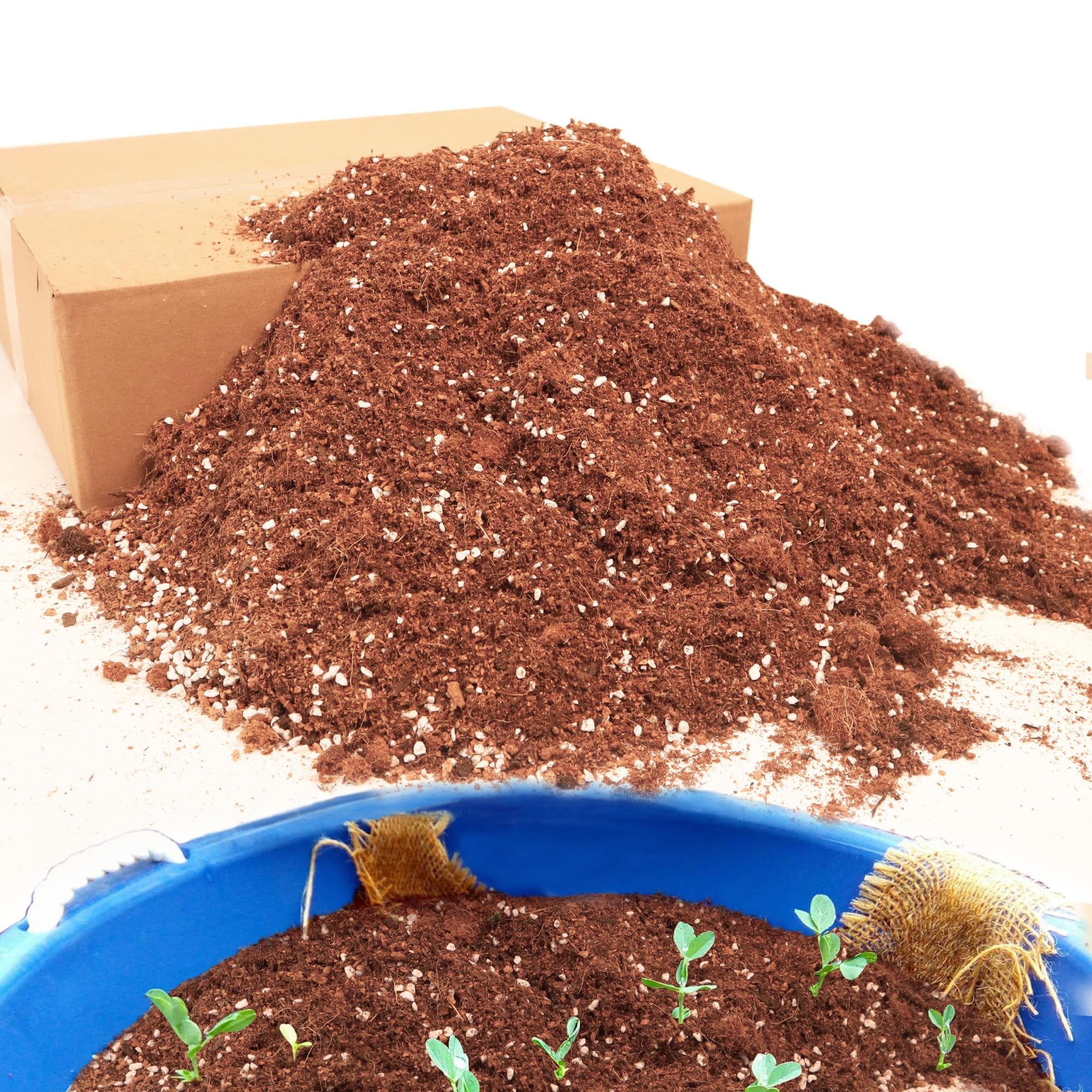
This mix spreads its bets across five ingredients: 55% coconut coir fiber, 12% peat moss, 11% perlite, 11% vermiculite, and 11% rice hull charcoal. That coir-heavy base holds water, the perlite and vermiculite keep it airy, and the rice hull charcoal is the unusual piece — a light charred material that shows up in the ingredient list and draws curious growers. The bag runs 9 quarts and the mix is light enough to lift easily when you are filling a hanging planter.
Because it drains fast and holds air, this is the mix for plants that hate wet feet. Think hoyas, pothos, and other epiphytes that want to dry out between waterings. One buyer’s hoyas and pothos did well in it, noting it holds a light moisture but not for long — which is a fair preview of the porous, quick-draining feel. Another praised it for low-water plants precisely because it is so porous. The five named ingredients — coir, peat, perlite, vermiculite, and rice hull charcoal — are the reason to pick this over a plain peat mix.
The trade-off is that quick-draining means frequent watering in summer, and the light moisture does not linger. If you grow thirsty tropicals, you will water more often than with the Midwest Hearth blend. The 9-quart bag is listed against a 3-quart spec in the technical details, so check what actually arrives before you plan a big repot — that mismatch is worth flagging before you buy, not after.
Why porous-plant growers like it
- Five named ingredients with real proportions, coir leading at 55%
- Perlite and vermiculite keep oxygen reaching the roots
- Light enough to handle in large or hanging containers
- Drains excess water away instead of letting it pool around roots
What to weigh first
- Porous blend dries out faster, so more watering in hot weather
- Listed volume and technical details disagree — confirm the size before ordering
- Not the pick for plants that want steady, heavy moisture
Best matched to: hoya, pothos, and succulent growers who want a light, fast-draining mix that lets roots breathe.
Look elsewhere if: you grow ferns or other moisture-lovers, or you want a single bag to cover a whole shelf — the fill volume is modest.
Know the Specs
Volume and Yield
Volume tells you how much planting you can actually do. A compressed brick lists its expanded yield — the MODELLOR four-pack swells to 9 gallons (36 quarts) — while a bagged mix lists the bag size, like 8 quarts or 4 quarts. Compare these on the same footing: a coir brick weighs almost nothing dry because the water comes later, so judge bricks by expanded gallons and bags by listed quarts.
What “No Fertilizer” Really Means
A feed-free medium is one where nothing is added to supply nutrients — straight coco coir and straight peat moss both fit that description. An organic mix can still carry a starter charge, so read the ingredient line for a fertilizer name rather than trusting the organic badge. For seeds and cuttings, a feed-free medium lets you add nutrients on your own schedule instead of inheriting a starter charge.
Perlite versus Vermiculite
Perlite is the white, porous granule that creates air space and speeds drainage. Vermiculite is the flaky mineral that holds water and releases it slowly. A blend with both — like the Midwest Hearth mix or the Avalution five-part blend — gives roots air and moisture together, which is what keeps a potted plant from swinging between bone dry and waterlogged.
Weight and Handling
Weight matters for how the bag feels on your shelf and in your hands. Pure coir is light dry — 5 pounds for four bricks — because it is compressed and holds no water yet. A ready-mix bag like the Miracle-Gro two-pack runs 9 pounds for its two bags, since it arrives moist and ready to use. Neither is right or wrong; they just tell you what you are carrying home.
Common Questions
Is coco coir a complete potting mix on its own?
Can I start seeds in a mix that already has fertilizer in it?
How much does one coco coir brick expand into?
Why does my new potting mix repel water at first?
Is peat moss the same thing as potting soil?
Which mix is better for hoyas and other epiphytes?
How many pots will a 4-quart bag of potting mix fill?
Do I need to add perlite to a ready-made potting mix?
Will an unfertilized mix feed my plants at all?
Why do fungus gnats appear after repotting with an indoor mix?
The Bottom Line
The winner for most people is the MODELLOR Coco Coir Bricks: 5 pounds of compressed coir swells to 9 gallons of additive-free medium, and you decide what goes into the mix. If you would rather open a bag and plant established houseplants, the Miracle-Gro Organic Indoor Potting Mix handles steady moisture and drainage for indoor pots. For repotting tropicals with a professional-style peat-perlite-vermiculite blend, reach for the Midwest Hearth Potting Soil Mix; and if you blend your own soilless recipe, the Espoma Organic Peat Moss is the pure base to build on.
One honest note: the MODELLOR pick earns its top spot on a strong record of owner satisfaction, but the bricks arrive hard and compressed, so you need a bucket, water, and about an hour before you can plant. If your plants need to be potted up the day the box arrives, choose a ready-to-use mix instead.
How we choose
We do not accept paid placement. Every pick is matched to a real buyer and a real use-case; we do not hands-on test units.
Sources
Specifications: manufacturer listings and product documentation. Review insights: verified customer reviews, as of October 2026. Pricing: not shown on this page (it changes often); check the current price via the retailer link.
As an Amazon Associate, Aappliancez earns from qualifying purchases. This does not affect which products we feature.