Disclosure: Some links in this post are affiliate links. As an Amazon Associate I earn from qualifying purchases, at no extra cost to you. Learn more
Specs are compiled from manufacturer listings and verified buyer reviews and can change over time — please confirm the key details on the product page before buying.
You paint a mug, you wait weeks for the kiln, and the purple comes out muddy blue. That is the pain every pottery painter knows, and the fix is almost never your brushwork — it is which glaze or underglaze you loaded into the brush. This guide separates the sets that hold their color through the fire from the ones that drift, and it starts with the Mayco Stroke & Coat kit, the crowd favorite at 4.5+ stars across 600+ owners.
This guide is built by comparing the manufacturers’ published specifications and the patterns across verified customer reviews, so you get each pick’s real strengths and trade-offs instead of marketing spin.
Below you will find picks grouped by what they actually do on the shelf — brush-on glaze, liquid underglaze, mid-fire opaque series, and class packs built for a room full of students. The short answer: match the cone range to your kiln first, then pick colors, because the best pottery glazes are the ones your kiln can finish properly.
Top Picks


How To Choose The Best Pottery Glazes
The first thing to check is not color — it is the cone range printed on the jar. A cone is a numbered marker of how much heat your kiln reaches, and a glaze formulated for one range can look completely different when fired outside it.
Read the cone range before you read the colors
Glazes here run from low fire to high fire, and many list a span rather than a single number. Mayco Fundamentals covers Cone 06-10, which means it is built to be tested at each end rather than assumed. Pasler lists Cone 06-6 for its underglazes, with some colors staying true as high as Cone 10.
If your kiln tops out at Cone 06, you have far more freedom than someone firing Cone 10. Buy for the top of your range, not the bottom, because that is where colors drift.
Glaze or underglaze — they do different jobs
A glaze is the glassy topcoat that gives shine and seals the surface. An underglaze is a pigmented color you paint on first, then cover with a clear glaze so the color survives and stays food safe.
Underglazes fire matte on their own, so if you want a satin or gloss finish you need a clear coat over them. Gloss glazes like the Mayco Stroke & Coat fire glossy without a clear overglaze.
How many coats you will actually brush
Most brush-on colors here build from one coat for a translucent wash to three coats for full opaque coverage. That count matters more than the bottle count, because three light coats drain a small squeeze bottle faster than you expect.
If you paint large flat areas rather than fine detail, buy the set with more bottles or the larger jars. If you do sgraffito and fine lines, the 2 oz bottles in a twelve-color set serve you better, since you are using tiny amounts of many colors.
Side-by-Side Comparison
| Model | Best For | Type | Firing Range | Set Contents | Amazon |
|---|---|---|---|---|---|
| Mayco Stroke & Coat Kit #1★ Best Overall | First brush-on color set | Gloss glaze | Cone 06 | 12 x 2 oz bottles | Amazon |
| Pasler Underglaze SetMost Consistent Color | Detailed underglaze painting | Liquid underglaze | Cone 06-6 | 12 x 2 fl oz | Amazon |
| Penguin Pottery Opaque Sample Set | Mid-fire opaque coverage | Opaque glaze | Cone 5-6 | 7 x 4 fl oz jars + wax resist | Amazon |
| Creative Hobbies Mayco Kit 1 | Class or studio starter | Gloss glaze | Cone 06 | 12 x 2 oz + booklet | Amazon |
| Creative Hobbies Underglaze Set of 10 | Watercolor washes and layers | Liquid underglaze | Cone 04-6 | 10 x 2 oz jars + booklet | Amazon |
| Mayco Fundamentals Set of 12 | High-fire color work | Liquid underglaze | Cone 06-10 | 12 x 2 oz jars | Amazon |
| AMACO Velvet Set No. 4 | Velvet finish and sgraffito | Velvet underglaze | Cone 05-10 | 12 x 2 oz jars | Amazon |
Detailed Reviews
1. Mayco Stroke & Coat Ceramic Glaze Kit #1
Our pick — 4.5+★ from 650+ verified ratings; the strongest balance of quality and price.
Twelve squeeze bottles that fire glossy on their own, with no clear overglaze required.
This is the set you hand someone who has never glazed a piece before. Twelve 2 oz squeeze bottles — Cotton Tail, Sunkissed, Orange-A-Peel, Hot Tamale, Rosey Posey, Grapel, Blue Yonder, Moody Blue, Green Thumb, Irish Luck, Java Bean, and Tuxedo — covering the whole basic palette in one box. The squeeze bottle is the quiet genius: draw a line straight onto the clay instead of decanting into a palette dish, so detail work stays fast.
What wins people over is how reliably the color survives the kiln. The heavy pigment means the color you brush on is close to the color you unload, and the set fires to a gloss surface all by itself, so you can skip the clear glaze step entirely for a simple piece. Brushing one coat gives you a translucent wash; build to three coats and the coverage goes fully opaque. Those coats do not run during firing, which matters if you are painting vertical sides.
The catch is coverage speed. Multiple coats are simply part of the deal for solid color, so a big bowl eats through a 2 oz bottle faster than you would guess. And the purple reads more lavender than the deep purple on the label even at two or three coats. A couple of the deepest shades need a heavier hand to match the swatch photo. That is cosmetic, not a defect — it is a “paint a test tile first” situation.
What Earns Its First Place
- Fires to a gloss finish without a separate clear overglaze
- Twelve 2 oz squeeze bottles work straight from the tip
- Stable in the kiln — colors hold instead of running
- Inter-mixable, so twelve bottles become far more shades
Where It Asks More Of You
- Solid coverage takes multiple coats, which drains a 2 oz bottle
- The purple lands lighter than the label suggests
Reach for this if: you are new to glazing, teaching a camp or classroom, or want a color you can draw with straight from the bottle.
Look elsewhere if: you need pint-sized volume for big sculptural pieces — 2 oz bottles go fast at three coats.
2. Pasler Underglaze Set
Twelve concentrated colors built for detail work, sgraffito, and mishima — not flat coverage.
Here is a set for the painter rather than the filler. These are concentrated, opaque liquid underglazes for pottery bisque or greenware, and the concentration is the whole point: they can be thinned down for a watercolor wash or layered thick without dripping during firing. A ceramics teacher who fires daily ran them through Cone 04 bisque and a Cone 6 clear, praising the buttery-smooth application and the lower cost than big-name underglaze brands.
Their real strength shows in high-fire work. Pinks, reds, and yellows have a habit of burning out in the kiln as the heat climbs, and these hold. Reds, oranges, browns, blues, and greens come through vividly at higher cones. The range is listed as Cone 06-6 (999°C – 1222°C), with some colors staying true up to Cone 10 (1305°C), which is a genuinely wide window for a 2 fl oz set.
Two honest notes. Purple shifts toward dark blue and runs slightly at high fire, and yellow can run a touch as well. The bigger practical gripe is volume — the white gets used up long before the others, and 2 fl oz is a small bottle for anyone covering large pieces. Colors also fire noticeably darker and more vibrant than they look in the jar, so test before committing a whole piece.
The coverage reality: applied thin, these read as a washed tint. Under-applied coats give a pale result with no way to correct after firing, so the honest approach is two solid coats rather than one optimistic pass.
Where it earns trust: the color itself. Vibrant, mixable without turning muddy, and stable enough that a teacher trusted it on student work.
Best matched to: painters doing detailed scenes, sgraffito, and mishima who want color to stay put at high fire.
Think twice if: you go through white fast — the set does not include a larger white bottle.
3. Penguin Pottery Sample Set
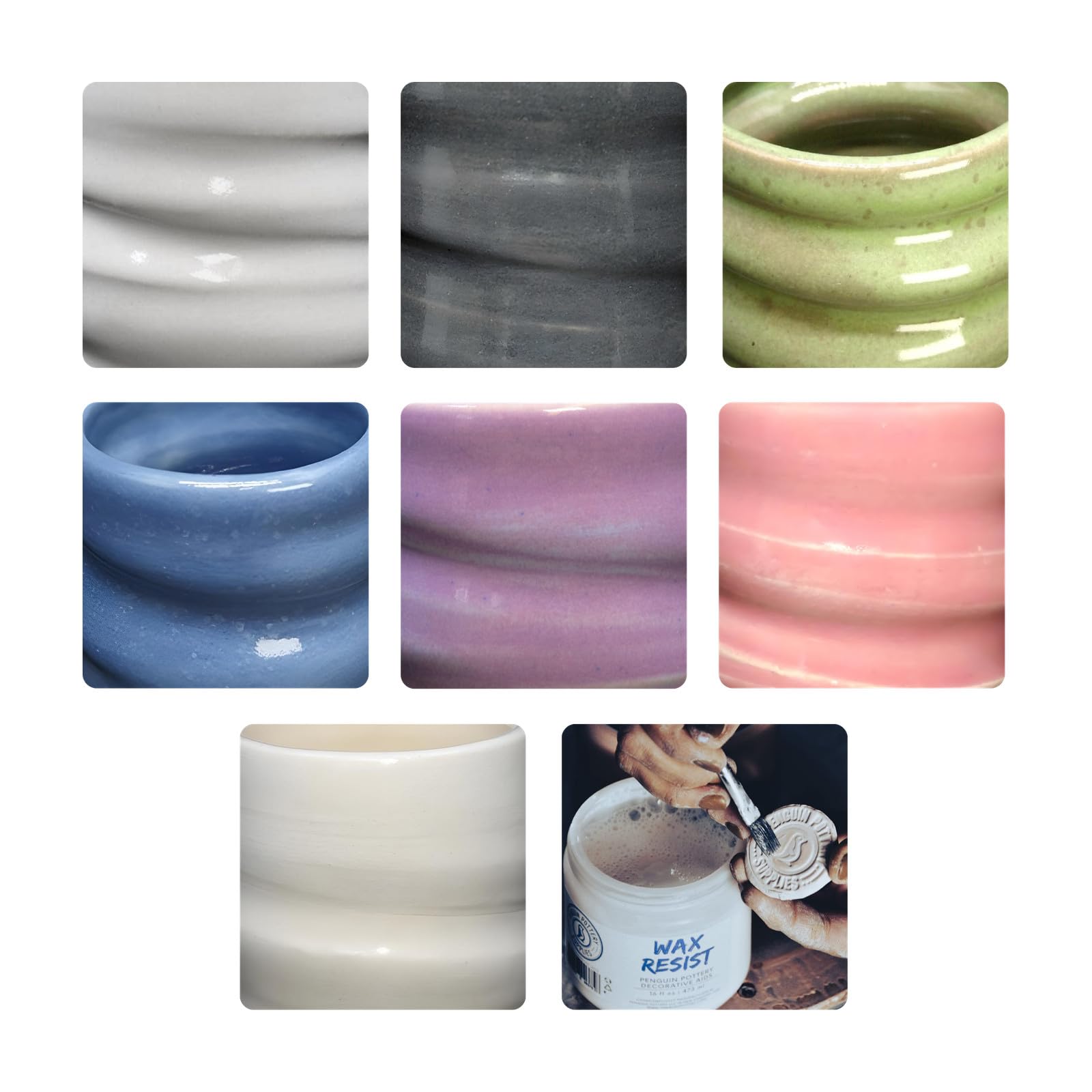
Seven 4 oz jars sized for mid-fire kilns, plus a jar of wax resist most sets leave out.
If your kiln runs Cone 5 to 6 — roughly 2167 to 2232°F — this set is aimed straight at you rather than at low fire. You get seven 4 oz jars: White, Charcoal Grey, Endive Green, Hydrangea, Carnation, Lilac, and Glossy Clear. The eighth jar is a wax resist, the waxy liquid you brush on the foot ring so glaze does not stick where the piece sits on the kiln shelf. Almost nobody includes that, and it saves a separate purchase.
The jars are the other reason to look here. At 3 pounds for the set, it runs heavier than the Mayco Stroke & Coat kit at 2.5 pounds — a real reminder that you are getting 4 oz jars instead of 2 oz bottles, so a full opaque coat on a large bowl has less chance of hitting the bottom mid-project. The finish is a glossy, opaque shine that covers the clay body completely.
Be honest about the firing instructions, though: this is mid-fire only, and it needs a calibrated pottery kiln, never a kitchen oven. One jar of colors came out chalky and matte instead of glossy, which almost always points to the piece not reaching the stated cone. Test your kiln before you commit a whole set to it.
Why Mid-Fire Potters Will Like It
- 7 x 4 oz jars give more working volume per color
- Includes a wax resist jar for clean foot rings
- Glossy opaque finish covers the clay fully
- Blends within the series for new shades
The Constraints To Know
- Cone 5-6 only, and a kitchen oven will not work
- Needs a calibrated kiln or the gloss can come out chalky
Suits you if: you fire mid-range and would rather have fuller jars than a dozen tiny bottles.
Not for you if: your kiln lives at Cone 06 or your results have been uneven — verify the firing first.
4. Creative Hobbies Ceramic Glaze Kit 1

The same twelve Mayco colors, plus a how-to booklet that matters when you are learning alone.
Anyone who signed up for a ceramics class and then discovered they had to supply their own glazes will recognize this exact scenario. That is who this kit serves: the beginner who needs the whole basic palette and a bit of written guidance in one order. Twelve 2 oz bottles cover the same Mayco Stroke & Coat range — Blue Yonder, Moody Blue, Irish Luck, Green Thumb, Sunkissed, Orange-A-Peel, Rosey Posey, Grapel, Hot Tamale, Java Bean, Cotton Tail, and Tuxedo — and a How to Paint Bisque booklet comes in the box.
Color is the headline. The pigments mix cleanly, so those twelve bottles stretch into far more shades, and the colors hold through a gas kiln at Cone 6. Even a third firing at 980°C over already-glazed pieces brought out vivid pigment instead of muddy gray. Brush one coat for translucent, three for rich opaque coverage. It is food safe, lead- and cadmium-free, ASTM D-4236 compliant, and AP certified non-toxic.
One handling note: the glazes can grip the brush a little during application, which usually traces back to water control rather than the glaze itself. Thin slightly if you see drag. Also know that despite the Cone 06 rating, plenty of people run these at Cone 6 successfully — just confirm your own results on a test tile first.
The value read: you are paying for twelve usable colors plus the booklet, in a kit built for a first class project rather than a production studio.
A small practical catch: the thick pigment can drag under the brush, so keep a little water handy and do not overwork a thin coat.
Made for: first-time students and hobbyists who want the full starter palette with written instructions included.
Skip the booklet purchase if: you already glaze confidently and just want bottles — a plain twelve-color glaze set covers that need.
5. Creative Hobbies Set of 10 Ceramic Underglaze Paint Colors

Ten jars that go from a thin watercolor wash to three-coat solid, all from the same bottle.
Mayco underglazes are the workhorse of the painting table, and this ten-jar set is the starter version. They work on wet clay, greenware, or Cone 04 bisque, which means you can pick one set and use it across your entire process instead of buying separately for each stage. A booklet on painting bisque comes with it, so someone brand new is not guessing at the first step.
The flexibility is what keeps these on the shelf. Thinned, they make watercolor and translucent washes. At three coats they build to solid, vibrant color. At Cone 6 they settle into a matte finish rather than the rough, sandy surface some matte underglazes show. Colors are honestly true — the red reads as a true red, and mixing two jars produces a clean third shade rather than mud.
The main friction is packaging, not pigment. A loose lid on one jar meant the contents leaked inside the box on arrival, so it pays to check the seals the moment you unpack. Volume is the secondary issue: ten 2 oz jars is a lean starter set, and heavy coverage painting will find you shopping for larger bottles fairly soon.
Standout spec: the Cone 04 to 6 range. That covers the full low-to-mid firing span most home potters and small studios work in.
The one caveat: results vary at the top of the range, so Cone 6 performance is worth proving on your own clay body.
Pick this for: watercolor effects, layered washes, and painters who want one set to do both fine detail and broad color.
Consider alternatives if: you need a dozen colors rather than ten, or you regularly fire above Cone 6.
6. Mayco Fundamentals Underglaze – Set of 12, 2 oz

A twelve-color palette rated up to Cone 10, with painterly control that does not move in the kiln.
Some people lose color to the fire, and others lose the drawing. Fundamentals solve the second problem: these underglazes stay exactly where the brush puts them, with no creeping or running during firing. That is a real gift for fine line work and details, because you can paint with confidence and open the kiln to the piece you designed. Twelve 2 oz jars cover China White, Bright Yellow, Orange, Fire Engine Red, Dragon Red, Regal Purple, Bright Blue, Kings Blue, Apple Green, Leaf Green, Chocolate, and Jet Black.
The firing range is the star spec. It is listed at Cone 06-10, which spans earthenware bisque right up to stoneware temperatures — rare in a set this size. The formula is built to mature at Cone 06/05, with most colors holding at higher heats, and Cone 6 performance is noted on the labels. Mix, blend, layer, or carve for sgraffito, because these inter-mix without concern of the layers combining into mud. Dilute with water for a thinned watercolor look.
Here is the honest limit on that range. On speckled stoneware at Cone 10, one potter found only red and black reliable; greens burned gray and blues dulled or dropped out. Most underglaze sets, this one included, are truest to name near the lower cones; the top of the range is a test-it-yourself zone. Also know these fire matte, so add a clear glaze if you want the color to intensify and the surface to shine.
The High-Fire Case
- Cone 06-10 range claimed on the jar
- Colors stay put in the kiln — fine line work survives
- Matte finish intensifies under a clear glaze
- Layers and intermixes without muddying
The Honest Limits
- True color holds best near Cone 06/05, not the top
- At Cone 10, greens and blues can burn out or dull
Right for: painters doing detail and line work who want colors that hold near their tested cone.
Reconsider if: you fire Cone 10 exclusively — test on your clay before relying on the full palette.
7. AMACO Velvet Underglazes, 2 oz. Jars, 12-Count Set No. 4

Twelve jars that dry fast and fire to a soft, velour look — until you want shine.
The finish is what you buy these for. Left unglazed, AMACO Velvet underglazes dry to a soft velour look, which is a genuinely different surface from a matte underglaze and a world away from gloss. Over that, you choose the topcoat: a clear matte glaze for satin, or a gloss glaze to intensify the color. Twelve 2 oz jars span Intense Yellow, Flame Orange, Bright Red, Rose, Amethyst, Medium Blue, Electric Blue, Light Green, Dark Green, Teddy Bear Brown, Jet Black, and White.
The palette is a rainbow from warm to cool in one box, and everything is made to be mixed into hundreds more colors. The application is fast and dry time is short, so a piece can move from painting to firing without a long wait on the shelf. At high fire the colors hold saturation to Cone 10 with little distortion, and the high pigment load keeps them vibrant after firing.
Two colors are the weak spot. Purple and yellow are the pair most likely to disappoint at high heat. And the jar size is the real budget question: 2 oz goes quickly once you are mixing custom shades, so this favors detail painters and sgraffito over large fill work.
The finish you are paying for: a velour surface that stands on its own, ready for either a matte or gloss topcoat depending on the look you want.
Paint it fast: a short dry time means the brush moves, so thin layers and keep your work in motion rather than letting it set under the brush.
Ideal for: sgraffito and detailed color work where you want the velour look as a design choice.
Know before you buy: purple and yellow are the least reliable at high fire.
Know the Specs
What a cone number means
A cone is a numbered marker of how much heat your kiln reaches, not a simple temperature setting. Low fire sits around Cone 06, mid fire around Cone 5-6, and high fire climbs toward Cone 10. A glaze listed as a range, such as Cone 06-10, means it was formulated to be tested across that span — usually truest near the lower end.
Match your glaze to the top of your kiln’s range, not the bottom. That is where colors drift, and that is where a test tile saves a whole set.
Gloss glaze versus underglaze
A gloss glaze fires shiny by itself, which is why the Mayco Stroke & Coat set does not need a clear overglaze. An underglaze is a pigmented color you paint on and then cover with clear glaze, so the color survives and stays food safe.
Underglazes fire matte or velour on their own. Add a clear matte glaze for a satin finish, or a gloss glaze to make the color read brighter.
Coats, coverage, and opacity
One coat gives a translucent wash. Two to three coats build to full, opaque coverage. That is the same rule across these sets, and it means coverage is a function of your brush count, not just the jar.
Test a swatch before you commit a whole piece. Under-applied color reads washed out after firing, with no fixing it once the kiln has done its work.
Food safety and certified labels
An AP Certified seal means the material is non-toxic when used as intended. Food safe on a label means a properly fired, fully covered surface that comes into contact with food or drink.
Crazing, pinholes, and blistering make a surface unsuitable, so always test your own clay and firing before a finished piece goes into service.
Common Questions
Can I use a low-fire Cone 06 glaze in a kiln that fires to Cone 6?
Do I need a clear glaze over an underglaze?
How many coats of underglaze do I need for solid color?
Will underglazes hold their color at Cone 10?
What is the difference between a glaze and an underglaze?
Are these glazes safe to use on dinnerware?
Can I mix two underglaze colors to make a new shade?
How long does a 2 oz jar of underglaze last?
Do I need a wax resist with pottery glaze?
Is a kitchen oven a safe substitute for a pottery kiln?
The Bottom Line
For most people buying their first serious color palette, the Mayco Stroke & Coat Kit #1 is the pick because it fires glossy without a separate clear coat and the colors hold instead of running. If your kiln runs Cone 5-6, the Penguin Pottery Opaque Sample Set gives you fuller 4 oz jars and the wax resist most sets leave out. And if you fire high and want color that stays put in the kiln, the AMACO Velvet Set No. 4 is the strongest choice for saturation at Cone 10 — just watch the purple and yellow. Start with one set that matches your kiln’s range, paint a test tile, and you will never again open a kiln to a color you did not choose.
How we choose
We do not accept paid placement. Every pick is matched to a real buyer and a real use-case; we do not hands-on test units.
Sources
Specifications: manufacturer listings and product documentation. Review insights: verified customer reviews, as of October 2026. Pricing: not shown on this page (it changes often); check the current price via the retailer link.
As an Amazon Associate, Aappliancez earns from qualifying purchases. This does not affect which products we feature.