Disclosure: Some links in this post are affiliate links. As an Amazon Associate I earn from qualifying purchases, at no extra cost to you. Learn more
Specs are compiled from manufacturer listings and verified buyer reviews and can change over time — please confirm the key details on the product page before buying.
If you spend your day hunched over a desk and your shoulders have quietly crept forward, the fix is not a stronger reminder — it is a garment that physically holds your spine in place. The three shirts and braces here do that job in different ways: one is a compression shirt with a reinforced lower back panel, one is a strapped brace with five support rods, and one is a posture undershirt. Sizing decides whether you actually wear it every day; all three run tight, and two of the three are widely reported to run small, so measure your chest or waist before you buy.
This guide is built by comparing the manufacturers’ published specifications and the patterns across verified customer reviews, so you get each pick’s real strengths and trade-offs instead of marketing spin.
Posture support only works if the shirt stays put through a full workday, so fit and compression matter more than fabric claims. Here is what holds up in a posture shirt.
Top Picks

How To Choose The Best Posture Shirt
Start with one question: do you want fabric pulling your shoulders back, or a frame holding them there? A compression shirt works by tension in the cloth itself, so it feels like a firm hug and disappears under a button-down. A strapped brace works with rigid rods and adjustable webbing, so it holds a harder line but sits bulkier against your body. Neither is better in the abstract — a compression shirt suits lower-back ache, a rod brace suits a rounded upper back.
Get the size right or nothing else matters
Sizing is the single biggest reason people give up on a posture shirt. A compression garment that is one size too small will not go on comfortably and one that is too loose will not hold anything. Measure your chest at its widest point for a compression shirt, and your waist at the belly button for a strapped brace. If you land between two sizes on a brace, the maker recommends the larger one. Expect the first few wears to feel snug before the fabric relaxes.
Decide how long you will actually wear it
A shirt thin enough to wear under your clothes for a full workday gets used; a brace you only tolerate for an hour does not. Breathability matters here, because a non-breathable panel against your back turns into a sweat trap by mid-afternoon. Mesh fabric and thin profiles are the two features that decide whether a posture shirt becomes a daily habit or a drawer ornament.
Know what these garments can and cannot do
A posture shirt is a reminder and a support, not a substitute for your own muscles. Wearing one constantly without doing any core or back work can let the muscles you are trying to train switch off. The sensible routine is a set number of hours a day plus a few minutes of strengthening work, which is exactly how the makers frame their own wear instructions.
Side-by-Side Comparison
| Model | Best For | Support Style | Material | Size Reviewed | Amazon |
|---|---|---|---|---|---|
| Tommie Copper Men’s Lower Back Support Compression Shirt★ Best Overall | All-day lower back compression under clothes | 4-panel power mesh shirt | Compression fabric | Men’s (size up advised) | Amazon |
| Kepwaa Posture Corrector with 5 Support Rods | Firmer upper and lower back correction | 5 flexible ABS rods | Polyester mesh | Large | Amazon |
| Curveless Men’s Posture Corrector T-shirt | Light compression as a posture reminder | Compression undershirt | Nylon and spandex | Medium | Amazon |
Detailed Reviews
1. Tommie Copper Men’s Lower Back Support Compression Shirts
Our pick — 4.0+★ from 900+ verified ratings; the strongest balance of quality and price.
A compression shirt built around your lower back, not just your chest.
The defining number here is not a weight or a battery figure — it is the 4-panel power mesh system stitched into the lower back, which is what turns an ordinary compression top into something that actually supports your spine. That panel is the reason you can wear it as a normal shirt or slip it under a work shirt, because the profile stays thin enough to hide. If your problem sits in your lower back rather than your shoulders, this is the shape you want.
What wins people over is the support itself, and it is not a subtle effect. Wearers describe sitting at a desk for long hours without the ache they used to get, and one buyer with a slipped disc reported it held his back steady through workouts and soccer. A wide-chested buyer at 5’8″ and 178 lbs sized up to XL on the maker’s chest chart and got a fit he called like being hugged all day. That is the pattern: the people who follow the chest-size chart and go up end up loving it, and the ones who order their usual size end up fighting it.
The catch is honest and it is about scale, not quality. The sizing chart runs small — one slim 33-year-old bought a small and found it fit closer to a child’s size — so treat the chart as a starting point and lean a full size up. Removal takes patience too; the fabric is slick, so pulling it off inside out with a hand from someone else saves the seams. And you are paying a premium for the copper branding, which does not add support on its own. Judge this shirt on the reinforced lower back panel, because that part is genuinely good.
What it gets right
- 4-panel power mesh focuses support on the lower back where a desk job does its damage
- Thin enough to wear as an undershirt without showing under a button-down
- Holds position through a workday with very little slippage
- Quality fabric that survives repeated washing when you follow the care tag
Where it asks patience
- Sizing runs small — plan to go up at least one size from your usual
- Getting it off is a two-hand, inside-out job that strains the seams if rushed
- The slick outer fabric lets trousers slide down more than usual
- You are paying extra for the copper label, not for extra support
Reach for this if: your ache lives in your lower back and you want support you can hide under a shirt all day.
Look elsewhere if: you need rigid shoulder correction rather than soft compression — the rod-based brace below does that job.
2. Kepwaa Posture Corrector with 5 Full Back Support Brace Rods
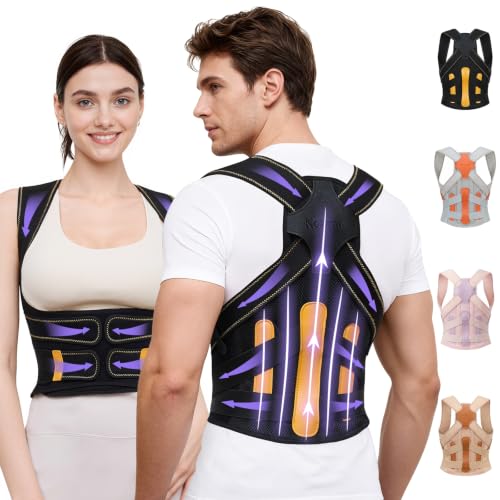
Five rigid rods and adjustable webbing — the firmest hold of the three.
Five flexible ABS support rods run up the back of this brace, and that is the whole point of it. Where a compression shirt nudges your shoulders back with fabric tension, this holds them there with structure, so it corrects a rounded upper back far more assertively. The straps adjust to pull your shoulders into line, and the ergonomic cut is shaped to leave your armpits alone even after long wear. If your hunchback sits high between the shoulder blades, this is the tool aimed at it.
The maker’s own wear plan is unusually specific: 1–2 hours a day for 28 consecutive days, with the goal of building muscle memory rather than dependence. Do that and the brace becomes a training aid. Skip it and wear it constantly, and you are just leaning on a crutch. The build quality backs the plan up — it is well made, the mesh is easy to hand wash and dries fast, and it slips under clothes without disrupting your workday.
Unlike the compression shirt above, this one is not trying to be invisible luxury — it is a piece of equipment, and it feels like one. The recurring gripe is heat: the panel traps sweat even in cold months, which is why some wearers layer a thin T-shirt underneath. Strap fit takes a few days of fiddling to dial in, and the shoulder straps can get in the way of a bra strap. The hook-and-loop fastening is the part to look after — keep lint and hair out of it and it lasts, but it can lose grip over time, and the maker has been quick to replace when it does. Sizing runs large, so measure your waist and size down if you are in between.
The honest read: this is the pick for real correction of a rounded upper back, and the five rods are why. It is not the pick for someone who wants a garment they forget they are wearing.
One thing to plan around: the heat. If you run warm or wear it over a bra, factor in a thin base layer.
Best for: a committed 28-day correction routine where you want firm, structured pull on the shoulders.
Not for: anyone who needs a brace they can forget about through a hot afternoon.
3. Curveless Men’s Posture Corrector T-shirt

The simplest of the three: a snug nylon-spandex undershirt that taps your shoulders as a reminder.
This is the plainest option in the group and it does not pretend otherwise. It is a pull-on shirt in nylon and spandex, hand wash only, and the way it works is tightness — the snug fit sits against your back and shoulders so you notice the moment you start to slump. There are no rods and no straps to adjust. For someone who wants a nudge rather than a frame, that simplicity is the appeal.
Where it falls short of the other two is consistency. A compression shirt with a reinforced panel, like the Tommie Copper above, holds a specific zone; this one relies on overall tightness, so the correction is only as good as the fit. It runs much smaller than expected — buyers consistently report needing to go up at least a size, and a 5’10” 195 lb wearer found an XL tight at first before it broke in. The fabric itself is decent; the issue is expectation, because a tight T-shirt is not the same thing as structured support.
The realistic way to use it is as a light reminder layer, not as your main correction tool. Some wearers find the snugness enough to keep them aware of their posture through a workday, and the short sleeves make it wearable under a regular shirt. What it will not do is pull a strongly rounded back into line the way the rod brace does. And there is a fair warning in the reviews worth repeating: prolonged, casual wear without any back strengthening can let the muscles you are trying to train get lazy. Use it for set hours, pair it with movement, and it earns its place.
Why it might be enough: no straps, no rods, no fiddling — just a tight undershirt that makes slouching uncomfortable to ignore.
Where it stops: it runs small and offers only light compression, so it will not correct a pronounced hunch the way a rod brace can.
Pick this one if: you want a low-key reminder layer under a shirt and are willing to size up.
Skip the idea if: you are expecting structured spinal support from a T-shirt — that is not what nylon and spandex can deliver.
Know the Specs
Support Mechanism: Fabric vs Rods
A compression shirt holds your posture with tension in the cloth — the 4-panel power mesh in the Tommie Copper is the clearest example, because it concentrates that tension on the lower back. A braced corrector like the Kepwaa uses five flexible ABS rods plus adjustable straps to physically pull the shoulders back. Fabric support feels softer and hides easily; rod support corrects harder and shows more. Neither is wrong — pick by how much pull you need.
Why Sizing Runs Small
Compression garments are cut tight on purpose, so the size that fits is usually one up from your everyday shirt. All three picks here skew small on the chart, and the makers say so indirectly by advising you to size up or choose the larger size between two. Measure your chest at its widest point for a shirt and your waist at the belly button for a brace. Measuring before you order is the difference between a garment you wear daily and one that sits in a drawer.
Breathability and Daily Wear
A posture shirt only helps if you keep it on, and heat is the usual reason people take it off. Mesh fabric and a thin profile are what make long wear bearable — the Kepwaa uses breathable polyester mesh, and the Tommie Copper is built ultra-thin so it disappears under clothing. If you run warm or wear a bra underneath, expect to need a thin base layer regardless of the fabric claims.
Cleaning and Longevity
Rod braces are hand wash only and dry fast, while compression shirts generally survive machine washing if you follow the care tag. The parts that wear first are seams and fastenings: the hook-and-loop on a brace loses grip when lint and hair get into it, and seams on a stretched compression shirt strain if you yank it off rather than easing it. Keep the hook-and-loop clean and ease the shirt off instead of yanking it, and any of these lasts considerably longer.
Common Questions
Should I buy a compression shirt or a strapped brace for posture?
Do posture shirts really run a size small?
How many hours a day should I wear a posture corrector?
Can I wear a posture shirt under my regular work clothes?
Why does my posture brace get so hot and sweaty?
Do the hook-and-loop straps wear out on a posture brace?
Is it bad to wear a posture corrector all day?
How do I wash a posture shirt or brace?
Will a posture shirt fix my posture on its own?
Which of these three is the safest first purchase?
The Bottom Line
For most people shopping for the posture shirt, the winner is the Tommie Copper Lower Back Support Compression Shirt because its 4-panel power mesh targets the lower back precisely and it stays thin enough to hide under a button-down all day. If your rounded upper back needs firmer, structured correction, grab the Kepwaa Posture Corrector — five ABS rods and adjustable straps pull harder than any fabric can. And for a light, low-key reminder layer under a shirt, the Curveless Posture Corrector T-shirt is the one to reach for. Whichever you pick, size up and wear it for set hours rather than all day — that is what turns a posture shirt into a habit.
How we choose
We do not accept paid placement. Every pick is matched to a real buyer and a real use-case; we do not hands-on test units.
Sources
Specifications: manufacturer listings and product documentation. Review insights: verified customer reviews, as of October 2026. Pricing: not shown on this page (it changes often); check the current price via the retailer link.
As an Amazon Associate, Aappliancez earns from qualifying purchases. This does not affect which products we feature.