Disclosure: Some links in this post are affiliate links. As an Amazon Associate I earn from qualifying purchases, at no extra cost to you. Learn more
Specs are compiled from manufacturer listings and verified buyer reviews and can change over time — please confirm the key details on the product page before buying.
Spurge is the weed that laughs at your mower. It mats flat against the soil, seeds itself before you blink, and shrugs off the weak spot sprays sold at big-box stores. The fix is a post-emergent herbicide (a spray that kills weeds already growing, not seeds waiting to sprout) built on the right active ingredient for your turf. Each pick below kills spurge without wrecking the grass around it, and each one fits a different yard, budget, and spray style.
This guide is built by comparing the manufacturers’ published specifications and the patterns across verified customer reviews, so you get each pick’s real strengths and trade-offs instead of marketing spin.
You will see which formulas actually knock spurge down, which tank mixes burn your lawn, and how each bottle handles a full season of spot spraying. The right post emergent herbicide for spurge turns a losing battle into a one-afternoon job you can repeat with confidence.
Top Picks

How To Choose The Best Post Emergent Herbicide for Spurge
Spurge spreads by seed and by creeping stems, so the spray has to reach the leaf and travel down to the root. A contact-only spray that burns the top will leave the crown alive and re-sprouting in a week. Pick a formula with a systemic active ingredient (one that moves inside the plant after the leaf absorbs it) if you want the whole weed dead, not just scorched.
Read the label for your grass type first
Every bottle lists which turf grasses it is safe on, and that list is the real gatekeeper. A formula that lists Kentucky Bluegrass, Bermudagrass, and Zoysiagrass is a different tool than one built for St. Augustine or Centipede. Spray the wrong one and you trade a spurge patch for a dead lawn strip.
Concentrate or ready-to-use
A concentrate (a bottle you dilute with water yourself) costs less per treated area and lets you dial the mix strength up or down. A ready-to-use jug (a pre-mixed spray bottle, often with a wand or hose attachment) skips the measuring cup but runs out faster on large yards. For a small spot-treatment job, ready-to-use wins on convenience. For a full-lawn pass, concentrate stretches farther.
Timing beats dosage
Spurge is easiest to kill when it is young and actively growing, usually in spring and again in fall. A mature, woody spurge mat resists the same spray that melts a young seedling. Spray on a sunny day when the weed is not drought-stressed, and give the leaf full coverage until droplets roll off.
Side-by-Side Comparison
| Model | Best For | Format | Volume | Weed List | Amazon |
|---|---|---|---|---|---|
| Fertilome Weed Free Zone★ Best Overall | All-around broadleaf control | Concentrate | 32 fl oz | 80+ broadleaf weeds | Amazon |
| Southern Ag Lawn Weed Killer with TrimecBest Value | Spurge on a budget | Concentrate | 32 fl oz | Wide range | Amazon |
| Bonide Captain Jack’s Deadweed Brew | Organic gardeners | Ready-to-use | 128 fl oz | Non-selective | Amazon |
| Ortho WeedClear with Comfort Wand | Spot spraying a small yard | Ready-to-use | 1 gal | Crabgrass, dandelion, clover | Amazon |
| Ortho Max Nutsedge Killer | Spurge plus sedge and tough weeds | Ready-to-use, 2-pack | 24 fl oz | 50+ tough weeds | Amazon |
Detailed Reviews
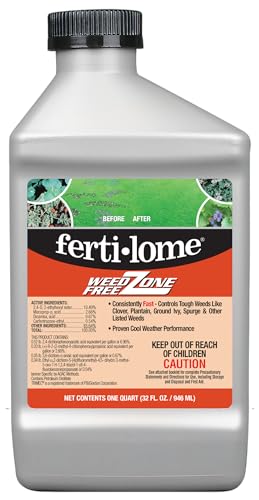
1. Fertilome 10525 Weed Free Zone Concentrate 32 oz
Our pick — 4.5+★ from 1,000+ verified ratings; the strongest balance of quality and price.
The dicamba-and-Triclopyr bottle that hits 80-plus broadleaf weeds and still spares Kentucky Bluegrass.
Here is the number that matters for a spurge problem: 80-plus broadleaf weeds on the label, including spurge, clover, chickweed, and thistle. That coverage is why this bulb is the default pick for a mixed-weed lawn. You get a concentrate that mixes with water at the rate on the label, so one 32 fl ounce bottle goes a long way — and for comparison, that leaves the ready-to-use Bonide at a 4-to-1 disadvantage on liquid volume (32 fluid ounces vs 128 fluid ounces), even though the Bonide only works on a non-selective basis.
The active ingredients are a dicamba and a Triclopyr-plus-Clopyralid blend — two of the go-to systemic herbicides (they absorb through the leaf and travel to the root). The label lists safety on Kentucky Bluegrass, Bermudagrass, Bahiagrass, and Zoysiagrass. The maker notes visible weed injury can show within hours of a spray, so you know quickly whether the pass worked.
The catch is concentration control, and the review pages are candid about it. Some buyers mix with a surfactant (an additive that helps the spray stick to waxy leaves) and a marker dye, and a few report a temporary yellowing of surrounding grass that recovers over a few days. The bottle has also drawn some grumbling on value-for-money, mostly from buyers who expected a larger treated area than a 32-ounce concentrate delivers on big lawns. If spurge is thick and you want volume, this is still a smart way to buy — as owners have found, some stubborn leaves need two or three passes.
What delivers the kill
- 80-plus broadleaf weed target list includes spurge, clover, chickweed, and thistle.
- Dicamba plus Triclopyr/Clopyralid travels to the root, not just the leaf.
- Safe on Kentucky Bluegrass, Bermudagrass, Bahiagrass, and Zoysiagrass per the label.
- Visible injury can appear within hours of application.
What you should know
- Concentrate means mixing, and over-mixing can yellow nearby grass briefly.
- Some buyers find the value disappointing for large-acreage use.
- Stubborn spurge may need two or three spray rounds.
- Must be mixed at the label rate — no shortcut for a full-dump mistake.
Best for: Mixed broadleaf lawns where spurge, clover, and chickweed share the same turf. This is the one to reach for if your grass is Bermudagrass or Zoysiagrass.
Hold off if: You want zero mixing and zero measuring — the ready-to-use picks lower down skip the jug-and-water part.
2. Southern Ag 13503 Lawn Weed Killer 32oz
A three-way Trimec concentrate that covers 5,000 square feet and treats nine turf types.
Southern Ag built this on Trimec, a combination of three proven weed killers in one bottle, and the label names spurge right in the customer feedback: buyers report it “kills spurge and dandelions.” Coverage is listed at 5,000 square feet from a 32-ounce concentrate, which is a lot of lawn from a small bottle. It works in conventional and hose-end sprayers alike, so you can mix in a pump can or clip it to a garden hose depending on your setup.
The ingredient list is the reason it can handle spurge and still leave grass standing. Trimec-style blends combine a trio of post-emergent herbicides that attack broadleaf weeds from different angles, which improves the odds against a tough weed. The label lists nine turf types. The maker recommends adding a surfactant to boost performance, and that small step is worth taking on spurge with its waxy leaves.
The honest note is that the results are genuinely mixed in the reviews. Some buyers see spurge, chickweed, and clover knocked back and better than common store brands, while others report a return of weeds within weeks and a need to reapply. A fair share of buyers also mention bare patches where the spray touched thin grass. This is a formula that rewards careful measurement and targeted spraying, not a whole-lawn blanket dump. Mix at the 2 ounce per gallon rate, spray young weeds, and keep the lawn dry for 24 hours, and you give it the best shot.
Where it shines
- Spurge and dandelion control reported by buyers.
- Three-way Trimec blend hits broadleaf weeds from multiple angles.
- 5,000 square feet of coverage from one 32-ounce bottle.
- Works in conventional and hose-end sprayers.
The honest limits
- Reapplication every few weeks may be needed to keep spurge down.
- Some buyers see grass yellowing or bare spots if not measured carefully.
- Results can be uneven from lawn to lawn and season to season.
- Not a season-long residual — it kills what is up, not what sprouts next.
Pick this one when: You want the strongest cost-per-square-foot on a spurge-heavy lawn and you are comfortable mixing a concentrate.
Think twice if: You expect one bottle to end spurge for the season — plan on a repeat pass a few weeks out.
3. Bonide Captain Jack’s Deadweed Brew 128 oz

A 128-ounce ready-to-spray jug that drops weeds in hours and is approved for organic gardens.
For organic gardeners, this is the bottle that does not force a trade-off. The label approves it for organic gardening, and it is non-selective — it kills whatever it lands on, so you aim it at spurge in gravel, along fence lines, or between raised beds, never directly on the plants you keep. It comes ready to use, so there is no mixing. One owner summed up the speed perfectly: “Weeds died within an hour of spraying.”
The volume is where this pick pulls ahead of every other bottle here. At 128 fluid ounces it holds four times the liquid of the 32-ounce Fertilome concentrate, so a full gallon of pre-mixed spray is ready the moment you unscrew the cap. It works in temperatures as low as 40 degrees Fahrenheit, which extends your spraying window into cool spring and late fall, and once it dries it becomes waterproof. That matters on a driveway or border that gets hosed down later.
The catch is sprayer quality, and the reviews are split on it. The included hand pump is fine for a patch but slow across a big gravel yard — many buyers transfer the brew into a larger wand sprayer for coverage. Some also report the top leaking once the bottle is opened and tipped. Effectiveness itself is genuinely mixed: most see fast browning, but a few report a batch that did almost nothing. Apply on a sunny day, saturate the leaves until droplets roll off, and spot-test a small patch first.
Fast-kill reality: “Weeds died within an hour of spraying” is not marketing — it is how the review pages read. The brew works best in full sun on a dry day with generous leaf coverage.
Two things to plan for: The included pump sprayer is fine for small jobs but tiring on a full gallon, and the cap can drip after opening.
Reach for it when: You garden organically and need a ready-mixed, non-selective killer for gravel paths, borders, and fence lines.
Look elsewhere if: You need a large-area sprayer included in the box — this one is best paired with a better pump or wand.
4. Ortho WeedClear Ready-to-Use 1 gal.

A one-gallon lawn sprayer with a battery-powered wand that targets sprouting spurge without bending.
Spot-treating spurge in a lawn is a job for accuracy, and the Comfort Wand is the feature that earns this pick its place. It is a battery-powered spray wand (a trigger-free handle with a nozzle on a stick) that lets you aim at a single spurge plant without crouching. The bottle covers 20,480 square feet per the label and is ready to use, so you fill the wand and walk the lawn. It is labeled safe on northern lawn grasses including Bermudagrass, Buffalograss, Fescues, Kentucky Bluegrass, Ryegrass, and Zoysiagrass.
On the kill side, the label targets crabgrass, dandelion, clover, chickweed, and creeping charlie down to the root and promises results in one application. That is the list to match against your weeds. If your lawn is mostly spurge plus dandelion, this fits. If it is a heavier mix of sedge or tough woody weeds, the ingredient list here is thinner than the Trimec blend above. The wand’s dual-setting nozzle also lets you switch from a fine spot to a wider spray.
Where this pick gets real is the honest split on results. Buyers who catch the weeds young see dandelions brown and die within days, and some report a full cleanup in about two weeks with grass left intact. But this formula is not built around Triclopyr, and one buyer specifically noted it struggled with Oxalis and spurge, wanting an ingredient this bottle does not carry. That tracks with the label — spurge is not named among the target weeds. If spurge is your main problem, this is a supporting tool for dandelion and clover around it, not the headliner. If you want a wand ready for quick spot passes on dandelion and clover, it is the convenient option.
Great choice for: Small lawns and walkways where dandelion, clover, and chickweed need precise spot treatment with a wand you do not have to pump.
Not the one for: Lawns where spurge is the star of the weed show — check the label versus your weeds first, because spurge is not on this list.
5. Ortho Max Nutsedge Killer Rtu, 24 fl.oz. (2 Pack)
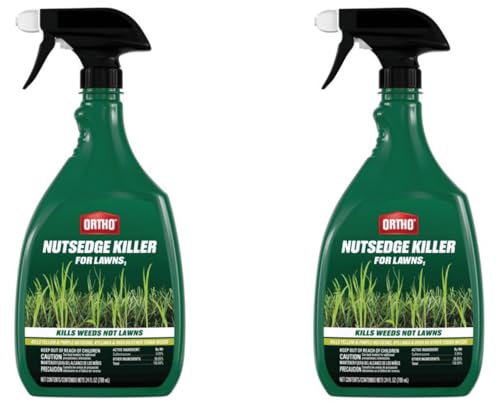
The two-bottle hose-attach that names spurge on its label and kills over 50 tough weeds while sparing lawn.
If spurge is not your only problem — and it rarely is — this is the bottle that names the widest weed list. The label targets yellow and purple nutsedge, kyllinga, wild onion, garlic, broadleaf plantain, purslane, redroot, pigweed, dandelion, and spurge, more than 50 tough weeds in all. The format is a two-pack of 24 fluid ounce ready-to-use bottles that attach to a hose with a simple on and off switch, so there is no mixing and no pump. It is labeled for both Northern and Southern turf grasses.
Rainfastness is a real advantage here: the label says it is rainproof within two hours of application. On a spurge patch near a driveway or bed that gets hit by a sprinkler, that two-hour window matters. The easy hose attachment also makes re-treatment simple, since the reviews show nutsedge dying in about three to four days, and owners mention early treatment works best. The active works systematically, killing the whole plant rather than just the leaf.
The honest limit is that this is a sedge-first formula, and spurge is on the extended list rather than the headline. Customers note the yellowing and browning is real — some see surrounding grass turn brown too, so keep the wand on the weed and off the turf. On spurge specifically, results are less consistent than on nutsedge. Pair it with a broadleaf-specific option above for the spurge and use this to clean up the sedge, kyllinga, and wild onion that come with it. As one long-time lawn fighter put it, this is “less work than prior nutsedge treatments,” and that convenience is the real selling point.
The two-hour window: Rainproof in 2 hours on the label means an unexpected sprinkler cycle will not wash the kill away. That is a real benefit on irrigated lawns where spurge sits near a sprinkler head.
Sedge-first, spurge-second: Yellow and purple nutsedge and kyllinga are the headline targets; spurge is on the wide list but not the lead. If a few patches of browning grass follow, that is the trade-off on a broad-spectrum hose-attach sprayer.
Best paired with: Lawns fighting sedge, kyllinga, and wild onion alongside spurge — the hose attachment makes repeat passes painless.
Weigh it carefully if: Spurge is your only weed, because a broadleaf-specific concentrate will target it more directly.
Know the Specs
Concentrate vs ready-to-use
A concentrate is a bottle you mix with water at a label-specified rate, usually measured in ounces per gallon. It costs less per treated area and gives you control over strength. A ready-to-use product is pre-mixed, so it is easier to apply but runs out faster on a large yard. For a small spurge spot, a ready-to-use bottle skips the measuring. For a full lawn, a concentrate such as the Fertilome 32-ounce bottle stretches much further.
Coverage in square feet
This is the number that tells you how much lawn one bottle can treat. Higher coverage means fewer bottles per application. Match coverage to your lawn size, and note that spot treatment uses less than a full-coverage pass. A 5,000 square foot bottle will not treat an acre in one go.
Active ingredients and mode of action
Systemic active ingredients, such as dicamba or a Triclopyr blend, absorb through the leaf and travel to the root. Contact herbicides burn only the leaf surface and leave the root to re-sprout. For spurge, which spreads from a creeping crown, systemic is usually the superior choice. Check the label for the specific actives before buying.
Turf safety lists
Every product lists which grasses it will not harm when used as directed. Safe turf grasses vary — some lists name Kentucky Bluegrass and Bermudagrass, others name Fescues and Ryegrass. Match the label’s turf list to your own lawn before spraying, because the wrong formula can damage the grass you are trying to protect.
Common Questions
Will a post-emergent herbicide kill spurge that has already spread across my lawn?
Do I need a concentrate or a ready-to-use bottle for spurge?
Can I spray spurge killer on my whole lawn, or only spot treatment?
Why does my lawn turn yellow after spraying spurge killer?
How long before I see spurge dying after spraying?
Is there a spurge killer approved for organic gardening?
Will spurge killer work in cool weather?
Can I use the Ortho Nutsedge Killer 2-pack on spurge?
Does spurge come back after one spray?
Should I add a surfactant to my spurge killer?
The Bottom Line
For most lawns with a real spurge problem, the Fertilome Weed Free Zone is the strongest overall pick — an 80-plus weed target list and a proven dicamba-and-Triclopyr blend that spares the grasses most people grow. If cost per square foot is your driver, the Southern Ag Trimec concentrate covers 5,000 square feet and treats nine turf types from the same 32-ounce size. And for organic gardens and gravel paths, the Bonide Captain Jack’s Deadweed Brew delivers 128 ounces ready to spray and dies-back weeds within the hour. Match the formula to your grass type, spray young spurge on a sunny day, and plan a follow-up pass.
How we choose
We do not accept paid placement. Every pick is matched to a real buyer and a real use-case; we do not hands-on test units.
Sources
Specifications: manufacturer listings and product documentation. Review insights: verified customer reviews, as of October 2026. Pricing: not shown on this page (it changes often); check the current price via the retailer link.
As an Amazon Associate, Aappliancez earns from qualifying purchases. This does not affect which products we feature.