Disclosure: Some links in this post are affiliate links. As an Amazon Associate I earn from qualifying purchases, at no extra cost to you. Learn more
Specs are compiled from manufacturer listings and verified buyer reviews and can change over time — please confirm the key details on the product page before buying.
If you have ever spent an afternoon bent over a fence line swinging a sledgehammer at a steel T-post, you already know why a dedicated post driver exists. A driver slides over the post top and its own weight slams it into the ground — no glancing hammer blows, no mushroomed post tops, no wrecked shoulders. The trick is matching inside diameter to your posts and head weight to your soil, which is what this guide sorts out.
This guide is built by comparing the manufacturers’ published specifications and the patterns across verified customer reviews, so you get each pick’s real strengths and trade-offs instead of marketing spin.
Inside diameter and head weight decide almost everything here, whether you are pounding u-channel sign posts into rock-hard desert ground or sinking wooden 4x4s along a ranch fence. The Insaga suits most buyers, and these seven drivers cover manual steel, SDS-Max attachment, and electric types.
Top Picks


How To Choose The Best Post Driver
Start with one measurement you take yourself: the width across your post, top to bottom. That number decides your inside diameter, and the inside diameter decides whether the driver is useful or useless on your land.
Inside Diameter Has To Match Your Post, Not Beat It
Inside diameter (the open tube size the post slides into) is the make-or-break spec. A driver with a 6.14 inch inside diameter swallows thick wooden 4×4 posts and even a 2×6 laid flat. A 3 inch inside diameter suits steel T-posts and u-channel. Get this wrong in either direction and you are returning the thing.
Check the shape too. U-channel posts (the folded metal kind with a channel down the middle) and T-posts (the classic studded steel farm post) both need a tube wide enough to clear their widest point. A few drivers list a working width for u-channel posts so you can check before you buy.
Weight, Lift Height And Your Soil
A manual post driver has no engine — gravity does the driving. Heavier heads hit harder but take more effort to lift on every stroke. A 20 lb driver is manageable for repeated lifts, while a 30 lb or 34 lb head does more of the work per drop but wears you out faster on a long run.
Overall length matters as much as head weight. A longer tube lets you raise the driver higher, and that extra drop travel lands harder. That is why a 23.2 inch body with a 20 lb head can out-drive expectations, while a very short driver forces a shallow, weak stroke if you are tall or working on hard ground.
Hammer Attachments And Electric Drivers
If you already own an SDS-Max rotary hammer or demolition hammer (a heavy-duty chipping hammer that takes thick-shanked bits), an SDS-Max driver attachment turns that tool into a powered post pounder. These fit only SDS-Max tools — not the thinner SDS-Plus system — so confirm your hammer’s shank first.
An electric post driver carries its own motor and needs no separate tool, which suits bigger jobs and softer soils. The trade-off is weight, noise, and a soil limit — none of them like rocky ground.
Side-by-Side Comparison
| Model | Best For | Type | Weight | Inside Diameter | Amazon |
|---|---|---|---|---|---|
| Insaga Enhance Post Driver★ Best Overall | All-round fence and garden posts | Manual steel | 20 LB | 4.7 inches | Amazon |
| Werhoo SDS-Max T Post DriverHammer Attachment | Owners of an SDS-Max hammer | SDS-Max attachment | — | 3 inches | Amazon |
| MTZUL SDS Max Shank T-Post Driver | Long-term hard-use fencing | SDS-Max attachment | — | 3 inches | Amazon |
| Focefec 34LB Metal Post Driver | Wooden posts and thick posts | Manual steel | 34 LB | 6.14 inches | Amazon |
| AshmanOnline Post Driver and Rammer | Dry, hard-packed ground | Manual steel | 30 lbs | 6 inches | Amazon |
| SmartSign Post Driver | Large sign posts and wide u-channel | Manual steel | 22 lb | 4 inches | Amazon |
| HIGOSPRO 2200W Electric T Post Driver | Big fencing jobs in soft soil | Electric | — | 55/70mm sleeves | Amazon |
Detailed Reviews
1. Insaga 20LB T Post Driver
Our pick — 4.5+★ from 250+ verified ratings; the strongest balance of quality and price.
The 20 lb steel pounder that lets a higher lift do the heavy lifting for you.
This is the pick that fits the most posts with the fewest surprises. The Insaga’s inside diameter measures 4.7 inches, which is wide enough to clear a 4 inch post and plenty of room for standard steel T-posts and u-channel. For comparison, the Werhoo SDS-Max attachment runs a 3 inch inside diameter — that 2.0x gap means the Insaga will swallow a much fatter post the Werhoo simply will not fit.
Weight lands at 20 LB, which is the honest middle of this category. Lift it, let it drop, and the mass drives the post. A pair of buyers reported that two older women drove ten T-posts across three trellises at roughly three minutes per post — the kind of pace that comes from a head that does not need brute force. The angled, soft-grip handles are the part that stands out in the field: owners say they do not fatigue hands and wrists over a session, which matters on a job where you are gripping and lifting hundreds of times.
The build has a double-layer welded body with triangular reinforced handle bends and clean, smooth welds, so nothing catches your glove. A carbon steel body with a scratch-resistant finish shrugs off being tossed in a truck bed. What wins people over most is how reliably it just functions — it accommodates Master Halco 3 inch posts, and the durability gets tested hard. Buyers report one unit survived a tractor bucket being used to ram posts with it, with no warp, dent, or scratch.
Where this one earns its keep
- 4.7 inch inside diameter clears 4 inch and Master Halco 3 inch posts
- 20 LB head is heavy enough to drive, light enough to lift repeatedly
- Soft, angled anti-slip grips hold up without tiring hands and wrists
- Double-layer welds and reinforced handle bends survive rough handling
What to weigh before you buy
- The 23.2 inch body can put the handles high on very tall posts
- Hard, dry, compacted clay will still take several drops per post
- Under repeated lifts the 20 LB head will tire you on a long run
Grab this for: mixed fencing work — T-posts, u-channel, wooden 4x4s and thick sign poles in one tool.
Look elsewhere if: your posts measure past 4.7 inches across, or you want the job done without lifting 20 LB yourself.
2. Werhoo SDS-Max T Post Driver 3in
Turn the SDS-Max hammer already in your truck into a powered post pounder.
If you own an SDS-Max rotary hammer, this forged steel attachment is the cheapest way to drive posts without arm work. It slots into the hammer’s shank, the 3 inch inside diameter cups the post, and the hammer’s percussion does the actual driving. It is not compatible with SDS-Plus tools, so check your hammer’s shank before ordering.
The fit is broad — this works with Bosch, DeWalt, Hitachi, Hilti, Makita, Milwaukee, and any other SDS-Max hammer — so brand loyalty does not lock you out. The one-piece forged build carries 0.3 inch thick metal walls, which is the depth that lets it take hammered impacts without denting. Its total length is 8-1/2 inches with a socket depth of 1-9/16 inches, sized for standard steel T-posts and posts up to 3 inches (76 mm) across.
Two owners mention the same pitch: driving T-posts with an SDS-Max hammer beats swinging manually “in seconds vs hours,” especially in hard clay soil and on tall 8 foot posts. The practical detail worth knowing is that it shines for starting a post dead straight — you set the line, the attachment holds the post plumb while the hammer drives, and that alignment is hard to match with a sledge. It also handles ground rods and rebar stakes, which widens its use past fencing.
The honest ceiling: a small demolition hammer has limits — some users pair it with a manual pounder to finish posts the hammer cannot push through. If your hammer is a light one, the post wins.
Best fit: anyone who already owns an SDS-Max hammer and wants a low-cost, no-arm-work pathway to setting posts and ground rods.
Where it wins: hard, dry soil and tall posts when you already own an SDS-Max hammer.
Skip the add: steer clear if your hammer uses SDS-Plus — this shank will not seat.
3. MTZUL SDS Max Shank T-Post Driver

A quenched-steel SDS-Max attachment aimed at project-after-project durability.
The same SDS-Max idea as the Werhoo above, but this MTZUL version leans hard into long-term durability. Its forged steel body goes through a full quenching heat-treatment process, and the 0.3 inch metal wall is thick enough to take repeated impact without cracking. The product listing states the tool provides care for two years, which is a real assurance in a category that usually leaves you on your own after a short return window.
The sizing matches the category standard: 8-1/2 inches long, 3 inch inside diameter, 3-1/2 inch outside diameter, and a 1-9/16 inch socket depth for T-posts and posts up to 3 inches (76 mm) across. It ships in a transparent plastic case, so storing or throwing it in the pickup bed is easy. Compatibility is just as broad — Milwaukee, Makita, Bosch, DeWalt, Hilti, Hitachi, and any SDS-Max rotary or demolition hammer — but not SDS-Plus, spline, or jack hammers.
The honest caveat here is durability, and it cuts both ways. Quality is the strongest thing owners point to, but the same listing shows a mixed read on durability overall — some units hold up beautifully while a few report failure after a light-use run. If you drive posts in volume and want a short-list start, keep the two-year care in mind and treat the tool’s limits as real. This is a pick to buy when you would rather pay once and back it with a warranty than chase the lowest price.
Built for: regular T-post and ground-rod driving where you want a warm warranty behind the steel.
Think twice if: you drive posts occasionally and want the cheapest way onto the SDS-Max platform.
4. 34LB Metal Post Hole Digger
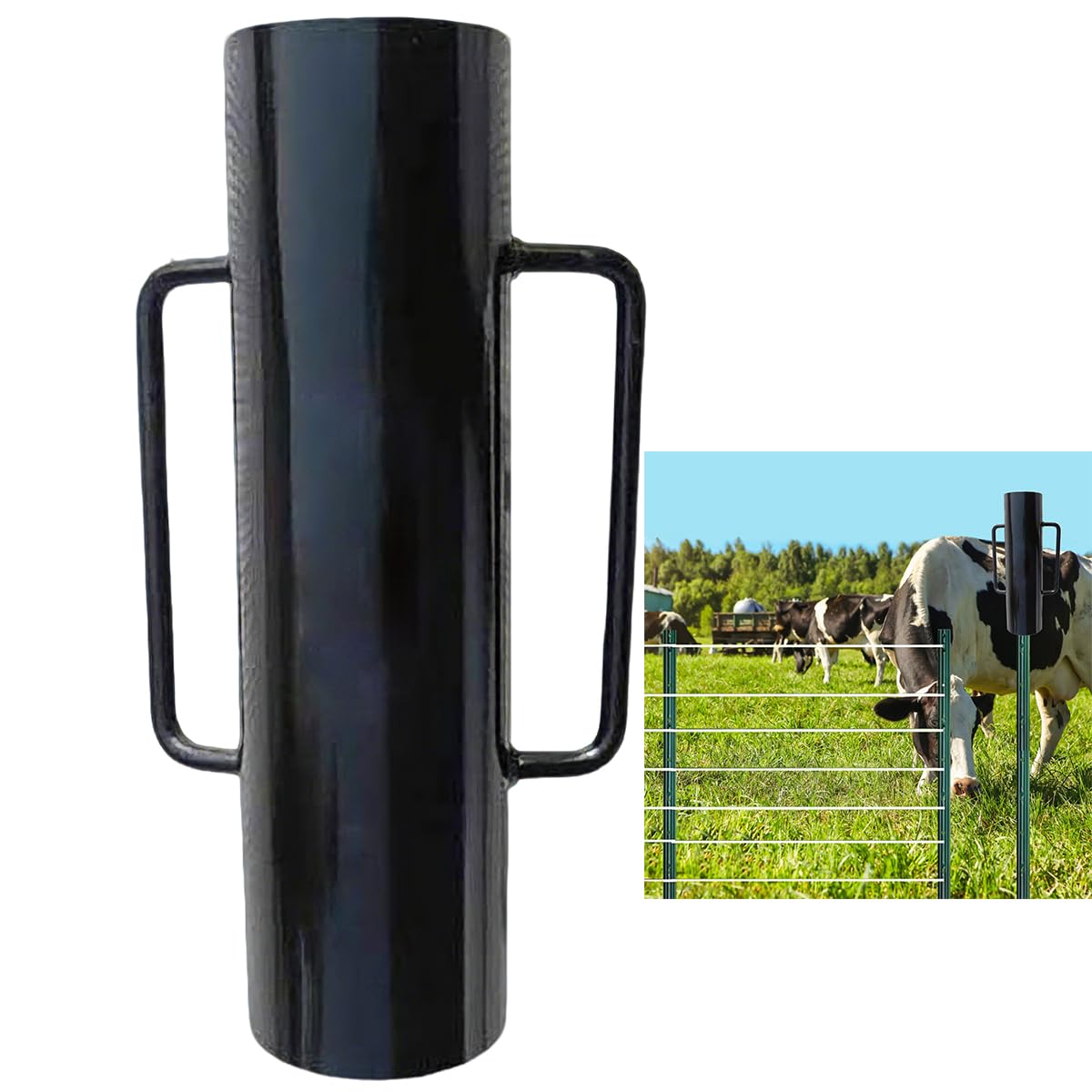
A 34 lb heavyweight with a 6.14 inch mouth built for fat wooden posts.
When your post is a 4×4, a 2×6 on edge, or a thick sign pole, you need a driver with a genuine opening. This one’s inside diameter is 6.14 inches — roughly double the 3 inch mouth of the Werhoo SDS-Max attachment above, and that 2.0x gap is exactly why the two live on different jobs. The 34 LB head is also the heaviest in this round, versus the Insaga’s 20 LB.
Owners put it to work in wood and metal alike. One drove 2×4 inch lumber into a lakebed for pallet anchoring and fish structure, noting the opening even fits 2×6 material and that you can run it upside down near water without trouble. The overall length is 23.6 inches — a shade longer than the Insaga’s 23.2 inches — giving it similar lift travel with far more mass behind each drop. Its scratch-resistant metal finish resists fading and rusting, and one person can operate it alone, working the driver up and down until the post hits depth.
The trade-offs are honest and worth knowing. At 34 LB this is a two-hands-then-rest tool; owners describe the work as tiring over hours, unlike the lighter Insaga you can lift all afternoon. And there is a specific quirk: the sharp inner edge of the opening can chew the top of a soft post until you dress it. One owner chamfered that edge with an angle grinder and the chewing stopped. Call it a hobbyist fix rather than a factory feature.
The weight verdict: for driving 4x4s and 2×6 stock, this head does more of the work per drop than the 20 LB Insaga — but it is heavy enough that a long fence run will earn its reputation.
The one to note: soft wooden posts will want their tops touched up before you go, or the sharp lip leaves marks.
Reach for it when: your posts are wooden, thick, or wider than a standard steel T-post.
Pass if: you drive mostly slim steel posts and want something you can swing one-handed all day.
5. AshmanOnline Post Driver and Rammer 30 lbs

The rock-hard-ground specialist with a 30 lb head that lets gravity finish the job.
Call this the desert pick. With a 30 lb head and a 6 inch inside diameter, it is tuned to push through ground that a shovel cannot dent. Buyers describe driving sign poles into rock-hard desert soil where digging was impossible, and getting them set fast with this driver. If you fence in hard, dry, or mineral-heavy ground, this is the weight class that matters — heavier than the 22 lb SmartSign, lighter than the 34 lb Focefec.
The technique is dead simple: set the driver on the post, lift, and let it fall. Its 24 inch height and 30 lb mass mean the drop does the work, and owners note there is no need to force it — you just pick it up and release. One used it to drive 65 cedar posts and reports it is still going. The tapered closed handles give a firm grip, and its powder-coated black finish resists scratching, fading, chipping, and rust, so it looks the same after seasons of use.
Two caveats keep the picture honest. Owners say its 6 inch opening is on the generous side for thin pipe, and that for driving well pipe or slim stakes a narrower mouth would seat better. Separately, the sheer weight is a workout — one buyer jokes that lifting it is shoulder training in itself. Neither is a defect, but on both counts the fit depends on what you are driving.
The right call for: hard, compacted, sandy or rock-hard ground where post pounding usually stops dead.
Look on if: you drive slim pipe or narrow stakes and want a tighter fit around the post.
6. SmartSign Post Driver 22 lb

The 4 inch mouth that fits oversized sign posts smaller drivers cannot reach.
Most post drivers choke on a big sign post. This one was built for exactly that job. Its 4 inch inner diameter and 4.5 inch outer diameter handle posts up to 4 inches wide, and it fits both T-posts and u-channel posts up to 3.5 inches across. That range is wider than several lighter pounders, which typically fit T-posts only. If a standard driver has ever slid off because the opening was too tight, this is the head that finally seats.
Owners are decisive about why. The 22 lb weight is enough for a good drop without the 30 lb-plus strain of the AshmanOnline or Focefec drivers, yet it drove a large sign post that a regular-sized driver could not fit over. Customers note about a dozen solid hits to seat a post when the pounder is paired with a post topper, and the solid-welded steel build reads as genuinely strong. The ergonomic handle fits the natural grip of your hand for a firmer hold and less fatigue, which matters on multi-post runs.
The one thing to know is the weight feel — it straddles the line. Some owners call it really heavy, others find it not so heavy, so expect it to sit between a light manual driver and a true heavyweight. It also is designed for the post shapes above; if you are driving thick wooden 4x4s, the wider 6.14 inch Focefec mouth is the better fit. Otherwise, this is a sturdy, purpose-built sign and fence pounder.
Where it stands out: fit and finish. Oversized sign posts and wide u-channel are exactly what its 4 inch mouth was engineered to drive.
One thing to expect: users split on whether 22 lb feels light or heavy — plan for a middle weight you will feel after a dozen posts.
Built for: sign posts, wide u-channel, and standard T-posts where fit is the deciding factor.
skip it if: you need to drive thick wooden 4x4s — the 4 inch opening will not clear them.
7. 2200W Electric T Post Driver with 2 Sleeves (55/70mm), 110V

The motorized option that trades your lift-and-drop for wall power.
This is the outlier — a HIGOSPRO electric pile driver with a 2200W motor, a 2100 RPM no-load speed, and 85 joules of impact energy per hit. Instead of lifting a heavy tube over and over, you hold the machine and the motor does the striking. It ships with two socket sleeves (Ф55 and Ф70, meaning 55 mm and 70 mm), a wrench, gloves, safety glasses, and three socket head wrenches. It is the only tool here that plugs in rather than relying on your arms.
The performance numbers back up the approach. One buyer sank 51 steel posts through clay while building a 350 foot vinyl fence, and the same review notes the driver will push 2-1/2 inch heavy round posts 4 feet deep into clay. It also handles ground rods better than an SDS-Max rotary hammer in the same user’s hands. At roughly 50 lbs it is heavy, and owners note it is loud enough to warrant hearing protection, with the power button placed a bit awkwardly for frequent on-off.
Two limits matter before you commit. First, the maker states it is not suitable for rocky soils, and owners confirm it will not push through roots — so it is a soft-to-firm-ground tool, not a rock-breaker. Second, durability is a real question: some units run for many posts, while a small number of reviewers point out overheating, power loss, or smoke after a short run. The listing reflects a mixed read on durability, weight, and power overall, though the brand issued a full refund to one buyer who had a failure. Treat this as the tool for a large, soft-ground fencing job where motor speed is worth the trade-offs.
Why it competes: speed and shoulder relief. A 2200W motor and 85J impact remove the manual lift that tires out every other driver on this list.
The catch: it is ground-dependent and heavier on durability risk than the manual steel picks — check your soil and your post count before you buy.
Best suited to: large fencing projects in soft-to-firm soil where a powered, shoulder-saving tool earns its keep.
Not for: rocky ground, root-heavy sites, or a one-off job where the manual picks will do.
Know the Specs
Inside Diameter: The Fit Spec
Inside diameter is the measured width of the opening the post slides into. Too small and the driver will not go on at all; too large and it rattles and strikes the post off-center. Measure across the widest point of your post and pick a driver whose inside diameter clears it comfortably.
Weight and Length: The Driving Spec
For a manual driver, weight and length are the whole engine. A heavier head delivers more force per drop, and a longer tube lets you raise it higher for a bigger fall. Together they decide how many hits a post takes and how tired you are at the end of the row.
Shank Type: The Compatibility Spec
SDS-Max driver attachments fit only SDS-Max rotary hammers and demolition hammers. They do not fit SDS-Plus, spline, or jack-hammer tools. Confirm your hammer’s shank system before buying an attachment, because a wrong shank connection means the tool will not seat.
Motor Specs: What Electric Adds
An electric pile driver lists watts, no-load RPM, and impact energy in joules. Higher impact energy means a stronger strike per hit, and higher RPM means more hits per minute. Electrical power removes the manual lift, but it also adds weight, noise, and a limit on what soil the tool can handle.
Common Questions
What size post driver do I need for a 4×4 wooden post?
Will an SDS-Max post driver attachment fit my SDS-Plus hammer?
How many hits does it take to drive a T-post?
Can one person use a post driver alone?
Do post drivers damage the top of the post?
Is an electric post driver better than a manual one?
Can I use a post driver on ground rods as well as fence posts?
What soil types are post drivers not suitable for?
The Bottom Line
For most buyers, the best post driver on this list is the Insaga Enhance Post Driver, because it balances a 4.7 inch mouth that fits most standard posts with a 20 lb head you can lift for the whole job — and the field reports on its durability back that up. If you already own an SDS-Max hammer and want zero arms-up effort, grab the Werhoo SDS-Max T Post Driver. And for driving thick wooden posts or a big run of sign posts, the Focefec 34LB Metal Post Driver and the SmartSign Post Driver are the ones to reach for.
How we choose
We do not accept paid placement. Every pick is matched to a real buyer and a real use-case; we do not hands-on test units.
Sources
Specifications: manufacturer listings and product documentation. Review insights: verified customer reviews, as of October 2026. Pricing: not shown on this page (it changes often); check the current price via the retailer link.
As an Amazon Associate, Aappliancez earns from qualifying purchases. This does not affect which products we feature.