Disclosure: Some links in this post are affiliate links. As an Amazon Associate I earn from qualifying purchases, at no extra cost to you. Learn more
Specs are compiled from manufacturer listings and verified buyer reviews and can change over time — please confirm the key details on the product page before buying.
You want a patch of shade that goes up before you get fried and stays planted when the ocean breeze turns into a real wind. That is the whole job: a shade that anchors into the sand, blocks the sun, and packs back into a bag small enough for one person to drag down the boardwalk. The picks below split into two styles — open canopies held by sandbags on four poles, and taller cabanas with side walls — and each one solves a different beach day.
This guide is built by comparing the manufacturers’ published specifications and the patterns across verified customer reviews, so you get each pick’s real strengths and trade-offs instead of marketing spin.
Four poles or eight, open canopy or sealed cabana, sand vs. wind — every one of these is a legitimate choice, and the right one depends on who is sitting under it. Here is how the seven strongest options handle the reality of a full beach day, laid out so you can pick once and stop scrolling for the portable beach shade that fits your crew.
Top Picks

How To Choose The Best Portable Beach Shade
The single biggest mistake beach-shade buyers make is choosing a canopy by how tall it stands, then finding out on day one that the poles wobble and the sandbags do nothing. A canopy that will not stay standing gives you no shade at all. So decide on two things before you look at anything else: how you plan to anchor it, and how many people are sitting under it.
Start with the anchor, not the canopy
A four-pole canopy lives or dies by its sandbags. An open canopy held down by eight bags is a genuinely different animal from one held by four, because each bag takes weight and the load is spread around the whole footprint. If you are buying for a breezy stretch of coastline, look for eight bags and bury them deep — a couple of inches of sand over the top does more than the poles ever will.
The floor area tells you how many bodies actually fit. A bigger canopy is more comfortable until it collects more wind and needs more anchors to hold. A small canopy that stands all day beats a giant one that collapses at the first gust, so size the footprint to your crew and the wind you expect.
Decide between an open canopy and a closed cabana
An open canopy gives you airflow and quick visibility — eye contact with the kids, a breeze straight through, and setup in a couple of minutes. A closed cabana with side walls gives you privacy for changing, a windbreak, and a darker interior for naps. The trade is heat: a sealed shelter gets stuffier, so look for mesh windows and a closure that opens up when you want it.
Treat the sun rating as a floor, not a guarantee
UPF 50+ means the fabric blocks the vast majority of direct sun. It does not mean you can skip sunscreen on the sand, especially where the fabric is thin and stretchy and lets light through. A side wall or a curtain that clips on to block angled afternoon sun does more for you than any number on the fabric label.
Side-by-Side Comparison
| Model | Best For | Footprint / Floor Area | Anchoring | Weight | Amazon |
|---|---|---|---|---|---|
| OutdoorMaster Beach Cabana with Fringes★ Best Overall | Families who want privacy and charm | 45 sq ft (72″ x 90″) | 4 stakes + built-in corner sandbags | 10.4 lb | Amazon |
| ADesign Windproof Beach TentMost Wind-Ready | Big groups on windy sand | 56 sq ft (120″ x 120″) | 8 sandbags + 4 guylines | 4.29 kg | Amazon |
| Venustas Beach Tent Sun Shelter | Couples and small families on a budget | 5105.4 sq in (86.6″ x 59″) | Fiberglass frame + stakes | 3.5 lb | Amazon |
| Vibemo Beach Tent 10×10 | Large crews needing full shade | 100 sq ft (120″ x 120″) | 8 sandbags + 4 aluminium poles | 8.3 lb | Amazon |
| Cabana Beach Blue (EasyGo) | Umbrella-swappers who want portability | 6′ x 6′ canopy | Built-in sand bags + 4 guylines | — | Amazon |
| Rhino Valley 10 x 10 FT Beach Tent | Beach days with several kids | 100 sq ft (10 x 10 ft) | 8 sandbags + 4 ropes + 4 poles | 8.7 lb | Amazon |
| Kelty Cabana | Privacy and weather cover | Fits 2-3 adults | Included stakes + sandbags | 6.4 lb | Amazon |
Detailed Reviews
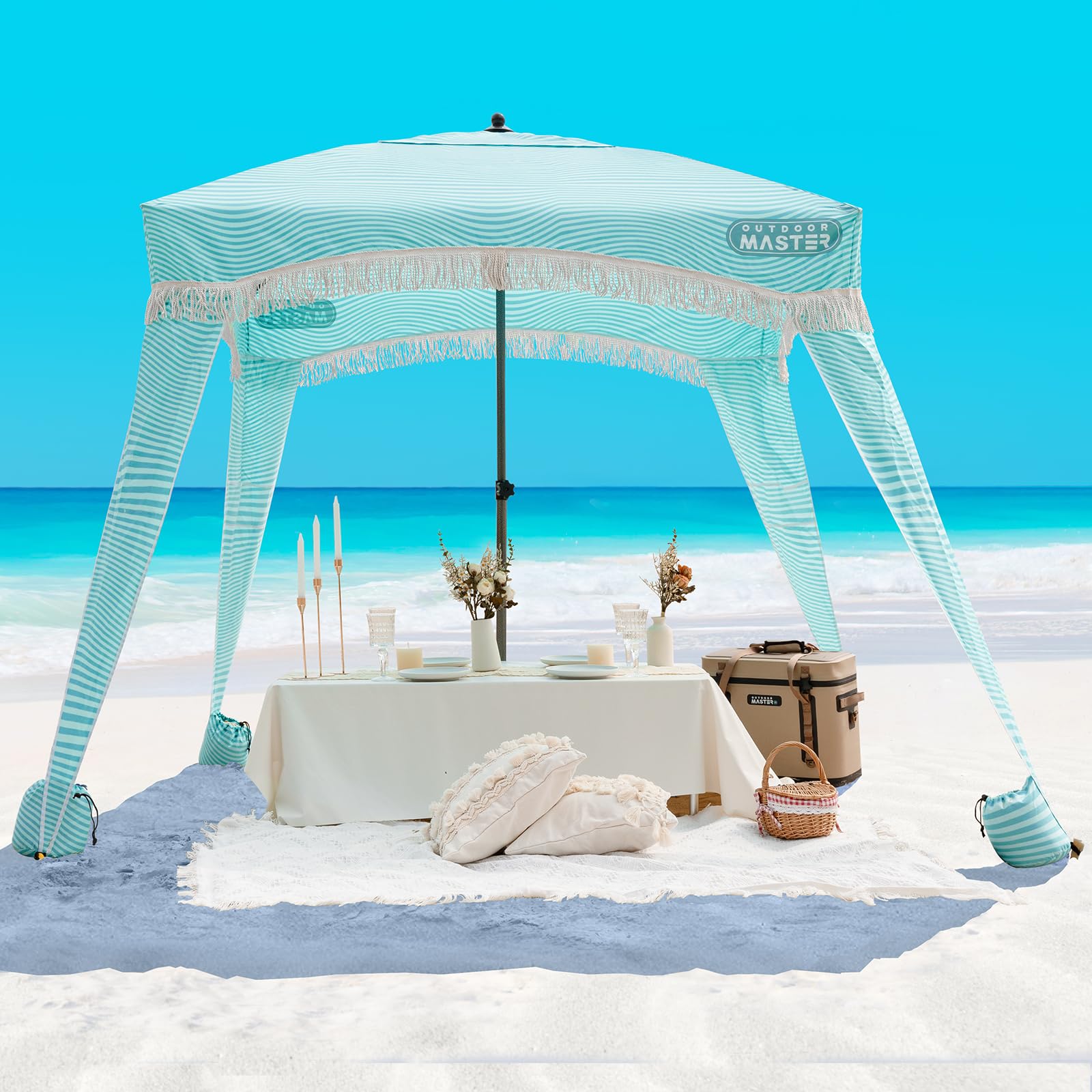
1. OutdoorMaster Beach Cabana with Fringes, 6′ x 6′
Our pick — 4.5+★ from 300+ verified ratings; the strongest balance of quality and price.
A fringed cabana that goes up solo, blocks the angled sun, and still looks like a postcard.
This is the pick for the family that wants a proper little room on the sand rather than a flat patch of shade. The OutdoorMaster is a 6′ x 6′ cabana covering 45 square feet, so two beach chairs and a kid’s chair fit under it, and the fiberglass frame holds a roof that sits above head height. What earns it the top slot is the design: a detachable side wall that clips on to cut angled afternoon sun and give you privacy while you change.
Setup is the reason it is the crowd favorite — 4.5+ stars across 300+ owners, and the ease of raising it is what wins people over most. The frame breaks into two main components, an umbrella and an extension pole, and the four sandbags sit at each corner ready to be filled. As buyers report, it goes up in a few minutes and comes apart just as fast. One owner’s routine is worth copying: “Setup takes 5-8 min if done correctly: lay flat, fill all 8 sand bags, assemble poles one at a time, tighten canopy to remove sag” — that advice belongs to the ADesign below, but the same discipline applies here with four bags instead of eight.
Inside, there are pockets on every corner for sunscreen, phones, and water bottles, plus a roof vent that keeps air moving so the interior does not turn into an oven. Down at the beach it stands through steady wind once the bags are full, and it packs back into its carry bag without a wrestling match. The honest catch is the footprint: 45 square feet is the smallest here and it is snug once you add two chairs and a child’s chair, so a family of four who spread out will want to size up. The 10.4 lb packed weight is the other trade — this is a bag you carry down the boardwalk, not one you forget you packed.
What it gets right
- Detachable side wall adds angled-sun shade and a spot to change with privacy
- Two-piece frame goes up solo in a few minutes and comes down just as fast
- Corner pockets on all four sides keep phones and sunscreen out of the sand
- Roof vent pushes air through so the interior stays cooler than a sealed shelter
- Fringed stripes draw compliments — the fun factor is real on an open beach
What to weigh first
- 45 square feet is the tightest footprint on this list for a family of four
- 10.4 lb packed is heavier than the open canopies here
- A few owners find the spring buttons fiddly and want the parasol to lock harder
Reach for this if: you want a cabana that seals off the side sun, gives you somewhere to change, and still goes up alone.
Think twice if: your group of four claims a lot of sand — the 45 square feet fills fast once chairs are out.
2. ADesign Windproof Beach Tent Sun Shelter with 8 Sandbags
Eight sandbags and a 56-square-foot canopy — the shade that stays put when the beach turns breezy.
Compare this one directly to the OutdoorMaster and the numbers tell the story: the ADesign measures 120″L x 120″W x 78.7″H against the OutdoorMaster’s 72″L x 90″W x 72″H, and its 56 square feet of shade beats the OutdoorMaster’s 45 square feet. That extra room is the difference between a family sitting comfortably and a family doing a chair reshuffle every ten minutes. It is also the taller of the two, which matters when someone over six feet wants to stand up without ducking.
What makes it wind-ready is simple arithmetic: eight sandbags and four guylines, each holding a share of the load. Fill every bag and the canopy behaves, and that is the point where owners stop worrying about it. The setup has a rhythm worth learning — spread it flat, fill the bags, raise the fiberglass poles one at a time, then tighten the canopy so it stops sagging. Miss the last step and the fabric flaps; get it right and the whole thing sits quiet. One owner’s honest estimate: five to eight minutes the first time, faster every trip after.
Weight is where this differs from the heavier family canopies — 4.29 kg (about 9.5 lb) in a bag, light enough for one person to haul while the other carries the cooler. Inside, the airflow is good and the Lycra fabric is water-repellent, which helps with a light drizzle but not real rain. The main trade-off is headroom at the edges: the canopy sits low enough that you bend underneath, and tall adults will feel it. If standing room matters, the Rhino Valley’s 6.5 ft height is the better fit.
Where the money goes: into the anchoring. Eight bags, four lines, and a fiberglass frame that keeps its shape — the setup discipline is the price of a shade that does not take off across the sand.
The everyday reality: a broad canopy that fits six to eight chairs, folds back into a small bag, and tolerates wind better than the single-anchor covers most people own.
Best for big groups: families of five or more who want maximum shade per person and plan to fill every bag.
Look elsewhere if: you need to stand up inside at full height — this canopy is at its lowest around the edges.
3. Venustas Beach Tent Sun Shelter

At 3.5 pounds it goes in a carry-on — a pop-up shelter for two that packs down like a sleeping bag.
If you travel to the beach rather than drive to it, this is the shape you want. The Venustas weighs 3.5 pounds in a compact carry bag, and owners routinely fly with it. It covers 5105.4 square inches with an 86.6″L x 59″W footprint and stands 48 inches tall, which is a genuine two-adult shelter and roomy enough for a small cooler. Three curtains zip shut for privacy, and the zippered windows let you hide valuables out of sight instead of hoping nobody notices your phone.
The selling point here is speed and simplicity. A four-layer coated polyester fabric gives UV protection and heat insulation, the 8mm fiberglass frame holds the shape without rusting, and it folds down like a pop-up rather than a puzzle. Setup runs under five minutes solo once you have done it twice, and folding it away gets easier with every trip. It stands through a breeze surprisingly well for something this light. Stretch it, anchor the stakes, and a steady wind that would roll an umbrella is usually manageable.
Know the limits before you buy. Three-person sizing means exactly that — three adults sitting cross-legged, not three adults reclining in chairs with legroom to spare. A 6’3″ user will have to sit with legs bent, and folding chairs will feel cramped. The included stakes are also the weak link: a few owners bent theirs driving into packed sand and swapped in heavier replacements. Neither is a defect so much as a heads-up — this is a compact travel shelter, not a full family parlor.
Best travel companion: carry-on sized, self-standing, and quick enough to set up on the sand without an audience.
The one caveat: treat the included stakes as a starter set and pack a heavier pair if you plan to hammer into hard sand.
Pick it for: couples and small families who fly to the beach and want shade that fits in a suitcase.
Skip it for: tall adults wanting to stretch out — the 48-inch height and two-adult width keep you seated.
4. Vibemo Beach Tent 10×10 ft with 8 Sandbags

A hundred square feet of shade held by eight bags and four aluminium poles — the full-crew option.
Ten by ten feet is a lot of shade, and this is the pick that turns a crowded beach day into a base camp. The taut Lycra fabric spreads across 100 square feet, the four thickened aluminium poles push it up to 78 inches, and eight upgraded sandbags anchor the corners and sides. Stretch the fabric tight and fill the bags and the whole thing reads as a proper pavilion rather than a pop-up. For a family of six or a group of friends with coolers, chairs, and toys, the open footprint means nobody sits in a huddle.
Where it shines is calm-to-steady days. The Lycra is UPF 50+ and blocks direct sun well, and the all-round openness keeps air moving so it stays tolerable underneath. Setup has a learning curve; once you know the order, it goes up in a few minutes with two people, and one person can manage it. Owners who bury the sandbags a foot deep report the canopy holding through real gusts, and one tells of a 25 mph day at Hilton Head when other canopies packed up and this one stayed up. The poles are not what holds it down — the buried sandbags are.
Now the honest part: stretchy fabric and strong wind are a difficult pair. Some owners find it will not stand up to even a slight breeze if the bags are not buried and the poles are not angled into the wind, and a handful report the canopy needing readjustment after a few hours as the fabric relaxes. The 78-inch height also sounds generous until you are under it — a 5’8″ owner has to duck his head. It is at its best when the forecast is fair and you want maximum shade for the money.
Why families pick it
- 100 square feet seats six or more chairs with gear in between
- Four aluminium poles and eight bags give a stable frame on calm days
- UPF 50+ Lycra blocks direct sun and keeps a breeze moving through
- Packs into a travel bag light enough for a trunk or carry-on
Where it asks for patience
- Stretchy fabric needs re-tightening as it settles, and wind exposure punishes slack anchoring
- 78 inches sounds tall but tall adults still duck at the edges
- The first couple of setups take real learning before the rhythm clicks
The one for a crowd: families and friend groups who want a big shaded base and will take the time to bury the bags properly.
The one to skip: if your beach is routinely gusty, a lower-profile shade with a tighter frame will hold its ground better.
5. Cabana Beach Blue by EasyGo Products

The umbrella you stop carrying once you try a canopy that opens with one hand and weighs next to nothing.
For anyone still wrestling a big beach umbrella, this is the easiest conversion on the list. The EasyGo cabana is a 6′ x 6′ canopy with a fiberglass and aluminium frame, UPF 50+ fabric, and a double-layer wind vent in the roof. It opens the way an umbrella does but gives you a square of shade instead of a moving circle, and the built-in sand pockets at each corner hold it down. The bonus sidewall clips on for angled sun and privacy. Setup takes about a minute, and the canopy stays put while you settle in.
The portability is the real draw. It comes with a carry bag and shoulder strap, packs back down quickly, and is light enough that a child can cart it. No sandbags to fill separately, no poles to thread — just damp sand packed into the built-in pockets for extra weight, which is a small trick worth knowing. Inside, there are pockets for sunscreen and phones, and the top vent keeps the air moving so the shade does not become a sauna. Owners who set it up alone in strong wind call it better than the big umbrella they used to bring, and the shade it throws is enough for four or five adults sitting together.
The catch is on the frame at the wrong moment. If you pack the sand pockets before you raise the canopy, the weight fights the plastic upper arm, and at least one owner cracked a joint that way — the fix is to open the canopy first, then fill. The delivered pole has also arrived damaged in a few cases, so check it from the start. Neither issue makes this a bad cabana; it makes it one to set up in the right order.
Why it is worth a look: a one-piece canopy that goes up like an umbrella, comes with a sidewall and shoulder strap, and fits three chairs without crowding.
The setup trick: raise the canopy before adding sand weight — doing it the other way around is what strains the arm.
Go for it if: you want the footprint of a small cabana with almost no assembly and a sidewall in the box.
Pass if: you need shade for more than four — the 6′ x 6′ footprint is sized for a close group.
6. Rhino Valley 10 x 10 FT Beach Tent

A hundred square feet at 6.5 feet tall — the tent that makes a beach day feel like a rented cabana.
What sets the Rhino Valley apart from the Vibemo is height and frame. Both cover 100 square feet, but this one stands 6.5 feet tall with 4 thickened aluminium poles and 4 windproof ropes working alongside 8 sandbags. That height is the difference between a shade you sit under and a shade you can actually walk into. Ventilation on all sides keeps the air moving, and the Lycra fabric is triple-stitched for tensile strength so it holds its shape without tearing. The vivid sky blue is genuinely distinctive on a crowded beach.
Setup is a few minutes once you know the order — spread it, fill the bags, add the poles, tighten. Two shovels are included for the sand, and one person can manage while a second helps with the poles. Owners keep coming back to burying the bags in holes rather than resting them on the surface, which turns a wide canopy into something a steady wind cannot shift. Cleanup is easy — the sand brushes off and the fabric dries quickly. It packs down into a compact bag that travels in a suitcase or trunk without eating the space.
The honest limit is the wind. With the bags buried and the poles angled into it, this holds through a breeze that leaves umbrella users packing up. But some find a stronger wind beats it when other brands keep standing, and the poles can bend if they are buried in the sand during a gust. If your beach is reliably breezy, treat this as a fair-weather companion with a burly anchor, not a shelter that will face down a gale every time.
What the extra height gives you: a walk-in shelter with 4-person-plus seating, all-round venting, and a bright color that is easy to find on a packed beach.
Where it has limits: strong wind is its weak spot — use the ropes and bury the bags, and pack it down if the gusts build.
Best for beach days with the kids: a tall, roomy shade that gives a family somewhere to gather out of the sun.
Not for exposed coasts: on a beach known for hard wind, a lower canopy with tighter fabric is the safer bet.
7. Kelty Cabana with Adjustable Side Walls

A cabana built like a real tent — you can close it up, change inside, and still see out.
This is the only pick here that behaves like an actual tent, and that changes what it is good for. The Kelty Cabana has front and side window covers that toggle shut for privacy, three large mesh windows for airflow, and a sealed front wall that doubles as a vestibule. The 68D polyester floor and fly are made to take years of beach use, and the frame is three wrapped fiberglass poles that attach to the outside. At 6.4 pounds in a stuff sack that carries like a duffel, it is easy to toss over a shoulder for the walk down.
Quick Corner setup is the other headline. The same corner design used on backpacking shelters means the poles go up fast without a fight, and the Shark Mouth opening on the stuff sack makes packing down far easier than wrestling a canopy back into a bag. First setup takes a bit of figuring; from the second trip on it runs in about five minutes. The interior fits two to three adults, and there is room for a floor-level family setup — the sort of shade you can put a toddler down for a nap in with the walls closed and the mesh open.
Where the Kelty asks for care is the window covers. They hook in loosely rather than zipping, so they can flap in a stiff wind and take a moment to line up. The fabric also handles moderate rain but is not waterproof, so a downpour will find its way in. Neither undermines what this is for — a private, weather-tolerant beach shelter for a small family — but if you want seal-it-and-forget-it walls, the closure system on a fully zippered cabana is the more reassuring design.
What you get: a genuine tent structure with closable walls, mesh ventilation, a floor, and a stuff sack that packs down like a duffel.
The honest trade: the window covers hook rather than zip, so they take fiddling to seat and can lift at the edges in strong wind.
Pick it when privacy matters: changing, a nap, a toddler’s meltdown — the Kelty closes up and gives you a room.
Choose lighter and cheaper if: you only need open shade and a place to sit, not walls that shut.
Know the Specs
Sandbags and guyline anchoring
A sandbag is a fabric pocket at the corner or foot of the canopy that you fill with sand to weigh the shelter down. The number matters because each bag carries only so much. Four bags anchor a small cabana; eight bags spread across a canopy hold far more steady and are what keep a big 100-square-foot shelter from rolling in a breeze. Burying the bag a few inches under the surface also resists wind much better than leaving it on top. Guylines — the ropes that run from the canopy to an anchor point — add a second line of hold on the larger shades.
UPF 50+ and why you still need sunscreen
UPF is the sun-protection rating for fabric, the clothing equivalent of the SPF number you see on lotion. UPF 50+ means the material blocks the vast majority of direct UV light from passing through. It does not mean the sand around you, the light bouncing off the water, or the gap at the edge of your shade are safe, and stretchy thin fabrics can let a little light through when taut. Combine shade with sunscreen, and add a side wall or curtain to block the low afternoon sun coming in sideways.
Floor area and how many people fit
Floor area is the shaded footprint measured in square feet, and it is the most honest way to compare canopies of different shapes. A 45-square-foot cabana holds two chairs and a child’s chair; a 56-square-foot shade gives a family of four or five room to spread; a 100-square-foot canopy seats six or more with coolers and toys. Bigger is more comfortable but catches more wind, so size the footprint to your group and your typical beach.
Frame material and packed weight
Fiberglass poles flex under wind rather than snapping and do not rust, which makes them a common choice for beach frames. Aluminium poles are lighter and firmer but can bend if they are buried in sand during a gust. Weight decides how easily the whole thing travels — a 3.5-pound shelter goes in a carry-on, an 8.7-pound canopy goes in the trunk. If you walk to the beach rather than drive, weight matters more than a few extra square feet.
Common Questions
How many sandbags do I need for a beach shade on a windy day?
Will a 10 x 10 ft beach shade fit my family of four?
What is the difference between an open beach canopy and a cabana with side walls?
Does UPF 50+ shade mean I can skip sunscreen?
Can I set up a beach shade alone, or do I need two people?
How do I stop my beach canopy from flapping or sagging?
Are beach shade tents waterproof or just water-repellent?
How much does a portable beach shade weigh when packed?
Can I use a beach shade in my backyard or at a campsite?
How do I pack a beach canopy back into its carry bag?
The Bottom Line
The pick that suits most beach days here is the OutdoorMaster Beach Cabana, because it gives you a private side wall, corner pockets for your valuables, and a two-piece frame you can raise alone. If your group is bigger and the wind is a factor, the ADesign Windproof Beach Tent spreads 56 square feet across eight sandbags and holds its ground when the beach turns breezy.
For a family that wants shade you can walk into and a height that keeps everyone comfortable, the Rhino Valley 10 x 10 FT Beach Tent is the one to reach for. And if privacy for changing or a toddler’s nap is the deciding factor, the Kelty Cabana closes up like a real tent. Match the shelter to your group size and the wind you expect, and the rest of the day takes care of itself.
How we choose
We do not accept paid placement. Every pick is matched to a real buyer and a real use-case; we do not hands-on test units.
Sources
Specifications: manufacturer listings and product documentation. Review insights: verified customer reviews, as of October 2026. Pricing: not shown on this page (it changes often); check the current price via the retailer link.
As an Amazon Associate, Aappliancez earns from qualifying purchases. This does not affect which products we feature.