Disclosure: Some links in this post are affiliate links. As an Amazon Associate I earn from qualifying purchases, at no extra cost to you. Learn more
Specs are compiled from manufacturer listings and verified buyer reviews and can change over time — please confirm the key details on the product page before buying.
You want a pool you can actually swim in, not a leaf trap you have to babysit every weekend. The honest answer up front: the Hayward SharkVac is the pick most inground owners should start with, because it runs a full cleaning pattern in 3 hours without hoses or hookups — and it holds the strongest track record in this group. Below is what really separates these robots, from battery runtime and suction flow to the wall-climbing quirks that decide whether a cleaner earns its keep.
This guide is built by comparing the manufacturers’ published specifications and the patterns across verified customer reviews, so you get each pick’s real strengths and trade-offs instead of marketing spin.
Corded robots run until your timer stops them; cordless ones stop when the battery runs down. Then match runtime and suction flow to your pool’s length and debris load. That is how you land on the right pool sweeps.
Top Picks


How To Choose The Best Pool Sweeps
The single biggest decision is corded versus cordless power. A corded robot cleans as long as you leave it in the water. A cordless one gives you freedom from tangled lines but finishes when its battery runs down — often 90 minutes to a few hours. Pick the power source that fits how long your pool takes to clean.
Corded versus cordless, and what runtime really means
A corded sweep draws continuous power, so its cleaning cycle is limited only by the timer you set. The Dolphin Liberty 200, by contrast, runs on a lithium-ion battery rated for 90 minutes of cleaning before it self-parks at the nearest wall. If your pool is long or heavily leafed, a longer runtime matters more than a shorter charge time. Check the cycle length against your pool’s size before you commit to cordless.
Suction flow and filter rating decide what gets trapped
Suction flow, measured in GPH (gallons per hour), tells you how much water the sweep pushes through its filter. The Aiper Scuba V3 Ultra rates its dual pumps at 8,500 GPH, while the iGarden K Pro lists 6604 GPH. Filter rating, measured in microns (µm — one millionth of a meter), tells you how fine a particle it catches. A 3µm micro-mesh traps cloudy algae particles that a coarser basket lets drift back into the water. Match the micron rating to what bothers you most: sand and silt need a finer mesh than leaves do.
Wall climbing, ledges, and the drains that stop robots
Every robot here claims to climb walls, but real pools throw obstacles at them. Non-flat main drains, shallow sun shelves, and floor-to-wall curves are where climbs fail. Owners of the Hayward SharkVac report the unit getting stuck on drains, which is why some pull the cord shorter to keep it off them. If your pool has a tanning ledge or steep slope, look for depth and obstacle sensors rather than relying on the climb claim alone.
Side-by-Side Comparison
| Model | Best For | Power | Cycle / Runtime | Debris Capacity | Amazon |
|---|---|---|---|---|---|
| Hayward SharkVac★ Best Overall | Most inground pools | Corded | 3-hour cycle | 2 filter elements | Amazon |
| Polaris 9450 SportMost Feature-Packed | Big pools up to 50 ft | Corded, 60 ft cable | 1.5-hour cycle | 5 L canister | Amazon |
| Dolphin Liberty 200Best Cordless Value | Cord-free simplicity | Cordless, lithium-ion | 90-min runtime | Large basket | Amazon |
| iGarden K Pro | Long battery sessions | Cordless, lithium-ion | 12 h floor / 7 h full | 4 L basket | Amazon |
| Polaris Freedom | App control, cordless | Cordless, 18V | 2.5-hour cycle | 4 L canister | Amazon |
| Hayward TigerShark QC | Quick touch-button cleans | Corded, 24V motor | 90-min / 4-hour cycles | Cartridge filter | Amazon |
| BUBLUE Bubot 800P Gen2 | App scheduling, tight budget | Corded, 28V | Under 2 hours | Dual 3 L baskets | Amazon |
| Aiper Scuba V3 Ultra | Full coverage plus skimming | Cordless, lithium-ion | Avg 4h43m per run | Multi-layer 3µm | Amazon |
Detailed Reviews
1. Hayward SharkVac Robotic Pool Vacuum
Our pick — 4.0+★ from 200+ verified ratings; the strongest balance of quality and price.
The workhorse that scrubs floor, coves, walls, and waterline in one 3-hour pass.
Three hours is the whole story here. The SharkVac runs a smart steering pattern across the floor, coves, walls, and waterline in a single 3-hour cycle, so you drop it in and walk away. It needs no hoses, no hookups, and no extra pump — it runs separately from your pool’s filtration system, which means less backwashing and less water wasted. At 44 pounds it is a solid unit, but the top-access filter means you pull the basket from the top and rinse it with a garden hose rather than tipping the whole cleaner over. Two fine-porosity filter elements come with it.
What wins people over is how little fuss it takes to operate. The out-of-water sensor protects the motor when the unit leaves the pool, and the beach-entry sensor reverses the robot when it starts climbing out. Owners describe it as a life-changer for getting their weekends back, and one long-term user reports it lasting 10 years with near-daily use. The honest catch is wall climbing — numerous buyers report the SharkVac failing to scale walls and getting stuck on main drains. Some shorten the 55-foot cord so the robot can’t reach the drains at all. It is also 24.6″L x 17.7″W x 29.9″H, noticeably more upright than the low-slung BUBLUE Bubot 800P Gen2 at 19.6″L x 18.3″W x 9″H.
What earns the top spot
- Full 3-hour pattern covers floor, coves, walls, and waterline without hoses or hookups
- Top-access filter rinses clean with a hose — no flipping the 44-pound body over
- Out-of-water and beach-entry sensors protect the motor as it climbs
Where owners hit friction
- Wall climbing is the weak point — expect it to stall on drains and some walls
- Durability reports split between lasting seasons and needing a gasket fix
- Filter elements are the part to watch; a worn foam gasket lets debris bypass the basket
Best fit: Inground owners who want a set-and-walk-away clean of the floor and coves and don’t need perfect wall scaling.
Think twice if: Your pool has raised main drains the robot can snag on, or you need top-to-waterline climbing every cycle.
2. Polaris 9450 Sport Robotic Pool Cleaner
A 1.5-hour cycle and a huge debris canister for pools up to 50 feet.
If your pool is long, the 9450 Sport is built for it. It handles inground pools up to 50 feet and finishes a full clean in as little as 1.5 hours — quicker than the Hayward SharkVac’s 3-hour cycle. Four-wheel drive pushes it around the floor, walls, and tile line, and the 60-foot cable uses a swivel to cut down on tangling. A premium caddy is included, which makes hauling it to and from the deck a lot easier.
The Vortex vacuum technology keeps debris suspended in the water column so suction stays strong through the run. Owners rave about exactly that — picking up leaves, silt, and small items, and scrubbing the waterline tile. One described it keeping a 30,000-gallon pool clear while cutting chemical use and backwash frequency in half. The lift feature gets repeated praise too, since it lets you raise the unit to empty the basket without heavy lifting. As owners mention, “Suction seems to be very strong compared to my old Aquabot.”
Here’s the trade-off you need to weigh. The motor block is the failure point — several owners describe it giving out around the 3.5-season mark, and a replacement motor block runs expensive enough that many buy a whole new unit instead. The 1-year warranty is short for a machine at this level. It also requires frequent emptying when the pool is dirty. Treat it as a strong performer with a service life you should plan around, not a lifetime purchase.
The 4WD payoff: Four-wheel drive plus the 5L canister means fewer trips to empty and better traction on the floor.
The honest math: Fast cleaning and strong suction, but the motor block’s lifespan is the number to read before you commit.
Worth it if: You have a pool up to 50 feet and want the fastest full clean in this group with a canister that goes longer between empties.
Pass if: You want a long warranty — the 1-year coverage is short for a cleaner at this tier.
3. Dolphin Liberty 200 Cordless Robotic Pool Vacuum Cleaner
No cord to untangle, 90 minutes of cleaning, and it parks itself when done.
Cutting the cord means no cable to untangle and a robot that self-parks when the cycle ends. The Liberty 200 runs on a lithium-ion battery rated for 90 minutes of cleaning, and when the cycle ends or the battery drops, the robot self-parks at the nearest wall so you can fish it out without hunting. Charging is inductive — a magnetic connection that snaps on for walk-away charging, with no exposed contacts to corrode. Three LED indicator lights show battery health at a glance. It handles above-ground and in-ground pools up to 33 feet in length, and the active scrubbing brush works the floor and walls while staying gentle on the surface.
The design suits people who want a lightweight helper rather than a heavyweight machine. The whole cleaner weighs 8.1 kg, and it climbs walls to scrub the floor-to-wall line. Owners note how easy it is to clean the filter and how much debris the large basket scoops up in one go. The cordless freedom gets repeated appreciation, and one buyer summed up the realistic expectation: “It won’t replace your pool guy but helps when needed.”
The caveat is battery life over time and, for some, an early defect. Charging takes 90 minutes, but customers note the pack not holding a charge as well over seasons, and a USB-style defect where one unit stopped charging after a week is the kind of gamble you take with any battery machine — reach for it knowing the warranty process is your safety net. It also flips on very shallow shelves, roughly a 1-foot sun shelf, and struggles with fine sand unless you fit a finer filter.
Go cordless here: Pool owners up to 33 feet who want a lightweight, self-parking robot and hate untangling cables.
Stay corded if: Your pool is heavily leafed and needs more than 90 minutes of cleaning per charge.
4. iGarden K Pro Cordless Robotic Pool Cleaner
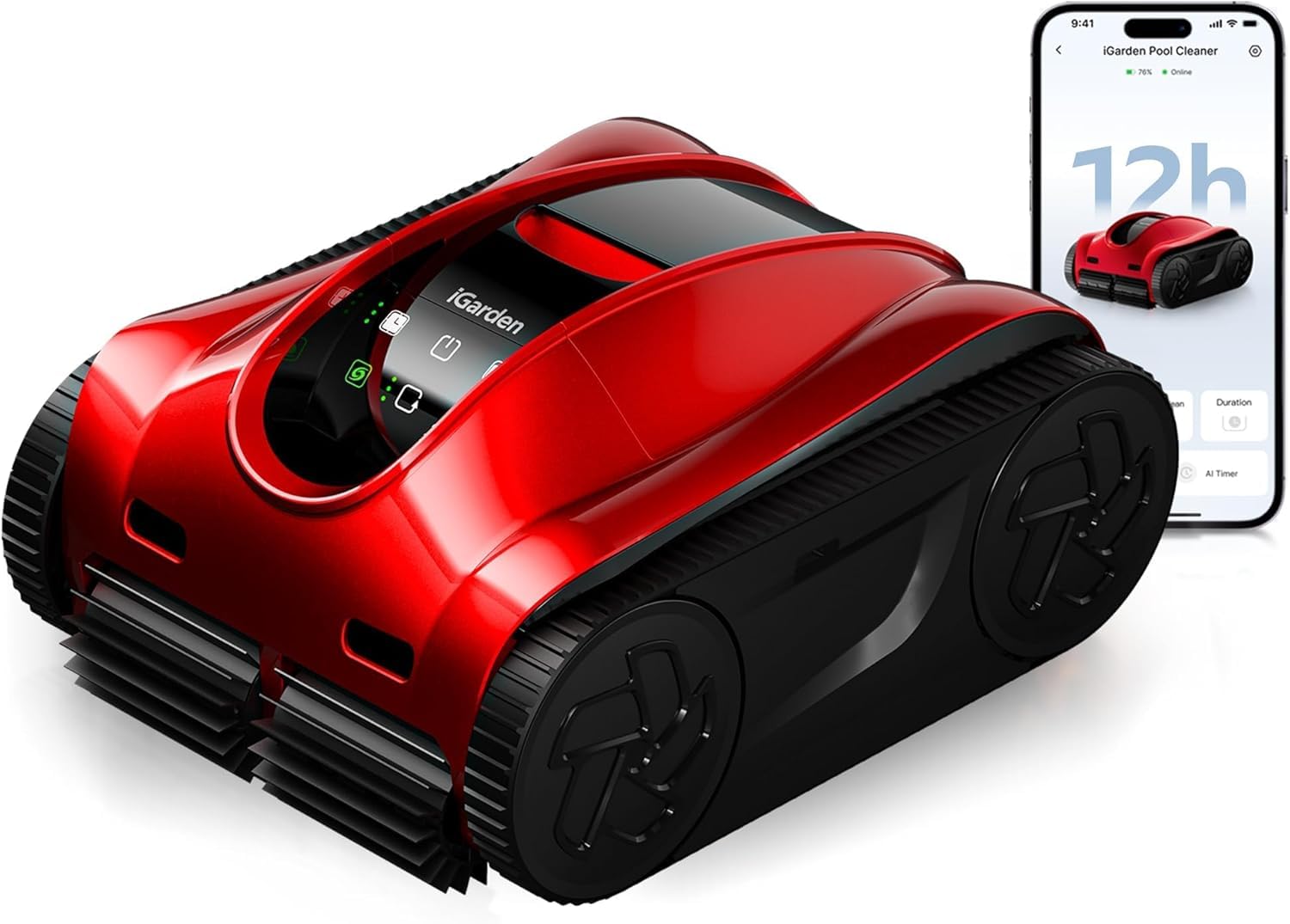
Twelve hours of floor cleaning on one charge — the longest runtime here by far.
The runtime is what sets the K Pro apart: up to 12 hours of floor cleaning on one charge. The K Pro’s battery delivers up to 12 hours of continuous floor cleaning, or 7 hours of full-pool deep cleaning, and its maker claims up to 18 days of spotless water on a single charge. Compare that to the Dolphin Liberty 200’s 90 minutes and the difference is a full workweek of cleaning between plug-ins. Suction comes from a triple-motor system and turbine impeller rated at 6604 GPH, with a Turbo Mode that doubles suction to blast leaves, sand, and hair. The 4-liter basket is described as 30% larger than its predecessor, and it runs two filters — a 180µm primary for leaves and gravel and a 50µm micro-mesh for algae and fine particles.
Control is unusual for this category. A built-in touchscreen lets you switch modes and set an AI timer right on the unit, and the app pairs over 2.4GHz Wi-Fi or Bluetooth for scheduling before the robot hits the water. Three-axis “S-Path” navigation maps the pool for coverage, and OTA updates mean the cleaning algorithm can improve over time. Owners praise the customer service in particular — one noted an initial unit failed after a month and support sent an upgraded replacement immediately. Another put it simply: “The pool has never looked better.” For sand and hair, owners say it cleans fast, sometimes under 2 hours.
The catch is slope handling and app range. On a steep floor-to-wall slope some units go airborne descending the drop-off, and the app only connects when the robot is out of the water, which limits its usefulness during a run. At 24.3 pounds it is heavier than the Liberty 200, and the 3-year warranty is the longest in this group — note if reliability worries you.
Runtime champ: 12 hours of floor cleaning per charge beats every cordless pick here, and the 3-year full replacement warranty is the longest in the group.
Fit note: Steep slopes can send it airborne, so steep-walled pools need a closer look before you buy.
Best for: Large pools and busy households that would rather charge once every couple of weeks than babysit a short-runtime robot.
Not for: Pools with steep drop-offs where the robot risks leaving the wall.
5. Polaris Freedom Cordless Robotic Pool Cleaner

A cordless Polaris that finishes a pool in 2.5 hours and texts you when it’s done.
This is the cordless Polaris built around app control and easy retrieval. FREEDOM cleans a pool in 2.5 hours or less, then climbs to the waterline so you can lift it out without hauling a submerged robot. The included Easy-Charge Station tops it up in 4 hours, and the WiFi iAquaLink app shows charging status, lets you pick cleaning modes, and pushes a notification when the cycle ends. You get four modes: floor-only, floor-plus-walls-plus-waterline, waterline-only, and a SMART Cycle that works out the right cleaning time for your pool. It handles inground pools up to 50 feet.
The fine filtration is the part owners love. It captures sand and micro particles that coarser baskets leave behind, and cordless operation feels far less of a hassle than a wired model. One reviewer noted it “works extremely well much better than I even could’ve imagined,” and another called it the best Polaris in 17 years of pool ownership. Quiet 2.5-hour cycles and easy filter removal round out a routine that fits a working week.
Two things temper the enthusiasm. First, the battery is a wear item at 18 volts — owners describe it dying after 2.5 years, and its replacement approaches the cost of a whole new unit. Second, the app is “useless underwater” because WiFi can’t transmit through the water, which owners point out is simply physics rather than a fault. Wall climbing is serviceable but scrub power on algae is weaker than you’d expect at this level.
Pick this one if: You want a cordless Polaris with app scheduling, fine filtration for sand, and a robot that surfaces for easy retrieval.
Look past it if: You plan to keep the robot long-term and don’t want to budget for a battery replacement down the road.
6. Hayward TigerShark QC Robotic Pool Cleaner

Ninety minutes for a quick pass, four hours for a deep clean, and one red button.
The TigerShark QC keeps operation dead simple. Drop it in, press the red button, and choose either the 90-minute Quick Clean or the 4-hour full cycle. An on-board pump pulls dirt and leaves off the floor of pools up to 20 x 40 feet, and the 24-volt motor is designed to keep energy use down. It runs independently of your pool’s filtration system, so it needs no extra hoses or pumps. Emptying is a cartridge you pull out and rinse with a hose. At 21.5 pounds it is the lightest of the Hayward picks here.
This is the cleaner long-time Hayward owners keep buying. One describes a unit lasting 10 years and the new model being nearly identical, keeping the pool clear with less chemical use at 7-to-10-day intervals. Another reports using it daily across two seasons, handling a post-construction cleanup and a winter opening, and surviving catching a hose without damage. The simple drop-in-and-press routine is the appeal — no remote, no programming, no app.
Where it falls short is corner coverage and filter upkeep. Owners note that corners need a brush sweep afterward, and filter cleaning takes real effort, with one set used per season. The 1-year warranty is short, and reliability reports are genuinely mixed — most units run for years, but a few arrive not cleaning properly from the start. It is the pick for someone who wants dependable basic cleaning and will trade corner precision and app features for a touch-button machine.
Why it keeps its fans
- 90-minute Quick Clean and 4-hour full cycle, chosen with one red button
- 21.5-pound body is the lightest Hayward here — easy to lift in and out
- Cartridge filter rinses with a hose; no app, no programming required
What to expect honestly
- Corners need a manual brush sweep afterward
- Mixed reliability reports — a small share arrive not cleaning properly
- Short 1-year warranty and filter cleaning that takes effort
Reach for this if: You value a simple one-button routine and a light, no-app cleaner for a pool up to 20 x 40 feet.
skip it if: You need corner-to-corner precision or the long warranty you get on the iGarden pick.
7. BUBLUE Bubot 800P Gen2 Robotic Pool Cleaner
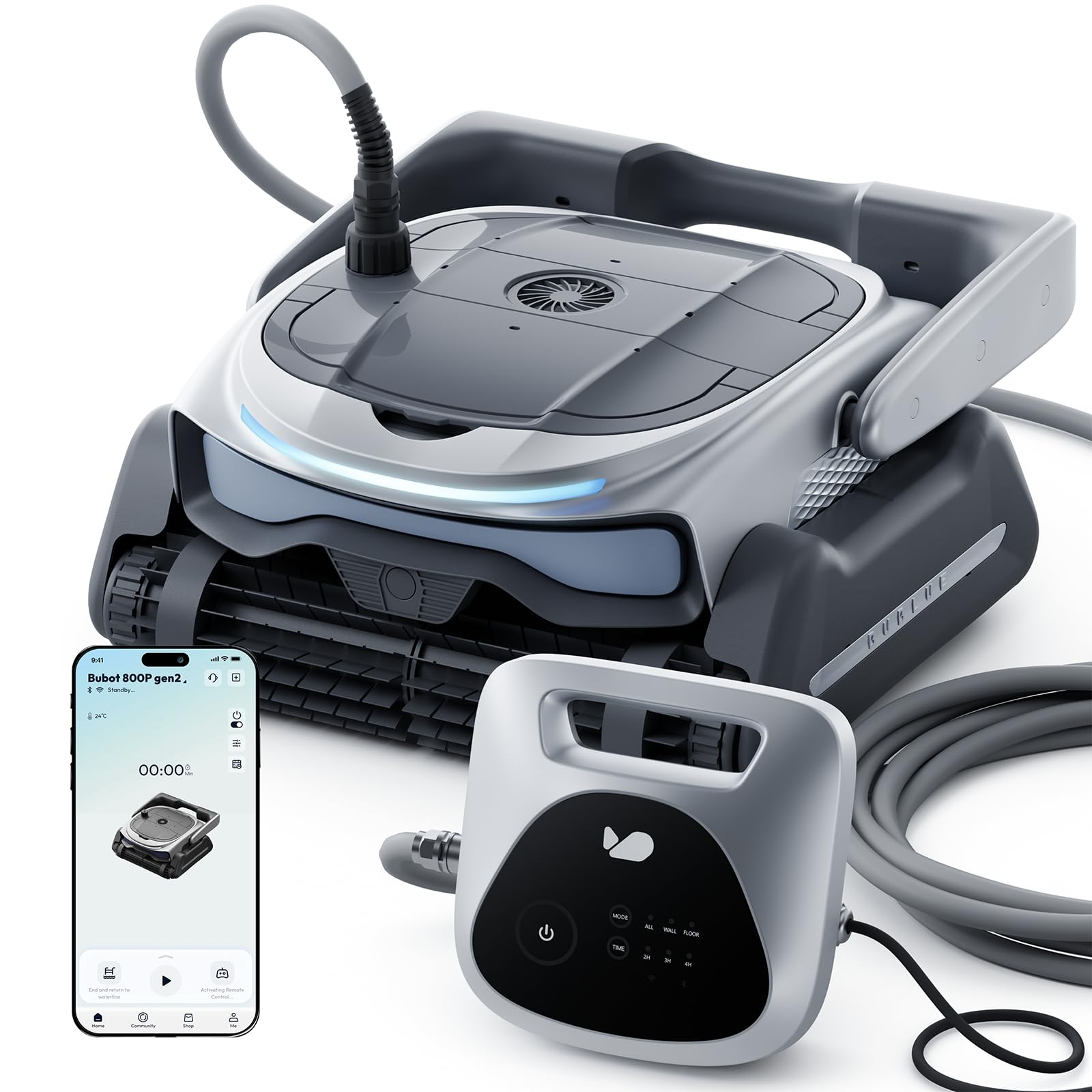
An app-controlled robot with dual filter baskets — at the lowest price in the group.
This is the entry point into app-controlled robotic cleaning. The Bubot 800P Gen2 pairs over Bluetooth or WiFi so you can schedule cleanings, check status, and switch modes from your phone, and it includes a Remote Control Car mode that lets you steer it for spot cleaning. Three cleaning modes cover Floor Only, Wall Only, and Auto. Four roller brushes and tank-style tracks climb walls and scrub the waterline. Suction comes from a 150-watt three-axis motor with dual suction ports, and two 3-liter filter baskets catch sand, hair, and dirt. It is rated for pools up to 1,076 square feet, and its footprint is a low 19.6″L x 18.3″W x 9″H — much less upright than the Hayward SharkVac’s 24.6″L x 17.7″W x 29.9″H.
Power runs continuously over a 28-volt cord, so there is no battery to wear down, and TangleEase technology works to keep the cord from knotting. Owners who get a good unit report a 14×30 pool cleaned in under two hours, and the app shows water temperature and lets you stop a cycle or set schedules. Setup is simple, and support has sent replacement units when a pump failed. One noted the cleaner does a “good job on walls and bottom.”
Cleaning performance is genuinely mixed — some robots clean beautifully and some miss fine dirt and one curved floor-wall area entirely. Stability is the recurring gripe: units pop wheelies and can stop with an error before completing a cycle, and the baskets can fall out. A few report a cord failure early on with a wait for replacement. The 2-year warranty offers some cover, but this is the pick for a smaller pool and a budget where you’re willing to accept that kind of variance.
Good entry point: Small-pool owners up to 1,076 sq ft who want app scheduling and wall climbing at the lowest outlay here.
Look elsewhere if: You want predictable cleaning of fine dirt — performance is the most-split topic on this model.
8. Aiper Scuba V3 Ultra Robotic Pool Cleaner

The only sweep here that skims the surface and scrubs the floor — with AI to plan the route.
This is the most ambitious cleaner in the group, and its coverage is why. Dual cameras and ultrasonic sensors detect 20+ debris types and map a path in real time, and the JellyFloat buoyancy engine lets it handle floors, walls, waterline, surface, and shallow areas down to 7.9 inches. That surface skimming is what none of the others do — a separate job you’d normally assign to a different tool. Suction comes from dual pumps rated at 8,500 GPH, the highest flow figure in this roundup, pulling through an enlarged 1.1-inch debris inlet. Filtration runs in layers: a 180µm mesh for big debris and a 3µm MicroMesh for fine particles, with ten adaptive cleaning paths to suit different pool shapes.
When it works, owners say it cleans all of the pool — including deep-end corners other cleaners miss — with minimal intervention. The cordless design, wireless charging, and automatic surface retrieval mean it rises to the top when done so you lift it without a hook. Over six runs an owner measured an average of 4 hours 43 minutes of battery, and the app lets you set cleaning presets and custom settings. Reviewers point out: “Picks up bigger debris wonderfully” in a second year of use.
Two real catches. First, at 28 pounds — and roughly 33 pounds dry by one owner’s measurement — it is the heaviest cordless pick here, and hauling it out takes effort. Second, reliability is genuinely mixed. A few units arrive defective, some report a battery overheating loop, and the top-water skimming floats without much aim. The required micro-fine filter cover is also a consumable, so check that replacements are available before you rely on it for a season. The 262.08 watt-hour battery and 4-plus-hour runtimes make this a serious machine with a matching service consideration.
The premium case: 8,500 GPH dual pumps and full surface-to-floor coverage in one robot, with automatic retrieval so you don’t fish it out.
The real caveat: It is heavy to lift out, and a consumable filter cover is required — confirm replacements are stocked.
For the full-coverage buyer: Large pools where surface skimming plus floor and wall cleaning in one cordless machine is worth the extra heft.
Reconsider if: Easy lifting matters more than skimming, or you want a robot with zero consumable parts to track.
Know the Specs
Suction flow in GPH
GPH stands for gallons per hour — how much water the robot pushes through its filter in an hour. A higher number often means it can pull heavier debris off the floor faster. The Aiper Scuba V3 Ultra rates at 8,500 GPH with dual pumps, while the iGarden K Pro lists 6604 GPH. In practice, flow matters most when your pool collects leaves and sand, because a stronger stream keeps debris moving toward the basket instead of settling back down.
Battery runtime versus corded power
A cordless robot runs on a rechargeable battery, so its cleaning window is limited by the charge — the Dolphin Liberty 200 gives 90 minutes, while the iGarden K Pro stretches to 12 hours of floor cleaning. A corded robot draws continuous power and cleans until the timer ends. Choose cordless for freedom from tangled lines and corded for longer or heavier sessions. Whichever you pick, check the runtime against how long your pool actually takes to clean.
Filter micron rating
A micron is one millionth of a meter, and the rating tells you the smallest particle a filter catches. A 3µm MicroMesh on the Aiper traps cloudy algae and fine silt; the iGarden runs a 180µm primary for leaves plus a 50µm micro-mesh for smaller particles. Finer filtration means clearer water but more frequent rinsing. If sand and algae are your problem, look for a low micron number; if you mostly fight leaves, a coarser basket that empties quickly can be easier to live with.
Debris capacity and basket access
Capacity, listed in liters, tells you how much debris the basket holds before you empty it. The Polaris 9450 Sport’s 5-liter canister and the iGarden’s 4-liter basket go longer between cleanouts than smaller models. Access matters just as much — a top-access filter you lift out and rinse, like the Hayward SharkVac’s, saves you tipping a heavy body over. Match capacity and access to how often your pool fills up with leaves.
Common Questions
Will a robotic pool sweep work on my above-ground pool?
How long does a cordless pool sweep actually run on one charge?
Do these sweepers climb walls or only clean the floor?
What does the micron rating on a pool sweep filter mean?
Is a cordless pool sweep better than a corded one?
How often do I need to empty the debris basket?
Will a pool sweep scrub algae off the walls?
Can the app control the sweep while it is underwater?
How long should a robotic pool cleaner last?
The Bottom Line
For most inground pools, the pool sweeps winner is the Hayward SharkVac, because it covers floor, coves, walls, and waterline in a single 3-hour cycle with a top-access filter you rinse in seconds. If long runtime and the longest warranty matter most, the iGarden K Pro delivers 12 hours of floor cleaning on a charge and a 3-year full replacement warranty. And if you want a robot that skims the surface on top of scrubbing the floor, the Aiper Scuba V3 Ultra is the one to reach for. The practical nudge: decide corded or cordless first, then match runtime and suction to your pool’s size.
How we choose
We do not accept paid placement. Every pick is matched to a real buyer and a real use-case; we do not hands-on test units.
Sources
Specifications: manufacturer listings and product documentation. Review insights: verified customer reviews, as of October 2026. Pricing: not shown on this page (it changes often); check the current price via the retailer link.
As an Amazon Associate, Aappliancez earns from qualifying purchases. This does not affect which products we feature.