Disclosure: Some links in this post are affiliate links. As an Amazon Associate I earn from qualifying purchases, at no extra cost to you. Learn more
Specs are compiled from manufacturer listings and verified buyer reviews and can change over time — please confirm the key details on the product page before buying.
You want a finish that protects the wood and still looks like wood. The short answer: a wipe-on polyurethane beats a brush-on can for anyone nervous about drips, streaks and brush marks, and the Minwax Oil-Based Wipe-On in Satin is the safest first buy for most interior projects. It’s dry to recoat in 2-3 hours, goes on with a rag instead of a brush, and builds a hand-rubbed satin look rather than a thick plastic shell. Below you get five real options sorted by what they are actually good at — interior furniture, intricate trim, outdoor pieces, and full floors.
This guide is built by comparing the manufacturers’ published specifications and the patterns across verified customer reviews, so you get each pick’s real strengths and trade-offs instead of marketing spin.
You can avoid sanding off a bad finish by checking three things before you buy: how thick the liquid is, how long it takes to dry, and whether you apply it by wiping or brushing. This guide to the best polyurethane explains each in plain terms so you pick the right can.
Top Picks


How To Choose The Best Polyurethane
The single most common mistake is buying a brush-on can for a project with corners, spindles or carved detail. Thick liquid drags on a brush, pools in tight spots, and leaves the marks you were trying to avoid. Wipe-on formulas are thinner on purpose so a cloth can lay them down evenly.
Wipe-On Versus Brush-On
A wipe-on polyurethane is applied with a clean cloth instead of a brush. You get thinner coats and almost no runs, and the finish reads as hand-rubbed rather than lacquered. The trade-off is honest: thin coats mean you need more of them. Expect several passes where a brush-on can might need two or three.
Match The Sheen To The Piece
Satin knocks down glare and hides small imperfections in the wood, which suits furniture, shelves and butcher block. Gloss throws light back and makes grain pop, which is why it lands on floors, tabletops and pieces you want to look polished. Neither is more durable — sheen is a look, not a strength rating.
Check The Recoat Window Before You Start
The recoat time is the wait before your next layer, and it sets your whole schedule. A can that lets you recoat after a few hours means several coats in one day. One that needs a full day between passes turns a weekend project into a week of evenings. Read that number first if time matters to you.
Indoor And Outdoor Formulas Are Not Interchangeable
A spar urethane is built for exterior wood: it flexes with weather swings and blocks UV light that greys timber. An interior polyurethane is tuned for furniture, cabinets and floors. Putting an interior can on a deck or railing is the wrong tool, and the sun will tell you so within a season.
Side-by-Side Comparison
| Model | Best For | Finish | Coverage | Recoat Time | Amazon |
|---|---|---|---|---|---|
| Minwax Oil-Based Wipe-On Polyurethane, 1 Quart, Satin★ Best Overall | First-time wipe-on users | Satin | — | 2–3 hours | Amazon |
| Watco Gloss Wipe-On Polyurethane FinishBest Value | Intricate and carved wood | Gloss | 100 sq ft | — | Amazon |
| General Finishes Arm-R-Seal Oil Based Topcoat, 1 Pint, Satin | High-use furniture tops | Satin | — | — | Amazon |
| Varathane Outdoor Spar Satin Urethane | Outdoor furniture and railings | Satin | 190 sq ft | 8 hours | Amazon |
| Minwax Fast Drying Polyurethane Clear Gloss 1 Gallon | Floors and large surfaces | Gloss | 600 sq. ft. | 4–6 hours | Amazon |
Detailed Reviews
1. Minwax Oil-Based Wipe-On Polyurethane, 1 Quart, Satin
Our pick — 4.5+★ from 600+ verified ratings; the strongest balance of quality and price.
The rag-and-liquid combo that removes the fear of drips from a first finish job.
Here is the number that sets your day: this Minwax wipe-on is dry to recoat in only 2-3 hours and ready for light use in 24 hours. That means you can lay down several coats in a single afternoon instead of waiting a day between each one. The 32 fluid ounces covers a full quart’s worth of interior furniture, shelves, trim and cabinets.
Because you apply it with a clean cloth, there are no brush marks to sand out and no drips running down a leg. The quart delivers a satin sheen that gives wood a warm, hand-rubbed look rather than a thick plastic shell. It is rated to protect against water, household chemicals, food stains and everyday wear, which is exactly the list you care about on a kitchen table or a coffee table.
The catch that comes up again and again is coat count. Thin coats are the whole point of a wipe-on, so a piece that would take three brush-on passes can want considerably more wipe-on layers before the grain looks fully sealed. The satin look is worth the extra passes, but budget for five or six coats. And as owners put it: “The wipe on polyurethane works well and dries within a few hours. Be sure to apply five to six coats and lightly sand between coats.”
What earns it the top slot
- Dry to recoat in 2-3 hours, so multiple coats fit in one day.
- Cloth application means no brush marks and far fewer runs.
- Satin sheen keeps wood looking like wood, not a plastic shell.
- 32 fluid ounces goes a long way across furniture and trim.
Where it asks more of you
- Thin coats stack up — you will apply more passes than with a brush-on can.
- Interior use only; it is not built for sun and weather.
- You need a steady supply of clean, lint-free cloths.
Reach for this if: you are finishing interior furniture, cabinets or shelves and want an even, mark-free result on your first try.
Think twice if: you want a two-coat job finished in an hour — the thin layers trade speed for a smoother look.
2. Watco Gloss Wipe-On Polyurethane Finish
Built for the corners no brush can reach — if you thin it first.
This Watco is the pick for elaborately detailed pieces: carved legs, turned spindles, routed trim, and the crevices a brush simply cannot follow. One quart covers up to 100 sq ft, dries to the touch in as little as 2 hours, and applies by hand with a clear dry rag for full control. It is oil-based, so it gives the same protection as a traditional polyurethane finish while going on far thinner.
What wins people over is the look and the reach — the finish soaks in deep, hides small flaws, and leaves a clear gloss that suits old rods, stained wood and detailed furniture. The gloss is genuinely glossy, so treat it as a look you are choosing on purpose.
The real caveat is consistency out of the can. It is thick, and thick liquid drags on a cloth, especially on big flat surfaces. Thin it roughly a third with mineral spirits and it flows properly — and if you have used it straight, you already know the drill: “Definitely thin this stuff down before using it. About 1/3 of thinner or half depending on your temp. Works great.” A few owners also find the cap stubborn to reopen after the first session, so clean the rim before you close it.
The thinning rule: treat the can as a concentrate, not a ready-to-pour finish. Small intricate pieces can take it neat; large flat panels want the mineral spirits cut.
Where it sits in the lineup: it beats the Minwax wipe-on on coverage — 100 sq ft stated vs no coverage figure on the Minwax — but the Minwax is the easier pour-and-go option for a beginner.
For the detail-obsessed: spindles, carving, routed edges and anything a brush turns into a mess.
Not for the impatient: if you will not thin and sand between passes, the drag marks will show.
3. General Finishes Arm-R-Seal Oil Based Topcoat, 1 Pint, Satin

The shop-grade topcoat that furniture makers reach for on surfaces that get used hard.
Arm-R-Seal earns its spot because it builds a hard, long-wearing film on surfaces that take real abuse — butcher block, work tables, countertops — thanks to its high-quality urethane resin. It comes in a 1 pint can weighing 1.05 pounds, and you can wipe it on with a cloth or apply it with a foam brush. That gives you wipe-on control with the durability of a heavier build. Buyers report ease of application is what they talk about most, and it goes on smooth without brush strokes.
Durability is the reason to pay the premium here. Owners have run this on butcher block countertops for years and report the surface still looking untouched — “Very solid product. Used it to protect my butcher block countertops. It’s been 7 years and they are still pristine.” Against a cheaper interior poly, the difference is a finish that stays smooth through daily cutting, wiping and hot pans rather than going soft and scuffed.
The trade-off is drying behaviour. It can be slow, and some users hit problems in heat and high humidity — an experienced refinisher blamed 80°F-plus conditions for a topcoat that would not settle smooth. Plan for at least two coats, keep the room reasonable, and sand fine between passes. A pint is also a small can, so measure your surface before you commit.
The case for the premium
- Urethane resin build that holds up on hard-use furniture tops.
- Wiped or foam-brushed on with no brush strokes.
- Satiny, streak-free result on stained wood.
What to plan around
- Drying is slow, and heat plus humidity can complicate it.
- The 1 pint can is small for a large surface.
- Wants fine sanding between coats to stay blemish-free.
Worth it when: the piece is a working surface, not a showpiece — this is the can you put on a countertop you actually cook on.
Size check first: a pint will not stretch across a whole kitchen, so buy what the job needs.
4. Varathane Outdoor Spar Satin Urethane

A spar urethane that flexes with the weather instead of cracking off the timber.
Indoor polyurethane on an outdoor chair is a mistake you only make once. This Varathane is built for the job: oil-based, weather and UV resistant, so it protects against the sun damage that greys timber, and it expands and contracts with the weather rather than splitting as the seasons swing. It covers up to 190 sq ft, dries to the touch in 2 hours, and takes a recoat after 8 hours. That 190 sq ft coverage is a big part of the appeal against the Watco’s 100 sq ft — nearly twice the surface from one can.
Satin keeps outdoor furniture looking like natural wood rather than varnished plastic, and the formula self-levels so brush marks settle out as it dries. Furniture, fences, railings, trim, doors — all fair game. It even adheres to cleaned and painted metal, which makes it useful on mixed-material outdoor pieces.
Two things to know before you start. First, the color is not truly clear on every species; it reads warm on natural wood but can shift the tone on pale or already-finished boards. Second, give it more time than the label promises if the air is cool or damp — owners routinely find it wants longer than the stated dry window. Two coats is the sensible minimum outdoors.
Why it holds up outside: UV blockers and a flexible film are the two things an exterior finish needs, and this can is built around both.
The honest snag: “not clear” comes up as the recurring note — test a hidden patch before you commit a whole gate or bench to it.
Point it at exterior wood: porch furniture, railings, fences, garage doors and carved outdoor pieces.
Keep it off interior projects: a flexible spar film belongs outside, and your indoor polyurethane finishes elsewhere in this list are the better call for cabinets and tabletops.
5. Minwax Fast Drying Polyurethane Clear Gloss 1 Gallon
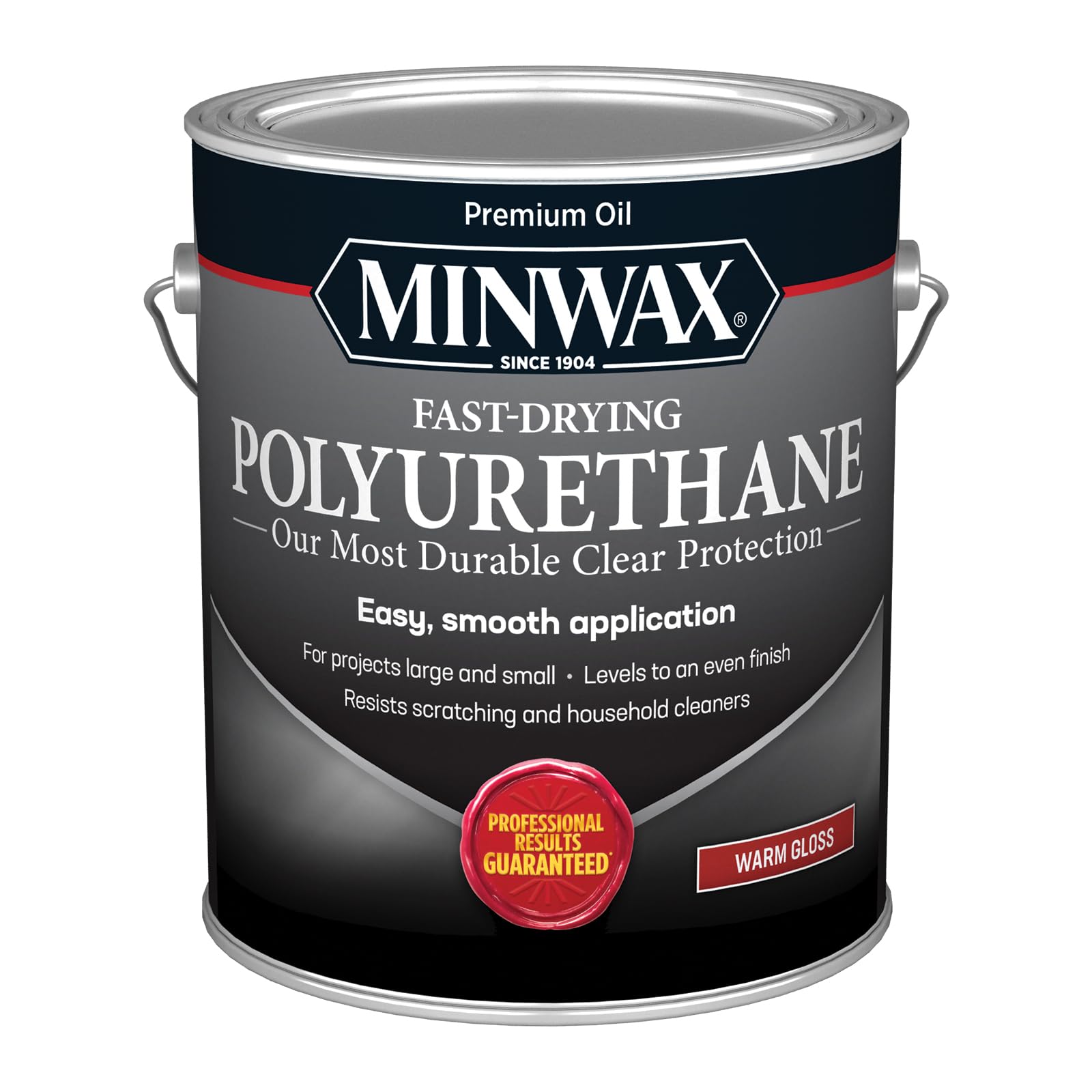
One gallon, 600 square feet, and a recoat window that lets you finish a floor in a day.
Floors are the reason this can exists. The gallon covers 600 sq ft, which swallows a whole room in one purchase where the smaller cans would need three or four. Recoats are allowed after 4-6 hours, so multiple passes land in a single day — exactly what a floor needs when the furniture is stacked in the hallway. Weighing 3.67 kg, it is a two-hand pour, so set up a smaller container before you start.
Gloss is the right choice for floors: it throws light back, making tired boards look freshly milled, and the oil-based film handles scratches and spills. Apply it with a high-quality natural or foam brush, or roll it on a long handle if you are doing a floor — no kneeling. On furniture and cabinets it works just as well, building a clear coat over the grain.
The downsides are real but manageable. The odor is strong, so ventilate and run a fan. Thin coats are needed to avoid streaks and bubbles, and those bubbles come from stirring rather than shaking the can. A few cans have arrived dented in transit, though the lids held. And 600 sq ft is the headline figure for a single coat — a floor in poor condition typically wants more than one.
The one-move upgrade: buy the gallon if your job is bigger than a few pieces. Coverage is where this beats every other can here by a wide margin.
Ventilation is non-negotiable: oil-based gloss carries a strong smell, and a closed room will punish you for it.
Buy this for: floors, long runs of trim, stair treads and any job measured in whole rooms rather than single pieces.
Look smaller if: you only have a table and two chairs to coat — a pint or quart will get you there with less left over.
Know the Specs
Coverage in Square Feet
Coverage tells you how much surface one can will treat in a single coat, so you can buy the right size instead of running out mid-job. A quart of spar urethane stating 190 sq ft suits a bench and a set of railings, while the gallon stating 600 sq ft is sized for a floor. Always read coverage as per-coat, not total — a second coat uses the same amount again.
Dry-to-Recoat Time
This is the wait before you can apply the next layer, and it decides whether a project fits into one afternoon. A wipe-on that is dry to recoat in 2-3 hours lets you stack coats the same day. One that needs 8 hours between passes means an overnight stop. Fast drying does not mean fully cured — light use on the Minwax wipe-on still waits 24 hours.
Satin, Gloss and What They Do
Sheen is a look, not a toughness rating. Satin scatters light softly and hides small surface flaws, making it the friendly choice for furniture and shelves. Gloss reflects light sharply, which brightens grain and makes floors and tabletops look polished. Neither resists scratches better than the other; pick the sheen by the surface and the room.
Oil-Based Versus Water-Based
Oil-based formulas like these amber slightly and build a hard, warm film with strong protection and a noticeable smell. Water-based finishes dry faster and smell far less, but they often need more coats for the same depth. Every can on this list is oil-based, so plan for ventilation and give each coat the time it asks for.
Common Questions
Can I use outdoor spar urethane on indoor furniture?
How many coats of wipe-on polyurethane does a table need?
Do I need to sand between coats of polyurethane?
Why is my wipe-on polyurethane leaving streaks?
How long before I can put furniture back on a finished floor?
Is gloss or satin polyurethane more durable?
Can I apply polyurethane with a rag instead of a brush?
Why does my polyurethane can get hard to open after the first use?
Will spar urethane change the color of my outdoor wood?
Does a fast-drying polyurethane still need a full cure?
The Bottom Line
For most interior projects, the polyurethane that does the least damage in untrained hands is the Minwax Oil-Based Wipe-On in Satin — it lets you recoat in 2-3 hours, uses a cloth instead of a brush, and gives you 32 fluid ounces to work with. If your project is all corners and carving, the Watco Gloss Wipe-On reaches where a brush cannot, as long as you thin it. For a countertop that takes daily abuse, the General Finishes Arm-R-Seal is the one that keeps its surface. Outdoors, the Varathane Spar flexes with the weather, and for a whole floor the Minwax Fast Drying gallon covers 600 sq ft per coat. If you are unsure, start with the wipe-on — it is the can most likely to give you a result you are happy to leave alone.
How we choose
We do not accept paid placement. Every pick is matched to a real buyer and a real use-case; we do not hands-on test units.
Sources
Specifications: manufacturer listings and product documentation. Review insights: verified customer reviews, as of October 2026. Pricing: not shown on this page (it changes often); check the current price via the retailer link.
As an Amazon Associate, Aappliancez earns from qualifying purchases. This does not affect which products we feature.