Disclosure: Some links in this post are affiliate links. As an Amazon Associate I earn from qualifying purchases, at no extra cost to you. Learn more
Specs are compiled from manufacturer listings and verified buyer reviews and can change over time — please confirm the key details on the product page before buying.
You aim your iPhone at a lake, a shop window, or a wet street after rain, and the shot comes back flat and washed out. Your phone has no way to remove the reflected light bouncing off shiny surfaces. A clip-on polarizing filter (a small glass disc that snaps over your phone lens and rotates to block that reflected light) fixes exactly that. The catch: these filters are tiny, fiddly, and not all of them actually polarize. Below are five that do the job, sorted by who each one genuinely suits.
This guide is built by comparing the manufacturers’ published specifications and the patterns across verified customer reviews, so you get each pick’s real strengths and trade-offs instead of marketing spin.
Some filters cut glare beautifully and some barely change your photo, so the mount matters as much as the glass. This breakdown covers the real differences between each polarizing filter for iphone so you can pick the one that fits your phone and your shooting style.
Top Picks

How To Choose The Best Polarizing Filter for iPhone
A polarizer doesn’t behave like a photo filter app. It adds no color and no drama on its own. It removes one specific kind of light — the glare bouncing off water, glass, paint, and skin. How much it removes depends on the angle you shoot from and how far you turn the ring. Get those two things right and the effect is obvious. Get them wrong and you’ll swear the filter does nothing.
Start with the mount, not the glass
A clip-on filter grips your phone with a spring-loaded arm. It fits almost any phone, with or without a case. But it adds bulk and can shift if you move fast. A press-on or snap-on design sits flatter against the camera bump and holds steadier. The trade-off: it usually locks you to specific iPhone models and can block the flash or the LiDAR sensor (the small depth sensor next to the lens). If you shoot handheld video, stability beats convenience.
Check the thread size before you buy
Most phone polarizers use a 52mm thread — the standard screw mount on the filter’s frame. A 52mm thread lets you stack other filters on top or swap the polarizer onto a step-up ring later. The K&F Concept press-on kit uses a wider 67mm thread. That opens up a bigger ecosystem of standard camera filters but takes up more room on your phone. Neither is better — just know which accessories you plan to add.
Match the filter to your iPhone model
Some snap-on filters are cut to fit one camera bump precisely. That’s why they hold so well, and also why they won’t fit a different model. Before you commit, confirm the filter lists your exact iPhone. If you upgrade phones every year or two, a universal clip-on will outlast your current handset.
Side-by-Side Comparison
| Model | Best For | Mount Type | Thread Size | Weight | Amazon |
|---|---|---|---|---|---|
| Clip On cpl Polarizing Filter for iPhone★ Best Overall | Tattoo and vlog work | Spring clip | 52mm | 44 g | Amazon |
| 52mm Clip-on Phone CPL Polarizing Lens FilterBest for Water | Water and window shots | Spring clip | 52mm | — | Amazon |
| CPL Filter for iPhone Samsung, 52mm Clip On | Cross-device use | Threaded clip | 52mm | — | Amazon |
| K&F CONCEPT 67mm Press-on CPL Kit | Filter stacking | Press-on clip | 67mm | 19.8 g | Amazon |
| K&F CONCEPT Snap-On CPL Filter | Gimbal video work | Snap-on deco | — | 9.5 g ±1 g | Amazon |
Detailed Reviews
1. Clip On cpl Polarizing Filter
Our pick — 4.0+★ from 150+ verified ratings; the strongest balance of quality and price.
The all-rounder that clips onto any phone and turns to fight glare, no tools needed.
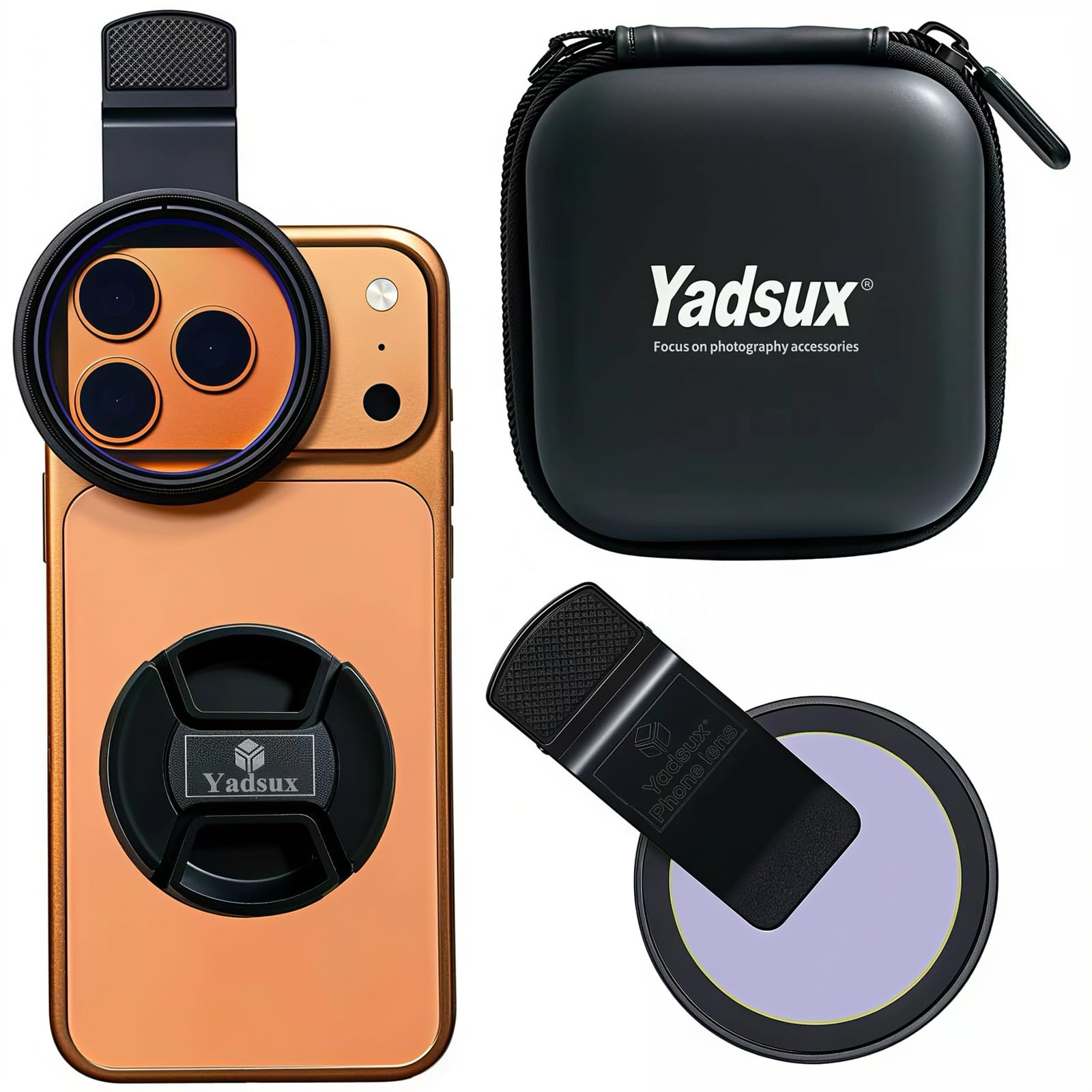
This filter earns the top spot because its spring-loaded metal clip grips any smartphone — iPhone, Samsung, Pixel, or Motorola — with or without a case. You don’t commit to one handset model or a specific case cutout. At 44 g it’s clearly heavier than the featherweight snap-on designs, and the clip arm spreads wider in a pocket. The frame measures 2.05″ by 2.05″, so it’s still a compact disc that slips into the included pouch.
The glass is the part that seals it. It’s double-sided multi-coated optical glass — anti-reflective layers on both faces that cut ghosting and lift contrast. Skies read deeper, and skin glare fades in your shot instead of glowing white. The textured rotating ring is the bit you’ll touch most; it lets you dial in polarization without smudging the glass. Tattoo artists keep coming back to this one for cutting the shine off fresh ink, and reviews back that up. “As a tattoo artist I use this a lot,” one buyer put it, and another called it a real difference for tattoo photography.
Here’s the honest catch. Glare reduction is the aspect buyers raise most often, and it splits both ways. For some it works beautifully. For others chasing specific reflections — car daytime running lights at night was one case — it doesn’t fully eliminate them. A polarizer removes light bouncing at the right angle, not every bright source. This is the strongest all-round pick for most iPhone shooters, but don’t expect it to erase a headlight beam.
What earns it the top slot
- Fits iPhone, Samsung, Pixel and more — with or without a case, no tools
- Rotating textured ring gives you live control over how much glare you cut
- Double-sided multi-coated glass sharpens contrast and reduces ghosting
- Complete kit: filter, metal clip, rotating adapter ring, pouch, cleaning cloth
Where it will frustrate you
- At 44 g it’s noticeably heavier than the snap-on designs
- Glare removal is real but not absolute — some reflections stay
- Clip arm makes it bulkier in a pocket than a flush-fit mount
Buy it if: you shoot on more than one phone or use a case and want one filter that adapts to any of them.
Think twice if: you need zero reflections on a bright light source — that’s beyond what a polarizer does.
2. 52mm Clip-on Phone CPL Polarizing Lens Filter
Built for the fisherman and the window-shopper — it strips glare off water and glass you can’t otherwise see through.
Point this one at a lake, a river, a shop window, or a car windshield and the surface reflection drops away. You see what’s underneath — fish, rocks, a display case, a cityscape behind glass. That’s the CPL (circular polarizer) job. This 52mm filter has a nano coating (a thin anti-reflective layer that reduces smearing and keeps the glass clear). Its frame is a chunky 3.54″ by 3.54″, noticeably larger than the 2.05″ clip filter above, so expect it to take real room in a bag.
Buyers mention ease of mounting and go-anywhere versatility most often. It clips onto an iPhone 13 Pro Max without covering any of the three lenses. A car videographer using an iPhone 15 Pro found it “covering all 3 lenses nicely” for TikTok filming. There’s a waterproof carry case with a carabiner, so you can clip it to a pack and forget about it until the shot appears.
The trade-off is a fit question, not a defect. For window and water shots it sings. But for some shooters it “barely has any effect” on the glare they were chasing, and a few find it one more thing to carry. If your photography is mostly landscape and reflections in water or glass, this is the pick. If you want a do-everything filter that disappears in your pocket, the smaller clip-on above suits better.
Why it earns its place: the water-and-window specialty is the most concrete use case in this whole lineup, and the 52mm thread keeps you open to adding a step-up ring or another filter later.
The honest limit: glare reduction is mixed across owners — brilliant on angled surface reflections, easy to miss on other bright sources.
Reach for this if: you shoot lakes, aquariums, or storefront windows and want to see past the surface.
Look elsewhere if: you want the lightest, most pocketable filter for everyday snapshots.
3. CPL Filter 52mm

The blue-ring outlier that treats your phone like a real camera — threads, step-up rings, and all.
A standard 52mm threaded mount is what sets this apart from the closed-system clip-ons. The filter screws onto a real filter thread on a metal clip. So you can stack other 52mm filters or step-up rings onto it, exactly as you would on a DSLR (a digital single-lens reflex camera). The blue textured twist ring rotates the polarizer smoothly without touching the glass, so you dial reflections out in real time.
Build quality is what serious shooters notice. One advanced hobbyist who also shoots Canon L-series lenses on a phone called it compact and high quality. They praised the smooth turning, zero distortion, and etched legends, plus the rigid hard case with a mesh pocket and carabiner. The spring-loaded clip is padded and holds securely. The kit fits both iPhones and Samsung Galaxy phones — a Galaxy S24 Plus owner reported no positioning trouble at all, and an iPhone 16 Pro user got reduced glare and a deeper contrast tint.
Two things to know before you buy. Alignment is fiddly on ultrawide shots; get the filter slightly off-center and you get vignetting (darkened corners). That’s a real adjustment period rather than a fault. And while the mount is secure for stills, it isn’t the tool for active video where you move constantly. Treat it as a stills-first filter that rewards a minute of setup, and it delivers. It’s priced in line with the other clip-ons, which is fair for a threaded, stackable kit.
Standout spec: a genuine 52mm threaded mount — the one thing that lets you build a filter stack on your phone instead of replacing the whole unit.
Learning curve: centering it takes practice, especially at ultrawide, or the corners darken.
Great for: the phone shooter who already owns camera filters and wants to reuse them or add more.
Not for: run-and-gun video where you’re moving constantly and need a rock-solid mount.
4. K&F CONCEPT 67mm Press-on CPL Phone Lens Filter Kit

A press-on mount slim enough to sit flush, with a 67mm thread that opens up a whole camera-filter ecosystem.
The 67mm alloy thread is the standout feature — a full-size camera thread instead of the 52mm mount most phone filters use. That means it mounts the vast library of standard 67mm camera filters and lenses. If you already shoot with a real camera and want to reuse your glass on your phone, this is the bridge. The press-on design also holds flatter against the phone than a traditional clip arm, so it feels more smooth in the hand.
At 19.8 g it adds almost nothing to the weight of your phone. A full ring of silicone padding on the back grips your case to stop it slipping mid-shoot. The anti-loss kit — a triple-layer protective case plus a security strap — saves you from a dropped filter near water. Build quality is what buyers praise most. One advanced hobbyist with a Galaxy S22 Ultra noted the parallel-arm holder with its soft rubber pad beats the old clothespin-style clip hands down, with smooth turning and no distortions. Note the squeeze: it’s not compatible with the iPhone 17 Pro or Pro Max, so check your model first.
Where it runs into trouble is the same place every polarizer does. It cuts reflections on bottles and surfaces but won’t remove every last one, and one buyer found results underwhelming outdoors in natural and aquarium light. Set your expectation to “noticeably better reflections” rather than “mirror gone,” and the 67mm versatility makes it a smart multi-gear pick.
Why photographers gravitate to it
- 67mm thread reuses your existing camera filters and lenses on your phone
- Press-on mount sits flatter than a clip arm for a smooth feel
- 19.8 g with silicone back padding — light and non-slip
- Anti-loss kit with triple-layer case and security strap included
What to check before buying
- Not compatible with iPhone 17 Pro or 17 Pro Max
- Won’t remove every reflection — think reduction, not elimination
- Press-on fit takes a minute of careful aligning to seat right
Best for: the hybrid shooter who wants one filter system that works on a phone and a real camera.
Check first: your iPhone model — 17 Pro and 17 Pro Max are off the list.
5. K&F CONCEPT Snap-On CPL Filter

Nine and a half grams that snaps onto the camera bump and never needs re-balancing on a gimbal.
If you vlog on a stabilizer, this filter is built for you. At 9.5 g ±1 g, the CNC-machined aluminium frame weighs roughly a tenth of traditional clip-on filters. So it doesn’t throw off your DJI OM or similar gimbal’s balance — you attach it and keep shooting without stopping to rebalance. It’s custom-fit to the iPhone 17 Pro and Pro Max camera bump for a smooth 1:1 fit. That’s why it holds with zero wobble instead of fighting you like a clip arm.
The glass is genuinely premium: AGC optical glass with a 28-layer double-sided multi-coating. The maker claims up to 99.5% light transmission, so most light reaches your sensor and skies stay deep instead of going dull. The smooth stepless damping ring lets you dial polarization in small increments for ProRAW and Log video work (high-detail recording formats). There’s a real catch on compatibility: it’s not compatible with full-wrap cases (those that cover the camera bump), only open-window cases with a cutout around the camera. It won’t fit the iPhone 18 Pro or 18 Pro Max at all.
Worth setting expectations on the effect itself. A 4-star buyer with an iPhone 17 Pro found glare reduction minimal on cars, water, windows, and counters — possibly because the phone sensor is small — with the biggest difference showing up in sky and water. And a couple of 1-star holdouts saw no difference at all. For most buyers, though, the everyday convenience wins: it’s easy to use and works well for iPhone photography beginners. It’s light enough to leave on a magnetic charger between shots.
The mic-drop spec: 9.5 g ±1 g CNC aluminium with a 28-layer double-sided coating — it disappears on your phone and keeps a gimbal balanced.
The compatibility catch: needs an open-window case and fits Pro-model 17 and earlier Pro bumps only, not the 18 Pro line.
Made for: gimbal vloggers on an iPhone 17 Pro or Pro Max who need weightless, wobble-free glare control.
Skip if: you use a full-wrap case or own an iPhone 18 Pro — it won’t seat.
Know the Specs
Thread size (52mm vs 67mm)
The thread is the screw mount on the filter’s metal frame. A 52mm thread is the common phone standard and keeps the filter small. A 67mm thread is a professional camera size that lets you mount a much wider range of lenses and filters. A bigger thread means more flexibility but a bulkier disc on your phone.
Coating layers
The coating is the anti-reflective film on the glass. A multi-coated or nano-coated surface reduces ghosting and smearing and keeps contrast crisp. A filter with no coating can let more stray reflections through. More coating layers tends to mean cleaner images in tricky light.
Mount style
Clip-on grips with a sprung arm and fits most phones. Press-on and snap-on sit flat against the camera bump and hold steadier, but often only fit specific iPhone models and may block the flash or LiDAR sensor. Video shooters usually want the flatter, steadier mount.
Weight and gimbal balance
A heavier filter throws off a gimbal’s balance and forces you to re-tune the stabilizer. Ultra-light designs keep a phone steady on a DJI OM or similar rig without extra work. Weight in grams is a good proxy for how much you’ll feel it in your hand and on a stabilizer.
Common Questions
Will a polarizing filter work on any iPhone model?
Why does my polarizing filter seem to do nothing?
What is the difference between a 52mm and 67mm filter?
Will a clip-on filter block my iPhone’s flash?
Can I use a polarizing filter over a phone case?
Are phone polarizers good enough for video work?
Does a polarizing filter change the color of my photo?
How do I stop my filter from causing dark corners?
Can I stack other filters on top of a phone polarizer?
Is a polarizing filter worth it for everyday phone photos?
The Bottom Line
For most iPhone shooters, the Clip On cpl Polarizing Filter for iPhone is the pick — it clips to any phone, cuts glare from water, glass, and skin, and the rotating ring gives you live control across tattoo, portrait, and landscape work. If water is your main subject, the 52mm Clip-on Phone CPL strips surface glare so you can see beneath. Want to reuse real camera filters? The 67mm K&F Concept press-on kit is your bridge. And if you vlog on a gimbal with an iPhone 17 Pro, the K&F Concept snap-on vanishes on your phone at 9.5 g ±1 g.
How we choose
We do not accept paid placement. Every pick is matched to a real buyer and a real use-case; we do not hands-on test units.
Sources
Specifications: manufacturer listings and product documentation. Review insights: verified customer reviews, as of October 2026. Pricing: not shown on this page (it changes often); check the current price via the retailer link.
As an Amazon Associate, Aappliancez earns from qualifying purchases. This does not affect which products we feature.