Disclosure: Some links in this post are affiliate links. As an Amazon Associate I earn from qualifying purchases, at no extra cost to you. Learn more
Specs are compiled from manufacturer listings and verified buyer reviews and can change over time — please confirm the key details on the product page before buying.
The honest answer up front: if you just want your pocket knife sharp again in a couple of minutes with no learning curve, a guided pull-through or rod sharpener gets you there fast. If you want a genuinely polished, hair-shaving edge and you are willing to spend a few minutes per blade, a multi-plate field kit earns its space in your pack. The single number that decides most of these purchases is the sharpening angle — usually 20° or 25° — because a guide locked at a fixed angle is what separates a sharp blade from a rounded one.
This guide is built by comparing the manufacturers’ published specifications and the patterns across verified customer reviews, so you get each pick’s real strengths and trade-offs instead of marketing spin.
Angle control and grit progression matter far more than brand name here, so every pick below is sorted by how much of each you actually get in your hand. Read on for the sharpest picks in this pocket knife sharpener lineup.
Top Picks


How To Choose The Best Pocket Knife Sharpener
You have three broad families to pick from. Pull-through sharpeners with carbide or ceramic V-slots are the fastest — a few strokes and you are done. Diamond rod and plate kits give you more control and a better final edge, but ask a little more of your hands. Rolling or bench systems sit at the top and deliver the most consistent bevel of the three, at the cost of size and setup time.
Start with the angle, not the brand
A fixed angle guide is the whole game. A guide locked to 20° (a common pocket-knife bevel) keeps your strokes repeatable, so the edge stays a clean V instead of rounding over. If your kit offers 25° as well, you have a sturdier option for hard-use blades like hunting or bushcraft knives.
Match grit to the job
Coarse grit — think 100 to 400 — is for repairing nicks and setting a new edge. Fine grit around 600 sharpens, and extra-fine around 1200 polishes. A single-grit sharpener will get a working edge, but a progression takes you from dull to shaving-sharp without swapping tools.
Decide how it will travel
If your sharpener lives in a drawer, size barely matters. If it rides in a tackle box, glovebox or pack, look for a folded footprint you can actually pocket and a case or sheath that keeps the abrasive away from your other gear. A diamond plate grinding against a flashlight lens or a stove in the same pack is how a field sharpener dies early.
Side-by-Side Comparison
| Model | Best For | Sharpening Angles | Grit / Abrasive | Folded Or Carry Size | Amazon |
|---|---|---|---|---|---|
| Work Sharp Guided Field Sharpener Elite★ Best Overall | Full kit in one case | 20° and 25° | 220 / 400 / 600 / 800 diamond plus ceramic and strop | 9.53″L x 5.42″W x 1.12″H with zipper case | Amazon |
| Redi-Edge Portable Knife SharpenerFastest Touch-Up | Fast everyday touch-ups | 20° double edge | Duromite fine elements | 2.6″L x 2.2″W x 9″H | Amazon |
| SHARPAL 178N 3-In-1Serration Specialist | Serrated edges and hooks | Freehand rod | 600 grit monocrystalline diamond | 9.25″L x 0.98″W x 0.98″H, stows in handle | Amazon |
| AccuSharp Hand-Held Carbide | Kitchen drawer staple | Built-in carbide V-slot | Diamond-honed tungsten carbide | 7.5″L x 0.87″W x 9″H, two-pack | Amazon |
| Work Sharp Folding Field Sharpener | Pocket carry with guides | 20° and 25° | 400 grit diamond plus fine ceramic | 5.25″L x 1.5″W x 0.7″H | Amazon |
| SHARPAL 116N Diamond Card | Wallet-sized insurance | Freehand | 325 / 600 / 1200 diamond | 3.27″L x 2.13″W x 0.14″H per card | Amazon |
| EZE-LAP Diamond Round in Brass | Curved and contoured edges | Freehand rod | 600 grit diamond | 3-1/4″ x 1/4″ rod | Amazon |
| Wicked Edge Venture WE20 | Guided sharpening on the trail | 20° with guide | 500 grit diamond and ceramic hone | 7″L x 1.38″W x 1.75″H | Amazon |
| Warthog V-Sharp A4 | Multi-angle bench work | 15° / 20° / 25° / 30° | 325 grit natural diamond hone plus finishing steel | 9″L x 9″W x 3″H metal frame | Amazon |
| Norton IM200 Oil Stone Kit | Benchtop stone purists | Angle guide included | 100 / 150 / 320 grit oil stones | 8″ stones in a plastic case | Amazon |
| HORL 2 Oak Rolling Sharpener | No-skill razor edges | 15° and 20° | Diamond and ceramic discs | 5.31″L x 4.72″W x 2.56″H oak body | Amazon |
Detailed Reviews
1. Work Sharp Guided Field Sharpener Elite
Our pick — 4.5+★ from 12,500+ verified ratings; the strongest balance of quality and price.
A complete sharpening bench that folds into a zippered pack case.
Four diamond plates at 220, 400, 600 and 800 grit cover everything from knocking out a nick to putting a polish on the bevel. That spread matters because a single-grit tool forces you to choose between fast repair and a clean finish — this one walks you through both in the same session. The included 20° and 25° angle guides hold the bevel steady, so you are not guessing at the angle with each stroke.
Beyond the plates you get a three-position ceramic rod with a fish hook groove, a dedicated serration rod and a leather strop for the final polish. It weighs 4.6 oz, runs on nothing but your arms, and ships with a broadhead wrench and a 3-year warranty. Measured against the SHARPAL 178N’s 0.98 in width, this kit’s 5.42 in width is a 5.5x difference — and the trade is honest: you gain a full progression and lose pocket-slimness.
What wins people over is how completely it replaces a drawer of separate tools. Buyers report bringing pocket knives back to shaving sharp in minutes, and they credit the guided angles (fixed slots that hold the blade at the right tilt) with preventing the mistakes that come from freehanding. The leather strop (a strip of leather for the final polish) and ceramic rod (a smooth rod for honing) are what push the edge past “usable” into genuinely refined. The catch is the size — at 9.53 in long it lives in a pack or glovebox, not a coin pocket, and the diamond plates (the abrasive surfaces that do the grinding) need to stay clear of other gear, which is exactly why the case is included.
Where It Pulls Ahead
- Four diamond grits (220/400/600/800) handle repair through polish on one platform
- Built-in 20° and 25° guides remove the guesswork from every stroke
- Ceramic rod, serration rod and leather strop deliver a finished edge without extras
- Runs at 4.6 oz with no batteries or outlet, backed by a 3-year warranty
What To Weigh First
- At 9.53 in long it is a pack or truck item, not a pocket one
- The diamond plates need the case to avoid scuffing nearby gear
Pick this if: you want one case that takes a dull hunting or pocket knife all the way to polished — the 220-to-800 progression plus strop does exactly that.
Think twice if: you want something that disappears into a jeans pocket, where the 4.6 oz kit is simply too much tool.
2. Redi-Edge Portable Knife Sharpener
Pull the blade through twice and get back to work.
Duromite sharpening elements set a 20° double edge, which is the angle most pocket knives ship with, so you are refreshing the bevel instead of reshaping it. The ribbed handle stays grippy whether your hands are dry or wet — a small detail that matters when you are standing in a stream with a fillet knife. Stainless steel parts and a lifetime limited warranty round out the build.
Where this one earns its place is speed. What gets praised most is raw performance, and the pattern behind that praise is always the same: a couple of swipes and a dull kitchen blade is cutting again. It is smaller than a belt sharpener and slides into a tackle box for field use, which is exactly the use case it was built for. At 9.07 g it adds nothing noticeable to a tackle box or glovebox.
The honest note is what it leaves behind. The fine Duromite elements throw steel shavings, so sharpen over a trash can or a paper towel rather than your counter. And because it is a pull-through, it refreshes an existing edge beautifully but is not the tool for grinding a new bevel onto a badly damaged blade — for that you want a diamond plate kit above.
The real draw: a genuine 20° double edge in a tool the size of a marker, which is why it keeps ending up in tackle boxes and glove compartments instead of a drawer.
One thing to plan for: the fine elements shed steel spirals, so keep a paper towel under the blade while you work.
Reach for this if: your knives are basically fine and you just want them sharp again in seconds before dinner or before the next cast.
Look elsewhere if: you are repairing chips and rolled edges — a pull-through refreshes, it does not rebuild.
3. SHARPAL 178N 3-In-1 Pocket Knife Sharpener
The one that finally handles serrations and gut hooks properly.
Three tools live inside one aluminum handle. A 4-inch round diamond rod sharpens straight edges. A 3.5-inch tapered rod works the scallops on serrated blades and gut hooks. And a sharpening groove handles fishhooks and pointed tools. Both rods stow inside the handle when you are done, which keeps the whole thing at 9.25 in long overall and 0.98 in wide — the slimmest profile in this lineup.
The abrasive is monocrystalline diamond at 600 grit, or 25 micron, coated rather than bonded. That matters because diamond cuts hard steels that oil stones skate off, and it works dry with no water or oil to carry. In the field, that is the difference between touching up a blade and skipping it entirely.
Here is the trade worth knowing about. Diamond this aggressive removes metal fast — great for a damaged blade, less forgiving if you lean on it. Use light strokes, and on a serrated edge work one scallop at a time with the tapered rod. The 3-year warranty covers defects in materials and workmanship, and the lanyard hole plus storage pouch make it easy to keep track of in a pack.
Why It Earns Its Slot
- Three tools in one handle: straight-edge rod, tapered serration rod, hook groove
- 600 grit (25 micron) monocrystalline diamond cuts hard steels dry
- Rods stow inside the aluminum handle for a 0.98 in wide carry
- Lanyard hole and storage pouch keep it findable in a pack
The Honest Trade-Off
- 600 grit is aggressive — heavy pressure removes more steel than you need
- Freehand only, so there is no fixed guide to lock your angle
Suits you if: your knives have serrations, your hooks have points, and your steels are hard enough to laugh at a cheap stone.
Not for you if: you want a fixed guide doing the angle math — this one trusts your hands.
4. AccuSharp Hand-Held Carbide Blade Sharpener (2-Pack)

Four strokes, a full-length finger guard, and back to the cutting board.
Diamond-honed tungsten carbide sits at the heart of this one — one of the hardest known materials, and the blades are reversible, which doubles their working life. The ergonomic handle fits either hand, so lefties get the same grip as righties, and the full-length guard keeps your fingers behind the cutting zone the whole time. A two-pack means one for the kitchen drawer and one for the toolbox.
Speed is the whole pitch, and it delivers. Four or five light strokes take a tired blade back to useful, which is why it outperforms a stone on any night you are already hungry. The build is double-beveled and cleans up with soap and water or in the dishwasher. Most users report 5 to 10 years between blade replacements, so the two-pack covers a decade-plus of kitchen duty.
The one behavior worth correcting: use gentle, light strokes. Leaning hard on the V-case spreads the plastic housing and changes the angle you are cutting at, which defeats the point. And as with any carbide sharpener, this is a working edge — it will not give you the polished bevel that a diamond progression does.
Built for the drawer: an ergonomic handle that works in either hand, a full-length finger guard, and reversible tungsten carbide blades that can be flipped to extend their life.
The habit that matters: light strokes only — heavy pressure spreads the plastic V-case and throws off your angle.
Best match for: a kitchen where knives go dull weekly and nobody wants a lesson in bevel angles.
Skip the shortcut if: you are chasing a polished, hair-shaving edge — carbide gives you a working edge, not a refined one.
5. Work Sharp Folding Field Sharpener
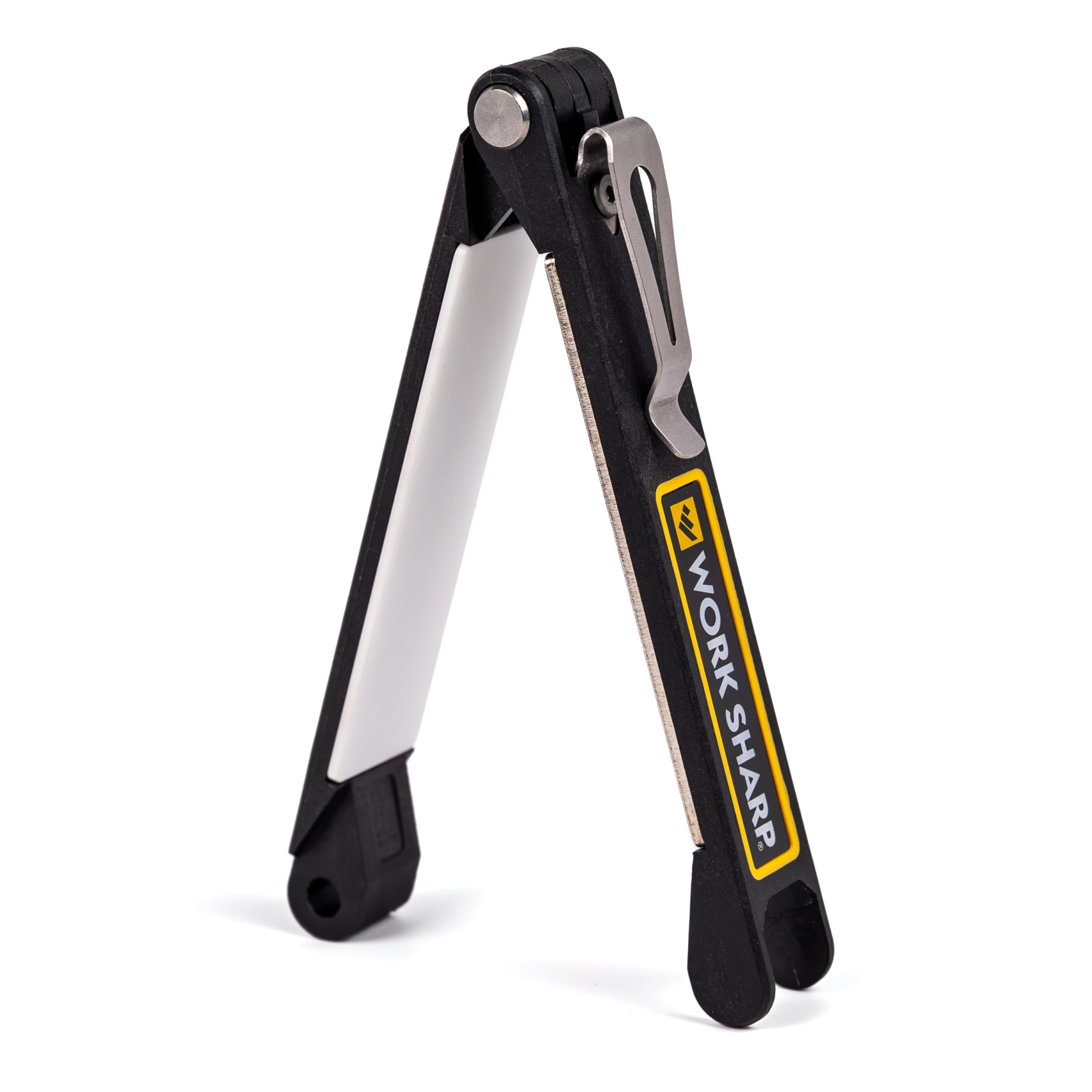
Angle guides and a pocket clip in a 2.08 oz folding package.
A 400 grit diamond plate with 20° sharpening guides sits on one face; a fine ceramic plate with 25° honing guides sits on the other. That pairing is the smart part — you set the edge at 20° and refine it at 25°, or switch between them depending on whether the blade needs sharpening or just a hone. The whole thing folds to 5.25 in long and 1.5 in wide, and the pocket clip keeps it upright in a pack pocket.
The non-slip handle gives you something to hold while your fingers stay clear of the edge, which is the difference between a confident stroke and a hesitant one. Field dressing, box breakdown, rope — the ceramic side brings an edge back with a few passes. It is designed, engineered and calibrated in Ashland, Oregon, and it is the lightest guided option here at 2.08 oz.
Where it asks something of you: the hinge takes a little practice to hold steady at the right angle, and the fold does not sit perfectly flush, so the plastic base is the part to watch over years of use. Compared with the Guided Field Sharpener Elite above, you give up two diamond grits (the coarser and finer abrasive grades) and the strop in exchange for a pocket-clip footprint — a fair trade if portability is the whole point.
What you gain: dual angle guides (20° and 25°) plus a 400 grit diamond plate and ceramic hone, all in a 2.08 oz folding body with a pocket clip.
What you give up: the four-grit progression and leather strop that the larger Work Sharp kit carries.
Reach for this if: you want guided angles that ride in a pocket rather than a pack, and most of your blades are around 3 inches.
Look to the Elite if: you need to repair real damage — two diamond grits and a strop do more than a 400 grit plate can alone.
6. SHARPAL 116N Pocket Diamond Sharpening Card
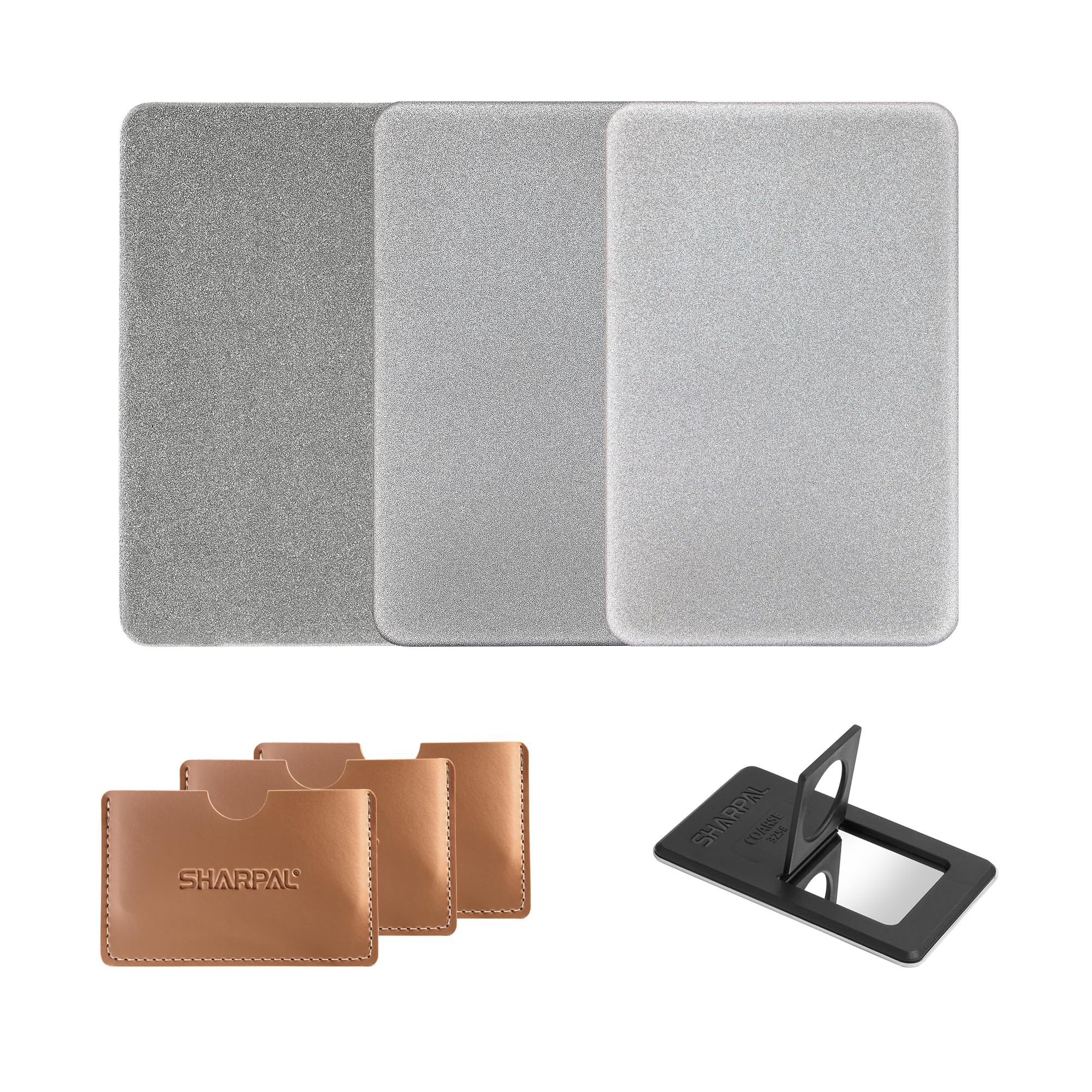
Three grits, one wallet slot, zero excuses for a dull blade.
Coarse 325 grit (45 micron) sets an edge, fine 600 grit (25 micron) sharpens it, and extra-fine 1200 grit (12 micron) hones and refines. That is a genuine three-stage progression on credit-card-sized plates — each one measures 3.27 in by 2.13 in and 0.14 in thick. A ring grip at the top protects your fingers, and a storage pouch keeps all three together.
Diamond is the abrasive here, and it works dry with no water or oil, so there is nothing to spill in a go bag. The carabiner-style ring also means you can hook the plate and pull the blade against it rather than the other way around, which is how you work a hatchet or a curved carving knife. Reviewers report six years of use on hard steels like D2 and M390, and they keep calling out how consistent the diamond stays.
The honest caveat: these are hand-held plates, so you bring the angle. If you can hold a steady stroke, they are excellent value; if you cannot, start with a guided kit and come back to these later. The plastic backing is also thicker than some would like, which adds bulk when you store them in a leather sheath.
The case for it: a 325/600/1200 diamond progression that fits in a wallet and cuts hard steels dry, with a ring grip that keeps your fingers out of the way.
The caveat: freehand only — no guide means the angle is entirely your responsibility.
Buy it if: you want a real grit progression in your go bag and you are comfortable holding an angle on your own.
Pass if: you are new to sharpening — a guided kit will teach you the angle before these plates test it.
7. EZE-LAP 3-1/4″ Diamond Round Sharpener in Brass Handle

A round diamond rod that follows a curved edge instead of fighting it.
The shaft is 3-1/4 inches long and a quarter inch across, coated in diamond, and it retracts into a brass handle that will not rust. That round profile is the point: it rolls along the curve of a hoof knife, a machete, or a serrated edge where a flat stone cannot reach. The handle screws onto the rod to form a hilt, so your hand stays behind a guard while you work.
At 600 grit it is a working edge, not a polishing tool. It removes burrs and minor nicks and gets a blade to the point where it cuts rope, cardboard and food cleanly — sharp enough to matter, not a mirror polish. At 1.6 oz it disappears into a pack, and the included leather sheath adds a belt-carry option. Owners mention using this same brass-handled rod design for decades, which says more about the round geometry than any spec sheet could.
The honest limit: if you want a flat bevel on a kitchen knife, a round rod is the wrong shape, and the 600 grit finish wants a finer stone afterward if you are chasing a polished edge. The leather sheath also runs bulky for belt carry, so some owners leave it behind.
Where it shines: curved blades, serrations and yard tools — anywhere a flat stone cannot make contact, the 3-1/4″ round diamond rod can.
Where it stops: 600 grit leaves a working edge, not a polished one, and a round rod will not give a kitchen knife a flat bevel.
Pick it if: your sharpening list includes curved edges, garden tools or serrated blades that a flat plate misses.
skip it if: your main goal is a mirror-finished kitchen edge — you need a flat progression for that.
8. Wicked Edge Venture WE20 Knife Sharpener
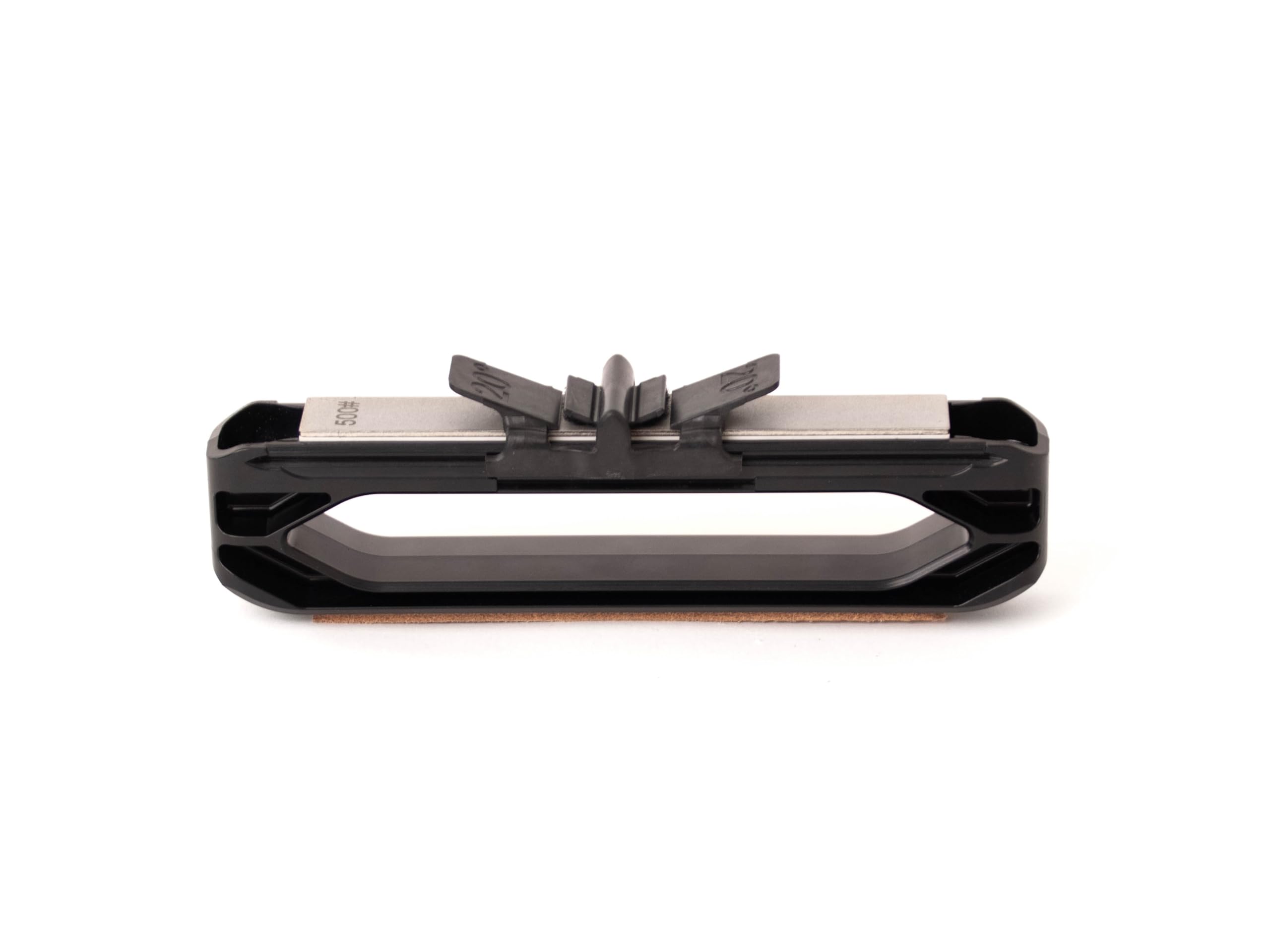
A patent-pending angle guide that takes the guesswork out of freehand.
The guide locks you to a consistent 20° bevel every stroke, and you can expand to 15°, 17° or 25° with separate Knife Guides. On board is a dual-sided 500 grit diamond stone for shaping and a fine ceramic hone for refining, plus a leather strop for the polish. It weighs 4 oz and measures 7 in long by 1.38 in wide, so it drops into a toolbox or glovebox without a second thought.
This is a made-in-USA tool with a 5-year warranty, and the approach is smart: put the angle in the hardware so the operator only has to hold the blade flat. The routine that keeps showing up is two passes on the coarse side, two on the hone and one on the leather per side, which produces a paper-slicing edge. That is a genuine step up from a pull-through if you want a true bevel rather than a refreshed one.
The catch is a real one worth sizing. The bevel guide can pop off mid-stroke, which is a stability issue rather than a sharpening one — steady, light pressure keeps it seated. The build also feels lighter-duty than the price tier suggests, and extra angle guides and stones are sold separately. Default 500 grit at 20° handles most pocket and kitchen knives without any of that.
The Arguments For It
- Angle guide holds a consistent 20° bevel, expandable to 15°, 17° or 25° with separate guides
- Dual-sided 500 grit diamond and ceramic hone plus leather strop in one tool
- 4 oz and 7 in long — genuinely glovebox-sized
- Made in the USA with a 5-year warranty
Where It Falls Short
- The bevel guide can pop off mid-stroke under heavy pressure
- Extra angles and grit stones are separate purchases
Fits you if: you want a real guided bevel that travels, and 20° covers most of your blades.
Keep looking if: you lean into your strokes — light pressure is what keeps the guide seated.
9. Warthog V-Sharp A4 Knife Sharpener

Two spring-loaded hones sharpening both sides of the blade at once.
A patented V-Sharp mechanism with four adjustable settings — 15°, 20°, 25° and 30° — covers everything from a delicate fillet knife to a thick machete. The hones are spring loaded and work both sides of the blade simultaneously, which is why this thing is fast. A 325 grit natural diamond hone sets the edge and a hardened hone steel finishes it, and the metal frame with a solid rubber base keeps the whole unit planted on the counter.
Setup takes a read of the instructions, but the sharpening itself is close to simple to use: you draw the knife down between the hones (the abrasive stones) and the guide keeps the angle honest. Twenty to thirty strokes takes a blade past its factory edge, and five or six strokes after each wash keeps it from dulling again. The spring loading (a spring that holds the hones in place) also keeps your fingers well clear, which is not true of every bench sharpener.
The trade is bulk. At 9 in by 9 in by 3 in it lives on a counter or a workbench, not in a pack. And the plastic-free metal frame is sturdy while the overall unit is heavier than a pocket tool, so this is a home base sharpener rather than a travel one.
The standout: four angles (15°, 20°, 25°, 30°) with spring-loaded hones that sharpen both sides at once — the reason a blade is done in 20 to 30 strokes.
The real cost: it occupies a 9 in by 9 in footprint on a counter, so it stays home.
Made for you if: you sharpen a whole drawer of knives at once and want four angles without touching a guide.
Look on if: you need something that travels — this one is a bench fixture.
10. Norton IM200 Knife Sharpener Oil Stone Kit

Three oil stones on a rotating axis — the old-school bench answer.
A 100 grit silicon carbide stone handles repair, a 150 grit silicon carbide stone sharpens and maintains, and a 320 grit aluminum oxide stone hones. All three sit in a self-contained bench unit with a reservoir for sharpening oil and a rotating axis, so you flip to the next stone without juggling loose slabs. Each stone measures 0.5 by 11.5 by 2.5 inches, which is enough length to run a full chef’s knife edge across in one pass.
The plastic case has a lid and rubber feet, so the base stays put while you work, and it catches the oil drips that would otherwise run across your counter. An angle guide is included to get you started, though experienced hands tend to set it aside once the motion is learned. It comes with sharpening stone oil, so there is nothing else to buy before your first session.
The honest part: this is a bench system that asks for time and technique. Freehanding on oil stones has a learning curve, and the included angle guide is a starting point rather than a crutch. If you want a polished edge and you are willing to practice, the 320 grit finish gets you there. If you want sharp in two minutes, this is the wrong tool.
Why it earns a place: a 100/150/320 grit progression on a rotating axis with an oil reservoir and rubber-footed case — a complete bench setup in one box.
The commitment: freehand oil stones reward practice and punish impatience, so budget the time.
Right for you if: you want a full stone progression at the bench and you are willing to learn the stroke.
Wrong for you if: you are shopping for something that sharpens a pocket knife in the field.
11. HORL 2 Oak Kitchen Knife Sharpener

Roll the disc, hold the magnet, and the angle takes care of itself.
An oak body, interchangeable diamond and ceramic grinding discs (swap-in wheels that do the sharpening), and a magnetic angle support that clamps the blade at 15° or 20°. The 20° setting is for sturdy cutting tasks; the 15° setting is for fine work like sushi, sashimi and Damascus blades. Because the magnet holds the knife and the disc rolls on the counter, your hands never have to hold an angle — which is the entire reason this design exists.
Diamond is the abrasive on the coarse disc, and it cuts steels of any hardness, including high-carbon blades that laugh at softer stones. A typical routine is roughly 12 to 18 rolls per side on the rough disc, then about 20 on the honing disc, and most knives are shaving sharp in under 10 minutes. The oak body and German build are the other half of the pitch — it is a piece of kitchen equipment you leave out rather than hide.
The honest catch: this is the premium end of the category, and plenty of buyers weigh that. It is also limited to two angles, so very fine knives that want 10° to 15° sit at the edge of what it offers. A dull knife can also take closer to 15 to 20 minutes rather than the quicker figure. And for very large blades, the trick is to set the roller on a wood cutting board so the disc has room to travel.
The no-skill promise, delivered: a magnetic holder pinning the blade at 15° or 20° plus diamond and ceramic discs means the angle is handled for you.
What it asks in return: two angles only, and a genuinely dull blade can run 15 to 20 minutes per knife.
Best for: the cook who wants a razor edge, hates the idea of angle math, and is happy to leave a nice-looking tool on the counter.
Not for: anyone who needs angles below 15° or wants to sharpen in a tent.
Know the Specs
Angle Guides (15°, 20°, 25°, 30°)
An angle guide is a physical stop that holds your blade at a set angle to the abrasive. Twenty degrees is the most common pocket-knife bevel and a good default. Twenty-five degrees gives you a sturdier edge for hard use. Fifteen degrees is finer and better for delicate kitchen work, while thirty degrees is for heavy blades. A fixed guide is what keeps your strokes repeatable, and repeatability is what keeps an edge from rounding over.
Grit (220, 600, 1200 and Beyond)
Grit is the size of the abrasive particles, and lower numbers cut faster. A 220 to 400 grit surface repairs nicks and sets a new edge. Around 600 grit you are sharpening. At 1200 grit and above you are polishing. A progression from coarse to fine takes a dull blade to a refined edge; a single grit gets you one or the other. Diamond, ceramic and carbide are the common abrasive types, and diamond handles the hardest steels.
Common Questions
Will a 20° sharpener work on my pocket knife if I do not know its bevel?
Can a pull-through sharpener ruin a serrated blade?
How often should I sharpen my pocket knife?
What is the difference between sharpening and honing?
Does a diamond sharpener need water or oil?
Can I sharpen a kitchen knife with a pocket sharpener?
Will these sharpeners handle hard steels like D2 or M390?
How long do these sharpeners last before they need replacing?
Is a rolling sharpener better than a rod sharpener?
Do I need a leather strop as well as a sharpener?
The Bottom Line
For most people hunting down the pocket knife sharpener that earns its space, the Work Sharp Guided Field Sharpener Elite wins because it is the only pick here that carries four diamond grits, a ceramic rod, a serration rod and a leather strop in one case. No other pick here pairs a 220 grit repair plate with a leather strop in one case. If speed is what you actually want, the Redi-Edge Portable Knife Sharpener delivers a genuine 20° double edge in a couple of swipes. And for serrations, gut hooks and fishhooks, the SHARPAL 178N 3-In-1 is the tool that reaches where a flat plate cannot. One nudge before you decide: the Work Sharp Elite carries a strong following for a reason, but if your knives are basically healthy and your patience is short, the simpler pull-through (a sharpener you drag the blade through) will keep you sharp without a lesson.
How we choose
We do not accept paid placement. Every pick is matched to a real buyer and a real use-case; we do not hands-on test units.
Sources
Specifications: manufacturer listings and product documentation. Review insights: verified customer reviews, as of October 2026. Pricing: not shown on this page (it changes often); check the current price via the retailer link.
As an Amazon Associate, Aappliancez earns from qualifying purchases. This does not affect which products we feature.