Disclosure: Some links in this post are affiliate links. As an Amazon Associate I earn from qualifying purchases, at no extra cost to you. Learn more
Specs are compiled from manufacturer listings and verified buyer reviews and can change over time — please confirm the key details on the product page before buying.
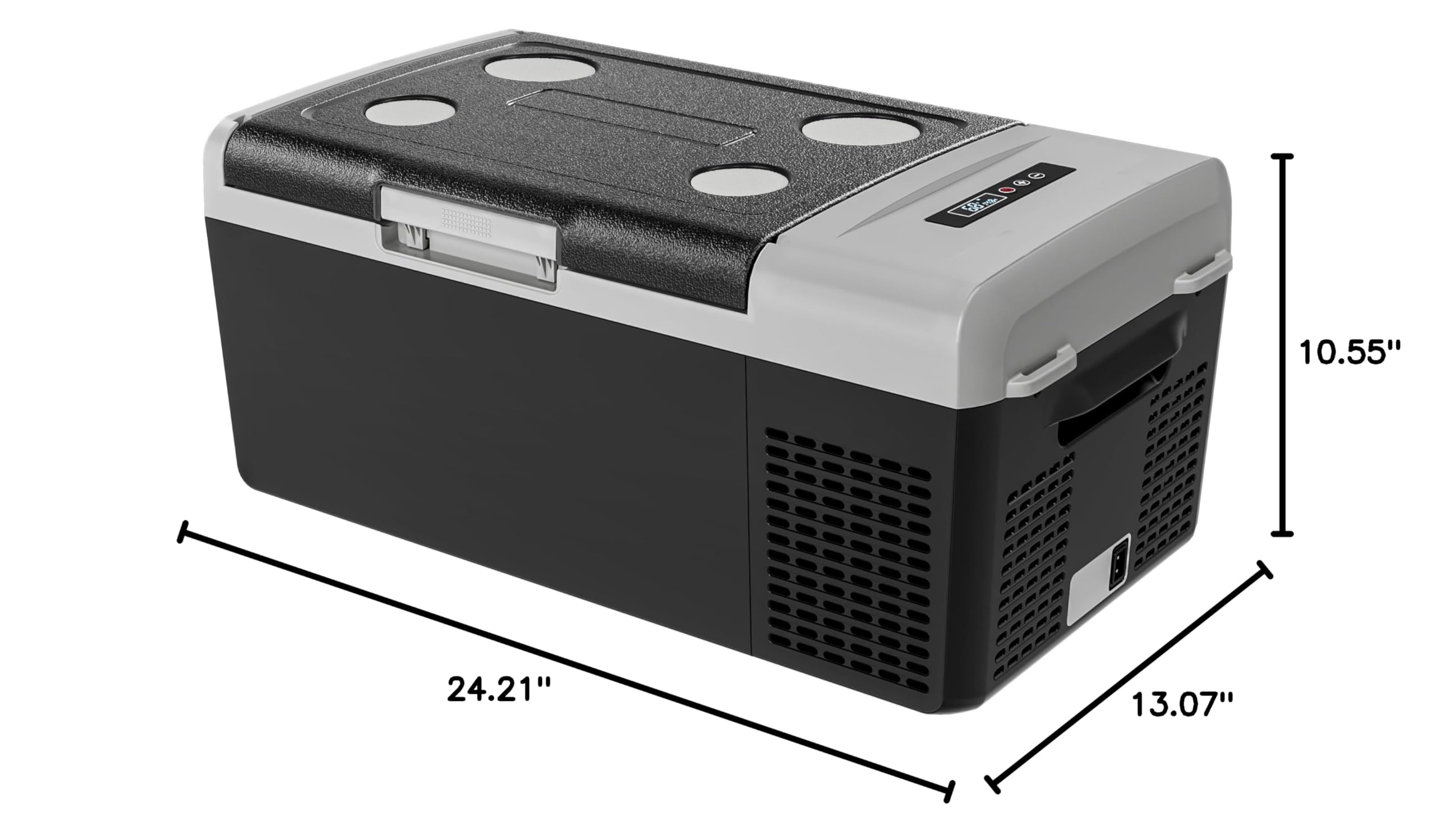
If you are tired of dumping melted ice water out of a cooler at a campsite, the fix is a plug in cooler with a real compressor inside. These run off your car’s 12V socket or a wall outlet and hold a set temperature instead of slowly losing the fight against a bag of ice. The EKOJUCE 15L is the one most buyers should start with: at 15 liters it fits one or two people, runs at 42dB, and rose only to about 52°F after a night unplugged.
This guide is built by comparing the manufacturers’ published specifications and the patterns across verified customer reviews, so you get each pick’s real strengths and trade-offs instead of marketing spin.
A plug in cooler only earns its space if it holds temperature once the engine stops, so every pick below is judged on cooling speed, insulation, and real power draw. Here is the honest shortlist of the plug in coolers that hold their cold when you need them to.
Top Picks

How To Choose The Best Plug in Coolers
Every pick here uses a compressor — the same sealed cooling pump a home fridge uses — rather than a thermoelectric plate. A compressor actually pulls heat from the start and can drive temperatures well below freezing. A thermoelectric cooler only gets you a set number of degrees below the air around it, so on a hot afternoon it gives up. That single difference decides whether your food survives a three-day trip.
Compressor type and cooling speed
A rotary scroll compressor is the quiet workhorse found in most of these fridges. Faster cooling numbers (like 15 minutes from 68°F to 32°F) tell you how quickly drinks chill, but they only matter if the insulation holds that cold afterward. Look at both, never one alone.
Zone count: single or dual
A single-zone fridge holds one temperature across the whole bin. A dual-zone model lets you run one side as a fridge and the other as a freezer at the same time, so you can keep meat solid and drinks chilled in the same box. If you travel as a couple and mostly carry drinks and snacks, one zone is enough and you save space and complexity.
Power draw and battery protection
The lower the wattage, the longer you can run off a portable power station or your car’s battery. Three-level battery protection (often labelled H1/H2/H3) cuts the compressor before your starter battery dies, then restarts when voltage recovers. If you camp off-grid, this setting matters more than any other spec on the page.
Insulation and the lid
The cold you paid for leaks out through a thin, hollow lid. Models with a foamed lid and a thick wall hold temperature far longer once the power is switched off during a hike or a fuel stop. A tight latch and a sealed gasket are the difference between a fridge and an expensive box of warm air.
Side-by-Side Comparison
| Model | Best For | Capacity | Temperature Range | Power / Zones | Amazon |
|---|---|---|---|---|---|
| EKOJUCE 12V 16 Quart★ Best Overall | Compact overnight trips | 15L (18L listed) | -4°F to 68°F | 12/24V DC + AC, single zone | Amazon |
| Setpower 21QT RF20Blackout Backup | Blackout backup cold | 20L (21 quart) | -4°F to 68°F | 28W eco / 40W max, single zone | Amazon |
| EUHOMY 22QT | Quiet camp setup | 21L (22 quart) | Refrigerator and freezer | 45W, single zone | Amazon |
| Megiu 23 Quart | Van and car camping | 23 quart | -0.4°F to 59°F | 45W average, single zone | Amazon |
| BougeRV CRPRO 21QT | Truck and seat fit | 21 quart | -8°F to 50°F | 45W eco / 60W max, single zone | Amazon |
| BODEGACOOLER 34 Quart | Two-zone family travel | 32L (34 quart) | -4°F to 68°F | Under 1 kWh/day, dual zone | Amazon |
| ICECO GO20 | Off-grid dual zone | 21 quart | 0°F to 50°F | 30-40W, dual zone | Amazon |
Detailed Reviews
1. EKOJUCE 12 Volt Refrigerator Portable Fridge 16 Quart (15L)
Our pick — 4.5+★ from 200+ verified ratings; the strongest balance of quality and price.
The compact 15L that keeps its cold even after you pull the plug.
On a three-week cross-country drive, buyers report the EKOJUCE held 43°F day after day — and when it sat unplugged overnight it rose to roughly 52°F, then recooled quickly once the power came back. That is the whole point of a plug in cooler: compressor cold from a 15L box. The 15-liter interior is enough for six waters, six small cokes, cheese and candy bars, so it suits one or two people rather than a family.
The specs behind that: a rotary scroll compressor, a -4°F to 68°F range set on the LCD panel, and 42dB of noise, which is quiet enough to sleep next to in a camper. It runs on 12/24V DC in the car and 100-240V AC at home, and 144 kWh a year of energy use keeps the draw modest. It is UL certified, and the three-level battery protection cuts the compressor before your car battery dies, then restarts on its own. Compared with the EKOJUCE’s own 15L bin, the Setpower 21QT below holds 20 liters — a genuinely roomier box if you need to feed more than two people.
Buyers talk most about how fast it cools, and the numbers back that up: it drops from 60°F to 37°F in 6-7 minutes, so a warm six-pack is cold before you reach the highway. The trade-off is the power connection. The 12V cigarette plug (the standard car power socket) has been the weak point on some units, failing across several vehicles until a replacement cord arrived, so test the DC cable (the 12-volt car power cord) at home before a big trip. Also note the maker’s instruction to stand the fridge upright for a day before first use.
What earns the top spot
- -4°F to 68°F range, cold enough to freeze ice packs solid
- 42dB operation and 144 kWh/year energy draw
- Runs on both 12/24V DC and 100-240V AC
- Three-level battery protection with auto-restart
The honest catches
- 15L fills up fast for a family of four
- The DC cigarette plug has failed on some units
- Needs a day standing upright before first use
Reach for this if: you want a small, quiet fridge for solo or couple trips and value overnight hold over raw capacity.
Consider the Setpower instead if: you regularly carry food for three or more.
2. Setpower 12V Refrigerator 21QT
A 50-hour ice pack built in — the fridge that survives a dead outlet.
Most plug in coolers go warm the moment the power dies. The Setpower’s a neat extra is a built-in ice pack that keeps food cool up to 50 hours through a blackout, and the same pack doubles as a divider between your vegetables and your drinks. That 50-hour backup cold is the reason to pay attention to this one if you camp where the power station runs out before the trip does.
On cooling speed it is quick: 77°F down to 32°F in 15 minutes in fast mode, and 77°F to -4°F in 45 minutes when you want to freeze. The Smartele compressor sips 28W in ECO mode and 40W in MAX, using far less than 1 kWh a day. You can run it from the control panel or from your phone through the app. The box measures 24.3″D × 13.1″W × 11.9″H and weighs 22.1lbs, with 20 liters of usable space — bigger than the EKOJUCE’s 15L bin, so it holds a few more days of food for a small group.
People cheer loudest about the cooling, and it proves itself on brutal days: owners mention the 21qt (21-quart) model hitting 40°F in under 30 minutes at 95°F, then reaching 12°F with frozen ice packs in about 3 hours. Running overnight on a solar setup (solar panels charging a battery) took roughly 10% of a 200Ah lithium bank (a large 200-amp-hour battery). The recurring complaint is the lid: one buyer calls it “hollow, unfoamed,” and it is the main heat-loss point, so treat the latch gently and keep the fridge out of direct sun. Durability scores weaker here, and the maker’s separate note about a 3-year compressor warranty gives you a cushion.
Where it shines: the 50-hour ice pack and 28W ECO draw make it the natural pick for off-grid campers running on a power station.
Where it stumbles: the unfoamed lid bleeds heat, and a few of these arrive with the latch feeling loose.
Buy it for: blackout insurance and long sunny days where you need the cold to outlast the power.
Pick a dual-zone model instead if: you want a true freezer alongside your fridge at the same time.
3. EUHOMY 22QT 12 Volt Refrigerator Portable Car Fridge
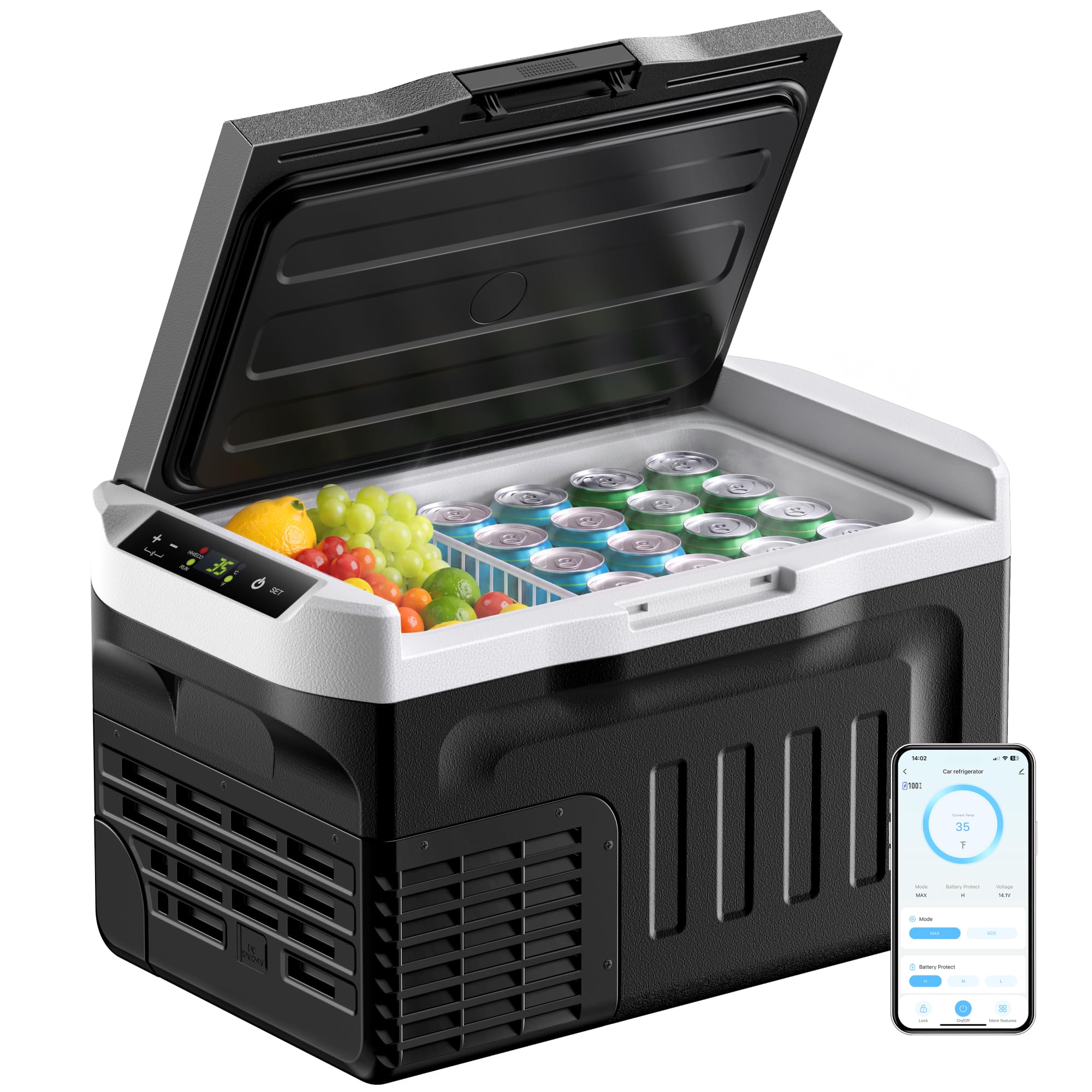
Wall-to-wall insulation in a 22QT box that chills fast and sleeps quiet.
Chilling from 68°F to 32°F in 15 minutes is the headline, but the part that actually keeps milk fresh on day four is the 45mm foam layer and wear-resistant composite shell wrapped around the EUHOMY. That 45mm foam layer does more for your food than a faster compressor, because once the box is cold it stays cold through a lunch stop.
The 21-liter interior runs on an advanced variable-frequency compressor at 45W, certified by UL for energy efficiency, with both an ECO and a MAX mode. Two removable dividers let you section off food, and a hidden handle plus a built-in LED light make late-night searching easy. Three-level battery protection (H1/H2/H3) guards the car battery from overload. It is the widest-used fridge on this list too, with 800+ ratings and a 4.0+ score — one of the crowd favorites here.
Owners notice the raw performance most, and it holds up under punishment: a 4-day trip at 90°F on AC (wall power) kept burgers frozen and drinks cold, and 2 days on a 50ah battery (a 50-amp-hour battery) used under half its capacity. One recurring quirk is the compressor sound — it can clunk audibly when it turns off, the trade-off for a strong pump. Longevity is the open question on a small number of units, but a year into heavy use the same owner still reports it running 4-6 days on 50ah.
The winning detail: 45mm of foam is more insulation than most rivals in this size class, and it is why the EUHOMY holds temperature long after the compressor stops.
It suits: campers who hate listening to a fridge cycle all night and want real insulation.
Look elsewhere if: you need two independent temperatures in the same box.
4. Megiu Car Refrigerator 23 Quart Portable 12V Freezer
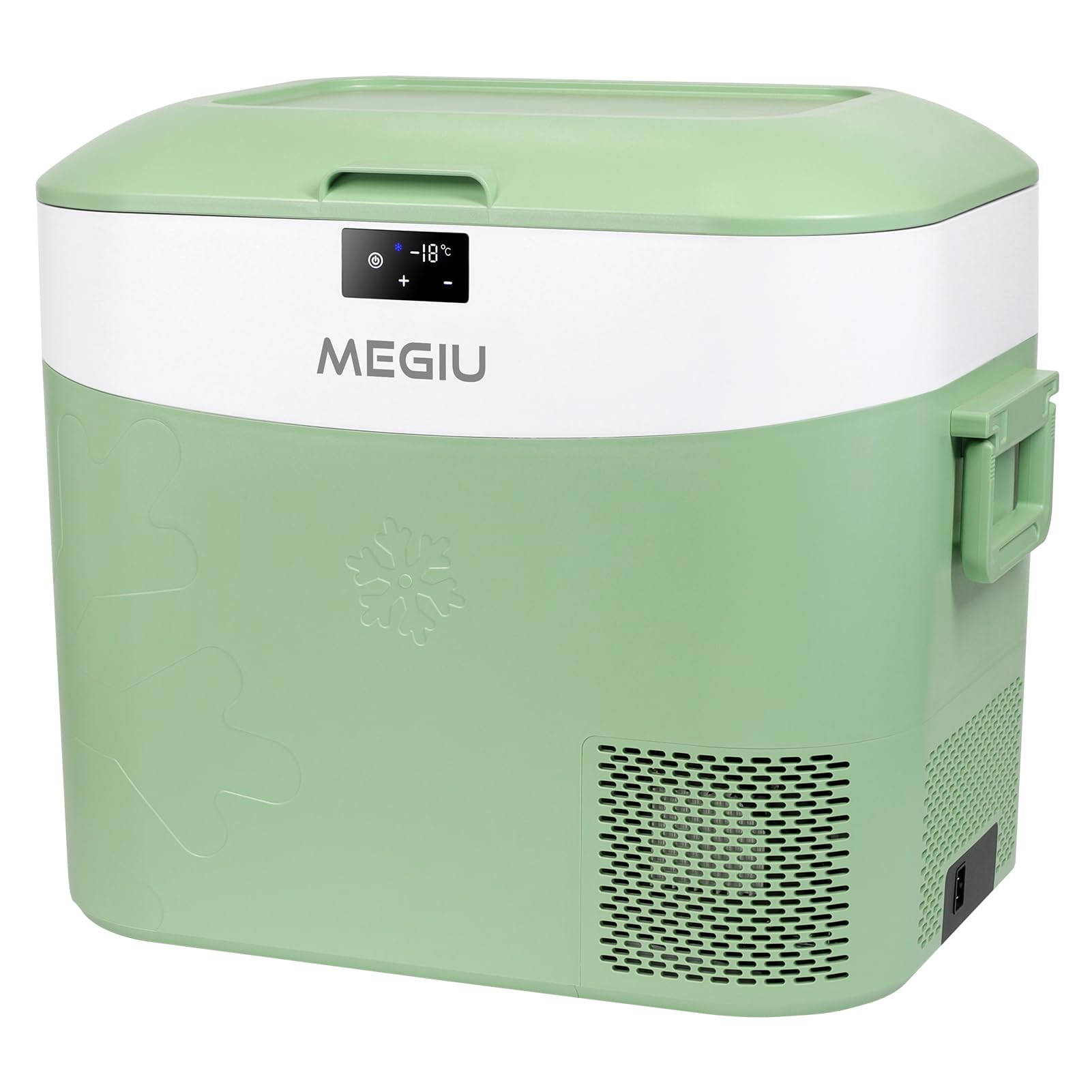
Twenty-three quarts that slip onto a car seat and buckle in.
If your rig is a minivan or a sedan rather than a built-out camper, width is everything. The Megiu is 18.3 inches wide, so it rides on the back seat held by a seat belt or drops into a trunk — the sort of footprint that fits a Dodge Caravan floor. The tough ABS shell shrugs off bumps against the case while you drive, and at 18.5lb empty it is light enough to lift out alone.
Cold-wise it runs a DC inverter compressor that reaches 32°F in 15 minutes and -0°F in 40, at under 40 decibels — quieter than many rivals and lower than the EUHOMY’s 45dB rating. The touch screen spans -0.4°F to 59°F, so it flips between fridge and freezer duty, and the removable basket doubles as a food tray. A 45W average draw keeps it under 1 kWh a day, and an AC adapter plus a 12/24V DC cable let it run at home or in the car. Battery protection stops the compressor when your car battery runs low.
The one thing to plan around is insulation. Customers note it cools to 35°F in about 2 hours on 110V and holds the 12 cans plus a 3qt Instant Pot you can cram in — but it warms quickly once unplugged, because the wall is minimal. For an owner with limited mobility, having a cold drink and sandwich makings within arm’s reach made it a daily companion and prompted a Ritz comparison. Keep it plugged in overnight and the weak insulation is a non-issue.
Reasons it earns a seat
- 18.3-inch width fits back seats and trunks
- Under 40dB, quieter than the 45dB rivals here
- Touch control from -0.4°F to 59°F
- Impact-resistant ABS shell for rough roads
What to keep in mind
- Thin insulation — warms fast once unplugged
- A plastic smell reported on the first few days
Made for: back-seat placement in a car or minivan where a big chest fridge simply will not sit.
Not for: off-grid camping without shore power, since it loses cold quickly.
5. BougeRV 12V Refrigerator CRPRO 21QT

A -8°F floor and a shock-proof body that climbs hills without complaint.
The CRPRO reaches lower than most in this group, running from -8°F up to 50°F, so you can hold medicines at a steady 35°F one day and drop to deep freeze the next. That range plus a warming mode makes it unusually flexible. Its 21-quart bin is compact — enough for about a 6-pack up close, or 15 upright 12oz cans with 3-4 inches of top clearance if you stack smart.
Built for rough ground, this is a proper chest-format fridge with a 30° incline rating, so it keeps running on steep off-road climbs. Four tie-down points on both sides let you lash it to a truck bed or a slippery seat. It consumes 60W in Max mode and 45W in Eco, adds an interior LED, and runs at 45dB. Dual power cords cover the car and the wall, and a 2-year tech support window backs it up.
What wins people over is that it outlasts cheaper iceless coolers — one buyer swapped in the CRPRO after a prior cooler failed in a single season and never looked back. It fits between the seats of a 2023 Ford Transit almost like it was made for the slot, and it cools 77°F to 27°F in 30 minutes while driving. The catch is size versus expectation: the interior is smaller than the 21-quart label suggests, so measure your space and your food before you commit. Going by the review pages, “a bit smaller than I thought but it cools down quickly” sums up the balanced verdict — perfect if your need is modest.
Strongest card: the -8°F to 50°F span plus a 30° incline rating makes this the pick for people who camp off-road and carry frozen goods.
Biggest limitation: the bin is smaller in real life than the quart figure hints at.
Choose this: for truckers and off-roaders who want a low-temperature freezer that survives a steep grade.
Skip if: you need maximum usable volume for the footprint.
6. BODEGACOOLER 12 Volt Car Refrigerator 34 Quart
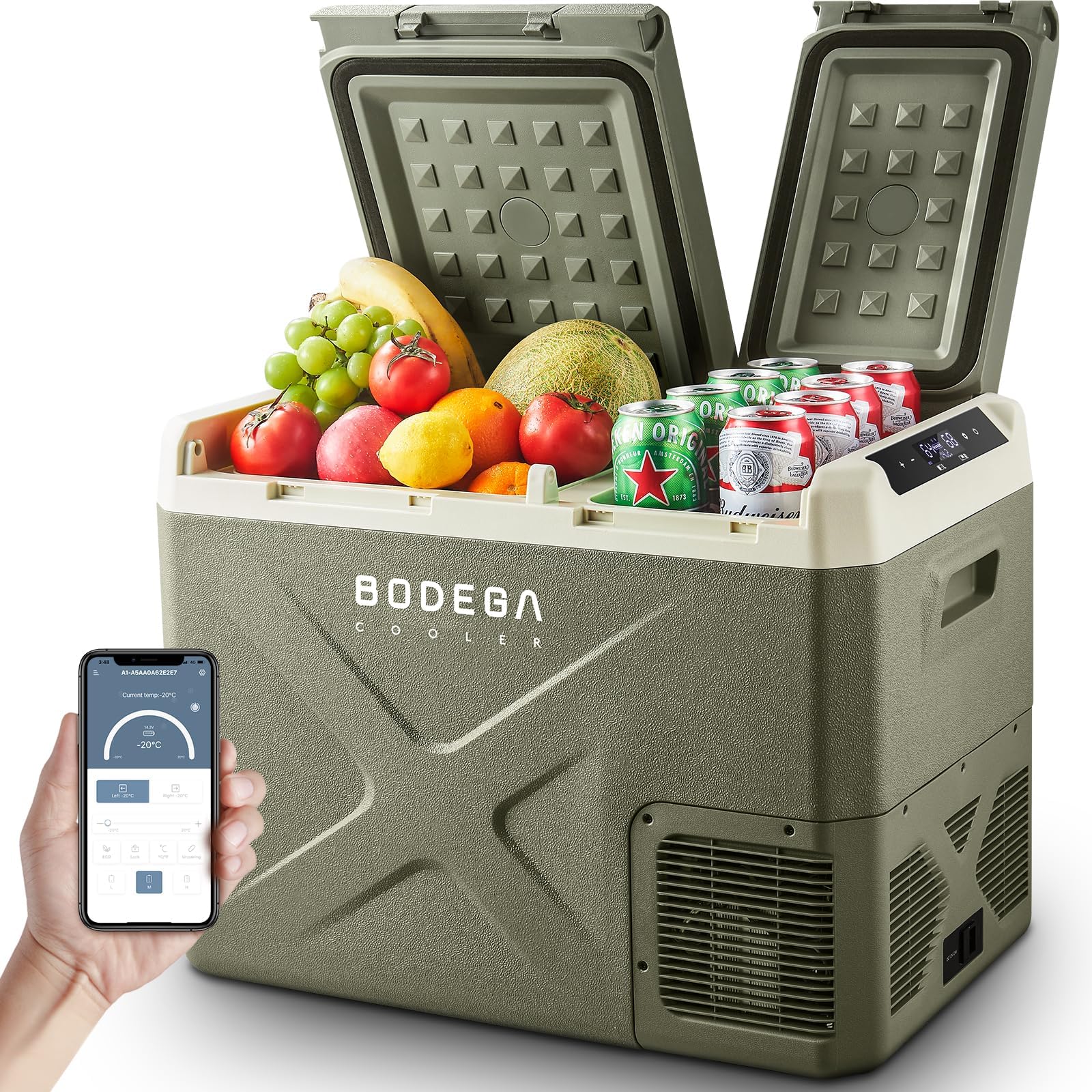
Two independent temperatures in one box — freezer on one side, fridge on the other.
For a family or a long-haul driver, the 34-quart BODEGACOOLER solves the split problem: the large 23.8L zone and the smaller 8.3L zone can each be set independently from 68°F to -4°F. Serve ice cream on one side and cold drinks on the other, all from the same compressor. It holds up to 32 cans of cola and 28 bottles of water, and an app lets you adjust and monitor both zones from your phone.
It cools fast: 15 minutes from 68°F to 32°F, and even on MAX it uses under 1 kWh a day (about a tenth of a typical home’s daily use) thanks to the ECO mode (a low-power setting). Anti-shake design keeps it running at a 30° incline (a steep driveway slope), and the detachable two-way lid can be flipped for access from either side. It runs at under 45dB (about the level of a quiet library), has a bottom drain hole for easy cleaning, and takes both 100/240V AC (wall power) and 12/24V DC (car or boat power). The 5-year compressor lifespan and 1-year parts cover add confidence.
The catch with any dual-zone is insulation, and this one shows it. One owner pre-cooled to near 0°F overnight, then a few hours unplugged let the temperature climb into the 70s — so it needs a power source at night or an insulated bag around it. Families will also find 34 quarts tight for four people, though it suits two well on a 14-night road trip with no ice to buy and no water to drain. That is the real gain on a 14-night trip: no meltwater, no daily ice run.
Why two zones win: independent fridge-and-freezer settings mean your waffles stay frozen while your water stays cold — impossible in a single-zone box.
The honest caveat: it needs to stay plugged in overnight, since unplugged temperature climbs fast.
Best for: couples and truckers who want a genuine freezer and fridge side by side.
Think twice if: you plan to leave it unpowered in a hot car for hours.
7. ICECO GO20 Dual Zone 12V Refrigerator
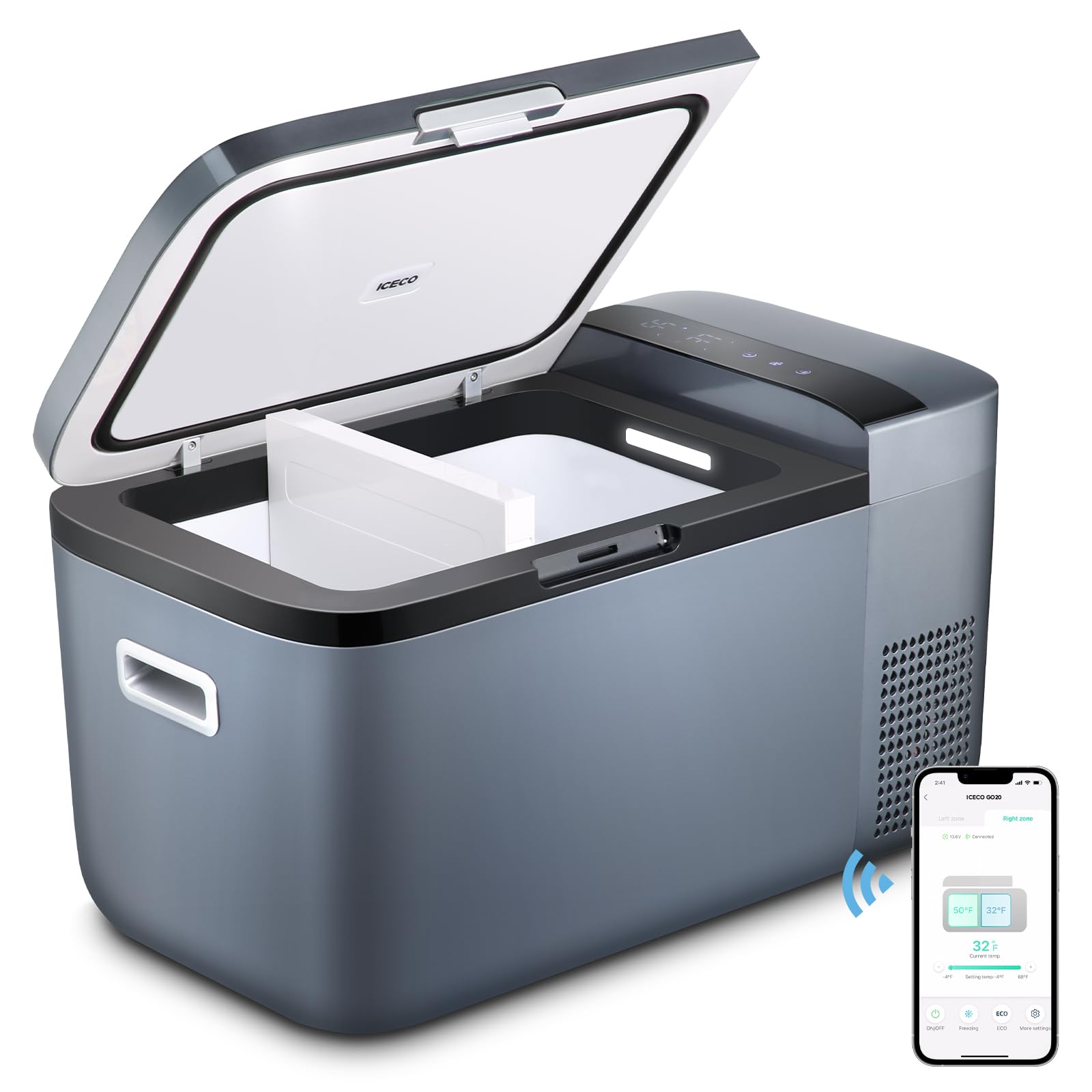
The award-winning dual zone with a SECOP pump that climbs 40 degrees of tilt.
The ICECO GO20 earns its spot with a SECOP compressor (a reliable fridge compressor brand) rated to run stably on a 40° incline — a genuinely tougher tilt rating than most rivals here — and it wears the German Red Dot Design Award and the IDEA International Design Excellence Award. The 21-quart box runs 0°F to 50°F and switches automatically between single and dual-zone mode when you pull out the detachable partition, so you can freeze on one side and refrigerate on the other with two independent controllers.
For home-and-car use it includes a 2.5m cigarette lighter cord (a 2.5-meter car power cable) and an adapter, working on 110/240V at home or 12V/24V in the vehicle, and it cuts down to a third of the size of a traditional cooler with no ice needed. It draws roughly 30-40W (about as much as a small light bulb), and reviewers point out running it 4-5 days on a 2000Wh power bank (a large portable battery). The 5-year compressor warranty and 1-year accessory cover, plus local after-sales phone support, are the longest warranty terms in this group.
What people value most is the build — it is a heavy, solid little unit that reaches 0°F in about 45 minutes in Super chill mode. The rub is the power plug: the adapter spring can let the cigarette plug pop out of the socket, which some owners fix with tape and which is the one recurring complaint. Battery protection has also been known to misread voltage on a cigarette lighter; it works best on a true sine wave inverter. If you can live with the plug and voltage quirks, this is the most durable-feeling fridge here.
Standout spec: a SECOP compressor that holds steady at a 40° tilt is more rugged than the 30° rating found on cheaper models.
Fiddly detail: the adapter’s spring-loaded plug can pop loose from the socket.
Suited to: off-grid overlanders who want the longest warranty and the toughest compressor.
Not ideal for: buyers who want a plug that never needs tape on a bumpy road.
Know the Specs
Compressor vs thermoelectric
A compressor fridge pushes heat from the start with a sealed pump, so it can cool well below freezing. A thermoelectric (Peltier) plate only drops a fixed number of degrees below ambient air, so on a hot day it gives up. Every pick here uses a compressor — that is what “plug in cooler” really means when it is built for real food storage.
Capacity in liters vs quarts
Listings mix the two units, and the number on the box does not always match usable space. A 15L bin suits one or two people, while a 32L dual-zone suits a couple with frozen goods. Check the real interior and how you will pack it, because the quart figure is often optimistic.
Battery protection levels
Three-level protection (H1/H2/H3) sets the voltage at which the fridge shuts off to save your car battery, then restarts when the voltage recovers. A low setting protects the fridge’s runtime, while a high setting protects your ability to start the engine the next morning. Pick the level that matches how you travel.
Noise in decibels
Fridges here run from under 40dB to 45dB — a range where the quieter units fade into background hum while louder ones click audibly when the compressor kicks in. If you sleep near the fridge or work beside it in a cab, the lower number matters.
Common Questions
Will a plug in cooler drain my car battery overnight?
How long does a compressor fridge stay cold after I unplug it?
Can a 12V cooler run as a freezer?
What is a dual-zone fridge and do I need one?
Will a plug in cooler work with a portable power station?
Do I need ice with a compressor cooler?
Can I run one on 110V household power?
Why does my fridge say -4°F but the food is not that cold?
How long should I leave a new fridge standing before plugging it in?
Is a compressor fridge louder than a thermoelectric cooler?
The Bottom Line
For most people, the plug in coolers winner is the EKOJUCE 15L because it holds temperature overnight, runs at a sleep-friendly 42dB, and cools from 60°F to 37°F in 6-7 minutes without an ice bag in sight. If a blackout is your worry, the Setpower 21QT keeps cold up to 50 hours on its ice pack. And if you need a real freezer beside a fridge, the BougeRV CRPRO drops to -8°F while surviving a steep off-road climb. Pick the one that matches how you travel, and leave the ice behind.
How we choose
We do not accept paid placement. Every pick is matched to a real buyer and a real use-case; we do not hands-on test units.
Sources
Specifications: manufacturer listings and product documentation. Review insights: verified customer reviews, as of October 2026. Pricing: not shown on this page (it changes often); check the current price via the retailer link.
As an Amazon Associate, Aappliancez earns from qualifying purchases. This does not affect which products we feature.